
Reading view

There are new articles available, click to refresh the page.

Watchdog urges DHS to address ‘fragmented’ law enforcement hiring

The Department of Homeland Security’s inconsistent hiring practices present major challenges at a time when DHS is surging recruitment across its law enforcement components, according to the department’s watchdog.

The DHS inspector general, in an annual report on top management and performance challenges, flagged “fragmented law enforcement hiring” as one of the department’s top three issues.

The IG warns that those longstanding issues have been amplified by a recent influx of funding from the One Big Beautiful Bill Act passed last year. Immigration and Customs Enforcement, Customs and Border Protection, and the Secret Service have all embarked on major hiring initiatives over the past year, backed by billions of dollars in funding.

“There is overlapping, competitive, law enforcement hiring among ICE, CBP, and USSS,” the report warns. “These competing interests can undermine the hiring process when conducted without departmentwide planning. Law enforcement hiring will endure additional stresses in the coming years due to the OBBBA, which funds an increase in departmental law enforcement personnel.”

DHS recruiting is “further complicated by inconsistent vetting requirements and application processes” across law enforcement agencies, according to the report.

“These inconsistencies make it difficult to implement a more centralized, efficient hiring process, resulting in duplication of effort, higher costs, and slower onboarding across the department,” the IG states.

The report comes as the Trump administration touts ICE’s hiring of 12,000 new employees in less than a year. However, the vetting and training of ICE officers has come under increasing scrutiny amid the rapid hiring blitz.

Cyber and AI hiring

The IG report also highlights challenges with DHS’s hiring of cybersecurity, IT and artificial intelligence specialists. For instance, DHS’s Office of Intelligence and Analysis and the Coast Guard, respectively, face administrative challenges in recruiting personnel with AI-related skillsets, according to the IG.

Those types of challenges could delay key DHS AI projects, the report states.

“These challenges are magnified by inconsistent hiring practices across components, pay disparities with the private sector, and complex clearance requirements,” it continues.

Meanwhile, DHS’s Cyber Talent Management System has not met its original goal to help recruit thousands of cyber experts. Hiring using CTMS has reached just several hundred staff since the system was launched in 2021.

“Although there has been some success using CTMS, the department continuously improves it in partnership with hiring managers to make it a more effective tool,” the IG report states.

Furthermore, the Cybersecurity and Infrastructure Security Agency last year terminated many probationary staffers who were part of CTMS, further shaking confidence in the novel talent system.

Still, the IG report recommends DHS deepen centralized hiring efforts like CTMS to address its tech talent gaps.

“These centralized hiring efforts are a step in the right direction,” the report states. “However, it is unclear that these hiring efforts are sufficient to meet the hiring surges required by the OBBBA or keep pace with evolving Department needs as AI and machine learning are integrated into all operations. Since previous hiring surges did not achieve intended outcomes, DHS should pivot to more successful recruitment methods.”

The post Watchdog urges DHS to address ‘fragmented’ law enforcement hiring first appeared on Federal News Network.

© The Associated Press

FILE - Customs and Border Patrol agents question occupants of a vehicle they pulled over, during an immigration crackdown in Kenner, La., Dec. 5, 2025. (AP Photo/Gerald Herbert, File)

Secret Service touts hiring goals amid major law enforcement recruiting push

The Secret Service is aiming to boost its ranks by thousands of officers over the next two years, part of a still swelling recruiting push across federal law enforcement agencies.

The Secret Service is aiming to hire 4,000 new employees by 2028, an agency spokesman confirmed. That would bring the Secret Service’s ranks to 6,800 law enforcement personnel and 10,000 total employees.

The Secret Service currently employs about 8,300 staff, according to agency budget figures. That includes 3,200 special agents and 1,300 uniformed division officers, per the Secret Service website.

“Last year, the agency launched a dynamic recruitment strategy aimed at both reducing inefficiencies in the hiring process and increasing the visibility of agency jobs to audiences with the requisite knowledge, skills and abilities to perform the mission,” the  Secret Service spokesman said. “We are focusing on targeting our recruitment efforts to individuals with a demonstrated track record of excellence, teamwork and trustworthiness — this includes former military, law enforcement, and top university graduates.”

The agency is also aiming to retain retirement-eligible agents, the spokesman added. Group retention incentives are being offered to special agents, uniformed division officers, cybersecurity professionals and specialty teams.

The Secret Service has long struggled with morale and attrition issues. A 2021 National Academy of Public Administration study found the agency’s mission demands have grown, while staffing levels have not kept up, requiring agents and officers to work longer hours.

But the Secret Service has been unsuccessful in previous attempts to grow its ranks to 10,000 employees.

The agency is now focused on streamlining the hiring process, including through new Accelerated Candidate events. The Secret Service says the events reduce the time to job offer by up to 120 days. The current average from application to entry-on-duty is 326 days for special agents and 256 days for the uniformed division.

The Washington Post first reported on the details of the Secret Service’s hiring goals.

The Secret Service’s recruiting drive comes amid a governmentwide law enforcement hiring push. The Trump administration is giving higher pay raises to federal law enforcement officers compared to most other government employees. 

In a post on X Tuesday, FBI Director Kash Patel said 2025 was a “huge year” for recruiting.

Patel didn’t cite how many employees the FBI hired. But he said the agency received 45,000 special agent applications and 30,000 professional staff applications in fiscal 2025.

He also said the FBI expanded the Reserve Service Program for retired FBI special agents to work as criminal investigators in field offices.

“These RSP-Special Agents will fill critical field office needs with experienced investigators – the first group will begin their assignments in January 2026,” Patel wrote.

Meanwhile, the Department of Homeland Security this week announced that Immigration and Customs Enforcement has already hired more than 12,000 officers and agents over the last 11 months. The recruiting drive, backed by billions in funding from the One Big Beautiful Bill Act, has spiked ICE ranks from 10,000 to 22,000 law enforcement personnel, DHS said.

Though the Trump administration’s original goal was to hire roughly 10,000 new ICE agents, DHS said this week that ICE is continuing to accept job applications.

Customs and Border Protection is also on a recruiting drive, aiming to hire 5,000 customs officers and 3,000 border patrol agents through 2029. Both CBP and ICE are offering massive recruitment and retention incentive packages.

The widespread recruiting push across federal law enforcement agencies is expected to put a strain on classes at the Federal Law Enforcement Training Centers. FLETC itself announced in September it was hiring 100 new instructors to support the “onboarding of thousands of new law enforcement officers nationwide.”

The post Secret Service touts hiring goals amid major law enforcement recruiting push first appeared on Federal News Network.

© Kay Nietfeld/picture-alliance/dpa/AP Images

09 July 2024, USA, Washington: Police officers from the Secret Service stand in front of the White House in the early morning before the start of the NATO summit. The NATO summit begins in the capital with celebrations to mark the 75th anniversary of the defense alliance. Photo by: Kay Nietfeld/picture-alliance/dpa/AP Images

CBP increases hiring incentives, amid record DHS recruiting year

Customs and Border Protection is increasing its total recruitment and retention incentives, as the Department of Homeland Security touts a record year for job applications.

CBP says new Border Patrol agents can now get up to $60,000 in incentives, including $10,000 after completing academy training and $10,000 for those assigned to a remote locations. Newly appointed Border Patrol agents can then qualify for up to $40,000 in retention incentives over the next four years.

Current Border Patrol agents are eligible to receive up to $50,000 in retention incentives.

Meanwhile, new officers assigned to “hard-to-fill and most difficult-to-fill locations” under CBP’s Office of Field Operations are eligible for up to $60,000 in retention incentives over a three year contract. CBP is also offering up to $60,000 in retention incentives for “experienced supervisors and officers eligible to retire in certain locations.”

New CBP Air and Marine Operations agents are also eligible for $10,000 signing bonuses, while new and current AMO agents can get up to 25% of their salary in retention incentives.

The increased incentives are funded under the One Big Beautiful Bill Act. The bill provided $4.1 billion for CBP to hire 5,000 customs officers and 3,000 border patrol agents over the next four years.

CBP for several years has offered both recruitment and retention incentives, as it prepares for an expected officer retirement surge starting in fiscal 2027.

The Department of Homeland Security, in an annual review, said CBP’s monthly hiring averages increased by 42.5% compared to the same time period last year. Meanwhile, hiring of Border Patrol agents increased by 84% over the same time last year, according to DHS.

ICE hiring surges, but under scrutiny

DHS also said Immigration and Customs Enforcement is on track to hire 10,000 new officers by the end of 2025. ICE has also offered $10,000 recruitment incentives and changed its minimum officer age to 18 years old to facilitate the recruitment campaign.

DHS said it has received a record number of job applications in 2025 at agencies including ICE, U.S. Citizenship and Immigration Services and the Secret Service.

The One Big Beautiful Bill Act, which passed in July, included $8 billion for the ICE hiring spree.

“Some” of the new ICE officers are already on the job, according to DHS.

But House Homeland Security Committee Democrats are now asking the Government Accountability Office to review ICE’s hiring practices.

In a Dec. 18 letter led by Ranking Member Bennie Thompson (D-Miss.) to GAO, the lawmakers point to media reports that ICE has put some new recruits into training without doing background checks and other standard vetting.

“This rapid expansion – the most significant staffing increase in the agency’s history – raises important questions about how ICE has changed its hiring standards and training protocols to meet its staffing aims,” the letter to GAO states.

The post CBP increases hiring incentives, amid record DHS recruiting year first appeared on Federal News Network.

© The Associated Press
FILE - Greg Bovino, the chief patrol agent for the U.S. Border Patrol El Centro sector, center, stands with federal immigration agents near an Immigration and Customs Enforcement facility in Broadview, Ill., Oct. 3, 2025. (AP Photo/Erin Hooley, File)

ICE used ‘stingray’ cell phone snooping tech hundreds of times since 2017

Newly released documents show U.S. immigration authorities have used a secretive cell phone snooping technology hundreds of times across the U.S. in the past three years.

The documents, obtained through a public records lawsuit by the American Civil Liberties Union and seen by TechCrunch, show that U.S. Immigration and Customs Enforcement (ICE) deployed cell site simulators — known as stingrays — at least 466 times between 2017 and 2019, which led to dozens of arrests and apprehensions. Previously obtained figures showed ICE used stingrays more than 1,885 times over a four-year period between 2013 and 2017.

The documents say that stingrays were not deployed for civil immigration investigations, like removals or deportations.

Although the numbers offer a rare insight into how often ICE uses this secretive and controversial technology, the documents don’t say how many Americans also had their phones inadvertently ensnared by these surveillance devices.

“We are all harmed by government practices that violate the Constitution and undermine civil liberties,” said Alexia Ramirez, a fellow with the ACLU’s Speech, Privacy, and Technology Project. “ICE’s use of cell site simulators affects all people, regardless of their immigration status.”

“When cell site simulators search for an individual, they necessarily also sweep in sensitive, private information about innocent bystanders,” said Ramirez. “This is part of the reason courts have said there are serious Fourth Amendment concerns with this technology.”

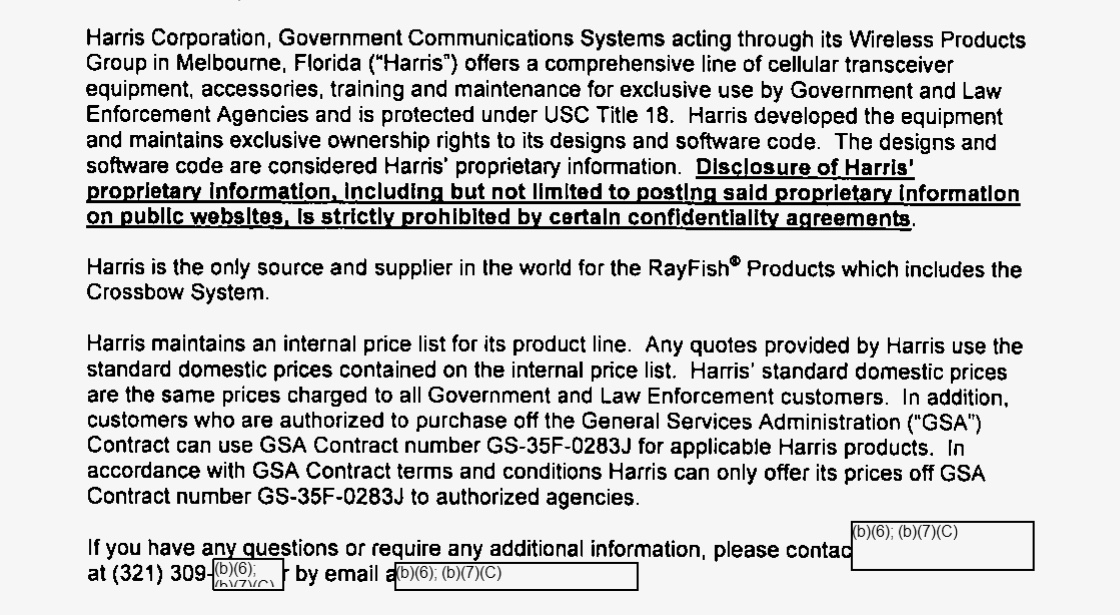
A letter from Harris Corp., which builds cell site simulators — known as “stingrays,” describing the non-disclosure terms for its Crossbow cell site simulator. (Source: ACLU)

Stingrays impersonate cell towers and capture the calls, messages, location and in some cases data of every cell phone in their range. Developed by Harris Corp., stingrays are sold exclusively to law enforcement. But their purchase and use are covered under strict non-disclosure agreements that prevent police from discussing how the technology works. These agreements are notoriously prohibitive; prosecutors have dropped court cases rather than disclose details about the stingrays.

The newly released documents are heavily redacted and offer little more about what we know of how stingrays work. One document did, however, reveal for the first time the existence of Harris’ most recent stingray, Crossbow. An email from 2012 refers to Crossbow as the “latest, most technologically up-to-date version of a Stingray system.”

But the civil liberties group said its public records lawsuit is not over. Customs and Border Protection (CBP), which was also named in the suit, has not yet turned over any documents sought by the ACLU, despite spending $2.5 million on buying at least 33 stingrays, according to a 2016 congressional oversight report.

“We are deeply skeptical of CBP’s assertion that they do not possess records about cell site simulators,” said Ramirez. “Given public information, the agency’s claim just doesn’t pass the sniff test.”

CBP has until June 12 to respond to the ACLU’s latest motion.

When reached, a spokesperson for CBP was unable to comment by our deadline. ICE did not respond to a request for comment.

ICE used ‘stingray’ cell phone snooping tech hundreds of times since 2017 by Zack Whittaker originally published on TechCrunch

❌