❌

Reading view

There are new articles available, click to refresh the page.

Making a CRT Spin Right Round, Round, Round
By: Lewin Day

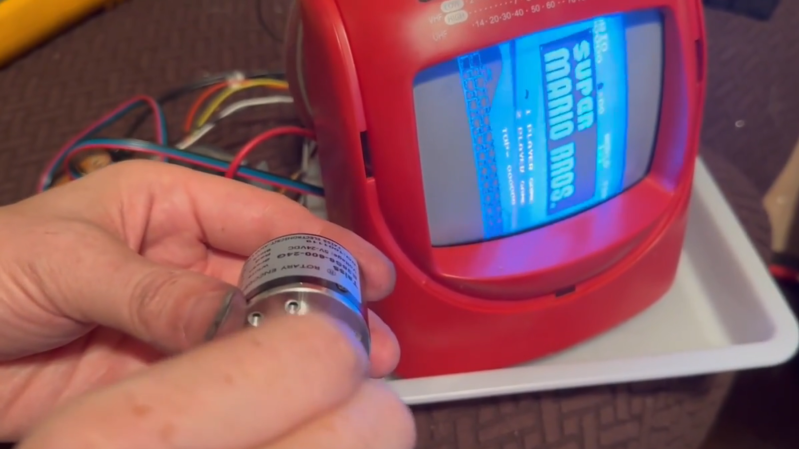
If you’ve got a decent CRT monitor, you can usually adjust the settings to make sure the image scans nicely across the whole display. But what if you could rotate the whole image itself? [Jeri Ellsworth] has shown us how to achieve this with an amusing mechanical hack.

The trick behind this is simple. On a standard CRT, the deflection yoke uses magnetic coils to steer the electron beam in the X and Y axes, spraying electrons at the phosphors as needed. To rotate the display as a whole, you could do some complicated maths and change how you drive the coils and steer the electron beams… or you could just rotate the entire yoke instead. [Jeri] achieves this by putting the whole deflection yoke on a custom slip ring assembly. This allows it to receive power and signal as it rotates around the neck of the tube, driven by a stepper motor.

Amusingly, [Jeri] even found a super nifty way to drive the stepper. There are no microcontrollers or fancy driver logic hereβ€”instead, the quadrature output from a rotary encoder outputs a perfectly legible pulse train which can drive the stepper as needed. [Jeri] notes this provides a nicely instantaneous response.Β There’s still work to be done, too. The project is due to get a 3D-printed housing, a homing system, and some improvements to the DIY slip ring setup.

If [Jeri’s] name sounds familiar, that’s because she’s built many a grand project over the years. You might have seen her work on the C64 DTV or the breadbin keytar.

I have big plans for spinny CRT

β€” Jeri Ellsworth (@jeriellsworth.bsky.social) 2026-01-05T10:42:52.953Z

[Thanks to Neonsystem95 for the tip!]
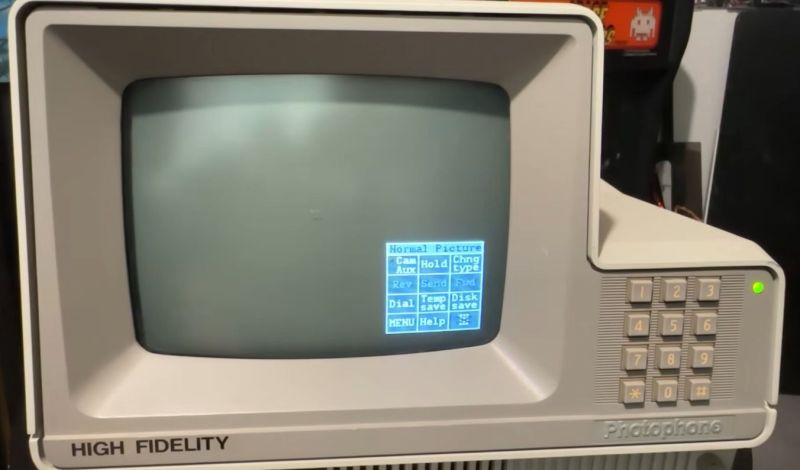
Powering on a 1985 Photophone CP220 Videoconference System

The concept of remote video calls has been worked on since Bell’s phone company began pitching upgrading from telegrams to real-time voice calls. It wasn’t until the era of digital video and real-time video compression that commercial solutions became feasible, with the 1985 Image Data Corporation Photophone CP220 being an early example. The CP220 is also exceedingly rare due to costing around $25,000 USD when adjusted to inflation. This makes the teardown and repair on the [SpaceTime Junction] channel a rather unique experience.

Perhaps the coolest part of the device is that the manual is integrated into the firmware, allowing you to browse through it on the monochrome CRT. Unfortunately after working fine for a while the device released the magic smoke, courtesy of the usual Rifa capacitors doing their thing. This is why a full teardown was necessary, resulting in the PSU being dug out and having said capacitors swapped.

After this deal the device powered on again, happily accepting a video input and saving screenshots to the floppy drive before it was replaced with a FDD emulator running FlashFloppy firmware. Unfortunately no video call was attempted, probably because of the missing camera and having to set up a suitable POTS landline for the built-in modem. Hopefully we’ll see that in an upcoming video to see what we common folk were missing out on back in the day.

Reviving ReBoot With a Tape Deck Repair

[Mark] shows off footage from a D1 master on the repaired deck

Do you remember ReBoot? If you were into early CGI, the name probably rings a bell, since when it premiered in 1994 it was the first fully computer-animated show on TV. Some time ago, a group found a pile of tapes from Mainframe Studios in Canada, the people behind ReBoot, and the computer historians amongst us were very excited… until they turned out to be digital broadcast master tapes. Exciting for fans of lost media, sure, but not quite the LTO backups of Mainframe’s SGI workstations some of us had hoped would turn up. Still, [Mark Westhaver], [Bryan Baker] and others at the β€œReBoot Rewind” project have made great strides, to the point that in their latest update video they declare β€œWe Saved ReBoot”

What does it take to revive a 30-year-old television project? Well, as stated, they started with the tapes. These aren’t ordinary VHS tapes: the Sony D-1 tapes, which were also known by the moniker β€œ4:2:2”, are a format that most people who didn’t work in the TV or film industry will have never seen, and the tape decks are rare as hen’s teeth these days. Just getting a working one, and keeping it working, was one of the biggest challenges [Mark] and Reboot Rewind faced. In the end it took three somewhat-dodgy machines long past their service lives and a miraculously located spare read/write head to get a stable scanning rate.

The uncompressed digital output of these tapes isn’t something you can just burn to a DVD, either. The 720 Γ— 576 resolution video stream is captured raw, but there are minor editing tweaks that need to be made in addition to tape errors that have cropped up over the years, and those need to be dealt with before the video and audio data gets encoded into a modern format. The video briefly glosses [Bryan Baker]’s workflow to do just that. At least they aren’t stuck with terrible USB video capture dongles VHS lovers have to deal with. Even if you don’t care about ReBoot,Β this isn’t the only show that was archived on D1 tapes so that workflow might be of interest to media fans.

We covered ReBoot Rewind when they were first searching for tape decks, so it’s great to have an update. Alas, the rights holders haven’t yet decided how exactly they’re going to release this fine footage, so if like this author you have fond memories of ReBoot,Β you may have to wait a bit longer for a reWatch.

❌