Reading view

There are new articles available, click to refresh the page.

Bitcoin’s Net Realized P/L Hits Zero Again — Is a June 2022-Style Capitulation Next?

Bitcoin is again near another critical on-chain inflection point as a key profitability indicator goes back to the levels that last occurred during one of the most painful downtrends in the history of the market.

CryptoQuant analyst Adler AM data shows that the Net Realized Profit and Loss of Bitcoin has dropped by approximately 97% after it achieved its recent high and is now approaching the levels of near-zero territory.

The situation is similar to those observed in June 2022 before BTC plummeted from about 30,000 to almost 16,000.

Net Realized P/L has dropped by 97% and returned to zero. The last time this happened was in June 2022 – right before the drop from $30K to $16K. Whales are still in profit (a 25-80% buffer), so there is no panic yet. But the market is being supported not by buyers – but by the… pic.twitter.com/ooQsnaGTCA

— Axel 💎🙌 Adler Jr (@AxelAdlerJr) January 26, 2026

Net Realized P/L tracks the balance between realized profits and losses on the Bitcoin network based on on-chain cost basis. Positive readings signal dominant profit-taking, while negative values reflect loss-driven selling.

Readings near zero suggest trades are occurring close to cost basis, indicating profit exhaustion and a balance between buyers and sellers.

Bitcoin Selling Pressure Fades, but Buyers Stay on the Sidelines

The analyst pointed out that the current setup resembles the period just before Bitcoin’s main capitulation leg in 2022. In late 2024 and early 2025, Net Realized P/L surged above $1.5 billion, reflecting an overheated profit-taking phase.

By January 26, 2026, that figure had collapsed to roughly $60 million, effectively flattening at the zero line. In 2022, a similar return to zero did not mark a bottom.

Instead, the metric continued lower into deeply negative territory, falling to around minus $350 million as the price slid another 50%.

Adler noted that the present zero reading should not be interpreted as a bullish reversal signal. Instead, it represents a pause where selling pressure from profit-takers has largely dried up, but fresh demand has not stepped in.

On-chain data suggests the market is currently being supported more by the absence of sellers than by strong buying interest, a fragile equilibrium that has historically broken lower during risk-off environments.
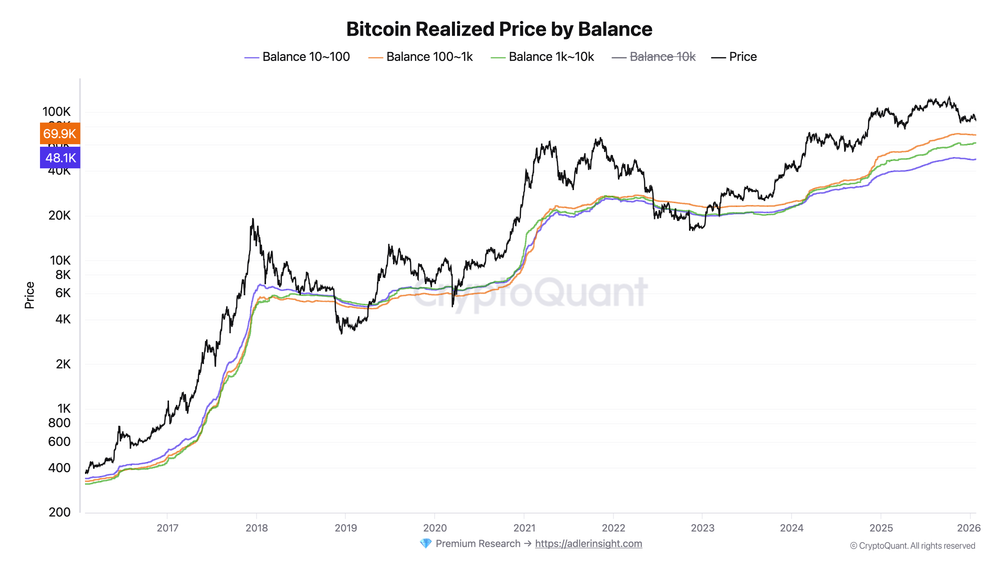
Source: CryptoQuant

Despite the warning signals, large Bitcoin holders remain in profit, as realized price data segmented by balance size shows that all major whale cohorts are still comfortably above their average acquisition costs.

Holders with balances between 100 and 1,000 BTC have the highest realized price, near $69,900, giving them an estimated profit buffer of about 25% at current prices.

Other large cohorts, including wallets holding 10–100 BTC and those with more than 10,000 BTC, have average entry prices closer to $48,000 and $51,000, translating to unrealized gains of 70% to 80%.

This helps explain the lack of panic selling, even as price has pulled back sharply from recent highs.

Bitcoin Slips Below $88K as Volatility Picks Up

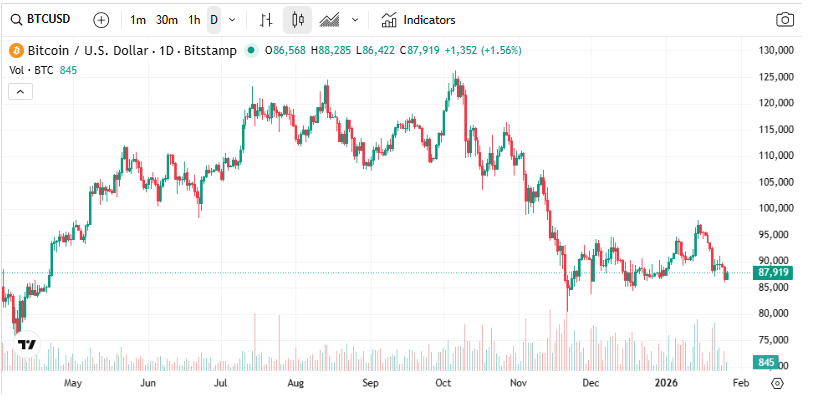
At the time of writing, Bitcoin was priced at approximately $87,756, having fallen by approximately 1.1% in the last 24 hours and 5.7% in the last week.
Source: Cryptonews

Trading volume, however, surged more than 160% day over day to $53.1 billion, pointing to heightened activity as traders reposition amid volatility.

Macro pressure has contributed to the discomfort because U.S. President Donald Trump threatened to impose 100% tariffs on any Canadian products in case Ottawa strengthens trade relations with China, and the rumors of a potential American government shutdown resurfaced.

The move triggered more than $320 million in liquidations of leveraged long positions in a matter of hours.

Also, CoinShares reported $1.73 billion in outflows from digital asset investment products last week.

📉 Digital asset investment products saw sharp outflows last week, with investors pulling $1.73B — the largest weekly decline since mid-November 2025, according to CoinShares.#BTC #ETPs https://t.co/2ni4w83evG

— Cryptonews.com (@cryptonews) January 26, 2026

Bitcoin-linked products accounted for $1.09 billion of those outflows, with the bulk coming from U.S.-based funds.

Exchange order book data shows sell-offs were absorbed with modest volume delta, indicating controlled selling.

Analysts say liquidity remains stable, with no signs yet of cascading capitulation.

The post Bitcoin’s Net Realized P/L Hits Zero Again — Is a June 2022-Style Capitulation Next? appeared first on Cryptonews.

Matcha Meta Breach Drains $16.8M via SwapNet Exploit — Users Urged to Revoke Access

A security breach tied to decentralized exchange aggregator Matcha Meta has resulted in the theft of roughly $16.8 million in crypto assets, adding to a growing list of smart-contract exploits that continue to test the safety assumptions of DeFi users.

The incident unfolded on Sunday and was traced not to Matcha’s core infrastructure, but to SwapNet, one of the liquidity providers integrated into the platform.

Matcha Meta disclosed the issue publicly in a post on X, saying users who had disabled its “One-Time Approval” feature and instead granted direct token allowances to individual aggregator contracts may have been exposed.

We are aware of an incident with SwapNet that users may have been exposed to on Matcha Meta for those who turned off One-Time Approvals

We are in contact with the SwapNet team and they have temporarily disabled their contracts

The team is actively investigating and will provide…

— Matcha Meta 🎆 (@matchametaxyz) January 25, 2026

The protocol urged affected users to immediately revoke approvals connected to SwapNet’s router contract, warning that failure to do so could leave wallets vulnerable to further unauthorized transfers.

$17M Vanishes in Seconds: How Matcha Hackers Slipped Funds Onto Ethereum

Blockchain security firms quickly began tracking the exploit as funds moved on-chain.

PeckShield reported that approximately $16.8 million had been drained in total, with the attacker swapping around $10.5 million in USDC for roughly 3,655 ETH on the Base network before starting to bridge assets to Ethereum.

#PeckShieldAlert Matcha Meta has reported a security breach involving SwapNet. Users who opted out of "One-Time Approvals" are at risk.

So far, ~$16.8M worth of crypto has been drained.

On #Base, the attacker swapped ~10.5M $USDC for ~3,655 $ETH and has begun bridging funds to… https://t.co/QOyV4IU3P3 pic.twitter.com/6OOJd9cvyF

— PeckShieldAlert (@PeckShieldAlert) January 26, 2026

CertiK independently flagged suspicious transactions, identifying one wallet that siphoned about $13.3 million in USDC on Base and converted the funds into wrapped Ether.

Both firms pointed to a vulnerability in the SwapNet contract that allowed arbitrary calls, enabling the attacker to transfer tokens that users had previously approved.

1/ The vulnerability seems to be in arbitrary call in @0xswapnet contract that let attacker to transfer funds approved to it. (https://t.co/B7ux5zzMLS)

The team have temporarily disabled their contracts is actively investigating.https://t.co/NBNvzxHCRw

Please revoke approval…

— CertiK Alert (@CertiKAlert) January 26, 2026

Matcha later clarified that the incident was not connected to 0x’s AllowanceHolder or Settler contracts, which underpin its One-Time Approval system.

The team noted that users who interacted with Matcha using One-Time Approvals were not affected, as this design limits how much access a third-party contract can retain.

After reviewing with 0x's protocol team, we have confirmed that the nature of the incident was not associated with 0x's AllowanceHolder or Settler contracts.

Users who have interacted with Matcha Meta via One-Time Approval are thus safe.

Users who have disabled One-Time… https://t.co/VQVmj4LL0F

— Matcha Meta 🎆 (@matchametaxyz) January 25, 2026

The exposure, the team said, applied only to users who opted out of that system and granted ongoing allowances directly to aggregator contracts. In response, Matcha has removed the option for users to set such direct approvals going forward.

Old Token Approvals Emerge as a Persistent DeFi Weak Spot

The breach highlights a recurring tension in DeFi between flexibility and safety. Token approvals, while necessary for interacting with smart contracts, have long been a weak point, particularly when permissions remain active long after a transaction is completed.

In this case, previously granted allowances became the pathway for the exploit once the SwapNet contract was compromised.

The incident arrives amid continued concerns over smart-contract security across the crypto sector.

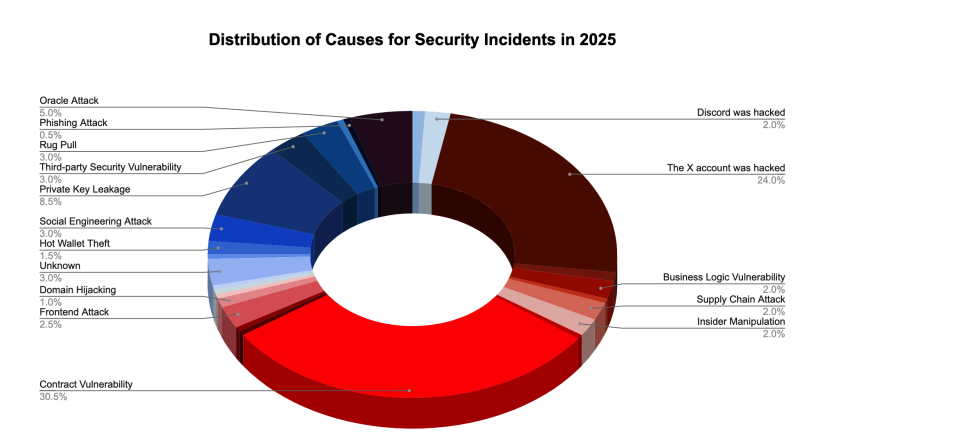
SlowMist’s year-end report shows that vulnerabilities in smart contracts accounted for just over 30% of crypto exploits in 2025, making them the leading cause of losses.

Source: SlowMist

Researchers have also warned that advances in artificial intelligence are accelerating how quickly attackers can identify and exploit weaknesses in on-chain code.

While overall crypto losses declined in December, falling about 60% month-on-month to roughly $76 million, security firms cautioned that the drop did not reflect a structural improvement.

📉 Crypto-related losses from hacks and cybersecurity exploits fell sharply in December, dropping 60% month-on-month to about $76 million.#Crypto #Hackhttps://t.co/mke6K8sLVQ

— Cryptonews.com (@cryptonews) January 2, 2026

PeckShield noted that a single address-poisoning scam accounted for $50 million of December’s losses, showing how concentrated and severe individual incidents can be even during quieter periods.

January has already seen several notable exploits. IPOR Labs confirmed a $336,000 attack on its USDC Fusion Optimizer vault on Arbitrum, while Truebit disclosed a smart-contract incident that on-chain analysts estimate drained more than 8,500 ETH, triggering a near-total collapse in the project’s token price.

Last week, Layer-1 network Saga paused its SagaEVM chain after an exploit moved close to $7 million in assets to Ethereum.

The post Matcha Meta Breach Drains $16.8M via SwapNet Exploit — Users Urged to Revoke Access appeared first on Cryptonews.

Ethereum Founder Vitalik Buterin Reverses Stance: Why ZK-SNARKs Are Now Ethereum’s ‘Magic Pill’

Ethereum co-founder Vitalik Buterin has publicly walked back a position he held for nearly a decade, showing Ethereum’s renewed stance about self-sovereignty, verification, and the future role of cryptography.

In a recent post on X, Buterin said he no longer agrees with a 2017 statement in which he dismissed the idea of users fully validating blockchains themselves as a “weird mountain man fantasy,” arguing that both technology and real-world experience have reshaped his view.

The idea of average users personally validating the entire history of the system is a weird mountain man fantasy. There, I said it.

— vitalik.eth (@VitalikButerin) June 9, 2017

The comment revisits a long-running debate in blockchain design that dates back to Ethereum’s early years.

What Changed Since 2017? ZK Proofs Rewrite a Classic Blockchain Argument

In 2017, Buterin sparred publicly with blockchain theorist Ian Grigg over whether blockchains should store full state, such as account balances and smart contract data, directly on-chain.

Grigg argued that chains only needed to record transaction ordering, with state reconstructed locally and discarded.

Buterin was a vehement opponent of such a design at the time, citing that such a design would require users to constantly rerun the whole transaction history or utilize third-party RPC services to get the current state.

At the time, Buterin claimed that Ethereum was better compromised with the design where state roots are pegged to block headers.

Using Merkle proofs and an honest majority assumption for proof-of-work or proof-of-stake, users would be able to check a certain value without going through a single intermediary.

⚡ Vitalik Buterin: Verkle Trees Implementation to Benefit Ethereum Stakers and Network Nodes

Ethereum co-founder @VitalikButerin has highlighted the advantages of implementing Verkle Trees within Ethereum’s staking protocol.#CryptoNews #newshttps://t.co/Ep7l0NaPr9

— Cryptonews.com (@cryptonews) February 19, 2024

Making the entire chain completely self-validating, he said, was in theory attractive but computationally impractical to ordinary users, unless the network grossly constrained its capacity.

The difference, as explained by Buterin, is the maturation of zero-knowledge cryptography, specifically zk-SNARKs.

These cryptographic evidences enable a user to prove that a group of calculations has been done right without re-running all the processes or showing the data behind the scenes.

Why Vitalik Buterin Now Sees ZK-SNARKs as Ethereum’s Safety Net

To him, it is like finding an inexpensive, one-size-fits-all solution after years of trade-off disputes. He claimed that with zk-SNARKs, Ethereum could obtain the security of full verification without necessarily subjecting users to prohibitive costs.

I no longer agree with this previous tweet of mine – since 2017, I have become a much more willing connoisseur of mountains. It's worth explaining why.https://t.co/SRvRtuFKQu

First, the original context. That tweet was in a debate with Ian Grigg, who argued that blockchains…

— vitalik.eth (@VitalikButerin) January 26, 2026

Buterin said this advance allows Ethereum to revisit trade-offs that were once accepted reluctantly, especially around scalability, decentralization, and verification. He also acknowledged that his earlier thinking relied too heavily on idealized assumptions.

In practice, he noted, networks experience outages, latency spikes, service shutdowns, and regulatory or social pressure that can push intermediaries to censor applications or users. In those moments, reliance on third parties or developer intervention can become a single point of failure.

That perspective underpins his renewed support for what he described metaphorically as the “mountain man’s cabin,” a fallback option that allows users to directly interact with the chain when everything else breaks.

Inside Ethereum’s Growing Push Toward ZK-Based Scaling

There has been a growing focus on Zk-SNARKs in the roadmap of Ethereum, especially in the form of zero-knowledge rollups.

These layer-2 networks reduce fees significantly by offloading thousands of transactions and making a single cryptographic proof to Ethereum.

Even projects like zkSync, StarkNet, Scroll, and others are already based on these methods, but with various trade-offs in the size of the proof, transparency, and the cost of calculation.

Mid-2025 community proposals stated that off-chain personal data and using cryptographic proofs might be a solution to align Ethereum with European rules on data protection.

🇪🇺 Ethereum community member Eugenio Reggianini has proposed a technical framework to align Ethereum with EU GDPR rules.#eth #eu #ethereumhttps://t.co/zDmQpFh647

— Cryptonews.com (@cryptonews) June 9, 2025

ZK-SNARKs were mentioned as a method of enabling validators to verify that data is correct without access to it, minimizing on-chain access.

On the protocol layer, Buterin has additionally admitted that there are certain remnants of legacy design that now pose a bottleneck to Ethereum’s ambitions to go zero-knowledge.

In late 2025, he proposed removing the modular exponentiation precompile, a feature he originally introduced, after it proved to be a major bottleneck for generating zk proofs.

The post Ethereum Founder Vitalik Buterin Reverses Stance: Why ZK-SNARKs Are Now Ethereum’s ‘Magic Pill’ appeared first on Cryptonews.

French Crypto Tax Platform Waltio Hit by 50,000-User Data Breach

French authorities have opened a preliminary investigation into a data breach at Waltio, a cryptocurrency tax reporting platform used by tens of thousands of investors.

This occurred when hackers reportedly got access to sensitive user information and tried to blackmail the company.

The event has brought up new issues regarding the exposure of personal data in the crypto industry, as target fraud and physical attacks against holders are becoming more and more frequent in France.

Authorities Link Waltio Breach to Shiny Hunters’ Extortion Attempt

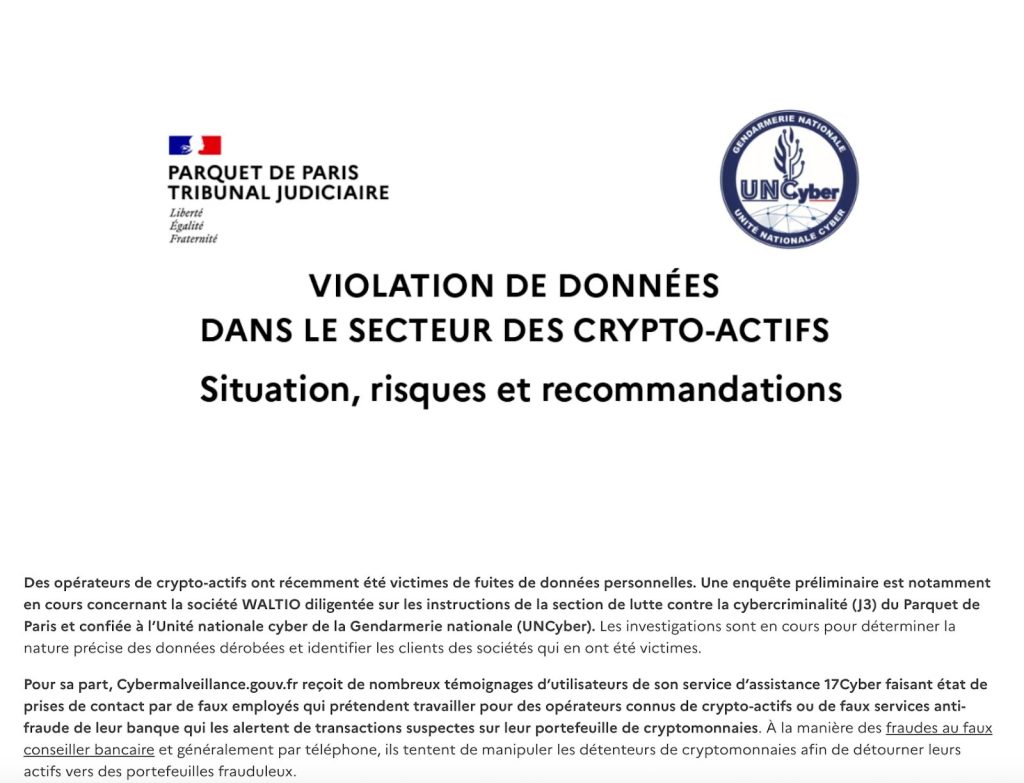
In a statement released this week, French cybersecurity institutions confirmed that, via its cybercrime division, the Paris Public Prosecutor’s Office had issued an order to the National Cyber Unit of the Gendarmerie to establish the extent of the breach and identify exposed users.

Source: Paris Public Prosecutor’s Office

Officials advised that users whose information might have been stolen should be wary of scammers who claim to be genuine service providers or other officials and force them to give up their digital assets using the stolen information.

The law enforcement agencies reported that some more recent fraudsters posed as crypto businesses, bank anti-fraud units, or even law enforcement officers and magistrates.

French newspaper Le Parisien stated that the attack at Waltio was associated with a ransom demand by a hacking organization called Shiny Hunters.

The group purportedly had obtained personal information of approximately 50,000 Waltio users, most of whom reside in France, and said it had samples of the stolen information as proof.

Waltio later filed a complaint of attempted extortion and unauthorized access to the automated data system.

Waltio said its initial internal assessment showed that the attackers accessed tax reports for the 2024 period. These documents included users’ email addresses, information on crypto profits or losses, and asset balances at the end of the year.

The company stated that banking details, administrative records, and tax identification data were not affected and that its core infrastructure was not compromised.

Waltio added that its services remain operational and that client funds are not at risk.

France Tightens Oversight After Crypto Data Breach Amid Rise in Kidnapping Cases

Waltio was founded in France and is headquartered in Clermont-Ferrand. It serves roughly 150,000 users and focuses on simplifying crypto tax compliance for European investors, particularly in France, Spain, and Belgium.

The platform aggregates transaction data from more than 700 exchanges, wallets, and blockchains to calculate capital gains, losses, and staking income, and generates tax-compliant reports for local filings.

The investigation comes amid heightened scrutiny of crypto-related data leaks in France.

In the last year, police have attributed a number of home invasions, kidnappings, and attempted kidnappings to the criminals who intended to use the knowledge of the victims having digital assets.

Although the leakage of data has not been directly linked to these crimes, the investigation teams have not eliminated the chances of the data being used to establish potential targets.

🇫🇷 Masked gunmen steal crypto USB in France as prosecutors reveal tax official sold government database access identifying crypto investors to criminal gangs for 800 euros per operation.#Crypto #Attack #Francehttps://t.co/GmfOkwsE6E

— Cryptonews.com (@cryptonews) January 9, 2026

Fraud victims have been cautioned to keep evidence, report to the police, and address the data protection authority in France in instances where they feel that their personal data has not been sufficiently safeguarded.

The Waltio incident is not the first case of data exposure in the crypto industry in the past.

Hardware wallet manufacturer Ledger announced earlier this month that a breach of a third-party payment processor, Global-e, took place, exposing the data of its customers.

Last month, crypto tax software developer Koinly also notified users of a potential email data breach related to the use of a third-party analytics platform.

The post French Crypto Tax Platform Waltio Hit by 50,000-User Data Breach appeared first on Cryptonews.

Bitcoin ETFs Bleed $1.62B in Four Days — Are Hedge Funds Dumping BTC?

Bitcoin spot exchange-traded funds have experienced steep outflows over four trading days, losing a combined total of $1.62 billion.

The exit has raised a question on whether hedge funds are withdrawing their Bitcoin exposure as the market conditions change.

The withdrawals occur as Bitcoin fails to regain momentum around critical price points, while a once-popular institutional arbitrage strategy steadily loses its appeal.

BlackRock’s IBIT Leads Bitcoin ETF Outflows as BTC Slips Below $90K

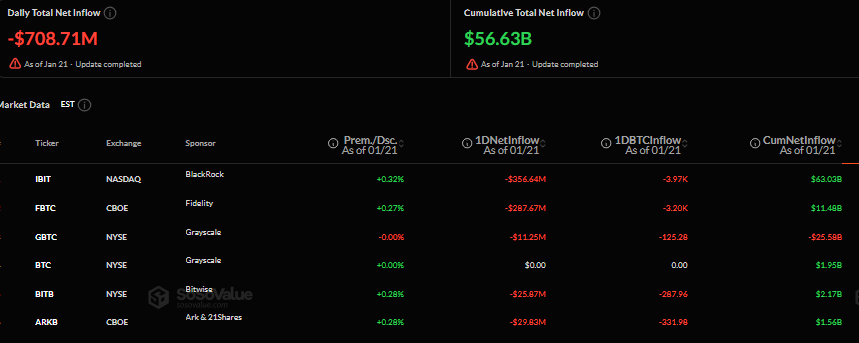
As of January 22, 2026, US-listed spot Bitcoin ETFs recorded net daily outflows of $32.11 million, extending a streak of redemptions that peaked at $708.71 million on January 21, following $483.38 million on January 20, Sosovalue data shows.

In the last one week, net outflows amounted to 1.22 billion.

Trading activity stayed strong on January 22, with Bitcoin spot ETFs recording $3.30 billion in volume, even as assets under management dipped to $115.99 billion, about 6.49% of Bitcoin’s market cap.

BlackRock’s iShares Bitcoin Trust led daily outflows, with $22.35 million redeemed, equivalent to roughly 249.5 BTC.

Despite the withdrawal, IBIT remains the dominant product, holding $69.84 billion in assets and nearly 4% of the Bitcoin supply represented in ETFs.

Bitcoin ETFs data Source: Sosovalue

Fidelity’s FBTC followed with $9.76 million in outflows, while Grayscale’s GBTC reported flat daily flows but remains deeply negative overall, with $25.58 billion in cumulative net outflows as investors continue rotating away from its higher 1.5% fee.

Other issuers, including Bitwise, Ark and 21Shares, VanEck, Invesco, Valkyrie, Franklin, and WisdomTree, recorded largely unchanged flows, showing a pause rather than broad panic selling.

The ETF pullback has unfolded alongside weakness in Bitcoin’s price.

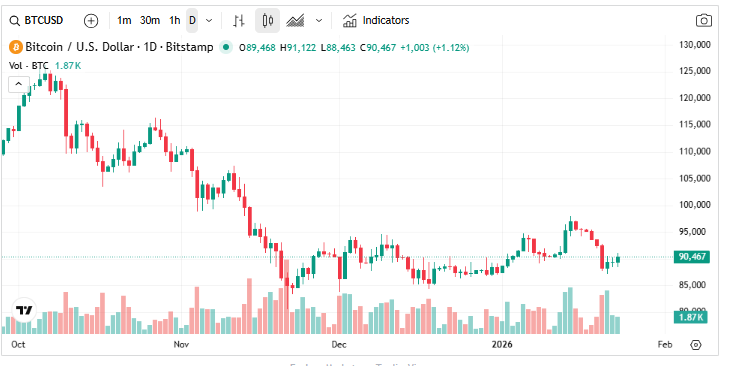
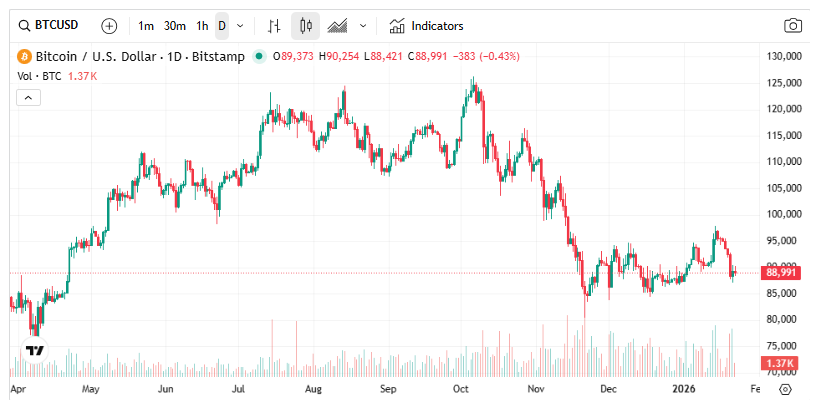
BTC was trading around $89,982 on January 22, down 1.3% on the day and nearly 5% over the past week, after briefly dipping to $88,600.

Source: Cryptonews

Trading volume has also cooled, falling nearly 28% to $37.77 billion, a sign that market participation is thinning as prices consolidate below $90,000.

Compressed Yields Trigger Hedge Fund Exit From Bitcoin ETFs

Market observers point to hedge fund positioning as a key driver behind the ETF outflows.

Amberdata shows that yields on the Bitcoin basis trade, a strategy that buys spot Bitcoin via ETFs while selling futures to capture price spreads, have dropped below 5%, down from around 17% a year ago.

As returns compress and approach the yield available on short-dated US Treasuries, fast-moving capital has less incentive to stay deployed.

Analyst noted that while hedge funds likely represent only 10% to 20% of ETF holders, their activity can overwhelm flows in the short term when the trade stops working.

Bloomberg data shows that the unwind is visible in derivatives markets as well.

Bitcoin futures open interest on Chicago Mercantile Exchange (CME) has fallen below Binance’s for the first time since 2023, showing reduced participation in cash-and-carry trades by US institutions after ETFs launched there.

One-month annualized basis yields now hover near 4.7%, barely clearing funding and execution costs, as spreads tighten and arbitrage opportunities fade.

CryptoQuant indicators show apparent demand turning negative, whale and dolphin wallets shifting from accumulation to distribution.

Also, the Coinbase premium remained deeply negative, suggesting weaker appetite from US institutions.

At the same time, leverage in Bitcoin futures has climbed to its highest level since November, increasing the market’s sensitivity to sharp moves in either direction.

Flows in other crypto ETFs underline that the sell-off is not uniform.

Ethereum spot ETFs also recorded heavy outflows this week, including $41.98 million on January 22, while XRP and Solana-linked products saw modest inflows, pointing to selective institutional repositioning rather than a wholesale exit from digital assets.

The post Bitcoin ETFs Bleed $1.62B in Four Days — Are Hedge Funds Dumping BTC? appeared first on Cryptonews.

Revolut Drops US Bank Merger Plan, Will Pursue Standalone License — Could This Speed Up Its Crypto Expansion?

Fintech unicorn Crypto-friendly Revolut is dropping its planned acquisition of an American bank in favor of an independent banking license on its way to expand in the US market, the Financial Times reported on Friday.

The report referred to individuals who are knowledgeable of the issue that Revolut has been negotiating with authorities in the U.S. regarding submitting an application to obtain a bank license via the Office of the Comptroller of the Currency (OCC).

The shift comes as regulatory attitudes in Washington soften toward fintechs and crypto firms.

Revolut Points to Softer U.S. Regulation as It Adjusts Expansion Plans

The UK-based fintech, valued at about $75 billion following a November share sale, had spent much of 2025 exploring the purchase of a nationally chartered US bank.

An acquisition would have allowed Revolut to bypass the lengthy process of applying for a banking charter from scratch and immediately gain the ability to lend across all 50 states.

As recently as July, executives believed this approach would be the quickest way to scale operations in the US.

🏦 @RevolutApp may buy a US bank with a national charter to fast-track its American expansion and bypass the lengthy process of obtaining its own licence.#Revolut #Fintechhttps://t.co/xeDYK3miuI

— Cryptonews.com (@cryptonews) July 30, 2025

This perception has already changed, as the company is currently gambling that the approval process can be completed faster in the Trump administration since the regulatory environment has become a lot lighter than it was in the past few years.

Revolut admitted that the US is the key to its long-term growth strategy and emphasized that it wanted to have a bank in the country but noted that no final decision has been made yet and plans may change.

Revolut is “actively working with the regulator to launch the [UK] bank this year. That’s our ambition – that we’re going to launch the bank this year,” said Sid Jajodia, Revolut's CBO

Revolut “ask” regulators to be faster at making decisions.

“Anything regulators can do to… https://t.co/6AZl3CMTax pic.twitter.com/GR1J9dAbQ2

— Max Karpis (@maxkarpis) September 24, 2025

Internally, the rethink is based on fears of the purchase of a community bank being problematic, such as the necessity to use physical branches and a more complicated approval procedure for any changes in ownership.

De novo license application, which has traditionally been slow, is now considered more predictable (and consistent with the Revolut digital-first model).

National Trust Charters Emerge as Key Path for Crypto and Fintech Firms

The relocation will put Revolut on a list of increasingly popular fintech and crypto-native companies that are pursuing national charters.

The OCC itself has received approximately 13 new bank and trust license applications in 2025 alone, which is close to the number of the past four years combined.

The regulator, in December, gave conditional approval to five crypto-based companies to become national trust banks, as well as BitGo, Fidelity Digital Assets, and Paxos, to turn current state licenses into national ones.

✅ The OCC has conditionally approved five crypto firms, including @Circle and @Ripple, to launch national trust banks.#Ripple #Circlehttps://t.co/wCeTNrhOQZ

— Cryptonews.com (@cryptonews) December 13, 2025

The US banking license would provide Revolut with greater access to the dollar clearing, custody, and compliance infrastructure, which could be valuable to its stablecoin and crypto offerings at a time when federal oversight is becoming the selling point to both institutional and retail customers.

Although national trust charters prohibit taking deposits or lending, they do provide regulatory visibility that a number of crypto companies have long been craving.

Revolut Strengthens Role as Bridge Between Banks and Crypto

Notably, Revolut has gradually developed its crypto service and established itself as a gateway between conventional finance and digital assets.

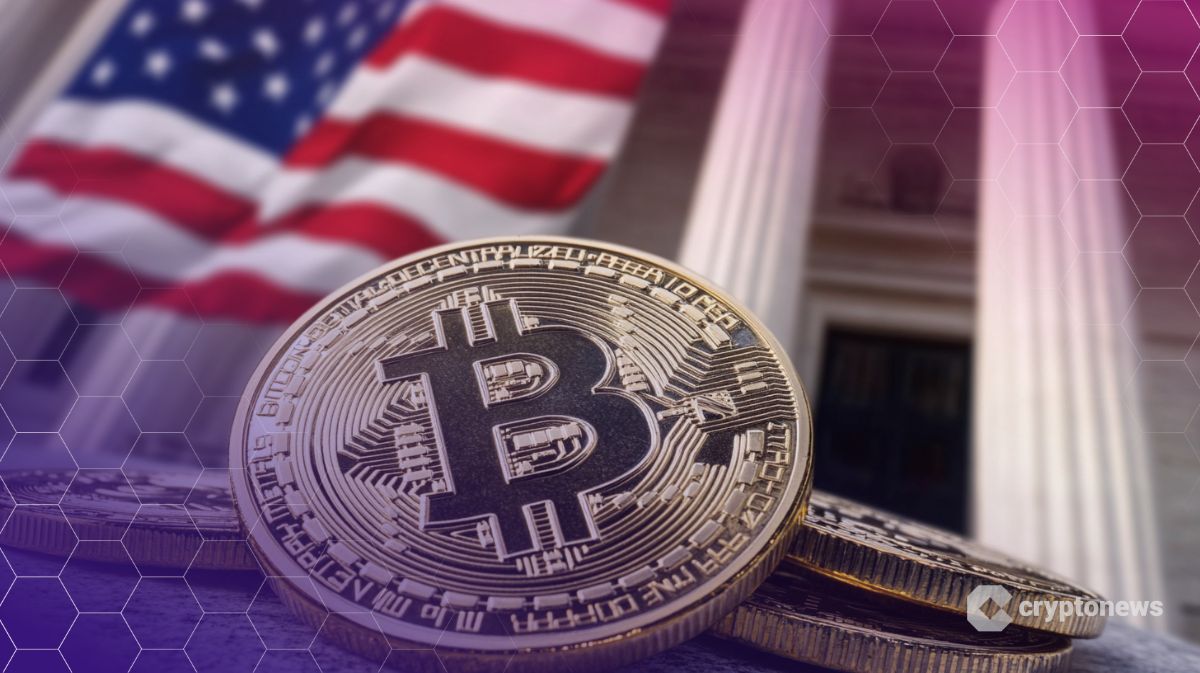
In October, the company eliminated all fees and spreads on the conversions of the US dollar into major stablecoins USDC and USDT.

🚀 Revolut launches zero-fee stablecoin swaps for its 65 million users as crypto trading drives 298% revenue growth in its wealth division.#Revolut #Stablecoinhttps://t.co/rFY9zImV4j
— Cryptonews.com (@cryptonews) October 31, 2025

The volume of stablecoin payments on the platform is projected to have increased by 156% in 2025 to approximately 10.5 billion due to daily payment transactions and not because of speculative trading.

Additionally, Revolut has also increased its global growth, gaining banking licenses in Colombia and Mexico, a crypto regulatory license in Cyprus, and more than 1 billion investments in France by 2028.

It is also said to consider a dual listing in London and New York, the move that would further establish its position as one of the most valuable fintechs in the world.

The post Revolut Drops US Bank Merger Plan, Will Pursue Standalone License — Could This Speed Up Its Crypto Expansion? appeared first on Cryptonews.

Ethereum Founder Vitalik Buterin Ditches Big Tech: His 2026 “Self-Sovereign” Stack Reveals Surprising Changes

Ethereum cofounder Vitalik Buterin has outlined a personal shift away from Big Tech platforms, framing 2026 as a pivotal year for what he calls “computing self-sovereignty.”

This is a concept that extends beyond blockchain and into how individuals use everyday software, communication tools, and artificial intelligence.

2026 is the year we take back lost ground in computing self-sovereignty.

But this applies far beyond the blockchain world.

In 2025, I made two major changes to the software I use:

* Switched almost fully to https://t.co/caFP0K5fYF (open source encrypted decentralized docs)
*…

— vitalik.eth (@VitalikButerin) January 22, 2026

In a post shared on X, Buterin described a series of changes he has made across his devices to reduce reliance on centralized, data-intensive services.

Vitalik Buterin Replaces Google, Telegram With Privacy-Focused Alternatives

He claimed that the process started in 2025 when he transferred nearly completely to the open-source and encrypted and decentralized document platform Fileverse, which is purported to be a privacy-focused alternative to Google Docs.

At roughly the same period, he reported having changed to Signal as his main messaging application, abandoning Telegram.

Signal supports end-to-end encryption on all conversations by default and only retains a little metadata, whereas Telegram encrypts messages only in optional so-called secret chats.

He further stated that it otherwise stores messages and metadata on its servers, a design that has attracted increased attention due to an increase in law enforcement requests in some jurisdictions.

🔒 Telegram CEO Pavel @Durov has issued a statement reaffirming the platform’s commitment to user privacy.#privacy #telegramhttps://t.co/ZPIeUno9K1

— Cryptonews.com (@cryptonews) April 21, 2025

The changes made in 2026 included more extensive ones, which were due to those initial adjustments.

Buterin claimed to have substituted Google Maps with OpenStreetMap, with Organic Maps on mobile phones, citing the advantage of local and offline use that restricted the volume of location data sent to third parties.

He also left Gmail for Proton Mail, citing encrypted messaging as a more powerful tool to use for confidential communication.

Simultaneously, he claimed to have started giving priority to decentralized social media and still tests the idea of running large language models locally, as opposed to using cloud-based AI services.

Buterin Sees Local AI as the Future of User Privacy

The rationale of these decisions is not purity in ideology but practicality, as Buterin wrote.

According to him, it is not necessary to send big amounts of personal information to centralized services, as there are tools that can be used to minimize this exposure.

He admitted that local AI systems still have usability and integration issues, especially for translation, transcription, and document search, but noted that there has been a lot of improvement in the last year.

He explained a more ambitious long-term vision where local models are integrated with cryptographic schemes like zero-knowledge proofs, trusted execution environments, and local data filtering to restrict the information that ever leaves a user’s device.

Rising AI Demand Puts Self-Sovereign Computing Back on the Map

The remarks made by Butterin come amidst the wider revival of interest in self-sovereign computing, which is a model that highlights the importance of individualized controls of data, identity, and computing resources.

The idea integrates identity systems based on decentralization, personal servers, and privacy-by-design software with the aim of minimizing reliance on platforms that are controlled by corporations.

Privacy activists, including Naomi Brockwell, have long held the position that the most consistent approach to ensuring autonomy is to run software and AI models in place.

The most private way to use AI is to host it locally, but you're limited by your own hardware. There are AI platforms that allow you to access more powerful models & also respect your privacy. Planning to update this video soon to include newcomers like https://t.co/ueOskOEx0g. pic.twitter.com/WlB6PUxlpA

— Naomi Brockwell priv/acc (@naomibrockwell) January 19, 2026

The time also stands out due to the re-evaluation of the strategic value of computing infrastructure by governments and corporations.

Analysts believe that 2026 will be the year of a change in the treatment of AI data centers, energy-backed compute and GPU capacity.

👀 Governments are expected to start treating AI data centers and energy-backed computing power as strategic infrastructure in 2026, similar to how oil reserves are managed.#AI #Energy #TokenizedDollars #Cryptohttps://t.co/DUYrsqn7iI
— Cryptonews.com (@cryptonews) January 13, 2026

With the demand of large-scale AI continuing to outpace its supply, compute and energy are becoming viewed as a source of geopolitical power.

In that environment, the appeal of local and decentralized computing models has grown, particularly as concerns mount over surveillance, data residency, and platform dependence.

The post Ethereum Founder Vitalik Buterin Ditches Big Tech: His 2026 “Self-Sovereign” Stack Reveals Surprising Changes appeared first on Cryptonews.

DOJ Targets Crypto Fraud in ‘America First’ Blitz as AI Scams Spike 450%

The U.S. Department of Justice is intensifying its efforts on crypto-related fraud as it escalates to execute what the authorities refer to as an “America First” enforcement agenda in response to a surge of digital asset-related frauds driven more by artificial intelligence.

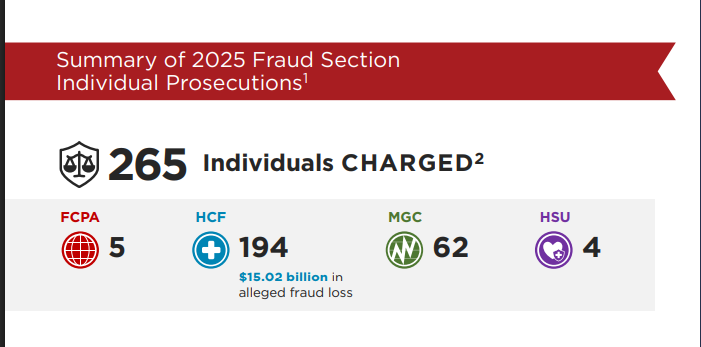
The shift was outlined in the DOJ Criminal Division Fraud Section 2025 Year in Review, published on Thursday, indicating prosecutors accused 265 defendants with a cumulative alleged loss on fraud cases of over $16 billion, nearly twice the amount reported the previous year.

Source: DOJ Criminal Division Fraud Section

Although the cases were in medical care, consumer protection, corporate fraud, and market manipulation, the DOJ said that cryptocurrency was increasingly becoming a type of payment rail, laundering, or asset category due to illicit funds.

In some significant cases, authorities seized crypto alongside cash, real estate, and luxury goods, showing the strong integration of digital assets into conventional fraudulent actions.

DOJ Health Care Fraud Crackdowns Lead to Major Crypto Seizures

One of the most prominent cases cited involved a $1 billion amniotic wound allograft fraud scheme that allegedly generated more than $600 million in improper Medicare payments.

Prosecutors charged Tyler Kontos, Joel Kupetz, and Jorge Kinds with targeting elderly and terminally ill patients for medically unnecessary procedures.

As part of the investigation, law enforcement seized more than $7.2 million in assets, including bank accounts and cryptocurrency.

The DOJ also highlighted the National Health Care Fraud Takedown carried out last year, the largest in the department’s history.

That operation charged 324 individuals across 50 federal districts for schemes involving more than $14.6 billion in intended losses.

Authorities confiscated more than $245 million in assets in the sweep, including significant amounts of cryptocurrency.

Simultaneously, the regulators prevented over $4 billion of fraudulent Medicare payments prior to their disbursement, indicating a more active, data-driven enforcement strategy.

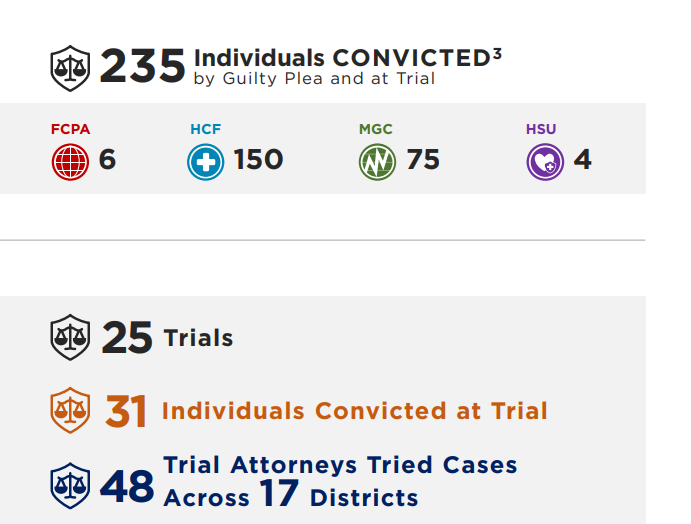
Behind these cases is the DOJ Fraud Section, which operates through four specialized units that increasingly intersect with crypto-related crime.

Its units include foreign bribery, market and consumer fraud, healthcare fraud, and health and safety crimes, areas where digital assets and blockchain-based laundering are now frequently involved.

Source: DOJ Criminal Division Fraud Section

Prosecutors reported securing 235 convictions in 2025, including 25 trials across 17 federal districts.

AI-Assisted Scams Drive Sharp Rise in Crypto Fraud Losses

This enforcement surge comes as reported crypto fraud losses continue to climb. The FBI’s Internet Crime Complaint Center recorded more than 41,500 crypto investment scam complaints in 2024, with reported losses exceeding $5.8 billion.

Federal data shows total crypto scam losses reached roughly $9.3 billion last year, with older Americans disproportionately affected.

👾 The FBI recorded $9.3 billion losses spread across various crypto-related investment scams, extortion, ATM and kiosks, among others, in 2024.#FBI #CryptoFraud #CryptoScamhttps://t.co/1Eb8KStAHk
— Cryptonews.com (@cryptonews) April 24, 2025

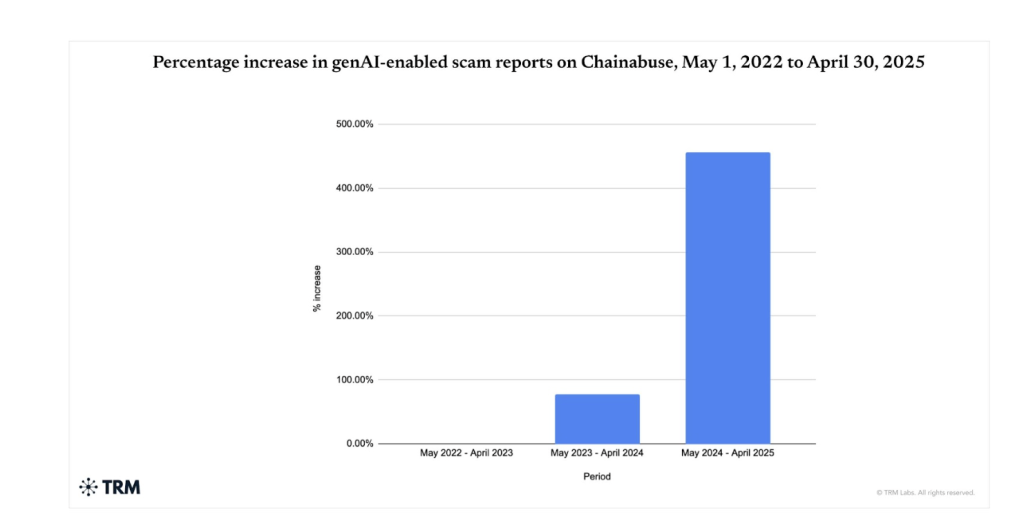
In 2025, blockchain analytics firms reported that average scam payments rose more than 250%, while AI-assisted scams have surged by more than 450%, as criminals deployed deepfake audio, synthetic identities, and automated phishing at scale.

Source: TRM Labs

In response, the DOJ and other agencies have launched coordinated initiatives aimed at transnational fraud networks, particularly so-called “pig butchering” scams linked to criminal groups operating in Southeast Asia.

A multi-agency strike force announced late last year has already seized and forfeited more than $401 million in cryptocurrency, including the largest bitcoin seizure in U.S. history.

Separately, the FBI’s Operation Level Up has notified thousands of potential victims and helped prevent hundreds of millions of dollars in additional losses.

Lawmakers have also moved to tighten the legal framework, as bipartisan bills introduced in Congress seek harsher penalties for AI-assisted fraud and stronger coordination across federal agencies to combat crypto-related scams.

In addition, two U.S. senators introduced the SAFE Crypto Act aimed at tightening the government’s response to cryptocurrency-related fraud.

The post DOJ Targets Crypto Fraud in ‘America First’ Blitz as AI Scams Spike 450% appeared first on Cryptonews.

South Korea Probes Theft of Seized Bitcoin Worth $48M in Suspected Phishing Heist

South Korean prosecutors are investigating the disappearance of a significant amount of Bitcoin that had been confiscated as criminal proceeds, after an internal audit suggested the assets may have vanished while under state custody.

The Gwangju District Prosecutors’ Office believes the loss likely occurred during the management period last year and is treating the incident as a suspected phishing attack, raising fresh concerns over how seized digital assets are stored and safeguarded.

According to a senior prosecution source cited by local media, preliminary internal assessments suggest the missing Bitcoin was worth roughly 70 billion won, or about $48 million, at the time of the loss.

Seized Bitcoin Lost After Wallet Password Exposure, Officials Say

An official at the prosecutor’s office stated that the investigators are striving to establish the locations of the seized properties, but they could not verify any additional information at the moment.

Local news states that the bitcoin was linked to an illegal gambling situation and that it was being seized as an illegal piece of property when it was lost.

The estimates reported in the domestic media indicate that the value might be in tens of billions of won, which would translate to several million dollars, but those numbers have not been verified by prosecutors.

The early evidence indicates that the bitcoin was stored in a portable USB, as opposed to a more durable custody system.

The wallet password was also reported to have been revealed to a third party during a regular examination of confiscated items, which provided an opportunity to illegally access it and transfer money.

🚨 @KoinlyOfficial warns a third-party breach may have exposed user emails but stresses that no wallet, transaction, tax, or portfolio data was shared with Mixpanel.#CryptoSecurity #CryptoTax #Koinlyhttps://t.co/ASDxMchfyg

— Cryptonews.com (@cryptonews) December 23, 2025

The case is one of the most recent high-profile cases of stolen cryptocurrency being re-stolen by law enforcement via social engineering instead of technical merits.

Phishing attacks are deceptive, not technical, as they take advantage of a trusting party. In a more institutionalized environment, they usually prosper through human error and poor internal controls as opposed to blockchain weaknesses.

South Korea’s Expanding Authority Over Seized Digital Assets

The Gwangju District Prosecutors’ Office is no stranger to large crypto seizure cases. In March 2024, it pursued the recovery of roughly 170 billion won, or about $127 million at the time, in Bitcoin linked to another illegal gambling operation.

The seizure of digital assets has been gradually institutionalized in South Korea in recent years after several landmark Supreme Court decisions made it clear that cryptocurrencies can be regulated as property under the Criminal Procedure Act.

🇰🇷 South Korea's Supreme Court rules Bitcoin on exchanges can be legally seized under Criminal Procedure Act, establishing precedent as regulators expand asset freeze powers and AML enforcement.#SouthKorea #Bitcoinhttps://t.co/3fa5PxHMMG

— Cryptonews.com (@cryptonews) January 9, 2026

Such a legal basis was initially established in 2018, when the Supreme Court decided that cryptocurrencies are intangible assets and have economic value and thus can be seized in case they are linked to a crime.

Later judicial decisions have further broadened the power of the seizure, and a December case verified that the bitcoin kept on domestic exchanges like Upbit and Bithumb may also be confiscated.

The recent case arrived on the day when the South Korean regulators are busy increasing control over the crypto industry.

In January, financial regulators announced an intention to test a payment freeze system whereby investigators can temporarily freeze crypto-related accounts before the suspected illicit funds are taken off or deposited in an offshore account.

The post South Korea Probes Theft of Seized Bitcoin Worth $48M in Suspected Phishing Heist appeared first on Cryptonews.

Solana DAT’s $DONT Memecoin Hits $26M – But Degens Are Warned: “Don’t Buy It”

Defi Development Corporation has pushed the boundaries of crypto culture and corporate experimentation after launching what it describes as the world’s first memecoin created by a publicly traded company.

The company’s move has already ignited controversy across the Solana ecosystem.

1/ ⚠ ANNOUNCING $DONT ⚠

Today, we announce @disclaimercoin, the first-ever publicly traded company-created memecoin launched via @bonkfun.

No roadmap, no utility, no cabal, & no promises.
Just a disclaimer: DONT buy it.

30% will sit on $DFDV's balance sheet FOREVER. 🧵 pic.twitter.com/epOPX3NPUk

— DeFi Dev Corp. (DFDV) (@defidevcorp) January 22, 2026

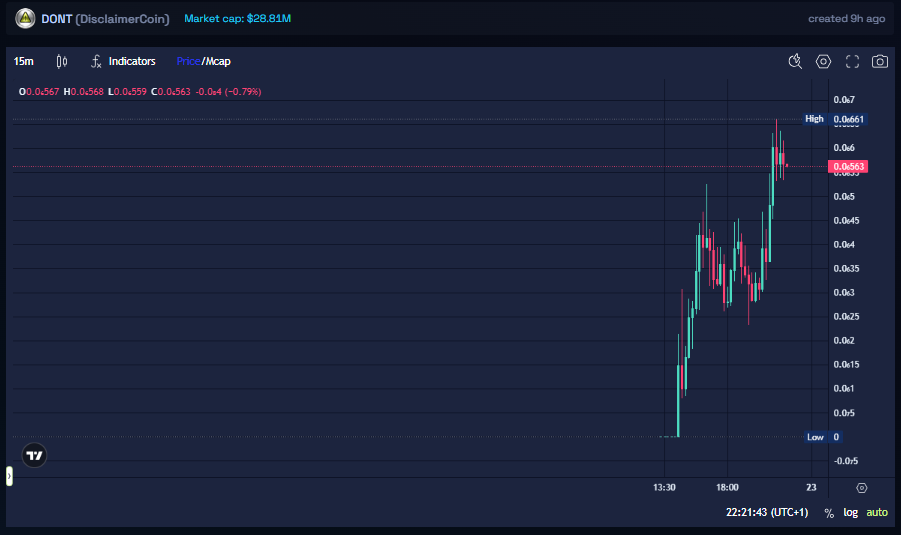
The token, called DisclaimerCoin and trading under the ticker $DONT, briefly surged to a market capitalization of more than $26 million within hours of launch.

DFDV Launches $DONT Memecoin as a Corporate Experiment

The launch comes at a time when Solana’s memecoin market remains hyperactive, driven by speculation, rapid liquidity rotation, and a growing overlap between on-chain culture and institutional capital.

Against that backdrop, DFDV’s decision to issue a memecoin has raised questions not only about market behavior but also about how far publicly listed companies can go in embracing crypto-native norms without crossing regulatory or ethical lines.

DeFi Development Corporation said that $DONT was intentionally released without a utility, roadmap, or promises.

The company framed the token as a live experiment rather than a product, stating that it exists purely to test what happens when a real corporation engages directly with internet-native markets.

In a post confirming the launch, DFDV executive Dan Kang said the token was legitimate and reiterated a simple message to traders: “Don’t buy it.”

Yes, it’s real. No, we were not hacked.

Don’t buy it. https://t.co/u1a9anbBD7

— DK (@CryptoIRGuy) January 22, 2026

Despite this, on-chain activity of the token has seen massive activity.

Within two hours of launch on the Bonk.fun platform and Raydium liquidity pools, $DONT climbed rapidly, with early wallets recording outsized gains.

Source: Raydium

On-chain Data Flags Early Profits in $DONT Debut

On-chain data shows that some addresses were able to trade the token profitably before or immediately after the public announcement, fueling speculation about insider access or privileged information.

One wallet reportedly sold billions of $DONT tokens for hundreds of thousands of dollars in profit without purchasing them on the open market.

Meanwhile, other wallets linked by analysts to validator infrastructure associated with DFDV also posted gains.

The suspicious activity has added to skepticism, particularly given Solana’s history of high-profile memecoin launches tied to compromised social media accounts.

However, Defi Development Corporation has repeatedly affirmed the authenticity of the token that $DONT was officially issued by DFDV.

Tokenomics published by the company outline a fixed supply of 420 billion $DONT, with no inflation mechanism.

Thirty percent of the supply is held permanently on DFDV’s balance sheet, forty percent was allocated to public liquidity, and twenty percent was reserved for ecosystem and community purposes.

Additionally, ten percent is assigned to early contributors, including employees subject to predefined sales rules.

As a result of the price surge, the balance sheet allocation alone briefly translated into an estimated $8 million increase in the company’s reported on-chain assets.

DeFi Development Sticks With Solana Despite Treasury Drawdown

The move fits into a broader pattern of experimentation by DeFi Development Corporation, which has positioned itself as an unconventional digital asset treasury firm.

✅ DeFi Development (@defidevcorp) expanded its stock buyback program to $100M, holding over 2M $SOL tokens.#DeFi #Solana https://t.co/G6CGnoAK7p

— Cryptonews.com (@cryptonews) September 24, 2025

Since adopting its non-Bitcoin DAT strategy in 2025, the company has tokenized its stock on-chain, operated validators as a treasury function, and deployed capital into Solana DeFi protocols to generate yield.

The firm ended 2025 as one of the top-performing crypto-linked Nasdaq stocks, even as the broader Solana market faced declining prices.

That context is important, as Solana-focused treasuries have been under pressure in recent months. With SOL down sharply from late 2025 highs, many DATs have seen treasury values fall, and net asset values compress.

DFDV’s treasury, currently valued at roughly $283 million and centered around nearly 2.2 million SOL, has declined by more than 30% over the past three months, underscoring the financial strain across the sector.

The post Solana DAT’s $DONT Memecoin Hits $26M – But Degens Are Warned: “Don’t Buy It” appeared first on Cryptonews.

Bitcoin & Ethereum ETFs Shed Over $1B – But Solana and XRP See Inflows

U.S.-listed spot Bitcoin and Ethereum exchange-traded funds saw over $1 billion in outflow in a single trading day on January 21, as investors moved out of the two largest cryptocurrencies during a broader market downturn.

Meanwhile, smaller altcoin-linked products linked to Solana and XRP experienced net inflows, which points to an apparent institutional positioning difference during the most recent volatility.

According to SoSoValue, on January 21(ET), Bitcoin spot ETFs saw a total net outflow of $709 million yesterday, marking three consecutive days of net outflows, while Ethereum spot ETFs recorded a total net outflow of $298 million. Meanwhile, Solana spot ETFs saw a total net… pic.twitter.com/rQZrHfM8LK

— Wu Blockchain (@WuBlockchain) January 22, 2026

Bitcoin and Ethereum ETFs recorded more than $1 billion in withdrawals, despite both asset classes recording positive cumulative inflows since inception.

Bitcoin ETFs Post November-High Redemptions During Global Market Rally

Bloomberg reported that outflows from Bitcoin ETFs were the biggest one-day redemption since November, and came at a time when the conventional risk assets reversed against calmer geopolitical tensions.

The remarks by U.S. President Donald Trump at Davos, where he dismissed military action over Greenland and indicated a halt to tariffs imposed on Europe, contributed to the boost in equities in the U.S., Europe, and Asia.

The iShares Bitcoin Trust at BlackRock recorded the highest outflow of $356.64 million, with Fidelity’s FBTC in second place at $287.67 million. Grayscale’s GBTC still experienced smaller yet steady redemptions and has had a total cumulative net outflow of over $25 billion since conversion.

Bitcoin ETF data source: SoSoValue

The HODL was the only big Bitcoin ETF that recorded a net inflow, which was $6.35 million.

Bitcoin ETFs have already registered weekly net outflows of $1.19 billion, while January remains slightly positive overall, with net inflows of $17.56 million.

Source: Cryptonews

At the time of writing, Bitcoin was trading at approximately $89,100, a loss of almost 7% over the past week, and the trading volume was decreasing, indicating a low level of activity in the short term.

Selling Pressure Hits Ethereum ETFs, Led by BlackRock’s ETHA

Ethereum ETFs mirrored the pressure seen in Bitcoin. On January 21, spot Ether ETFs posted net outflows of $297.51 million, following another heavy outflow the previous day.

BlackRock’s ETHA accounted for the bulk of the redemptions, shedding more than $250 million, while Fidelity’s FETH and Grayscale’s ETHE also saw net withdrawals. Grayscale’s lower-fee ETH mini trust was a notable exception, recording a modest inflow.

Despite the outflows, Ethereum ETFs still managed close to $18.3 billion in assets, roughly 5% of Ethereum’s market capitalization.

Ethereum itself briefly reclaimed the $3,000 level before slipping back, trading near $2,900, and was down nearly 13% over the past week.

Capital Shifts to Solana and XRP ETFs Amid Broader ETF Selloff

In contrast to the sell-off in Bitcoin and Ethereum products, Solana and XRP spot ETFs attracted fresh capital. Solana ETFs recorded net inflows of $2.92 million on January 21, lifting cumulative inflows to nearly $870 million.

Assets under management rose to about $1.10 billion, supported by steady interest in products from Fidelity, VanEck, and Grayscale, even as SOL’s price fell more than 11% on the week.

XRP ETFs also rebounded, posting $7.16 million in net inflows after starting the week with outflows. Cumulative inflows since launch now stand at $1.23 billion, with total assets around $1.39 billion.

Funds from Bitwise, Franklin Templeton, and Canary Capital led the day’s inflows, despite XRP trading lower alongside the broader market.

Market watchers said the divergence reflected positioning, not fundamentals, with Bitcoin and Ethereum ETFs reacting to macro-driven rebalancing, while smaller Solana and XRP funds drew selective inflows after earlier declines.

The post Bitcoin & Ethereum ETFs Shed Over $1B – But Solana and XRP See Inflows appeared first on Cryptonews.

Binance Founder CZ Confirms Government Talks to Tokenize National Assets On-Chain

Founder of Binance Changpeng “CZ” Zhao has stated that several governments are currently engaged in deliberations on tokenizing their assets on blockchain networks.

In a panel at the World Economic Forum in Davos, Zhao said that he is negotiating with over a dozen governments to tokenize their state-owned assets, as the next big step in crypto adoption after exchanges and stablecoins.

.@cz_binance on what’s working in crypto – and what’s next – at @wef Davos 🔥

What's proven at scale: exchanges & stablecoins.

The next frontier:
> State-level tokenization of assets
> Crypto as the invisible payment rail
> AI agents transacting autonomously, using crypto as… pic.twitter.com/PG3eoNBMRV

— YZi Labs (@yzilabs) January 22, 2026

Zhao positioned tokenization as the next stage of crypto adoption following what he characterized as the initial two industries that have already been put to the test on a global scale: exchanges and stablecoins.

Tokenization Shifts Upstream as Governments Target Liquidity and Control

CZ noted that most other crypto sectors remain comparatively small or experimental.

Tokenization, however, is now being approached by governments as a way to directly capture financial upside from their own assets, rather than outsourcing value creation to private intermediaries.

He explained that governments want to tokenize large asset bases, realize gains earlier through improved liquidity and market access, and reinvest those proceeds into domestic market development and infrastructure.

The discussion places state-led tokenization in a different category from earlier private-sector efforts to tokenize real-world assets.

National assets such as government bonds, commodities like oil or gold, and public real estate can be represented as blockchain-based tokens that enable fractional ownership, continuous trading, faster settlement and automated payments through smart contracts.

For governments, this structure also offers transparency and direct control over issuance and distribution, while keeping financial returns within the public sector.

Zhao’s comments come as several countries and financial institutions are already moving in this direction.

Pakistan’s finance ministry announced plans this month to tokenize up to $2 billion in domestic sovereign debt as part of a broader effort to modernize public debt markets and attract retail participation.

In Europe, the DLT Pilot Regime of the European Union already offers a regulatory framework to trade and settle tokenized securities, and the UK already appoint a dedicated official to support the country’s transition to blockchain-based financial infrastructure.

🇬🇧 UK appoints digital lead to coordinate financial market tokenization, signaling institutional interest in blockchain-based infrastructure.#uk #tokenizationhttps://t.co/SAU9U8go3N

— Cryptonews.com (@cryptonews) October 8, 2025

Tokenization Gains Ground as NYSE and DTCC Move Forward

Traditional market infrastructure is also gaining steam with the NYSE on January 19 confirming that it is in the process of building a platform to facilitate the trade of tokenized stocks and exchange-traded funds with 24/7 trading and on-chain settlement, pending regulatory approval.

Zhao publicly welcomed the move, calling it bullish for crypto and exchanges.

This is bullish for crypto, and crypto exchanges. https://t.co/zqCOlbBW7V

— CZ 🔶 BNB (@cz_binance) January 19, 2026

Regulatory signals in the United States have also shifted as the Securities and Exchange Commission In December issued a rare no-action letter to the Depository Trust and Clearing Corporation, allowing it to proceed with a controlled tokenization program covering US Treasuries, ETFs and Russell 1000 equities.

👨🏻‍⚖️ The SEC has given a key green light to the Depository Trust and Clearing Corporation’s (DTCC) push into blockchain-based markets. #SEC #Cryptohttps://t.co/LOvN1BzjZ1

— Cryptonews.com (@cryptonews) December 12, 2025

The service is scheduled to launch in late 2026 and will operate on approved blockchains, with the DTCC emphasizing that tokenized assets will carry the same legal rights and investor protections as traditional securities.

Zhao also linked the rise of tokenization to other structural trends as he highlighted payments as another area where crypto is already functioning at scale, particularly through stablecoins.

He further noted that the next stage would be “invisible payments,” where users transact in fiat while crypto rails operate in the background.

Market data suggests tokenization is already gaining traction as tokenized gold products added nearly $2.8 billion in net value in 2025, with total market capitalization rising 177% year over year and trading volumes reaching levels comparable to major global gold investment vehicles.

Analysts see this as evidence that on-chain markets are beginning to absorb liquidity that traditionally flowed through conventional financial products.

The post Binance Founder CZ Confirms Government Talks to Tokenize National Assets On-Chain appeared first on Cryptonews.

Vitalik Buterin Proposes Fix to Ethereum Staking — No More Single-Node Risk

Vitalik Buterin, the co-founder of Ethereum, has suggested the fundamental alteration to the staking system in the network to eliminate the dependency on one validator node.

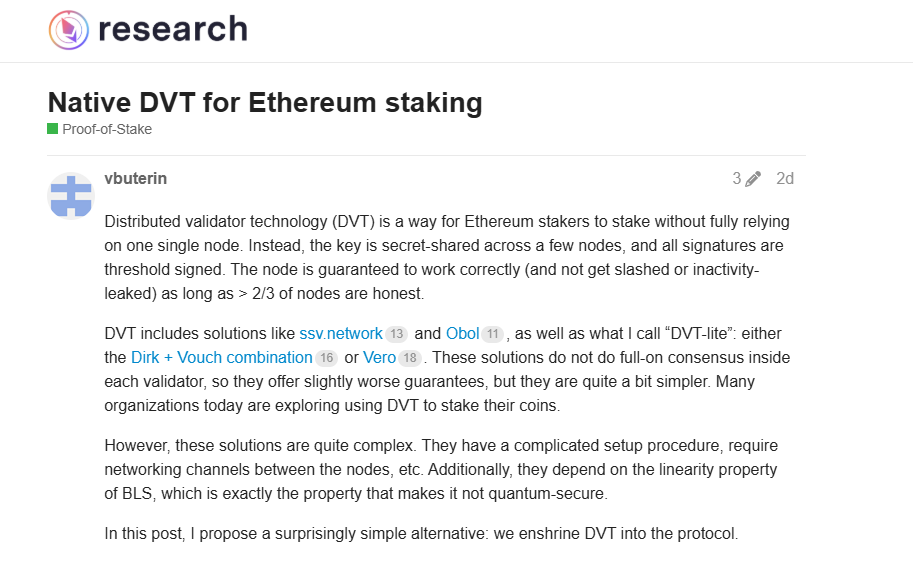
In a detailed post published Wednesday on the Ethereum Research forum, Buterin introduced the idea of “native distributed validator technology,” or native DVT.

Source: ethresear.ch

The idea would allow stakers to split validator responsibilities across multiple nodes directly at the protocol level rather than relying on complex external setups.

Ethereum’s Staking Boom Brings New Security Questions

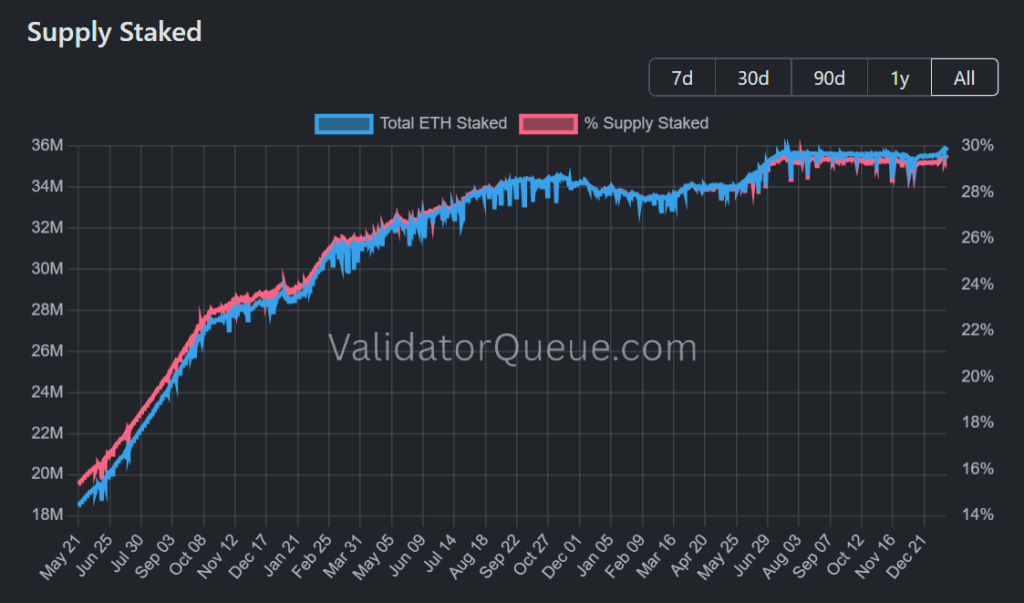
The proposal comes as Ethereum staking reaches record scale with more than 36 million ETH now staked across nearly one million validators, with the total value of staked assets exceeding $118 billion.

Source: ValidatorQueue.

While this growth has reinforced Ethereum’s security, it has also amplified long-standing concerns around centralization, operational risk, and the technical barriers faced by solo stakers.

For much of Ethereum’s proof-of-stake history, running a validator meant placing 32 ETH behind a single machine and a single private key.

Any failure, from a power outage to a software bug or security breach, could result in inactivity penalties or slashing.

These risks pushed many users toward large staking providers and liquid staking platforms, concentrating control of consensus among a relatively small group of operators and cloud providers.

Buterin’s proposal directly targets that single-node risk, as under the proposed native DVT, a validator with a larger balance would be allowed to register multiple keys, up to a maximum of 16, and define a threshold for signing duties.

Validator actions, such as block proposals or attestations, would only be considered valid if a minimum number of those keys signed off together.

As long as more than two-thirds of the nodes behave honestly, the validator would continue operating normally without penalties.

Buterin’s Native DVT Idea Targets Easier, Safer ETH Staking

Unlike existing DVT solutions such as Obol or ssv.network, which rely on external tooling, networking layers, and the linear properties of BLS signatures, Buterin’s design would be embedded directly into Ethereum’s consensus rules.

He argued this would dramatically simplify staking operations, reduce setup complexity, and remove dependencies that may not be compatible with future cryptographic upgrades.

🚀 @VitalikButerin unveils "The Splurge," a bold plan to prepare Ethereum for a quantum future!#Ethereum #QuantumComputinghttps://t.co/vvRijeahpS

— Cryptonews.com (@cryptonews) October 29, 2024

From a user perspective, Buterin described the experience as running multiple standard validator nodes with minimal configuration changes.

Most of the added complexity would be limited to block production, where one node would act as a temporary leader and others would co-sign its output.

The proposal is explicitly aimed at medium- to large-sized ETH holders, including institutions and individual “whales,” who currently face a choice between running fragile single-node setups or outsourcing control to staking providers.

By making multi-node staking simpler, Buterin said native DVT could increase client diversity, improve measurable decentralization metrics, and encourage more self-custodial staking.

Ethereum Developers Debate Practical Challenges of the DVT model

The discussion quickly drew technical feedback from the community.

Ethereum developer Alonmuroch raised questions around coordination during block production, the possibility of multiple proposers racing to collect signatures, and the need for protocol-level key rotation to handle compromised keys without forcing validators to exit and re-stake.

Buterin largely agreed, noting that instant key changes should be feasible and that reducing operational headaches is central to the proposal’s motivation.

The proposal also fits into a broader shift in Buterin’s recent public messaging.

Earlier this month, he declared 2026 the year Ethereum would reclaim lost ground on self-sovereignty and trustlessness, calling for fewer compromises in favor of convenience.

Days later, he warned that Ethereum risks becoming an “unwieldy mess” if developers continue layering complexity onto the protocol without deliberate simplification.

The post Vitalik Buterin Proposes Fix to Ethereum Staking — No More Single-Node Risk appeared first on Cryptonews.

Caroline Ellison Walks Free 10 Months Early After FTX Testimony – What Happens Next?

Caroline Ellison, who used to be a co-CEO of Alameda Research and one of the main figures of the FTX downfall, is going to be released this week, nearly one year before her two-year prison sentence awarded by a federal court.

The U.S. Bureau of Prisons reported that Ellison, at 31 years old, will be released on Wednesday, the 21st of January, into a residential reentry management program in New York, the final step in her release from a federal prison.

Source: Federal Bureau of Prisons

Following the collapse of FTX in November 2022, amidst a liquidity crunch and claims of all-around misappropriation of customer funds, Ellison admitted the next month to seven felony counts.

The indictments are for such things as wire fraud, securities fraud, commodities fraud, and money laundering conspiracy.

Ellison’s Testimony Exposed the Inner Workings of the FTX Fraud

Her prosecutors claimed that under her tenure, Alameda Research had an open line of credit with FTX that had allowed the transfer of billions of dollars of customer deposits into the trading company without any obstruction.

Such funds were subsequently found to have been spent on covering the losses incurred by Alameda, on high-risk investments, political donations, and a range of other expenses, all the time letting customers think that their money was safely held by the exchange.

Ellison confessed in court that these were done under orders of Sam Bankman-Fried, the founder of both FTX and Alameda, and her evidence became the keystone of the government case.

Prosecutors described Ellison as a “remarkable” and “exemplary” witness who met with investigators roughly 20 times and helped decode the inner mechanics of the fraud.

During Bankman-Fried’s 2023 trial, she spent three days on the stand detailing how customer funds were misused and how Alameda was shielded from normal risk controls.

Bankman-Fried was ultimately convicted and sentenced in March to nearly 25 years in prison, along with an order to repay up to $11 billion in losses.

He has since filed an appeal and has publicly explored the possibility of a presidential pardon, which President Trump said was denied.

FTX's Sam Bankman-Fried files appeal to reduce 25-year sentence with November 4 oral arguments as 3AC plans October deposition.#FTX #SBFhttps://t.co/4ZRoQG88ck

— Cryptonews.com (@cryptonews) September 12, 2025

Ellison, by contrast, received a sharply reduced sentence.

In September 2024, she was sentenced by Judge Lewis Kaplan to serve 2 years in jail, declining the request of her lawyers to have no jail time but noting that her cooperation made her unlike other defendants.

In November 2024, she started her sentence in a low-security prison in Danbury, Connecticut, and was transferred to community confinement, sometimes known as a halfway house, in October 2025.

FTX Cooperators Exit Custody as Legal Penalties Remain

Residential reentry centers are constructed to assist inmates in integrating back into society under federal oversight.

Residents are kept under close supervision, restricted from movement unless under permit for approved activities, subject to frequent drug and alcohol testing, and required to meet financial requirements, such as paying a given percentage of income as part of living expenses.

The Bureau of Prisons typically uses these facilities in the final months of a sentence, and inmates housed there are still considered to be in federal custody.

The projected release date of Ellison was later changed to January 2026 based on time, good conduct, and the credit she enjoys due to providing substantial help to prosecutors.

Her discharge technically brings to an end the custodial period of the key cooperating witnesses in the FTX matter.

Former FTX Chief Technology Officer Gary Wang and former co-lead engineer Nishad Singh also cooperated and received no prison time, while former executive Ryan Salame, who did not cooperate, was sentenced to more than seven years in prison.

⚖ SEC seeks 10-year officer ban for Caroline Ellison and eight-year prohibitions for Gary Wang and Nishad Singh following FTX fraud cooperation and permanent injunctions.#SEC #FTXhttps://t.co/IsjAs2o0fE

— Cryptonews.com (@cryptonews) December 19, 2025

Although Ellison is leaving custody, her legal consequences are far from over.

She remains subject to supervision and has been ordered to forfeit $11 billion as part of the case.

In recent months, the Securities and Exchange Commission has also moved to bar Ellison, Wang, and Singh from serving as officers or directors of any public company for several years.

The post Caroline Ellison Walks Free 10 Months Early After FTX Testimony – What Happens Next? appeared first on Cryptonews.

Guernsey Seizes $11.4M in OneCoin Fraud as Cryptoqueen’s Empire Crumbles

Guernsey has recovered over £8.5 million, or about $11.4 million, of money associated with the OneCoin fraud, which is one of the most tangible financial recoveries to date connected with the case of fugitive founder Ruja Ignatova, also known as the “Cryptoqueen.”

The ruling adds fresh weight to international efforts to dismantle what remains of OneCoin’s financial footprint, even as its mastermind has been missing for more than eight years.

According to the report issued by the Guernsey Press, the Royal Court of Guernsey agreed to an overseas forfeiture order sought by German prosecutors in the city of Bielefeld.

The decision of the court was that the money in the name of Aquitaine Group Limited held in Guernsey in the account of RBS International, which amounted to £8.59 million plus accumulated interest, was under the control of Ignatova and that it should be seized.

The money is now in the Seized Asset Fund of Guernsey, where it is to be utilized mainly to recompense victims and aid law enforcement.

How OneCoin’s Fake Crypto Trail Led to £8.8M in Seized Assets

Ignatova was a Bulgarian-born German citizen who established OneCoin in 2014 and marketed it to the world as a disruptive cryptocurrency and a killer of Bitcoin.

In practice, prosecutors subsequently confirmed that OneCoin did not even have an operating blockchain or working mining procedure but was a multi-level marketing business where returns were subsidized by additional deposits of new investors.

💰 OneCoin’s legal chief pleaded guilty to money laundering and wire fraud charges, according to a statement released today from the U.S. Attorney’s Office for the Southern District of New York.#CryptoNewshttps://t.co/zKdVwzCWse

— Cryptonews.com (@cryptonews) November 9, 2023

The FBI estimates that investors worldwide lost more than $4 billion, though some assessments place total losses higher.

The Royal Court noted that Ignatova was given 28 days in November to object to the confiscation application.

There was no answer since Ignatova had not appeared in public since October 2017, when she vanished days after a sealed arrest warrant was issued in the United States.

She was subsequently the only female ever to be listed on the FBI’s Ten Most Wanted Fugitives list, and authorities in the United States were willing to pay a reward of up to $5 million for information leading to her arrest.

The US Department of State announced a new incentive, a $5 million reward, for information leading to OneCoin founder Ruja Ignatova's arrest.#onecoin #reward #ignatovahttps://t.co/XWdRn6yYhs

— Cryptonews.com (@cryptonews) June 26, 2024

German prosecutors, working with Guernsey authorities, have been seeking to recover proceeds from the sale of two London apartments previously owned by Ignatova through Guernsey-registered companies.

The properties, a penthouse and a smaller apartment, were placed under a Royal Court restraint order in November 2021 and later sold for more than £11 million.

After fees and taxes, about £8.8 million remained as of May 2024, forming the bulk of the confiscated sum.

OneCoin’s Inner Circle Faces Justice as Ignatova Mystery Drags On

This latest action fits into a broader pattern of asset recovery and legal fallout that has continued years after OneCoin’s collapse.

Several of Ignatova’s close associates have been convicted and sentenced.

In 2023, co-founder Sebastian Greenwood was sentenced to 20 years in prison.

⚖ OneCoin Crypto Scam: German Court Sentences Fraudsters to Jail

Founders of the infamous OneCoin cryptocurrency scam have been sentenced to several years in jail by a German court.#CryptoNews #newshttps://t.co/JZj5HWattJ

— Cryptonews.com (@cryptonews) January 10, 2024

Other figures, including senior legal and financial facilitators, have also been jailed.

At the same time, questions about Ignatova’s fate remain unresolved.

Investigative reporting, including a 2023 and 2024 BBC investigation, has pointed to alleged links between Ignatova and Bulgarian organized crime figures.

This figure includes Hristoforos Nikos Amanatidis, known as “Taki,” who reportedly provided security during her escape.

There have been some indications that she was possibly murdered in 2018, perhaps on a yacht in the Ionian Sea, but law enforcement has emphasized that no concrete evidence has been presented.

This has made international agencies still treat her as a fugitive who may still be alive.

The post Guernsey Seizes $11.4M in OneCoin Fraud as Cryptoqueen’s Empire Crumbles appeared first on Cryptonews.

SEC Crypto Task Force Pressed on Self-Custody Rights and DeFi ‘Dealer’ Rules in New Filings

The US Securities and Exchange Commission’s Crypto Task Force is facing renewed pressure from industry groups and individual contributors as questions around self-custody rights and the scope of dealer regulation in decentralized finance move back into focus.

On Tuesday, the Task Force’s public “Written Input” page added two new submissions that reflect a broader tension shaping US crypto policy: how to protect investors without collapsing core features of on-chain markets, particularly self-custody and non-custodial trading.

SEC Filings Spotlight Self-Custody Protections and DeFi Market Structure

One submission, filed by an individual identified as DK Willard, centers on the experience of retail crypto users in Louisiana and ties state-level protections directly to the federal debate now unfolding in Washington.

Willard points to Louisiana legislation such as House Bill 488, which explicitly affirms residents’ right to self-custody digital assets, arguing that these protections should not be diluted by federal market structure proposals.

The filing shows that Congress is considering frameworks that include registration, transparency, and anti-fraud standards, but certain exemptions risk allowing developers or platforms to sidestep core investor protections.

In Willard’s view, weakening self-custody protections could expose consumers to fraud and financial crime rather than supporting responsible innovation.

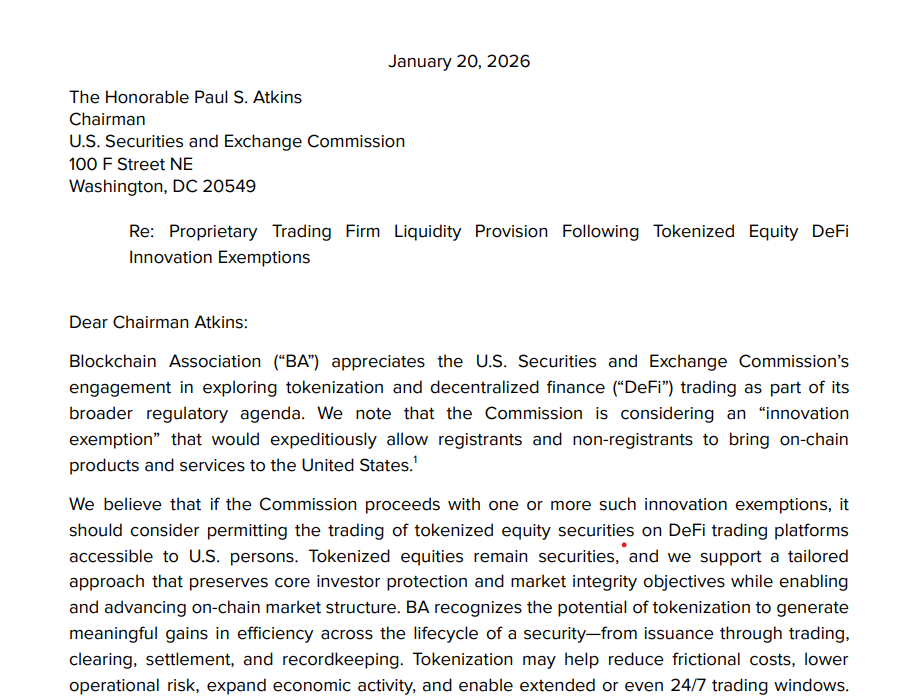
At the same time, a more technical submission from the Blockchain Association’s Trading Firm Working Group focuses on how proprietary trading firms should be treated when providing liquidity in tokenized equity markets that operate on DeFi infrastructure.

Source: SEC

The group argues that long-standing distinctions in securities law between dealers and traders should continue to apply on-chain.

Trading for one’s own account, without customer solicitation, custody, or agency execution, should not trigger dealer registration under the Exchange Act, the filing says, even when that trading occurs through smart contracts and decentralized venues.

The association frames this issue as central to whether tokenized equity markets can function at all during any SEC-approved innovation exemption or sandbox.

Without legal certainty, proprietary trading firms may avoid on-chain markets altogether, leaving tokenized equities without reliable liquidity, price discovery, or arbitrage.

The group stresses that existing broker-dealer rules, including those governing clearing, custody, reporting, and capital, were designed for intermediated markets and will take time to adapt to atomic settlement and smart contract execution.

Allowing proprietary firms to participate immediately, they argue, would give regulators space to modernize those frameworks without freezing market activity in the interim.

SEC’s New Crypto Approach Takes Shape After 2025 Restructuring

These submissions land within a broader shift at the SEC that began after the agency’s restructuring in early 2025.

Under Commissioner Hester Peirce, the Crypto Task Force has moved away from what industry participants long criticized as regulation by enforcement and toward formal rulemaking and guidance.

Over the past year, that approach has included dismissing the SEC’s lawsuit against Coinbase, pausing enforcement actions against Binance, and closing investigations into other major platforms.

📉 The @SECGov plans to drop its enforcement case against @coinbase, with CEO @brian_armstrong calling a "huge day" for crypto. #Coinbase #SEChttps://t.co/8Q5mkqG1J8

— Cryptonews.com (@cryptonews) February 21, 2025

The agency has also rescinded restrictive custody guidance and clarified that certain crypto activities do not constitute securities transactions.

The latest filings also intersect with an increasingly complex legislative backdrop.

Negotiations over the CLARITY Act, which aims to establish a comprehensive federal market structure for digital assets, remain unsettled.

‼ Coinbase says crypto market structure bill more complex than stablecoin framework but global competition will force congressional action this year.#Coinbase #ClarityActhttps://t.co/PEuIKIZkwu
— Cryptonews.com (@cryptonews) January 3, 2026

A scheduled markup in the Senate Banking Committee was postponed following industry opposition, while the Senate Agriculture Committee is still expected to review the bill later this month.

Other recent submissions to the Crypto Task Force highlight how contested the custody question remains.

Industry groups, including SIFMA, have cautioned against granting broad exemptions to wallet providers that perform broker-dealer functions, while policy groups tied to the Solana ecosystem are calling for clearer distinctions between non-custodial software and regulated intermediaries.

The post SEC Crypto Task Force Pressed on Self-Custody Rights and DeFi ‘Dealer’ Rules in New Filings appeared first on Cryptonews.

Aave Hands Lens to Mask Network, Doubles Down on DeFi Ambitions

Aave has handed stewardship of the Lens Protocol to Mask Network, marking a strategic shift that narrows Aave’s focus back to decentralized finance.

This will place the next phase of decentralized social development in the hands of a team more tightly focused on consumer-facing execution.

The transition was confirmed this week by statements from Aave and Lens founder Stani Kulechov, as well as from Mask Network.

Aave Keeps Advisory Role while giving Lens App Development to Mask Network

Kulechov said Aave’s role in Lens will now be limited to technical advisory support, describing the move as a refocus rather than a retreat.

He explained that Aave initially expanded beyond onchain financial primitives to build social primitives that users could own, resulting in the creation of Lens.

Over the years, we have built some of the most important onchain financial primitives. We later expanded that ambition to social primitives that users truly own.

We built the Lens Protocol and its underlying onchain rails, including state-of-the-art decentralized data storage… https://t.co/g0zLIUlaBh

— Stani.eth (@StaniKulechov) January 20, 2026

The original aim, he said, was to create neutral social infrastructure that developers could rely on to build consumer-grade applications capable of reaching mainstream users.

With that foundation now in place, stewardship is shifting to Mask Network, which will lead development at the application and product layer while Aave returns to its core expertise in DeFi.

Both Aave and Lens emphasized that the move is not an acquisition, sale, or exit. There was no indication of a transfer of protocol ownership, intellectual property, treasuries, or governance control.

Lens’ core components, including its onchain social graph, profiles, follows, and smart contracts, will remain open-source and permissionless.

Aave said it will continue to provide input on protocol-level decisions but will no longer lead product development or operate social applications directly.

Mask Network, a Web3 company known for integrating blockchain features into social and messaging platforms, will now assume responsibility for consumer-facing execution.

This includes product roadmap decisions, user experience design, and day-to-day operational leadership for social applications built on Lens, such as Orb.

In a statement announcing the transition, Lens said the ecosystem’s next phase requires less protocol experimentation and more focus on unified social experiences that can operate at scale and meet user expectations.

Lens was launched by Aave in 2022 as a Web3-native social protocol designed to give users ownership over their social identities and content through onchain profiles and NFTs.

From the outset, it was positioned as infrastructure rather than a standalone social network.

Lens Enters Its Next Chapter as Decentralized Social Gains Momentum

Since launch, Lens has grown into one of the most widely used decentralized social protocols. Early builder adoption was rapid, with more than 50 projects built on Lens shortly after launch.

By early 2023, the protocol had surpassed 100,000 minted profiles and supported more than 120 applications.

Lens later migrated to Polygon mainnet, rolled out V2 and V3 upgrades, and introduced Lens Chain, a purpose-built network powered by ZKsync and Avail, aimed at improving scalability, speed, and monetization.

Lens uses GHO as gas, enabling near-instant, low-cost transactions, and includes decentralized storage through Grove and features like Family Accounts.

The handover to Mask Network comes as decentralized social regains attention across the crypto industry.

Ethereum co-founder Vitalik Buterin said he plans to spend more time on decentralized social platforms in 2026, arguing that better mass communication tools are needed and that decentralization enables competition by allowing multiple clients to build on shared data layers.

In 2026, I plan to be fully back to decentralized social.

If we want a better society, we need better mass communication tools. We need mass communication tools that surface the best information and arguments and help people find points of agreement. We need mass communication… https://t.co/ye249HsojJ

— vitalik.eth (@VitalikButerin) January 21, 2026

Mask Network founder Suji Yan described the transition as aligned with the cypherpunk values at the heart of crypto, saying decentralized social should be part of everyday life rather than limited to financial products.

🫡🫡

Lens stands for decentralization and the cypherpunk spirit at the heart of blockchain/crypto.

Crypto shouldn’t be just financial products — it should be part of everyday life, in every post, every interaction. Own your post – and make SocialFi great again.

Honored to… https://t.co/EjR7PFqWjB

— Suji Yan 💜🔥🎭 (@suji_yan) January 20, 2026

He said Mask Network intends to focus on building consumer-ready SocialFi applications that bring Lens from infrastructure into daily use.

The post Aave Hands Lens to Mask Network, Doubles Down on DeFi Ambitions appeared first on Cryptonews.

BitMine Gobbles Up $110M Ethereum in Massive Dip Buy — Is the “Alchemy of 5%” Imminent?

BitMine Immersion Technologies has once again pushed itself to the center of the crypto market after revealing a fresh wave of Ethereum accumulation that reflects how far the company has come in just six months.

The New York–listed firm disclosed on January 20 that it now holds 4,203,036 ETH, valued at roughly $13.5 billion at recent prices, following weeks of steady purchases made during market weakness.


BitMine provided its latest holdings update for January 20th, 2026:

$14.5 billion in total crypto + "moonshots":
– 4,203,036 ETH at $3,211 (@coinbase)
– 193 Bitcoin (BTC)
– $22 million stake in Eightco Holdings (NASDAQ: $ORBS) (“moonshots”) and
– total cash of $979…

— Bitmine (NYSE-BMNR) $ETH (@BitMNR) January 20, 2026

Ethereum has declined by 10.8% over the past seven days and is down 4.5% in the last 24 hours, currently trading at $2,966.44.

The update immediately reignited debate around BitMine’s stated goal of acquiring 5% of Ethereum’s total circulating supply, a target the company calls the “alchemy of 5%.”

Weekly ETH Buys Push BitMine Toward 5% Supply Mark

The numbers show how close BitMine already is; with Ethereum’s circulating supply estimated at about 120.7 million ETH, a 5% stake would amount to roughly 6.03 million ETH.

BitMine’s current holdings represent about 3.48% of supply, leaving the company needing approximately 1.8 million additional ETH to reach its stated threshold.

Source: CoinGecko

At prevailing prices near $3,000 per token, that remaining gap translates into several billion dollars of capital, even before accounting for market impact.

Company disclosures show that BitMine has been buying ETH nearly every week since late October, including more than 35,000 ETH in the week ending January 20.

These purchases have taken place alongside broader volatility in crypto markets, reinforcing the firm’s message that it is using price weakness to build a long-term position rather than trading short-term moves.

Chairman Tom Lee has repeatedly framed the strategy as accretive to net asset value, emphasizing that the company does not intend to issue shares below its internal estimate of mNAV.

That approach appears to have won shareholder backing, so that even at BitMine’s January 15 stockholder meeting in Las Vegas, investors approved all four proposals put forward by management.

📈 Tom Lee @fundstrat wants BitMine to raise its authorized share limit to 50 billion to enable future stock splits as its valuation tracks Ethereum.#Ethereum #BitMinehttps://t.co/C76OxSDEOP

— Cryptonews.com (@cryptonews) January 3, 2026

About 81% of votes cast supported the change, representing more than half of all outstanding shares.

Lee described the result as a clear show that shareholders understand and support the ETH accumulation strategy, even as concerns around dilution continue to surface in market discussions.

BitMine Ramps Up Ethereum Staking as Treasury Swells

Beyond simply holding Ether, BitMine is also moving aggressively to stake its position. As of January 19, the company had staked 1,838,003 ETH, worth close to $5.9 billion, up sharply from just over 650,000 ETH earlier this month.

The staking effort currently relies on third-party providers, but BitMine is preparing to launch its own infrastructure, the Made in America Validator Network, or MAVAN, in early 2026.

🚀 BitMine @BitMNR plans an early-2026 launch of its MAVAN validator network, aiming to turn a $12B Ether treasury into staking yield at scale.#BitMine #Staking https://t.co/YOlkeNouQu

— Cryptonews.com (@cryptonews) December 30, 2025

Using the current composite Ethereum staking rate of about 2.81%, the company estimates that a fully deployed staking operation could generate roughly $374 million in annual fees, or more than $1 million per day, assuming performance and network conditions remain stable.

The scale of BitMine’s balance sheet now places it in rare territory among public companies.

Its crypto, cash, and “moonshot” holdings total about $14.5 billion, including nearly $1 billion in cash, a smaller Bitcoin position of 193 BTC, and equity stakes such as a recently announced $200 million investment into Beast Industries.

🚀 @BitMNR has further cemented its position as the largest corporate holder of Ether after adding more than 24,000 ETH to its balance sheet.#Bitmine #Etherhttps://t.co/vphtiEXCXb

— Cryptonews.com (@cryptonews) January 13, 2026

While that investment is not directly tied to the Ethereum strategy, it reflects BitMine’s broader effort to diversify alongside its core crypto treasury.

Source: Google Finance

Following the news, Bitmine stock is trading slightly above $28, far below its mid-2025 peak, yet it remains one of the most actively traded stocks in the United States, with average daily dollar volume around $1.5 billion.

The post BitMine Gobbles Up $110M Ethereum in Massive Dip Buy — Is the “Alchemy of 5%” Imminent? appeared first on Cryptonews.

New CFTC Chair Declares “Golden Age,” Launches ‘Future-Proof’ Drive to Rewrite Crypto Rules

The CFTC Chair Michael Selig called his chairmanship the beginning of what he calls a “golden age” for American financial markets as he takes over leadership of the U.S. Commodity Futures Trading Commission.

His remarks come as pressure intensifies on Washington to finally clarify how digital asset markets should be regulated.

Shortly after assuming office as chairman of the agency, Selig proclaimed a comprehensive plan to revamp the agency, the Future-Proof, which is a review to update decades-old CFTC regulations to more effectively reflect markets created by crypto, blockchain, and artificial intelligence.

🇺🇸 The Senate finally confirms @MichaelSelig as the new @CFTC Chair, ending a long leadership vacuum and setting the stage for clearer U.S. crypto regulation. #CFTC #MikeSelig https://t.co/IvLEpQhesH

— Cryptonews.com (@cryptonews) December 19, 2025

Selig Outlines Plan to Update CFTC Rules for Blockchain and AI Trading

In an announcement of the initiative put out publicly, Selig stated that the CFTC needs to be in place to provide services to the markets of the future, and that the present-day period is a turning point in U.S. finance.

Today, I am launching the “Future-Proof” initiative at the @CFTC.

We are at a pivotal moment in the evolution of American financial markets. The CFTC must be equipped to serve the markets of the future.

Read my full op-ed in today’s @washingtonpost: https://t.co/zWAAjXt4Kg. /1

— Mike Selig (@ChairmanSelig) January 20, 2026

He elaborated that opinion in a Washington Post opinion piece, in which he claimed that technological changes were altering the way that financial products are produced, traded, and consumed, and that Congress was now near enacting long-awaited legislation on digital asset market structure.

He said that legislation would have a straightforward mandate on regulators and would bring sanity to an industry that has become a market worth over 3 trillion dollars.

The message by Selig is the opposite of the regulative policy of the past few years.

His criticism of the former administration was that they operated based on enforcement measures instead of explicit rules, and that digital assets and perpetual futures were shoehorned into the systems of traditional markets.

According to Selig, the strategy outsourced innovation and reduced the input of the common American.

Under his leadership, he claimed that the CFTC will work on custom-fit, purpose-specific rules that safeguard against fraud and manipulation without choking new products before they can grow.

The Future-Proof initiative will mean that CFTC staff will undergo a thorough review of the existing rules, most of which were originally agricultural futures market rules.

Selig said those rules may still work for traditional products, but do not account for blockchain-based trading venues, prediction markets, or AI-driven risk tools.

His stated goal is to modernize requirements in a way that creates a level playing field for incumbents and new entrants, while delivering what he described as the “minimum effective dose” of regulation.

New CFTC Chair Inherits Expanding Crypto Agenda

Selig officially assumed the role on December 22 after being confirmed by the Senate on December 18, replacing acting chair Caroline Pham.

🤝 Michael Selig becomes CFTC chairman as Caroline Pham exits agency after implementing major crypto regulatory reforms including spot trading approval and prediction market relief.#CFTC #Pham #Selighttps://t.co/TznOLfEfQw

— Cryptonews.com (@cryptonews) December 23, 2025

Pham’s tenure was marked by an aggressive push to modernize the CFTC’s approach to crypto.

Over the past year, she launched the agency’s Crypto Sprint and oversaw the introduction of spot crypto trading on CFTC-regulated futures platforms.

She also implemented internal reforms, including the deployment of an automated market surveillance system that the agency said would save nearly $50 million annually.

Just before leaving office, Pham granted no-action relief to several prediction market operators, easing enforcement pressure while requiring full collateralization and transaction transparency.

✅ The CFTC granted narrow no-action relief to four prediction markets, reducing immediate enforcement risk.#CFTC #Cryptohttps://t.co/hqT6BcApBB

— Cryptonews.com (@cryptonews) December 12, 2025

Selig has shown continuity with that agenda, while also promising a broader reset.

Since taking office, Selig has moved quickly. On January 1, he appointed Amir Zaidi, a longtime CFTC veteran who previously worked on early regulated Bitcoin products, as his chief of staff.

On January 13, he launched the Innovation Advisory Committee, replacing the former Technology Advisory Committee, to bring in expertise from industry, academia, and public interest groups as the agency prepares rules for emerging technologies.

The post New CFTC Chair Declares “Golden Age,” Launches ‘Future-Proof’ Drive to Rewrite Crypto Rules appeared first on Cryptonews.

Trump Media Sets Feb. 2 Deadline For Rewards Token – But There’s a Catch for DJT Holders

Trump Media and Technology Group has set February 2, 2026, as the important date upon which shareholders can claim its long-awaited digital rewards token.

However, the fine print around eligibility, ownership status, and token utility suggests the initiative will come with meaningful limitations for DJT holders.

In a press release of January 20, the company stated that the shareholders who are the ultimate beneficial owners of at least one whole share of DJT as of February 2 will be qualified to engage in the digital token program.

The announcement follows the company’s December confirmation that it plans to distribute a blockchain-based token as part of a broader push into crypto-adjacent products tied to its media and financial services ecosystem.

Trump Media Clarifies Who Qualifies for Its Planned Digital Token

The eligibility rules introduce an immediate complication.

Trump Media warned that shareholders designated as objecting beneficial owners, known as OBOs, may face delays or may not receive the timely information needed to claim tokens.

To avoid that risk, the company encouraged shareholders to confirm their status as non-objecting beneficial owners with their brokers or to move their shares into direct registration through Odyssey Transfer & Trust Company, the firm’s transfer agent.

The language effectively places the burden on shareholders to ensure they are visible to the company ahead of the record date.

When the plan was first outlined at the end of December, the company framed the token as a shareholder engagement tool rather than a financial instrument, emphasizing regulatory caution and non-security characteristics.

After February 2, Trump Media plans to work with Crypto.com to mint the tokens, record them on the blockchain, and hold custody of the assets until distribution.

While the company did not explicitly name the underlying network in the latest release, earlier disclosures indicated the tokens are expected to run on Crypto.com’s Cronos blockchain.

Trump Media said additional details on allocation and distribution will be released after the record date.

The company also reiterated that token holders may periodically receive rewards throughout the year.

These incentives are expected to take the form of benefits or discounts connected to Trump Media’s products, including Truth Social, its Truth+ streaming service, and Truth Predict.

🚀 Truth Social partners with @Cryptocom to introduce "Truth Predict," a new prediction market feature for its users.#TruthSocial #PredictionMarkets #Trump https://t.co/527D0BiJ6W

— Cryptonews.com (@cryptonews) October 28, 2025

However, the company was clear about what the token would not represent.

The company Lays Groundwork for Shareholder Token Rollout

According to the disclosure, the digital token will not confer ownership rights, will not be transferable, cannot be exchanged for cash, and should not be viewed as a claim on profits or managerial efforts.

Only shareholders who own DJT shares outright on the record date, excluding borrowers of stock, will be eligible.

Trump Media CEO and Chairman Devin Nunes said the partnership with Crypto.com is intended to align with existing Securities and Exchange Commission guidance while also helping the company gain a clearer view of its shareholder base as of the record date.

The company also reserved the right to modify or terminate the token distribution or any associated terms at its discretion, with or without prior notice.

The announcement comes as DJT shares showed modest gains.

At the time of publication, the stock was up about 3.1% and trading near $14.38, according to Google Finance.

Ownership data from Yahoo Finance shows a tightly held structure, with company insiders controlling roughly 42.72% of outstanding shares.

Source: Yahoo Finance

Institutional investors hold about 24.07% of total shares, representing just over 42% of the public float, with 401 institutions reporting positions.

The token initiative marks the most concrete step yet in Trump Media’s gradual move toward blockchain-based features.

The post Trump Media Sets Feb. 2 Deadline For Rewards Token – But There’s a Catch for DJT Holders appeared first on Cryptonews.

❌