❌

Reading view

There are new articles available, click to refresh the page.

Crypto Firm Partners With Visa to Enable Near Real-Time Crypto-to-Fiat Off-Ramping

By: Amin Ayan

Crypto payments firm Mercuryo has partnered with Visa to enable near real-time conversion of digital assets into fiat currency.

Key Takeaways:

  • Mercuryo’s partnership with Visa enables near real-time crypto-to-fiat off-ramps directly to Visa debit and credit cards.
  • The integration cuts costs and settlement times, especially for cross-border payouts.
  • Users can convert and spend crypto through existing wallets at over 150 million merchants worldwide.

The move allows users to send proceeds directly to Visa debit and credit cards through Visa Direct, the payments giant’s real-time money movement network.

Under the arrangement, eligible Mercuryo users will be able to off-ramp crypto holdings and receive fiat funds on their cards within minutes, according to the companies.

Mercuryo Taps Visa Direct to Speed Up Low-Cost Crypto-to-Fiat Payments

The service is designed to reduce settlement times and costs compared with traditional conversion and payout methods, particularly for cross-border transactions.

The integration expands Mercuryo’s use of Visa Direct, which already supports real-time transfers across brokerage, crypto and digital banking accounts.

By tapping into Visa’s global payments infrastructure, Mercuryo said it aims to make crypto-to-fiat conversions more accessible without requiring users to leave the wallets, exchanges or platforms they already use.

Mercuryo said the partnership allows Visa Direct to connect with its network of non-custodial wallets, exchanges and payment providers, giving millions of users access to fast off-ramping tools through familiar interfaces.

Visa 🀝@Mercuryo_io, working to make cross-border payouts faster, reduce delays, and help people access their funds quickly in their local currencies.#crypto #VisaDirect https://t.co/bYNbTjKiYF

β€” VisaNews (@VisaNews) January 22, 2026

Funds converted to fiat can be spent at more than 150 million merchant locations worldwide that accept Visa.

β€œThis partnership with Visa will further enhance Mercuryo’s ability to deliver a fast, low-cost user experience,” said Mercuryo co-founder and CEO Petr Kozyakov.

He said the integration reduces the friction historically associated with moving funds across borders or cashing out digital assets, allowing users to access local currencies more quickly.

Anastasia Serikova, head of Visa Direct in Europe, said the collaboration is intended to bridge the gap between crypto platforms and traditional financial systems.

She said the service enables users to convert digital assets into fiat in near real time, improving convenience and reliability for everyday payments.

Visa Deepens Crypto Strategy as Stablecoin Settlements Reach $3.5B Run Rate

The deal adds to Visa’s growing push into digital assets. In December, the company launched a Stablecoins Advisory Practice to help businesses explore ways to integrate stablecoins into their operations.

In July last year, Visa surpassed $200 million in cumulative stablecoin settlement volume while expanding its crypto infrastructure through African partnerships and platform development.

However, CEO Ryan McInerney warned that the technology still requires clearer regulations to reach its full potential.

Visa has also reported rising stablecoin settlement volumes, reaching an annualized run rate of $3.5 billion.

Earlier, Visa partnered with crypto infrastructure firm Aquanow to improve stablecoin settlement speeds and reduce reliance on legacy payment rails.

The post Crypto Firm Partners With Visa to Enable Near Real-Time Crypto-to-Fiat Off-Ramping appeared first on Cryptonews.


Ethereum Caught Between Weak Flows And Strong Fundamentals β€” What This Means

Ethereum finds itself in an unusual position where the fundamentals are strengthening, but capital flows remain hesitant. On-chain activity and the real-world tokenization of assets point to a network that is becoming increasingly useful and more deeply embedded in financial infrastructure. The price action movement shows that ETH is stuck in a range where it is struggling to attract sustained momentum.

Why Fundamentals And Price Are Diverging

Ethereum is stuck in the middle, with the price hovering around $3,300, which is slightly up from earlier this month, but it remains compressed within the same triangle that has been forming since November. An investor known as Pepeisfriend mentioned on X that this kind of price action usually means pressure is building and a move is coming. However, the direction hasn’t been specified.Β 

As a result of this move, big money doesn’t seem very excited. ETH whales have been slowly reducing their exposure since mid-December, with no panic selling, just lightening positions. This kind of behavior signals a lower willingness from large investors to carry risk at these levels. The ETF flows have shown that there have been a few days of positive inflows, but the overall net flows are still negative, showing institutions haven’t truly rotated back into ETH the way they did during the previous hype phase.

Meanwhile, Decentralized Finance (DeFi) activity looks weaker, and total value locked (TVL) has dropped noticeably, suggesting that on-chain capital is either leaving or just sitting on the sidelines. When DeFi isn’t active, ETH struggles to generate sustained upside momentum.

Investor Pepeisfriend concluded that ETH isn’t bearish, but also not inspiring confidence for a breakout. This is a clear β€œwait for confirmation” phase that must be held, but probably still too early to go all-in or expect an immediate breakout.

The Moment That Will Look Obvious In Hindsight

While the market is obsessed with layer-1 competition, Ethereum is transitioning from a speculative asset into a yield-bearing, productive asset. Analyst Senior pointed out that on January 15, 2026, Sharplink Gaming deployed $170 million worth of ETH into a combined staking and restaking strategy on Linea. This move shows that institutional treasuries have moved beyond simple accumulation to active yield generation.

Ethereum

At the same time, Visa is piloting stablecoin payouts directly on-chain, and EIP-7702 infrastructure is finally going live to eliminate biometric authentication seed phrases via Face ID. The user experience gap that once held ETH back has officially closed. This is the moment ETH is positioning itself as the most secure and liquid on-chain neobank financial platform in the world, and why the $3,500 breakout attempt will feel obvious.

Ethereum

Visa Brings Stablecoins To $1.7 Trillion Platform In BVNK Partnership

Visa has partnered with BVNK to bring stablecoin payments to the Visa Direct platform, expanding its digital payments infrastructure.

BVNK Will Power Visa Direct’s Stablecoin Infrastructure

As announced in a Wednesday press release, BVNK and Visa have formed a strategic partnership to enable stablecoin payments on the latter’s Visa Direct platform. Based in the US, Visa is the second-largest card payment organization globally, behind only China’s UnionPay. In fact, when excluding China, the firm is the single largest, making up for 50% of total card payments.

Lately, Visa has been exploring digital asset payments, particularly those involving stablecoins, in a bid to modernize money movement. In 2025, the payments giant ran multiple stablecoin pilots related to Visa Direct, its $1.7 trillion real-time global payouts platform.

Now, it seems Visa has taken the next step by partnering with BVNK, a stablecoin infrastructure provider processing over $30 billion in payments annually. Mark Nelsen, Visa’s head of product, commercial, and money movement, said:

Stablecoins are an exciting opportunity for global payments, with enormous potential to reduce friction and expand access to faster, more efficient payment options – including during weekends, holidays and when banks are closed.

Starting with markets with strong demand for digital payments, BVNK will power a few different Visa Direct services, including stablecoin pre-funding and payouts. Visa’s new deal with BVNK hasn’t come out of the blue. Back in May 2025, Visa Ventures made an investment in the digital asset payments rail company. Jesse Hemson-Struthers, BVNK CEO, noted:

Visa and BVNK both believe in the transformational potential of stablecoin technology, not just as a payment method, but as a powerful layer of payments infrastructure.

Following the initial rollout, a broader global expansion of the service is planned, but so far, it’s unconfirmed which markets will be included, only that Visa will decide it based on β€œcustomer needs.” Stablecoins have witnessed growing adoption during the past year, as multiple countries have pushed on with legislation related to the sector. Among the most notable developments was the signing of the GENIUS Act by US President Donald Trump.

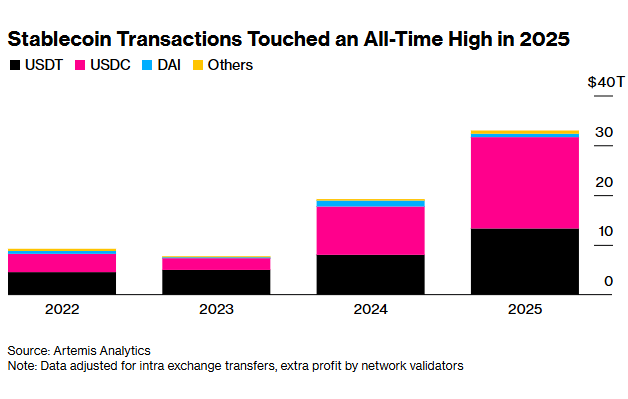
According to a report from Bloomberg, total stablecoin transaction volume rose 72% to $33 trillion in 2025, a new record.

Stablecoin Volume

Tether’s USDT is the largest fiat-tied cryptocurrency based on market cap, with a valuation that’s more than double Circle’s USDC, but the latter still dominated in transactions during 2025. USDC made up for $18.3 trillion of the total volume, while USDT accounted for $13.3 trillion.

Together, the two tokens covered an extreme majority of the total volume last year, suggesting that activity related to other dollar-pegged tokens and non-USD stablecoins remained low.

Bitcoin Price

At the time of writing, Bitcoin is trading around $95,000, up more than 3% over the past week.

Bitcoin Price Chart

Washington joins lawsuit opposing $100K fee for H-1B visas allowing foreign STEM and medical workers

The University of Washington’s Red Square. The UW is one of the state institutions that employs H1-B visa holders. (GeekWire Photo / Lisa Stiffler)

Washington state is part of a newly filed lawsuit against the Trump administration, challenging the legality of a $100,000 fee for new H-1B visas that allow highly-skilled individuals to work temporarily in the U.S.

Attorneys general from 20 states claim the U.S. Department of Homeland Security set the fee at an arbitrary amount that does not reflect the agency’s costs, and that the fee was enacted without going through a required notice-and-comment process.

The visa is meant to recruit employees from abroad who have specialized expertise not found in sufficient numbers in the U.S. workforce.

Seattle-based Amazon has roughly 19,100 employees working under H-1B visas nationwide. Microsoft, which is based in Redmond, Wash., nationally employs more than 6,200 H-1B visa holders. Washington’s public universities and agencies have nearly 500 H-1B visa holders on their payrolls, according to federal data and state analysis.

Employers are responsible for paying H-1B fees, which used to run between $960 and $7,595, said Washington State Attorney General Nick Brown’s office. Raising the fees, the state warned, will result in empty university labs and science discoveries β€œwill be made somewhere else.”

β€œThese institutions will lose their competitive edge, particularly in the areas of artificial intelligence, cybersecurity, and medical fields,” said a press release from Brown’s office.

In announcing the increased fee in September, the Trump administration said the visa was being abused by employers to supplant Americans with β€œlower-paid, lower-skilled labor.”

β€œThe large-scale replacement of American workers through systemic abuse of the program has undermined both our economic and national security,” said a White House memo addressing restrictions of nonimmigrant workers.

Priyanka Kulkarni, CEO of the immigration tech startup Casium, said the H1-B workers are not low paid, noting that the median salary for the visa holders was about $120,000 last year.

β€œEngineers, scientists, healthcare specialists, and educators recruited from abroad often fill critical gaps that enable companies and institutions to grow, invest, and create jobs locally,” she added via email.

The Trump administration has specifically called out high-tech companies’ use of the program, saying they β€œhave prominently manipulated the H-1B system, significantly harming American workers in computer-related fields.”

Xiao Wang, CEO of the startup Boundless Immigration, noted that while tech giants are targeted for criticism, the visa also allows for doctors, nurses and researchers to work in the U.S. β€” echoing some of the concerns raised by Washington’s attorney general.

β€œAdding a $100K fee for all foreign talent trying to enter Washington to work in these fields would all but eliminate this pathway for anyone outside of the most valuable companies in the world and would leave the state with a significant shortage of important roles,” Wang said by email.

He added that putting a nurse and an AI engineer in the same visa category highlights an overdue need for immigration reform.

Wang called on Americans to demand that Congress β€œpass new immigration regulations to stay competitive as a country.”

❌