Login
LoginPalmer Luckey says the coolest thing about Anduril expanding is the fighter jets
Anduril on Thursday announced its plans to expand its Southern California presence with a major campus in Long Beach, the town where founder Palmer Luckey grew up.

5 min read
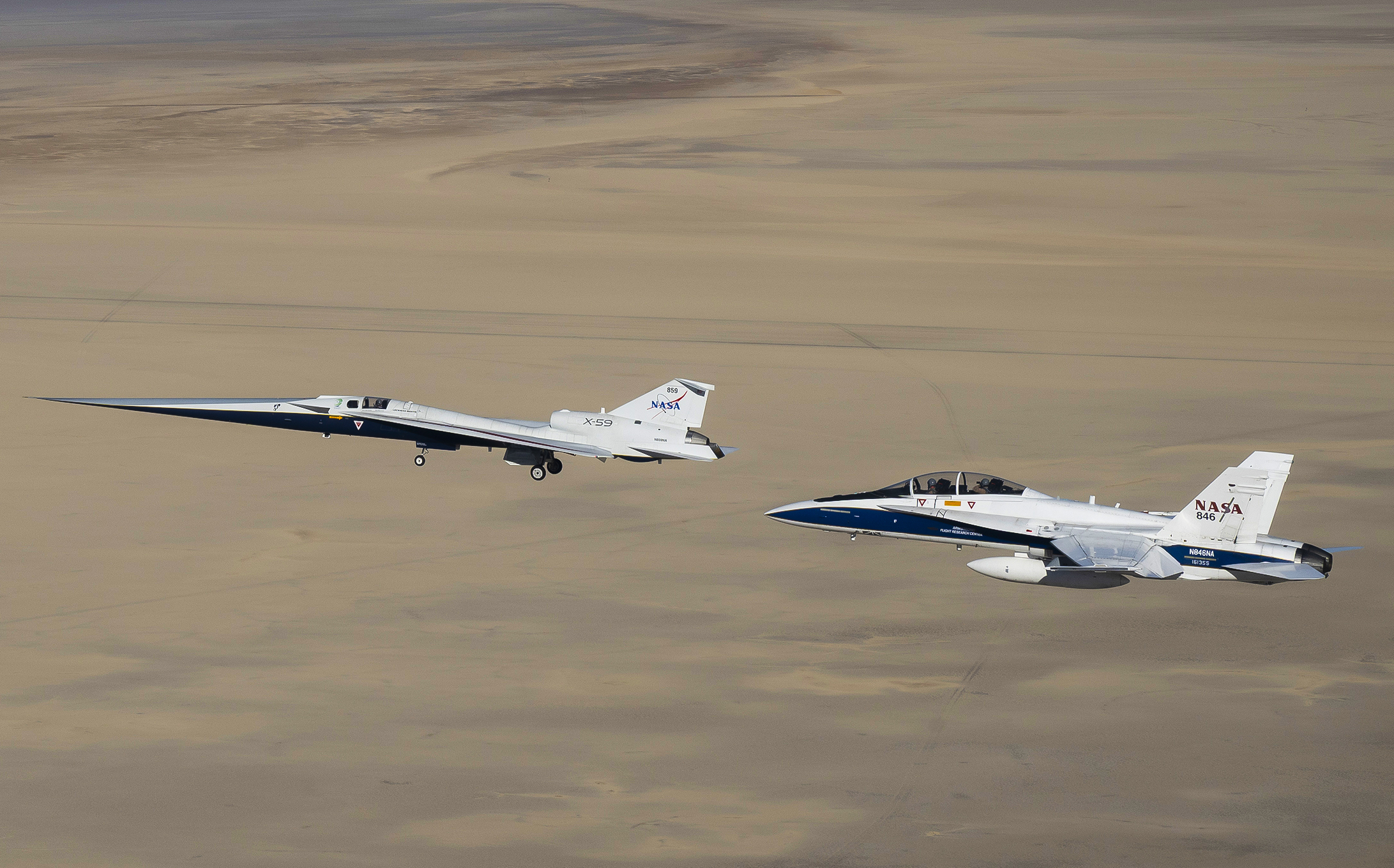
As NASA’s X-59 quiet supersonic research aircraft continues a series of flight tests over the California high desert in 2026, its pilot will be flying with a buddy closely looking out for his safety.
That colleague will be another test pilot in a separate chase aircraft. His job as chase pilot: keep a careful watch on things as he tracks the X-59 through the sky, providing an extra set of eyes to help ensure the flight tests are as safe as possible.
Having a chase pilot watch to make sure operations are going smoothly is an essential task when an experimental aircraft is exercising its capabilities for the first time. The chase pilot also takes on tasks like monitoring local weather and supplementing communications between the X-59 and air traffic control.
“All this helps reduce the test pilot’s workload so he can concentrate on the actual test mission,” said Jim “Clue” Less, a NASA research pilot since 2010 and 21-year veteran U.S. Air Force flyer.
Less served as chase pilot in a NASA F/A-18 research jet when NASA test pilot Nils Larson made the X-59’s first flight on Oct. 28. Going forward, Less and Larson will take turns flying as X-59 test pilot or chase pilot.
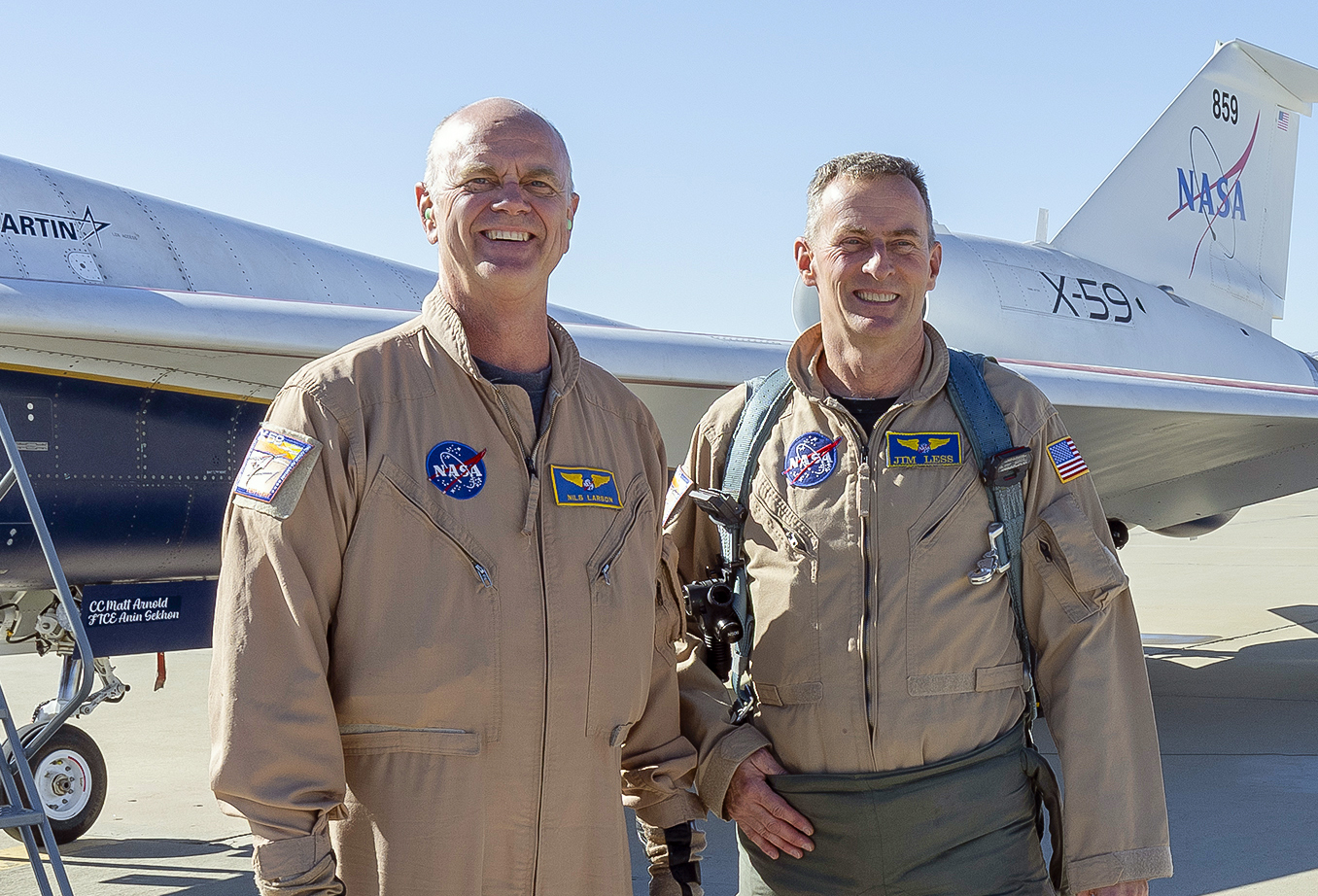
So how close does a chase aircraft fly to the X-59?
“We fly as close as we need to,” Less said. “But no closer than we need to.”
The distance depends on where the chase aircraft needs to be to best ensure the success of the test flight. Chase pilots, however, never get so close as to jeopardize safety.

Jim "clue" LESS
NASA Test Pilot
For example, during the X-59’s first flight the chase aircraft moved to within a wingspan of the experimental aircraft. At that proximity, the airspeed and altitude indicators inside both aircraft could be compared, allowing the X-59 team to calibrate their instruments.
Generally, the chase aircraft will remain about 500 and 1,000 feet away—or about 5-10 times the length of the X-59 itself—as the two aircraft cruise together.
“Of course, the chase pilot can move in closer if I need to look over something on the aircraft,” Less said. “We would come in as close as needed, but for the most part the goal is to stay out of the way.”
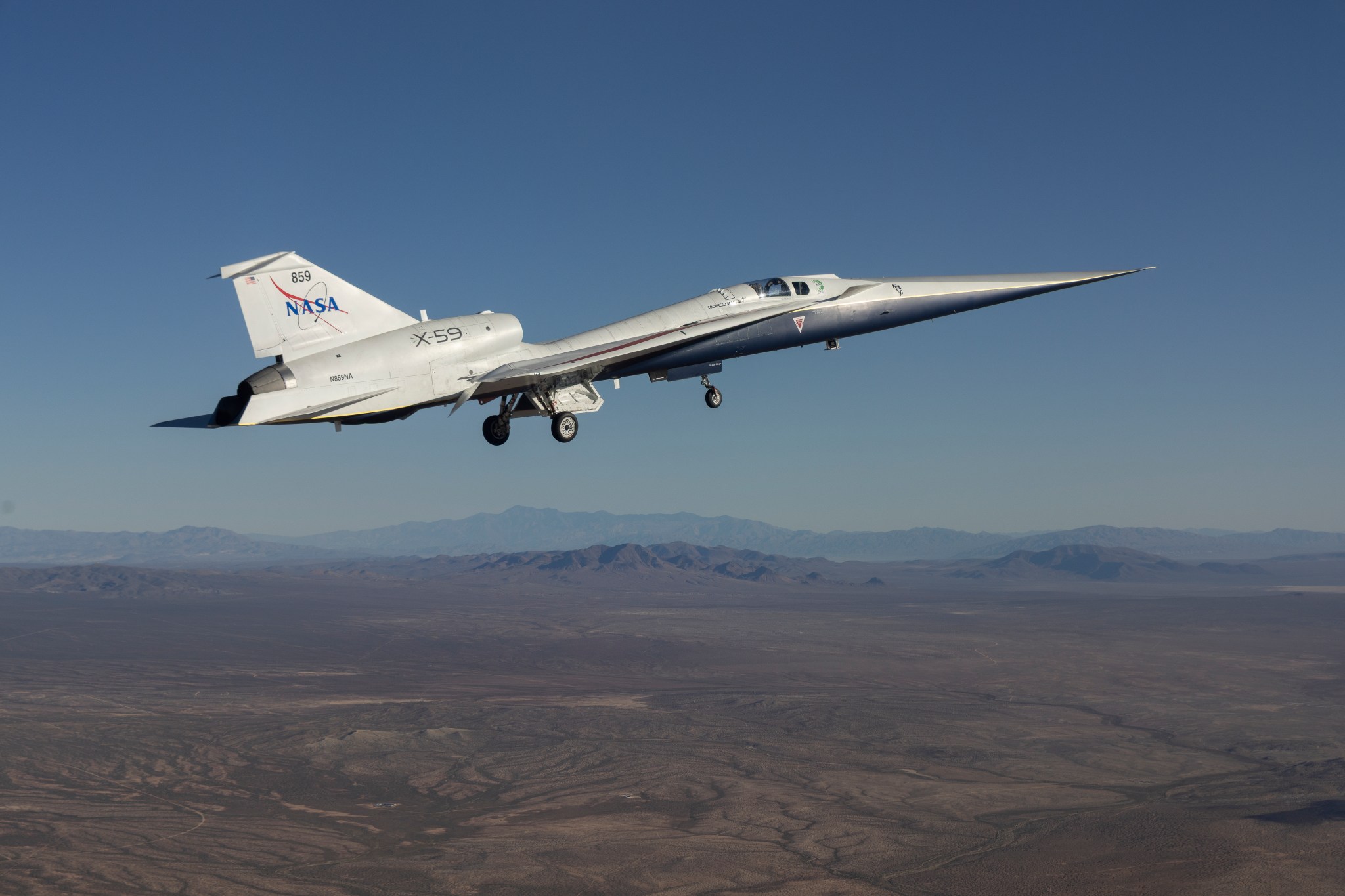
The up-close-and-personal vantage point of the chase aircraft also affords the opportunity to capture photos and video of the test aircraft.
For the initial X-59 flight, a NASA photographer—fully trained and certified to fly in a high-performance jet—sat in the chase aircraft’s rear seat to record images and transmit high-definition video down to the ground.
“We really have the best views,” Less said. “The top focus of the test team always is a safe flight and landing. But if we get some great shots in the process, it’s an added bonus.”
Chase aircraft can also carry sensors that gather data during the flight that would be impossible to obtain from the ground. In a future phase of X-59 flights, the chase aircraft will carry a probe to measure the X-59’s supersonic shock waves and help validate that the airplane is producing a quieter sonic “thump,” rather than a loud sonic boom to people on the ground.
The instrumentation was successfully tested using a pair of NASA F-15 research jets earlier this year.
As part of NASA’s Quesst mission, the data could help open the way for commercial faster-than-sound air travel over land.
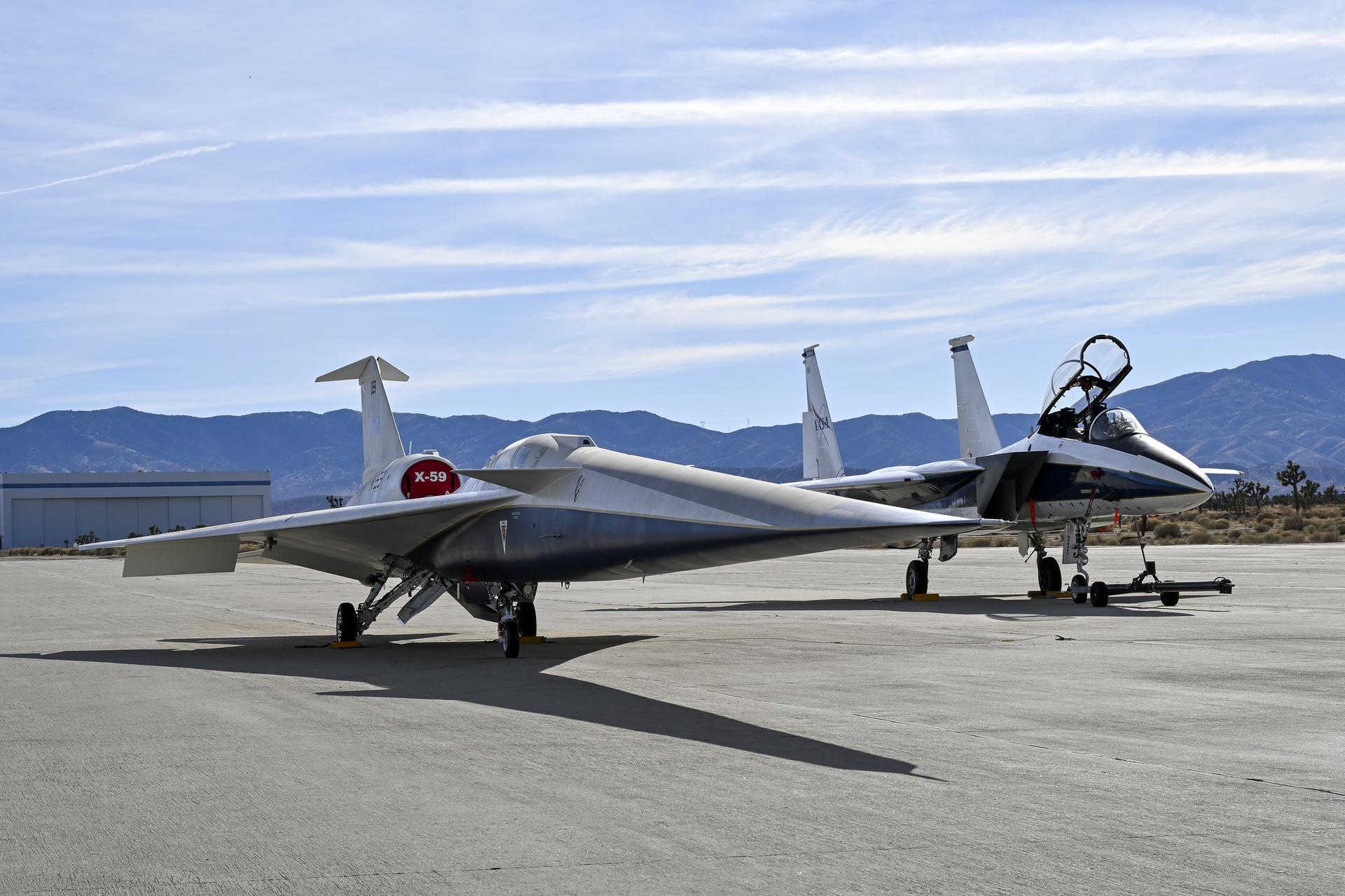
Chase aircraft have served as a staple of civilian and military flight tests for decades, with NASA and its predecessor—the National Advisory Committee for Aeronautics—employing aircraft of all types for the job.
Today, at NASA’s Armstrong Flight Research Center in Edwards, California, two different types of research aircraft are available to serve as chase for X-59 flights: NASA-operated F/A-18 Hornets and F-15 Eagles.
While both types are qualified as chase aircraft for the X-59, each has characteristics that make them appropriate for certain tasks.
The F/A-18 is a little more agile flying at lower speeds. One of NASA’s F/A-18s has a two-seat cockpit, and the optical quality and field of view of its canopy makes it the preferred aircraft for Armstrong’s in-flight photographers.
At the same time, the F-15 is more capable of keeping pace with the X-59 during supersonic test flights and carries the instrumentation that will measure the X-59’s shock waves.
“The choice for which chase aircraft we will use for any given X-59 test flight could go either way depending on other mission needs and if any scheduled maintenance requires the airplane to be grounded for a while,” Less said.

Jim Banke is a veteran aviation and aerospace communicator with more than 40 years of experience as a writer, producer, consultant, and project manager based at Cape Canaveral, Florida. He is part of NASA Aeronautics' Strategic Communications Team and is Managing Editor for the Aeronautics topic on the NASA website.
A couple of years ago, we covered a project called Arnis, created by [Louis Erbkamm], which allowed you to generate any portion of Earth into Minecraft blocks and maps. It was already impressive, but since we last checked in the open source project has made some incredible progress.
When we first covered Arnis, it was stuck on the Java edition of Minecraft. But now the project has been updated to support the more modern Bedrock Edition, meaning you can put your home into any device’s version of Minecraft!

Beyond Bedrock version support, the actual tool has improved with proper elevation generation using data provided from NASA. This allows you to view the Alps or the Himalayas in all their voxel glory, or explore an entire map of the Moon. Perhaps what’s even more impressive is that the generation is accurate enough to be used in an actual research study involving flood mitigation education.
All of this has been made possible with help from a passionate community who have volunteered their time to assist [Louis] with the project — a testament to the power of open source.
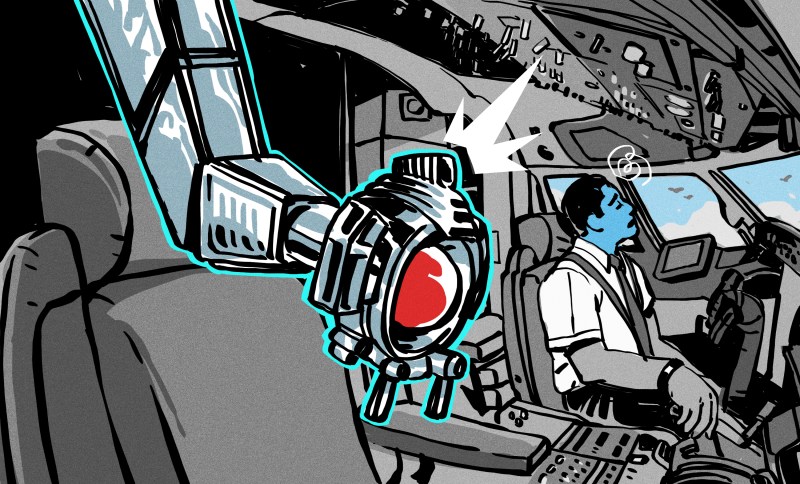
It’s a cliché in movies that whenever an airplane’s pilots are incapacitated, some distraught crew member queries the self-loading freight if any of them know how to fly a plane. For small airplanes we picture a hapless passenger taking over the controls so that a heroic traffic controller can talk them through the landing procedure and save the day.
Back in reality, there have been zero cases of large airliners being controlled by passengers in this fashion, while it has happened a few times in small craft, but with variable results. And in each of these cases, another person in the two- to six-seater aircraft was present to take over from the pilot, which may not always be the case.
To provide a more reliable backup, a range of automated systems have been proposed and implemented. Recently, the Garmin Emergency Autoland system got its first real use: the Beechcraft B200 Super King Air landed safely with two conscious pilots on board, but they let the Autoland do it’s thing due to the “complexity” of the situation.
Throughout the history of aviation, a human pilot has been a crucial component for the longest time for fairly obvious reasons, such as not flying past the destination airport or casually into terrain or rough weather. This changed a few decades ago with the advent of more advanced sensors, fast computing systems and landing assistance systems such as the ILS radio navigation system. It’s now become easier than ever to automate things like take-off and landing, which are generally considered to be the hardest part of any flight.
Meanwhile, the use of an autopilot of some description has become indispensable since the first long-distance flights became a thing by around the 1930s. This was followed by a surge in long-distance aviation and precise bombing runs during World War II, which in turn resulted in a massive boost in R&D on airplane automation.

While the the early gyroscopic autopilots provided basic controls that kept the airplane level and roughly on course, the push remained to increase the level of automation. This resulted in the first fully automatic take-off, flight and landing being performed on September 22, 1947 involving a USAF C-54 Skymaster. As the military version of the venerable DC-4 commercial airplane its main adaptations included extended fuel capacity, which allowed it to safely perform this autonomous flight from Newfoundland to the UK.
In the absence of GNSS satellites, two ships were located along the flight path to relay bearings to the airplane’s board computer via radio communication. As the C-54 approached the airfield at Brise Norton, a radio beacon provided the glide slope and other information necessary for a safe landing. The fact that this feat was performed just over twenty-eight years after the non-stop Atlantic crossing of Alcock and Brown in their Vickers Vimy airplane shows just how fast technology progressed at the time.
Nearly eighty years later, it bears asking the question why we still need human pilots, especially in this age of GNSS navigation, machine vision, and ILS beacons at any decently sized airfield. The other question that comes to mind is why we accept that airplanes effectively fall out of the sky the moment that they run out of functioning human pilots to push buttons, twist dials, and fiddle with sticks.
In the world of aviation, increased automation has become the norm, with Airbus in particular taking the lead. This means that Airbus has also taken the lead in spectacular automation-related mishaps: Flight 296Q in 1988 and Air France Flight 447 in 2009. While some have blamed the 296Q accident on the automation interfering with the pilot’s attempt to increase thrust for a go-around, the official explanation is that the pilots simply failed to notice that they were flying too low and thus tried to blame the automation.
For the AF447 crash the cause was less ambiguous, even if took a few years to recover the flight recorders from the seafloor. Based on the available evidence it was clear by then that the automation had functioned as designed, with the autopilot disengaging at some point due to the unheated pitot tubes freezing up, resulting in inconsistent airspeed readings. Suddenly handed the reins, the pilots took over and reacted incorrectly to the airspeed information, stalled the plane, and crashed into the ocean.
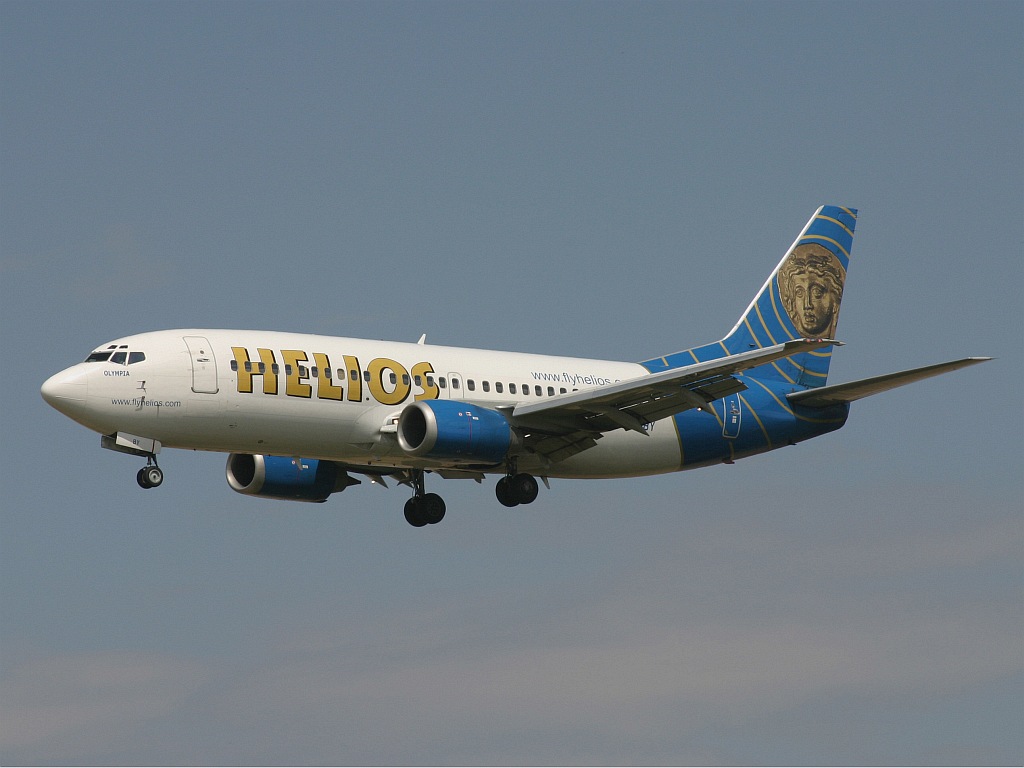
One could perhaps say that AF447 shows that there ought to be either more automation, or better pilot training so that the human element can fly an airplane unassisted by an autopilot. When we then consider the tragic case of Helios Airways Flight 522, the ‘ghost flight’ that flew on autopilot with no conscious souls on board due to hypoxia, we can imagine a dead-man switch that auto-lands the airplane instead of leaving onlookers powerless to do anything but watch the airplane run out of fuel and crash.
Although there are still a significant number of people who would not dare to step a foot on an airliner that doesn’t have at least two full-blooded, breathing human pilots on board, there is definitely a solid case to be made for emergency landing systems to become a feature on airplanes, starting small. Much like the Cirrus Airframe Parachute System (CAPS) – a whole-airplane parachute system that has saved many lives as well as airframes – the Garmin Autoland feature targets smaller airplanes.

After a recent successful test with a HondaJet, this recent unscheduled event with the Beechcraft B200 Super King Air twin-prop airplane turned out to be effectively another test. As the two pilots in this airplane were flying between airports for a repositioning flight, the cabin suddenly lost pressurization. Although both pilots were able to don their oxygen masks, the Autoland system engaged due to the dangerous cabin conditions. They then did not disengage the system as they didn’t know the full extent of the situation.
This effectively kept both pilots ready to take full control of the airplane should the need have arisen to interfere, but with the automated system making a textbook descent, approach and landing, it’s clear that even if their airplane had turned into another ghost flight, they would have woken up groggy but whole on the airstrip, surrounded by emergency personnel.
Considering how many small airplanes fly each year in the US alone, systems like CAPS and Autoland stand to save many lives both in the air and on the ground the coming years. Combine this with increased ATC automation at towers and elsewhere such as the FAA’s STARS and Saab’s I-ATS, and a picture begins to form of increased automation that takes the human element out of the loop as much as possible.
Although we’re still a long way off from the world imagined in 1947 where ‘electronic brains’ would unerringly fly all airplanes and more for us, it’s clear that we are moving in that direction, with such technology even within the reach of the average owner of an airplane of some description.
These are the perfect winter decorations for plant lovers: succulent snow globes! A snow globe is meant as ... Read More
The post A Succulent Snow Globe Will be the Star of Your Collection appeared first on Garden Therapy.
PARUPPU TENGAI AND AN INTERCULTURL WEDDING
We enjoyed the best of both worlds when an intercultural wedding was celebrated in the family a month ago . Fun and frolic , music and dance , flowers and lights , food and beverages dotted with various religious ceremonies kept both guests and hosts on toes .
%20resized.jpg)

After the exchange of garlands the couple were made to sit on a decorated swing . Elderly ladies queued up to to feed the couple with banana slices mixed with milk . Red and yellow coloured rice balls were waved around the bride and groom and thrown on all the four directions to protect them from the negative effects of evil eyes .
The high pitched Oonjal songs specially composed for the occasion echoed all around . The groom's father surprised the crowd by singing a Carnatic Classical while the aunt presented an 'abhinayam' (expressing the essence of the lyrics in Bharatanatyam dance Style ) for the same.
Ladies aged from 8 to 80 danced around the bride and the groom for a 'Kummi' Song played by the Naadaswaram artist . The participants went round in circles dancing and clapping to the rhythm of the instrument . As the momentum caught up more and more ladies joined the fun .

%20resized.jpg)
Finally with Fire God as witness and the full moon smiling from above , Saath Phere / Saptapadi - the most important ritual in a Hindu wedding which seals the wedding bond between the bride and the groom , was conducted !
The memories of the royal wedding celebrated in a dream land still lingers in my mind 💖!
The following text about Vilayaadal and Vilayaadal Saamaan is from the notes read out to the bride by the little girls in the family.
INTRODUCTION
Vilayaadal is a Tamil word literally meaning 'playing'. It is a fun filled social event which originated in olden times when children were married off at a very young age , the bride often younger than ten . Vilayaadal ritual was meant to serve as an ice breaker for the young couple as well as for their respective siblings. The child brides were presented with dolls , play things , grooming kits , clothes and accessories by the groom's sisters . The newly married couple were also made to play variety of competitive games with relatives on both sides joining as cheer leaders . The participants were also encouraged to display their singing and dancing talents.
In modern times marrying couples are no longer little kids . But the Vilayaadal ritual is retained in traditional weddings for the sheer fun and joy it brings to the wedding festivities. Many modern brides find it amusing to receive Barbie Dolls and toys as Vilayaadal gifts !
Here is a brief account of the Vilayaadal Saamaan presented to welcome the lovely Mumbai bride to our Bengaluru family. The assortment of artifacts representing the customary Vilayaadal items are hand picked from the four Southern States on behalf of all the little girls of our family .
MARAPPACHI DOLLS
These dolls are hand carved , out of Red Sanders , a valuable wood found in Andhra Pradesh .The paste of the wood has healing properties and is valued in indigenous medical systems.
The Marappachi pair represents Lakshmi and Vishnu or Raja Rani and occupy pride of place in the Navaratri Dolls Display ( Golu in Tamil , Gombe Habba in Kannada , Bommala Koluvu in Telugu ) organized in South Indian homes.
ROSEWOOD INLAY JEWEL BOX
An intricate handicraft of Karnataka , a state rich in forest wealth . Inlay work using various materials on rosewood base is a traditional craft perfected by the Gudigars ( artisans who carve wood ) of Karnataka . The craft was patronized by the Wodeyar Kings of Mysore Kingdom.
The elephant motif is very popular in the State and is seen in all possible arts and crafts . Karnataka is home to the largest population of Elephants in India.
SANDALWOOD JEWELLARY
Southern Karnataka is called Gandhada Gudi - The temple of Sandal Wood - as the forests are thick with Sandal Wood trees . Creating beautiful and fragrant artefacts out of the valuable wood is a traditional craft promoted by the former Kings and now by the Government of Karnataka.
Sandal wood bead malas and bracelets are choice pieces from our artisans.
CHANNAPATNA TOYS
The wooden toys and other articles made in Channapatna - THE TOY TOWN OF KARNATAKA - are G I Tagged. The products are hand turned , hand painted and finished with lacquer coating. They are light weight , and have a non toxic colouring. The craft was introduced in Channapatna 300 years ago and perfected with Japanese Techniques 100 years ago. The wood used is Ivory Wood , Cedar , Sycamore and Rubber Wood.
CHOPPU JAAMAAN ( SAAMAAN)
Toy Kitchen set made of wood are known as Choppu . Kitchen play sets are traditional toys gifted to little girls from times immemorial in all societies of the world.
These Choppu Jaamaan from Kanyakumari District of Tamil Nadu are both play things and collectibles. Colourful wooden Choppus are widely sold in Fairs , Pilgrimage centers and retro shops. All sets big or small are packed in hand woven palm leaf baskets called Olai Koodai.
COCONUT SHELL CRAFT OF KERALA
Kerala the land of coconut palms has a long tradition of using all parts of this palm - called Kalpavriksham - without wasting even a twig. The hard shells of the nut make very good cups and utensils , found in all traditional homes along the South West Coast . In present times too eco friendly essentials are being made with more refined finishing.
The Soup Bowls with spoons are from the rural artisans near Palakkad in Kerala .
METAL LAMPS
In India a lamp is regarded as a metaphor for Knowledge . No ritual is complete without lighting an oil lamp. Brass and Bronze lamps of high quality are produced in centuries old foundries of Swamimalai near Kumbakonam in Tamil Nadu . Kerala too has its own long tradition in casting Bronze lamps. In Karnataka , Nagamangala and Karkala have been traditional centers for metal casting by a process called Lost Wax Process.
Kuttuvilakku , Agal Vilakku , Paavai Vilakku , Koondu Vilakku , Kamakshi Vilakku are some of the traditional lamps cast in brass and bronze.
MYSORE SILK STOLE
The name Mysore Silk has justly become a byword for high quality soft silk . The innovative yarn twisting procedure introduced in the Mysore Kingdom during the 20th century beat back the Silk that was being imported from China. Local weavers who had already adopted Silk Worm breeding and Silk Yarn spinning during the middle of 18th century were trained to create the iconic MYSORE SILK. Ramanagaram continues to be the bulk producer of Silk since then.
KOBRI SAKKRE
This is a commonly prepared give away Prasadam in and around Mysore region. It is given to visitors on all happy occasions as a symbol of sharing joy. Dry coconut ( Kobri) , Sugar ( Sakkre ) , Roasted gram and Cardamom are ground together into a coarse powder and given to the guests in small packets along with the customary Tamboolam ( Betel leaves , betel nuts and coconut ).

For weddings beautiful motifs are carved on whole Kobris or made into decorative Kobri dolls to represent the bride and the groom .

Sugar dolls ( Sakkre Achchu ) have a special place in this ensemble . The Nandi Idol moulded with Roasted gram and jaggery complete the use of all the auspicious ingredients for the happy occasion.
%20resized.jpg)
In olden days all traditional homes had skilled hands which were adept in making decorative Kobris and Sugar Dolls ( Sakkre Achchu). In modern times these beautiful edible artifacts are out sourced along with other wedding Sweets.
PARUPPU TENGAI
Paruppu Tengai is a cone shaped traditional sweet which has a prominent place in South Indian Weddings . Boondi , Manoharam , Coconut Burfi , Sugar or jaggery coated Cashew nuts , Peanuts , Roasted gram are some of the sweets used in the making of Paruppu Tengais . Sometimes colourful Cadbury candies are also used in preparing the cones. Any prepared Sweet at the finishing stage is poured into greased conical moulds and are allowed to cool down . The pair of Sweet Cones are said to represent Shiva and Shakti .
.jpg)
The colourfully decorated Paruppu Tengais occupy the central position among other Seer Bakshanams presented to the groom's party during the wedding rituals .
I conclude this post with lots of blessings to the newly weds , who gave us an opportunity for the inter cultural bonding of two families , which will last for ever . Thank you family for encouraging me to write this memoir ! Special thanks to my sister who always stands by me in all my endeavours .
--------------------------------------------------------------------------------------------------------------------------
%20resized.jpg)

EQUULEUS has a water propellant engine named AQUARIUS (AQUA ResIstojet propUlsion System) that uses heat from communications equipment to turn water into steam, which can be jetted out to generate thrust.
Water is a better choice than other fuels for use in small, cheap satellites because it is easier to store and handle.
Artemis I injected the spacecraft into a lunar flyby trajectory. Then EQUULEUS fired its steam engines and started its journey to the second Moon Lagrange point (EML2), and it should take a year and a half to reach EML2.
"I am proud of the EQUULEUS operation team, who were able to immediately complete the orbital control necessary for the lunar fly-by, just one day after the checkout operation shortly after launch. This was a difficult operation that had to be successful. I feel we were able to succeed in this critical operation due to their careful preparation, including numerous back-up plans, and the ability to respond flexibly through training. We are now at the start line of the long voyage to the Lagrange point," said FUNASE Ryu, an associate professor at the Department of Aeronautics and Astronautics, the University of Tokyo, Japan.
If you want to know more about EQUULEUS and how it works, read Development of the Water Resistojet Propulsion System for Deep Space Exploration by the CubeSat: EQUULEUS.