❌

Reading view

There are new articles available, click to refresh the page.

Ethereum Could Surge To $7,500 And Leave Bitcoin Behind, Banking Giant Says

Standard Chartered has pushed its base-case price target for Ethereum to $7,500 by the end of the year, a big jump from an earlier $4,000 projection.

According to the bank’s digital assets team, growing demand from corporate treasury buyers and spot ETH products has driven the change in outlook.

Bank Raises Ethereum Target

The bank’s lead analyst expects fee growth on the Ethereum network and stronger institutional adoption to be key drivers for the move higher.

The bank also revised its longer-term numbers, lifting its 2028 target to $25,000 and laying out scenarios that push toward $40,000 by 2030. These wider targets reflect models where stablecoins and tokenized assets expand on Ethereum’s chain.

Institutional Buying Drives Demand

Data cited by market researchers points to heavy accumulation since June, with spot ETF flows and treasury firms together taking close to 4% of Ether’s circulating supply over that period.

ETHEREUM SEEN OUTPERFORMING BITCOIN

Standard Chartered says Ethereum’s outlook has improved and it is likely to outperform bitcoin. While weak bitcoin performance has weighed on the broader crypto market, rising institutional demand for ethereum and its dominance in stablecoins,…

β€” *Walter Bloomberg (@DeItaone) January 13, 2026

Treasury firms alone reportedly bought about 2.3 million ETH in just over two months, a pace that Standard Chartered says outstrips some previous accumulation phases seen in Bitcoin.

Ethereum Vs. Bitcoin

Standard Chartered’s note also argues that Ether could outperform Bitcoin, raising the possibility of the ETH/BTC ratio returning toward levels last seen during 2021’s run-up.

Based on the bank’s scenarios, weaker Bitcoin momentum combined with stronger real-world use of Ethereum might lift Ether’s price faster than Bitcoin’s in the months ahead.

Long-Term Upside Scenarios

Some headlines have pointed to even bigger long-range targets produced by the same models, including forecasts of $30,000 by 2029 and $40,000 by 2030 under more bullish assumptions.

These outcomes rely on a substantial expansion of stablecoin use, tokenized real-world assets, and continued staking demand that would remove supply from the market.

Independent forecasters remain split, and other banks have offered lower year-end projections, offering a reminder that expert views differ.

Meanwhile, market watchers caution, though, that relative moves depend heavily on ETF flows and corporate balance-sheet decisions.

Network Fundamentals And Risks

According to the bank, Ethereum’s large share of stablecoin activity and its role in decentralized finance make fee income and on-chain demand a meaningful part of valuation models.

That said, the bank notes that scale improvements and Layer 1 throughput will matter a lot if big, traditional finance transactions migrate onchain.

The research also warns that shifts in macro conditions, outflows from major ETFs, or regulatory setbacks could change the math quickly.

Featured image from Unsplash, chart from TradingView

Ethereum Outlook Has Improved, And It Could Outperform Bitcoin – Here’s What To Know

Ethereum’s outlook has been improving its case. After a prolonged period of underperformance and skepticism, the network is starting to exhibit signs of renewed structural and fundamental strength.Β  While BTC continues to anchor the market as the primary store of value and digital gold, conditions are emerging that could allow ETH to outperform BTC over the coming period.

Why The Ethereum Narrative Is Gaining Strength

Ethereum has been seen outperforming Bitcoin. In a recent post on X, Walter Bloomberg revealed that Standard Chartered says that the ETH outlook has improved, and now ETH might outperform BTC, citing rising institutional demand and stronger fundamental positioning across key on-chain sectors.Β 

While weakness in BTC has weighed on the broader crypto market, ETH has continued to benefit from institutional-driven demand, and its dominance in stablecoins, decentralized finance (DeFi), and real-world assets (RWA) tokenization.

Standard Chartered also points to the increased throughput and potential US regulatory clarity that it could provide additional upside. In terms of valuation, the bank forecasts ETH at $7,500 this year and $30,000 by 2029, reflecting the expectations of sustained network growth.

The Co-founder of PinkBrains_io, a DeFi Creator Studio, DefiIgnas, has highlighted that Ethereum could outperform Bitcoin this year, and the reason is roadmap execution. While BTC will likely keep facing recurring waves of quantum FUD into 2026, ETH has a clear roadmap to prepare for future cryptographic risks.Β 

Furthermore, ETH is actually scaling. Gas limits on layer 1 keep rising, and zkEVMs will get full production readiness, making ETH cheap and fast enough for high-value transactions, while layer 2s will handle most of the trading and high-frequency activity.

Related Reading: Bitcoin And Ethereum Market Structure Points To Crypto Winter – Details

These upgrades are incremental, which means there’s no breaking news moment for ETH, but progress is happening fast. Early in the cycle, a lot of Degens loaded up on ETH before the bull run, but many got disillusioned and sold their ETH for BTC. β€œIt would be fun to see the playbook reverse higher,” DefiIgnas noted.

A Different Liquidity Cycle Than Previous Bull Markets

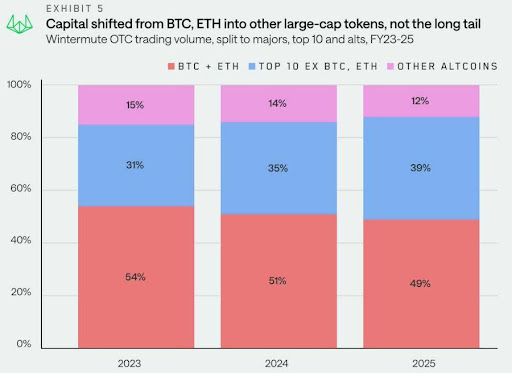
Crypto liquidity quality witnessed a change in 2025. A technical analyst and show host of Crypto Banter, Kyledoops, reported that Wintermute noted that capital in 2025 stopped rotating broadly across the market. Instead, liquidity is concentrated into Bitcoin, Ethereum, and a small group of large-cap tokens. As a result, the long-anticipated wave of altcoin-wide liquidity never really arrived.

Ethereum

Meanwhile, the rise of spot ETFs and crypto treasury vehicles created a new, highly structured inflow channel that funneled flow into the top of the market. These vehicles break the crypto’s oldest playbooks. Price action is no longer driven by broad market expansion. It’s driven by where new liquidity can actually enter.

Ethereum

Top Bullish Predictions That Put XRP Price At New All-Time Highs Above $3.8

XRP is trading at around $2.06 on January 13, 2026, leaving its price action a full step below the zone that capped its last rally that ended with a high of $3.65 in July 2025.Β 

However, predictions that point to XRP reclaiming that peak and then pushing into new highs above $3.8, have been on the front page of bank research notes and trader-led chart projections. Notably, various technical analyses have suggested that XRP is programmed to return back into the upper-$3s and into new price territories this year.

Standard Chartered’s XRP Target Clears $3.8

XRP’s all-time high price now looks out of reach, especially considering the cryptocurrency is now struggling to leave $2 behind. At the time of writing, XRP has dropped by about 44% from its July 2025 peak of $3.65, but institutional buys from Spot XRP ETFs are still giving glimmers of hope.

One of the most recently notable institutional-style projections from XRP comes from Standard Chartered’s digital assets research, which lays out a multi-year path that sees XRP breaking well above the $3.8 threshold.Β 

According to analysts at the bank, XRP is slated to reach as high as $8 by the end of 2026, a level that comfortably eclipses the previous peak and implies roughly 300% upside from current levels if certain conditions hold.Β 

Interestingly, this outlook came from Geoffrey Kendrick, Standard Chartered’s Global Head of Digital Assets Research. The prediction was made based on an outlook of continued institutional adoption and strong inflows into XRP-based spot ETFs.

Technical Outlooks As Ripple Heads Into A Consequential 2026

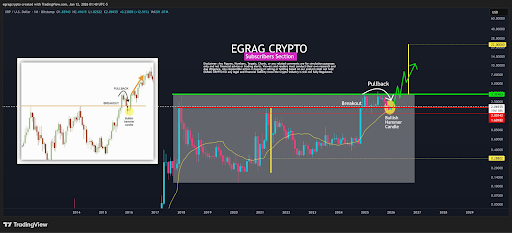
Recent technical commentary from multiple analysts has converged on a bullish bias for XRP. For instance, XRP analyst EGRAG CRYPTO pointed out a developing breakout retest structure on the monthly candlestick timeframe. According to the analyst, historical probabilities favor upside as long as XRP holds above the $1.60 to $1.40 range on higher timeframes, with long-term channel projections placing the XRP price as high as $22.

XRP

For a shorter-term perspective, Crypto Feras described XRP’s recent break above $2 as a bullish reversal signal. His analysis points to $2.67 and $3.01 as the next resistance levels, areas that could open the path toward a full retest of the prior peak near $3.8 if cleared. Adding to this, ChartNerd noted that XRP’s long-term upside fractal structure is still valid despite the recent XRP price correction.Β 

Related Reading: Analyst Updates XRP Price Prediction: Why $16 Is Still On The Table

These price projections are being viewed more favorably against the backdrop of Ripple’s momentum heading into the year. Ripple CEO Brad Garlinghouse recently pointed to strong progress in 2025 with examples of major acquisitions of Ripple Prime and GTreasury and a growing global licensing footprint.Β 

Now that Ripple is positioning itself for what its leadership has described as a consequential 2026, the combination of technical outlooks and company fundamentals has strengthened the narrative that XRP could be approaching a move to new all-time highs.

XRP

Bitcoin Bulls Trim Near-Term Price Targets as BTC Demand Slows

Bitcoin Magazine

Bitcoin Bulls Trim Near-Term Price Targets as BTC Demand Slows

Wall Street’s biggest Bitcoin bulls are cutting near-term price targets after the latest market pullback. Their longer-term outlook remains intact. Standard Chartered, one of crypto’s most prominent backers, halved its Bitcoin forecasts in a note published Tuesday.Β 

The bank now sees Bitcoin reaching $100,000 by the end of 2025, down from $200,000, and $150,000 by the end of 2026.Β 

Its long-term target of $500,000 remains, though the timeline has been pushed to 2030 from 2028.

The downgrade reflects a shift in demand. Corporate treasury buying, once a major driver, has faded. Exchange-traded fund flows have slowed.Β 

Geoffrey Kendrick, Standard Chartered’s global head of digital asset research, said aggressive corporate accumulation has β€œrun its course.”

β€œFuture price gains will be driven by one leg only,” Kendrick wrote, referring to ETF inflows. He expects consolidation rather than broad selling.

Bernstein analysts struck a similar tone. They forecast Bitcoin at $150,000 by the end of next year and near $200,000 by late 2027, according to Bloomberg.

The firm dropped its call for a $200,000 peak this year but argues Bitcoin is no longer bound by its historical four-year cycle. Analysts say institutional participation has added durability to the market.

The revisions follow a rough stretch for prices. Bitcoin has fallen almost 30% from its October peak above $126,000.Β 

Spot Bitcoin ETFs posted $60 million in net outflows on Monday. BlackRock’s iShares Bitcoin Trust lost about $2.3 billion in November, its largest monthly redemption since launch.

Those outflows represent about 3% of the fund’s assets. Bernstein notes that total ETF withdrawals remain below 5% of assets under management. Retail investors still hold most ETF shares, though institutional ownership has climbed to 28%.

Bitcoin price reboundΒ 

Despite these predictions, Bitcoin rose more than 4% today to near $94,640, pushing market capitalization to about $1.86 trillion as trading volume climbed to $46 billion and prices hit a seven-day high.Β 

Institutional momentum continued with Twenty One ringing the NYSE opening bell holding over 43,500 BTC, while PNC became the first major U.S. bank to offer direct spot bitcoin trading to private clients and Bank of America encouraged limited digital asset allocations.

Investors are also weighing supportive macro signals, with expectations of Federal Reserve rate cuts and comments from Cathie Wood suggesting Bitcoin’s cycle lows may already be in.

At the time of writing, Bitcoin is trading near $94,000.Β 

This post Bitcoin Bulls Trim Near-Term Price Targets as BTC Demand Slows first appeared on Bitcoin Magazine and is written by Micah Zimmerman.

❌