Reading view

There are new articles available, click to refresh the page.

The Case Against Small Modular Nuclear Reactors

Small modular nuclear reactors (or SMRs) are touted as "cheaper, safer, faster to build and easier to finance" than conventional nuclear reactors, reports CNN. Amazon has invested in X-Energy, and earlier this month, Meta announced a deal with Oklo, and in Michigan last month, Holtec began the long formal licensing process for two SMRs with America's Nuclear Regulatory Commission next to a nuclear plant it hopes to reactive. (And in 2024, California-based Kairos Power broke ground in Tennessee on a SMR "demo" reactor.) But "The reality, as ever, is likely to be messier and experts are sounding notes of caution..." All the arguments in favor of SMRs overlook a fundamental issue, said Edwin Lyman, director of nuclear power safety at the Union of Concerned Scientists: They are too expensive. Despite all the money swilling around the sector, "it's still not enough," he told CNN. Nuclear power cannot compete on cost with alternatives, both fossil fuels and increasingly renewable energy, he said." Some SMRs also have an issue with fuel. The more unconventional designs, those cooled by salt or gas, often require a special type of fuel called high-assay low-enriched uranium, known as HALEU (pronounced hay-loo). The amounts available are limited and the supply chain has been dominated by Russia, despite efforts to build up a domestic supply. It's a major risk, said Nick Touran [a nuclear engineer and independent consultant]. The biggest challenge nuclear has is competing with natural gas, he said, a "luxury, super expensive fuel may not be the best way." There is still stigma around nuclear waste, too. SMR companies say smaller reactors mean less nuclear waste, but 2022 research from Stanford University suggested some SMRs could actually generate more waste, in part because they are less fuel efficient... As companies race to prove SMRs can meet the hype, experts appear to be divided in their thinking. For some, SMRs are an expensive — and potentially dangerous — distraction, with timelines that stretch so far into the future they cannot be a genuine answer to soaring needs for clean power right now. Nuclear engineering/consultant Touran told CNN the small reactors are "a technological solution to a financial problem. No venture capitalists can say, like, 'oh, sure, we'll build a $30 billion plant.' But, if you're down into hundreds of millions, maybe they can do it."

Read more of this story at Slashdot.

Cheap Green Tech Allows Faster Path To Electrification For the Developing World

Slashdot reader Mr. Dollar Ton summarizes this article from Bloomberg: According to a new report from think tank "Ember", the availability of cheap green tech can have developing countries profit from earlier investment and skip steps in the transition from fossil to alternatives. India is put forward as an example. While China's rapid electrification has been hailed as a miracle, by some measures, India is moving ahead faster than China did when it was at similar levels of economic development. It's an indication that clean electricity could be the most direct way to boost growth for other developing economies. That's mainly because India has access to solar panels and electric cars at a much lower price than China did about a decade ago. Chinese investments lowered the costs of what experts call "modular technologies" — the production of each solar panel, battery cell and electric car enables engineers to learn how to make it more efficiently. The think tank's team even argues "that countries such as India, which don't have significant domestic fossil-fuel reserves, will become 'electrostates' that meet most of their energy needs through electricity generated from clean sources," according to the article: No country is an electrostate yet, [says Ember strategist Kingsmill Bond], but countries are increasingly turning to green electricity to power their economies. Nations that are less developed than India will see even more advantages as the cost of electricity technologies, from solar panels and electric vehicles to battery components and minerals, continue to fall. Neither India nor China is going electric purely to cut emissions or meet climate targets, says Bond. They're doing so because it makes economic sense, particularly for India, which imports more than 40% of its primary energy in the form of coal, oil and gas, according to the International Energy Agency. "To grow and have energy independence, India needs to reduce the terrible burden of fossil-fuel imports worth $150 billion each year," said Bond. "India needs to find other solutions...." [I]f countries like India find ways to grow electrotech manufacturing without absolute dependence on Chinese equipment, electrification could speed up further. With the U.S. and Europe continuing to add exclusions for Chinese-linked electrotech, countries like India will have an incentive to invest in their own manufacturing capacity. "We are probably at a moment of peak Chinese dominance in the electrotech system, as the rest of the world starts to wake up and realize that this is the energy future," he said.

Read more of this story at Slashdot.

Cutting Nuclear Power Plant Costs: Argonne Develops Framework for Smarter Maintenance

1/24/26
NUCLEAR POWER
Enable IntenseDebate Comments: 
Enable IntenseDebate Comments

Merge a multiphysics simulation with real nuclear reactor inspection data and the result is a revolutionizing tool that predicts component failure before it happens.

Researchers at the U.S. Department of Energy’s (DOE) Argonne National Laboratory have developed an innovative framework to improve maintenance schedules for critical components in nuclear power plants. This breakthrough could save millions of dollars on operating costs while keeping power reliable.

read more

INL Advances Department of Defense’s Project Pele Demonstration Microreactor with First TRISO Fuel Delivery

By: Staff
1/24/26
NUCLEAR POWER
Enable IntenseDebate Comments: 
Enable IntenseDebate Comments

The recent delivery of advanced nuclear fuel to the Idaho National Laboratory’s Transient Reactor Test Facility marks a major milestone for Project Pele, a first-of-its-kind mobile microreactor prototype designed to provide resilient power for military operations.

read more

Solar and Wind Overtake Fossil Fuels in the EU

By: msmash
Wind and solar power overtook fossil fuels last year as a source of electricity in the EU for the first time, a new report found. Semafor adds: The milestone was hit largely thanks to a rise in solar power, which generated a record 13% of electricity in the EU, according to Ember. Together, wind and solar hit 30% of EU electricity generation, edging out fossil fuels at 29%. The shift is especially important with the bloc's alternative to Russian LNG -- Washington -- becoming increasingly unreliable and willing to weaponize economic tools. The US Commerce Secretary threw shade at the bloc's renewable push during Davos, warning that China uses net zero goals to make allies "subservient" by controlling battery and critical mineral supply chains. Still, renewables now provide nearly half of EU power, with wind and solar outpacing all fossil sources in more than half of member countries. "The stakes of transitioning to clean energy are clearer than ever," the Ember report's author said.

Read more of this story at Slashdot.

The Long Arc Of American Power

OPINION — “We [the U.S.] began as a sliver of a country and next thing you know we're a continental power, and we did not do that primarily through our great diplomacy and our good looks and our charm. We did that primarily by taking the land from other people.”

That was Michael O’Hanlon, the Brookings Institution’s Director of Research in the Foreign Policy program, speaking January 12, about his new book, To Dare Mighty Things: U.S. Defense Strategy Since the Revolution, on a panel with retired-Gen. David Petraeus and Historian Robert Kagan.

O’Hanlon continued, “Now, this is not a revisionist history that's meant to beat up on the United States for having become a world power, because if we hadn't done that, if we hadn't become this continental power, then we could never have prevailed in the World Wars…The world would have been a much worse place and we could never have played the role we did in the Cold War and at least up until recent times, the post-Cold-War world. So generally speaking, I'm glad for this American assertiveness, but to me, it's striking just how little we understand that about ourselves.”

Listening to that event eight days ago at Brookings, and looking around at what the Trump administration is doing at home and abroad today, I thought elements of what I heard from these three were worth repeating and reviewing.

For example, O’Hanlon pointed out a great amount of U.S. grand strategy and national security thinking took place during historic periods considered times of American isolationism and retrenchment.

O’Hanlon said, “A lot of the institutional machinery, a lot of the intellectual and leadership development capability of the United States began in this period starting in the late 19th century and accelerating into the inner [World] War years [1918-to-1941]. And without that, we would not have had the great leaders like [Gen. Dwight D.] Eisenhower, and [Gen. George C.] Marshall, trained in the way they were. I think that made them ready for World War II.”

He added, “We would not have had many of the innovations that occurred in this period of time -- so whether it's [Rear Admiral William A.] Moffett and [Navy] air power and [aircraft] carrier power, [Army Brig. Gen.] Billy Mitchell and the development of the Army Air Corps, [Marine Maj. Gen. John A.] Lejeune and the thinking about amphibious warfare. A lot of these great military leaders and innovators were doing their thing in the early decades of the 20th century and including in the inner war years in ways that prepared us for all these new innovations, all these new kinds of operations that would prove so crucial in World War II.”

“To me it's sort of striking,” O’Hanlon said, “how quickly we got momentum in World War II, given how underprepared we were in terms of standing armies and navies and capabilities. And by early 1943 at the latest, I think we're basically starting to win that war, which is faster than we've often turned things around in many of our conflicts in our history.”

Kagan, a Brookings senior fellow and author of the 2012 book The World America Made, picked up on American assertiveness. “Ideologically, the United States was expansive,” Kagan said, “We had a universalist ideology. We got upset when we saw liberalism being attacked, even back in the 1820s. You know, a lot of Americans wanted to help the Greek rebellion [against the Ottoman Empire]. The world was very ideological in the 19th century and we saw ourselves as being on the side of liberalism and freedom versus genuine autocracies like Russia and Austria and Prussia. And so we always had these sympathies. Now everybody would say wait a second it's none of our business blah blah blah blah, but nevertheless the general trend was we cared.”

Kagan went on, “People keep doing things out there that we're finding offensive in one way or another. And so we're like wanting to do something about it. So then we get dragged into, [or] we drag ourselves into these conflicts and then we say, ‘Wait a second, we're perfectly safe here [protected east and west by the Atlantic and Pacific Oceans]. Why are we involved in all this stuff?’ And then we want to come back. And so this tension between our essential security on the one hand and…our kind of busy bodyness in the world has just been has been a constant -- and I think explains why we have vacillated in terms of our military capability.”

Petraeus, began by saying, “I'm a soldier not a historian here,” and then defended some past U.S. interventions as “basically when we've been attacked,” citing Pearl Harbor and ships being sunk in the Atlantic. He added, “Sometimes it's and/or when we fear hostile powers especially, if they're aligned as it was during the Cold War with the communists, or now arguably with China and/or Russia or both taking control of again Eurasia, Southeast Asia, East Asia.”

Petraeus admitted, “We have sometimes misread that. You can certainly argue that Vietnam was arguably more nationalist [North Vietnamese seeking independence from France] maybe than it was communist. But that I think still applies. I think one of the motivations with respect to [Venezuelan President Nicolas] Maduro is that they [the Maduro Venezuelan leadership] were more closely than ever aligning with China, Iran to a degree, Russia and so forth. And we've seen that play out on a number of occasions as well.”

The Cipher Brief brings expert-level context to national and global security stories. It’s never been more important to understand what’s happening in the world. Upgrade your access to exclusive content by becoming a subscriber.

Petraeus, who played several roles in Iraq, said the U.S. had “to be very measured in what your objectives are if you're going to use force, and…try to avoid boots-on-the-ground. If they're going to be on the ground, then employ advise, assist, and enable operations where it's the host nation forces or partner forces that are on the front lines rather than Americans.”

Looking back, Petraeus said, “I think we were unprepared definitely intellectually for these operations after toppling regimes in Iraq and Afghanistan and not just [in] the catastrophically bad post-conflict as phase,” citing “horrific decisions to fire the entire Iraqi military without telling them what their future was. And then firing the Baath Party down to the level of bureaucrats. That meant that tens of thousands [of Iraqis] without an agreed reconciliation process are literally cast out. And by the way, they're the bureaucrats that we needed to actually help us run a country [Iraq] we didn't sufficiently understand.”

Describing another lesson learned, Petraeus said, “In looking back on Afghanistan, trying to distill what happened, what we did wrong, what we did right, I really concluded that we were never truly committed to Afghanistan nation building. Rather, we were repeatedly committed to exiting. And that was a huge challenge [for the 20 years the U.S. was there], because if you tell the enemy that you're going to draw down on a given date, during the speech in which you announce a buildup, really undermines the enemy's sense of your will in what is a contest of wills at the end of the day. Not saying that we didn't want to draw down, but to do it according to the right conditions. And of course then the other challenge was that the draw-down became much more based on conditions in Washington than it did on conditions in Afghanistan, which is again another pretty fatal flaw.”

Kagan gave his view on past American interventions with U.S. troops in foreign countries, and tied them sharply to today’s situation, not only in Caracas, but also in Washington. “You know, the United States did not go to war in Iraq to promote democracy despite the vast mythology that has grown up about that,” Kagan began.

He then continued, “It was primarily fear of security. Saddam was a serial aggressor. He certainly was working on weapons of mass destruction. Rightly or wrongly that was the primary motive [of the George W. Bush administration]. But then Americans, as always the case, and you know, all you have to do is look at what we did in Germany after World War II, what we did in Japan after World War II. Americans never felt very comfortable about moving into some country, taking it over for whatever reason and then turning it over to some dictator. We wanted to be able to say that we left something like democratic governance behind. Until now that has been such a key element of our self-perception and our character.”

Need a daily dose of reality on national and global security issues? Subscriber to The Cipher Brief’s Nightcap newsletter, delivering expert insights on today’s events – right to your inbox. Sign up for free today.

Kagan said the Bush administration then sent U.S. troops into Iraq “was not because we were dying to send troops into Iraq, but because we had concluded you cannot control countries from the air. And so we're now [with Venezuela] we’re back in that mode.”

But here, Kagan gave his view of an important change from the past. He said, “So here's what's different. We did not want to leave in Iraq Saddam's number two. Go ahead, take over. In Venezuela, we've gone after a regime head…[but] this isn't regime change. This is decapitation and now we've turned it over to the next, you know, part of the Maduro regime and said you take care of it. We'll run it, but you take care of it. That is a departure from American history and I think it is directly a consequence of the fact that for the first time I can say without any doubt we do not have a president who believes in the American principles of liberalism, but is actively hostile to them here in the United States as well as internationally. He is on the side of anti-liberalism. He is on the side of authoritarianism, both here and abroad. That, to my mind, it's not do we intervene in Latin America, Yes, we do, but for what purpose? And I think that is the huge break [from the past] that we're witnessing right now.”

To my mind and others, Kagan has it right. President Trump, facing political problems at home – affordability, the Epstein files, the upcoming November House and Senate elections – has tried to show expanding power abroad. Based on past success in Iran bombing nuclear sites and removing Maduro from Venezuela, Trump wants to absorb Greenland, send U.S. forces into Mexico after drug cartels, and threaten attacking the faltering regime in Iran.

Let me add a final element to Trump’s current eagerness to show power abroad. The one thing he doesn’t want is the death of any U.S. military personnel he sends into harm’s way. Trump and his top aides have repeatedly pointed out, whether it was in blowing up narco-trafficking boats or the Iran bombing or the Maduro snatch, no American lives were lost.

The Cipher Brief is committed to publishing a range of perspectives on national security issues submitted by deeply experienced national security professionals. Opinions expressed are those of the author and do not represent the views or opinions of The Cipher Brief.

Have a perspective to share based on your experience in the national security field? Send it to Editor@thecipherbrief.com for publication consideration.

Read more expert-driven national security insights, perspective and analysis in The Cipher Brief, because national security is everyone’s business.

Grid Wars: Bitcoin Hashrate Drops As AI Demands More Electricity

Bitcoin’s network power dipped this week, falling back under the one-zettahash mark after several months above it. Reports show the seven-day average hashrate near 993 EH/s, a clear pullback from last year’s highs.

Hunger For Power

Reports say big AI data centers are buying long-term power contracts and willing to pay more for steady, round-the-clock electricity, pushing some miners to cut or shift operations. This competition has changed who gets the cheapest power on the grid.

Some publicly traded miners are closing deals to lease space to chipmakers and AI firms, turning parts of their sites into AI data centers. One large miner signed a multi-year lease with a major chip company, showing how companies are hedging against volatile mining profits.

On Monday, StandardHash CEO and founder Leon Lyu said on X that the drop came as Bitcoin miners shifted electricity toward AI computing to chase better profit margins.

Why The Shift Matters Now

Electricity is the single biggest cost for mining. When data centers bid for the same megawatts, miners face a straight choice: pay more, accept narrower margins, or repurpose capacity.

Bitcoin Hashrate Alert: A Shift in the Mining Landscape 📉

For the first time since Sept 2025, BTC’s 7-day average hashrate has fallen below 1 ZH/s. A -4.34% difficulty adjustment is expected in ~3 days.

What’s driving the exodus? 🧵

1⃣ The AI Pivot: Major mining firms are… pic.twitter.com/hg8O8xBIkx

— Leon Lyu (@LeonLyuLv) January 19, 2026

`

The network’s difficulty has been eased a bit by the drop in hashpower, which keeps block times roughly steady, but that mechanical fix does not change who holds the power contracts.

PJM, the grid operator serving the mid-Atlantic, has moved quickly to propose rules aimed at handling surging AI demand.

The plan asks large new power users to take responsibility for their own supply or accept curtailment rules so essential services and homes do not face outages. These moves are meant to limit the strain that rapid AI growth could place on the system.


Bitcoin Vs. AI: Policy Moves And Political Pressure

US President Donald Trump and several state leaders have urged steps that would make tech firms pay more to secure power, including proposals for emergency auctions to fund new plants.

The pressure reflects worry about higher bills and the risk that expanding data centers could crowd out other users.

What Miners Are Doing To Stay Alive

Many operators are not only shutting rigs when power gets costly; they are retrofitting sites to host GPUs and other AI hardware.

That change can mean steadier revenue and longer contracts than mining alone would offer. It also signals a structural shift: bitcoin mining is becoming one part of a broader compute business for some companies.

Block rewards and protocol rules still secure the network. But if hashrate stays lower for a long stretch, planners and investors will watch whether centralization rises in places where power stays cheap.

For everyday users, the system keeps producing blocks; for miners, the contest for electricity is now a defining business problem.

Featured image from Unsplash, chart from TradingView

Biggest Offshore Wind Project In US To Resume Construction

By: BeauHD
A federal judge has temporarily lifted the Trump administration's suspension of the Coastal Virginia Offshore Wind, allowing construction on the largest offshore wind project in the U.S. to resume. CNBC reports: Judge Jamar Walker of the U.S. District Court for the Eastern District of Virginia granted Dominion's request for a preliminary injunction Friday. Dominion called the Trump suspension "arbitrary and illegal" in its lawsuit. "Our team will now focus on safely restarting work to ensure CVOW begins delivery of critical energy in just weeks," a Dominion spokesperson told CNBC in a statement Friday. "While our legal challenge proceeds, we will continue seeking a durable resolution of this matter through cooperation with the federal government," the spokesperson said. Dominion said in December that "stopping CVOW for any length of time will threaten grid reliability for some of the nation's most important war fighting, AI and civilian assets." Coastal Virginia Offshore Wind is a 176-turbine project that would provide enough power for more than 600,000 homes, according to Dominion. It is scheduled to start dispatching power by the end of the first quarter of 2026. In December, the Trump administration paused the leases on all five offshore wind sites currently under construction in the U.S., blaming the decisions on a classified report from the Department of Defense.

Read more of this story at Slashdot.

Trump Wants Tech Companies To Foot the Bill For New Power Plants

By: BeauHD
The Trump administration urged the largest electricity grid in the U.S. to make big tech companies pay for new power plants to support the surging electricity demand from AI and data centers. CNBC reports: Electricity prices have exploded in recent years on PJM Interconnection due in part to the data centers that tech companies are building to train and power artificial intelligence. The PJM grid serves more than 65 million people across 13 states and Washington, D.C. Its service area includes northern Virginia, the largest data center market in the world. The Trump administration and several states signed a pact that calls for tech companies to pay for new power plants built in PJM. Leading tech companies have agreed to fund $15 billion of new generation for the grid, according to an administration statement. The Trump administration and the states urged PJM to hold an emergency capacity auction to procure this power, according to the Department of Energy. PJM should also cap the amount that existing power plants can charge in the grid's capacity market to protect ratepayers, according to the administration. "We have to get out from underneath this bureaucratic system that we have in the regional grid operators and we've got to allow markets to work," said Interior Secretary Doug Burgum at the White House. "One of the ways markets can work is to have the hyperscalers actually rapidly building power."

Read more of this story at Slashdot.

Security Guards at Vogtle Nuclear Power Plant Demand Vote to Remove SPFPA Union Officials

By: Staff
1/15/26
SECURITY GUARDS
Enable IntenseDebate Comments: 
Enable IntenseDebate Comments

Security guards working for Southern Nuclear Operating Company have recently filed a petition asking the National Labor Relations Board (NLRB) to hold a vote to remove the Security, Police and Fire Professionals of America (SPFPA) union from their workplace. The guards, who filed the petition with assistance from National Right to Work Foundation staff attorneys, work at Plant Vogtle, a major nuclear power plant in Waynesboro, Georgia.

read more

The Significance of the Vogtle Nuclear Plant

By: Staff
1/15/26
NUCLEAR POWER
Enable IntenseDebate Comments: 
Enable IntenseDebate Comments

The Alvin W. Vogtle Electric Generating Plant is a major nuclear power station near Waynesboro, Georgia, on the Savannah River. It originally comprised two pressurized-water reactors (Units 1 and 2) built in the 1970s–80s. The reactors went into commercial operation in 1987 and 1989, respectively, and together produce around 2,430 MW of electricity.

In the early 2000s, Vogtle became the focal point of the first large-scale nuclear expansion in the United States in decades: Units 3 and 4, based on the modern Westinghouse AP1000 design.

read more

Britain Awards Wind Farm Contracts That Will Power 12 Million Homes

By: BeauHD
The UK government has awarded guaranteed electricity prices to offshore wind projects totaling 8.4 GW in a bid to revive wind development, attract nearly $30 billion in private investment, and stabilize energy costs. The New York Times reports: On Wednesday, the British government said that it would provide guaranteed electricity prices for a group of wind farms off England, Scotland and Wales that would, once built, provide power for 12 million homes. The 8.4 gigawatts, a power capacity measure, that won support is the largest amount that has been achieved in an auction in Britain. The government said that these wind farms could lead to 22 billion pounds, or almost $30 billion, in private investment. The government holds regular auctions, roughly on an annual basis. Results have been improving after a failed auction in 2023 that produced no bids from developers. The government almost doubled its original budget for the recent auction to about 1.8 billion pounds per year. To encourage renewable energy sources like offshore wind, Britain offers a price floor to provide certainty for investors. The average floor, or strike price, from the auction on Wednesday was about 91 pounds, or $122 per megawatt-hour, in 2024 prices, up about 11 percent from the last auction. Over the past year the wholesale price for electricity in Britain was on average about 79 pounds, according to Drax Electric Insights, a market analysis website. The bulk of the planned wind farms that won price supports will be off eastern England. Support will also go to wind farms off Scotland and Wales. The British government wants at least 95 percent of the country's electricity generation to come from clean sources by 2030. Political consensus for ambitious climate goals is eroding in Britain, but the government of Prime Minister Keir Starmer believes that an enormous bet on clean energy, especially offshore wind, is necessary to protect consumers from volatile fossil fuel prices.

Read more of this story at Slashdot.

NASA, Department of Energy to Develop Lunar Surface Reactor by 2030

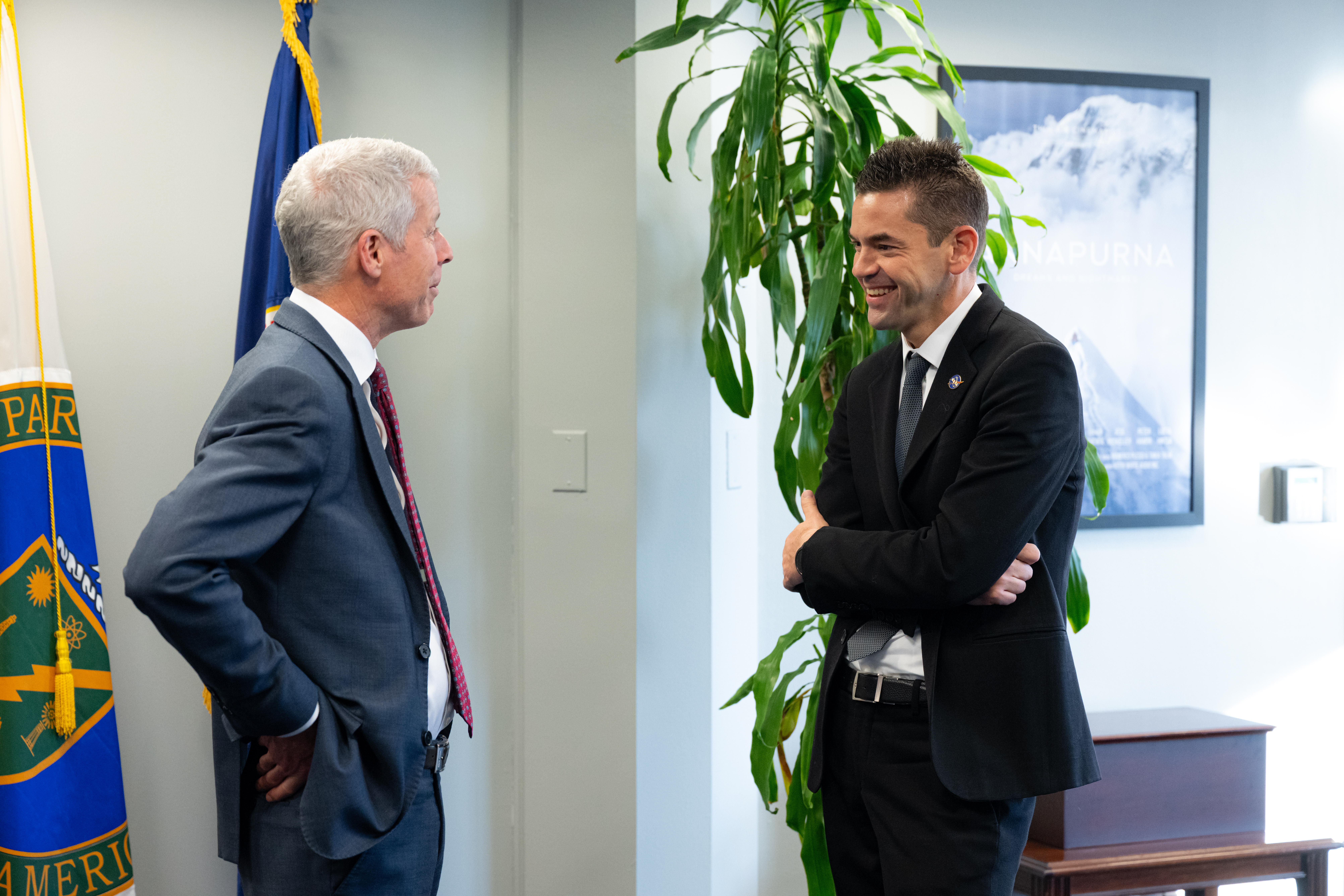
U.S. Energy Secretary Chris Wright (left) and NASA Administrator Jared Isaacman (right) meet in Washington on Jan. 8, 2026
U.S. Secretary of Energy Chris Wright (left) and NASA Administrator Jared Isaacman (right) meet at the Department of Energy headquarters in Washington on Jan. 8, 2026.
Credit: NASA/John Kraus

NASA, along with the U.S. Department of Energy (DOE), announced Tuesday a renewed commitment to their longstanding partnership to support the research and development of a fission surface power system for use on the Moon under the Artemis campaign and future NASA missions to Mars.

A recently signed memorandum of understanding between the agencies solidifies this collaboration and advances President Trump’s vision of American space superiority by deploying nuclear reactors on the Moon and in orbit, including the development of a lunar surface reactor by 2030. This effort ensures the United States leads the world in space exploration and commerce. 

“Under President Trump’s national space policy, America is committed to returning to the Moon, building the infrastructure to stay, and making the investments required for the next giant leap to Mars and beyond,” said NASA Administrator Jared Isaacman. “Achieving this future requires harnessing nuclear power. This agreement enables closer collaboration between NASA and the Department of Energy to deliver the capabilities necessary to usher in the Golden Age of space exploration and discovery.”

NASA and DOE anticipate deploying a fission surface power system capable of producing safe, efficient, and plentiful electrical power that will be able to operate for years without the need to refuel. The deployment of a lunar surface reactor will enable future sustained lunar missions by providing continuous and abundant power, regardless of sunlight or temperature.

“History shows that when American science and innovation come together, from the Manhattan Project to the Apollo Mission, our nation leads the world to reach new frontiers once thought impossible,” said U.S. Secretary of Energy Chris Wright. “This agreement continues that legacy. Thanks to President Trump’s leadership and his America First Space Policy, the department is proud to work with NASA and the commercial space industry on what will be one of the greatest technical achievements in the history of nuclear energy and space exploration.”   

The agencies’ joint effort to develop, fuel, authorize, and ready a lunar surface reactor for launch builds upon more than 50 years of successful collaboration in support of space exploration, technology development, and the strengthening of our national security. 

For more about NASA’s Moon to Mars exploration plans, visit:

https://www.nasa.gov/moontomarsarchitecture

-end-

Bethany Stevens
Headquarters, Washington
771-216-2606
bethany.c.stevens@nasa.gov

Share

Details

Last Updated
Jan 13, 2026
Editor
Jennifer M. Dooren

America's Biggest Power Grid Operator Has an AI Problem - Too Many Data Centers

By: msmash
America's largest power-grid operator, PJM, which delivers electricity to 67 million people across a 13-state region from New Jersey to Kentucky, is approaching a supply crisis as AI data centers in Northern Virginia's "Data Center Alley" consume electricity at an unprecedented rate. The nonprofit expects demand to grow by 4.8% annually over the next decade. Mark Christie, former chairman of the Federal Energy Regulatory Commission, said the reliability risk that was once "on the horizon" is now "across the street." Dominion Energy, the utility serving parts of Virginia, has received requests from data-center developers requiring more than 40 gigawatts of electricity -- roughly twice its Virginia network capacity at the end of 2024. Older power plants are going out of service faster than new ones can be built, and the grid could max out during periods of high demand, forcing rolling blackouts during heat waves or deep freezes. In November, efforts to establish new rules for data centers stalled when PJM, tech companies, power suppliers and utilities couldn't agree on a plan. Monitoring Analytics, the firm that oversees the market, warned that unless data centers bring their own power supply, "PJM will be in the position of allocating blackouts rather than ensuring reliability."

Read more of this story at Slashdot.

❌