China has shipped a batch of Type 59 130mm towed artillery systems to a foreign customer, with images confirming the weapons loaded aboard a cargo vessel and prepared for export, according to open-source visuals recorded during offloading operations. Footage circulating on social media shows multiple Type 59 artillery pieces secured on wheeled carriages and covered […]
Saudi airstrikes hit positions near the Saudi border in Yemen’s Hadramout province on Friday amid clashes between forces loyal to the Saudi-backed provincial governor and fighters aligned with the separatist Southern Transitional Council (STC), according to statements from local officials and the STC. The STC accused Saudi Arabia of carrying out seven airstrikes against its […]
The United States Missile Defense Agency has awarded Lockheed Martin Space a $142.6 million contract modification to provide continued maintenance and sustainment support for two Terminal High Altitude Area Defense batteries operated by the United Arab Emirates, according to an official contract announcement. Lockheed Martin Space, based in Sunnyvale, California, received the noncompetitive contract modification, […]
Saudi Arabia carried out an airstrike on Yemen’s Mukalla Port after determining that ships carrying armored vehicles and weapons for UAE-backed separatist forces were present at the facility, according to a report by Clash Report. The strike targeted vessels described as transporting military equipment from the United Arab Emirates intended for the Southern Transitional Council, […]
Bybit will gradually scale back services for Japanese users from 2026 amid ongoing regulatory pressure.
Japan’s strict licensing rules are forcing unregistered crypto exchanges to limit or exit the market.
While pulling back in Japan, Bybit is expanding in the UK and Middle East under clearer frameworks.
Bybit is preparing to gradually scale back services for users based in Japan from 2026, marking a further shift in how global crypto exchanges navigate one of the world’s most tightly regulated digital asset markets.
The move follows months of regulatory pressure and earlier steps taken by the exchange to reduce its footprint in the country.
Bybit said the process will involve rolling account restrictions applied over time, rather than an immediate shutdown, as it aligns with Japan’s regulatory framework.
The development comes even as the exchange expands in other jurisdictions, underlining the uneven global regulatory landscape for crypto platforms.
Japan’s regulatory pressure
The phased restrictions will apply to users identified as Japanese residents, with Bybit implementing the measures on a rolling basis.
Users who believe they have been incorrectly classified have been asked to complete additional identity verification checks to resolve their status.
Bybit is not registered with the Financial Services Agency, which requires crypto exchanges serving Japanese residents to obtain local approval before offering services.
Japan’s regulatory regime has long been regarded as one of the strictest globally, shaped by past exchange failures and consumer protection concerns.
This framework has limited the ability of overseas platforms to operate freely in the country without a local licence.
Bybit’s decision to begin a structured withdrawal from 2026 reflects the growing difficulty for unregistered foreign exchanges to maintain access to Japanese users.
Earlier restrictions in Japan
The latest announcement builds on earlier actions taken by Bybit to curb its exposure to the Japanese market.
In October, the exchange halted new user registrations in Japan, citing ongoing discussions with regulators.
That decision signalled that continued full operations without registration were becoming increasingly unsustainable.
Regulatory scrutiny intensified in February, when Japan’s Financial Services Agency requested that app stores run by Apple and Google suspend downloads of five unregistered cryptocurrency exchanges.
Alongside Bybit, the list included MEXC Global, LBank Exchange, KuCoin, and Bitget. The move reinforced Japan’s stance that access to local users must be tightly controlled.
Industry figures have warned that this regulatory bottleneck is driving innovation elsewhere.
In July, Maksym Sakharov, co-founder and CEO of WeFi, said Japan’s strict oversight was pushing crypto development out of the country, as companies look for more flexible jurisdictions.
Despite the Japan pullback, Bybit remains one of the most active exchanges globally.
Rather than exiting heavily regulated markets altogether, Bybit has increasingly adopted jurisdiction-specific strategies, limiting certain services while expanding in regions with clearer or more accommodating frameworks.
Expansion beyond Japan
While scaling down in Japan, Bybit is simultaneously rebuilding its presence in other markets.
The exchange is reentering the UK after a two-year pause, launching a platform that offers spot trading and peer-to-peer services.
The UK return is structured through a promotions arrangement approved by Archax, rather than through direct UK registration.
Bybit has also strengthened its position in the Middle East.
Last month, it secured a Virtual Asset Platform Operator Licence from the United Arab Emirates’ Securities and Commodities Authority, eight months after receiving in-principle approval.
The licence allows the exchange to expand services in a region that has actively positioned itself as a hub for digital asset firms.
DEEP DIVE — Entire cities in the Darfur region of Sudan have been burned and razed, millions have fled their homes, and unspeakable terror and violence plague those left behind. When fighting erupted on April 15, 2023, between the Sudanese Armed Forces (SAF) under Abdel Fattah al‑Burhan and the Rapid Support Forces (RSF) led by Mohamed Hamdan Dagalo, better known as Hemedti, few predicted the conflict would become one of Africa’s worst humanitarian disasters.
There is, however, more to this war than just an internal battleground. The war in Darfur is no longer simply a domestic power struggle. It has become a multilayered proxy battlefield involving Egypt, Turkey, the United Arab Emirates (UAE), Saudi Arabia, Russia, Iran and more — each supporting rival Sudanese actors to secure strategic footholds.
“The current phase has Darfur as a killing field. The Sudanese protagonists have sorted out somewhat the areas each controls. Still, on the political front, both are committed to eliminating the other in a fight to the finish,” United States Ambassador to Sudan during the George W. Bush administration, Cameron Hume, tells The Cipher Brief. “There may be agreement on a time-limited humanitarian ceasefire, but no one is aiming at a durable political settlement between the two main parties.”
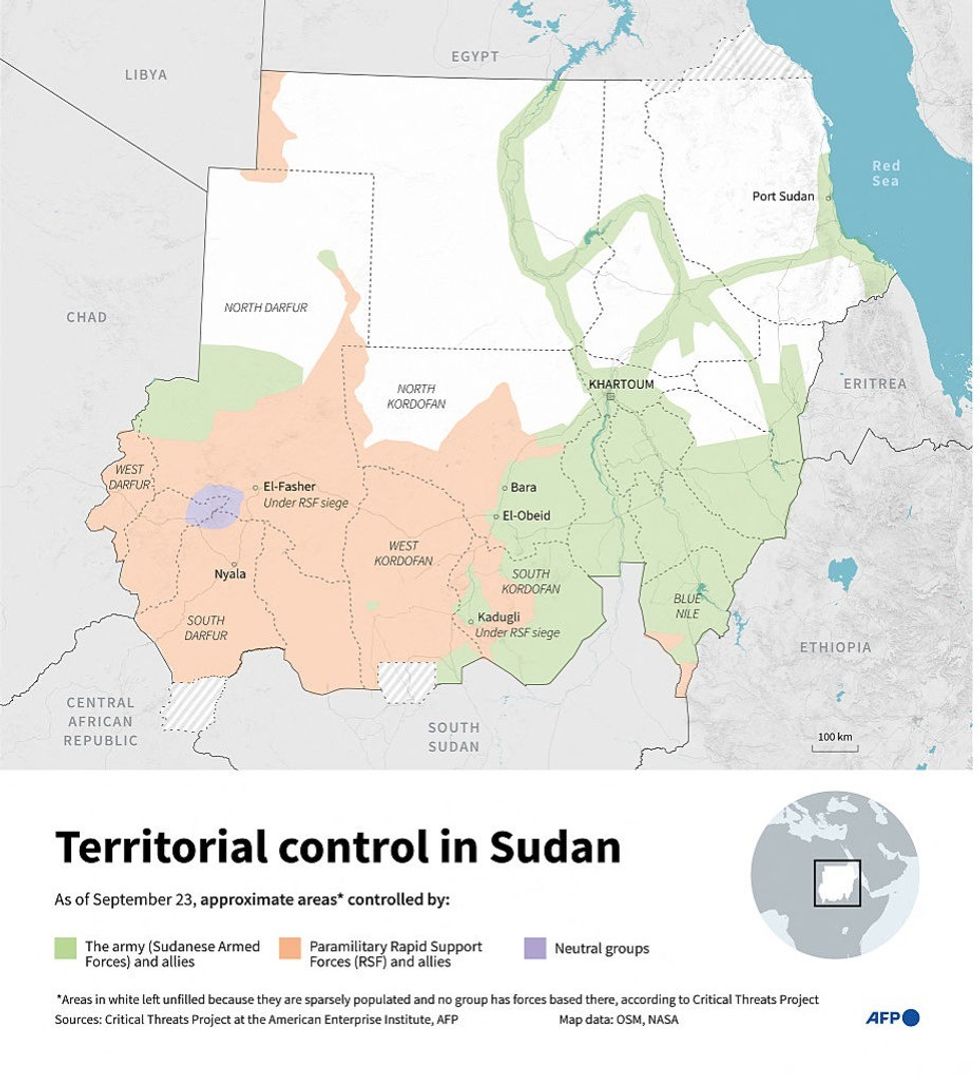
Infographic with a map showing areas controlled by the army, the Rapid Support Forces and neutral groups in Sudan as of September 23, 2025, according to the Critical Threats Project at the American Enterprise Institute and the AFP. (Infographic with a map showing areas controlled by the army, the Rapid Support Forces and neutral groups in Sudan as of September 23, 2025, according to the Critical Threats Project at the American Enterprise Institute and the AFP (Graphic by AFP) (Graphic by Olivia Bugault, Valentina Breschi, Nalini Lepetit-Chella/AFP via Getty Images)
United Arab Emirates
Despite official denials, the UAE remains the RSF’s cornerstone patron in Darfur, suspected of funneling advanced weaponry — including Chinese CH-95 and “Long Wang 2” strategic drones for 24-hour surveillance and strikes, Norinco-guided bombs, howitzers, and thermobaric munitions —via a covert air bridge of more than 240 UAE-chartered flights from November 2024, often landing at Chad’s Amdjarass airfield or South Darfur’s Nyala base.
These supplies, additionally routed through Libyan intermediaries like Khalifa Haftar’s networks and Ugandan/Somali airfields, have empowered RSF assaults, such as the latest siege and takeover of El Fasher. Economically, UAE-based firms like Hemedti’s Al-Junaid control Darfur’s Jebel Amer and Songo gold mines, exporting $1.6B in 2024, reportedly laundered via seven sanctioned Dubai entities to fund RSF salaries, Colombian mercenaries and further arms.
“The United Arab Emirates is the key sponsor of the RSF in strategic terms. Its interest is to convert influence in western Sudan into leverage over corridors, gold monetization and logistics, and to prevent an outcome in which Islamists consolidate in Khartoum,” Dr. Andreas Krieg, Associate Professor at King’s College London, tells The Cipher Brief.
Sudan’s gold — its primary export — has also become a lifeline for the UAE, feeding Dubai’s markets with more than ten tons a year from RSF-controlled areas. The trade aligns with Abu Dhabi’s long-term ambitions and its stance against the Muslim Brotherhood, as well as its past reliance on RSF fighters in Yemen. Despite Emirati denials and Sudan’s failed genocide case against the UAE at the ICJ, evidence ties the UAE directly to embargo breaches, from passports recovered in Omdurman to Emirati-made vehicles found at RSF sites.
As the UAE expands its influence through RSF control of Darfur’s 700-kilometer Red Sea corridor, reviving stalled DP World and AD Ports projects to rival Saudi NEOM, it effectively uses the militia as a proxy to secure resources and block SAF dominance. Approximately 70 percent of Sudan’s gold production from RSF-controlled areas is smuggled through Dubai, while overall illicit exports account for around 40 percent of the country’s total gold output.
Need a daily dose of reality on national and global security issues? Subscriber to The Cipher Brief’s Nightcap newsletter, delivering expert insights on today’s events – right to your inbox. Sign up for free today.
Turkey
Ankara, seeing the Darfurian conflict as both a threat to its regional ambitions and a challenge to Islamist allies, has backed al-Burhan’s forces with drones worth $120 million, delivered through Egypt. Their weapons supply assisted SAF in retaking Khartoum earlier this year but comes with deeper incentives: ideological ties with Burhan’s Islamist faction and strategic objectives for Red Sea access.
“Turkey’s quiet intelligence-sharing and counterterrorism pacts give it outsized sway over local regimes,” John Thomas, managing director of strategic policy firm Nestpoint Associates, tells TheCipher Brief.
The result, experts say, is a dangerous and growing proxy war between the UAE and Turkey — one now fought with advanced drones and air defenses across Sudan’s skies. The stalemate has fractured the country, spilled instability into Chad and Libya, and left tens of thousands dead, a toll experts warn could further destabilize the Horn of Africa.
Beyond the pace and scale of Turkish arms transfers, the presence of Turkish private military contractors (PMCs) in Africa merits closer scrutiny.
“In addition to the pace and spread of Turkey’s arms flow, I would say the presence of Turkish PMCs in Africa is something policymakers really ought to focus on more closely,” Will Doran, Turkey researcher at the Foundation for Defense of Democracies, tells The Cipher Brief. “A lot of these PMCs, like Erdogan himself, are warm towards the Muslim Brotherhood and have some questionable ties to Islamist militias on the ground in the Sahel. This isn’t to say Turkey is backing the region’s big names in terrorism. For one, Ankara’s deployed against al-Shabaab in Somalia, but the PMC trend is worrisome nonetheless.”
Egypt
Egypt views Sudan as a vital flank for its national interests. The Nile River flows from Sudan into Egypt, and Cairo has long been vigilant about any instability upstream. Egypt supports General Abdel Fattah al-Burhan and his Sudanese Armed Forces (SAF) because Cairo views them as the most dependable group to safeguard Egypt’s key national interests — namely, the Nile River corridor, which is Egypt’s sustenance for water and trade, and the southern border, which it shares with Sudan.
According to Dr. Krieg, “Egypt is the principal state backer of the army.”
“Its strategic priorities are the security of the Nile heartland, avoidance of an Islamist resurgence, and denial of hostile basing or rival influence along the Red Sea,” he continued.
Egypt, already hosting more than a million refugees, also fears that if Khartoum collapses into chaos, the resulting instability — such as refugee flows, arms trafficking, or militant activity — could spill over the border into its territory. Diplomatically, Cairo has kept direct intervention limited and insists on a Sudan-led solution, yet it retains close military and political ties to Burhan.
Saudi Arabia
Riyadh shares a parallel concern: as the Gulf kingdom pursues its Vision 2030 and Red Sea coastal investments, it has an interest in a stable Sudan firmly aligned with its regional agenda. Riyadh has backed the SAF via financial and diplomatic support, while also positioning itself as a mediator.
“Saudi Arabia is perhaps the outside player with potential influence that gets the least attention,” said Amb. Hume.
Dr. Krieg also observed that “Saudi Arabia has positioned itself as a convenor and would prefer a unified state that secures the Red Sea.”
“Chad and the Haftar camp in eastern Libya function as corridors and logistics enablers, and their choices directly affect the intensity of fighting in Darfur,” he explained. “Those intermediaries in Libya and Chad are all part of the UAE’s Axis of Secessionists; a network of non-state actors that are all tied to Abu Dhabi directly or indirectly.”
Are you Subscribed to The Cipher Brief’s Digital Channel on YouTube? There is no better place to get clear perspectives from deeply experienced national security experts.
Iran
Since late 2023, Iran has resumed ties with SAF leader Abdel Fattah al-Burhan after a seven-year break, sending Mohajer-6 and Ababil drones, artillery, and intel via seven Qeshm Fars Air flights to Port Sudan from December 2023 through July 2024. This aid helped SAF retake Khartoum in March 2025 and strike RSF in Darfur. In addition, Iran uses Sudan’s Yarmouk arms factory to counter the UAE-backed RSF. Tehran’s overarching goal? Access to Port Sudan to support the Houthis in Yemen and spread Shiite influence — risking wider regional proxy conflict.
“Iran’s military support has helped shift momentum toward the SAF. As one of many foreign actors exacerbating Sudan’s internal tensions, Iran contributes to the country’s unfolding humanitarian disaster,” Jonathan Ruhe, Director of Foreign Policy at the JINSA Gemunder Center for Defense & Strategy, tells The Cipher Brief. “And as one of many foreign actors trying to claim concessions from the government and vying to exploit Sudan’s natural resources, Iran helps worsen the country’s already high levels of impoverishment.
Research Fellow at the Foundation for the Defense of Democracies, Husain Abdul-Hussain, also underscored that while Iranian involvement in Sudan is still in its infancy, “it will certainly grow as the war grinds on.”
“The more reliant Islamist militias become on Iran, the stronger they become and the more indebted to Tehran,” he explained. “Eventually, relations between Iran and Sudanese Islamist militias will be similar to its relations with Islamist militias in Lebanon (Hezbollah), Iraq (Hashd Shaabi), Gaza (Hamas) and Yemen (Houthis). Note that Sudan Islamist militias are Sunni (like Hamas in Gaza), and unlike Shia Iran and its Lebanese and Iraqi Shia militias. The Houthis are their own breed of Islam (Yazidis) but are allied with Shia Iran.”
Russia
Moscow, meanwhile, has played both sides in Sudan’s civil war for profit and power. Before 2024, the Wagner Group, now under Russia’s Defense Ministry, backed the RSF with arms like surface-to-air missiles, in return for gold from RSF-held mines like Jebel Amer — smuggling up to 32.7 tons worth $1.9 billion via Dubai from 2022 to 2023 to skirt Ukraine war sanctions and fund operations. This fueled RSF violence, including the 2023 to 2025 massacres in el-Geneina and el-Fasher.
Around midway through last year, in the aftermath of Prigozhin’s demise, Moscow flipped to bolstering the SAF in its quest for a Port Sudan naval base. Russia subsequently vetoed a UN ceasefire resolution last November to keep up its influence in Khartoum, while reports emerged of Russian mercenaries operating in West Darfur, worsening the fear and displacement.
“Russia linked commercial and security networks remain present around gold flows and in facilitation roles close to the RSF camp,” said Dr. Krieg.
Why So Many Foreign Players?
At the heart of Sudan’s crisis lie three intertwined forces: geography, resources, and regional rivalry. Poised along the Nile, the Red Sea, and the Horn of Africa, Sudan is pivotal to everything from Cairo’s water security to the maritime goals of Gulf States to the influence ambitions of Moscow and Ankara. Moreover, its ports and resource-rich land have morphed domestic infighting into a lucrative war economy.
“Material backing has lengthened the war and structured its geography,” Mr. Krieg said. “The result is not a decisive victory for either side but a hardening of zones, with the RSF advantaged in a peripheral theatre where it can police corridors and extract revenue, and the army entrenched where the state’s core institutions, population and donor attention reside.”
Why It’s So Hard to End the War
With so many players in the field and a deep distrust among warring parties, ending the war in Sudan has become extraordinarily difficult. The United States, for its part, leads the “Quad” alongside the UAE, Egypt, and Saudi Arabia, pushing for a three-month humanitarian truce. The RSF agreed to a deal on November 6, and Washington is now pressing the Sudanese army to do the same in hopes of easing the fighting and starting talks on the war’s deeper causes.
If the war in Sudan continues, the U.S. faces a growing humanitarian catastrophe: estimates suggest more than 150,000 deaths and over 14 million people displaced, with nearly 25 million facing acute hunger. Regionally, unchecked control of the RSF in Darfur could destabilize the Red Sea corridor, a vital route for global trade and U.S. allies. Domestically, failure to resolve the conflict would erode U.S. credibility on human rights and genocide prevention, heighten refugee pressures in North Africa and Europe, and contradict the moral precedent set during the 2003 Darfur genocide.
“Washington will be paying more attention,” one White House-connected source tells The Cipher Brief. “It isn’t ignored. It is a conflict Trump wants to see ended.”
Dr. Krieg asserted that Sudan is entering a consolidation phase in which the Rapid Support Forces have turned Darfur into a defensible rear area and administrative base. The fall of El Fasher removed the last significant government foothold in the region. It gave the RSF control of the interior lines across West, South, Central, and much of North Darfur, as well as access to Libya and Chad for resupply and commerce.
He thus asserts that Sudan’s future is likely to go one of two ways.
“The Sudanese Armed Forces still hold the Nile corridor, the capital area and much of the east, which creates a west versus centre geography. That configuration points to two near-term paths. Either the front stabilises into a frozen conflict that resembles an informal partition, or the RSF seeks to push east through North Kordofan and test the approaches to the center,” Dr. Krieg added. “Humanitarian conditions are acute, with siege tactics, displacement and food insecurity now baked into the conflict economy. The political tempo has slowed rather than accelerated, since battlefield gains in Darfur give the RSF reasons to bank advantages before contemplating concessions.”
Read more expert-driven national security insights, perspective and analysis in The Cipher Brief because National Security is Everyone’s Business.

 Login
Login China has shipped a batch of Type 59 130mm towed artillery systems to a foreign customer, with images confirming the weapons loaded aboard a cargo vessel and prepared for export, according to open-source visuals recorded during offloading operations. Footage circulating on social media shows multiple Type 59 artillery pieces secured on wheeled carriages and covered […]
  Saudi airstrikes hit positions near the Saudi border in Yemen’s Hadramout province on Friday amid clashes between forces loyal to the Saudi-backed provincial governor and fighters aligned with the separatist Southern Transitional Council (STC), according to statements from local officials and the STC. The STC accused Saudi Arabia of carrying out seven airstrikes against its […]
  The United States Missile Defense Agency has awarded Lockheed Martin Space a $142.6 million contract modification to provide continued maintenance and sustainment support for two Terminal High Altitude Area Defense batteries operated by the United Arab Emirates, according to an official contract announcement. Lockheed Martin Space, based in Sunnyvale, California, received the noncompetitive contract modification, […]
  Saudi Arabia carried out an airstrike on Yemen’s Mukalla Port after determining that ships carrying armored vehicles and weapons for UAE-backed separatist forces were present at the facility, according to a report by Clash Report. The strike targeted vessels described as transporting military equipment from the United Arab Emirates intended for the Southern Transitional Council, […]