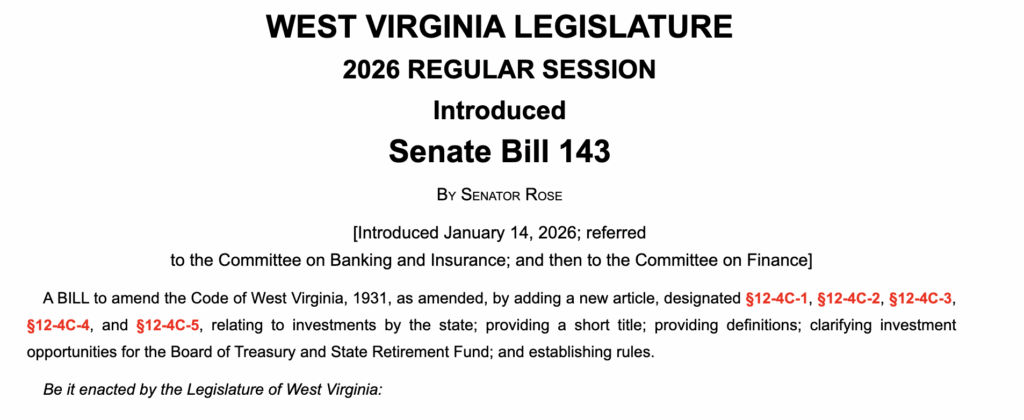
West Virginia lawmakers have taken a step toward letting the state put a slice of its cash into gold, stablecoins and very large cryptocurrencies. Senate Bill 143, introduced on January 15, 2026, is being called the Inflation Protection Act and was filed by State Senator Chris Rose.
Inflation Protection Act Details
According to the proposal, the State Treasury Board could place up to 10% of certain treasury accounts into a limited list of nontraditional assets.
Those assets would include precious metals like gold and silver, regulator-approved stablecoins, and digital currencies that meet a very high market-cap test. The bill sets that threshold at US$750 billion averaged over the prior calendar year.
The Market Cap Door Is Narrow
Based on reports, only the largest cryptocurrencies would clear that bar. At the moment, that effectively names Bitcoin as the sole qualifying digital asset, given the US$750 billion requirement. That choice was framed as a way to limit exposure to volatile or fringe tokens.
How The State Could Hold These Assets
The bill does not demand one custody model. Instead, it allows the treasury to hold metals or crypto directly, to use exchange-traded products, or other approved custody setups. The language also contemplates tools like staking or ETPs as options for generating returns, but it attaches rules intended to reduce operational and security risks.
A Policy Shift At The State Level
Rose and backers present the move as a hedge against inflation and a way to diversify reserves beyond bonds and cash. Opponents are likely to press on fiduciary duty, volatility, and the risks of adopting assets with rapid price swings.
The debate taps into a wider trend: several US states have been exploring ways to create strategic reserves that include precious metals or crypto.
What Happens Next
SB 143 has been assigned to the Committee on Banking and Insurance, with further review expected before any vote. Lawmakers will weigh technical safeguards, reporting rules, and how to audit and insure holdings before moving the measure forward.
If implemented, the plan would let West Virginia place a modest, capped portion—10%—of qualifying funds into a narrow set of assets aimed at preserving buying power.
Supporters argue it is a cautious experiment; critics say the risk profile of crypto still demands care. Either way, the proposal will force a detailed policy discussion in Charleston about how public money should be managed when new financial tools are on the table.
Featured image from Corcoran, chart from TradingView
West Virginia lawmakers introduced legislation this week that would authorize the state treasurer to invest a portion of public funds in bitcoin, precious metals, and regulated stablecoins, marking a significant step toward integrating digital assets into state-level finance.
West Virginia Senate Bill 143, introduced by Sen. Chris Rose during the 2026 regular legislative session, would create a new section of state law titled the “Inflation Protection Act of 2026.” The measure permits the Board of Treasury Investments to allocate up to 10% of funds it oversees into gold, silver, platinum, and certain digital assets, subject to existing investment rules.
Under the bill, the West Virginia could invest in digital assets that maintained an average market capitalization above $750 billion over the prior calendar year. That threshold currently limits eligibility to only bitcoin, without naming the asset directly in statute.
At the end of the digital bill, there is text that says “The purpose of this bill is to empower the Treasurer to invest in gold, silver, and bitcoin.”
The proposed 10% cap would apply at the time an investment is made. If asset prices rise and push the allocation above that threshold, the board would not be required to sell holdings, though it would be barred from making additional purchases until the allocation falls back below the limit.
The legislation includes detailed custody requirements for digital assets. Holdings would need to be secured either directly by the West Virginia treasurer through a defined secure custody system, by a qualified third-party custodian, or through a registered exchange-traded product.
The bill outlines standards for key control, geographic redundancy, access controls, audits, and disaster recovery.
In addition to holding digital assets, the bill would allow the treasurer to pursue yield-generating activities. Digital assets could be staked using third-party providers if legal ownership remains with West Virginia. The treasurer could also loan digital assets under rules designed to avoid added financial risk.
JUST IN: West Virginia introduces a bill to allow allocating 10% of state funds to #Bitcoin
Precious metals investments could be held through exchange-traded products, by qualified custodians, or directly by West Virginia in physical form. The bill allows for cooperative custody arrangements with other states, subject to rules established by the treasurer.
West Virginia retirement funds would face tighter limits. Under the proposal, retirement systems could invest only in exchange-traded products registered with federal or state regulators, rather than holding digital assets directly.
The bill grants the treasurer authority to propose implementing rules, which would require legislative approval.
The proposal reflects a growing interest among U.S. states in using bitcoin and hard assets as long-term stores of value for public funds.
West Virginia and other states exploring bitcoin
Several states have explored or enacted similar measures allowing limited exposure to digital assets, though most have relied on exchange-traded products rather than direct custody.
Most recently, Rhode Island lawmakers reintroduced Senate Bill S2021, which would temporarily exempt small Bitcoin transactions from state income and capital gains taxes, allowing up to $5,000 per month and $20,000 annually to be tax-free.
Introduced January 9 by Senator Peter A. Appollonio, the bill was referred to the Senate Finance Committee and is framed as a pilot program to reduce tax friction for everyday Bitcoin use.
This marks the second consecutive year Rhode Island legislators have proposed a targeted Bitcoin tax exemption.
West Virginia Senate Bill 143 has been referred to the Senate Committee on Banking and Insurance, with a subsequent referral to the Committee on Finance.
At the time of writing, Bitcoin is trading at $95,494 with a 24-hour volume of $52 billion, down 1% on the day and roughly 1% below its seven-day high of $96,933. The asset’s market cap stands at $1.91 trillion, supported by a circulating supply of 19.98 million BTC out of a maximum 21 million.
The Cannabist Co. will sell its Virginia medical marijuana permit for $130 million plus a $30 million lease liability - much more than $110 million offered earlier in the month by Curaleaf.
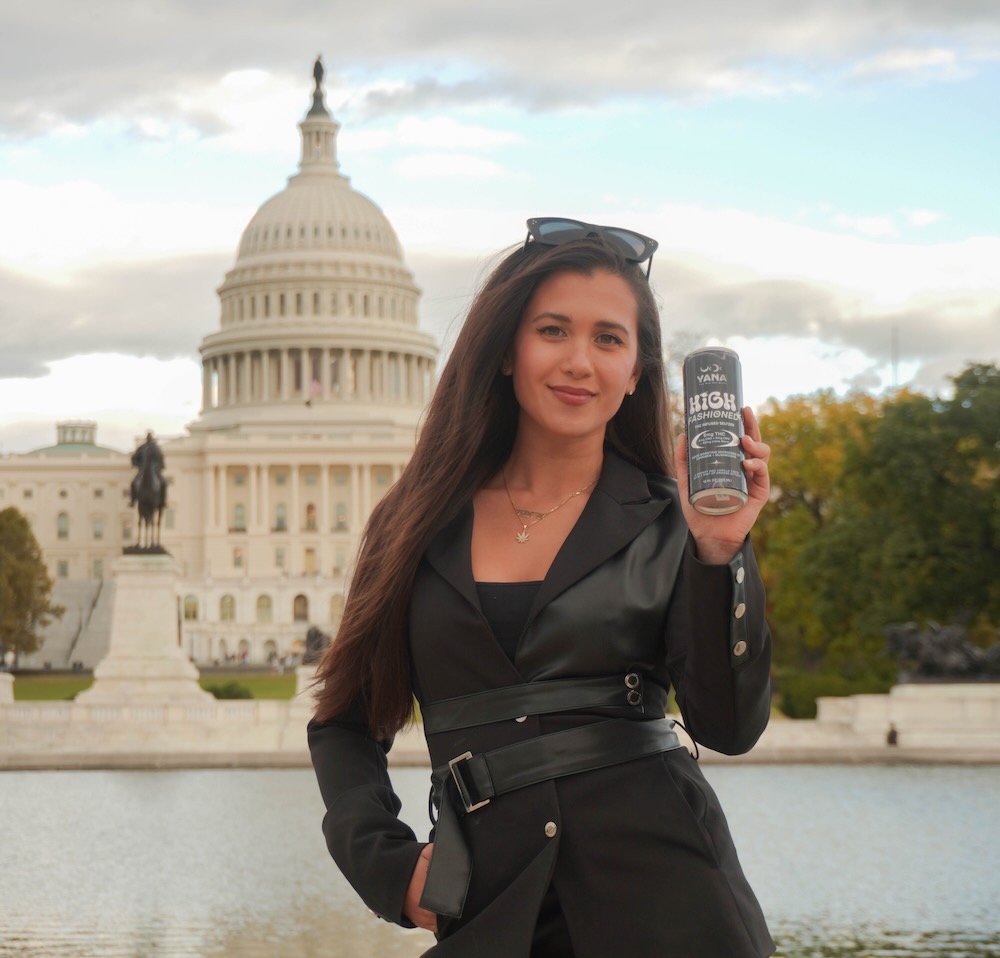
YANA Wellness, a women-owned and operated cannabis brand with a licensed dispensary in Washington, DC, officially makes history as the first hemp-derived THC beverage line in all Total Wine retail locations across Virginia. Their e-commerce platform also reaches consumers with their plant-based alternative drinks nationwide. This marks a major milestone not only for YANA as a small, women-owned business, but for all women pioneering plant-based wellness products for nationwide distribution.
The Founder and CEO of YANA, Ariana Fleishman, has made a blueprint for minority small business owners to create accessible, compliant and community-driven products. Fleishman utilizes her social media platforms to educate consumers and business owners alike.
“YANA stands for You Are Not Alone, and it is also the nickname my mom gave me as a kid. I’ve always wanted to create a community around this mission. Mental health issues are at an all-time with everything going on in the world today. I truly believe you can’t change the world until you change your own community,” Fleishman says. “Adderall and alcohol—these are so normalized in today’s society. My doctor would prescribe me Adderall for the workday to combat my ADHD. Then at night, bars and restaurants only have alcohol on the menu, which completely impairs my memory and makes me feel so sick the next day. Why is this lifestyle still so normalized? Why do we have to be so quiet when we choose to consume plants over poison?”
“Cannabis and Mushrooms are already clinically proven to be an effective medicine and provide so many life-changing benefits when purchased from lab-tested and credible sources,” she continues. “But still, the norm is to take highly addictive drugs prescribed by doctors and to drink alcohol to socialize with friends. My goal is to change this stigma by providing plant-based alternatives in mainstream settings.”
Breaking Down Prohibition Barriers and Entering the Mainstream Market
With cannabis still under federal prohibition, Fleishman purposely developed a variety of plant-based alternative blends so that at least one of their drinks on the product line would meet all jurisdictional regulations in every state. This was her strategy for expanding the brand and the plant-based alternatives culture into new markets while cannabis legalization is still uncertain nationwide.
If you find yourself in Virginia, be sure to look for YANA products at your nearest Total Wine. Beyond these stores, consumers can now also find YANA drinks on various restaurant menus in the DMV area and explore the benefits of cannabinoids, functional mushrooms and adaptogens without fear of the negative stigma.
YANA’s Rizzi Mushroom Elixir is a consumer favorite that contains no THC or CBD—just a federally legal blend of nootropic and adaptogenic mushrooms. Rizzi Elixir is featured at premiere social clubs in DC, like Ciel Rooftop at Marriott’s Downtown Hotel and Spark Social, DC’s first non-alcoholic social club for the LGBTQ+ community. These mainstream venues showcase how plant-based alternative drinks can be part of a holistic social wellness lifestyle—and it’s only the beginning. Virginia can now legally sell hemp-derived THC drinks in bars and restaurants with a hemp license as well. Learn more about their full product line and check out where you can buy YANA drinks near you here.
Women Leading the Future of Cannabis
YANA’s success story symbolizes the perseverance of women who have navigated the cannabis industry’s challenging transition from prohibition to legitimacy. Fleishman and her team have emerged from the “gray market” era in DC after five years in the industry to now operating a fully legal, women-run cannabis dispensary. The Chief Strategy Officer of YANA Wellness Brands, Hannah Clarke, a longtime cannabis lobbyist and consultant, emphasizes the significance of their achievements: “Women are not just participating in the industry anymore—we’re building it,” Clarke says. “This is about changing perceptions, policy and the path forward for future generations of women in cannabis.”
YANA prioritizes education, research and inclusion, integrating science, advocacy and entrepreneurship opportunities for their team of young women entering the workforce. Through wellness program collaborations with clinical psychologist Dr. Vivid and university internship programs with American University and the University of Maryland, YANA Wellness offers students the rare opportunity to study the psychological effects of cannabis and mushrooms to properly sell and promote these alternative medicines to conscious consumers.
“I’ve been interested in psychology for a while, but I never imagined I’d find an internship that focuses on the psychological effects of cannabis and mushrooms, at least not so early in my career,” said Lucrezia Brody, a YANA psychology intern and student at American University. “The research we conduct isn’t just filed away—it directly informs our patients and wellness consultants to help improve our community.”
Expanding While Stimulating the Local Economy
YANA is operated by a small team of 10 women, but their strategic partnerships with local, family-owned businesses in Virginia are how YANA is scaling effectively and stimulating the local economy. Fleishman knows that the cannabis market is already dominated by MSOs (multi-state operators) in healthcare, largely owned by publicly traded companies and pharmaceutical businesses, so she has devoted herself to working with local small businesses in all parts of the supply chain.
Pure Shenandoah is a family-owned hemp manufacturing business that provides high-quality cannabis extractions, and Brothers Craft Brewery is a family-owned brewery that YANA uses for canning their drinks. “It was very important to me to stimulate the local economy that I grew up in and keep my mission of building community through plant medicine alternatives,” Fleishman states.
YANA also just signed with Specialty Beverage, a family-owned beverage distribution company known for its large-scale deliveries to mainstream businesses. This partnership increases the accessibility of hemp-derived THC beverages to reach retail locations and restaurant menus that want to provide plant-based alternatives to alcohol.
The Evolution of YANA
In 2019, Ariana Fleishman, also known as “Ari Tokes” on social media, founded YANA Wellness as Cannabis Creatives Collectives for the DC metropolitan area to connect with others through curated social experiences. As the laws changed in DC, YANA evolved into a Holistic Wellness Center and Licensed Cannabis Dispensary.
Fleishman simultaneously spent two years developing the YANA drink line while opening the retail location so she could reach people nationwide with a variety of plant-based alternative blends. Through their social media platforms, YANA continues to advocate for responsible, inclusive and research-backed cannabis culture nationwide. Stay tuned in on their social media for updates on community events, cannabis news, and the culture here.
Medical cannabis is available from Greenlight at locations all across West Virginia. Their locations all feature a wide selection of brands and knowledgeable staff. Patients with a medical card are welcome between 10:00 a.m. and 8:00 p.m. every day of the week. Do not operate a vehicle or machinery under the influence of this drug. […]
With Virginia Gov.-elect Abigail Spanberger's promise to launch adult-use cannabis sales, the legal industry is awaiting its biggest new opportunity in years.
As Virginia navigates its unique position with legal cannabis but no safe access or commercial sales, the need for trusted, reliable education on home cultivation and consumption has never been greater. To fill this critical gap, Oaksterdam University, the nation’s premier cannabis educator, is bringing its expertise directly to the Mid-Atlantic region. On Sunday, September 14, […]

 Login
Login

 West Virginia introduces a bill to allow allocating 10% of state funds to