Reading view

There are new articles available, click to refresh the page.

$7 Trillion Player Is Moving Into Bitcoin, Can This Trigger A Surge To $200,000?

Swiss banking giant UBS, with assets under management (AuM) of up to $7 trillion, is set to launch Bitcoin trading for some of its clients. This comes amid predictions that regulatory clarity and broader adoption could send the BTC price to as high as $200,000. 

UBS To Offer Bitcoin Trading To Some Wealth Clients

Bloomberg reported that UBS is planning to launch crypto trading for some of its wealth clients, starting with its private bank clients in Switzerland. The bank will reportedly begin by offering these clients the opportunity to invest in Bitcoin and Ethereum. At the same time, the crypto offering could further expand to clients in the Pacific-Asia region and the U.S.

The banking giant is currently in discussions with potential partners, and there is no clear timeline for when it could launch Bitcoin and Ethereum trading for clients. This move is said to be partly due to increased demand from wealth clients for crypto exposure. UBS also faces increased competition as other Wall Street giants are working to offer crypto trading. 

Morgan Stanley, in partnership with Zerohash, announced plans to launch crypto trading in the first half of this year, starting with Bitcoin, Ethereum, and Solana. The banking giant may soon also be able to offer its crypto products, as it has filed with the SEC to launch spot BTC, ETH, and SOL ETFs. 

Furthermore, JPMorgan, another of UBS’ competitors, is considering offering crypto trading to institutional clients, although this plan is still in the early stages. The bank already accepts Bitcoin and Ethereum as collateral from its clients. Last year, it also filed to offer BTC structured notes that will track the performance of the BlackRock Bitcoin ETF.

Can Bank’s Entry Trigger A BTC Rally To $200,000  

Kevin O’Leary predicted that Bitcoin could rally to between $150,000 and $200,000 this year, driven by the passage of the CLARITY Act. His prediction came just as White House Crypto Czar David Sacks said banks would fully enter crypto once the bill passes. As such, there is a possibility that BTC could reach this $200,000 psychological level in anticipation of the amount of new capital that could flow into BTC from these banks once the bill passes. 

BitMine’s Chairman, Tom Lee, also predicted during a CNBC interview that Bitcoin could reach between $200,000 and $250,000 this year, partly due to growing institutional adoption by Wall Street giants. Meanwhile, Binance founder Changpeng “CZ” Zhao said that a BTC rally to $200,000 is the “most obvious thing in the world” to him.

At the time of writing, the Bitcoin price is trading at around $89,600, up in the last 24 hours, according to data from CoinMarketCap.


Bitcoin

Another Dogecoin ETF Has Gone Live For Trading, How Did It Perform?

The US crypto market has welcomed a new entrant as 21Shares rolls out its Spot Dogecoin ETF, giving investors another avenue to engage with the infamous dog-themed meme coin. Trading kicked off amid a mix of curiosity and caution, with on-chain data already showing how much the DOGE ETF has performed so far. 

21Shares Launches Dogecoin ETF

In a press release on Thursday, January 22, 21Shares announced the official launch of its Spot Dogecoin ETF, TDOG, which began trading on NASDAQ the same day. The new ETF provides investors with direct exposure to Dogecoin through a fully backed, regulated, and transparent vehicle. Each ETF share is also backed 1:1 by DOGE held in institutional-grade custody. 

Notably, the launch of the new TDOG ETF brings the total number of US Dogecoin ETFs to three, joining Grayscale’s GDOG and Bitwise’s BWOW. 21Shares is also the only ETF provider endorsed by House of Doge, the official corporate arm of the Dogecoin foundation, highlighting the global asset manager’s close ties to the meme coin. 

As one of the largest crypto ETF issuers, 21Shares continues to expand its crypto product lineup with the introduction of TDOG. This follows the investment company’s previous ETF offerings, including TSOL, a Solana ETF released in November 2025; ARKB, a Spot Bitcoin ETF launched in January 2024; and TETH, an Ethereum ETF introduced in July of the same year. Together, these products demonstrate 21Shares’ commitment to providing institutional-grade access to high-demand digital assets. 

Federick Brokate, Global Head of Business Development at 21Shares, highlighted DOGE’s large and active global community, calling it a unique digital asset with constantly growing use cases. He added that the new TDOG ETF will give investors regulated, physically backed exposure through a familiar ETF structure they know and trust. 

Marco Margiotta, the CEO of House of Doge, also shared comments on the recently launched 21Shares ETF. He said that TDOG is a step toward making Dogecoin easier to access through traditional financial systems. He also disclosed that House of Doge’s partnership with 21Shares will help more people get involved as the Dogecoin ecosystem grows. 

How 21Shares Dogecoin ETF Has Performed So Far

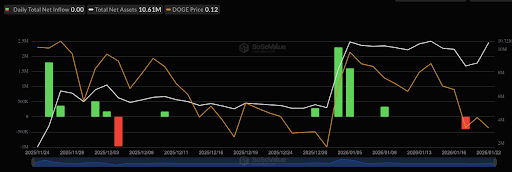
Contrary to expectations, 21Shares’ recently launched Dogecoin ETF saw weak performance on the first day of trading, signaling investors’ lack of interest in the investment product. Data from SoSoValue shows that TDOG experienced no inflows on January 22 and instead declined by about 0.07%. Despite it being the second day of trading, the DOGE ETF has still not registered any flows. 

Dogecoin

This lackluster performance has been observed across all Dogecoin ETFs this week. Grayscales’ GDOG and Bitwise BWOW have reported zero inflows over the last week. The last time GDOG saw positive activity was on January 8, when it received around $333,083 in investments. Before that, the ETF recorded its highest inflows on January 2, totaling roughly $2.3 million. Since its launch in November 2025, GDOG ETF inflows have been unstable, with more days of inactivity than significant investment. 

Dogecoin

Nasdaq Moves to Remove Position Limits on Bitcoin ETF Options

Bitcoin Magazine

Nasdaq Moves to Remove Position Limits on Bitcoin ETF Options

Nasdaq has filed a rule change with the U.S. Securities and Exchange Commission seeking to remove position and exercise limits on options tied to spot Bitcoin exchange-traded funds, a move that would further integrate crypto-linked products into traditional derivatives markets.

The proposal, originally filed on Jan. 7 and made effective this week on the 21st, eliminates the current 25,000-contract cap on options linked to Bitcoin and Ethereum ETFs listed on Nasdaq. 

Affected products include funds from BlackRock, Fidelity, Grayscale, Bitwise, ARK/21Shares and VanEck, according to the filing.

The SEC waived its standard 30-day waiting period, allowing the rule change to take effect immediately, while retaining the authority to suspend it within 60 days if further review is deemed necessary. 

A public comment period is now open, with a final SEC determination expected by late February unless the rule is paused.

Nasdaq argued that lifting the limits would allow crypto ETF options to be treated “in the same manner as all other options that qualify for listing,” eliminating what it described as unequal treatment without undermining investor protections. 

The exchange said the change would support market efficiency while maintaining safeguards against manipulation and excessive risk.

Options are derivative contracts that give traders the right, but not the obligation, to buy or sell an asset at a predetermined price before a set expiration date. Position and exercise limits are typically imposed to prevent concentrated positions that could amplify volatility or destabilize markets.

The filing builds on Nasdaq’s approval in late 2025 to list options on single-asset crypto ETFs as commodity-based trusts. While that decision allowed Bitcoin and Ethereum ETF options to trade on the exchange, existing position limits remained in place.

Nasdaq has steadily expanded its involvement in crypto markets in recent years. 

Nasdaq’s bitcoin and digital asset push

In November, the exchange filed a separate proposal to raise position limits on options tied to BlackRock’s iShares Bitcoin Trust (IBIT) to as much as one million contracts, citing growing institutional demand and increased use of options for hedging strategies.

The exchange has also pushed into crypto indexing and tokenization. In January, Nasdaq and CME Group announced plans to unify their crypto benchmarks under the Nasdaq-CME Crypto Index, which tracks major digital assets including Bitcoin, Ether, XRP, Solana, Cardano and Avalanche.

If approved permanently, the latest rule change would mark another step toward normalizing Bitcoin derivatives within U.S. regulated markets, further blurring the line between traditional financial instruments and crypto-native assets.

This post Nasdaq Moves to Remove Position Limits on Bitcoin ETF Options first appeared on Bitcoin Magazine and is written by Micah Zimmerman.

Thailand Finalizes Rules for Bitcoin ETFs and Crypto Futures in Early-2026 Push

Bitcoin Magazine

Thailand Finalizes Rules for Bitcoin ETFs and Crypto Futures in Early-2026 Push

Thailand is moving decisively to cement its position as one of Asia’s most crypto-friendly financial centers, with regulators finalizing new rules for bitcoin and crypto exchange-traded funds (ETFs), futures trading, and tokenized investment products in early 2026.

The country’s Securities and Exchange Commission (SEC) confirmed this week that it is preparing comprehensive regulatory guidelines that would allow crypto ETFs to be formally established, crypto futures to trade on the Thailand Futures Exchange (TFEX), and digital assets to be recognized as an official asset class under existing derivatives law.

SEC Deputy Secretary-General Jomkwan Kongsakul said the new framework is designed to expand access to digital assets while addressing security and custody risks that have historically deterred institutional investors.

“A key advantage of crypto ETFs is ease of access,” Kongsakul said, according to local reports. “They eliminate concerns over hacking and wallet security, which has been a major barrier for many investors.”

Bitcoin and crypto ETFs are moving closer to market

Thailand’s SEC board has already approved crypto ETFs in principle, with regulators now finalizing operational rules covering custody, liquidity, and cooperation between asset managers and licensed digital asset exchanges.

Thailand approved its first spot Bitcoin ETF in June 2024, initially restricting participation to institutional investors. By October 2025, the regulator signaled plans to expand offerings beyond bitcoin to include other cryptocurrencies, such as ether, potentially in the form of diversified crypto “basket” products.

Under the proposed framework, investors would be allowed to allocate up to 4–5% of diversified portfolios to digital assets—an approach aimed at balancing innovation with risk management.

Once approved, domestically listed crypto ETFs could trade on the Stock Exchange of Thailand, offering local exposure without requiring investors to directly hold or manage cryptocurrencies.

Alongside ETFs, the SEC is advancing plans to launch crypto futures trading on TFEX under the Futures Trading Act. Regulators also intend to formally recognize digital assets as an underlying asset class under the Derivatives Act, providing a clearer legal foundation for crypto-linked derivatives.

To support liquidity and price stability, the SEC plans to introduce market-making mechanisms in 2026. Potential market makers could include financial institutions, licensed digital asset exchanges, corporations, and entities holding cryptocurrencies on their balance sheets.

The futures market is expected to provide investors with hedging tools and more advanced risk management options, while expanding institutional participation in Thailand’s digital asset markets.

Thailand’s recent crypto incentives

Thailand’s regulatory push extends beyond ETFs and derivatives. The SEC is also developing rules for tokenized real-world assets (RWAs), including tokenized bonds and other securities that could be issued and traded on blockchain infrastructure.

These efforts align with broader global trends in asset tokenization and could eventually include baht-backed stablecoins. In 2025, Thailand approved U.S. dollar stablecoins for local trading, marking another step toward regulated digital finance.

On the tax front, Thailand eliminated capital gains tax on crypto trading from January 1, 2025, through December 31, 2029. 

This post Thailand Finalizes Rules for Bitcoin ETFs and Crypto Futures in Early-2026 Push first appeared on Bitcoin Magazine and is written by Micah Zimmerman.

BTC stays below $90k despite Trump backing off Greenland tariff threats

Key takeaways

  • Bitcoin is up 1% in the last 24 hours but continues to trade below $90k.
  • The performance comes despite Trump’s Davos speech on Wednesday, which ended the imposition of new tariffs on European nations against the US purchase of Greenland.

Bitcoin remains below $90k despite improved risk sentiment

Bitcoin is currently in the green after adding 1% to its value in the last 24 hours, ending its six consecutive days of decline. 

The price recovery comes following strengthened global risk sentiment in response to US President Trump’s U-turn on Greenland at the World Economic Forum in Davos.

On Wednesday, Trump mentioned that he had reached an agreement with the North Atlantic Treaty Organization (NATO) on a framework for a future deal on Greenland. This ended the need to impose new tariffs on European nations.

In addition to that, Trump added that he hopes to sign the bill on crypto soon, as the US Congress continues to work on a crypto market structure bill that was postponed last week by the Senate Banking Committee.

However, the positive news hasn’t affected Bitcoin’s price action as it continues to trade below the $90k threshold. 

Institutional demand for Bitcoin is also on the decline. Data obtained from SoSoValue shows that spot Bitcoin ETFs recorded an outflow of $708.71 million on Wednesday, the third consecutive day of withdrawals and the highest single-day outflow since November 20. 

BTC eyes $93k if the $87k support holds

The BTC/USD 4H chart is bearish and efficient as Bitcoin has lost 7% of its value over the last seven days. 

It is currently trading below the 50-day Exponential Moving Average (EMA) at $92,044 and has lost the $90k psychological level. Bitcoin is trading at $89,900 after retesting the midpoint of a horizontal parallel channel at $87,787 earlier this week. 

If BTC continues its ongoing recovery, it could extend the advance toward the 50-day EMA at $92,044.

The RSI on the 4-hour chart is 40, pointing upward toward the neutral 50 level, indicating fading bearish momentum. However, the RSI must stay above the neutral 50 for the bulls to push the price higher. 

BTC/USD 4H Chart

The Moving Average Convergence Divergence (MACD) indicator showed a bearish crossover on Tuesday, indicating downward pressure.

However, if BTC closes the daily candle below the $87,787 support, it could extend the fall toward the next support level at $85,569.

The post BTC stays below $90k despite Trump backing off Greenland tariff threats appeared first on CoinJournal.

South Korea Preparing to Approve Spot Bitcoin ETFs in Crypto Policy Pivot

Bitcoin Magazine

South Korea Preparing to Approve Spot Bitcoin ETFs in Crypto Policy Pivot

South Korea is reportedly preparing to open its financial markets to spot bitcoin exchange-traded funds (ETFs) this year, marking a shift in the country’s long-standing approach to digital assets as regulators accelerate work on a comprehensive new crypto law.

The plan was outlined in the government’s newly released 2026 Economic Growth Strategy, with the Financial Services Commission (FSC) taking the lead on implementation. 

If approved, spot bitcoin ETFs would become available to domestic investors for the first time, placing South Korea alongside markets such as the United States and Hong Kong, where similar products have already attracted billions of dollars in inflows.

Until now, Korea’s capital markets rules have not recognized cryptocurrencies like bitcoin or bitcoin ETFs as eligible underlying assets for ETFs, effectively blocking their launch. That stance is now changing as policymakers look to bring more crypto activity into regulated channels and reduce the flow of capital to offshore platforms.

The bitcoin ETF push is moving in parallel with a broader overhaul of digital asset regulation. The FSC is fast-tracking what it calls “Phase Two” digital asset legislation, a bill expected to focus heavily on stablecoins. 

According to government plans, the law will introduce a licensing system for stablecoin issuers, minimum capital requirements, and strict reserve rules requiring at least 100% backing of issued tokens. Issuers would also be required to guarantee user redemption rights.

Regulators say the framework is designed to prevent failures like the 2022 Terra-Luna collapse, which wiped out roughly $40 billion and had deep ties to South Korea. 

Alongside domestic rules, authorities are drafting standards for cross-border stablecoin transfers and transactions, reflecting growing use of digital tokens in trade and remittances. The effort is being coordinated between the FSC and the Ministry of Economy and Finance.

Global bitcoin ETF implementation

Officials point to global precedents as a key influence. Spot bitcoin ETFs in the U.S. and Hong Kong have seen strong demand, with major asset managers now treating the products as mainstream investment tools. 

Korea’s Financial Intelligence Unit estimates that more than 10 million people are eligible to trade digital assets domestically, underscoring the scale of potential demand.

Beyond private markets, blockchain is also moving into public finance. The government plans to digitize parts of the national treasury using so-called “deposit tokens,” a form of government-linked digital currency distinct from stablecoins, according to reports.

By 2030, up to 25% of treasury operations could be conducted via blockchain-based payments.

Pilot programs are already underway, and lawmakers are reviewing amendments to the Bank of Korea Act and the National Treasury Act to establish a legal foundation for these systems. 

Officials say the goal is faster settlement, lower administrative costs, and improved transparency.

This post South Korea Preparing to Approve Spot Bitcoin ETFs in Crypto Policy Pivot first appeared on Bitcoin Magazine and is written by Micah Zimmerman.

Bitcoin ETF flows turn negative after explosive start to 2026

  • Bitcoin ETF outflows return after blockbuster start to 2026

  • Fidelity-led selling offsets early-year Bitcoin ETF surge

  • Ethereum, XRP and Solana ETFs still attract fresh inflows

US spot Bitcoin exchange-traded funds slipped back into negative territory on Tuesday, snapping a brief run of strong inflows that had marked the opening days of 2026.

According to data from SoSoValue, Bitcoin ETFs recorded $243 million in net outflows on Tuesday, marking the first day of negative aggregate flows this year.

The reversal followed a powerful start to the year, during which the products attracted more than $1.16 billion in net inflows across the first two trading sessions.

Fidelity and Grayscale drive outflows

The pullback was led by Fidelity’s Wise Origin Bitcoin Fund (FBTC), which saw $312.24 million exit the fund on Tuesday.

Grayscale’s flagship Bitcoin Trust (GBTC) also recorded notable withdrawals, with $83.07 million in net outflows. Grayscale’s Bitcoin Mini Trust saw a further $32.73 million leave the product.

Funds managed by Ark & 21Shares and VanEck also posted net outflows during the session, contributing to the overall negative total for the day.

The selling pressure was partially offset by continued demand for BlackRock’s iShares Bitcoin Trust (IBIT), which took in $228.66 million on Tuesday.

Date IBIT FBTC BITB ARKB BTCO EZBC BRRR HODL BTCW GBTC BTC Total
06 Jan 2026 228.7 -312.2 0.0 -29.5 0.0 0.0 0.0 -14.4 0.0 -83.1 -32.7 -243.2
05 Jan 2026 372.5 191.2 38.5 36.0 15.0 13.6 7.2 5.3 0.0 0.0 17.9 697.2
02 Jan 2026 287.4 88.1 41.5 6.7 4.5 13.0 0.0 8.3 0.0 15.4 6.4 471.3
31 Dec 2025 -99.0 -66.6 -13.8 -76.5 0.0 -5.1 0.0 -6.8 0.0 -69.1 -11.2 -348.1
30 Dec 2025 143.7 78.6 13.9 109.6 0.0 0.0 0.0 5.0 0.0 0.0 4.3 355.1

IBIT was the only US spot bitcoin ETF to record net inflows during the session.

Despite the single-day reversal, IBIT remains the standout performer early in the year.

Across the first three trading days of 2026, the fund has attracted a cumulative $888 million in net inflows, underscoring its dominant position in the market.

Ethereum and altcoin ETFs buck the trend

While Bitcoin ETFs saw redemptions, other crypto-linked products continued to attract capital.

US spot Ethereum ETFs recorded $114.7 million in net inflows on Tuesday, even as some products from Grayscale and Fidelity experienced outflows.

Altcoin-focused ETFs also remained in positive territory.

XRP ETFs added $19 million in net inflows, while Solana ETFs saw $9 million flow into the products, highlighting continued investor interest beyond Bitcoin despite broader market volatility.

Explosive start still shapes 2026 narrative

Tuesday’s outflows came after what had been an exceptionally strong opening to the year for Bitcoin ETFs.

In the first two trading days of 2026 alone, US spot Bitcoin ETFs pulled in more than $1.2 billion in net inflows, placing the sector on pace for a potentially record-setting year if momentum resumes.

“The spot Bitcoin ETFs are coming into 2026 like a lion,” said Bloomberg senior ETF analyst Eric Balchunas on Tuesday.

Balchunas noted that inflows exceeded $1.2 billion in just two days, with nearly all funds participating.

The WisdomTree Bitcoin Fund was the lone exception, he said.

He added that maintaining this pace would imply annual inflows of roughly $150 billion, or about 600% more than total inflows recorded in 2025.

“Told ya’ll if they can take in $22 billion when it’s raining, imagine when the sun is shining,” Balchunas said.

US spot bitcoin ETFs attracted $21.4 billion in net inflows in 2025, down from $35.2 billion in 2024.

BlackRock’s IBIT accounted for the majority of last year’s inflows.

Momentum accelerated sharply on Monday, when bitcoin ETFs logged $697 million in net inflows — the largest single-day intake in three months — as Bitcoin prices reclaimed and held above the $90,000 level following a volatile end to 2025.

Adding to the sector’s momentum, Morgan Stanley disclosed in a filing with the U.S. Securities and Exchange Commission on Tuesday that it plans to launch Bitcoin and Solana ETFs.

According to the filing, the proposed Morgan Stanley Bitcoin Trust will be a passive vehicle designed to track bitcoin’s spot price and will not employ leverage or derivatives.

The post Bitcoin ETF flows turn negative after explosive start to 2026 appeared first on CoinJournal.

Bitcoin Price Jumps 8% Into New Year as Bullish Momentum Builds

Bitcoin Magazine

Bitcoin Price Jumps 8% Into New Year as Bullish Momentum Builds

Bitcoin began 2026 with some renewed strength, climbing roughly 8% since the start of the year as institutional inflows, derivatives positioning and geopolitical developments have come together to lift sentiment across crypto markets.

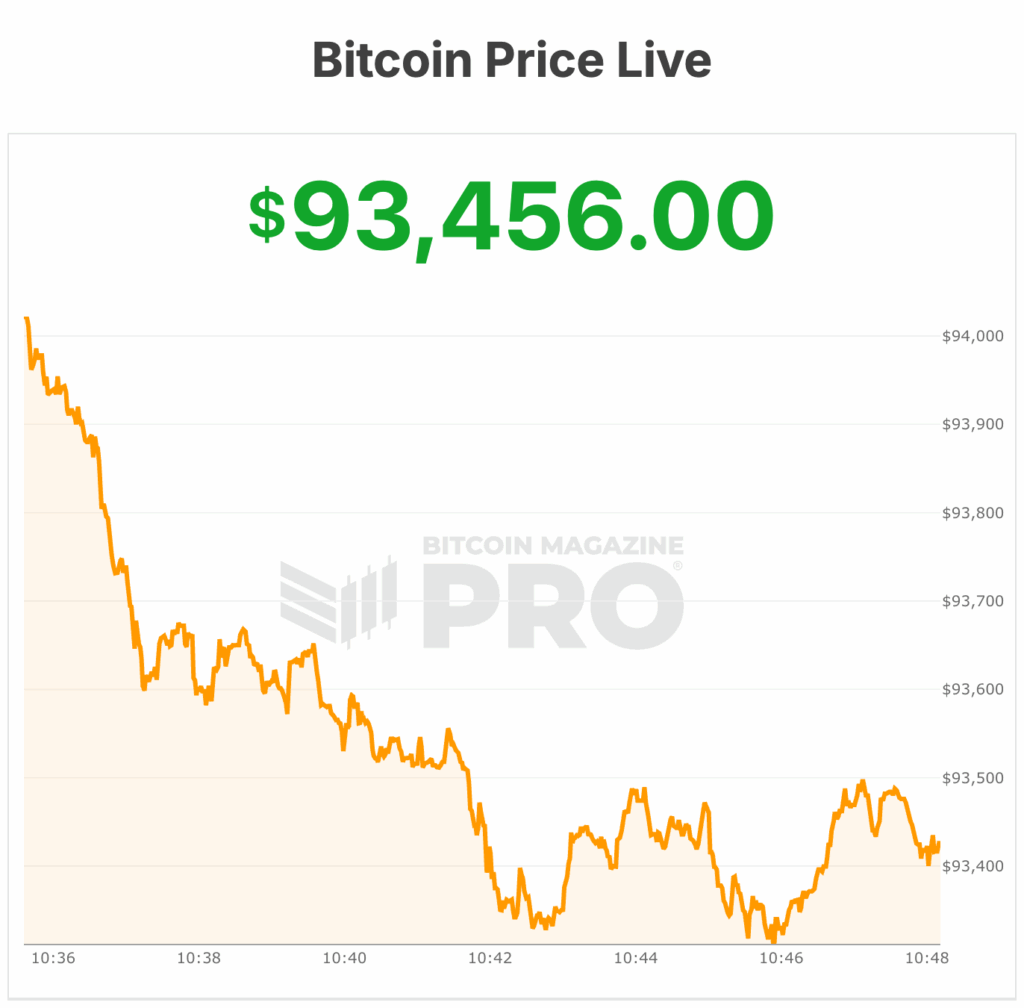
The bitcoin price is trading near $94,100 today, reaching levels last seen in early December. The price briefly touched an intraday high of $94,352 after opening the year near $87,400 on Jan. 1, per Bitcoin Magazine Pro data.

As of this morning, bitcoin was changing hands around $94,000, according to market data, putting it within 1% of its recent seven-day high.

The rally pushed bitcoin’s market capitalization to roughly $1.87 trillion, with daily trading volume hovering near $51 billion. Bitcoin’s circulating supply stands just under 20 million coins, out of a fixed cap of 21 million.

The move higher followed a period of sideways trading through late December, when the bitcoin price struggled to break above resistance near $91,000. That level has since turned into short-term support, opening the door to a renewed test of the $94,000 – $98,000 range that capped prices for much of the past two months.

Geopolitics and the hedge narrative

Bitcoin’s rebound coincided with weekend reports that the United States had captured Venezuelan President Nicolás Maduro, a development that rippled across commodity and crypto markets. 

Oil stocks jumped on expectations that Venezuela’s energy sector could reopen under new leadership, while crypto-linked equities such as Coinbase and Strategy each rose more than 4%.

Analysts cautioned that the event itself was not a direct catalyst for bitcoin. Instead, it reinforced bitcoin’s role as a hedge against geopolitical pressures and sanctions risk.

“Escalating pressure without direct military conflict is supportive of bitcoin,” said Dean Chen, an analyst at crypto derivatives exchange Bitunix. He pointed to historical patterns in which tighter sanctions, capital controls or restrictions on the global banking system have coincided with increased real-world bitcoin usage.

Bitcoin price options market targets six figures and ETF inflows return

Derivatives markets suggest traders are positioning for further upside. On Deribit, the world’s largest crypto options exchange, open interest has surged in January call options with a $100,000 strike price.

The $100,000 January call has become the most popular contract on the platform, with total notional open interest reaching about $1.45 billion.

Spot bitcoin exchange-traded funds have also reemerged as a key driver. U.S.-listed bitcoin ETFs recorded nearly $700 million in net inflows on Monday, the strongest single-day total since October, according to industry data.

That demand represents more than 7,000 BTC, far exceeding daily new issuance from miners. Sustained ETF buying can tighten available supply and support higher prices, particularly when paired with declining balances on exchanges.

On-chain data shows roughly $1.2 billion worth of bitcoin was withdrawn from exchanges over the past 24 hours, a sign that investors are moving coins into self-custody rather than preparing to sell.

Bitcoin price technical levels

From a technical perspective, bitcoin price’s breakout from a multi-week consolidation has shifted attention to resistance near $98,000. A move above that level could bring the psychological $100,000 mark back into play, a threshold bitcoin failed to hold during late-2025 rallies.

Support for bitcoin price now sits near $91,400, with stronger backing around $87,000 if prices pull back. A failure below $84,000 would weaken the bitcoin price near-term structure, though longer-term bulls argue that rising yearly lows continue to define bitcoin’s broader uptrend.

For now, traders enter the new year with momentum on their side. Whether bitcoin price can turn the early-January surge into a sustained breakout will depend on continued ETF demand, options market dynamics and how global macro risks evolve in the weeks ahead.

bitcoin price

This post Bitcoin Price Jumps 8% Into New Year as Bullish Momentum Builds first appeared on Bitcoin Magazine and is written by Micah Zimmerman.

Morgan Stanley Seeks SEC Approval for Spot Bitcoin ETF

Bitcoin Magazine

Morgan Stanley Seeks SEC Approval for Spot Bitcoin ETF

Morgan Stanley has filed with U.S. regulators to launch a spot bitcoin exchange-traded fund, marking the first time a major U.S. bank has sought approval to issue an ETF tied directly to the price of bitcoin.

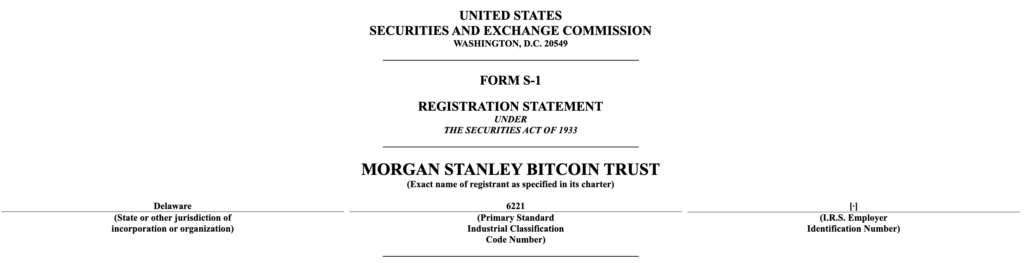
The filing, submitted to the Securities and Exchange Commission, proposes the Morgan Stanley Bitcoin Trust, an exchange-traded fund designed to track the price of bitcoin, net of fees and expenses. 

If approved, the fund would hold bitcoin directly rather than relying on futures, derivatives, or leverage, according to the registration statement.

The move places Morgan Stanley alongside asset managers that have dominated the bitcoin ETF market since regulators approved the first U.S. spot products in early 2024. 

Those funds now manage more than $120 billion in assets, representing a meaningful share of bitcoin’s total market value. Much of that growth has flowed into bitcoin-only products from firms such as BlackRock and Fidelity.

Morgan Stanley’s entry signals a shift by large banks from distributing third-party crypto products toward issuing their own. 

Until recently, U.S. banks largely limited their role to custody and brokerage services, citing regulatory uncertainty and risk controls. That stance has begun to change as federal agencies clarified how banks can engage with digital assets.

In December, the Office of the Comptroller of the Currency said banks may act as intermediaries for crypto transactions, narrowing the divide between traditional finance and digital markets. The SEC has also adjusted listing standards for spot crypto ETFs, smoothing the approval path for new issuers.

Morgan Stanley steps deeper into bitcoin

The proposed bitcoin trust would be sponsored by Morgan Stanley Investment Management. Shares would be created and redeemed in large blocks by authorized participants, either in cash or in kind. 

The fund’s net asset value would be calculated daily using a pricing benchmark based on activity across major spot bitcoin exchanges. Retail investors would trade shares on a secondary market through standard brokerage accounts.

For Morgan Stanley, the filing builds on steps taken last year to expand crypto access across its wealth management business. In October, the bank widened eligibility for crypto investments to include all clients and account types.

By offering a proprietary bitcoin ETF, the firm can integrate the product directly into client portfolios and retain management fees that might otherwise go to rival issuers.

The move also reflects the economics of the bitcoin ETF market. Spot bitcoin funds have become some of the fastest-growing products in the U.S. ETF industry, with steady inflows even during periods of price volatility. BlackRock’s bitcoin ETF emerged as one of the firm’s top revenue contributors within its first year.

Morgan Stanley also filed paperwork for a similar fund tied to Solana, but bitcoin remains the core focus of institutional demand. Most assets in U.S. crypto ETFs are concentrated in bitcoin products, while funds linked to other tokens have drawn limited capital.

morgan stanley

This post Morgan Stanley Seeks SEC Approval for Spot Bitcoin ETF first appeared on Bitcoin Magazine and is written by Micah Zimmerman.

❌