Reading view

There are new articles available, click to refresh the page.

Chainlink On Standby: A Big Move Is Loading, But Bitcoin Decides

Chainlink remains on standby as daily candles continue to show indecision, keeping traders on edge. The next significant move for LINK largely depends on Bitcoin’s momentum, with bulls and bears waiting for a clear signal before committing. Until then, the market is in a holding pattern, building tension for the breakout or breakdown.

Traders Await Clear Direction For Chainlink

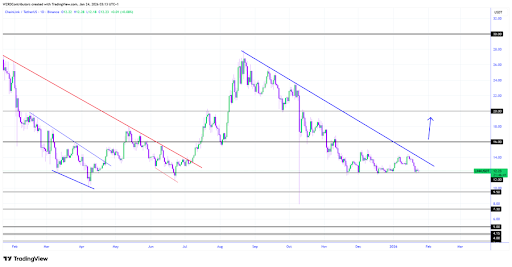
According to an update from CryptoWzrd, the daily candles for both Chainlink and LINKBTC continue to print indecisive price action, reflecting a lack of strong conviction from either side of the market. Despite recent movements, neither buyers nor sellers have been able to establish a clear directional edge, keeping the broader outlook neutral for now.

To gain a reliable directional bias and unlock higher-probability trade opportunities, healthier and more decisive daily candles are required, as price could continue to chop within its current range. Bitcoin is expected to remain the primary driver of the next significant move. In particular, LINKBTC needs to print another bullish daily candle in the coming week to maintain any constructive momentum. 
Chainlink

Failure to do so could shift the balance back in favor of the bears and increase downside pressure. A continuation of weakness would likely result in a break of the daily lower-high trendline, followed by a loss of the critical $12 support level. 

On the bullish side, if Bitcoin provides the necessary support, LINK could attempt a recovery rally toward the $16 resistance zone. Until a clearer higher-timeframe structure emerges, the trading focus remains tactical. Attention will be placed on the lower-timeframe charts, particularly over the weekend, to capitalize on quick, short-term opportunities while avoiding unnecessary exposure to indecisive daily conditions.

Intraday Chart Shows Tight Range, Market Lacks Clear Direction

The analyst concluded that the intraday chart remains choppy, with price action tightly compressed within a narrow range. Such conditions point to persistent market indecision, in which neither bulls nor bears have shown sufficient conviction to drive a sustained move in either direction. As a result, trade setups lack clarity and carry elevated risk.

From a tactical perspective, a retest of the $13 resistance level, followed by clear signs of rejection or fading momentum, could open the door to a short opportunity. However, if price holds above $13 with strong acceptance, that would place the market in more constructive territory and tilt the bias back in favor of the bulls.

Until one of these scenarios plays out decisively, the analyst emphasized the importance of waiting. A more mature and well-defined chart structure is needed before engaging in the next trade, ensuring better confirmation, cleaner entries, and improved risk-to-reward conditions.

Chainlink

Chainlink (LINK) Stuck In A Box: What The Current Price Channel Means For Traders

Chainlink’s native token, LINK, continues to trade within a clearly defined price channel, reflecting a period of consolidation as the broader crypto market is yet to establish a clear market direction. Meanwhile, renowned analyst Ali Martinez provides some key insights on the LINK market, highlighting the potential price targets for the next breakout.

Chainlink In Compression Phase Between $12-$15 — What Next? 

In a recent X post, Martinez shares an analysis of the LINK 12-hour chart, which shows the altcoin has been range-bound between key support at $11.89 and resistance near $14.64, a structure that has remained intact over multiple trading sessions stretching back to 2025. This price behavior implies that neither bulls nor bears have been able to assert sustained control as each attempt to push higher has been capped near the upper boundary of the channel, while pullbacks have consistently found buyers around the $11.89 support zone. 

Chainlink

From a technical standpoint, the channel highlights a phase of consolidation following earlier volatility. Therefore, this structure may be laying the groundwork for a more decisive move once the price escapes the current boundaries. 

The $14.64 resistance level remains the key hurdle for bullish continuation. A confirmed breakout above this zone, ideally supported by rising volume, could reignite upside momentum with potential targets set at $17.00. On the downside, a loss of the $11.89 support could change the technical outlook, exposing LINK to deeper retracements, with potential around $10.00. For now, however, this support has held firm, reinforcing the validity of the channel and keeping bearish momentum in check.

LINK Market Overview

At press time, LINK trades at $12.21, reflecting a major loss of 10.95% in the last seven days amid a general market downturn. However, the monthly loss of just 1.09% indicates that downside momentum remains relatively contained, suggesting that recent selling pressure may be corrective rather than structural and that many new market entrants could soon return to profit if prices stabilize.

In other news, Chainlink has completed the acquisition of Atlas, the order flow auction protocol developed by FastLane. According to the blockchain team, this move strengthens Chainlink’s value capture stack by expanding the reach of Chainlink SVR into the new DeFi ecosystem, thereby helping improve MEV recapture.  With a market cap of $8.65 billion, Chainlink is ranked as the 13th largest digital asset in the world.

Chainlink

How to prepare for the next big mobile outage

Verizon recently suffered a significant outage that left millions across the US without calls, texts, or internet for an entire day. This was a huge hit, restricting friends’ and families’ ability to communicate and forcing some businesses to shut down for the day. What can you do to protect yourself from the next time a mobile network goes down?

[InterLink by Design #2] The 100 Billion Question: Why InterLink Built a Filter, Not a Pump

Supply is not designed for price. It is designed for roles.

In [Part I], we dismantled a common assumption: that Web3 payments require a native stablecoin.

We established that InterLink doesn’t “mint” stability through a dollar peg. Instead, it enforces stability through settlement rules, identity verification, and controlled distribution.

🔗LINK[InterLink by Design #1]

Once you accept that premise, a deeper question emerges:

If InterLink isn’t optimizing for price stability through a stablecoin, what exactly are its token numbers optimizing for?

This is where most analyses break down — and where design, not speculation, becomes decisive.

AI-generated image for illustrative purposes. Not a real photograph.

🎰 The “Price-First” Trap: A Legacy of Gambling

The crypto industry has spent a decade perfecting the art of gambling.
Now, it’s time to start perfecting the art of survival.

Most token supplies are designed backwards — starting from price expectations rather than system behavior.

They collapse into “Price Anxiety,” obsessing over whether a supply is scarce enough to pump or when the next unlock will hit. This is the manufacture of early hype through artificial scarcity.
​​

InterLink does not play the price-first game.
Its numbers are built to withstand time — not to excite markets today.

🔋 Supply as Capacity, Not Scarcity

Here is the inversion most people miss:
Token supply does not set price. It sets access.

InterLink’s dual-token structure is built on this very principle.

  • ITLG: A participation container. 🥣
  • ITL: A settlement and utility asset. ☕🍞

​These quantities aren’t signals to traders; they are load-bearing limits for human behavior.

Asking if 100 billion ITLG is “too much” misses the point. The real question is:

How many humans, actions, and years must this system absorb without breaking?

🌊 Why ITLG Must Be Large: The Participation Container

ITLG’s supply is intentionally expansive because its role is expansive. ITLG is not “money” in the traditional sense;

it is Proof of Participation.

To achieve global scale, the system must support:

  • Massive global onboarding. 🌍
  • Decade-long time horizons. 🕰️
  • Uneven human contributions. 📊
  • Activity-weighted (not capital-weighted) distribution. 🏃

A small supply would create scarcity at the participation layer, immediately giving an advantage to those with capital (gatekeeping).

Instead, InterLink allows ITLG to be abundant before it becomes valuable.

That value is earned later — through verification.

⚙️ The Filter: Raw ITLG vs. Verified ITLG

Raw ITLG is easy to earn. Verified ITLG is not.

Between the two sits a sophisticated qualification layer:

  • Human Credit Score (HCS)
    A filter for genuine human behavior.
  • Consistency ⏱️
    Reward for the “time-spent” variable.
  • Security Groups 🛡️
    Network-level trust participation.

Activity ≠ Ownership. Only verified behavior converts participation into on-chain assets.

Supply is abundant.
Value is conditional.

⚓ Why ITL Must Be Limited: The Trust Anchor

If ITLG is about inclusion, ITL is about trust.

Settlement assets cannot be infinite. A currency that anyone can mint freely isn’t a currency — it’s noise.

Therefore, ITL is: 🚫

  • Not mined directly.
  • Not freely issued.
  • Not accessible without verified participation.

​Every unit of ITL originates from qualified ITLG activity. It is allocated, not exchanged.

💡 Done.T’s Note

ITL is a defensive outcome — strictly capped at 10% of the total ITLG supply.

It is not designed to flood the market, but to anchor it. Because of this 10% constraint, every unit of ITL is released Slowly. Deliberately. Defensively.

🔢 What These Numbers Are Actually Doing

InterLink’s token quantities don’t perform “Scarcity Theater.”

​They enforce Role Separation 🔀

  1. Abundant Participation vs. Restricted Settlement.
  2. Open Entry vs. Controlled Output.
  3. Human Activity vs. Monetary Consequence.
Price prediction is the wrong lens.
The real question isn’t how high it goes, but how long it holds.

🏁 Conclusion: Defensive Design

InterLink’s numbers are defensive by design.

They don’t manufacture scarcity for the sake of a chart; they reserve scarcity for the precise layer where it is required for trust.

​Participation is open.

Ownership is earned.

Settlement is protected.

InterLink’s token numbers do not predict price.

They enforce who is allowed to matter — over time.

🔜 Continue to Part III:
🔗 Retail vs. Institutions: Who Actually Holds the Power in InterLink?

About the Author

Done.T is a Web3 analyst specializing in the InterLink ecosystem.
He unpacks the underlying logic of the Human Node economy, translating complex system design into actionable, data-driven insights for a global audience.

Reference
🔗 [Chapter 2. The Deep Dive — Mechanics & Insights]​

Disclaimer: This article provides a strategic analysis of InterLink’s publicly available infrastructure and documentation.
It is not financial advice. Readers should conduct their own due diligence.


[InterLink by Design #2] The 100 Billion Question: Why InterLink Built a Filter, Not a Pump was originally published in Coinmonks on Medium, where people are continuing the conversation by highlighting and responding to this story.

Chainlink Drops To $12.50, But Largest Whales Are Accumulating

On-chain data shows the largest of Chainlink whales have been accumulating recently even as the cryptocurrency’s price has slipped below $13.00.

Top 100 Chainlink Whales Have Been Expanding Their Supply

In a new post on X, on-chain analytics firm Santiment has talked about the latest trend in the holdings of the 100 largest addresses present on the Chainlink network.

This category of holders naturally includes the large whales, investors who carry sums significant enough to have some influence on the blockchain. As such, their combined supply can be worth keeping an eye on.

Below is the chart shared by Santiment that shows the trend in the supply of the 100 largest Chainlink addresses over the last few months.

Chainlink Whale Supply

As displayed in the graph, the Chainlink supply held by the top 100 addresses went up in November as the cryptocurrency’s price plummeted, a possible sign that big-money investors were loading up.

These whales shed some of their holdings in December and the first week of January, but recently, they have showed signs of renewed accumulation as LINK’s price has plunged below the $13.00 level. Compared to the start of November, the cohort’s holdings are up 16.1 million tokens.

“As retail sells off due to impatience & FUD, it’s common to see smart money gather up more $LINK to prepare for (or cause) the next pump,” explained the analytics firm. It now remains to be seen whether this accumulation will have any effect on the cryptocurrency.

Chainlink isn’t the only asset that has seen movements from large investors recently. As Santiment has highlighted in another X post, Bitcoin sharks and whales have participated in net buying over the last nine days.

In the context of BTC, sharks and whales are defined as investors holding between 10 to 10,000 tokens. Below is a chart that shows how the supply of these investors has changed since late July.

Bitcoin Sharks & Whales

As is visible in the graph, the Bitcoin sharks and whales have increased their combined supply by 36,322 BTC in the last nine days, equivalent to an increase of 0.27%. Interestingly, the large investors have held on despite the fact that the asset’s price has gone through a retrace over the past few days.

However, the same hasn’t been true for the opposite end of the market, the retail entities. These investors, corresponding to addresses holding less than 0.01 BTC, have shed 132 BTC (0.28%) in the same window.

LINK Price

At the time of writing, Chainlink is floating around $12.33, down more than 10% in the last seven days.

Chainlink Price Chart

Fight for the Future, EFF, Others Push Back Against Growing ICE Surveillance

facial recognition, surveillance, camera, security, data

The privacy rights group Fight for the Future was one of 44 organizations that sent a letter to lawmakers urging them to pull back on funding for ICE, noting the growing threats to U.S. citizens and others as the agency spends millions of dollars on its growing surveillance capabilities.

The post Fight for the Future, EFF, Others Push Back Against Growing ICE Surveillance appeared first on Security Boulevard.

DeFi Gains 24/5 Access to U.S. Equity Market Data, Chainlink Brings $80Tn Stock Market Onchain

Major oracle platform Chainlink has expanded its Data Streams with the launch of the novel 24/5 U.S. Equities Streams, providing market data for U.S. equities and ETFs across trading sessions 24 hours a day, 5 days a week.

Per the announcement, Data Streams is available on more than 40 blockchains. It allows protocols to build onchain equity markets that are not limited to standard U.S. trading hours. They can build equity perps and prediction markets, among others.

Moreover, a number of protocols already utilise the Chainlink 24/5 U.S. Equities Streams. These include Lighter, BitMEX, ApeX, HelloTrade, Decibel, Monaco, Opinion Labs, and Orderly.

JUST SHIPPED: Chainlink 24/5 U.S. Equities Streams brings the ~$80T U.S. equities market onchain.

Fast, secure stock & ETF data is now live across 40+ chains—24 hours a day, 5 days a week.

Trusted by @lighter_xyz, @BitMEX, @OfficialApeXdex, & more.

🧵https://t.co/DMzBK5yJ71

— Chainlink (@chainlink) January 20, 2026

Chainlink states that they built the 24/5 Streams on their Chainlink Data Standard. The latter has so far enabled over $27 trillion in transaction value and delivered over 19 billion total verified messages onchain. It also claims to have secured some 70% of oracle-related DeFi.

Additionally, the new offer includes bid and ask price, bid and ask volume, mid price, last traded price, staleness indicator, and market status flags.

Per the team, “For the first time, DeFi has secure access to U.S. equity market data that also includes after-hours and overnight sessions, unlocking the ~$80T U.S. stock market onchain.”

Moreover, 24/5 U.S. Equities Streams resolve several significant issues, its creators say.

Primarily, reliable sub-second pricing – available 24 hours a day across regular, pre-market, post-market, and overnight sessions – removes pricing gaps, blind spots during off-hours, and the risk of stale reference prices.

Beyond data price, 24/5 Streams offers asset data for financial applications for “a more complete picture of market conditions.” The data enables “smarter pricing logic, enhanced risk management, and faster execution for onchain protocols,” Chainlink says.

Transforming Fragmented Equity Market Data Into Continuous Streams

According to Chainlink, 24/5 U.S. Equities Streams come with expanded coverage and enhanced data schemas, enabling a variety of onchain use cases.

Traders can work with stocks and ETFs onchain all day for most of the week, be it for trading, lending, or another purpose.

Also, the product provides builders with risk controls, safer execution, and advanced logic, all via market data.

Use cases include:

  • building perpetuals and derivatives 24 hours a day;
  • creating prediction markets for accurate resolution;
  • creating synthetic equities and ETFs;
  • operating lending markets: dynamic margining, collateral valuation, and risk management;
  • enabling structured products and vaults: new yield and exposure strategies tied to U.S. equities.

.@lighter_xyz, the #2 perp DEX by volume and largest ZK rollup on Ethereum, leverages Chainlink as its official RWA oracle.

By integrating Chainlink's 24/5 Equities Streams as its primary oracle, Lighter is unlocking new low-latency markets that go beyond standard trading hours. pic.twitter.com/1besjKyN8f

— Chainlink (@chainlink) January 20, 2026

Meanwhile, the press release went into the key issue the novel product aims to resolve. It explains that, while real-world assets (RWAs) are seeing fast onchain adoption, U.S. equities remain “significantly underrepresented.” And yet, the latter is one of the world’s largest and most liquid asset classes, the team argue.

The reason is structural, they explain. Blockchain-enabled trading operates nonstop. However, U.S. equity markets trade across fragmented sessions during dedicated market hours.

Also, most onchain data solutions provide only one price point for equities during standard trading hours. This creates two interrelated issues:

  • a gap where onchain markets are unable to reliably replicate market conditions all 24 hours of the day:
  • pricing blind spots, increased risk during off-hours, and difficulty building secure, scalable equity-based financial products onchain.

Chainlink 24/5 U.S. Equities Streams solves this “by transforming fragmented U.S. equity market data into continuous, cryptographically signed Data Streams,” the announcement says. “As a result, traditional markets can properly operate onchain.”

The post DeFi Gains 24/5 Access to U.S. Equity Market Data, Chainlink Brings $80Tn Stock Market Onchain appeared first on Cryptonews.

Cardano Head To Wall Street As CME Plans New Futures Products – What This Means For ADA

Bullish sentiment is gradually returning to the broader cryptocurrency space, and Cardano (ADA) is seeing growing institutional interest and adoption. Even though its price remains in a consolidation phase, several moves are being made to showcase Cardano’s relevance in the global finance sector.

CME To Broaden Crypto Offering With Cardano Futures

One of the most recent announcements making the headlines in the cryptocurrency sector is the Chicago Mercantile Exchange (CME) Group’s move to expand its crypto portfolio, choosing Cardano as one of the major coins. The CME is preparing to increase the scope of its crypto derivatives offering and take a further step toward the institutionalization of digital asset markets, with the introduction of futures contracts for Cardano (ADA) and Chainlink (LINK)

By adding ADA and LINK futures to its platform, CME is strengthening the function of regulated derivatives as an entry point for institutional involvement in the developing cryptocurrency ecosystem. This action demonstrates the rising significance of other blockchain networks in global finance. It also reflects the growing demand from professional traders seeking regulated exposure outside of Bitcoin and Ethereum, the two largest crypto assets.

According to Lucas Macchiavelli, a Cardano ambassador and blockchain strategist, this could be the strongest institutional validation in ADA’s history, and it might be the largest sign of approval the leading altcoin has ever gotten. Macchiavelli added that this is not just another listing since the move expands the network’s role in digital finance operations.

The strategist’s claims major hinges on the fact that the CME Group is the largest derivatives exchange in the world, which is increasingly used by banks, hedge funds, asset managers, and institutional investors across the globe. Currently, this goes beyond Cardano. 

Macchiavelli stated that this kind of action sends a signal to the entire cryptocurrency market, improving price discovery, deepening capital access, increasing institutional visibility, and making it easier for traditional finance to participate. “This is how crypto keeps moving into the financial mainstream,” the expert added.

Data On The ADA Stays Written

Crypto expert Dave stated that Cardano is exceptionally well-suited to real-world use cases like traceability because once data is written on the network, it stays written. There is no rewriting history, no ambiguity, just facts that are retained exactly as they were recorded.

Such performance underscores its immutability, which is backed by over 8 years of continuous reliability. Cardano network has been continuously operating, developing, and securing genuine worth while being enhanced between. This is key when trust, verification, and accountability are required in real-world governance by compliance and regulation.

According to the expert, the network quietly stands apart in a world of transparency and reliability. With this, ADA goes beyond the status of a store of value. It is also considered a store of truth, continuity, and real utility.

Cardano

Chainlink Ignites Swift’s Multi-Bank Tokenization Breakthrough

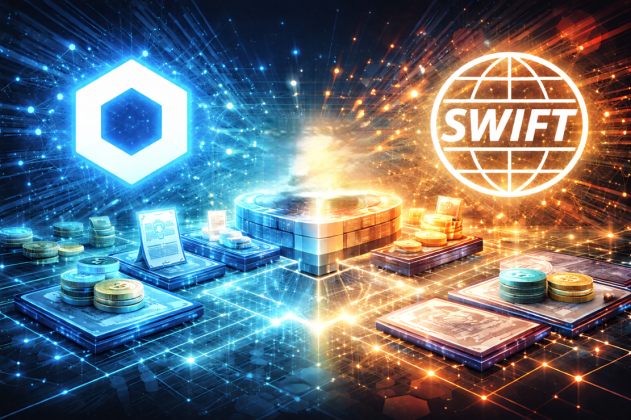
Swift has completed a new set of digital asset interoperability trials with BNP Paribas Securities Services, Intesa Sanpaolo, and Société Générale’s tokenization unit SG-FORGE, extending work that also includes Chainlink and UBS Asset Management as the messaging network pushes deeper into tokenized capital markets workflows. The project matters because it targets the hardest part of institutional tokenization: getting assets, cash, and operational processes to move cleanly across multiple platforms without forcing banks to abandon existing rails.

Swift Hits Tokenized-Asset Interoperability Milestone

Chainlink posted via X on Jan 15: “As part of Swift’s work with Chainlink & UBS Asset Management, Swift completes landmark interoperability milestone with BNP Paribas, Intesa Sanpaolo, & Société Générale.”

The trial, which Swift described as a “landmark” milestone, focused on the “seamless exchange and settlement of tokenized bonds,” with payments supported in both fiat and digital currencies. Swift said the work covered delivery-versus-payment settlement and key lifecycle events including interest payouts and redemption, with participants taking on familiar market roles such as paying agent, custodian and registrar.

Swift framed the outcome as a step beyond point integrations. It said this was “the first time we have demonstrated our ability to orchestrate tokenized asset transactions as a single, coordinated process across both blockchain platforms and traditional systems,” positioning Swift as a neutral coordinator in a market that is rapidly splintering across chains, protocols, and settlement stacks.

A key element of the project ran through SG-FORGE’s infrastructure. Swift said the trial “harness[ed] their digital asset and EURCV stablecoin” to enable DvP settlement for tokenized bonds using both fiat and stablecoins, while also supporting the bond lifecycle events tested in the exercise. BNP Paribas Securities Services and Intesa Sanpaolo acted as paying agents and custodians, and Swift argued the settlement flows executing “over Swift” showed tokenized bonds can leverage existing infrastructure rather than forcing institutions into bespoke blockchain plumbing.

The network also highlighted standards alignment, saying the initiative showcased integration of ISO 20022 messaging with “blockchain-native platforms,” a detail that speaks directly to operational adoption for firms already running ISO-native post-trade and payments processes.

Thomas Dugauquier, Swift’s tokenised assets product lead, cast the effort in institutional terms: “This milestone demonstrates how collaboration and interoperability will shape the future of capital markets. It’s about creating a bridge between traditional finance and emerging technologies.”

Chainlink’s Role

While the bond trial involved European banking counterparts, Swift explicitly tied the work to a broader sequence of pilots, including “bridging tokenized assets with existing payment systems with UBS Asset Management and Chainlink.” In that earlier UBS pilot, Swift, UBS Asset Management and Chainlink tested a model for settling tokenized fund subscriptions and redemptions while keeping cash settlement compatible with existing fiat rails carried over Swift’s network footprint.

Swift also pointed to other recent experiments spanning fiat and digital currency settlement with Citi, digital asset transaction exchange with Northern Trust and the Reserve Bank of Australia, and ISO 20022-based blockchain interoperability with HSBC and Ant International.

Beyond technology, Swift said it has submitted proposed market practice guidelines to the Securities Market Practice Group, arguing that innovation in digital assets should not come “at the expense of systemic stability” and that clearer practices can reduce onboarding complexity for institutions.

With the trial series “now complete,” Swift said it is focused on adding “a blockchain-based ledger” to its infrastructure stack, starting with real-time, 24/7 cross-border payments “designed in collaboration with over 30 banks worldwide.”

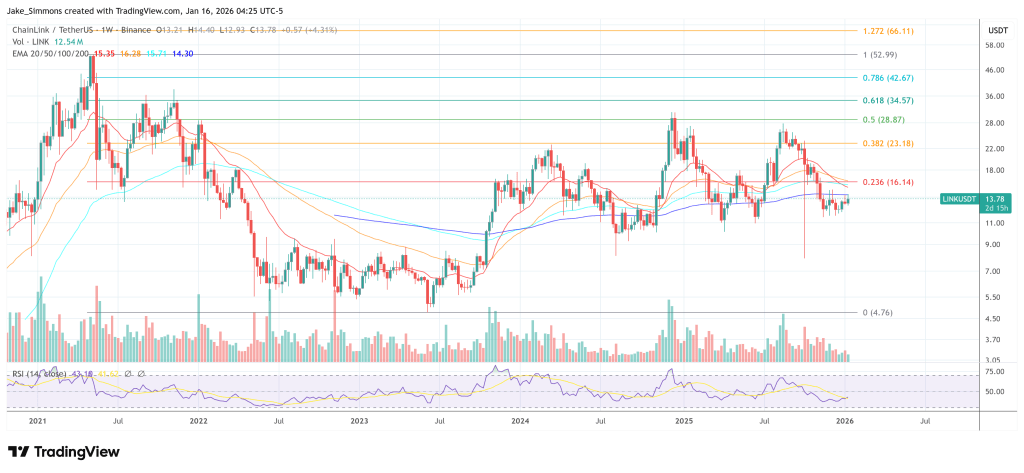
At press time, Chainlink (LINK) traded at $13.78.

Chainlink price chart

Money as Infrastructure: The Rise of the First Monetary Protocol

[The Shift of Monetary Power #3] Currencies Denominate; Protocols Coordinate.

🔙 In Part 2, we discussed a looming “structural mismatch” between the U.S. dollar and the emerging economic era.

🔗 LINK [The Shift of Monetary Power #2]

Beyond Borders: From Nation-States to Global Platforms

While the dollar was designed for a world of nation-states, human intermediaries, and territorial boundaries, the rise of AGI and global platforms demands something else: borderless continuity, algorithmic coordination, and machine-speed settlement.

This friction cannot be resolved through policy alone. As production migrates into digital and algorithmic environments, we must ask a fundamental question:

What kind of monetary system can function natively within this new architecture?

To find the answer, we must stop viewing money as a mere commodity and start seeing it as a structural coordination layer.

AI-generated image for illustrative purposes. Not a real photograph.

⚠️ Why “Digital” Alone Is Not Enough

It is tempting to assume that existing digital assets like Bitcoin or Ethereum will automatically fill this void.

However, many current crypto-assets remain structurally disconnected from real-time production. They are excellent at moving or storing value, but they often lack the “sensory” capacity to measure the quality of participation or the consistency of contribution within a network.

The next evolutionary step isn’t just a “digital currency” — it is a Monetary Protocol. A system that doesn’t just denominate value, but serves as the nervous system that coordinates it.

📋 Five Requirements for a Post-Industrial Monetary Layer

For any system to emerge as a viable alternative in this gravitational shift, it must satisfy five structural criteria:

  1. Production-Coupled Issuance 🧲: Value must be linked to verified participation.
  2. Identity-Aware Design 🛡️: The ability to distinguish humans from AI agents without centralized surveillance.
  3. Native Digital Settlement : Programmable settlement that operates at the speed of the networks it serves.
  4. Adaptive Governance 💠: Rules dictated by network trust and data, not political cycles.
  5. Transition Compatibility 🌉: The ability to operate alongside and enhance existing financial rails rather than seeking their immediate destruction.

📑 A Case Study in Structural Innovation: InterLink

While several projects are exploring these frontiers, InterLink represents one of the most compelling models for how a monetary protocol can be architected from the ground up.

Separation of Roles: ITLG vs. ITL

Most monetary systems fail by forcing a single asset to be both a store of value and a medium of exchange, often leading to a “velocity trap.” InterLink resolves this by separating ITLG (Qualification) from ITL (Utility).

ITLG is not something you buy; it is earned through consistent participation and serves as your verified “standing” within the protocol.

By separating status from liquidity, the system ensures that value accrual does not hinder the speed of commerce.

✅ Human Nodes: Presence as the New Production

In the industrial era, production was measured by physical output.

In the era of global platforms, production is Presence, Availability, and Coordination. InterLink’s “Human Node” model captures this shift by recording behavioral continuity rather than hardware power or capital leverage.

This moves the needle from “Proof of Wealth” to “Proof of Presence,” offering a more equitable framework for the Global South.

✅ Trust as an Algorithmic Variable (HCS)

Trust is often a vague social concept, but InterLink implements it as a computed variable. The Human Credit Score (HCS) evaluates longitudinal patterns of activity. Two users might hold the same balance, but their “weight” in the network is determined by their history of reliable behavior.

In this model, fairness is not an empty promise; it is an algorithmic output.

🕊️ Settlement Without Conflict

InterLink avoids the common pitfall of unnecessary confrontation with the state. Instead of trying to replace national currencies or regulated stablecoins, it seeks to operate beneath them as a coordination layer.

By providing a verified trust-infrastructure, it becomes a tool that existing financial systems can use to qualify and filter digital participation.

🏁 Final Reflection: From Currency to Infrastructure

We are not witnessing a total collapse of existing currencies, but rather the emergence of a parallel trust layer designed for the complexities of digital production.

In this new environment, the decisive question is no longer what the money is called, but what system grants the right to generate and settle it.

Money has evolved beyond being a simple unit of account; it has become infrastructure.

Protocols like InterLink provide an essential roadmap for how this infrastructure might look as we move into a world where trust is algorithmic and production is digital.

The shift is no longer a distant possibility — it is an architectural inevitability.

About the Author

Done.T is a Web3 analyst specializing in the InterLink ecosystem.
He unpacks the underlying logic of the Human Node economy, translating complex system design into actionable, data-driven insights for a global audience.

Reference
🔗 [Chapter 3. The Evolution — The Macro Thesis]

​​​

Disclaimer: This content is for educational purposes only and does not constitute financial advice. All insights and interpretations reflect the author’s independent analysis of the InterLink ecosystem and its architectural role in the evolving monetary landscape, based on publicly available technical data and documentation.


Money as Infrastructure: The Rise of the First Monetary Protocol was originally published in Coinmonks on Medium, where people are continuing the conversation by highlighting and responding to this story.

Russia equips new attack drones with Starlink-type terminals

Russia has equipped a BM-35 one-way attack drone with a Starlink-type satellite terminal, Ukrainian specialists said after the aircraft was shot down and examined this week. According to Serhii Beskrestnov, known by the call sign “Flash,” the recovered drone showed clear evidence of remote control through the Starlink system. “For the first time, the fact […]
❌