Entropy, a decentralized crypto custody startup backed by Andreessen Horowitz (a16z), is winding down and plans to return remaining capital to investors, according to founder and chief executive Tux Pacific.
Pacific wrote on X over the weekend, “I am winding-up Entropy.” They added, “After four years, several pivots, and two rounds of layoffs, I’ve decided to wind-up Entropy and return capital to our investors.”
Crypto Automation Bet Fell Short After Investor Feedback
The shutdown follows a late-stage push in 2025 to reposition the company around a crypto automations platform, which Pacific described as “basically n8n/zapier/etc for crypto,” with automated signing via threshold cryptography, secure computation using trusted execution environments, and “deep AI integrations.”
I am winding-up Entropy.
After four years, several pivots, and two rounds of layoffs, I’ve decided to wind-up Entropy and return capital to our investors.
For the latter half of 2025, the Entropy team was hard at work on a crypto automations platform (basically n8n/zapier/etc…
That product direction still failed to clear a venture-style growth bar. “After an initial feedback request revealed that the business model wasn’t venture scale, I was left with the choice to find a creative way forward or pivot once more,” Pacific wrote.
Entropy first drew attention in 2022 when it raised $25M in a seed round led by a16z crypto, with participation including Dragonfly Capital, Coinbase Ventures, Robot Ventures, Ethereal Ventures, Variant and Inflection. The company had earlier raised a $1.95M pre-seed round.
Founder Looks Beyond Digital Assets Toward Pharmaceuticals Research
At launch, Entropy pitched itself as a decentralized alternative to custody providers such as Fireblocks and Coinbase, leaning on cryptographic approaches like multi-party computation to let users control how funds could move, including rule-based constraints.
Pacific also thanked a16z crypto and Guy Wuollet for helping steer the wind-down, calling their guidance “invaluable.”
The closure lands in a tougher funding climate for early-stage crypto startups. Crypto venture deal count fell about 60% year-on-year in 2025, dropping to roughly 1,200 transactions from more than 2,900 in 2024.
Next, Pacific said they plan to step back before deciding what comes after Entropy. “My time in crypto might be coming to an end, as I feel myself drawn specifically into pharmaceuticals,” they wrote, adding they want to work on hormone delivery and validate research on new estradiol drug formulations.
Crypto traders often assume that meaningful gains need long timelines to take place, and they often give up during the wait and silence. However, crypto has a habit of shattering that belief without warning. History shows that when conditions line up, altcoins do not grind higher over years. They release and erase multiple years of drawdowns in a matter of weeks.
That memory was highlighted by a crypto commentator known as Waterman on the social media platform X, who noted a familiar seasonal window between February and late April to early May for an altcoin explosion.
Speed Matters More Than Time
The most notable example of an altcoin rally season was in 2021, when the entire altcoin market went on a rally to new all-time highs, many of which are still unbroken for some cryptocurrencies.
The 2021 cycle delivered some of the clearest reminders of just how fast capital can rotate once momentum takes hold. Solana moved from roughly $20 to $200 in about 50 days, a clean tenfold run. Although Solana has since broken above this peak to register a new all-time high of $293 in January 2025, this was still Solana’s most explosive rally to date.
Dogecoin followed an even sharper trajectory, climbing from $0.07 to a peak of $0.73 in under a month due to speculative interest that flowed into other memecoins like Shiba Inu. Unlike Solana, Dogecoin is yet to reclaim or surpass this peak price.
Avalanche went further, rallying from around $3 to $60 in less than 40 days, a twentyfold expansion that unfolded faster than most long-term projections ever anticipate. None of these moves required years of development or prolonged accumulation.
A Timeframe To Watch Closely
Notably, February through late April or early May has more often than not been the period where altcoin performance increases the most. If that pattern repeats, the coming weeks may matter far more than the years that came before them.
At the time of writing, the notion of an altcoin season is still impeded by strong Bitcoin dominance. Much of that comes down to how the entire crypto industry ecosystem has changed massively since 2021, especially after the launch of crypto-based ETFs. That steady demand has kept capital inflows concentrated around Bitcoin and slowed the usual rotation into altcoins.
At the same time, investors have become more selective, favoring cryptocurrencies tied to clearer utility. As a result, many crypto communities have been working to create utility for their meme coins.
Nonetheless, as noted by Waterman, you only need about four to six weeks for an altcoin to wipe out three to four years of suffering. You don’t need one to two years for altcoins to make massive gains.
Featured image from YouHodler, chart from TradingView
China has placed its top operational military commander, General Zhang Youxia, under investigation for serious violations of discipline and law, a move that is expected to disrupt command continuity and delay any near-term plans for a military operation against Taiwan, The Telegraph reported. China’s Ministry of National Defense confirmed on Saturday that Zhang, vice chairman […]
Several Pakistan Air Force Ilyushin Il-78 aircraft were spotted at an airfield in China’s Sichuan province on January 19–20, according to photographs that surfaced online and were reviewed by regional observers. The aircraft, including one carrying the registration number R11-003, were seen on the ground and during departure from the base, indicating a temporary presence […]
China has launched an investigation into two of its most senior military officials, Zhang Youxia and Liu Zhenli, on suspicion of serious violations of discipline and law, the Chinese government announced on Saturday, in a move that reaches the highest levels of the People’s Liberation Army command structure. According to the official announcement, Zhang Youxia, […]
Technical analysis of XRP’s price action on the 3-week candlestick timeframe chart shows that the cryptocurrency is about to play out a road to the double-digit threshold based on its long-term structure.
The analysis, which was shared on the social media platform X alongside a multiyear chart, points to XRP trading in what is labeled Phase 4. At the center of this setup is a clear technical target of a break above the previous all-time high and a run to at least $21.5
XRP Price Action In Phases
Technical analysis of XRP price action shows that the cryptocurrency has been trading in a series of four phases for more than a decade. One full sequence of four phases unfolded between mid-2013 and mid-2017 as the foundation for XRP’s first rally to price peaks. Since then, a second set of four phases has been developing and following a similar pattern.
XRP transitioned into a new phase 1 and phase 2 sequence that led to a 2018 peak for phase 1 and then a pullback for phase 2 between 2018 and 2020. This was followed by an unusually long p3 that stretched from 2019 to mid-2024, visible on the chart as a broad, multi-year consolidation with converging trendlines of lower highs and higher lows. During this time, XRP’s price action was trapped inside the compression structure, just like the behavior seen during phase 3 of the first cycle.
According to the technical analysis, phase 4 began in 2025, when XRP finally broke above the compression range in mid-2024. This breakout was the same structural transition seen in mid-2017, when XRP exited consolidation and entered expansion.
Phase 4 has already been in progress for several months and includes the period when XRP rallied to new all-time highs in mid-2025, eventually topping out at $3.65 in July. Since that peak, however, XRP’s price action has been playing out a corrective downward trend and is down by roughly 48% at the time of writing.
Despite the ongoing correction, the projection is that XRP is still in phase 4 and is going to break into new all-time highs soon. This shows that phase 4 could unfold over an extended period and not with a single impulse move. The current all-time high of $3.65 is the first major technical hurdle, and a break above it will serve as confirmation that XRP is back into price discovery.
Based on this technical analysis, past expansion ratios from the previous cycle are applied and a 6.618 Fibonacci extension is measured from the phase 3 support low. This points to a projected price level near $21.5. At the time of writing, XRP is trading at $1.89, meaning a move to that level would represent an increase of roughly 1,040% from current prices.
Featured image from Pexels, chart from TradingView
Bitcoin ETFs recorded $1.33 billion in net outflows during the week ending January 23 and had the second-largest weekly redemption on record. The exodus reversed the previous week’s $1.42 billion inflow, as institutional investors reduced crypto exposure amid market volatility.…
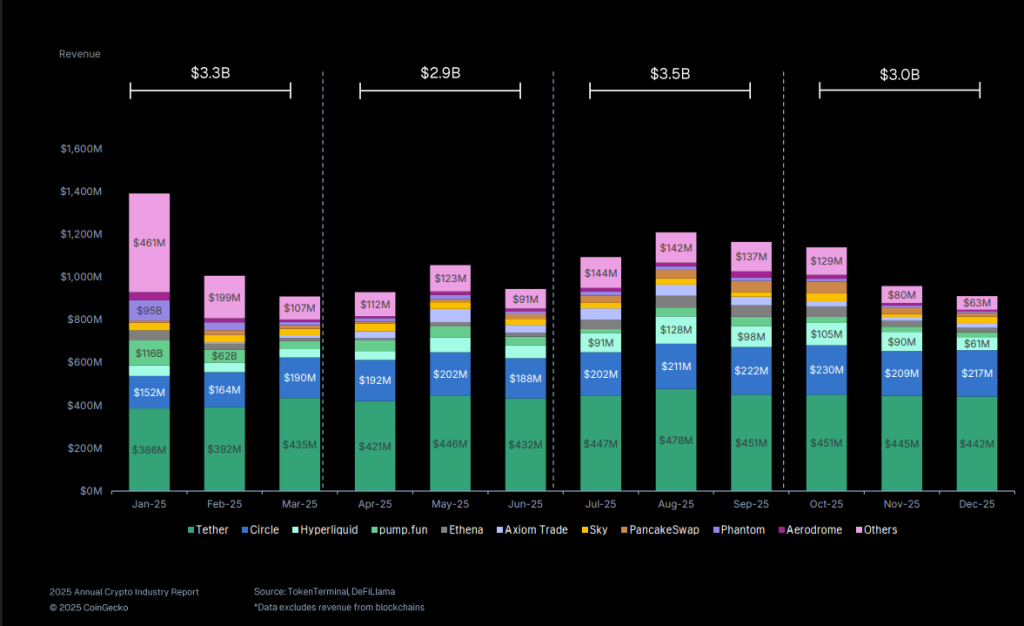
Tether led crypto protocol revenue in 2025 with approximately $5.2 billion, accounting for 41.9% of total revenue across 168 revenue-generating protocols, according to CoinGecko Research. Stablecoin issuers dominated the rankings, with just four entities generating 65.7% or roughly $8.3 billion…
The calls of a potential Bitcoin supercycle in 2026 intensified over the past week after former Binance CEO Changpeng ‘CZ’ Zhao — yet another prominent voice in crypto — laid out his predictions for the new year. However, a popular analyst on the social media platform X has released an opposing view, predicting a deep bottom for the BTC price this year.
BTC Price At Risk Of Further 65% Decline
In a January 25th post on the X platform, prominent crypto trader Ali Martinez said, in a sarcastic tone, that “the super cycle is super cycling.” In what seemed like a response to the buzz around CZ’s Bitcoin supercycle projection, the market pundit tempered the expectations with a $31,000 price bottom call for the premier cryptocurrency in 2026.
This bearish prediction is based on the appearance of price fractals on the BTC chart. For context, fractals are repeating patterns in price charts that can help map and project potential price movements for a particular cryptocurrency (Bitcoin, in this scenario).
As observed in the chart above, the price of BTC is currently following a similar movement pattern as in 2022. The premier cryptocurrency, after initially setting a then all-time high around $67,000 in early 2021, witnessed a nearly 55% correction to just above the $30,000 level by mid-July.
While the price of Bitcoin recovered and went back to set a record high of above $69,000 by the end of 2021, the market leader spent the majority of the following year in a downward trend. Exacerbated by the various bearish events of 2022, BTC ended the year at a low of around $15,500.
Martinez believes that the Bitcoin price is undergoing a similar movement pattern, having experienced an over 32% decline before climbing to the current all-time high of $126,080. The market pundit postulates that the premier cryptocurrency is currently witnessing the extended decline that saw its price reach $15,500 in 2022.
However, it is worth mentioning that the target this time around lies at $31,800, nearly 65% drop from the current price point. Hence, if the historical patterns highlighted by Martinez are to go by, there seems to be a higher likelihood of the Bitcoin price embarking on an extended downward trend rather than a supercycle.
Bitcoin Price At A Glance
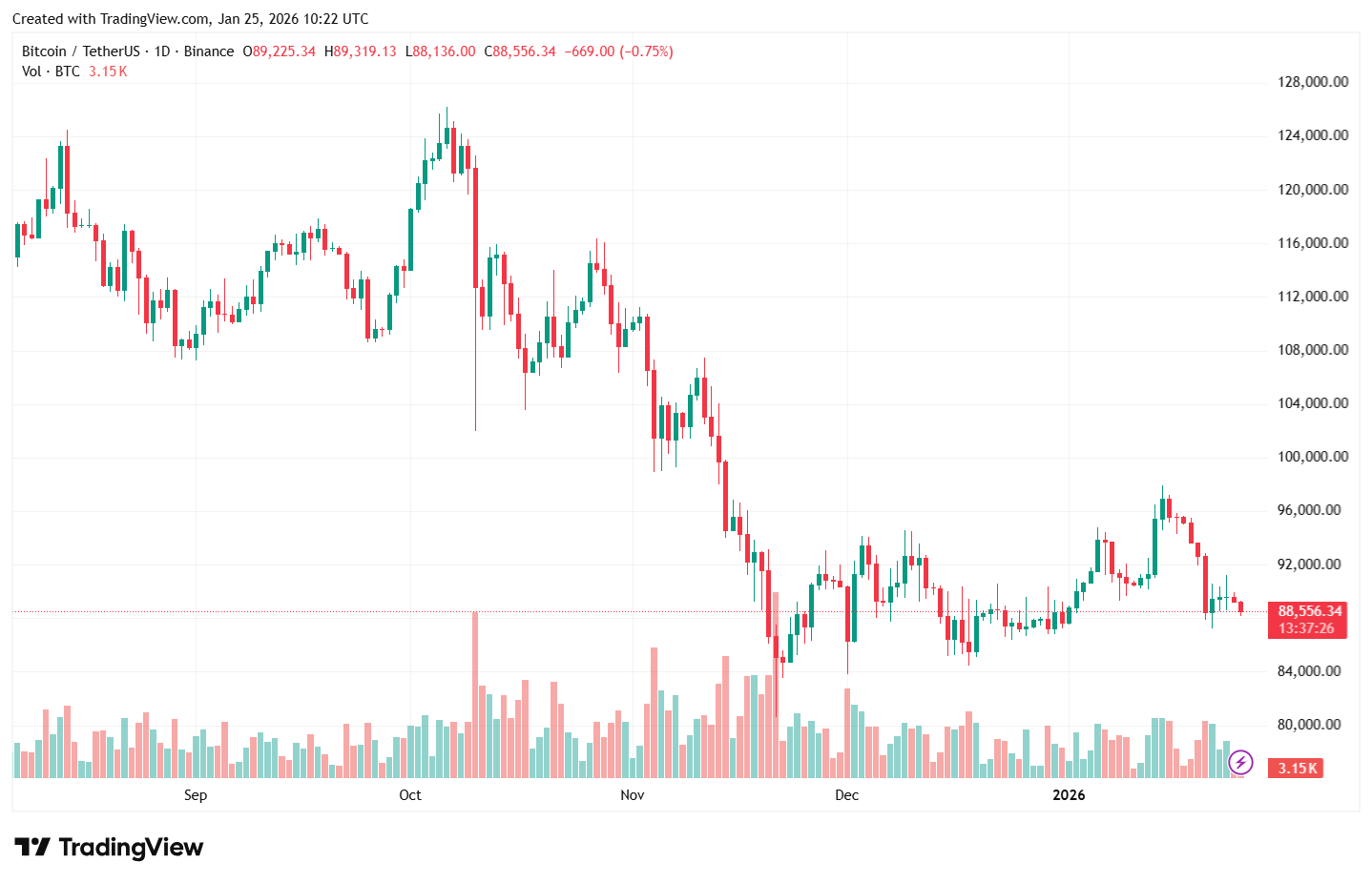
As of this writing, the price of BTC stands at around $88,528, reflecting an over 1% decline in the past 24 hours.
Small shops and some bigger chains in Las Vegas are now taking Bitcoin for everyday buys. People scan a QR code, pay from a phone, and the merchant gets paid. According to local reports, owners are trying this out to cut the cost of credit card processing and to attract customers who prefer crypto.
Merchants Cut Costs With Bitcoin
Reports say the move is largely about fees. Credit card processing often takes away 2.5–3.5% of a sale. For many small operators, that is painful. Payment tools that accept Bitcoin — often routed over the Lightning Network or through services that can convert crypto to cash — have lowered that burden for merchants.
According to FOX5, more businesses across Las Vegas are now accepting Bitcoin payments, from chains like Steak ’n Shake to small shops and medical practices. Merchants said Bitcoin helps attract new customers and cut costs, while Square has enabled about 4 million U.S. merchants…
Square’s program, which lets millions of US merchants enable Bitcoin checkout with no processing fee through 2026, helped speed up adoption in the area.
Stores Report Real Transactions
Business owners are reporting real use, not just experiments. Juice stands and cafes have processed payments. Some larger outlets are listed on public payment maps so customers can find them.
This has meant more foot traffic from people who travel with crypto or who prefer to keep their cards for other uses. Reports note both new customers and savings on fees as clear benefits.
Lightning Network Speeds Up Payments
The Lightning Network is being used to make payments faster and cheaper at the cash register. It moves small Bitcoin payments quickly without the long wait a base-layer transfer can cause.
Merchants scan a code or show one on a screen. The payment is then sent from the buyer’s wallet and settled almost instantly. This technical fix has made in-person Bitcoin payments workable for the first time at many spots.
How Owners See It
Owners are balancing savings against new risks. Some keep crypto for a short time, then sell it for cash. Others leave part of their receipts in Bitcoin. Chargebacks, a problem with cards, are reduced when crypto is used.
A few places say small boosts in sales followed their switch to crypto, yet long-term patterns are still being watched. Reports have disclosed these mixed outcomes as part of a slow but clear shift.
Customers Find New Ways To Pay
Shoppers are adapting. Tourists who carry crypto find these spots useful. Locals who are curious try the method at least once. Payment apps and merchant directories make the process easier for everyone.
For those who like simple steps, scanning a QR code and approving a payment on a phone works fine. For others it is a novelty that might stick.
Featured image from Unsplash, chart from TradingView
Las Vegas Valley businesses are accepting Bitcoin as payment as the cryptocurrency continues to grow in popularity.For more Local News from KVVU: https://www...
WhatsApp's upcoming group chat history sharing feature aims to eliminate confusion for newly added members by letting admins share up to 100 recent messages.
“Bitcoin is the digital gold” is one of the most popular narratives in the cryptocurrency industry, reiterating BTC’s growing status as a formidable store of value. However, while the premier cryptocurrency has floundered over the past months, gold and the metals market have largely witnessed explosive growth.
These contrasting performances have led to conversations about capital rotation between Bitcoin and gold, as the crowd expects one to always outperform the other at any given time. Recent data, however, suggests that the relationship between the BTC and gold price action is overrated.
Capital Flow Link Between BTC And Gold Overestimated
In a January 24 post on the X platform, on-chain analyst with the pseudonym Darkfost weighed in on the discourse surrounding capital rotation between gold and Bitcoin. According to the market pundit, the idea that investor funds flow from gold to Bitcoin is somewhat overblown.
To highlight this overestimation, Darkfost shared a chart showing periods where BTC outperforms or underperforms depending on gold’s trend. This chart typically provides two signals: positive (BTC above the 180-day moving average [MA] and gold below the 180-day MA) and negative (BTC below the 180-day moving average and gold below the 180-day MA).
As observed in the chart above and stated by Darkfost, the relationship between Bitcoin and gold does not appear to be fully substantiated. The on-chain analyst revealed that there have been as many positive periods as the negative ones, suggesting that the flagship cryptocurrency moves independently of gold.
Darkfost wrote:
This suggests that BTC continues to evolve independently, without clear evidence of a sustained capital rotation from gold.
Furthermore, Darkfost noted that a positive signal does not necessarily mean that capital is flowing out of gold into Bitcoin. According to the on-chain analyst, it is simply not possible to determine whether there is a capital flow relationship between the world’s largest cryptocurrency and gold.
Bitcoin & Gold Price Overview
While Bitcoin started the new year on a pretty strong note, the bullish momentum has pretty much waned over the past two weeks. Meanwhile, the gold price has continued to flourish this year, recently reaching a new all-time high above $4,900 per ounce.
As of this writing, the price of BTC stands at around $89,230, reflecting no significant movement in the past 24 hours. According to data from CoinGecko, the flagship cryptocurrency is nearly 30% adrift its all-time high above the $126,000 level.
Tether emerged as the most profitable crypto entity in 2025, generating an estimated $5.2 billion in revenue as stablecoins overtook all other protocol categories in earnings.
According to the latest Coingecko annual crypto industry report, Tether alone accounted for 41.9% of all stablecoin-related revenue in 2025, outpacing competitors such as Circle, Hyperliquid, Pump.fun, Ethena, Axiom, Phantom, and PancakeSwap.
The results show that dollar-backed digital currencies have become the most durable revenue engine in crypto, even as market conditions fluctuated throughout the year.
Tether Leads Stablecoin Issuers To Capture Crypto Revenue Crown
Among more than 168 crypto protocols tracked in 2025, stablecoin issuers collectively generated the highest revenue, with Tether firmly at the center.
INSIGHT: Stablecoins generated $5.2B in revenue in 2025, accounting for 41.9% of total protocol revenue. pic.twitter.com/fjJrAn9k7B
Its $5.2 billion haul placed it well ahead of Circle and other major players, reinforcing USDT’s position as the industry’s primary settlement asset.
Within the top ten revenue-generating protocols, just four entities, led by Tether and Circle, produced 65.7% of total earnings, equivalent to roughly $8.3 billion.
Source: Coingecko
The remaining six protocols in the top ten were all trading-focused platforms, highlighting a sharp divide between stable revenue streams and market-dependent income.
That contrast became clear as trading revenues swung widely with investor sentiment during the year.
Phantom, for example, recorded $95.2 million in revenue in January at the height of the Solana meme coin frenzy, only to see earnings fall to $8.6 million by December as speculative activity cooled.
USDT Claims 60% Share Of $311B Stablecoin Market
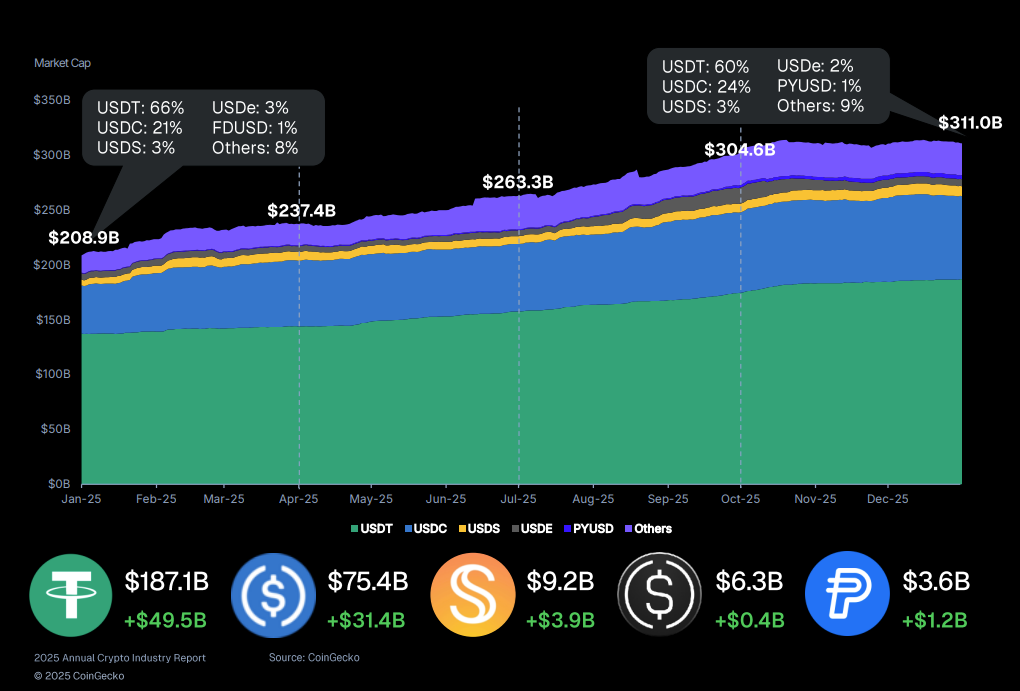
The broader stablecoin market expanded rapidly, with total market capitalization rising by $6.3 billion in the fourth quarter alone to reach a record $311.0 billion.
That marked a 48.9% year-over-year increase, adding $102.1 billion as adoption accelerated across regions.
Tether maintained clear leadership with 60.1% of the total stablecoin market cap, or about $187.0 billion, followed by Circle’s USDC at 24.2%, equivalent to $72.4 billion.
Source: Coingecko
Tether is now the world’s third-largest digital asset by market value at $186.8 billion, up roughly 50% from a year earlier.
While the top players strengthened their grip, shifts within the top five reflected changing risk appetites.
Ethena’s USDe experienced the sharpest reversal, with its market cap plunging 57.3%, or $6.5 billion, after a mid-October depeg on Binance undermined confidence in high-yield looping strategies.
Other stablecoins posted mixed but notable moves as capital rotated within the sector.
PayPal’s PYUSD surged 48.4%, adding $1.2 billion to reach $3.6 billion and briefly claiming the fifth spot before World Liberty Financial’s USD1 reclaimed it by nearly $1.
Additional high-growth tokens included Ripple’s RLUSD, which expanded 61.8% to add $488.2 million, and USDD, which climbed 76.9% with a $366.8 million increase.
Inside Tether’s $500B Valuation Path and Expanding Investment Empire
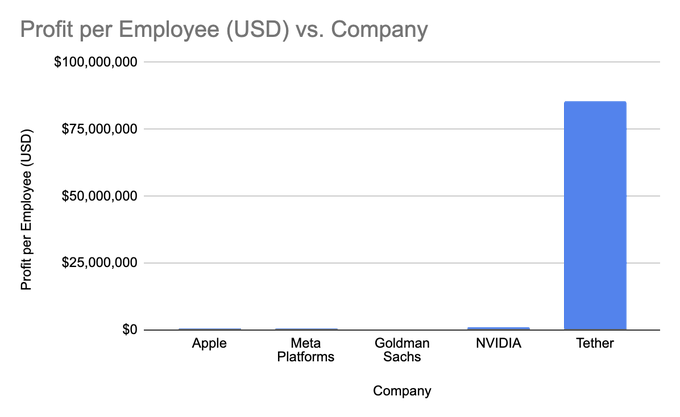
Looking ahead, Bitwise CIO Matt Hougan recently suggested that Tether could become the world’s most profitable company if its trajectory continues.
“There’s a chance that many emerging market countries will convert from primarily using their own currencies to using USDT,” Hougan said, pointing to Tether’s near-total dominance outside Western markets.
Based on projected interest income, calculations indicate that custody of $3 trillion in assets could generate annual revenue exceeding the $120 billion earned by Saudi Aramco last year.
Tether CEO Paolo Ardoino previously told Cryptonews he remains confident USDT will retain its lead due to the company’s deep understanding of real-world usage.
Beyond stablecoins, Tether has expanded aggressively into traditional assets and investments.
The company recently became the second-largest shareholder in Italian football club Juventus and has reportedly explored raising $20 billion for a 3% stake, a deal that would imply a valuation near $500 billion and place Tether among the world’s most valuable firms.
Reports say the Ethereum Foundation has started a new team to prepare the network for possible quantum computer attacks. These machines could one day break the math behind wallets and signatures. The team’s work is moving from research into practical tests and experiments, which has drawn attention across the crypto community.
Ethereum Launches Post-Quantum Team
Based on reports, Thomas Coratger will lead the effort. The team includes cryptographers and engineers already testing new systems on devnets. Some work ties into a project called leanVM and a researcher named Emile, who focuses on building simple quantum-safe tools. The goal is to test new algorithms in real software while keeping current transactions running smoothly.
Today marks an inflection in the Ethereum Foundation’s long-term quantum strategy.
We’ve formed a new Post Quantum (PQ) team, led by the brilliant Thomas Coratger (@tcoratger). Joining him is Emile, one of the world-class talents behind leanVM. leanVM is the cryptographic…
A $1 million prize has been set for improvements to the Poseidon hash function. Another $1 million prize supports broader post-quantum research. In total, roughly $2 million are being offered to labs and independent developers to design and test quantum-resistant solutions. Reports say this funding is meant to speed up work and show what can realistically replace current signatures.
Early Tests And Community Involvement
Multi-client devnets are already active. Developers are experimenting with new signature types to see what works and what fails. Biweekly sessions led by researchers like Antonio Sanso let teams share results and update code. A Post-Quantum Day is scheduled for March 2026 before ETHCC, with a larger event planned in October 2026 to show progress and plan next steps.
Quantum computers could, in theory, break the ECDSA and secp256k1 schemes used today. That risk is not immediate but serious enough that Ethereum is acting now. Reports note users should watch for official guidance, follow wallet updates, and avoid reusing addresses once upgrades roll out.
Community reaction has been mixed. Some online discussions praised the careful planning, while traders noticed a small dip in ETH price. Others questioned how upgrades would reach millions of wallets and what happens to old keys. The Foundation’s approach is to test solutions early so users and services are better protected when changes happen.
This step is part of Ethereum’s long-term plan for safety. Tests will continue, standards will be debated, and progress will be shared publicly. By acting now, Ethereum aims to reduce risk and make future transitions smoother for everyday users and the network as a whole.
Featured image from Unsplash, chart from TradingView
Rick Rieder, a senior BlackRock executive overseeing over $2.4 trillion in assets, has become the front-runner to become the next head of the Federal Reserve after impressing Donald Trump in his recent interview. A Polymarket poll places his odds at…
The Bitcoin price action has been muted over the past few days, trading within the $90,000 and $88,000 levels. Classically, consolidation periods often precede major moves either to the upside or downside of the market.
As such, questions on the next trajectory of the flagship cryptocurrency are being asked. A latest on-chain evaluation has offered a positive prognosis on the next direction for the Bitcoin price.
Accumulation Demand Metric Surges To All-Time-High
In a Quicktake post on CryptoQuant, on-chain analyst CoinNiel hypothesized that the Bitcoin price could be at the beginning of a bullish trend. The market quant based this prognosis on two metrics — the Accumulator Address Demand and the Liquidity Inventory Ratio (month).
The Accumulator Address Demand metric monitors the net buying pressure coming from addresses that buy Bitcoin consistently, and without any significant selling. This behavior (of buying and rarely selling) is typical of the large-scale Bitcoin holders, commonly known as the whales.
Notably, CoinNiel also pointed out that when major withdrawals from exchanges occur, they are rarely ever incited by retailers, but by whales. As such, when the Bitcoin whales withdraw their holdings from exchanges, their buying pressure translates into an increase in the Accumulator Address Demand.
From the chart above, the indicator has reached an all-time high level. According to the crypto pundit, this could be a sign that the whales are currently experiencing, on intense levels, the “fear of missing out.”
The second metric, the Liquidity Inventory Ratio (Month), also reinforces CoinNiel’s bullish outlook. This metric tracks and compares existing Bitcoin demand to the supply available on exchanges, showing whether demand can overwhelm available supply.
When this ratio rises sharply, it is usually a sign that demand is absorbing newly created supply. From the data shared by the analyst, the Liquidity Inventory Ratio has also reached an extreme value of 3.8.
However, this extreme reading is only a reflection of what is happening on US exchanges. Hence, CoinNiel implied that, for the first time in years, US exchanges are recording exceptionally high demand relative to the coins available.
In theory, a 3.8 reading implies the imminence of a supply shock in the scenario where current conditions prevail. But, the analyst highlighted that it may not necessarily happen, as a 3.8 reading is more a sign of intensified whale demand than a surefire means to predict supply shocks.
The big picture, especially when these two metrics are looked at together, appears to be distinctly bullish. This is because available data points out that the whales are likely positioning for what could be a resumed bullish trajectory for the Bitcoin price.
Bitcoin Price At A Glance
As of this writing, Bitcoin is valued at $88,520, reflecting an over 1% decline in the past 24 hours.
Scroll co-founder Ye Chen’s X account was hijacked in a sophisticated phishing operation where attackers posed as platform employees to target crypto industry figures.
The compromised account, which commands substantial influence among crypto leaders, began distributing fraudulent messages claiming copyright violations and threatening account restrictions unless users clicked on malicious links within 48 hours.
The hackers transformed Chen’s profile to mimic X’s official branding, updating the bio to reference Twitter and nCino while warning followers about security breaches.
Screenshot from X
The attackers flooded the feed with reposts from X’s verified accounts to enhance perceived legitimacy, then launched their phishing campaign via direct messages.
Sophisticated Attack Mirrors Growing Pattern
The breach follows established tactics where hackers exploit trusted accounts to distribute malicious links disguised as urgent platform notifications.
Recipients received messages appearing to come from X’s rights management team, complete with fake compliance warnings and time-sensitive appeals processes designed to create panic and bypass security awareness.
Blockchain security researcher Wu Blockchain first identified the compromise and alerted the community to ignore any communications from the account.
The warning emphasized particular concern given Chen’s extensive network of high-profile cryptocurrency executives, developers, and investors who might trust messages from his verified account.
Scroll co-founder @shenhaichen's X account has been hacked and is currently sending phishing private messages impersonating X employees. This account has a large following among prominent figures in the crypto industry; the community and users are advised to be aware of the… pic.twitter.com/ctXk2G0bQm
The attack represents the latest escalation in social media compromises targeting crypto industry leaders, in which hackers increasingly leverage delegated account access and expired domain registrations to bypass security measures, including two-factor authentication.
Industry Faces Relentless Social Engineering Wave
BNB Chain’s official account suffered a similar breach in October when hackers posted fake reward programs with phishing links after Binance co-founder CZ warned followers against clicking suspicious content.
The compromised account promoted fraudulent BSC token distributions, promising early payouts to users who voted on reward dates through malicious URLs designed to drain digital wallets.
Binance co-CEO Yi He’s WeChat account was also hijacked in December to promote meme coin schemes, with attackers conducting a coordinated pump-and-dump operation around the token MUBARA.
Two wallets created hours before the breach accumulated 21.16 million tokens before dumping holdings as retail traders flooded in, netting attackers approximately $55,000 while leaving later buyers exposed to price collapse.
Among other notable accounts hacked were ZKsync and Matter Labs, which were compromised in May through what the team described as “delegated accounts” with limited posting privileges.
Hackers published false claims about an SEC investigation alongside fake airdrop promotions, triggering a 5% drop in the ZK token price despite a prior 38.5% weekly rally.
The prominent crypto media company, Watcher.Guru also confirmed its account breach in March after fake Ripple-SWIFT partnership claims spread across connected Telegram, Facebook, and Discord channels through automated content bots.
The team suspects the compromise originated from a suspicious link containing unusual query strings shared in their Telegram group weeks earlier.
Record Theft Year Exposes Escalating Threats
The crypto ecosystem witnessed over $3.4 billion stolen in 2025, according to Chainalysis’s 2026 Crypto Crime Report, with North Korean state-backed hackers accounting for a record $2.02 billion across fewer but increasingly sophisticated attacks.
Source: Chainalysis
The Democratic People’s Republic of Korea now represents 76% of all service compromises, bringing cumulative DPRK cryptocurrency theft to $6.75 billion since operations began.
Personal wallet compromises surged to 158,000 incidents affecting at least 80,000 unique victims, triple the 54,000 cases recorded in 2022.
Address poisoning scams drove December’s single-largest loss, when one victim transferred $50 million to a fraudulent wallet mimicking their intended destination, while private key leaks resulted in $27.3 million stolen from multi-signature wallets.
Personal Security Breaches Surge Across Platforms
Most recently, Ubuntu developer Alan Pope warned that attackers are hijacking Snap Store publisher accounts by registering expired domains linked to legitimate developers, then pushing malicious updates to previously trusted packages.
The technique exploits automatic update systems and established trust signals, with at least 2 confirmed cases of wallet-stealing malware distributed through seemingly normal applications.
Hackers are exploiting trusted Snap Store packages to steal cryptocurrency by hijacking existing publisher accounts.#Hack#Cryptohttps://t.co/YV5Yoiwb0F
Given these growing, multifaceted attack vectors, Better Business Bureau officials are warning consumers about phishing campaigns that lock X users out of their accounts and are subsequently used for cryptocurrency promotions.
Kentucky journalist Jennie Rees described receiving direct messages from apparent colleagues requesting contest votes, only to find her account posting fake Audi purchase claims tied to crypto earnings after clicking the malicious link.

 Login
Login

 China has placed its top operational military commander, General Zhang Youxia, under investigation for serious violations of discipline and law, a move that is expected to disrupt command continuity and delay any near-term plans for a military operation against Taiwan, The Telegraph reported. China’s Ministry of National Defense confirmed on Saturday that Zhang, vice chairman […]
  Several Pakistan Air Force Ilyushin Il-78 aircraft were spotted at an airfield in China’s Sichuan province on January 19–20, according to photographs that surfaced online and were reviewed by regional observers. The aircraft, including one carrying the registration number R11-003, were seen on the ground and during departure from the base, indicating a temporary presence […]
  China has launched an investigation into two of its most senior military officials, Zhang Youxia and Liu Zhenli, on suspicion of serious violations of discipline and law, the Chinese government announced on Saturday, in a move that reaches the highest levels of the People’s Liberation Army command structure. According to the official announcement, Zhang Youxia, […]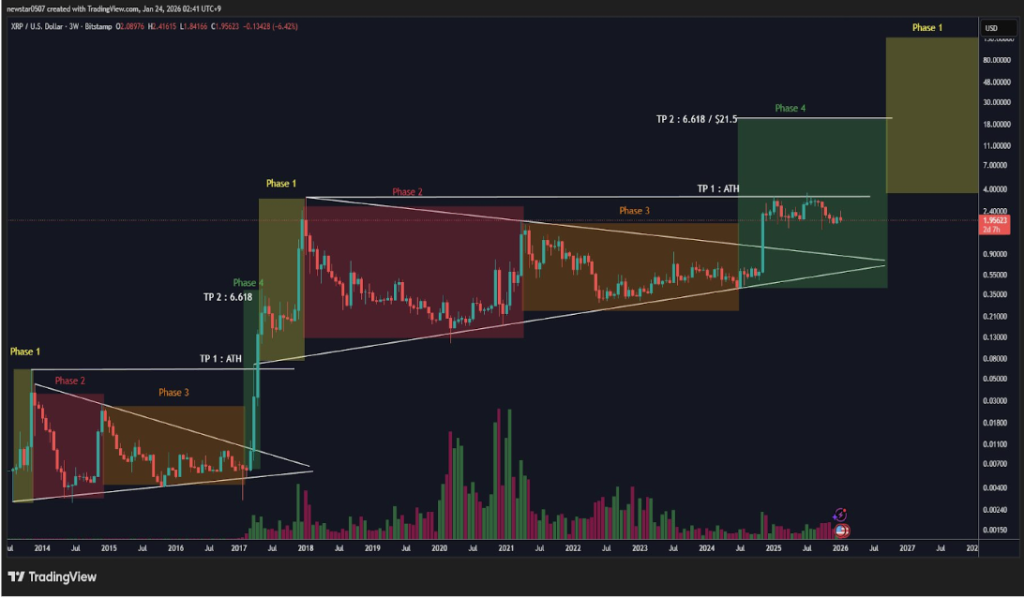








 @Tether_to has launched an all-cash bid to acquire Italy’s






 Changpeng Zhao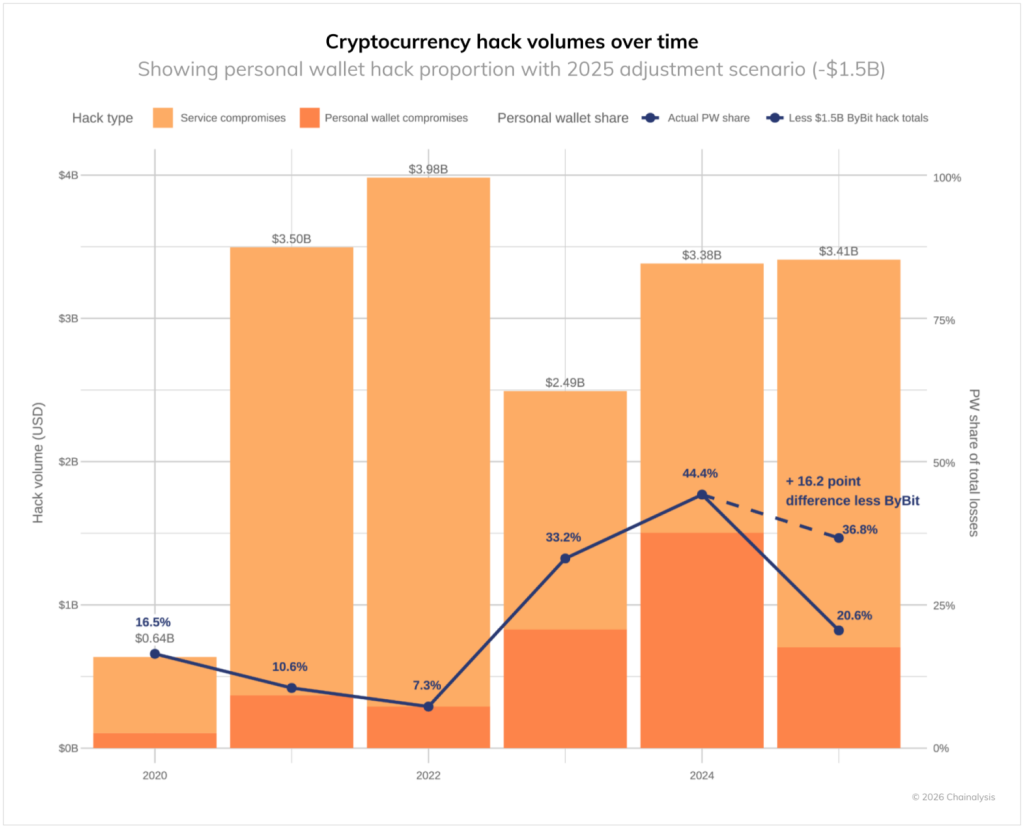
 Hackers are exploiting trusted Snap Store packages to steal cryptocurrency by hijacking existing publisher accounts.