Reading view

There are new articles available, click to refresh the page.

India Crypto Executives Push to Roll Back 1% TDS, Ease 30% Tax Ahead of Budget

By: Amin Ayan

India’s crypto industry is renewing its call for tax reform ahead of the Union Budget, arguing that the current regime is driving trading activity offshore.

Key Takeaways:

  • Crypto firms want Budget 2026 to ease the 1% TDS and 30% VDA tax to curb offshore trading.
  • India’s 2022 crypto tax rules improved traceability but drained onshore liquidity.
  • Executives warn offshore platforms weaken consumer protection and export jobs and tax revenue.

Senior executives from WazirX and Delta Exchange say the government has an opportunity in Budget 2026 to recalibrate its approach by easing the 1% transaction-level tax deducted at source (TDS) on crypto trades and revisiting the flat 30% tax on virtual digital asset (VDA) gains, which currently does not allow losses to be offset.

India’s Crypto Tax Push Improved Traceability but Drained Liquidity

India introduced the 30% VDA tax and the 1% TDS in 2022 as part of a broader push to bring digital asset activity into the formal tax net.

While the measures succeeded in improving transaction traceability, industry participants say they have also had unintended consequences, including a sharp drop in onshore liquidity and a migration of traders to overseas platforms beyond Indian jurisdiction.

“As India prepares for Budget 2026, there is a clear opportunity to fine-tune a framework that supports transparency and compliance while fostering innovation,” said Nischal Shetty, founder of WazirX.

He added that a reduction in TDS and a review of loss set-off rules could help keep more economic activity within India’s regulated perimeter without weakening oversight.

Executives argue that the global crypto market has evolved significantly since the tax rules were introduced, with greater institutional participation and clearer regulatory approaches emerging in several major jurisdictions.

Sad to see

India 🇮🇳 has the most crypto owners in the world, with 93M+ users.

Yet, we still have no clear crypto policy.

While countries like Singapore, Dubai, and U.S are trying to become crypto hubs, India is stuck with:

– 30% tax on every trade
– 1% TDS on every… pic.twitter.com/2pIrL5U8oT

— Sujal Jethwani (@SujalJethwani) January 7, 2026

The industry is also framing the debate in terms of economic leakage.

According to estimates cited by Delta Exchange, Indian users contributed nearly ₹5 lakh crore in trading volume on offshore exchanges between October 2024 and October 2025.

Executives warn that when platforms operate outside Indian oversight, consumer protection weakens and jobs and tax revenues flow overseas.

“Relying on non-accountable foreign platforms for critical financial infrastructure introduces systemic risk,” said Pankaj Balani, CEO and co-founder of Delta Exchange, calling for a “Make in India” approach that backs compliant domestic platforms while acting decisively against unauthorised operators.

India Tax Officials Warn Crypto Could Weaken Enforcement of Tax Rules

Earlier this month, Indian tax officials renewed concerns over cryptocurrency activity, warning that the growing use of digital assets could undermine the country’s ability to enforce tax rules effectively.

The caution was raised by the Income Tax Department (ITD), which operates under the Central Board of Direct Taxes, during a recent parliamentary standing committee on finance.

As reported, India has also moved to tighten oversight of cryptocurrency platforms, with the Financial Intelligence Unit introducing stricter identity and monitoring requirements aimed at curbing illicit activity.

The new rules require platforms to go beyond basic document uploads during onboarding.

Reporting entities must carry out live identity verification and implement stronger Client Due Diligence (CDD) processes, reflecting concerns about the speed and pseudonymous nature of crypto transactions.

The post India Crypto Executives Push to Roll Back 1% TDS, Ease 30% Tax Ahead of Budget appeared first on Cryptonews.

Hong Kong Professionals Association Urges Regulators To Ease Crypto Reporting Rules

A Hong Kong industry group has urged the city’s regulators to ease aspects of the Organisation for Economic Co-operation and Development’s (OECD) crypto reporting rules ahead of its implementation.

Association Pushes To Soften CARF Requirements

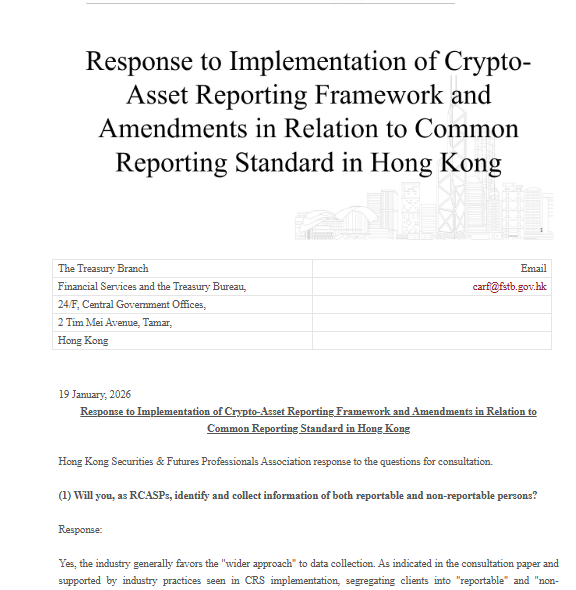
On Monday, the Hong Kong Securities & Futures Professionals Association (HKSFPA) released a response to the implementation of the OECD’s Crypto Asset Reporting Framework (CARF) and the related amendments made to Hong Kong’s Common Reporting Standard (CRS).

In their official response, the association shared its concerns about certain elements of the CARF and CRS amendments, warning that they could create operational and liability risks for market participants.

Notably, the HKSFPA affirmed that it mostly supports the proposals, but urged regulators to ease the record-keeping requirements for dissolved entities. “We generally agree with the six-year retention period to align with existing inland revenue and CRS standards,” they explained, “but we have concerns regarding the obligations placed on individuals post-dissolution.”

The industry group argued that holding directors or principal officers personally liable for record-keeping after dissolution poses significant practical challenges, noting that former officers of dissolved companies may lack the resources, infrastructure, and legal standing to maintain sensitive personal data of former clients.

As a result, they suggested the government “allow for the appointment of a designated third-party custodian (such as a liquidator or a licensed corporate service provider) to fulfill this obligation, rather than placing indefinite personal liability and logistical burden on former individual officers.”

Moreover, the association also cautioned that the proposed uncapped per-account penalties for minor technical errors. They asserted that this could lead to “disproportionately astronomical fines for systemic software errors affecting thousands of accounts where there was no intent to defraud.”

To solve this, they proposed a “reasonable cap” on total penalties for unintentional administrative errors or first-time offenses to ensure that the per-account calculation “is reserved for cases of willful negligence or intentional evasion.”

Additionally, the group suggested a “lite” registration or a simplified annual declaration process for Reporting Crypto-Asset Service Providers (RCASPs) that anticipate filing Nil Returns, to reduce administrative costs while still satisfying the Inland Revenue Department’s oversight requirements.

Hong Kong’s Crypto Hub Efforts

Notably, Hong Kong is among the 76 markets committed to implementing the upcoming crypto reporting framework, which is the OECD’s new global standard for exchanging tax information on crypto assets.

The CARF is designed to prevent tax evasion by bringing crypto users across borders under global tax transparency rules, similar to the OECD’s existing CRS for traditional finance. Hong Kong will be among the 27 jurisdictions that will begin their first cross-border exchanges of crypto reporting data in 2028.

Over the past few years, Hong Kong financial authorities have been actively working to develop a comprehensive framework that supports the expansion of the digital assets industry, part of its strategy to become a leading crypto hub in the world.

As reported by Bitcoinist, the city is exploring rules to allow insurance companies to invest in cryptocurrencies and the infrastructure sector. The Hong Kong Insurance Authority recently proposed a framework that could channel insurance capital into cryptocurrencies and stablecoins.

Moreover, the Hong Kong Monetary Authority (HKMA) is expected to grant the first batch of stablecoin issuer licenses in the first few months of the year. The HKMA enacted the Stablecoins Ordinance in August, which directs any individual or entity seeking to issue a stablecoin in Hong Kong, or any Hong Kong Dollar-pegged token, to obtain a license from the regulator.

Multiple companies have applied for the license, with over 30 applications filed in 2025, including logistics technology firm Reitar Logtech and the overseas arm of Chinese mainland financial technology giant Ant Group.

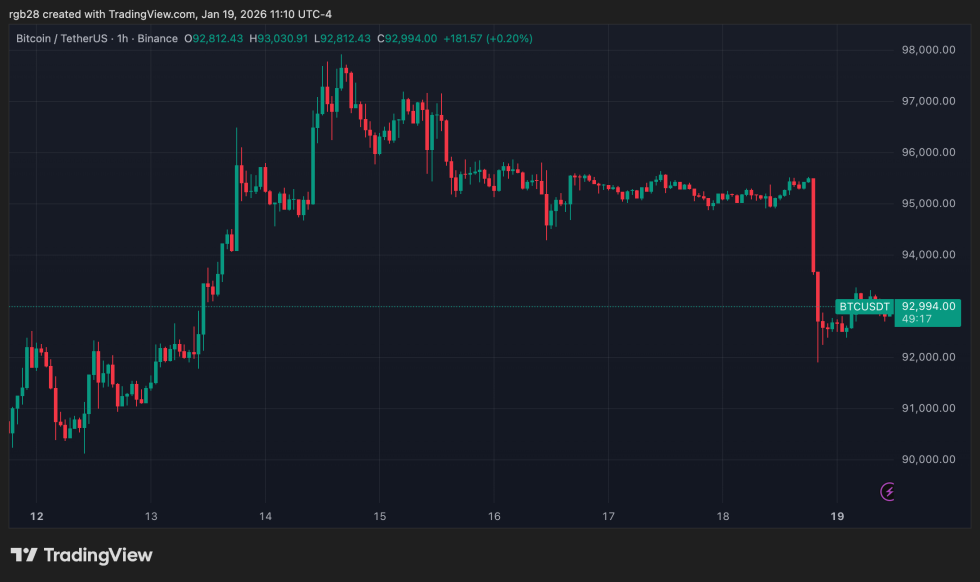
crypto, bitcoin, btc, btcusdt

Hong Kong Crypto Firms Warn CARF Tax Rules Could Backfire — How?

Hong Kong’s crypto industry is warning that the city’s planned adoption of new global tax reporting rules could produce unintended consequences if regulators do not adjust how the framework is applied in practice.

The concerns center on the Crypto-Asset Reporting Framework (CARF), a standard developed by the Organisation for Economic Co-operation and Development to enable the automatic cross-border exchange of tax information related to crypto-asset transactions.

Hong Kong officials say the CARF is needed to protect the city’s role as an international financial hub, as OECD peer reviews increasingly judge jurisdictions on how well rules are enforced, not just whether they exist.

Hong Kong Weighs CARF as Industry Seeks Smoother Implementation

In a detailed submission sent this week to the Financial Services and the Treasury Bureau, the Hong Kong Securities & Futures Professionals Association urged authorities to refine how the rules are rolled out.

Source: HKSFPA

While the group said it broadly supports the goal of tax transparency, several elements of the proposed regime could expose local crypto firms to operational strain, legal uncertainty, and disproportionate penalties.

The association represents professionals working across securities, futures, and virtual asset markets and framed its comments as an effort to ensure Hong Kong remains competitive as a financial hub while meeting international obligations.

CARF is designed to close gaps left by existing tax reporting systems by capturing crypto-specific activity that falls outside traditional financial accounts.

Under CARF, crypto-asset service providers would be required to collect and report detailed information on users and transactions, which would then be shared automatically with other participating jurisdictions.

🇭🇰 Hong Kong is set to implement the Crypto Asset Reporting Framework by 2026, enhancing tax transparency and tackling cross-border tax evasion in the crypto space!#Crypto #Taxhttps://t.co/MU2Cg6ac0D

— Cryptonews.com (@cryptonews) December 17, 2024

Hong Kong is among 76 markets that have committed to the framework and is part of the first group of 27 jurisdictions expected to begin exchanging data by 2028.

The government plans to complete legislative amendments in 2026, following a public consultation that began late last year.

Progress Welcomed, but Data Rules Raise Red Flags

Industry participants say the direction of travel is clear, but the details matter.

One major concern is data collection, as the association said most firms favor a “wider approach,” collecting information on both reportable and non-reportable clients upfront.

However, it warned that without explicit legal protection, firms could face conflicts with Hong Kong’s personal data privacy rules for holding information on clients who are not yet reportable.

Record-keeping requirements are another pressure point. While the industry accepts a six-year retention period in line with existing tax rules, it raised alarms about proposals that could hold directors or senior officers personally responsible for maintaining records after a company is dissolved.

It argued that former officers may lack the legal authority or infrastructure to securely store sensitive client data once an entity no longer exists.

Firms Push Back on CARF Fines and Tight Reporting Deadlines

Penalties under CARF and the amended CRS also drew scrutiny.

While the industry supports the introduction of administrative penalties as an alternative to criminal prosecution, it warned that fines calculated on a “per account” basis could spiral into massive liabilities for firms hit by technical or software errors affecting thousands of users.

The association called for reasonable caps for unintentional breaches and a graduated approach that distinguishes between administrative mistakes and deliberate non-compliance.

Operationally, firms welcomed plans for electronic filing but said reliance on manual XML uploads could introduce avoidable risks.

Large institutions, in particular, are pushing for direct API connections to allow automated reporting.

They also warned that the proposed five-month filing deadline after year-end could be tight in the early years and suggested grace periods as systems are tested and refined.

The post Hong Kong Crypto Firms Warn CARF Tax Rules Could Backfire — How? appeared first on Cryptonews.

Washington state lawmaker says proposed payroll tax could benefit large tech companies

Rep. Shaun Scott, D-43.

A newly proposed payroll tax would add new costs for large businesses in Washington state. But Rep. Shaun Scott, a Seattle Democrat sponsoring the bill, argues it would protect the basic services that help companies recruit and retain talent.

“People are looking to the state legislature for leadership on protecting the programs that make our state actually a healthy climate to do business in,” Scott told GeekWire this week.

House Bill 2100, pre-filed this week in Olympia, would create the “Well Washington Fund” and levy a 5% payroll expense tax on “large operating companies” for employee wages above a $125,000 threshold. The bill defines a “large operating company” as one with more than 20 employees and more than $5 million in gross receipts or sales, among other criteria. Employers with total employee wages under $7 million in the prior year would be exempt.

Scott is pitching the bill as a state backstop against federal cuts hitting Medicaid, higher education, housing and other programs. He said it would generate more than $2 billion annually and impact the about 4,300 businesses — including Redmond, Wash.-based tech giant Microsoft and telecom behemoth T-Mobile, headquartered in Bellevue.

Seattle-based companies such as Amazon that already pay the city’s JumpStart payroll tax would be exempt.

Scott said there is a “corollary effect” on corporations from policies that benefit “everyday people.”

“My sense of it is that the public is on our side on this issue,” he said. “They understand that when you have very well-funded higher education, what that means is a well-trained workforce that could seek employment at a place like Microsoft or Amazon — and the company would benefit as a result.”

“When you have people who have very good housing options, that makes Washington that much more of a competitive place to come and do business,” he added.

Business groups are wary of the proposal. Rachel Smith, the new CEO of Washington Roundtable, called it a “tax-first, plan later” idea. She also cited the state’s recent tax increases impacting businesses — passed in part to help address a $16 billion budget shortfall — and broader economic uncertainty.

Washington Roundtable CEO Rachel Smith. (Washington Roundtable Photo)

“If a job is cheaper somewhere else, and a company has an operational environment that allows them to deploy that job somewhere else, of course that’s going to be something they consider,” Smith said in an interview with GeekWire.

Lawmakers tried to pass a similar statewide payroll tax this year, but the bill did not advance. In March, Microsoft President Brad Smith criticized that tax proposal and said it would increase prices for consumers, reduce jobs, and hurt the tech industry.

Microsoft declined to comment on Rep. Scott’s proposal when contacted by GeekWire this week.

Rep. Scott said it’s “disingenuous” that critics raise alarms about companies leaving when the state talks about funding the safety net, but don’t ask similar questions when companies cut jobs on their own. He said the relocation question “does not come up when we see large tech firms investing in artificial intelligence, which is designed to divest from human labor.”

Washington is one of a few states without a personal or corporate income tax. Most state revenue comes from sales, property, and B&O taxes — a system critics say disproportionately burdens lower-income residents.

Gabriella Buono, interim president and CEO at the Seattle Metro Chamber, said that “raising taxes in an affordability crisis will mean higher prices on everyday essentials, fewer job opportunities, and more closures in sectors that are already on the edge.”

“Voters across the political spectrum are clear: they want smart spending, transparency, and results, not new taxes that make it harder to live and work in this state,” Buono said in a statement.

Revenue from the proposed bill would initially go to the state general fund in 2026, then split beginning in 2027, with 51% directed to a dedicated Well Washington fund account and 49% to the general fund. A new oversight and accountability board would guide priorities and report annually. Spending from the account would be limited to higher education, health care — especially Medicaid — cash assistance, and energy and housing programs.

Washington Lawmakers Propose Raising Taxes on Higher Potency Weed

Cannabis consumers in Washington state may soon be subject to a “dank tax.” 

Lawmakers there have introduced a bill that would tax marijuana products based on the percentage of THC.

In other words: the stronger the weed, the higher the price.

“Research indicates that between 12 and 50% of psychotic disorders could be prevented if high potency cannabis products were not available,” said Washington state House Rep. Lauren Davis, one of the sponsors of the bill, as quoted by local news station KXLY.

Davis believes that the measure is necessary to combat what she describes as a “crisis.”

“If we fail to act now to counter the emerging public health crisis created by high potency cannabis products, we will soon have another epidemic on our hands,” Davis added.

The legislation, House Bill 1641, would restructure “the 37 percent cannabis excise tax to a tax of 37 percent, 50 percent, or 65 percent of the selling price, based on product type and tetrahydrocannabinol (THC) concentration,” according to an official legislative summary of the measure. 

“[Thirty-seven] percent of the selling price on each retail sale of cannabis-infused products, useable cannabis with a THC concentration less than 35 percent, and cannabis concentrates with a THC concentration less than 35 percent,” the summary read. “[Fifty] percent of the selling price on each retail sale of cannabis concentrates and useable cannabis with a THC concentration of 35 percent or greater but less than 60 percent; and 65 percent of the selling price on each retail sale of cannabis concentrates and useable cannabis with a THC concentration greater than 60 percent.”

HB 1641, which had its first public hearing last week, would also establish the following, per the legislative summary:

“Marketing and advertising prohibitions on advertising a product that contains greater than 35 percent total THC … Prohibits cannabis retail outlets from selling a cannabis product with greater than 35 percent total THC to a person who is under age 25 who is not a qualifying patient or designated provider … Requires cannabis retailers to provide point-of-sale information to consumers who purchase certain cannabis products and requires the Liquor and Cannabis Board to develop optional training for retail staff … Requires mandatory health warning labels for cannabis products that contain greater than 35 percent total THC … Requires cannabis products to be labeled with the number of serving units of THC included in the package, and with an expression of a standard THC unit in volume or amount of product … Directs $1 million annually from the Dedicated Cannabis Account for targeted public health messages and social marketing campaigns.” 

Not everyone is on board with the proposal, which has a dozen sponsors. 

Carol Ehrhart, who owns a dispensary in the state, told KXLY that the proposed tax increase could lead to some adverse consequences. 

“There’s this, you know, idea that the THC is going to get me further along. The higher that we make those prices, the more apt someone is to buy the higher priced item because they think they’re getting more bang for their buck when they’re really not,” Ehrhart told the station.

“A product that we’re selling right now for $40 that’s over the 60% threshold would go to $47, almost $48. You know, that’s seven or $8 in taxes on one piece of product,” Ehrhart added.

Washington became one of the first two states to legalize recreational cannabis in 2012, when voters there approved a measure that legalized possession and paved the way for a regulated market. (Colorado also approved a legalization measure the same year.)

The post Washington Lawmakers Propose Raising Taxes on Higher Potency Weed appeared first on High Times.

Potency Tax Could be a Major Buzzkill for Sanctioned Cannabis Retailers

This story was written in partnership with Crain’s New York, the trusted voice of the New York business community. 

One of the most controversial aspects of New York’s new recreational cannabis market is its tax system, which some have worried will undermine licensed businesses by driving consumers to cheaper underground dealers.

A white paper published in December by a pair of New York tax attorneys, just weeks before the formal start of recreational marijuana sales on Dec. 29, warned of that very possibility. It predicted—and was proven accurate after sales launched—that a legal eighth of cannabis flower in New York with 30% THC would cost about $75.

Prices at Housing Works—the first state-sanctioned cannabis retailer in the five boroughs—proved to be not far below that, with prices fluctuating because taxes are based on THC potency. According to the nonprofit’s online menu, an eighth of cannabis flower ranges in price and potency from 19% THC for $40 to 27% for $60. With the 13% excise tax added, out-the-door prices would be between $45 and $68, respectively.

But if customers remain price-sensitive, as data from other mature recreational marijuana markets suggest, then they’ll broadly be willing to pay only as much as 10% to 15% above prices on the unregulated market, according to the paper, authored by attorneys Jason Klimek and James Mann.

By contrast, unlicensed street vendors in New York City last month were peddling cannabis eighths for between $10 and $45, Green Market Report found.

Combine that with overall lax enforcement to date against the underground market, and the situation has the potential to undercut state-licensed retailers—particularly smaller and less-capitalized businesses—before they can truly get off the ground, Klimek and Mann asserted.

Charles King, CEO of Housing Works / photo by Buck Ennis

Charles King, the CEO of Housing Works, said in early January that he doesn’t think the situation is that dire, and companies such as his will be able to survive as long as they stick to a solid retail business plan and tap the immense tourism market.

“I think people know that you’re paying for quality, you’re paying for the taxes and all the rest of what goes with the regulated, licensed market,” King said.

Still, there will have to be more of a focus on enforcement against illicit competition by state authorities, King said.

It’s a big undertaking, as many illicit operators already have brand recognition by offering legally produced but illegally shipped cannabis from California and Oregon, such as the famed SoCal brand Jungle Boys. That’s one brand name New York City resident Joe Lustberg, managing partner at Upwise Capital, said he ran into recently at a smoke shop.

“For some cannabis operator who’s competing with the smoke shop next door [that is] able to sell California eighths for $30 [and] that’s better weed than what they’re selling at Housing Works, it’s tough,” Lustberg said.

The tax structure also might be altered by the Legislature, because making the system more business-friendly is a top priority of industry interests in Albany, including for the Cannabis Association of New York.

“I do feel confident that the state is very much aware of the issue with the potency tax and, at the very least, open to reform,” said Brittany Carbone, a board member of CANY and a cannabis farmer upstate. “It’s been well proven that more reasonable tax structures actually result in higher rates of purchase in legal dispensaries, which results in a net positive win for the state, in terms of tax revenues.”

Even if the tax structure doesn’t change, cannabis attorney Lauren Rudick said, the THC-based potency tax will probably encourage the creation and sale of a more diverse range of cannabinoid products that don’t rely only on THC to please consumers. And that could be just what the burgeoning industry needs: more product variety.


By the Numbers:

$68

Highest price, with taxes added, for an eighth of cannabis with 27% THC sold at Housing Works

$10

Lowest price for an eight of cannabis bought on the street

The post Potency Tax Could be a Major Buzzkill for Sanctioned Cannabis Retailers appeared first on Green Market Report.

Weed-Funded Rec Center Opens in Aurora, Colorado

The city of Aurora, Colorado hosted a grand opening on Tuesday for its brand new 77,000-square foot, nearly $42 million recreational facility that was funded entirely by tax revenue generated from legal marijuana sales. 

Known as the “Southeast Recreation Center and Fieldhouse,” the facility boasts a slew of amenities, according to local news station KDVR: “A 23,000-square-foot fieldhouse with temperature controlled indoor environment; A full-sized field with professional-grade turf; An 8,000-square-foot multiuse gymnasium [that] will be able to accommodate one main basketball court, two cross basketball courts, two volleyball courts or three pickleball courts; A 1/9-mile long track elevated above the fitness area and gymnasium; A 7,600-square-foot fitness area with state-of-the-art equipment, including: A functional fitness area; An outdoor fitness space; A fitness studio; A large community room; [and a] natatorium, which in turn is comprised of: A 125,000-gallon swimming pool with a maximum depth of seven feet; A spa pool with water jets; A leisure pool that includes a 25-yard, four-lane lap pool, a lazy river, and a 20-foot-tall waterslide.” 

The city broke ground on the facility in early 2021, and it is the second new recreational facility to open in Aurora in the last four years.

The other rec center, which opened in 2019, was also funded by taxes from marijuana sales, according to KDVR. The news outlet Westworld reported that the Aurora City Council in 2020 “approved increasing the city’s sales tax on recreational marijuana from 7.75 percent to 8.75 percent, with the additional revenues going to fund youth violence prevention projects.” 

“We are excited to open our newest recreation center and fieldhouse,” Brooke Bell, the director of the Aurora Parks, Recreation and Open Space, said in a press release from the city earlier this month. “After an extensive community engagement process, the feedback received guided the creation of this exceptional facility; we look forward to the community enjoying the space they helped envision for years to come.”

In the press release, the city said that the Southeast Recreation Center is located “near several neighborhoods and the Aurora Reservoir,” and that “the center is a regional destination boasting the first indoor fieldhouse within the city in addition to a variety of other amenities and breathtaking views of the Colorado mountains.”

The construction of the two recreational facilities in Aurora serve as “proof of concept” for advocates who helped Colorado become one of the first two states to legalize recreational cannabis a little more than a decade ago when voters there approved Amendment 64. 

Supporters of marijuana legalization have long contended that a regulated cannabis retail market could be an economic boon for state and local governments. 

“Colorado did what no one had done before,” Colorado Gov. Jared Polis said at an event in October commemorating the 10th anniversary of the state’s legalization measure, as quoted by the Denver Gazette. “With voter [approval] of Amendment 64, we made history and therefore it is fitting that we are celebrating today 10 years here at History Colorado.”

Polis, a Democrat, has worked to strengthen the marijuana law. Last summer, he signed an executive order “to ensure that no Coloradan is subject to penalization for the possession, cultivation, or use of marijuana as this substance is legal in Colorado as a result of Amendment 64,” his office announced at the time.

“The exclusion of people from the workforce because of marijuana-related activities that are lawful in Colorado, but still criminally penalized in other states, hinders our residents, economy and our State. No one who lawfully consumes, possesses, cultivates or processes marijuana pursuant to Colorado law should be subject to professional sanctions or denied a professional license in Colorado. This includes individuals who consume, possess, cultivate or process marijuana in another state in a manner that would be legal under Colorado law,” Polis said in a statement.

The post Weed-Funded Rec Center Opens in Aurora, Colorado appeared first on High Times.

❌