Reading view

There are new articles available, click to refresh the page.

Microsoft’s private OpenAI emails, Satya’s new AI catchphrase, and the rise of physical AI startups

This week on the GeekWire Podcast: Newly unsealed court documents reveal the behind-the-scenes history of Microsoft and OpenAI, including a surprise: Amazon Web Services was OpenAI’s original partner. We tell the story behind the story, explaining how it all came to light.

Plus, Microsoft CEO Satya Nadella debuts a new AI catchphrase at Davos, startup CEO Dave Clark stirs controversy with his “wildly productive weekend,” Elon Musk talks aliens, and the latest on Seattle-area physical AI startups, including Overland AI and AIM Intelligent Machines.

Subscribe to GeekWire in Apple Podcasts, Spotify, or wherever you listen.

With GeekWire co-founders John Cook and Todd Bishop; edited by Curt Milton.

How did Davos turn into a tech conference?

The World Economic Forum’s annual meeting in Davos felt different this year, and not just because Meta and Salesforce took over storefronts on the main promenade. AI dominated the conversation in a way that overshadowed traditional topics like climate change and global poverty, and the CEOs weren’t holding back. There was public criticism of trade policy, warnings about AI […]

Ethereum Emerges As Likely Candidate In BlackRock Tokenization Vision – Here’s Why

Recent remarks from BlackRock CEO Larry Fink have pointed toward the need for a single, unified blockchain for tokenized markets, and have intensified the focus on platforms capable of handling institutional-scale liquidity, compliance, and settlement. With its long track record in smart contracts, extensive developer ecosystem, and growing role in regulated financial products, Ethereum is now emerging as the most likely candidate to serve as the settlement layer for tokenized capital markets.

Why Asset Managers Prefer Familiar Infrastructure

In an X post, the Ethereum Daily shared a video in which BlackRock CEO Larry Fink made it clear that tokenization is necessary. Speaking at the World Economic Forum, Fink said the financial system must move rapidly toward digitization, adding that a single, common blockchain could reduce corruption and improve transparency across the global markets.

While Fink did not name a specific network, the most plausible candidate could be ETH, based on BlackRock’s own initiatives and public statements that emphasized the role of ETH in asset tokenization. The firm has consistently highlighted ETH as a core platform for its on-chain strategy. Meanwhile, BlackRock launched its BUIDL tokenized money market fund directly on ETH, a product that has already grown to over $2 billion in total value locked. “There’s no second best,” Ethereum Daily noted.

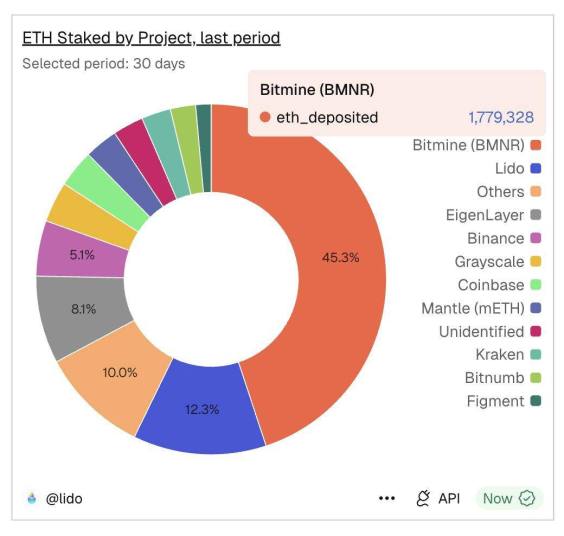
In the staking space, Bitmine has turned Ethereum staking into a multi-billion-dollar business. An analyst known as Milk Road has revealed that the company now has 1.83 million ETH staked, worth roughly $6 million at current prices, and plans to scale that figure toward 4.2 million ETH over time. Over the past months, Bitmine Immersion Technologies Inc. (BMNR) has accounted for nearly 50% of all new ETH entering the staking queue.

Ethereum

Staking at this scale is important because it removes ETH from the liquid supply and locks it into long-term infrastructure rather than keeping it for short-term trading. When one player is willing to commit billions of dollars worth of ETH to staking, it reflects confidence in ETH’s future economic prospects. A lower liquid supply, combined with sustained network demand, will create structural pressure over time.

How Support Built Through Multiple Market Cycles

Analyst Milk Road has also highlighted that Ethereum is holding near a critical support zone around $3,000, hovering just above the lower boundary of its long-term rising structure, an area that has acted as a stress test for ETH throughout the cycle. Historically, when ETH drifts into this area, the market will need to decide whether the weakness is temporary or structural.

The $2,750 level remains the key line because it has repeatedly stopped downside pressure after macro-driven or narrative-driven pullbacks, making it a reliable floor for the broader trend. As long as ETH holds above that level, the broader multi-year uptrend will remain intact.

Ethereum

Banks’ Concerns Over Stablecoin Interest Payments Are ‘Totally Absurd’, Circle CEO Says

The CEO of stablecoin issuer Circle has weighed in on the importance of stablecoin rewards and why he believes the banking industry’s concerns about interest payments on these assets are “absurd.”

Circle CEO Rejects Banks’ Stablecoin Fears

Speaking at the World Economic Forum (WEF) in Davos, Circle’s CEO, Jeremy Allaire, discussed banks’ growing concerns that paying interest on stablecoins poses a threat to the industry, calling the deposit flight narrative “totally absurd.”

The banking sector has expressed concerns about stablecoin rewards, arguing that interest payments will distort market dynamics and affect credit creation. In the US, banks have heavily criticized the GENIUS Act, claiming that it has loopholes that could pose risks to the financial system.

The executive rejected the sector’s general arguments, citing historical and practical reasons. He asserted that this exact argument has been historically used when new financial products, such as government money market funds, have emerged.

Notably, Bank of America CEO Brian Moynihan recently compared the digital assets to money market mutual funds, which require reserves to be held in short-term instruments, such as US Treasuries, reducing lending capacity in the system.

The executive told investors that the banking sector, small- and medium-sized businesses in particular, could face significant challenges if the US Congress does not prohibit interest-bearing stablecoins, as up to $6 trillion in deposits, or 30% to 35% of all US commercial bank deposits, could flow out of the banking system and into the stablecoin sector.

However, Allaire pointed out that, despite institutions claiming that financial products would “draw all the deposit base,” their growth has not “stopped the ability for lending to happen.”

The importance Of Rewards

Circle’s CEO also argued that stablecoins should not be singled out when rewards for other financial products exist and contribute to the system. “Those rewards (…) exist in every balance that you have with a credit card that you use. They exist around so many other financial products and services that we have,” he detailed.

“These rewards are actually very important,” Allaire continued. “They help with stickiness, they help with customer traction. They are not themselves like these huge monetary policy dampers.”

Most importantly, he pointed out that lending is moving away from the risk-taking of banks, with “a huge amount of lending is moving towards private credit.”

He cited a Wednesday WEF panel, in which a capital markets participant highlighted how the vast majority of GDP growth in the United States was “formed by capital market formation around junk bonds.”

“So private credit issuing junk bonds, capitalizing the build out of the American technology advancements, not bank credit,” the executive added.

Previously, Coinbase Institute shared a similar argument, affirming that “credit is evolving, not shrinking. Lending is shifting to private credit, fintech, and DeFi channels that don’t depend on deposits. Liquidity moves—it doesn’t vanish.”

Allaire concluded that “we want stablecoin money to be cash instrument money, prudentially supervised, very, very safe money. And then I think what we want to do is we want to build models for lending that build on top of stablecoins.”

stablecoin, total

Satya Nadella’s new metaphor for the AI Age: We are becoming ‘managers of infinite minds’

Microsoft CEO Satya Nadella and former UK Prime Minister Rishi Sunak at the World Economic Forum in Davos. (Screenshot via LinkedIn)

Bicycles for the mind. … Information at your fingertips. … Managers of infinite minds?

Microsoft CEO Satya Nadella riffed on some famous lines from tech leaders past this week in an appearance at the World Economic Forum in Davos, Switzerland, and offered up his own trippy candidate to join the canon of computing metaphors. 

Nadella traced the lineage in a conversation with former UK Prime Minister Rishi Sunak.

  • “Computers are like a bicycle for the mind” was the famous line from Apple’s Steve Jobs.
  • “Information at your fingertips” was Bill Gates’ classic Microsoft refrain back in the day.

And now? “All of us are going to be managers of infinite minds,” Nadella said. “And so if we have that as the theory, then the question is, what can we do with it?”

He was referring to AI agents — the autonomous software that can take on tasks, work through problems, and keep going while you sleep. Microsoft and others have been talking for the better part of a year now about people starting to oversee large fleets of them. 

Nadella said it’s already reshaping how teams are structured. At Microsoft-owned LinkedIn, the company has merged design, program management, product management, and front-end engineering into a single new role: full-stack builders. Overall, he called it the biggest structural change to software teams he’s seen in a career that started at Microsoft in the 1990s.

“The jobs of the future are here,” Nadella said, putting his own spin on a famous line often attributed to sci-fi writer William Gibson. “They’re just not evenly distributed.”

Nadella’s comments came during a live stream for LinkedIn Premium members, hosted from Davos by LinkedIn VP and Editor in Chief Daniel Roth, after Sunak mentioned his two teenage daughters, and the world they’ll enter. Young people may not manage lots of people at age 20 or 21, he said, “but they will be managing a team of agents.” 

Sunak was referencing an essay by Goldman Sachs CIO Marco Argenti in Time. 

The agentic shift, Argenti wrote, requires “moving from being a sole performer to an orchestra conductor” — your team now includes AI agents that “must be guided and supervised with the same approach you would apply to a new, junior colleague.”

Nadella agreed, saying “we do need a new theory of the mind” to navigate what’s coming, before he offered up his new metaphor about managing infinite minds.

In other remarks at Davos, Nadella made headlines with his warning that AI’s massive energy demands risk eroding its “social permission” unless it delivers tangible benefits in health, education, and productivity. Energy costs, he added, will decide the AI race’s winners, with GDP growth tied to cheap power for processing AI tokens.

Whether “infinite minds” catches on like “bicycles” and “fingertips” remains to be seen. But it’s definitely more psychedelic. And if this shift is stranger than what came before, maybe we do need a mind-expanding metaphor to make sense of it all.

WEF Document Name-Drops Ripple’s XRP, What Does It Say?

A decade-old report from the World Economic Forum (WEF) is resurfacing in the crypto space, highlighting early recognition of Ripple and XRP’s potential in the banking sector. Analysts say the document illustrates how decentralized networks like Ripple may allow institutions to settle payments faster and more directly in the future. 

WEF Spotlights Ripple For Settlement Case Study

A crypto market analyst identified as ‘SMQKE’ on X recently revived a 2015 WEF report, sparking fresh discussions in the crypto community. The document explores how traditional banks could interact with emerging payment technologies, and it specifically mentions the company as a system capable of transforming interbank settlement.

The WEF report revealed that, as alternative payment methods, such as decentralized networks, grow in popularity worldwide, banks have the opportunity to integrate them into their services. By adopting these technologies, institutions can make it easier for customers to move value in and out of non-traditional networks while also exploring new financial products. Ripple is cited as an example of a protocol that could serve as one of these alternative rails. 

Beyond customer use, these networks can also improve how banks operate internally. By leveraging non-traditional networks, banks could streamline processes and offer smoother, faster products and services. Ripple’s protocol, for instance, enhances this process by enabling real-time settlement between banks, eliminating the need for traditional clearinghouses or correspondent banks. 

A case study in the WEF report focuses on German-based Fidor Bank, an online full-service bank that implemented the payment firm for its internal settlement operations in 2014. According to the World Economic Forum, broader adoption of Ripple could enable other banks to settle payments instantly with one another. This early example demonstrates how the crypto payments company was already seen as a practical tool for improving banking efficiency

Though the WEF report is over a decade old, its insights remain relevant as financial institutions continue exploring blockchain-based payment solutions. Notably, this is not the first time the World Economic Forum has mentioned Ripple in its reports. In its May 2025 report, the international organization highlighted Ripple and the XRP Ledger (XRPL) as key technologies in the future of asset tokenization. 

How XRP Fits In The Bank Settlement Scheme

As the native token of the XRP Ledger (XRPL), XRP is designed to serve as a digital bridge for fast, low-cost cross-border payments between financial institutions. By leveraging XRPL, Ripple enables banks and payment providers to settle transactions in seconds rather than days. 

Due to its high throughput and ability to handle large transaction volumes with minimal effort, the XRP Ledger appears well-suited for the demands of modern banking. Its efficiency and speed have led many to compare Ripple to SWIFT, the long-standing messaging network used by banks worldwide for international transfers.

Ripple

Federal Executive Forum: Artificial Intelligence Strategies in Government Progress and Best Practices 2026

By: wfedstaff

Artificial intelligence continues to accelerate — expanding both its capabilities and its use across government. How are federal agencies applying AI to advance mission outcomes, manage risk and prepare for what’s next?

During this webinar, you’ll hear directly from senior government technology leaders on the strategies shaping AI adoption today:

  • Donald Coulter, Senior Science Advisor for Cybersecurity, Science and Technology Directorate, Department of Homeland Security (Confirmed, pending final approval)
  • Israel Soong, Deputy Director, Office of Artificial Intelligence, Central Intelligence Agency (Confirmed, pending final approval)
  • Dr. Omar Hatamleh, Chief Artificial Intelligence Officer, Goddard Space Flight Center, NASA (Invited) or Matt Dosberg, Deputy Artificial Intelligence Officer, Goddard Space Flight Center, NASA (Invited)
  • Susan Davenport, Chief Data and Artificial Intelligence Officer, Air Force (Invited)
  • Rachael Martin, Director, MAVEN Office, National Geospatial-Intelligence Agency (Invited)
  • Chad Cisco, Chief Customer Officer, DataRobot (Invited)
  • Nate Riley, Field Sales Manager, Public Sector, BMC Helix (Invited)
  • ICF Executive (Invited)
  • Moderator: Luke McCormack, Host of the Federal Executive Forum


Panelists also will share lessons learned, challenges and solutions, and a vision for the future.

The post Federal Executive Forum: Artificial Intelligence Strategies in Government Progress and Best Practices 2026 first appeared on Federal News Network.

© Getty Images

AI or Artificial intelligence concept. Businessman using computer use ai to help business and used in daily life, Digital Transformation, Internet of Things, Artificial intelligence brain, A.I.,

Federal Executive Forum Cybersecurity for Defense and Homeland Progress and Best Practices 2025

By: wfedstaff

Government cybersecurity strategies are evolving as threats become more complex. The Defense and Homeland Security departments emphasize proactive security, including building protections into development, adopting zero trust and strengthening threat intelligence, workforce skills and infrastructure. How are agencies adapting their cyber strategies to stay ahead of emerging risks?

During this webinar, you will hear about those strategies and more from the unique perspective of these top government security experts:

  • Brig. Gen. Brian Wisniewski, Army Cyber Command (Invited)
  • Robert Costello, Chief Information Officer, Cybersecurity and Infrastructure Security Agency (Invited)
  • Michael “Barry” Tanner, Acting Chief Information Officer, Navy (Invited) or Damen Hofheinz, Acting Chief Information Security Officer, Navy (Invited)
  • Sudha Vyas, Deputy Chief Information Security Officer, Department of Defense (Invited)
  • Timothy Sydnor, Defense Intelligence Agency (Invited) or Deidra Bass, Chief Information Security Officer, Defense Intelligence Agency (Invited)
  • Lamont Copeland, Senior Director, Federal Solutions Architecture, Verizon Business Group
  • John Sourk, Regional Director, Federal, Abnormal AI
  • CrowdStrike Executive (Invited)
  • Moderator: Luke McCormack, Host of the Federal Executive Forum

Panelists also will share lessons learned, challenges and solutions, and a vision for the future.

The post Federal Executive Forum Cybersecurity for Defense and Homeland Progress and Best Practices 2025 first appeared on Federal News Network.

© Getty Images/Alexander Sikov

Cyber Security Data Protection Business Technology Privacy concept

Former U.S. Cyber Chief: Crowdsource Cyber Defense

EXPERT INTERVIEW — Riyadh’s Global Cybersecurity Forum (GCF) in Saudi Arabia kicked off last week under the theme “Scaling Cohesive Advancement in Cyberspace.” The gathering came as researchers are increasingly discovering new malware and hacking campaigns, cybercrime is at an all-time high, and, in the U.S., critical cybersecurity legislation and authorities have been allowed to expire.

We caught up there with Chris Inglis, the first U.S. National Cyber Director, who says he sees reason for optimism. Inglis spoke on a cybercrime panel at the GCF and told us why he’s bullish on the prospect of cooperation and collaborative action to effectively counter cyber threats. Our conversation has been lightly edited for length and clarity.

The Cipher Brief: What is the real focus there right now as all of these cyber experts gather?

Inglis: There is a buzz to be sure, and I think that buzz kind of revolves around the use of the term in their title this year, which is to do “cohesive scaling.” Both of those attributes are important. Cohesive implies the notion not just of concurrent action, but collaborative action. And scale is what lies before us. So we must scale this effort because we're being crowdsourced by a vast array of actors, malign actors, holdings at risk through things like ransomware or insertions or critical infrastructure. So I think the buzz is what do we do together as opposed to the single point solutions that might be offered by the technologist alone.

The Cipher Brief: You're on a panel there talking about cybercrime and the global stakeholders associated with cybercrime. Can you give us a few highlights of some of the things that you're going to talk about in that session?

Inglis: I think that the reality of cybercrime is it's perhaps a more appealing, more transcendent issue to focus collective action on, because every citizen, regardless of what nation he or she might be from, cares about crime and wants to live in a world where they're not going to be thwarted or taken down by somebody that takes advantage of digital infrastructure that's not quite fit for purpose.

And so rather than talk about who those actors are that hold them at risk or talk about coalitions of one form or another that might take on coalitions of malign actors, let's talk about the needs of our citizens and that everyone wants to live in a crime-free world. That might sound like a bit of a panacea, but there's no one that would argue against that.

And I think the other thing about taking on the criminal elements is that there's so many of them, the cost of entry is still so low and the assets they might acquire still so high that we're never going to entirely remove them from the field. That might sound like I'm giving up before I even start, but it's going to focus us on this high-leverage proposition of, what if we just made it too hard for them to succeed? I then don't need to find each and every one of those that's transgressed and succeeded against me. I actually am in a better place because they decided today not to try or they failed in trying in the first place.

And so it focuses us, again, on resilience and robustness, not for its own sake, but so that we might have confidence in digital infrastructure. I think those are the highlights of this collective action and a focus on resilience.

The Cipher Brief: Oftentimes, criminal groups now are being backed by nation states. How is that being tackled at an international forum like this?

Inglis: We're being too kind. Sometimes, criminal enterprises are nation states, thinking about North Korea where it's a money-making proposition. It's an unholy alliance to be sure, and I think it gives them the kind of backing that we do not want to put into the hands of any single adversary. But we have the right on the defensive side to not simply collaborate, but to do so in the light of day. We don't have to skulk about in the dark or to accomplish these crowdsourcing activities on the dark web. We could do it in the light of day in a place like Riyadh, which is what's taking place here.

Talking about what our common aspirations are for our citizens, talking about what the common kind challenges are to those aspirations, and thinking about not just collective action, which might be a concurrent application of all this talent, but collaborative action with a degree of professional intimacy that we actually assist one another in ways that no one of us could succeed alone. So I'm bullish about what the defense can pull off if they follow the same tactics that the offense does, which is let's crowdsource the other side.

The Cipher Brief: While you're talking about collaboration in Riyadh, CISA 2015 expired here in the United States on September 30th, and that really has a lot of indicators in terms of information sharing between government and the private sector. How serious of an issue is this?

Inglis: Of course, I'm worried about the lack of the legal authority and the liability protections that are attendant to that. But if it was truly valuable in the first place, then I hope, imagine and am confident that that degree of sharing still goes on. That form should follow function.

We should get the law back in place as soon as possible. I've heard no one argue against the usefulness of that, and we're just caught in a time and place where we ran out of time. But behind the scenes, hopefully, and I'm more than hopeful, I'm confident there is a degree of collaboration going on. Why? Not because it's mandated, but because it's useful to all sides.

The Cipher Brief: President Trump was just in Saudi Arabia earlier this year where he announced a pretty incredible investment package. AI was a big focus of his trip there, and of those announcements that were made, I'm wondering how concerned you are about autonomous AI-driven cyber weapons escalating conflicts, and if there is a path toward international guardrails or norms here.

Inglis: I don't think anyone's actually talking about the literal kind of creation of autonomous AI driven systems. That term is sometimes not well-defined. Ask it this way, which is do we want weapon systems that can change sides in the middle of a war? Of course not. So we don't want autonomous weapon systems. But do we want highly capable weapon systems that augment human capacity, that can take a line of action from a human being who remains accountable, the human remains accountable, and execute that at scope and scale in ways that a human alone could not? Yes, of course we do, but we need a value scheme to go with that. And there's talk not just on the part of governments, but on the part of the private sector for the necessity of that.

If we went back 50, 60 years to the days of early robotics, Isaac Asimov would be advising us that we should have three rules for robots. One, it should never hurt a human being. Two, it should obey human beings. And three, it should protect itself. In that order. And it turns out there's an equivalent to those three simple rules for generative AI or agentic AI.

I'm not afraid of AI that achieves human-like capacities, but I am very nervous about having it be completely independent of human beings. And no one that I know is talking about having it be independent of human beings. Human accountability must and will remain on the loop, even though the speed of the human's ability to think through the complex problems AI can take on is going to be overmatched in a wondrous way by generative AI. We will remain accountable for it, and therefore the values that Asimov would recommend play through to this day. And I think that there's a version of that in every instance that I've seen of responsible parties talking about let's use this way in some different capacity.

Sign up for the Cyber Initiatives Group Sunday newsletter, delivering expert-level insights on the cyber and tech stories of the day – directly to your inbox. Sign up for the CIG newsletter today.

The Cipher Brief: How bullish are you on the idea of norms, particularly when we're seeing so many nation-states using cyber as a national security tool, an espionage tool, and cybercrime? How bullish are you on norms and the effectiveness of norms?

Ingli: I'm bullish on the utility of norms. I'm less bullish on the implementation of those kind of universally and kind of the same across all kind of players in this space. As we talked about earlier in this conversation, clearly there are some actors who are broadly ignoring those norms, and the answer to that is to not for ourselves to actually similarly violate those norms. Why? Because our people are then disadvantaged in that regard. They get caught in the churn. Our allies or those who would collaborate with us in this world will not then commit their full-time and attention to that in the absence of shared value, shared norms, shared aspirations, and so I think that norms still have their value, and it still tells us how we actually deliver on the human aspirations that ultimately have a foundation in values, not just technology.

The Cipher Brief: What are some of the most interesting conversations that you've had on the sidelines there in Riyadh?

Inglis: I think the most interesting conversations are about those who argue for collaboration as opposed to division of effort. And the pitch that they make is not one that's to their own advantage, it's to the collective advantage. Reminding us that we're not trying to solve similar problems. We're all trying to solve the same problem or deliver the same aspirations to our citizens. Those are the most compelling conversations that I've seen so far.

And the focus by the GCF, the Global Cyber Forum that's convened here by the Saudis, a focus on those things that every parent, every human being could find a noble aspiration for our children: child protection, elimination of ransomware that holds individuals and small businesses at risk. Those are, I think, the most meaningful discussions. The technology can follow, the doctrine can follow, but if we get those aspirations right, we're in a better place at the start.

Are you Subscribed to The Cipher Brief’s Digital Channel on YouTube? There is no better place to get clear perspectives from deeply experienced national security experts.

Read more expert-driven national security insights, perspective and analysis in The Cipher Brief because National Security is Everyone’s Business.

The Road to New York’s Potentially Massive Cannabis Market

Graffiti in New York

The New York state cannabis market is projected to be one of the biggest in the world, with some industry estimates forecasting sales to surpass $2 billion within just a few years. But the state’s recreational industry is just starting to get off the ground, with multiple players eyeing how to break in and make money.

The city’s first state-sanctioned adult-use dispensary opened in December, and its second – but first social-equity licensed store – just opened this week. Meanwhile, smoke shops are popping up on seemingly every corner, and medical marijuana dispensaries are holding on to prime real estate as both await what they hope will be their turn in the licensing process.

This month, Green Market Report joined forces with our sister publication Crain’s New York to take a closer look at the rollout:

We also asked some of the various stakeholders to share their thoughts on where the rollout is – and where they think it should go. Contributors include:

This package really is just a snapshot of an evolving market and industry – one that we’ll be keeping a close eye on in the weeks and months to come.

Thanks to Telisha Bryan, managing editor of Crain’s New York, and her team for helping us create this package for you, and to Buck Ennis for capturing the industry in pictures.

The post The Road to New York’s Potentially Massive Cannabis Market appeared first on Green Market Report.

Potency Tax Could be a Major Buzzkill for Sanctioned Cannabis Retailers

This story was written in partnership with Crain’s New York, the trusted voice of the New York business community. 

One of the most controversial aspects of New York’s new recreational cannabis market is its tax system, which some have worried will undermine licensed businesses by driving consumers to cheaper underground dealers.

A white paper published in December by a pair of New York tax attorneys, just weeks before the formal start of recreational marijuana sales on Dec. 29, warned of that very possibility. It predicted—and was proven accurate after sales launched—that a legal eighth of cannabis flower in New York with 30% THC would cost about $75.

Prices at Housing Works—the first state-sanctioned cannabis retailer in the five boroughs—proved to be not far below that, with prices fluctuating because taxes are based on THC potency. According to the nonprofit’s online menu, an eighth of cannabis flower ranges in price and potency from 19% THC for $40 to 27% for $60. With the 13% excise tax added, out-the-door prices would be between $45 and $68, respectively.

But if customers remain price-sensitive, as data from other mature recreational marijuana markets suggest, then they’ll broadly be willing to pay only as much as 10% to 15% above prices on the unregulated market, according to the paper, authored by attorneys Jason Klimek and James Mann.

By contrast, unlicensed street vendors in New York City last month were peddling cannabis eighths for between $10 and $45, Green Market Report found.

Combine that with overall lax enforcement to date against the underground market, and the situation has the potential to undercut state-licensed retailers—particularly smaller and less-capitalized businesses—before they can truly get off the ground, Klimek and Mann asserted.

Charles King, CEO of Housing Works / photo by Buck Ennis

Charles King, the CEO of Housing Works, said in early January that he doesn’t think the situation is that dire, and companies such as his will be able to survive as long as they stick to a solid retail business plan and tap the immense tourism market.

“I think people know that you’re paying for quality, you’re paying for the taxes and all the rest of what goes with the regulated, licensed market,” King said.

Still, there will have to be more of a focus on enforcement against illicit competition by state authorities, King said.

It’s a big undertaking, as many illicit operators already have brand recognition by offering legally produced but illegally shipped cannabis from California and Oregon, such as the famed SoCal brand Jungle Boys. That’s one brand name New York City resident Joe Lustberg, managing partner at Upwise Capital, said he ran into recently at a smoke shop.

“For some cannabis operator who’s competing with the smoke shop next door [that is] able to sell California eighths for $30 [and] that’s better weed than what they’re selling at Housing Works, it’s tough,” Lustberg said.

The tax structure also might be altered by the Legislature, because making the system more business-friendly is a top priority of industry interests in Albany, including for the Cannabis Association of New York.

“I do feel confident that the state is very much aware of the issue with the potency tax and, at the very least, open to reform,” said Brittany Carbone, a board member of CANY and a cannabis farmer upstate. “It’s been well proven that more reasonable tax structures actually result in higher rates of purchase in legal dispensaries, which results in a net positive win for the state, in terms of tax revenues.”

Even if the tax structure doesn’t change, cannabis attorney Lauren Rudick said, the THC-based potency tax will probably encourage the creation and sale of a more diverse range of cannabinoid products that don’t rely only on THC to please consumers. And that could be just what the burgeoning industry needs: more product variety.


By the Numbers:

$68

Highest price, with taxes added, for an eighth of cannabis with 27% THC sold at Housing Works

$10

Lowest price for an eight of cannabis bought on the street

The post Potency Tax Could be a Major Buzzkill for Sanctioned Cannabis Retailers appeared first on Green Market Report.

As Rec Sales Start, Medical Marijuana Firms Left Warming the Bench

This story was written in partnership with Crain’s New York, the trusted voice of the New York business community. 

When New York gave the sale and use of medical marijuana the green light, officially permitting it in 2014, the firms that vied for a spot as one of the state’s 10 vertically licensed operators envisioned the true golden ticket to be early entry into the eventual recreational cannabis retail market.

That expectation was amplified when the state passed the Marijuana Regulation and Taxation Act in 2021. Investment dollars poured in, and medical licenses traded at high valuations on the secondary market, bolstered by the idea that those who bought in early would be able to capitalize on both adult-use and medical retail sales, cultivation and manufacturing.

However, under draft regulations released in November, those companies will have to wait at least three years from the official launch date of adult-use sales just to apply for a recreational retail permit. Final rules have yet to be published.

“They were hit with a bait and switch by the state regulators,” said Tom Adams, principal analyst and CEO of Global Go. “You know, ‘Come to our state and help apply your expertise and your capital to building out this incredibly limited medical-­only market that you’re clearly not going to make any money at anywhere in New York.’”

The Columbia Care medical marijuana dispensary near Union Square in Manhattan. / photo by Buck Ennis

So the multistate operators came.

The proposed rules, however, also established a two-tier system that prohibits growers and manufacturers from participating on the retail side—and vice versa. That means those same players who helped establish the medical cannabis industry “got sort of the back of the hand from regulators” and now must accept that they cannot implement the business models they’ve used in other states, Adams said.

Those who invested in medical operations in New York early on expected, if not “the first bite at the apple … at least a first bite at the same time as the other licensees for some of these retail adult-use licenses,” said Brandon Kurtzman, a partner at cannabis law firm Vicente Sederberg.

Both Adams and Kurtzman said the pivot now is to develop product brands through the cultivation and manufacturing side to sell to retailers and social consumption lounges.

Boxed in

The $138.9 million write-down Toronto-­based RIV Capital took after its acquisition of New York’s Etain, one of the 10 local medical cannabis license holders, illustrates the conundrum. RIV Capital agreed to pay $212 million in cash and $35 million in stock for the small, women-led medical cannabis company.

But instead of being able to capitalize on its existing business structure, Etain has been forced into a single channel. With heavy investment already sunk into cultivation, the company appears to be boxed into being a grower—the less lucrative side of the cannabis business.

The price paid for Etain was so troubling to RIV Capital’s largest shareholder, JW Asset Management, that the firm asked for a special meeting of shareholders to replace five of the seven directors on RIV’s board.

In New York, Adams said, having a brand on store shelves “is probably more valuable than anything else” an operator can do, as there is not much real brand dominance yet among the plethora of cannabis companies out there.

Despite the firms seemingly being last in line, nothing is completely set in stone.

“It’ll be very interesting to see what happens with these draft regulations, see what the comments look like and if there’s going to be any compromise between what they put out [and] what [medical operators] are looking for in this market,” Kurtzman noted.

“The goal here is to provide access to consumers,” he added. “I think you do that by allowing new licensees but also allowing the existing licensees to participate, because that’s more or less what you told them they were going to be able to do in the law.”

The post As Rec Sales Start, Medical Marijuana Firms Left Warming the Bench appeared first on Green Market Report.

New York’s Cannabis Market Faces Uphill Climb as Adult-Use Sales Begin

This story was written in partnership with Crain’s New York, the trusted voice of the New York business community. 

The New York state cannabis market is projected to be one of the biggest in the world, with some industry estimates forecasting sales to surpass $2 billion within just a few years. But the slow rollout and uncertain regulations—after all, the rules are still in draft form—leave many wondering if a large chunk of sales will continue going to unlicensed dealers.

On top of that, the state’s unclear timeline for when licenses will be issued and storefronts will be fully operational as well as concerns about how much consumers will be willing to spend once potency and excise taxes are baked in, among other hurdles, have given some stakeholders pause about how successful smaller players will be in the market.

“This is a very optimistic time, but the business owner in me is very stressed out every single day on how I’m actually going to make this work,” said Brittany Carbone, a board member of the Cannabis Association of New York and the CEO of Tricolla Farms, near Ithaca. “There could be thousands of millionaires rather than a few billionaires created through the New York market, and the first step is getting more people licensed.”

Cultivation licenses were the first to be issued, but they were restricted to existing hemp farmers who could convert to growing marijuana to supply product rich in THC, the chemical that provides users with the sensation of being high, when the adult-use market launched.

There’s a long way to go, however. As of early January, the New York Office of Cannabis Management had awarded 354 conditional licenses, made up of 279 growers, 39 processors and 36 retailers, on top of the 10 registered organizations, or ROs, that are allowed to sell medical cannabis.

That includes 26 new adult-use retail licenses for four of New York City’s boroughs and Long Island. (Brooklyn was one of five regions where licensing has been delayed by litigation.) Each of those licensees can open three stores.

In addition, Manhattan, Queens, the Bronx, Brooklyn and Staten Island are already home to eight medical dispensaries, including three in Brooklyn.

It’s not clear when authorities will grant more permits; 903 applications were filed for the first round of retail licenses alone last year, so timing is a major question mark.

Not only that, but the sheer price difference between the first legal retailer in New York thus far Manhattan’s — Housing Works — and the enormous number of unlicensed dealers have some fearing that many companies won’t survive.

“It is an uphill battle, but again, it’s always an uphill battle when you don’t have massive capital, no matter what industry you’re in. But when you throw in the illicit market side, it makes it even harder,” attorney Jason Klimek, a member of the New York Bar Association’s cannabis law section, said when asked how he thinks the market—which is centered on small mom-and-pop businesses—will perform.

The most immediate obstacle for many New York cannabis hopefuls is getting licensed and operational, but the timeline on that front is painfully unclear.

The state has no limit on the number of business permits it will award—in theory—but regulators have been painstakingly slow on that front, particularly for retailers. The first round, which is so far only partially completed, will award 175 retail permits, including 150 for “justice-involved” individuals and an additional 25 for nonprofits.

The longer those retailers have to wait, the closer they’ll get to the three-year deadline, at the end of 2025, when the 10 multistate operator ROs will be allowed to fully enter the recreational cannabis side of the market. For now those behemoths are relegated to wholesaling cannabis products to licensed adult-use firms.

Most industry observers agree that the 10 will likely start dominating quickly because they’ve got an edge that no other retailer will have: vertical integration, their own in-house supply chains and branded product lines.

All the other retailers are prohibited from building such infrastructure or even having their own brands—another complaint of some license hopefuls.

“That is not good, because the only way we can level the playing field is for the smaller players like myself … to be able to support each other and be able to have each others’ products. The way the regulations are set up, I don’t think we could do that,” said Vladimir Bautista, CEO of New York City–based cannabis lifestyle brand Happy Munkey, one of the contenders for a retail license.

There’s even more uncertainty about the licensing rollout because of ongoing litigation that has held up at least 18 retail licenses thus far and has the potential to delay the permitting even more.

The post New York’s Cannabis Market Faces Uphill Climb as Adult-Use Sales Begin appeared first on Green Market Report.

Your Take: NY’s Cannabis Market Isn’t Moving Too Slowly — It’s on a Mission

By: Staff

This story was written in partnership with Crain’s New York, the trusted voice of the New York business community. 

by Dasheeda Dawson, Cannabis NYC

Dasheeda Dawson, Cannabis NYC

It took nearly a century to suppress the legacy of cannabis in American agriculture and medicine. Just a decade ago, as a Brooklyn native who grew up during the height of cannabis criminalization, I could not have imagined buying an eighth of weed legally in New York City.

Despite the history, on March 31, 2021, the Marijuana Regulation and Taxation Act, championed by Assembly Majority Leader Crystal Peoples-Stokes, state Sen. Liz Krueger and the StartSMART Coalition, became the country’s landmark equity-centered law to intentionally hold government accountable for restoring and repairing communities disproportionately impacted by the overpolicing and disinvestment of the prohibition era.

I never expected the damage from decades of harsh laws and entrenched negative stigmas to disappear overnight. However, some have criticized the state’s timing, peddling the narrative that it is moving too slowly.

Analyzing the adult-use markets legalized prior to New York’s, every state had a lag period between legalization and launch, more often giving first access to already licensed medical operators, which further exacerbated inequities in the industry. In 2016 California and Massachusetts legalized adult use, and both opened the market for sales in 2018. In 2020 New Jersey legalized cannabis, and the state opened the market for first sales in 2022.

Providing 300-plus licenses to justice-involved individuals, small-business owners and farmers, the New York state Office of Cannabis Management should be commended for rapidly building a seed-to-shelf supply chain in less than two years, culminating with the first dispensary opening in December 2022.

New York is also taking an unprecedented approach to support previously existing, unlicensed cannabis entrepreneurs, often referred to as “legacy operators,” transition into the legal industry. Though others demonized the legacy market, New York has embraced the underground culture and its credibility.

The state’s conditional adult-use retail dispensary license and Cannabis Compliance Training and Mentorship Program mark the start of intentional inclusion in New York’s market. The nonprofit CAURD licensing opportunity also demonstrates an extraordinary model that supports sustainable funding to organizations that have served marginalized communities, provides opportunities to those same communities for retail workforce development and contributes to state cannabis tax revenue, 40% of which goes back to the communities disproportionately impacted by criminalization.

Amid these groundbreaking advancements for the state, New York City is contending with the proliferation of visible, unlicensed smoke shops, a common trend experienced during the lag period in other markets. From my experience in legalization efforts across the country, an industry grounded in restorative justice requires a three-pronged approach to enforcement:

  1. Facilitating the transition of preexisting legacy operators into the legal market through intentional programming and resources;
  2. Bringing unlicensed businesses that have received warnings into compliance through rehabilitative engagement; and,
  3. Using civil enforcement actions to disrupt unregulated activities that pose a risk to public health and safety.

Mayor Eric Adams launched Cannabis NYC to support New Yorkers starting or growing a legal cannabis-related business. As an emerging multibillion-dollar industry, cannabis will contribute significantly to the city’s economic recovery and can address the past wrongs that disproportionately affected Black and brown communities.

Cannabis NYC is on a mission to make our city the global leader in cannabis industry excellence in education and equity across business, science and culture. To accomplish this, MRTA’s intent must be protected, and efforts to repair social, economic, environmental and human injuries caused by prohibition must not be derailed by stigma and misinformation.

Cannabis NYC is actively creating an interagency hub of free resources and services for all New Yorkers, kicking off with a five-borough informational tour, in collaboration with the New York City Housing Authority and the Mayor’s Office of Equity. We are partnering with industry pioneers and institutions to support citywide public education initiatives, workforce training and curriculum development. The NYC Cannabis Policy Advisory Commission will include a diverse group of local and global experts, including racial justice, economic development and health equity leaders tasked with publishing an annual policy report. This is just the beginning.

Cannabis is a plant with agricultural, industrial, nutritional, medical and spiritual utilities that will have global impact, from health to hospitality to housing. Armed with the right alignment of community advocacy, business innovation and government leadership, at the state and local level, New York is poised to become a model of cannabis excellence for the world.

Dasheeda Dawson is founding director of Cannabis NYC.

The post Your Take: NY’s Cannabis Market Isn’t Moving Too Slowly — It’s on a Mission appeared first on Green Market Report.

Your Take: New York’s Legal Cannabis Industry Must be Accessible to the Latino Community

By: Staff

This story was written in partnership with Crain’s New York, the trusted voice of the New York business community. 

To read this post in Spanish, click here.

by Kristina Lopez Adduci, House of Puff, and Vladimir Bautista, Happy Munkey

Kristina Lopez Adduci, House of Puff

As dispensaries begin to open and New York makes meaningful progress to launch its adult-use cannabis industry, one demographic that cannot be overlooked is the Latino community. We must address language barriers, cultural incompetence and the damage done by prohibition.

This is not an easy feat, but if we overcome this, Hispanic New Yorkers stand to be a key population to help our state’s legal industry achieve its true potential and fulfill the vision set out by the Marijuana Regulation and Taxation Act. Here’s why New York must do more to make legal cannabis accessible to its Latino population.

Prohibition was harmful to Latinos.

Vladimir Bautista, Happy Munkey

The racist undertones of anti-cannabis movements, such as the War on Drugs, adversely affected Latinos, and reversing those impacts must be a priority in the legal industry. It is commonly known that the now derogatory term “marijuana,” along with the first wave of prohibition in Texas, was created because of anti-Mexican sentiments and the plant’s association with migrants crossing the border.

For the Latino community, the War on Drugs not only perpetuated racist stereotypes, but it was also a driver of mass deportations and increased hostilities toward Hispanic migrant populations. Latino women were more likely to be arrested or have their children taken away in connection to cannabis use and possession. Prohibition also sparked the creation of the Drug Enforcement Administration, an agency responsible for the criminalization and incarceration of Latinos in the United States and in South America. This deepened the negative and discriminatory stereotypes about Spanish-speaking Americans and cannabis, especially in major cities with large Hispanic populations like New York City.

Latinos have an influential presence in New York.

New York state has the fourth-largest Latino population in the U.S., tallying almost 4 million of us. In New York City, we make up more than a quarter of the population, being outnumbered only by Caucasians. Due to our growing presence, Latinos will play an increasingly large role in the state’s culture, innovation, politics and key industries. This influence will undoubtedly continue in New York’s emerging cannabis industry. We have been leaders in legalization efforts in the state and trailblazers in the wider industry. We also represent a large portion of the legacy community and a significant consumer profile.

Latino culture and cannabis culture are closely related. We must ensure that this connective tissue remains as we transition into a legal market.

Latinos are becoming fierce cannabis advocates and consumers.

The Latino population is the youngest ethnic group in the U.S. Additionally, Hispanic culture has historically recognized the medicinal benefits of the plant. Attitudes are still shifting within our community. Though it is common for elder-generation Latinos to perpetuate negative stigmas around cannabis consumption, overall, our community not only consumes cannabis but fiercely advocates for it. According to a 2019 report by Ad Age, Hispanics are 30% more likely than the average cannabis consumer to belong to a group that actively promotes legalizing cannabis. The study also found that Latinos are 42% more likely than the average American to be cannabis campaigners. Cannabis campaigners are characterized as people who don’t necessarily consume cannabis, but who are informed about cannabis issues and actively support legalization.

New York must tap this enthusiasm to effectively incorporate our community into the cannabis industry. This means more cannabis education and restorative justice efforts in Latino neighborhoods, more programming and advertising in Spanish, and culturally competent “budtenders” and staff at dispensaries.

To most effectively address these barriers, an increase in Latino operators and dispensary owners is also key. That would grant us the social and economic equity benefits of the new legal industry and repair the lingering damage done to our communities by the War on Drugs.

Latinos will be a decisive demographic in the long-term success of the state’s legal industry. From Latino trailblazers paving the way within the community to Latino consumers and stakeholders posing an influence from the outside, we will uplift the cannabis sector for the long term. For the sake of social equity and the health of the industry, New York must activate our community in the rollout of its adult-use program.

Kristina Lopez Adduci is the founder and CEO of House of Puff, a cannabis accessories brand with a focus on education and destigmatization. Vladimir Bautista is CEO and co-founder of cannabis lifestyle brand Happy Munkey and a conditional adult-use retail dispensary license applicant.


The post Your Take: New York’s Legal Cannabis Industry Must be Accessible to the Latino Community appeared first on Green Market Report.

Darknet Forum Dread to Relaunch After Month-Long Downtime Due to DDOS Attack

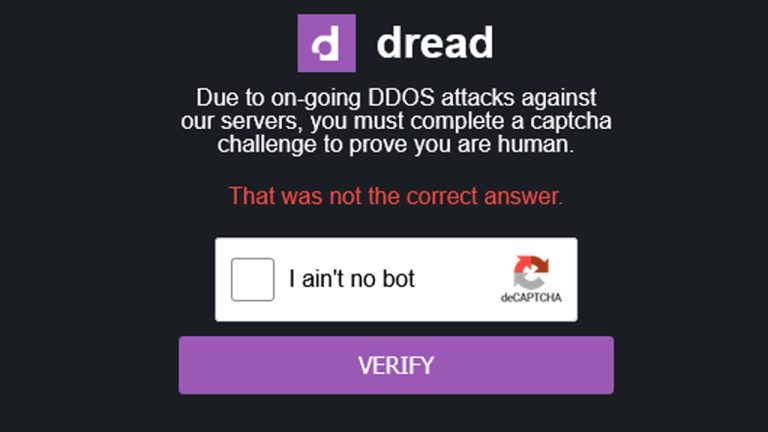
According to web portal darkdot.com and anonymous journalist Darkdotfail, the popular darknet forum Dread has been down for a month. The well-known forum, which was a place for darknet market (DNM) patrons to discuss operations security, rate specific vendors, and talk about stealth delivery ideas, has been absent for 30 days. However, the forum’s founder, “Hugbunter,” has stated that it will relaunch in the near future.

Dread Forum Founder Announces Plans to Relaunch

In the underground world of darknet markets (DNMs), the forum Dread was known for being a go-to source of information. According to a Jan. 1, 2023 update hosted on darkdot.com, the forum has been down for a month. “Dread is a critical source of truth in an anonymous community proliferated with scams,” the update notes. “The popular Tor freedom of speech forum went offline on Nov. 30, 2022, and has yet to return.” The update adds that while the Dread admin team typically posts status updates on Reddit at /r/dreadalert, communication has been sparse.

The anonymous journalist known as Darkdotfail has written about the issue on Twitter and their website, dark.fail, also indicates that Dread is currently offline. According to a Jan. 5, 2023 update on the website, Dread is offline due to a DDOS attack and readers should follow /r/dreadalert for updates. On Jan. 2, 2023, the DNM and Tor researcher wrote that Dread’s founder, Hugbunter, had privately confirmed that the forum will return. “Dread’s now been offline for a month, Hugbunter privately confirmed to us that it will return,” Darkdotfail wrote. Two days later, Darkdotfail shared an update from the Reddit forum /r/dreadalert.

The privacy advocate and anonymous journalist said:

Hugbunter posted an update regarding Dread’s downtime to /r/dreadalert. Meanwhile, the team behind Incognito Market opportunistically coded and launched a competing forum, Libre, during Dread’s downtime. Never boring around here.

The message from Hugbunter, which includes the founder’s PGP signature, explains that the team has been “working extremely hard to restore service.” In the message, the Dread founder estimates that the team is about a week away from a solid estimated time of arrival (ETA).

“As of right now, we’re about a week out from being able to give a solid ETA on a return of Dread, but I will say we’re hopeful of it being next week,” Hugbunter detailed. “This depends on there being no further issues as we finalize everything on the server side and also if I manage to work through some rewrites of the codebase in a timely manner, however, it is not an easy or small task — So no further pressure please.”

This is not the first time Dread has experienced a significantly long downtime. On Sept. 30, 2019, Bitcoin.com News reported on the forum’s first major outage. At that time, Hugbunter’s dead man’s switch was triggered, resulting in a temporary loss of control over the forum. However, Hugbunter returned shortly after and validated the forum owner’s identity through the PGP keys associated with the Dread founder. The forum remained active, with some exceptions due to DDOS attacks, until Nov. 2022. In addition to Dread’s outage from DDOS attacks, the Tor Project reported that the Tor network itself has slowed by close to 50%.

In the Jan. 3 message, Hugbunter, the founder of Dread, detailed that the forum’s DDOS issues would be solved by the time it returns and “any other service who needs assistance.” Hugbunter promised that Dread will relaunch with a revamped user experience and proper DDOS protection, saying “the plans I have with the relaunch and also for the near future are going to allow all of us to move forward significantly and we will continue to innovate this space. We are not going anywhere and I still have much to provide and share.”

What do you think about Dread’s current downtime and Hugbunter explaining that the forum will return soon? Let us know what you think about this subject in the comments section below.

❌