Reading view

There are new articles available, click to refresh the page.

Volatility Expands, But Bitcoin Whales And Sharks Aren’t Selling — They’re Buying More

Bitcoin briefly reclaimed the pivotal $90,000 price mark once again after a brief bounce, but volatility still lingers around the largest cryptocurrency asset. During the ongoing volatile landscape, investors appear to have found a new niche, and that is buying BTC at a significant and fast rate.

Large Bitcoin Holders Are Buying In The Noise

The ongoing market volatility may have significantly impacted the Bitcoin price direction, but this is not the same for investors’ sentiment and activity. In the current bearish state, BTC investors are now sending a clear bullish signal, especially as indicated in the activity of the largest holders.

Sentiment observed among BTC large holders has shifted toward buying once again. According to research shared by Santiment, a leading on-chain data analytics platform, whales and sharks continue to accumulate more BTC even as market volatility intensifies. 

During the ongoing bearish market, BTC’s price fell back to the $89,400 level, and assets like Silver and Gold experienced a steady spike. Instead of being shaken out by the pullback, these high-net-worth investors are persistently building positions, indicating a great level of confidence beneath the surface. 

When these key investors start to buy BTC at a rapid rate again while the broader market signals caution, it is often viewed as a strategic move or repositioning ahead of a potential price spike. This kind of behavior is typically seen during transitional phases.
Bitcoin

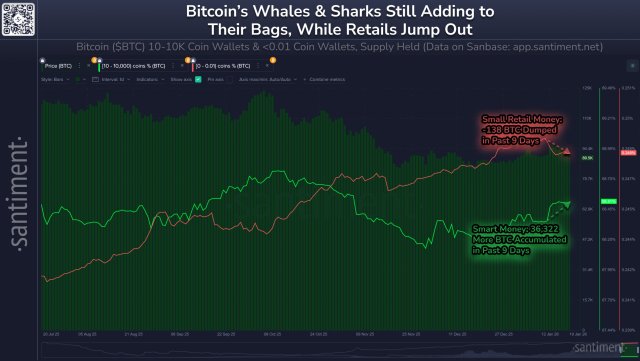
Data shows that wallet addresses holding between 10 and 10,000 BTC have purchased an additional +36,322 BTC, representing an over 0.27% rise in the past 9 days. Should this renewed buying pressure from big investors continue, it is likely to play a role in determining BTC’s next major move as it reshapes its supply and price dynamics.

While whale investors steadily add to their positions, wallet addresses holding 0.01 BTC have been dumping to the noise. This group, regarded as shrimp holders, has offloaded over 132 BTC within the same timeframe, indicating a -0.28% drop.

Santiment highlighted that it is considered an optimal condition for a crypto breakout when smart money accumulates, and retailers dump. In the absence of a geopolitical issue, this pattern continues to demonstrate a long-term bullish divergence.

Risk Around BTC Is Becoming High

Following the bearish reaction on Wednesday, the Bitcoin Risk Index metric experienced a surge, reaching the 21 level and hovering just below the High Risk zone at level 25. This uptick suggests that the continuation of the consolidation phase is highly likely and will be bolstered by the massive high-risk environment seen over the past few months.

Despite the surge, the market is still technically in a low-risk environment, and buyers are struggling to hold the pivotal support level at $89,200. At this level, the market is presented with two different scenarios.

The first, which is the bullish scenario, tells that BTC could undergo a clear push toward $94,800 and possibly $99,000 if $89,200 support holds in the short term. Meanwhile, in the bearish scenario, a continued consolidation below the support level driven by sellers would cause a drop to $84,500, marking the next line of defense for buyers.


Bitcoin

DEX Aggregator 1inch Expands Gasless DeFi Access Through Rewardy Wallet Integration

Decentralized exchange aggregator 1inch has expanded its consumer wallet integrations through a new partnership with Rewardy Wallet, allowing users to swap tokens across multiple blockchains without holding native gas tokens such as ETH, BNB or MATIC.

The integration brings the 1inch Swap API directly into Rewardy Wallet’s in-app swap interface, allowing users to execute cross-chain swaps while paying transaction fees in Rewardy’s native token, RWD.

Rewardy Wallet now supports 1inch Swap API across five chains.@RewardyWalletKR's users get optimized routing, global liquidity, and – here's the part that matters – gas paid in $RWD through EIP-7702. You don't need ETH to use Ethereum. You don't need BNB to swap on BNB Chain. pic.twitter.com/K8yI8ZXBGd

— 1inch (@1inch) January 22, 2026

By abstracting gas payments away from network-specific tokens the update removes one of DeFi’s most persistent friction points and reduces the likelihood of failed transactions caused by insufficient gas balances.

Removing Gas Tokens From the User Experience

Gas management has long been a barrier to mainstream DeFi adoption, particularly for newer users navigating multiple blockchain networks. The requirement to hold the correct native token for each chain often results in stalled or failed transactions and adds unnecessary complexity to everyday crypto use.

By eliminating the need to pre-purchase native gas tokens, the integration delivers a cleaner, more intuitive experience that aligns with the expectations users have of modern financial applications, while preserving self-custody and execution quality.

Powered by 1inch’s Aggregation Infrastructure

Through the integration of the 1inch Swap API, Rewardy Wallet gains access to aggregation and routing infrastructure. The firm claims users benefit from optimized pricing and liquidity across supported chains, all executed within Rewardy’s in-app swap environment.

The setup allows swapping across Ethereum, BNB Chain and other supported networks without requiring users to manage network settings or gas assets manually.

Built on Account Abstraction and EIP-7702

Rewardy Wallet is built around account abstraction and gasless UX principles, with the gas-free swap experience through EIP-7702. This allows transaction fees to be paid using RWD instead of native network tokens, reducing onboarding friction and simplifying cross-chain activity.

“DeFi is still too complicated for most people, and gas tokens are one of the biggest reasons,” said Yoon Jeon, CEO of Rewardy Wallet. “By partnering with 1inch and leveraging EIP-7702, we’re removing unnecessary steps and making swaps feel as simple as any modern financial app without compromising on self-custody or execution quality.”

1inch Pushes Toward Mainstream Adoption

“If DeFi is to reach its first billion users, the experience must be seamless and secure,” said Sergej Kunz, co-founder of 1inch. “Through the integration of our Swap API, wallets like Rewardy are helping drive a more intuitive and accessible future for users.”

The integration also supports swaps across Ethereum, BNB Chain, Base, Arbitrum and Optimism, and marks another step in 1inch’s strategy of embedding its infrastructure into consumer-ready platforms.

The post DEX Aggregator 1inch Expands Gasless DeFi Access Through Rewardy Wallet Integration appeared first on Cryptonews.

Ripple’s RLUSD Is Not A Threat To XRP’s Future, Here’s Why

Rumors about XRP suddenly becoming useless and less relevant appear to be spreading across the crypto market following the introduction of Ripple’s stablecoin, RLUSD. Crypto market analyst XFinanceBull recently took to X to debunk these claims, stating that, rather than being a potential threat, RLUSD was created to complement XRP’s functionality and use cases on the ledger.

Why Ripple’s RLUSD Poses No Danger To XRP 

In his post, XFinanceBull revealed that many in the crypto community now see XRP as less useful because of RLUSD. These concerns carry weight given the growing dissatisfaction over XRP’s price struggles. Furthermore, with a stablecoin in place, the perception is that XRP’s use cases could deteriorate, especially given RLUSD’s greater stability. 

Addressing these growing concerns, XFinanceBull emphasized that XRP and RLUSD serve different purposes within the ecosystem. His commentary aims to correct the misconception that RLUSD was introduced to replace XRP. The analyst referenced statements from Ripple’s former Chief Technology Officer (CTO), David Schwartz, who, in a video, clearly explained the distinct roles of XRP and RLUSD, highlighting how the stablecoin benefits the altcoin rather than threatens it. 

According to XFinanceBull, Schwartz stated that RLUSD attracts large, credible flows to the XRP Ledger (XRPL), and this capital provides structural benefits to XRP. The analyst declared that RLUSD does not replace XRP, but instead amplifies its functionality. He added that as liquidity grows through the stablecoin, more payment routes are created, leading to increased XRP burns. 

XFinanceBull also noted that every stablecoin trade within the Ripple ecosystem indirectly drives demand for XRP as a bridge asset. He concluded that the world will eventually realize that utility is not defined by a whitepaper alone, but by real transaction flows. He added that although the XRP price may be declining, its rails are still being built.  

How RLUSD Benefits XRP

In the video shared by XFinanceBull, Schwartz stated that RLUSD is designed to benefit XRP. He explained that RLUSD strengthens XRP by introducing more credible assets onto the XRP Ledger, thereby expanding the network’s use cases and creating more opportunities for developers. 

The former Ripple CTO also revealed that adding trusted assets, such as RLUSD, increases trading activity on XRPL’s DEX. According to him, higher trading volume generates both direct and indirect benefits for the decentralized network and its native token, XRP. 

A key advantage of the XRPL DEX is its auto-bridging feature, which uses XRP to facilitate trades between different assets. Schwartz said that this mechanism allows XRP to act as an intermediary, helping users find the most efficient trading routes. He added that RLUSD and XRP are designed to complement each other, given their different roles within the ecosystem. While the stablecoin offers price stability, the altcoin functions as a bridge currency within Ripple’s payment products. This means that as RLUSD usage grows, demand for XRP is reinforced.

Ripple

Bitcoin Sentiment Whiplash: Mood Sours From Greed To Extreme Fear In Days

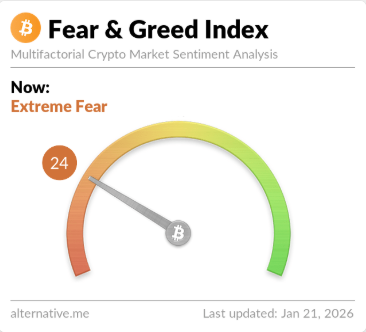
Data shows the Bitcoin market sentiment has seen a sharp turnaround recently as the Fear & Greed Index has swung to extreme fear.

Bitcoin Fear & Greed Index Is Back In Extreme Fear Zone

The “Fear & Greed Index” refers to an indicator created by Alternative that tells us about the average sentiment present among traders in the Bitcoin and wider cryptocurrency markets.

The index uses the data of the following five factors to determine the investor mentality: market cap dominance, trading volume, volatility, Google Trends, and social media sentiment. To represent the sentiment, it uses a numerical scale running from zero to hundred.

When the value of the Fear & Greed Index is greater than 53, it means a sentiment of greed is shared by the majority of traders. On the other hand, the indicator being below 47 implies the dominance of fear. All values lying between these two cutoffs correspond to a net neutral mentality.

Besides these three core regions, there are also two ‘extreme’ zones, known as the extreme fear (occurring at 25 and under) and extreme greed (above 75). At present, the market sentiment is in one of these zones, as the Fear & Greed Index’s latest value suggests.

Bitcoin Extreme Fear

As displayed above, the Bitcoin market sentiment is just inside the extreme fear territory right now, with the Fear & Greed Index sitting at 24. This level of despair among traders is a new development, as just earlier mood was much better.

Bitcoin Fear & Greed Index

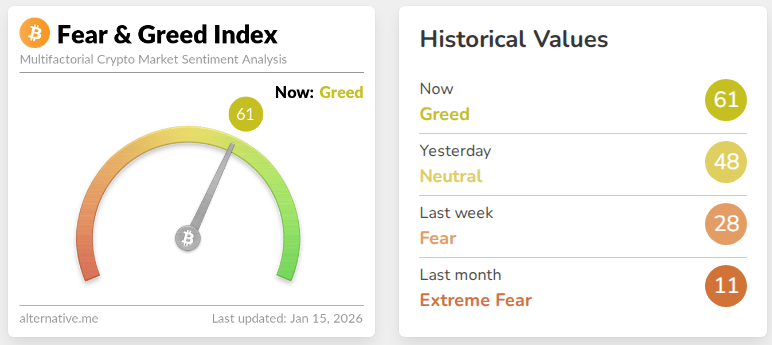
On January 15th, the index had a value of 61, putting the sentiment of the average investor firmly inside the greed territory. Only six days later, the situation has completely flipped.

The reason behind this shift lies in the bearish price action that the cryptocurrency has faced since US President Donald Trump announced tariffs on several European countries over Greenland.

The earlier greed sentiment also came after trader mentality saw a sharp swing. In fact, the shift was even faster back then, as the Fear & Greed Index went from a near-extreme fear level of 26 to the greedy value of 61 over just two days as Bitcoin witnessed a price surge beyond $97,000.

The latest drop back into the extreme zone may not entirely be a negative development for the cryptocurrency, though, if history is anything to refer to. Often, digital asset markets have tended to move in the direction that goes contrary to the expectations of the majority.

Since extreme fear is where a bearish mentality is the strongest, bottoms can be likely to occur in the zone. Similarly, extreme greed can lead to tops instead. With the sentiment currently in the former zone, it now remains to be seen how long it will take for Bitcoin to find back its footing.

BTC Price

Bitcoin dropped under $88,000 earlier in the day, but the coin has since bounced back to $90,200.

Bitcoin Price Chart

How to Develop a Decentralized Exchange Using TON Network

If you’re thinking about starting a decentralized exchange for more than a month, then you’ve probably checked out blockchain networks like Ethereum, BNB Chain, or Polygon, and more. But, TON (The Open Network) is another platform that’s been steadily improving in this highly competitive space.

This network is backed by Telegram and made for fast speeds, low costs, and widespread use. TON is becoming a real option for DeFi creators. If you’re planning to create a DEX in 2026, using TON could give you an advantage.

So, here’s the step-by-step guide to dex platform development on the TON blockchain network.

1. Understand Why Choose TON

Remember: Before you build, understand the platform.

TON is a layer-1 blockchain originally developed by Telegram, now maintained by the open-source TON Foundation. It’s optimized for mobile-first use, ultra-fast execution, and low network fees. It has over 900,000 daily active wallets and has seen a sharp rise in DeFi-related developer activity in the past year.

For founders, this means you’re not only using a powerful blockchain but also building within a growing group of users who are already using it.

Next…

dex platform development

2. Decide The DEX Type You Want To Build

DEXs can be different.

So, before looking for the DEX development service, decide early on what type of DEX you want to start. Will you create a DEX based on AMM, like Uniswap or PancakeSwap?

Now, some of you might think, “Can TON’s design handle advanced trading systems in addition to simpler automated market makers (AMMs)?”

Actually, TON can do both, but AMMs are quicker to set up and work better with the current ways to manage money.

Also, consider whether you want to include:

  • Liquidity farming
  • Native staking
  • NFT integration
  • On-chain analytics for traders

The model you choose will define your feature set, tech stack, and liquidity plan.

3. Pick the Right Clone or Framework

If you are using a pre-made DEX script to launch fast, check that it works with TON Virtual Machine (TVM) and the smart contract framework that TON supports.

TON is different from Ethereum and doesn’t use Solidity. It has its own language, FunC, for smart contracts. Make sure your code works with TON. Ensure that you have hired a Defi development company that can change it to work well.

Don’t just aim to replicate Ethereum DEX designs. Understand how TON works to avoid problems later when launching and checking your DEX. Partner with the team that can build a DEX on Ton blockchain.

4. Create and Check Smart Contracts

After your contract logic is ready, you can launch it and make it live. But TON smart contracts work differently from those on EVM chains, so make sure that the DEX development company tests well before deployment.

So, hire a DEX development team that specializes in using tools like:

  • TON CLI and TON Dev Tools.
  • Testnet environment for stress testing pools and trades.
  • Explorer integration to verify live transaction data

If you’re working with external contributors or validators, test interaction flows like liquidity provision, swap execution, and token listing approvals.

5. Focus On Creating a Simple, Mobile-Friendly DEX

Here’s where TON really differs from other chains. Its community is largely Telegram-based and mobile-heavy.

Your DEX website should be simple, work well on phones, and load quickly. It’s good if it works with TON wallets like Tonkeeper or Tonhub, which are popular with Telegram users.

So, ask your DEX development company to implement intuitive layouts on your DEX. And, aim to make trading easy and clear for people using phones.

6. Launch and Get People to Use It

After launching, focus on getting more money into your DEX and getting more users.

To get people to use your decentralized exchange, think about connecting with other projects on TON or using Telegram Mini Apps to get new users at the initial stages.

By mid-2026, the total value locked in TON’s DeFi world was more than $170 million, and it keeps growing every month. So, stepping into this space now will be the smarter choice.

Final Thoughts

So, building a DEX platform on the TON blockchain will be a good idea, but one thing you need to keep in mind is “hiring a reliable decentralized exchange development company”. Why? Because the TON network and its smart contracts framework are different from existing platforms, only experienced companies that know how to build DEX on Ton Blockchain can offer you a bug-free protocol.

https://www.innblockchain.com/defi-development

#DeFiDevelopment #DeFiCompany #BlockchainDevelopment #SmartContracts #DEXDevelopment #Web3 #CryptoDevelopment


How to Develop a Decentralized Exchange Using TON Network was originally published in Coinmonks on Medium, where people are continuing the conversation by highlighting and responding to this story.

Investment Manager Predicts XRP Will Dominate This Trillion-Dollar Sector

Canary Capital’s CEO, Steven McClurg, has predicted that XRP will be the leading token in real-world assets (RWAs), which is projected to be a trillion-dollar sector. This came as he highlighted recent developments that put the altcoin on course to dominate the industry.

Canary Capital CEO Predicts XRP Will Dominate RWAs

During an interview, the investment manager opined that XRP will be the leading token for real-world assets, based on Ripple’s moves over the last two years. He noted that the crypto firm has done a great job of integrating the XRP Ledger (XRPL) into many transactions and into Wall Street, which has led to institutional adoption.

The Canary Capital CEO further noted that the XRP Ledger is moving assets such as stablecoins, including Ripple’s RLUSD stablecoin, and other tokenized real-world assets. Notably, Ondo Finance has also tokenized its U.S. treasury fund (OUSG) on the XRPL, while Ripple has partnered with Securitize to add RLUSD access for BlackRock’s BUIDL fund. 

Furthermore, Ripple partnered with Archax and UK-based asset manager abrdn to introduce the first tokenized money market fund on the XRP Ledger. There are also plans for the network to get a tokenized gold upgrade, even as demand for precious metals rises. It is also worth noting that Ripple has previously predicted that the XRP Ledger could dominate the real-world assets industry, putting XRP at the heart of the industry, as McClurg has also predicted. 

Interestingly, McClurg’s prediction comes as the XRP ETFs draw institutional investors into the altcoin’s ecosystem. These ETFs have been a success since their launch, recording only one net outflow since November. Coincidentally, McClurg’s Canary Capital is currently the largest XRP ETF issuer, with $374 million in total net assets, according to SoSoValue data

New Features To Onboard TradFi Onto The XRPL

Ripple and XRP Ledger developers continue to work on introducing new features on the network to attract traditional finance (TradFi) institutions. XRPL validator Vet recently revealed that compliance features for TradFi are coming to the network. This includes on-chain compliance tools such as KYC, AML, and other credentials, which will be used by lending protocols, as well as the XRPL DEX and the Permissioned DEX.

Meanwhile, Ripple developers also described Permissioned Domains, which are part of the amendments, as a game-changer for the XRP Ledger because they will bring institutional-grade controls to a public network, without sacrificing the trade-offs of a private chain. The developers further noted that this will set the stage for financial institutions to engage in permissioned flows on a fast, scalable, and resilient blockchain network such as the XRPL. 

At the time of writing, the XRP price is trading at around $2.06, down in the last 24 hours, according to data from CoinMarketCap.

XRP

💾

Is Bitcoin headed back into the $60Ks — and does that mean the four-year cycle is broken? 🤔Stephen McClurg, CEO of Canary Capital, explains why Bitcoin coul...

Dogecoin RSI Just Entered Historical Oversold Levels Again, Will It Repeat 2021?

The Dogecoin Relative Strength Index (RSI) is said to have entered historical oversold levels. This has raised the possibility that the foremost meme coin could repeat its parabolic rally in the 2021 bull cycle

Dogecoin Eyes Parabolic Rally As RSI Enters Oversold Levels

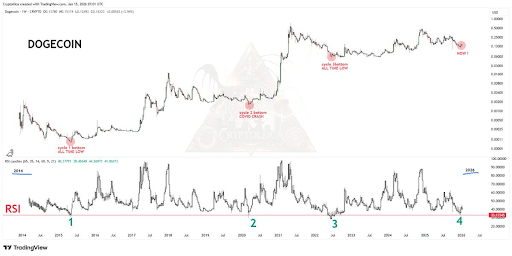
Crypto analyst Cryptollica has indicated that the Dogecoin price could record another parabolic rally as the RSI enters oversold levels. In an X post, the analyst noted that this is the fourth time in 12 years that the DOGE RSI has been this oversold, and that every time this has happened, it has been life-changing. 

Cryptollica further remarked that the drop in Dogecoin’s RSI to this low has always been an “epic buying opportunity” and that those who loaded up made insane gains. In line with this, the analyst remarked that this is another massive opportunity. Meanwhile, Cryptollica alluded to previous times when the RSI dropped this low, including during the last cycle bottom, when DOGE dropped to $0.5. 

Dogecoin

Dogecoin rallied to a new all-time high (ATH) of $0.74 after bottoming at $0.05, recording massive gains in the process. Cryptollica noted that these setups don’t come often and urged market participants not to miss this one. His accompanying chart suggested that DOGE could rally to the psychological $1 level this time around, marking a new ATH for the foremost meme coin. 

DOGE Mirroring Past Accumulation Pattern

In another X post, Cryptollica highlighted a similar DOGE/BTC pattern between the 2014-2017 and 2021-2026 accumulations. The analyst stated that the structure is identical and assured that the bleed against Bitcoin is not “death” but the necessary energy compression before the rotation. Cryptollica added that when the green line breaks, risk appetite changes instantly. 

Meanwhile, Cryptollica declared that the fractal was loading, with Dogecoin set to be the heartbeat of the altcoin cycle. The analyst claimed that this is the final stage of a multi-year compression against Bitcoin. This historically leads to a specific volatility squeeze that precedes a massive capital rotation from BTC to altcoins. 

Crypto analyst Bitcoinsensus raised the possibility of a Dogecoin rally to $0.70, which could be near. This came as the analyst noted that DOGE has been moving in a nice way up throughout this entire bull cycle. This is said to be evident in the mini cycles, with the foremost meme coin tapping the dotted line, followed by a slow retrace. Based on this pattern, Bitcoinensus noted that DOGE could soon target the $0.70 range if the strong momentum in the crypto market returns. 

At the time of writing, the Dogecoin price is trading at around $0.137, down in the last 24 hours, according to data from CoinMarketCap.

Dogecoin

Bitcoin Bull Score Hits Level Seen Only 7 Times In 6 Years – A Rare Historical Signal

Bitcoin has shown renewed bullish momentum in recent sessions, pushing price back toward the $97,000 level after weeks of persistent selling pressure. For much of the recent consolidation, the market struggled under distribution from short-term participants and cautious positioning from traders who remained uncertain about the broader trend.

That dynamic now appears to be shifting. While price action alone does not confirm a full trend reversal, the latest rebound suggests that downside pressure is easing and that buyers are becoming more willing to absorb available supply.

This improvement in price behavior is supported by on-chain context rather than pure speculation. A quick insight from a CryptoQuant analyst highlights a rare development in market sentiment: the Bitcoin Bull Score Index has dropped to 20, a level that has historically appeared only a handful of times over the past several years. Such readings typically reflect deeply pessimistic conditions, when bullish signals across multiple indicators are scarce.

Paradoxically, these environments often coincide with transitional phases rather than sustained declines. When bearish sentiment becomes widespread and measurable optimism disappears, markets tend to become increasingly sensitive to even modest improvements in demand.

Bitcoin Bull Score Hits A Rare Historical Level

Over the past six years, the Bitcoin Bull Score Index has fallen to levels of 20 or lower only seven times. The market is now experiencing the seventh occurrence, placing the current environment among the rarest sentiment regimes in Bitcoin’s history.

This index aggregates multiple on-chain and market indicators to assess whether conditions favor bullish continuation or reflect broad-based weakness. Readings near 20 indicate that very few bullish signals are active at the same time, highlighting a market dominated by caution rather than optimism.

Bitcoin Bull Score Index | Source: CryptoQuant

Historically, such extremes have tended to appear during transitional phases. They often emerge late in corrections, when selling pressure has largely played out, but confidence has not yet returned. This does not guarantee an immediate reversal. However, it does suggest that downside momentum is becoming increasingly fragile, as most participants who wanted to de-risk have already done so.

The timing of this signal is particularly relevant as Bitcoin approaches a critical psychological zone near $100,000. This level represents both a major round-number resistance and a key reference point for short-term and long-term holders.

The coming weeks will be decisive. A sustained push toward and above $100K, accompanied by improving breadth in on-chain indicators, would likely mark a shift away from defensive positioning. Conversely, failure at this level could reinforce consolidation and prolong uncertainty.

Weekly Chart Shows Recovery Attempt Below Resistance

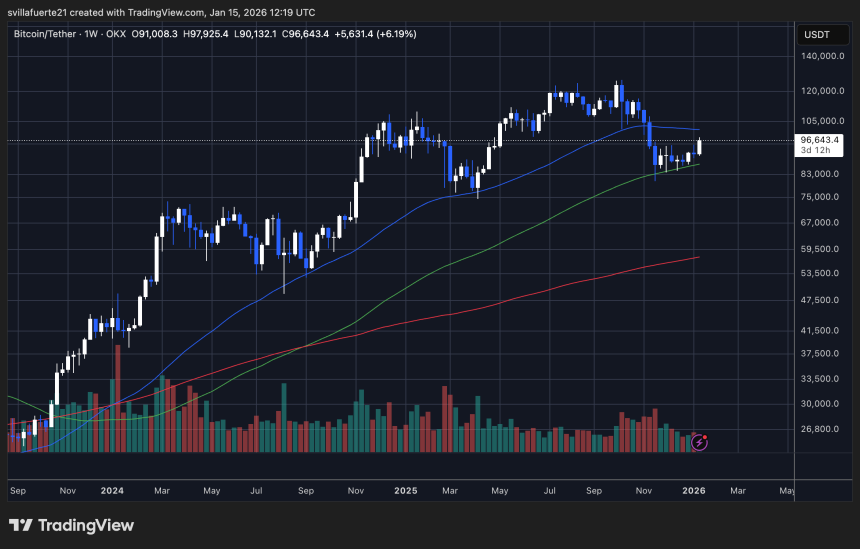
Bitcoin’s weekly chart shows a market attempting to reassert strength after a prolonged corrective phase, with price now trading around the $96,000–$97,000 zone. This area is technically important, as it aligns with a former consolidation range that acted as support during mid-2025 and later flipped into resistance after the November breakdown. The recent rebound suggests buyers are willing to defend higher lows, but confirmation remains incomplete.

Bitcoin testing key resistance level below $100K | Source: BTCUSDT chart on TradingView

From a trend perspective, Bitcoin is still trading below the declining 50-week moving average, which currently caps upside attempts. This level has acted as dynamic resistance during previous bear-to-neutral transitions. And will be a critical area to reclaim for trend continuation.

Below the price, the 100-week moving average continues to slope upward and has provided structural support during the recent pullbacks. Reinforcing the idea that the broader market structure remains intact despite short-term weakness.

Volume behavior is also notable. The rebound toward $97,000 occurred without a major expansion in volume, revealing that the move may still lack strong conviction. This supports the view that the current advance could be a recovery leg within a larger consolidation rather than the start of an impulse.

If Bitcoin can consolidate above $95,000 and eventually reclaim the 50-week moving average, the probability of a continuation toward the $105,000–$110,000 region increases. Failure to hold this zone would expose the market to renewed downside tests toward the mid-$80,000s. Keeping the broader consolidation unresolved.

Featured image from ChatGPT, chart from TradingView.com 

Greed Reawakens In Crypto Land After A Long Cold Stretch

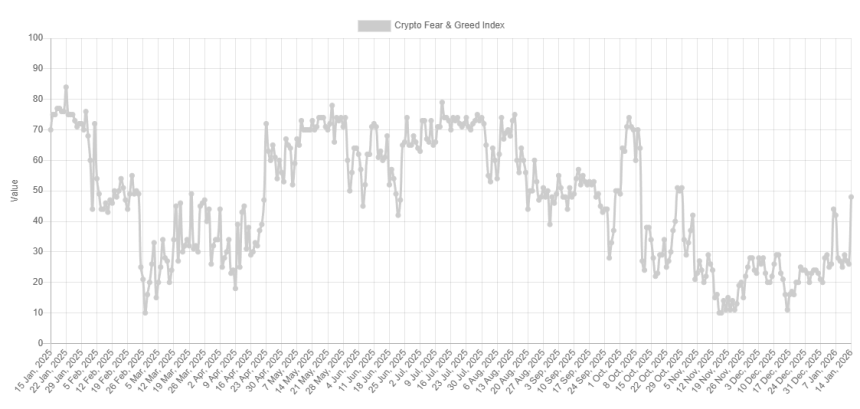
According to the Crypto Fear & Greed Index, investor mood has swung back toward optimism, registering a score of 61 on Thursday. That is the first time the gauge has moved into the “greed” zone since the large market fallout on Oct. 11, when roughly $19 billion in liquidations drove many traders from altcoins. The index had climbed to 48 just a day earlier, moving out of “neutral” and signaling a quick change in sentiment.

Crypto Fear And Greed Shifts

The index combines several signals — price moves, trading activity, momentum, Google search interest and social media chatter — to produce a single reading. Based on reports, the measure fell into low double digits several times during November and December after the October sell-off. A score of 61 does not imply euphoria, but it does show growing confidence among traders after weeks of anxiety and patience being tested.

Bitcoin Price Rebounds

Bitcoin’s price has been moving in step with the improving mood. In the past seven days, Bitcoin rose from $89,750 to a two-month high of $97,720 on Wednesday, according to data from CoinMarketCap. That level was last seen on Nov. 14, when the market was still struggling and sentiment readings were weak even as prices briefly touched similar highs. Market watchers say the recent rally has helped lift trader confidence and is one of the main reasons the index improved so fast.

Retail Exit And Exchange Supply

According to market intelligence firm Santiment, there was a net drop of 47,244 Bitcoin holders over a three-day stretch. Reports have disclosed that many small investors left their positions, a reaction blamed on FUD and impatience. At the same time, the amount of Bitcoin held on exchanges fell to a seven-month low of 1.18 million BTC. Less supply sitting on exchange platforms tends to lower the immediate risk of a large, sudden sell-off.

What This Means For Traders

Traders use sentiment tools as one input among many when deciding whether to buy, sell or wait. A return to “greed” suggests more people are willing to buy, which can push prices higher if buying pressure continues. On the other hand, sentiment can flip quickly; a sharp move back down would likely make some traders nervous again. Analysts point out that a shrinking pool of retail participants can leave the market in the hands of more committed holders, which often supports steadier price action.

From Anxiety To Optimism

Based on reports and current readings, the market has shifted from anxiety toward a more upbeat mood, backed by Bitcoin’s recent gains and lower exchange balances. That combination is seen by many former skeptics as a healthier setup than the panic-filled trading seen after the October liquidations. The picture is cautiously positive: optimism is rising, but the swings that define crypto markets have not disappeared.

Featured image from Unsplash, chart from TradingView

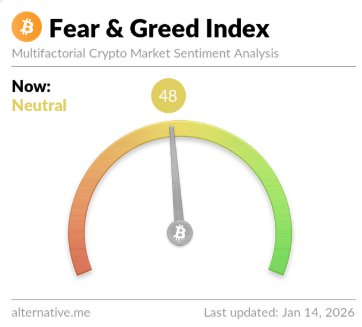
Bitcoin Fear & Greed Index Turns ‘Neutral’ For First Time Since October

Sentiment in the Bitcoin market has marked an improvement recently as the Fear & Greed Index has surged into the neutral zone for the first time in months.

Bitcoin Fear & Greed Index Is Now Pointing At ‘Neutral’

The “Fear & Greed Index” refers to an indicator created by Alternative that tells us about the average sentiment present among traders in the Bitcoin and wider cryptocurrency markets. It determines the investor mentality using the data of five factors: market cap dominance, trading volume, volatility, social media sentiment, and Google Trends.

To represent the sentiment, the index makes use of a numerical scale running from 0 to 100. All values below 47 correspond to fear among the investors, while those above 53 reflect the dominance of greed. The metric being between the two cutoffs suggests a net neutral sentiment.

Now, here is how the current market sentiment is like, according to the Fear & Greed Index:

Bitcoin Neutral

As is visible above, the index has a value of 48 right now, indicating that sentiment around Bitcoin is neutral. This is a sharp change from how the market mood looked just yesterday.

Bitcoin Fear & Greed Index

The Bitcoin Fear & Greed Index had a value of 26 on Tuesday, which means that the investor sentiment was deep inside the fear zone. The reason behind the turnaround in trader mood has been the coin’s recovery rally, which has now taken its price beyond the $97,000 level.

Since the Fear & Greed Index hasn’t made it into the greed zone yet, investors still look to be hesitant about embracing the bullish price action. In the past, the cryptocurrency market has often tended to move against the expectations of the majority, so the fact that traders aren’t outright greedy yet could actually be a positive sign for the rally’s sustainability.

That said, the latest jump in sentiment has been a rapid one, so the indicator could be to keep an eye on in the coming days, as a venture into the greed zone could very well be next.

The current break into the neutral zone reflects the first time since late October that the Fear & Greed Index has surged into the region. A greedy sentiment hasn’t been witnessed since the first half of October, more than three months ago.

In some other news, the new Bitcoin recovery run has triggered a large amount of liquidations, as revealed by on-chain analytics firm Glassnode.

Crypto Liquidations

“Across the top 500 cryptocurrencies, the latest move triggered the largest short-liquidation event since 10/10,” explained Glassnode.

BTC Price

At the time of writing, Bitcoin is floating around $97,500, up more than 7% in the last seven days.

Bitcoin Price Chart

XRP/Gold Ratio Just Reached A Historical Support Zone, What This Means For Price

Despite its slow momentum over the past few weeks, XRP is still on analysts’ radar as they look beyond its dollar price action and into its performance against gold. One analyst has said that the long-term XRP/Gold ratio has just reached a historical support zone, signaling a familiar technical setup that could determine its next move.

XRP/Gold Ratio Arrives At Critical Support Level

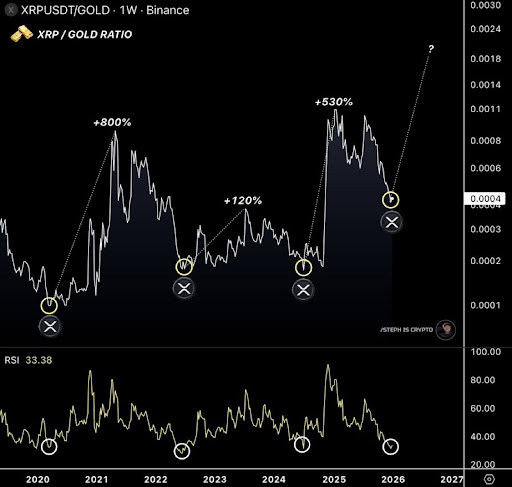
Market expert ‘Steph is Crypto’ has released a fresh analysis focusing on the XRP to gold ratio and its historical behaviour. In his post on X this Tuesday, he stated that the ratio has returned to a long-standing support zone around $0.0004, which has consistently marked major turning points in XRP’s price action relative to gold

According to the analyst, this same area previously preceded powerful upside moves in the XRP/gold ratio. Each prior visit to this zone was followed by a sharp reversal higher, as highlighted by the circled lows and steep advances that followed. The chart shows rallies of more than 800% in 2020, over 120% in 2022, and about 530% in 2024. 

XRP

Steph is Crypto also pointed to momentum conditions, noting that the Relative Strength Index (RSI) was oversold in the past when the XRP/gold ratio hit the historical support. In the current 2026 cycle, the RSI sits around 33.38, reflecting a similar oversold setup to previous cycles. According to the analyst, this suggests downside momentum is fading. 

The general outlook of this analysis suggests that if past trends repeat, the XRP/gold ratio could experience another strong rally this cycle. This time, Steph is Crypto predicts a rally from the support around $0.0004 to over $0.0018, representing a gain of more than 350%. 

Analyst Links XRP Trajectory To That Of Gold And Silver

In a subsequent post, Steph is Crypto shared another analysis comparing the historical price movements and expansion phase of gold and silver with XRP. He presented parallel charts for each asset, highlighting distinct phases preceding major price rallies in the precious metals while illustrating the potential path for XRP based on gold and silver’s past performance

The chart showed that gold and silver experienced a major distribution phase in 2021, followed by a compression phase in 2023 and an expansion in 2026. In Gold’s case, its price reversal was sharp and vertical, with minimal pullbacks before reaching an all-time high near $4,700. Silver’s movement was more muted, showing significant volatility from 2023 to 2025 before accelerating in 2026 to peak above $91.

Based on these performances, Steph is Crypto predicts that XRP could follow a similar trajectory. The cryptocurrency has completed its distribution phase above $3 and its compression stage near $2.3, and the analyst now expects it to enter an expansion phase, with a projected ATH target of $32.

XRP

Here’s Why The Bitcoin, Ethereum, And Dogecoin Prices Are Surging Today

The broader crypto market is seeing an unexpected uptick, with the Bitcoin, Ethereum, and Dogecoin prices among the top coins recording gains. This sharp increase in value follows the release of US economic data, which indicates positive trends in unemployment and consumer spending. Additionally, potential regulatory changes stemming from a proposed bill are also fueling market momentum and boosting investor confidence across the sector. 

Bitcoin, Ethereum, And Dogecoin Prices Rally Amid Positive Economic Data

After consolidating for days following their last rebounds, Bitcoin, Ethereum, and Dogecoin are surging again amid a series of recent US data reports. The US Bureau of Labor Statistics (BLS) released the Consumer Price Index (CPI) for all urban consumers earlier on Tuesday, January 13, covering December 2025. 

The CPI report revealed that prices rose 0.3% on a seasonally adjusted basis last month, with the year-over-year all items index up 2.7% unadjustment. The shelter index increased 0.4% in December, making it the largest contributor to the overall rise. Meanwhile, food prices rose 0.7% both at home and away, and energy rose 0.3%. This increase in CPI data tends to affect cryptocurrency price movements, as moderate inflation often reduces fears of aggressive rate hikes by the US Federal Reserve (FED), encouraging investors to allocate funds to alternative stores of value like BTC and higher risk assets like ETH and DOGE. 

In addition to the CPI data, the US jobs report, released on January 9, showed that 50,000 jobs were added in December 2025. Although this was below the revised 56,000 in November and lower than the initial forecast of 60,000, it was still a significant and positive result for investors. While changes in job reports do not directly affect cryptocurrency price action, they can influence investor sentiment by increasing the likelihood of an interest rate cut

The crypto market has also been bullish ahead of the US Senate Banking Committee’s vote on the CLARITY Act on January 15, 2026. If passed, the bill is expected to provide clearer legal frameworks for digital assets in the US. Subsequently, the regulatory progress will reduce uncertainty and encourage more institutional participation in the crypto market.

Overall, the combination of the US CPI release, jobs report, and potential regulatory clarity is what’s driving the market. Traders are responding favorably to these developments, reflecting renewed optimism. 

How Much BTC, ETH, And DOGE Rose Today

Fueled by positive economic data, Bitcoin’s price has increased by over 3% so far today, rising from around $91,000 to over $94,000 at the time of writing. CoinMarketCap data also shows that Ethereum has seen even stronger gains, surging more than 6% to trade above $3,300. Meanwhile, Dogecoin has risen by over 6%, reaching $0.148.

Bitcoin

Operational Readiness and Resiliency Index: A new model to assess talent, performance

You just left a high-level meeting with agency leadership. You and your colleagues have been informed that Congress passed new legislation, and your agency is expected to implement the new law with your existing budget and staff. The lead program office replied, “We can make this work.” The agency head is pleased to hear this, but has reservations. How?

Another situation: The president just announced a new priority and has assigned it to your agency. Again, there is no new funding for the effort. Your agency head assigns the priority to your program with the expectation for success. How do you proceed?

Today, given the recent reductions in force (RIFs), people voluntarily leaving government, and structural reorganizations that have taken place and will likely continue, answering the question “How to proceed?” is even more difficult. There is a real need to “know” with a level of certainty whether there are sufficient resources to effectively deliver and sustain new programs or in some cases even the larger agency mission.

Members of the Management Advisory Group — a voluntary group of former appointees under Presidents George W. Bush and Donald Trump — and I believe the answer to these and other questions around an organization’s capabilities and capacity to perform can be found by employing the Operational Readiness and Resiliency Index (ORRI). ORRI is a domestic equivalent of the military readiness model. It is structured into four categories:

  • Workforce
  • Performance
  • Culture
  • Health

Composed of approximately 50 data elements and populated by existing systems of record, including payroll, learning management systems, finance, budget and programmatic/functional work systems, ORRI links capabilities/capacity with performance, informed by culture and health to provide agency heads and executives with an objective assessment of their organization’s current and future performance.

In the past, dynamic budgeting and incrementalism meant that risk was low and performance at some levels predictable. We have all managed some increases or cuts to budgets. Those days are gone. Government is changing now at a speed and degree of transformation that has not been witnessed before. Relying on traditional budgeting methods and employee surveys cannot provide insights needed to assess whether current resources provide the capabilities or capacity for future performance of an agency — at any level.

So how does it work?

As is evident with the illustration above, ORRI pulls mainly from existing systems of record. Many of these systems are outside of traditional human resources (HR) departments to include budget, finance and work-systems. Traditionally, HR departments relied on personnel data alone. These systems told you what staff were paid to do, not what they could do. It is focused on classification and pay, not skills, capacity or performance.

Over the years, we have made many efforts to better measure performance. The Government Performance and Results Act (GPRA) as amended, the Performance Assessment Rating Tool (PART), category management and other efforts have attempted to better account for performance. These tools — along with improvements in budgeting to include zero-based budgeting, planning, programming and budgeting systems, and enterprise risk management — have continued to advance our thinking along systems lines. These past efforts, however, failed to produce an integrated model that runs in near real-time or sets objective performance targets using best-in-class benchmarks. Linking capabilities/capacity to performance provides the ability to ask new questions and conduct comparative performance assessments. ORRI can answer such questions as:

  • Are our staffing plans ready for the next mission priority? Can we adapt? Are we resilient?
  • Do we have the right numbers with the right skills assigned to our top priorities?
  • Are we over-staffed in uncritical areas?
  • Given related functions, where are the performance outliers — good and bad?
  • Given our skill shortages, where do I have those skills that are at the right level available now? Should we recruit, train or reassign to make sure we have the right skills? What is in the best interest of the agency/taxpayer?
  • Is our performance comparable — in named activity, to the best — regardless of sector?
  • What does our data/evidence tell us about our culture? Do we represent excellence in whatever we do? Compared to whom?
  • Where are we excelling and why?
  • Where can we invest to demonstrate impact faster?

Focusing on workforce and performance are critical. However, if you believe that culture eats strategy every time, workforce and performance needs to be informed by culture. Hence ORRI includes culture as a category. Culture in this model concentrates on having a team of executives that drive and sustain the culture, evidenced by cycles of learning, change management success and employee engagement. Health is also a key driver for sustained higher performance. In this regard, ORRI tracks both positive and negative indicators of health, as is evident in the illustration. Again, targets are set and measured to drive performance and increase organizational health. Targets are set by industry best in class standards and strategic performance targets necessary for mission achievement.

Governmentwide, ORRI can provide the Office of Management and Budget with real-time comparative performance around key legislative and presidential priorities and cross-agency thematic initiatives. For the Office of Personnel Management, it can provide strategic intelligence on talent, such as enterprise risk management based on an objective assessment: data driven, on critical skills, numbers, competitive environment and performance.

ORRI represents the first phase of an expanded notion of talent assessment. It concentrates on human talent: federal employees.

Phase two of this model will expand the notion of operating capabilities to include AI agents and robotics. As the AI revolution gains speed and acceptance, we can see that agencies will move toward increased use of these tools to increase productivity and reduce transactional cost of government services. Government customer service and adjudication processes will be assigned to AI agents. Like Amazon, more and more warehouse functions will be assigned to physical robots. Talent will need to include machine capabilities, and the total capabilities/capacity reflect the new performance curve — optimizing talent from various sources. This new reality will require a reset in the way government plans, budgets, deploys talent, and assesses overall performance. Phase three will encompass the government’s formalized external supply chains which represent the non-governmental delivery systems — essentially government by other means. For example, the rise of public/private partnerships is fundamentally changing the nature of federated government; think of NASA and its dependence on Space X, Boeing, Lockheed Martin and others. ORRI will need to expand to accurately capture these alternative delivery systems to overall government performance. As the role of the federal government continues to evolve, so too do our models for planning, managing talent and assessing performance. ORRI provides that framework.

John Mullins served on the Trump 45 Transition Team and later as the senior advisor to the director at OPM. Most recently Mullins served as strategy and business development executive for IBM supporting NASA, the General Services Administration and OPM.

Mark Forman was the first administrator for E-Government and Information Technology (Federal CIO). He most recently served as chief strategy officer at Amida Technology Solutions.

The post Operational Readiness and Resiliency Index: A new model to assess talent, performance first appeared on Federal News Network.

© Getty Images/iStockphoto/ipopba

Businessman hold circle of network structure HR - Human resources. Business leadership concept. Management and recruitment. Social network. Different people.

Bitcoin Price Trades Near $87,000 as Market Slips Into ‘Extreme Fear’

Bitcoin Magazine

Bitcoin Price Trades Near $87,000 as Market Slips Into ‘Extreme Fear’

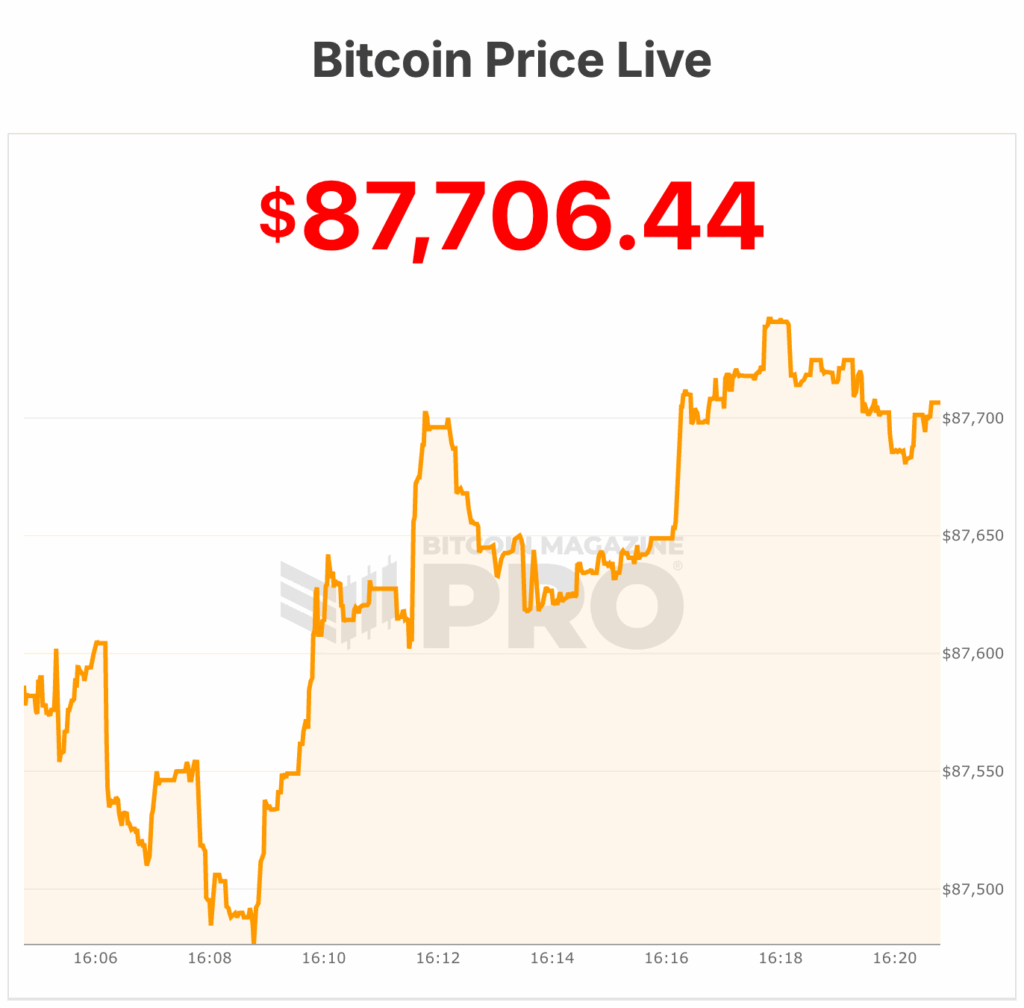
Bitcoin price hovered above $87,000 today as market sentiment and the Crypto Fear and Greed Index plunged to 11 out of 100, a level signaling extreme fear among investors.

At the time of writing, the bitcoin price is trading at $87,696, up roughly 2% over the past 24 hours, according to market data. Despite the modest rebound, BTC remains trapped in a choppy consolidation range, sitting just 0.2% below its seven-day high of $87,918 and 2% above its weekly low near $85,575.

Yesterday, the bitcoin price cratered from close to $90,000 to the mid $85,000s.

Trading volume over the past day totaled approximately $51 billion, suggesting continued participation but little conviction on either side of the market. Bitcoin’s total market capitalization stood at $1.75 trillion, reflecting a 2% increase over the prior 24 hours, according to Bitcoin Magazine Pro data.

The uneasy price action comes as sentiment has turned decisively bearish. The Fear and Greed Index—a composite indicator that incorporates volatility, volume, social media trends, and momentum—has fallen deep into its lowest category, historically associated with panic-driven selling and heightened emotional decision-making.

Extreme fear hits crypto markets

A reading of 11 places the market firmly in “extreme fear,” a zone typically marked by heightened downside anxiety and risk aversion. Historically, such conditions have often coincided with local bottoms, though timing remains uncertain.

The index operates on a 0–100 scale, where readings below 25 indicate extreme fear and levels above 75 suggest extreme greed. 

At current levels, investors appear more concerned about further downside than missing potential upside, reinforcing the defensive tone seen across digital asset markets.Market participants often view extreme fear as a contrarian signal, arguing that widespread pessimism can create favorable long-term entry points. 

Thin liquidity amplifies downside moves

Bitcoin price’s recent slide below the $90,000 level occurred during typically illiquid weekend trading, exacerbating volatility as sellers encountered limited buy-side support. Prices fell from the low-$92,000 range late last week to weekend lows near $87,000, marking one of the sharpest short-term pullbacks since October’s all-time high.

The broader crypto market mirrored bitcoin’s weakness. Major altcoins continued to post double-digit monthly losses, while bitcoin dominance climbed toward 57%, underscoring a flight to relative safety within the digital asset complex.

Muted volumes suggest the move lower reflects caution rather than capitulation, with traders reluctant to deploy fresh capital ahead of key macroeconomic events.

Globally, attention is also turning to Japan, where the Bank of Japan is widely expected to raise interest rates. Such a move could pressure yen-funded carry trades that have supported global risk assets over the past year, potentially adding another headwind for crypto markets.

Bitcoin price levels in focus

From a technical perspective, analysts are closely watching the mid-$80,000 range as near-term support. A sustained break below this zone could open the door to a deeper retracement toward the low-$80,000s or below. 

Conversely, holding current levels would reinforce the view that the bitcoin price remains range-bound rather than entering a prolonged bearish phase.

Despite the gloomy mood, long-term narratives remain intact for many investors, particularly as institutional participation continues to expand through spot bitcoin ETFs and broader regulatory clarity.

For now, however, bitcoin’s price action reflects a market caught between structural optimism and short-term fear—an uneasy balance that has pushed sentiment to one of its most pessimistic readings of the year.

Despite all this, earlier today, asset manager Bitwise released a new report that argues that bitcoin is poised to break from its historical four-year market cycle, setting new all-time highs in 2026 while becoming less volatile and less correlated with equities.

At the time of writing, the bitcoin price is $87,706.

bitcoin price

This post Bitcoin Price Trades Near $87,000 as Market Slips Into ‘Extreme Fear’ first appeared on Bitcoin Magazine and is written by Micah Zimmerman.

The AI Hype Index: The people can’t get enough of AI slop

Separating AI reality from hyped-up fiction isn’t always easy. That’s why we’ve created the AI Hype Index—a simple, at-a-glance summary of everything you need to know about the state of the industry.

Last year, the fantasy author Joanna Maciejewska went viral (if such a thing is still possible on X) with a post saying “I want AI to do my laundry and dishes so that I can do art and writing, not for AI to do my art and writing so that I can do my laundry and dishes.” Clearly, it struck a chord with the disaffected masses.

Regrettably, 18 months after Maciejewska’s post, the entertainment industry insists that machines should make art and artists should do laundry. The streaming platform Disney+ has plans to let its users generate their own content from its intellectual property instead of, y’know, paying humans to make some new Star Wars or Marvel movies.

Elsewhere, it seems AI-generated music is resonating with a depressingly large audience, given that the AI band Breaking Rust has topped Billboard’s Country Digital Song Sales chart. If the people demand AI slop, who are we to deny them?

1E Acquires Exoprise to Enhance its Leading DEX Platform

London, UK and Austin, TX – October 3rd, 2024 – 1E, the leading Digital Employee Experience (DEX) platform company known for its scaled remediation and automation capabilities, announced today its acquisition of Exoprise, a leader in converged Digital Experience Monitoring (DEM) for digital workplaces. This strategic acquisition strengthens 1E’s commitment to delivering comprehensive, user-centric IT…

The post 1E Acquires Exoprise to Enhance its Leading DEX Platform appeared first on Exoprise.

Why Your Desktop-as-a-Service (DaaS) Is Causing More Support Tickets

As organizations continue to embrace digital transformation, Desktop-as-a-Service (DaaS) has become a popular solution for delivering virtual desktop environments to employees. With the flexibility, scalability, and security Virtual Desktop Infrastructure (VDI) offers, DaaS has the potential to streamline operations and boost productivity. However, this technology is not without its challenges, particularly when it comes to…

The post Why Your Desktop-as-a-Service (DaaS) Is Causing More Support Tickets appeared first on Exoprise.

How To Write Code With OpenAI’s Latest Tool ‘Codex’

OpenAI is currently generating buzz as its intelligent chatbot, ChatGPT. The Chabot gathers data from the web to answer a wide range of questions. Although its responses may not always be correct. ChatGPT has piqued people’s interest and sparked discussions about the future role of artificial intelligence. Keep reading to know how to use Codex for Software writing?

The company has also been developing Codex, a less well-known service that has the potential to revolutionize the way developers work. This new tool is a ChatGPT-like AI model that can write software. This makes it a powerful tool for developers. In this article, we’ll explore why Codex won’t replace developers and will instead create more demand for their skills.

OpenAI Codex

How Does Codex Work?

First and foremost, it’s important to understand what Codex does and how it works. Codex is a tool powered by the GPT-3 model that has the capability to generate code in multiple programming languages such as Python, JavaScript, and C++. It uses advanced natural language processing techniques to understand the requirements given by a developer and then writes the code accordingly. The tool is designed to save time for developers by handling routine coding tasks such as writing boilerplate code. This allows them to concentrate on more complex tasks.

How To Use Codex For Software Writing?

To use Codex, you need to provide it with the details of the software problem you want to solve. You can do this by describing the problem in natural language. Your instruction should outline the requirements and specify the programming language you want to use. Codex will then generate a code solution based on its understanding and its training data.

For instance, if you were trying to build a web application that displays the current weather, you could provide Codex with the following information: “I want to build a web application that displays the current weather for a specific location. I want to use JavaScript.” Codex would then generate a code solution that implements this requirement. This will include the code for fetching the weather data and displaying it on a web page.

It’s a good idea to review the code generated by Codex. In this way, you can then make any necessary modifications to ensure that it meets your requirements. To use Codex, you may need to have some basic knowledge of programming and software development, as well as experience working with the specified programming language.

Using Codex via API Key

Codex API is a set of APIs provided by OpenAI that allow you to access the functionality of their large language models. With Codex API, you can programmatically perform various language-related tasks. These include text generation, question answering, text summarization, and more.

To use Codex API, you need to make API requests over the internet. This is typically done using a programming language like Python or JavaScript. The API request contains the input data, such as a text prompt or a question, and the API key. The response from the API contains the results of your query, which can be processed and used in your applications.

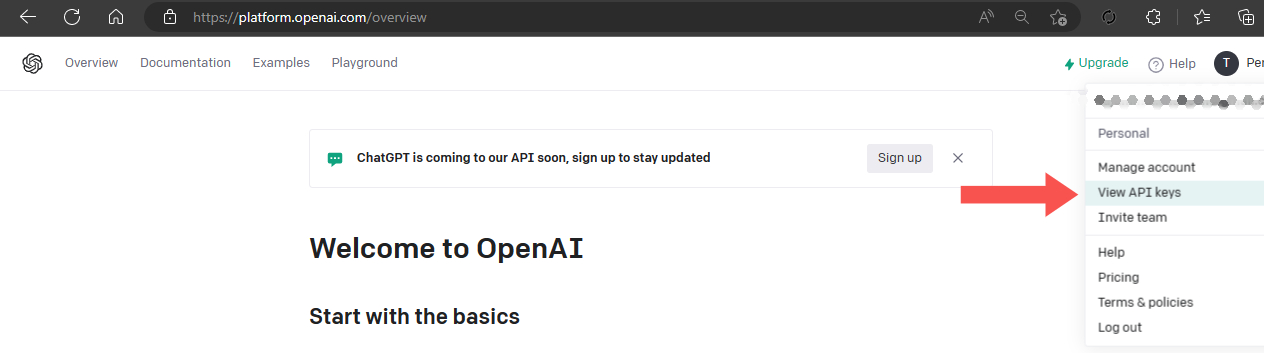
Here is how you can get your API key from OpenAI and can call it in Python.

  1. Login to your OpenAI account, or create one.
  2. In the upper right corner, click on your account profile.
  3. Select View your API keys. (as shown below)
  4. You can copy an existing key or create a new one.
How to use Codex for Software writing?
How to get your API keys?

The next step is to utilize your Codex API key in a programming language. In this article, we will use Python as an example.

To install the official Python bindings for Codex, execute the following command in your Python terminal:

pip install openai

Why Codex Can’t Replace Humans?

Software development is a complex and ever-evolving field. The technology used to build software changes rapidly, and new tools and frameworks are constantly being introduced. Developers have to stay up-to-date with these changes in order to work efficiently. They have to be able to adapt to new tools and technologies. When it comes to Codex, it operates on a pre-programmed set of algorithms and does not have the ability to learn and adapt to new technologies.

Codex requires a significant amount of input and guidance from a human developer to function effectively. It cannot write code without specific instructions and parameters. All this conclude that developers must still be involved in complex projects. That’s the reason Codex will not replace developers any soon. Although we can say, it will augment their abilities and help them work more efficiently.

Conclusion

Codex is not a replacement for the creativity and innovation that developers bring to the table. Software development requires a great deal of creativity and problem-solving skills. Developers must be able to think outside the box and come up with innovative solutions to complex problems. However, Codex is limited by its pre-programmed algorithms and cannot generate creative solutions on its own. Developers bring a unique perspective, problem-solving abilities, and creativity to the table, which cannot be replicated by Codex or any other AI tool. The future of software development is not one of replacement but of collaboration between humans and AI, and Codex will play a crucial role in this collaboration by making the development process more efficient and streamlined.

The post How To Write Code With OpenAI’s Latest Tool ‘Codex’ first appeared on Internet Security Blog - Hackology.

Should we trust John McAfee?

By: Skyler

John McAfee is a tech pioneer and successful entrepreneur. He started his career as a software developer and went on to create the first commercial anti-virus program. McAfee founded McAfee Inc. in 1987 and resigned in 1994, selling his remaining shares in the company over time. His net worth is estimated at four million dollars, but that is likely to be (a lot) higher, given that he owns significant amounts of cryptocurrency.

After his resignation, he sporadically popped up in the news and on social media, giving occasional tech-related interviews. At one point, he was accused of a murder that took place in Belize. McAfee is perhaps best known for a rather bizarre YouTube video that went viral.

McAfee is a vocal proponent of cryptocurrencies and freedom of information. He gained notoriety for his bullish claims and ICO promotions. For example, he claimed Bitcoin would reach one million dollars, only to call it later a ‘true shitcoin.’

No clue WTF I am doing….but here it is:

Buthere pic.twitter.com/uoYRI5K1yU

— John McAfee (@officialmcafee) May 16, 2020

Ghost coin

McAfee is a prominent advocate for Monero, stating that no significant vulnerabilities are plausible until further development in quantum computing. He believes the world needs a real privacy coin due to governmental and private spying. However, he sees exchanges as a weakness, specifically centralized exchanges that require some form of government ID to trade. Therefore, McAfee created a decentralized exchange called McAfeeDex.

Decentralized exchanges are nothing new. Platforms such as Bisq and Blocknet have provided such services for several years. Bisq gives users the option to trade cryptocurrency directly for fiat. Still, most traded coins on these exchanges do not provide the anonymization that a coin like Monero does. Furthermore, Monero is not compatible with decentralized exchanges, and it does not aspire to be in the future. That is most likely due to fears of government intervention.

MacAfee saw this as a golden opportunity for his exchange, subsequently announcing his coin called Ghost. That coin is modeled after Monero but explicitly designed to be compatible with his exchange, though McAfee’s platform has not seen widespread adoption yet.

Ghost focuses on privacy, shielding, and erasing transaction history. It is a decentralized proof of stake network, including fast transactions and low fees. Their white paper and the TDLR lite paper are undoubtedly interesting.

Plagiarism

Rapidly after the publication of the white paper, allegations of plagiarism and technical incompetence arose. The developers of the PIVX coin – an MIT licensed open source project focusing on privacy – stated that twenty out of 26 pages of the Ghost white paper were plagiarized.

Besides, they state that there are several technical inconsistencies and flaws within the white paper. Representatives of Ghost acknowledged that their coin was indeed a fork of PIVX, but defended themselves by arguing that PIVX is itself a fork of Dash. Moreover, they claimed to make significant improvements and that they would continue to innovate.

We still have to wait until the code becomes available publicly, in order to conclude. It should be noted that if Ghost does not respect the MIT license, they could be subject to a DMCA takedown, as well as exclusion from exchanges.

McAfee’s shady dealings

It is no wonder McAfee is living in (self-described) exile. He faces serious plagiarism accusations. Furthermore, his Ghost coin is also very suitable for money laundering. In a recently released podcast, he states he is on the run for the Federal Communications Commission, but he does not provide any evidence. Subsequently, he argues that it is not his job to police the world and that he is merely an entrepreneur that ‘builds shit.’

It is not unprecedented for the US government to intervene in such projects, though. TON, a blockchain project from the developers of the popular messaging app Telegram, was forced to shut down in a rather bizarre court ruling. Yet, it is hard to determine whether the US authorities are currently targeting McAfee.

In addition, McAfee stated in the past that he was in fact on the run due to tax evasion. He said: “I have not paid taxes for ten years, and I never will.” That appears consistent with his libertarian views.

When McAfee was arrested in the Dominican Republic for possessing illegal weapons and ammunition, there where no pending extradition requests from the US. He was released and allowed to travel to the United Kingdom. That strengthens the case that he is not in any (legal) trouble with the US. Meanwhile, he uses the media circus surrounding him as a form of marketing and publicity.  

Something he seems to thrive on is appealing to a broad spectrum of dissident media pundits. In an interview with the right-wing Youtuber Keith Woods – a staunch critic of capitalism and advocate of the third political way – he claimed that the CIA was hunting him, although he called them ‘incompetent.’ He also alleges he had multiple interactions with the Israeli Mossad. Even though it is possible, such wild claims are hard to prove.

MacAfee is not very popular within the crypto community either, as he made many bullish statements, only to later deem them as sarcasm. He is known to promote cryptocurrency in return for payment. That led to the accusation of running a pump-and-dump scheme, as he never mentioned those coins again.

Trustworthiness

McAfee is an intelligent man. His image as a tech cowboy earned him fame and significant wealth. When it comes to developing and innovating, he seems to be chasing trends more than setting them.

Only time will tell whether Ghost will live up to its promises. However, McAfee broke his promises many times before. He does not see that as immoral, though, referring to his libertarian beliefs.

We recommend caution using or investing in any of his projects. 

The post Should we trust John McAfee? appeared first on Rana News.

❌