Reading view

There are new articles available, click to refresh the page.

Stablecoin Trading Surges 62% in Korea as Dollar Strengthens Against Won

South Korean crypto exchanges recorded a 62% surge in stablecoin trading volumes as the won fell to multi-year lows against the dollar, prompting platforms to intensify marketing campaigns around dollar-pegged tokens.

According to The Korea Times, trading volume in Tether (USDT) across the nation’s five major won-based exchanges climbed to 378.2 billion won ($261 million) when the exchange rate exceeded 1,480 won per dollar last Wednesday, citing CryptoQuant data.

The spike follows mounting currency pressures that pushed the won through nine consecutive days of declines against the dollar, marking its longest losing streak since 2008, Bloomberg reported.
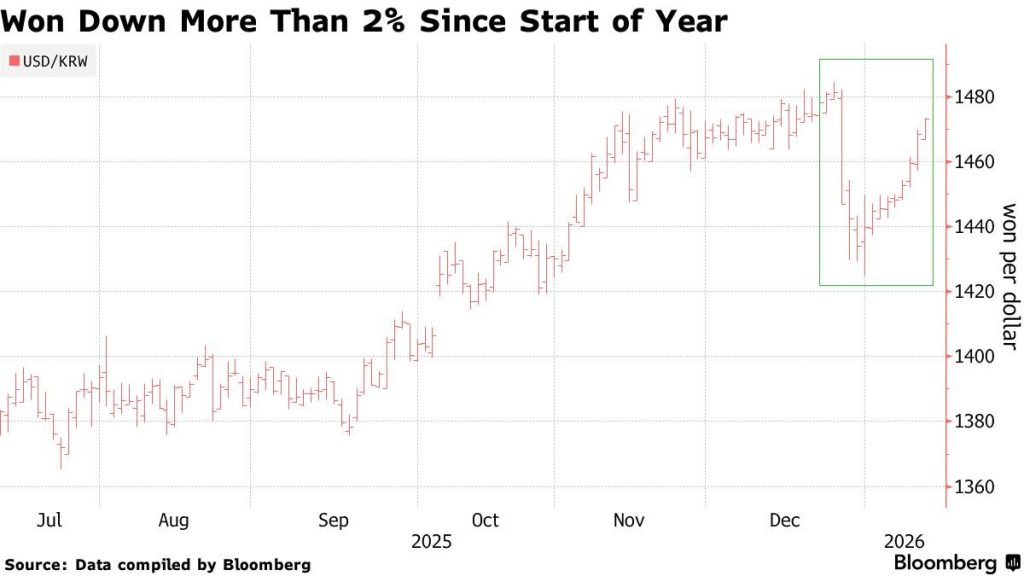
Stablecoin Korea Dollar WON/USD Chart Bloomberg
Source: Bloomberg

Major exchanges, including Korbit, Coinone, Upbit, and Bithumb, launched aggressive promotional campaigns centered on stablecoins, including USDC and USDe, waiving trading fees and distributing rewards to boost volumes during what industry officials described as a downturn in broader crypto markets.

Banks Slash Dollar Rates as Government Defends Currency

According to The Chosun Daily, South Korea’s major commercial banks slashed dollar deposit interest rates to near zero in response to government pressure to defend the exchange rate.

Shinhan Bank cut its annual rate from 1.5% to 0.1% starting January 30, while Hana Bank reduced rates from 2% to 0.05% for its Travelog Foreign Currency Account.

The coordinated move followed the authorities’ summoning of bank executives and their request that they “refrain from excessive marketing that encourages foreign currency deposits such as dollars.

Banks responded by introducing incentives for won conversion, with Shinhan offering a 90% preferential rate for customers converting dollar deposits back to won, plus an additional 0.1 percentage point rate boost for those subscribing to won-term deposits afterward.

Dollar deposit balances at the five major banks fell 3.8% from month-end to 63.25 billion dollars as of January 22, marking the first decline after three consecutive months of surges.

Corporate deposits, which account for 80% of all dollar holdings, dropped sharply from 52.42 billion dollars at year-end to 49.83 billion dollars, suggesting that the authorities’ recommendation to sell dollars spot, combined with perceptions that the exchange rate had peaked, was driving the decline.

Individual dollar deposits grew at a significantly slower pace, rising just 109.64 million dollars, compared with the previous month’s 1.09 billion dollar surge.

Presidential Intervention Accelerates Won Stabilization

President Lee Jae-myung delivered a rare verbal intervention on the exchange rate during a January 21 press conference, stating authorities predicted the rate would drop to around 1,400 won within one to two months.

The won-dollar rate immediately fell from 1,481.4 won to 1,467.7 won following his remarks, closing at 1,471.3 won.

Stablecoin Korea Dollar
Source: TheChosunDaily

Market observers noted the unprecedented nature of a sitting president specifying both an exchange rate target and timeline, with Lee’s statement carrying significantly more weight than U.S. Treasury Secretary Scott Bessent’s earlier comment that the won’s recent decline was “inconsistent with Korea’s strong fundamentals.

Meanwhile, demand for dollar exchange slowed as average daily won-to-dollar conversions reached 16.54 million dollars from January 1-22, while dollar-to-won conversions surged to 5.2 million dollars daily, significantly exceeding last year’s 3.78 million dollar average and indicating increased profit-taking.

In fact, according to CNBC, South Korea’s fourth-quarter GDP growth slowed to 1.5% year over year, missing economists’ forecasts of 1.9%, as construction investment shrank 3.9% and exports pulled back 2.1% from the previous quarter.

The won has lost nearly 2% against the greenback this year, making it one of Asia’s worst-performing currencies, while South Korean retail investors bought approximately 2.4 billion dollars of U.S. equities on a net basis through mid-January, up roughly 60% from the same period last year.

The broader economic slowdown comes as Seoul advances major crypto policy reforms despite regulatory gridlock over stablecoin governance.

Earlier this month, South Korea ended its nine-year corporate crypto trading ban, permitting listed companies to invest up to 5% of equity capital in top-20 cryptocurrencies, while lawmakers passed amendments to the Capital Markets Act and Electronic Securities Act establishing legal frameworks for tokenized securities trading beginning January 2027.

🇰🇷South Korea has launched guidelines, allowing listed companies and professional investors to invest up to 5% of their equity capital crypto.#SouthKorea #CorporateCryptoInvestment #CryptoInvestmenthttps://t.co/d55u3TDsBF

— Cryptonews.com (@cryptonews) January 12, 2026

Korea Exchange Chairman Jeong Eun-bo pledged to launch spot Bitcoin ETFs and extend trading hours to 24/7 as part of efforts to eliminate the “Korea discount,” though comprehensive digital asset legislation remains stalled amid disputes between the Financial Services Commission and the Bank of Korea over stablecoin issuance rules.

The post Stablecoin Trading Surges 62% in Korea as Dollar Strengthens Against Won appeared first on Cryptonews.


Spot vs Perpetual Trading on Hyperliquid: What Every Trader Must Understand

By: MintonFin
Spot vs Perpetual Trading on Hyperliquid

One wrong choice between spot and perpetual trading can silently drain your capital — especially on a high-performance platform like Hyperliquid.

Hyperliquid has rapidly emerged as one of the most talked-about decentralized trading platforms in crypto. With lightning-fast execution, deep liquidity, and a fully on-chain order book, it attracts everyone from casual traders to highly leveraged professionals.

But here’s the uncomfortable truth most guides don’t tell you:

  • Spot and perpetual trading on Hyperliquid are not interchangeable.
  • They reward completely different mindsets, risk tolerances, and time horizons.
  • Choosing the wrong one can turn a profitable strategy into a liquidation event.

In this guide, you’ll learn exactly how spot trading and perpetual trading work on Hyperliquid, how they differ, and most importantly, which one aligns with your goals, capital structure, and psychology as a trader.

Whether you’re a long-term crypto holder, an active DeFi participant, or an advanced derivatives trader, this article will help you make smarter, safer, and more profitable decisions on Hyperliquid.

What Is Hyperliquid?

Hyperliquid is a decentralized exchange (DEX) optimized for high-performance spot and perpetual futures trading, built with a custom Layer-1 blockchain designed specifically for trading.

Unlike many DeFi platforms that rely on AMMs (automated market makers), Hyperliquid uses a fully on-chain central limit order book (CLOB) — similar to Binance or OKX, but decentralized.

Key Features of Hyperliquid

  • Fully on-chain order book
  • Ultra-low latency execution
  • Deep liquidity for major trading pairs
  • Spot trading and perpetual futures in one interface
  • No KYC required
  • Non-custodial (you control your funds)

This hybrid design makes Hyperliquid uniquely powerful — but also more complex than typical DeFi platforms.

Understanding spot vs perpetual trading is critical before using it seriously.

Are you servicing a high-interest debt or want better savings?

Private credit is becoming the new income solution. Get $300 on first deposit with Insidefinacent.

Spot Trading Explained (Hyperliquid Spot Markets)

What Is Spot Trading?

Spot trading means buying or selling an asset for immediate settlement at the current market price.

When you buy ETH on the spot market:

  • You own the ETH
  • It appears directly in your wallet
  • There is no leverage
  • No liquidation risk

How Spot Trading Works on Hyperliquid

On Hyperliquid’s spot market:

  • You trade crypto pairs (e.g., ETH/USDC)
  • Trades settle instantly on-chain
  • Assets are fully owned by you
  • Profits and losses are unrealized until you sell

Spot Trading Example

If you:

  • Buy ETH at $2,500
  • Hold it for three months
  • Sell at $3,000

Your profit is simply:

($3,000 — $2,500) × ETH amount

No funding rates. No margin calls. No forced liquidation.

Advantages of Spot Trading on Hyperliquid

Spot trading is often underestimated — especially in a derivatives-driven market.

1. Zero Liquidation Risk

Your position cannot be forcibly closed due to volatility.

This makes spot trading ideal for:

  • Long-term investors
  • Conservative traders
  • Portfolio builders

2. Full Asset Ownership

You actually own the underlying crypto, which means:

  • You can withdraw anytime
  • You can move assets to cold storage
  • You can use them in DeFi elsewhere

3. Simple Risk Management

Your maximum loss is limited to your initial investment.

No leverage = no surprise margin calls.

4. Ideal for Market Cycles

Spot trading excels during:

  • Bull markets
  • Accumulation phases
  • Long-term trend formation

Disadvantages of Spot Trading

Despite its safety, spot trading has limitations.

1. Capital Inefficiency

Without leverage:

  • Returns are slower
  • Large capital is needed for meaningful gains

2. No Short Selling (in pure spot)

You cannot profit from falling prices unless:

  • You sell an asset you already own
  • Or rotate into stablecoins

3. Opportunity Cost

Capital tied in spot positions can’t be redeployed quickly for short-term trades.

Perpetual Trading Explained (Hyperliquid Perps)

What Are Perpetual Futures?

Perpetual contracts (perps) are derivative instruments that track the price of an asset without expiration.

You do NOT own the underlying asset.

Instead, you:

  • Open long or short positions
  • Use margin
  • Trade price movement only

How Perpetual Trading Works on Hyperliquid

Hyperliquid’s perpetual markets allow:

  • High leverage
  • Long and short positions
  • Cross-margin and isolated margin
  • Continuous funding payments

Key Components

  • Margin: Collateral posted to open a position
  • Leverage: Borrowed exposure (e.g., 10x, 20x)
  • Funding Rate: Periodic payments between longs and shorts
  • Liquidation Price: Price at which your position is forcibly closed

Perpetual Trading Example

You:

  • Deposit $1,000
  • Open a 10x long on ETH
  • Control $10,000 worth of ETH exposure

If ETH rises 5%:

  • Your profit ≈ 50%

If ETH drops ~10%:

  • Your position is liquidated
  • Your capital is gone

Advantages of Perpetual Trading on Hyperliquid

1. Leverage Amplifies Returns

Perps allow:

  • Faster capital growth
  • Efficient use of capital
  • Aggressive strategies

2. Ability to Short the Market

You can profit from:

  • Bear markets
  • Downtrends
  • Market corrections

This is critical for professional traders.

3. High Liquidity and Tight Spreads

Hyperliquid’s order book provides:

  • Minimal slippage
  • Institutional-grade execution

4. Advanced Trading Strategies

Perpetuals support:

  • Hedging spot positions
  • Delta-neutral strategies
  • Arbitrage opportunities

Risks of Perpetual Trading

Perpetual trading is not forgiving.

1. Liquidation Risk

Small price movements can wipe out positions.

Most retail traders lose money due to:

  • Over-leverage
  • Poor stop placement
  • Emotional trading

2. Funding Rate Costs

Holding perps long-term can:

  • Erode profits
  • Turn winning trades negative

3. Psychological Pressure

Perps amplify:

  • Stress
  • Overtrading
  • Revenge trading

This is why many traders underperform despite good analysis.

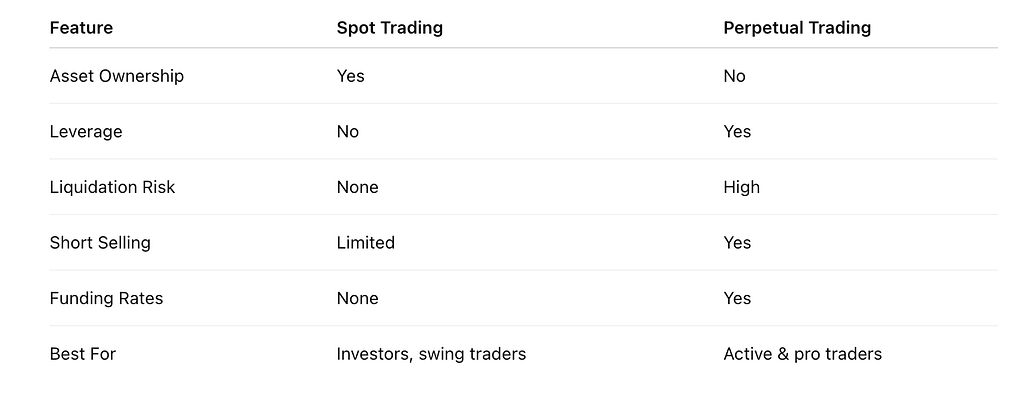
Spot vs Perpetual Trading on Hyperliquid (Comparison Table)

Spot vs Perpetual Trading on Hyperliquid

Which Should You Choose on Hyperliquid?

Choose Spot Trading If:

  • You’re building long-term positions
  • You want low stress
  • You prioritize capital preservation
  • You’re new to Hyperliquid

Choose Perpetual Trading If:

  • You understand leverage deeply
  • You actively manage risk
  • You trade intraday or swing short-term
  • You have strict stop-loss discipline

Advanced Strategy: Combining Spot + Perpetuals

Professional traders often use both.

Example Hedging Strategy

  • Hold ETH spot long-term
  • Short ETH perps during market weakness
  • Reduce volatility without selling spot

This approach:

  • Protects capital
  • Preserves upside
  • Requires discipline

This is how professionals trade. Combining spot and perpetuals isn’t advanced — it’s essential.

If this strategy changed how you think about trading, clap to help it reach more serious traders.

Common Mistakes Traders Make on Hyperliquid

  1. Over-leveraging perps
  2. Using perps for long-term holding
  3. Ignoring funding rates
  4. Trading emotionally after losses
  5. Treating perps like spot

Avoiding these mistakes alone can dramatically improve performance.

Is Hyperliquid Safe for Spot and Perpetual Trading?

Hyperliquid’s non-custodial design reduces:

  • Exchange counterparty risk
  • Custody failures

However:

  • Smart contract risk exists
  • Trader behavior is the biggest risk factor

The platform isn’t dangerous — poor risk management is.

Final Thoughts: Spot vs Perpetual Trading on Hyperliquid

Hyperliquid is one of the most powerful decentralized trading platforms available today. But power cuts both ways.

  • Spot trading rewards patience and conviction
  • Perpetual trading rewards precision and discipline

Understanding the difference is not optional — it’s essential.

The traders who thrive on Hyperliquid aren’t the most aggressive. They’re the ones who choose the right tool for the right market condition.

Trade Smarter on Hyperliquid

The difference between surviving and thriving isn’t luck — it’s structure.

  • Save this guide
  • Clap if it added value
  • Follow for more no-nonsense crypto trading breakdowns

Your capital deserves better decisions.


Spot vs Perpetual Trading on Hyperliquid: What Every Trader Must Understand was originally published in Coinmonks on Medium, where people are continuing the conversation by highlighting and responding to this story.

What Are the Best Strategies to Attract Real Users to Your P2P Exchange?

Building a P2P exchange is easy earning real user trust is the real challenge. This blog shares simple, practical strategies to attract genuine users, build confidence, and grow a P2P exchange that people actually enjoy using.

The technology may be ready, but real success begins when genuine users start trusting your platform and trading regularly. Attracting real users isn’t about aggressive promotion, it’s about building something people feel comfortable using. When P2P Crypto Exchange Development is approached with empathy and clarity, users don’t just sign up, they stay.

Start by Understanding What Users Truly Care About

Every successful platform starts with a simple understanding: users don’t care about features as much as they care about outcomes. They want safety, flexibility, and control. When founders focus on solving real user problems instead of copying competitors, the platform naturally stands out. A user first mindset during P2P Crypto Exchange Development helps create an exchange that feels purposeful, not generic.

Trust Is Built Quietly, Long Before the First Trade

Trust doesn’t come from promises, it comes from clarity. Users want to understand how trades are protected and what happens if something goes wrong. When transparency is built into the experience, users feel confident enough to act. A calm, reassuring approach to trust during P2P Crypto Exchange Development creates confidence without needing loud messaging.

The First Experience Often Decides Everything

The first few minutes on your platform decide everything. If users feel confused, they leave without explanation. If things feel simple and intuitive, they explore further. Exchanges that prioritize ease during P2P Crypto Exchange Development reduce friction and make users feel welcome rather than overwhelmed.

Clear Communication Builds Instant Confidence

Professional doesn’t have to mean complicated. Clear, friendly language builds stronger connections than technical explanations. When users understand what’s happening at every step, they feel respected. Thoughtful communication throughout P2P Crypto Exchange Development turns uncertainty into confidence.

Make Your Platform Fit Naturally Into Everyday Life

People trust platforms that align with how they already operate. Supporting familiar payment methods and local preferences makes your exchange feel practical and relevant. When real life usability is considered during P2P Crypto Exchange Development, users don’t need to adjust their habits; they simply participate.

Early Users Shape the Future of Your Exchange

Early users are more than sign ups, they are your first believers. When they feel valued, they share their experience organically. A respectful, fair approach during P2P Crypto Exchange Development turns early adopters into long-term supporters who help shape your platform’s reputation.

Helping Users Learn at Their Own Pace Builds Loyalty

Not every user arrives ready to trade immediately. Some need time to understand how things work. Simple guidance and patient education help users build confidence at their own pace. When learning is part of P2P Crypto Exchange Development, users feel supported rather than pressured.

Users Stay Where the Platform Feels Alive

Users stay where they feel noticed. Quick responses, visible improvements, and open to feedback create a sense of presence. A platform designed with care during P2P Crypto Exchange Development feels alive, trustworthy, and worth returning to.

Consistency Is What Turns Users Into Regular Traders

Trust grows through repetition. When a platform performs reliable day after day, users relax and trade more freely. Strong foundations in P2P Crypto Exchange Development ensure the exchange grows without losing stability, which is essential for long-term confidence.

Authenticity Is What Makes Users Believe in You

Users recognize authenticity. When marketing reflects the actual experience, trust deepens naturally. An honest approach aligned with P2P Crypto Exchange Development creates relationships built on respect, not exaggeration.

Conclusion

Attracting real users to your P2P exchange is a gradual, people driven process. Business owners and startups that succeed focus on trust, simplicity, and genuine value rather than quick wins. When users feel understood and protected, growth follows naturally. Building with intention and care makes all the difference, and partnering with a depend on P2P Crypto Exchange Development Company like Beleaf Technologies can help turn this thoughtful approach into a platform users truly trust and recommend.


What Are the Best Strategies to Attract Real Users to Your P2P Exchange? was originally published in Coinmonks on Medium, where people are continuing the conversation by highlighting and responding to this story.

SEC Drops Enforcement Case Against Winklevoss-Founded Crypto Exchange Gemini

By: Amin Ayan

The US Securities and Exchange Commission has agreed to dismiss its enforcement case against Gemini, the cryptocurrency exchange founded by billionaire twins Tyler and Cameron Winklevoss, after investors in its defunct lending program recovered their crypto assets in full.

Key Takeaways:

  • The SEC dropped its case after Gemini Earn investors were fully repaid in crypto.
  • Repayments came through the Genesis bankruptcy process in mid-2024.
  • The decision hinged on a 100% in-kind return of customer assets.

In a joint filing submitted Friday to federal court in Manhattan, the SEC and Gemini Space Station cited the complete repayment of assets to users of the Gemini Earn program through the Genesis Global Capital bankruptcy process.

The repayments were completed between May and June 2024, according to the court document.

SEC Drops Gemini Case After Earn Investors Made Whole

The regulator said the decision followed the “100 percent in-kind return” of crypto assets to affected investors, meaning customers received the same digital assets they had originally deposited rather than cash equivalents.

Based on that outcome, the SEC concluded that dismissing its claims against Gemini was appropriate.

The case stems from charges brought in January 2023, when the SEC accused Gemini Trust Company and Genesis Global Capital of offering unregistered securities through the Gemini Earn program.

Under the arrangement, Gemini users loaned their crypto to Genesis in exchange for yield, with Gemini acting as the platform intermediary.

The SEC has dismissed its lawsuit against the Winklevoss twins–backed Gemini over its earn product pic.twitter.com/aq35vpGxG7

— 0xMarioNawfal (@RoundtableSpace) January 23, 2026

At its peak, the Gemini Earn program held approximately $940 million in customer assets.

That balance was frozen in November 2022 when Genesis halted withdrawals amid broader market turmoil following the collapse of several major crypto firms.

Genesis later filed for bankruptcy, triggering months of negotiations among creditors, regulators, and counterparties.

Unlike many firms that failed during the 2022 crypto downturn, Genesis ultimately returned customer assets rather than liquidating holdings and distributing cash proceeds.

That outcome played a central role in the SEC’s decision to unwind its case against Gemini.

SEC Drops Gemini Case as Crypto Policy Softens and Exchange Grows

The dismissal comes amid a broader shift in the SEC’s approach to digital asset regulation under US President Donald Trump.

The administration has signaled a more accommodating stance toward the crypto sector, with Trump publicly pledging to support mainstream adoption of digital assets and ease regulatory pressure on the industry.

In its filing, the SEC stressed that the dismissal does not reflect its position on other crypto-related enforcement actions, underscoring that the decision was specific to the facts of the Gemini case.

The exchange has continued to expand its institutional footprint following the resolution of the Earn dispute.

Gemini made a high-profile debut on Nasdaq last year, reflecting renewed investor interest in regulated crypto platforms as the market rebounds. According to LSEG data, the company is currently valued at approximately $1.14 billion.

The post SEC Drops Enforcement Case Against Winklevoss-Founded Crypto Exchange Gemini appeared first on Cryptonews.

Is White Label Crypto Exchange Software the Right Fit for Your Business Model?

By: John Wick

Launching a crypto exchange is no longer just an idea for large tech companies. Many startups, fintech firms, and entrepreneurs now explore crypto exchange businesses as part of their growth plans. One option that often comes up is white label cryptocurrency exchange software. It promises faster launch times and lower technical effort, but it may not suit every business equally. Before choosing this path, it is important to understand what white label crypto exchange software offers, what it limits, and how it aligns with different business models. This article breaks down those aspects in a clear and practical way.

Understanding What White Label Crypto Exchange Software Really Is

White label cryptocurrency exchange software is a ready-made trading platform that can be rebranded and customized to some extent. Instead of building an exchange from scratch, businesses adopt an existing framework and launch under their own name. The core trading engine, wallet system, admin panel, and security setup are already developed. Businesses mainly focus on configuration, branding, and compliance setup. This approach significantly reduces development time and technical complexity. However, using white label software also means accepting certain predefined structures. Understanding this trade-off is key when evaluating whether it fits your business goals.

white label crypto exchange software

Business Models That Benefit the Most From White Label Exchanges

White label crypto exchange software works best for businesses that prioritize speed and market entry. If the goal is to launch quickly, test a market, or expand an existing financial service offering, this model can be practical. Startups with limited technical teams often benefit because they avoid long development cycles. Financial service providers entering crypto for the first time can use white label solutions to reduce risk while learning market behavior. Educational platforms, regional exchanges, and niche trading communities also find value in white label exchanges, especially when customization needs are moderate rather than complex.

Cost, Time, and Resource Considerations

One of the biggest reasons businesses choose white label cryptocurrency exchange software is cost efficiency. Building a custom exchange requires significant investment in development, testing, security audits, and long-term maintenance. White label solutions reduce upfront costs and shorten launch timelines. Instead of months or years, businesses can go live in weeks. This allows faster revenue generation and earlier market feedback. However, long-term costs should also be considered. Licensing fees, customization limits, and scaling expenses can affect profitability over time. A lower initial cost does not always mean lower total cost.

Customization Limits and Brand Differentiation

While white label platforms allow branding changes such as logos, colors, and basic feature settings, deep customization can be limited. The underlying architecture remains the same for all users of the software. For businesses that rely heavily on unique trading features or innovative user experiences, this can be a challenge. Differentiating the platform beyond surface-level branding may require additional development layers or integrations. If your business model depends on standing out through advanced trading tools or novel workflows, it is important to assess whether white label software can support that vision.

Security, Compliance, and Operational Control

Security is a major concern for any crypto exchange. White label cryptocurrency exchange software usually comes with built-in security features such as encryption, wallet protection, and access controls. This can be beneficial for teams without deep security expertise. However, operational control may be shared or limited depending on the setup. Businesses must understand who manages updates, security patches, and infrastructure stability. Compliance flexibility also matters. Regulatory requirements vary by region, and not all white label platforms are equally adaptable. A business must ensure the software can support necessary identity checks, transaction monitoring, and reporting standards.

Scalability and Long-Term Growth Planning

White label exchanges are often designed to handle moderate growth efficiently. They can support increasing user numbers and trading volume up to a certain point. For businesses planning aggressive expansion or global operations, scalability becomes a critical question. Some white label platforms may struggle under high load or require costly upgrades to scale further. Long-term growth planning should include evaluating whether the software can evolve with market changes, new asset types, and increasing regulatory demands.

When White Label Software May Not Be the Right Choice

White label cryptocurrency exchange software may not be ideal for every business. Companies with strong technical teams and long-term innovation goals may prefer building a custom platform. If control, flexibility, and unique architecture are central to your business strategy, white label solutions may feel restrictive. Similarly, businesses targeting institutional traders or complex financial products may need deeper customization than white label platforms can offer. Choosing white label software without aligning it to the business model can lead to limitations that slow growth later.

Final Thoughts

White label cryptocurrency exchange software can be the right fit for many businesses, but only when used with clear expectations. It offers speed, cost efficiency, and reduced technical complexity, making it attractive for startups and market entrants. At the same time, it comes with limits around customization, control, and long-term scalability. The decision should be based on your business goals, technical capacity, and growth plans rather than convenience alone. Understanding where white label exchanges perform best and where they fall short helps businesses make informed choices and build sustainable crypto trading platforms.


Is White Label Crypto Exchange Software the Right Fit for Your Business Model? was originally published in Coinmonks on Medium, where people are continuing the conversation by highlighting and responding to this story.

❌