❌

Reading view

There are new articles available, click to refresh the page.

Zcash Surges Post-SEC Probe: Is a Fresh Yearly High on the Horizon?

Zcash (ZEC) is back on investors’ radar after U.S. regulators ended a long-running investigation into the Zcash Foundation without enforcement. The decision removes a key source of uncertainty that had followed the privacy-focused cryptocurrency since 2023.

Related Reading: XRP Price Is Approaching A Key Decision Zone, But Structure Is Still Firmly Bullish

Markets reacted quickly, with ZEC posting double-digit gains in some sessions and stabilizing above the $400 level. While regulatory clarity has helped improve sentiment, questions around governance and long-term development remain.
Zcash ZEC ZECUSD ZECUSD_2026-01-15_13-08-32

SEC Closes Two-Year Zcash Investigation

The U.S. Securities and Exchange Commission confirmed it has concluded its review of the Zcash Foundation, which began with a subpoena issued on August 31, 2023.

The inquiry focused on potential securities law concerns tied to Zcash’s funding model, governance structure, and token distribution. According to the foundation, the SEC does not intend to recommend enforcement action, fines, or operational changes.

This outcome marks a notable shift for privacy-focused cryptocurrencies, which have often faced heightened regulatory scrutiny due to concerns about illicit use. The decision suggests that Zcash’s privacy features alone were not deemed sufficient grounds for action under existing securities laws.

The closure also aligns with a broader trend of the SEC withdrawing from several high-profile crypto investigations in recent months under new leadership. For Zcash, the end of the probe removes a regulatory overhang that had weighed on investor confidence for nearly two years.

Market Reaction and Price Projections

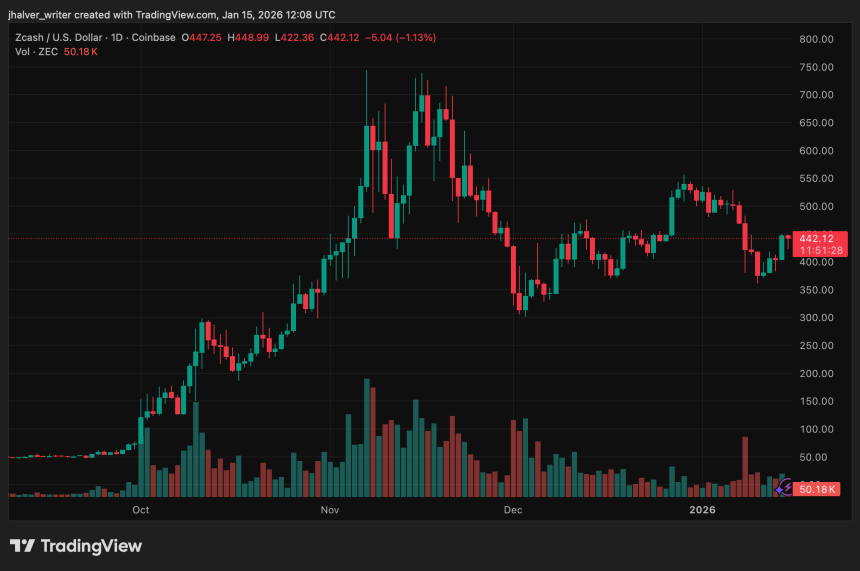
Following the announcement, ZEC surged between 5% and 14% across major exchanges, briefly testing the $440–$450 resistance zone. Currently, the token is trading around $427–$442, holding above the $400 psychological support level.

Technically, ZEC remains in a consolidation phase after falling from its January high near $535. Resistance is clustered around $450–$470, while support sits near $400, with a deeper floor around $350 if sentiment weakens.

Some analysts point to a symmetrical triangle pattern on longer timeframes, often viewed as a continuation structure after strong rallies. A confirmed breakout above the upper trendline could open the door toward higher levels, including a potential retest of the $1,000 mark later in 2026.

Governance Uncertainty Clouds the Outlook

Despite the regulatory win, internal challenges persist. Earlier this month, the full development team at Electric Coin Company (ECC), which has led core Zcash development, resigned following a dispute with its nonprofit board.

Former ECC leaders cited deteriorating working conditions and have since announced plans to launch a new privacy-focused wallet, cashZ, based on Zcash technology.

Related Reading: Arthur Hayes Bets On MSTR, Metaplanet And Zcash As Bitcoin Liquidity Turns

The Zcash Foundation has stated that network operations and protocol stability remain unaffected by the personnel changes. Still, the departures have raised concerns about governance stability, development continuity, and long-term coordination within the ecosystem.

Cover image from ChatGPT, ZECUSD chart from Tradingview

Arthur Hayes Bets On MSTR, Metaplanet And Zcash As Bitcoin Liquidity Turns

Arthur Hayes is positioning for a 2026 liquidity rebound, arguing that Bitcoin’s weak 2025 wasn’t a referendum on β€œcrypto narratives” so much as a straightforward dollar-credit story. In his latest essay, β€œFrowny Cloud,” the Maelstrom CIO says he is adding risk via Strategy (MSTR), Japan’s Metaplanet, and Zcash (ZEC) as he expects US dollar liquidity to inflect higher after a year in which Bitcoin lagged both gold and US tech stocks.

Hayes frames 2025 as an awkward year for the standard cross-asset shorthand that treats Bitcoin as either digital gold or a high-beta proxy for US tech. In his telling, Bitcoin behaved β€œas expected” under tightening conditions, while gold and the Nasdaq 100 rose for different reasons despite falling dollar liquidity.

He argues gold’s bid is being driven by sovereign balance sheets rather than retail mania, rooted in distrust of US Treasury exposure after prior asset-freeze precedents. β€œIf the US president steals your money, it’s an instant zero. Does it then matter what price you buy gold at?” he writes, casting central banks as price-insensitive buyers.

On equities, Hayes leans into an industrial-policy interpretation of the AI trade. His claim is that the US and China have effectively treated β€œwinning AI” as strategic, dulling the usual market discipline and helping explain why the Nasdaq decoupled from his dollar-liquidity index in 2025. That divergence matters because it sets up his core takeaway for 2026: Bitcoin needs expanding dollar liquidity to regain momentum.

β€œBitcoin and the Nasdaq rise when dollar liquidity expands. The only problem is the recent divergence,” Hayes writes, before returning to the β€œvicissitudes of dollar liquidity” as the primary driver he wants to track.

The Three-Pillar Liquidity Pitch

Hayes’ 2026 outlook hinges on a sharp rebound in dollar credit creation. He cites three channels: a growing Fed balance sheet via Reserve Management Purchases (RMP), commercial-bank lending into β€œstrategic industries,” and lower mortgage rates catalyzed by policy-driven demand for mortgage-backed securities.

In his account, quantitative tightening faded as a dominant headwind in late 2025, with QT ending in December and RMP beginning as a new, steady buyer. He claims RMP β€œat a minimum” expands the balance sheet by $40 billion per month, and expects that pace to rise as government funding needs increase.

The second leg is bank credit creation, which he says accelerated in 4Q25, with large lenders willing to extend loans where government equity stakes or offtake agreements reduce default risk. The third is housing: Hayes points to Trump-backed directives for Fannie Mae and Freddie Mac to deploy $200 billion toward MBS purchases, arguing that lower mortgage rates could unlock a familiar wealth effect and, by extension, more credit.

He ties the pieces together with a simple conclusion: if liquidity turns, Bitcoin should follow. β€œBitcoin … and dollar liquidity bottomed around the same time,” he writes, arguing that the next major leg depends less on sentiment than on renewed credit expansion.

MSTR, Metaplanet, And ZCash

Hayes describes himself as a β€œdegen speculator” and says Maelstrom is already β€œnearly fully invested,” but he still wants β€œMOAR risk” to capture upside convexity if Bitcoin reclaims higher levels. Rather than using perpetuals or options, he says he’s long Strategy and Metaplanet for levered exposure via corporate balance sheets.

His timing argument is valuation-relative: he compares each company’s β€œDAT” to Bitcoin priced in the relevant currency (yen for Metaplanet, dollars for Strategy) and says those ratios sit near the low end of the past two years, after being β€œdown substantially” from mid-2025 peaks. He adds a key condition: β€œIf Bitcoin can retake $110,000, investors will get the itch to go long Bitcoin through these vehicles. Given the leverage embedded in the capital structure of these businesses, they will outperform Bitcoin on the upside.”

He also flags continued accumulation of Zcash. Hayes argues the departure of developers at Electric Coin Company (ECC) is not bearish: β€œWe continue to add to our Zcash position. The departure of the devs at ECC is not bearish. I firmly believe they will ship better, more impactful products within their own for-profit entity. I’m thankful for the opportunity to buy discounted ZEC from weak hands.”

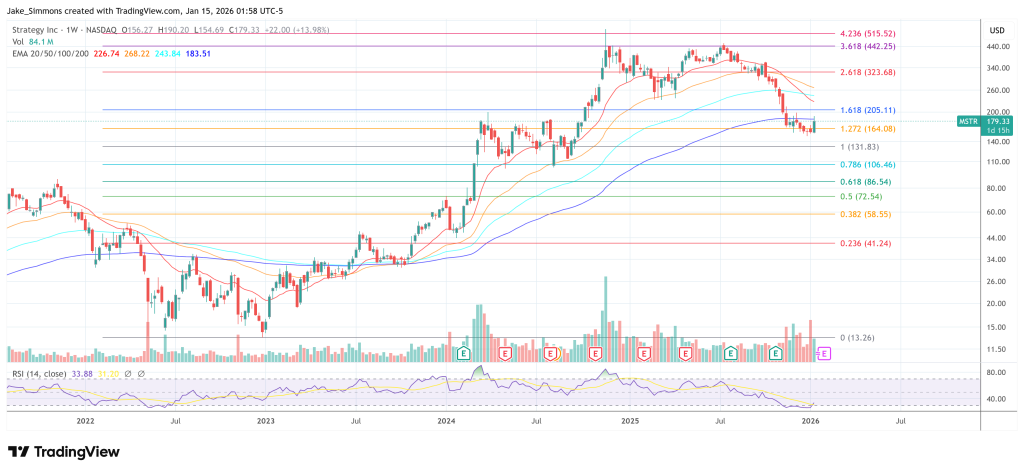
At press time, MSTR traded at $179.33.

MSTR price chart

❌