Reading view

There are new articles available, click to refresh the page.

Stablecoin Trading Surges 62% in Korea as Dollar Strengthens Against Won

South Korean crypto exchanges recorded a 62% surge in stablecoin trading volumes as the won fell to multi-year lows against the dollar, prompting platforms to intensify marketing campaigns around dollar-pegged tokens.

According to The Korea Times, trading volume in Tether (USDT) across the nation’s five major won-based exchanges climbed to 378.2 billion won ($261 million) when the exchange rate exceeded 1,480 won per dollar last Wednesday, citing CryptoQuant data.

The spike follows mounting currency pressures that pushed the won through nine consecutive days of declines against the dollar, marking its longest losing streak since 2008, Bloomberg reported.
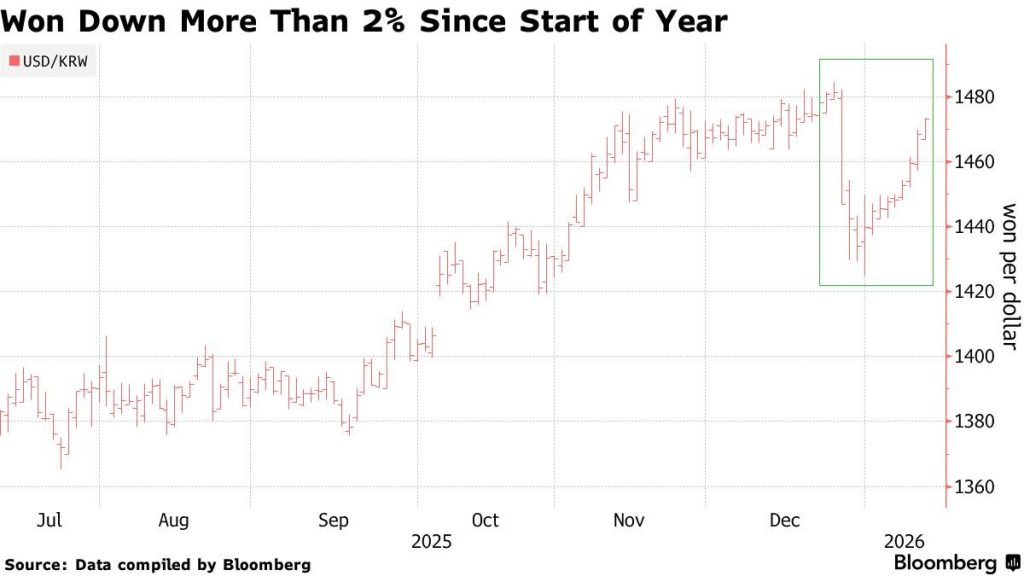
Stablecoin Korea Dollar WON/USD Chart Bloomberg
Source: Bloomberg

Major exchanges, including Korbit, Coinone, Upbit, and Bithumb, launched aggressive promotional campaigns centered on stablecoins, including USDC and USDe, waiving trading fees and distributing rewards to boost volumes during what industry officials described as a downturn in broader crypto markets.

Banks Slash Dollar Rates as Government Defends Currency

According to The Chosun Daily, South Korea’s major commercial banks slashed dollar deposit interest rates to near zero in response to government pressure to defend the exchange rate.

Shinhan Bank cut its annual rate from 1.5% to 0.1% starting January 30, while Hana Bank reduced rates from 2% to 0.05% for its Travelog Foreign Currency Account.

The coordinated move followed the authorities’ summoning of bank executives and their request that they “refrain from excessive marketing that encourages foreign currency deposits such as dollars.

Banks responded by introducing incentives for won conversion, with Shinhan offering a 90% preferential rate for customers converting dollar deposits back to won, plus an additional 0.1 percentage point rate boost for those subscribing to won-term deposits afterward.

Dollar deposit balances at the five major banks fell 3.8% from month-end to 63.25 billion dollars as of January 22, marking the first decline after three consecutive months of surges.

Corporate deposits, which account for 80% of all dollar holdings, dropped sharply from 52.42 billion dollars at year-end to 49.83 billion dollars, suggesting that the authorities’ recommendation to sell dollars spot, combined with perceptions that the exchange rate had peaked, was driving the decline.

Individual dollar deposits grew at a significantly slower pace, rising just 109.64 million dollars, compared with the previous month’s 1.09 billion dollar surge.

Presidential Intervention Accelerates Won Stabilization

President Lee Jae-myung delivered a rare verbal intervention on the exchange rate during a January 21 press conference, stating authorities predicted the rate would drop to around 1,400 won within one to two months.

The won-dollar rate immediately fell from 1,481.4 won to 1,467.7 won following his remarks, closing at 1,471.3 won.
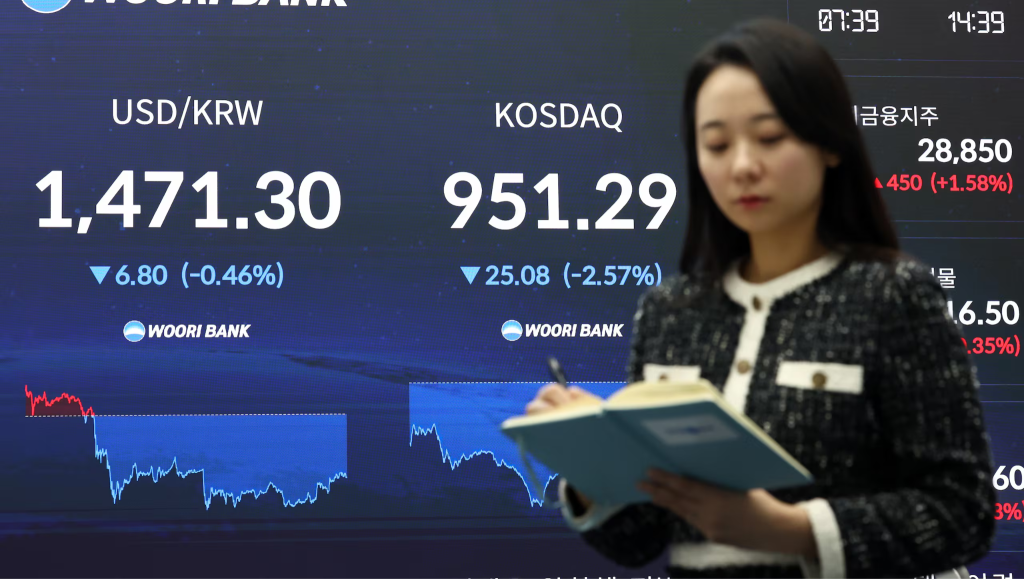
Stablecoin Korea Dollar
Source: TheChosunDaily

Market observers noted the unprecedented nature of a sitting president specifying both an exchange rate target and timeline, with Lee’s statement carrying significantly more weight than U.S. Treasury Secretary Scott Bessent’s earlier comment that the won’s recent decline was “inconsistent with Korea’s strong fundamentals.

Meanwhile, demand for dollar exchange slowed as average daily won-to-dollar conversions reached 16.54 million dollars from January 1-22, while dollar-to-won conversions surged to 5.2 million dollars daily, significantly exceeding last year’s 3.78 million dollar average and indicating increased profit-taking.

In fact, according to CNBC, South Korea’s fourth-quarter GDP growth slowed to 1.5% year over year, missing economists’ forecasts of 1.9%, as construction investment shrank 3.9% and exports pulled back 2.1% from the previous quarter.

The won has lost nearly 2% against the greenback this year, making it one of Asia’s worst-performing currencies, while South Korean retail investors bought approximately 2.4 billion dollars of U.S. equities on a net basis through mid-January, up roughly 60% from the same period last year.

The broader economic slowdown comes as Seoul advances major crypto policy reforms despite regulatory gridlock over stablecoin governance.

Earlier this month, South Korea ended its nine-year corporate crypto trading ban, permitting listed companies to invest up to 5% of equity capital in top-20 cryptocurrencies, while lawmakers passed amendments to the Capital Markets Act and Electronic Securities Act establishing legal frameworks for tokenized securities trading beginning January 2027.

🇰🇷South Korea has launched guidelines, allowing listed companies and professional investors to invest up to 5% of their equity capital crypto.#SouthKorea #CorporateCryptoInvestment #CryptoInvestmenthttps://t.co/d55u3TDsBF

— Cryptonews.com (@cryptonews) January 12, 2026

Korea Exchange Chairman Jeong Eun-bo pledged to launch spot Bitcoin ETFs and extend trading hours to 24/7 as part of efforts to eliminate the “Korea discount,” though comprehensive digital asset legislation remains stalled amid disputes between the Financial Services Commission and the Bank of Korea over stablecoin issuance rules.

The post Stablecoin Trading Surges 62% in Korea as Dollar Strengthens Against Won appeared first on Cryptonews.
Big Banks Go Stablecoins: Capital One Buys Brex For $5.15 Billion

Reports say Capital One will buy stablecoin fintech Brex for $5.15 billion in a deal that mixes cash and stock. According to the bank’s release, roughly half of the price will be paid in cash and the other half in Capital One stock.

Regulators must still sign off. The two companies expect the transaction to finish by mid-2026, though that timing could shift if approvals take longer.

Brex Brings Cards, Software — And Stablecoin Plans

Brex began as a corporate card and expense tool for startups and has added services for larger firms.

Reports note the company moved quickly into payment tech last year when it announced plans to offer native stablecoin payments, letting customers send and accept dollar-pegged tokens with automatic conversion back into USD balances.

That bit of tech is a major part of why the deal matters to a bank that wants faster settlement options.

A Mix Of Old And New

This is not just about software. It is also a play for customers. Brex runs business accounts, serves big names in tech, and has built a set of tools that many businesses use daily.

Some of those clients moved business deposits to Brex after the 2023 banking turmoil, and those relationships are part of the package Capital One is buying.

The price tag looks smaller than Brex’s peak private valuation years ago, which shows how venture valuations have reset across the sector.

Why This Matters For Payments

Banks have been testing token-based rails and faster settlement for a while. By folding Brex into its operations, Capital One gains a ready platform that already experiments with stablecoin rails.

Real-time settlement for businesses can lower friction and could cut the waiting time for funds to clear. At the same time, regulators in the US and abroad are paying closer attention to token projects, so the new setup will run under tighter scrutiny.

Source: Coingecko The Growing Stablecoin Market

Stablecoins have drawn growing attention across traditional finance after Congress approved major rules for the tokens last year.

Based on data from Coingecko, the total value of stablecoins has climbed over 18% to an all-time high of $315 billion since the GENIUS Act was passed in July 2025. USDT takes the lion share of the overall stablecoin market.

Leadership And Market Reaction

Reports note that Pedro Franceschi, Brex’s CEO, will continue to lead the unit after the sale, now inside Capital One.

Investors reacted calmly overall; Capital One’s shares dipped early but were supported by robust quarterly results announced at the same time. That earnings strength helped soften any sharp market moves.

Featured image from YouHodler, chart from TradingView

Banks Make Killing Stablecoin Yields Their Top 2026 Priority

The American Bankers Association placed stablecoin rewards at the forefront of its 2026 policy agenda, escalating an industry-wide campaign against digital-dollar incentive programs that banks claim threaten deposit bases and community lending capacity.

The trade group’s newly released Blueprint for Growth explicitly calls on Congress to “stop payment stablecoins from becoming deposit substitutes that slash community bank lending by prohibiting paying interest, yield or rewards regardless of the platform.

ABA President and CEO Rob Nichols said the priorities were developed through collaboration with all 52 state bankers’ associations to advance policies that “bolster the economy, expand access to credit and enhance competition in the financial services marketplace.

The document positions stablecoin yield restrictions as the association’s leading economic priority ahead of fraud prevention, regulatory threshold indexing, and support for minority-serving financial institutions.

Just released – ABA’s 2026 Blueprint for Growth outlines key policy priorities: https://t.co/KsOScu1Lgs pic.twitter.com/C3gMrXQn84

— American Bankers Association (@ABABankers) January 20, 2026

Banking Industry Intensifies Pressure on Lawmakers

The coordinated push comes as Senate Banking Committee negotiations over digital asset market structure legislation remain deadlocked over stablecoin reward provisions.

Banking executives have spent months warning that yield-bearing tokens could trigger massive deposit outflows, with Bank of America CEO Brian Moynihan estimating that $6 trillion in deposits could migrate into stablecoins under permissive regulatory frameworks.

JPMorgan CFO Jeremy Barnum also warned during the bank’s fourth-quarter earnings call that interest-bearing stablecoins risk creating “a parallel banking system that sort of has all the features of banking, including something that looks a lot like a deposit that pays interest, without the associated prudential safeguards.

⚠ @JPMorgan backs blockchain innovation but warns yield-bearing stablecoins mimic bank deposits without oversight.#JPMorgan #Stablecoinhttps://t.co/4Fbu8pMOwk

— Cryptonews.com (@cryptonews) January 14, 2026

Community bankers have been particularly vocal, with the Community Bankers Council urging Congress in early January to close what it called a “loophole” allowing stablecoin issuers to indirectly fund yield through exchange partners.

The group warned that large-scale deposit outflows could reduce credit availability for small businesses, farmers, students, and homebuyers in local communities.

Senator Tim Scott’s draft crypto market structure bill released January 9 includes language prohibiting digital asset service providers from paying interest or yield solely for holding stablecoins, though the provision allows activity-based rewards tied to functions like staking and liquidity provision.

Crypto Coalition Mobilizes Against Expanded Restrictions

A coalition of 125 crypto and fintech organizations, including Coinbase, PayPal, Stripe, Ripple, and Kraken, delivered a forceful rejection of expanded yield restrictions in December.

The Blockchain Association-led group argued that banking industry efforts represent “overtly protectionist” measures rather than consumer protection, noting that banks face no similar restrictions on credit card rewards despite engaging in riskier balance-sheet activities.

The push to restrict stablecoin rewards beyond that agreed to in GENIUS is not a technical refinement or a consumer protection fix,” the coalition stated.

It would prohibit the same types of incentive programs for stablecoin payments that banks have long offered on credit cards and other types of payment services.

Just yesterday, Circle CEO Jeremy Allaire called banking concerns “totally absurd” during a World Economic Forum panel, drawing parallels to historical opposition to money market funds.

🙅‍♂️ Circle CEO rejects bank warnings on stablecoin yields as "absurd," citing money market precedent as transaction volumes reach $33 trillion in 2025.#Stablecoin #Circlehttps://t.co/kPQw5xYpBh
— Cryptonews.com (@cryptonews) January 22, 2026

The exact same arguments were made,” Allaire stated, noting that roughly $11 trillion in money market funds has grown without preventing lending activity.

He emphasized that all major stablecoin regulations prohibit issuers from paying interest directly, while partner platforms may offer rewards based on commercial arrangements.

Rewards around financial products exist in every balance that you have with a credit card that you use,” Allaire said.

The crypto coalition disputed Treasury projections suggesting yield-bearing stablecoins could result in up to $6.6 trillion in deposit flight, citing analysis that found no evidence of disproportionate deposit outflows from community banks.

The groups questioned how banks can claim deposit constraints while holding $2.9 trillion in reserve balances at the Federal Reserve.

Coinbase CEO Brian Armstrong said the exchange could not back Scott’s draft bill, citing provisions that would eliminate stablecoin rewards.

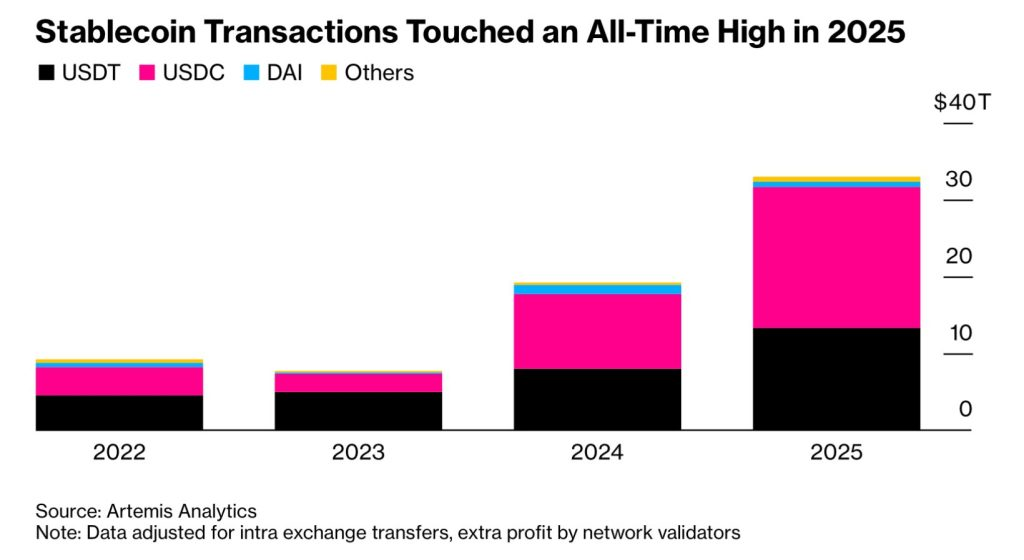
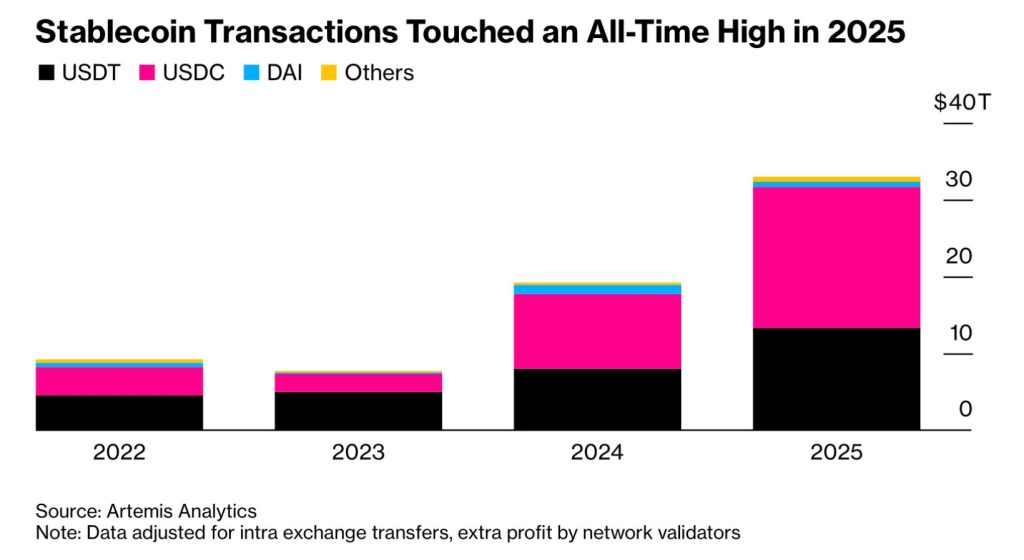
These divisions come as global stablecoin transaction volumes reached $33 trillion in 2025, up 72% from the previous year, with USDC processing $18.3 trillion.

Banks Stablecoin Yields - Stablecoin Transactions Volume 2025 Chart
Source: Artemis Analytics

Bloomberg Intelligence predicted that flows could reach $56 trillion by 2030 as institutional payment infrastructure adoption accelerates.

For now, the Banking Committee may postpone further work until late February or March, following Coinbase’s withdrawal of support and divided attention to the new housing policy agenda demanded by Trump.

However, the Senate Agriculture Committee has scheduled a markup of competing legislation for January 27 that takes a fundamentally different approach by excluding payment stablecoins from CFTC authority entirely and deferring regulation to frameworks like the GENIUS Act rather than setting specific yield rules.

The post Banks Make Killing Stablecoin Yields Their Top 2026 Priority appeared first on Cryptonews.

Russia’s A7A5 Stablecoin Moved $100 Billion Before Global Crackdown: Elliptic

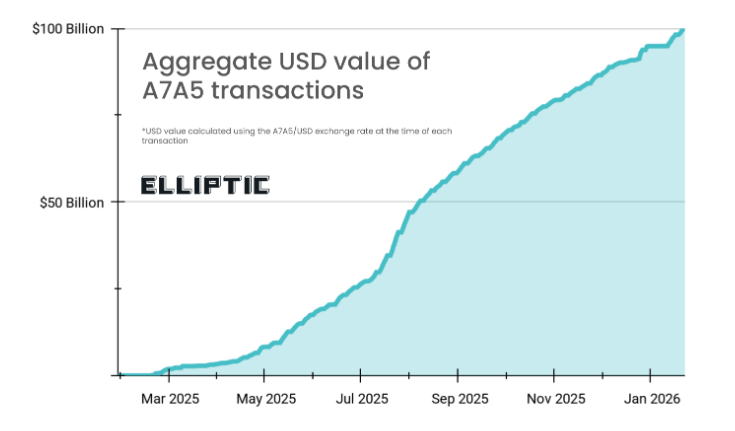
A little token that few people had heard of a year ago has become a big mover of money. Reports say the A7A5 stablecoin, launched as a rouble-linked coin, has processed the equivalent of $100 billion in transfers since it began moving at scale.

Elliptic Finds Rapid Growth And Large Volumes

According to analysis by Elliptic, A7A5 grew quickly after its launch and was used heavily for settlement between firms that could not rely on regular banks. The firm traced huge daily flows, with transaction totals rising into the billions and aggregate transfers passing major milestones.

Origins And Backing

A7A5 was set up in a way that tied it to rouble deposits and to a handful of private entities connected to Russia’s financial network.

Reports say the project was linked to a payments group and to banking partners that have been under western scrutiny. Some of the people and firms behind the token were later sanctioned by authorities in the US and the UK.

How The Money Moved

Transactions were concentrated on a small number of exchanges and on on-chain routes that made cross-border transfers possible without the usual banking rails.

In practice, the coin served as a bridge into other stablecoins and crypto markets. That routing let trade keep moving even when formal channels were closed to certain actors.

A7A5 Stablecoin Role In Sanctions Evasion Claims

Reports note that regulators and analysts view those flows as a tool that could help avoid sanctions. Regulators in several countries have taken action against linked platforms and individuals after patterns of transfers were uncovered.

Some of the design choices around the token made monitoring harder for a time, and in a few cases tokens were reissued in new wallets to muddy traces.

Market Reaction And The Wider Impact

Markets noticed. The token’s market cap surged, and exchanges that handled it saw sharply higher volumes.

Ordinary traders were not the main users; activity was often timed with business hours and weekdays, which suggested corporate or institutional flows rather than retail swaps. This type of pattern changed how people outside the region looked at crypto as a payments tool.

Authorities responded by blacklisting some addresses and platforms and by stepping up enforcement against those named in the network.

The moves show that a token can move a lot of value, but it can also draw regulatory heat and prompt countermeasures that affect every participant in the chain.

Featured image from Pixabay, chart from TradingView

Banks’ Concerns Over Stablecoin Interest Payments Are ‘Totally Absurd’, Circle CEO Says

The CEO of stablecoin issuer Circle has weighed in on the importance of stablecoin rewards and why he believes the banking industry’s concerns about interest payments on these assets are “absurd.”

Circle CEO Rejects Banks’ Stablecoin Fears

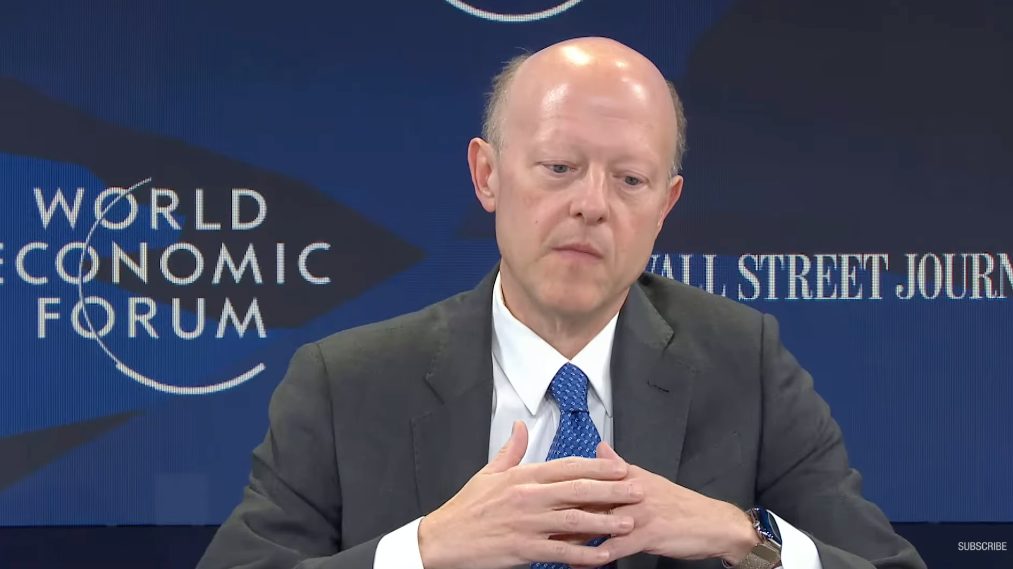
Speaking at the World Economic Forum (WEF) in Davos, Circle’s CEO, Jeremy Allaire, discussed banks’ growing concerns that paying interest on stablecoins poses a threat to the industry, calling the deposit flight narrative “totally absurd.”

The banking sector has expressed concerns about stablecoin rewards, arguing that interest payments will distort market dynamics and affect credit creation. In the US, banks have heavily criticized the GENIUS Act, claiming that it has loopholes that could pose risks to the financial system.

The executive rejected the sector’s general arguments, citing historical and practical reasons. He asserted that this exact argument has been historically used when new financial products, such as government money market funds, have emerged.

Notably, Bank of America CEO Brian Moynihan recently compared the digital assets to money market mutual funds, which require reserves to be held in short-term instruments, such as US Treasuries, reducing lending capacity in the system.

The executive told investors that the banking sector, small- and medium-sized businesses in particular, could face significant challenges if the US Congress does not prohibit interest-bearing stablecoins, as up to $6 trillion in deposits, or 30% to 35% of all US commercial bank deposits, could flow out of the banking system and into the stablecoin sector.

However, Allaire pointed out that, despite institutions claiming that financial products would “draw all the deposit base,” their growth has not “stopped the ability for lending to happen.”

The importance Of Rewards

Circle’s CEO also argued that stablecoins should not be singled out when rewards for other financial products exist and contribute to the system. “Those rewards (…) exist in every balance that you have with a credit card that you use. They exist around so many other financial products and services that we have,” he detailed.

“These rewards are actually very important,” Allaire continued. “They help with stickiness, they help with customer traction. They are not themselves like these huge monetary policy dampers.”

Most importantly, he pointed out that lending is moving away from the risk-taking of banks, with “a huge amount of lending is moving towards private credit.”

He cited a Wednesday WEF panel, in which a capital markets participant highlighted how the vast majority of GDP growth in the United States was “formed by capital market formation around junk bonds.”

“So private credit issuing junk bonds, capitalizing the build out of the American technology advancements, not bank credit,” the executive added.

Previously, Coinbase Institute shared a similar argument, affirming that “credit is evolving, not shrinking. Lending is shifting to private credit, fintech, and DeFi channels that don’t depend on deposits. Liquidity moves—it doesn’t vanish.”

Allaire concluded that “we want stablecoin money to be cash instrument money, prudentially supervised, very, very safe money. And then I think what we want to do is we want to build models for lending that build on top of stablecoins.”

stablecoin, total

Capital One Agrees to Acquire Technology and Stablecoin Firm Brex in $5.15B Deal

By: Amin Ayan

Capital One has agreed to acquire fintech firm Brex in a deal valued at $5.15 billion, marking one of the largest fintech transactions in recent years and signaling the bank’s growing interest in stablecoin-based payments.

Key Takeaways:

  • Capital One will acquire Brex for $5.15 billion, gaining its payments technology and stablecoin infrastructure.
  • The deal strengthens Capital One’s push into business payments as competition from fintech firms intensifies.
  • Growing regulatory clarity and market growth are driving banks to explore stablecoins for mainstream payments.

The US banking giant said on Thursday that the transaction will be structured as a combination of cash and stock and is expected to close in mid-2026, subject to regulatory approvals and customary closing conditions.

As part of the deal, Capital One will absorb Brex’s payments technology, including its stablecoin infrastructure.

Capital One Says Brex Deal Accelerates Push Into Business Payments

“Since our founding, we set out to build a payments company at the frontier of the technology revolution,” Capital One founder and CEO Richard Fairbank said in a statement.

He added that the acquisition would accelerate the bank’s push into business payments, an area where competition from fintech firms has intensified.

Brex, best known for its corporate cards and spend management tools, has increasingly positioned itself at the intersection of traditional finance and crypto.

In October, the company announced plans to become the first global corporate card provider to support native stablecoin payments, beginning with USDC.

That move placed Brex among a small but growing group of fintech firms experimenting with blockchain-based settlement for everyday business transactions.

Brex co-founder and CEO Pedro Franceschi said he would continue to lead the company following the acquisition.

Writing on X, Franceschi said the deal would allow both firms to move faster and invest more deeply, bringing expanded financial tools to businesses that remain underserved by traditional banks.

https://t.co/IfEmfj5RSJ

— Pedro Franceschi (@pedroh96) January 22, 2026

The acquisition comes as stablecoins draw renewed attention across Wall Street.

Following the passage of comprehensive US stablecoin legislation last year, major financial institutions have begun exploring how tokenized dollars could fit into payments, treasury management, and cross-border transfers.

According to CoinGecko, the total market capitalization of stablecoins has climbed 18.6% since the GENIUS Act was passed in July 2025, reaching a record $314 billion.

That growth has sharpened interest from banks seeking to modernize payment rails while staying within regulatory boundaries.

Stablecoin Transactions Hit $33 Trillion in 2025 as USDC Leads Usage

Global stablecoin transaction value reached $33 trillion in 2025, marking a 72% increase from the previous year, according to Bloomberg data compiled by Artemis Analytics.

USDC emerged as the most-used stablecoin by transaction volume, processing $18.3 trillion, while Tether’s USDT handled $13.3 trillion, despite maintaining its lead by market capitalization at $187 billion.

The surge in activity followed the passage of the GENIUS Act in July 2025, the first comprehensive U.S. regulatory framework for payment stablecoins.

Industry participants say the legislation has provided legal certainty that encouraged broader institutional and global adoption.

As reported, stablecoin usage on fintech platform Revolut also accelerated sharply in 2025, with payment volumes estimated to have climbed 156% year over year to roughly $10.5 billion, as digital dollars gain ground in everyday payments.

The post Capital One Agrees to Acquire Technology and Stablecoin Firm Brex in $5.15B Deal appeared first on Cryptonews.

Iran Turns To USDT, Acquiring $507 Million To Defend Its Currency

Iran’s central bank quietly built up a large stash of Tether’s USDT last year as the rial struggled and trade with the outside world grew harder. The move turned parts of the crypto ledger into a public trail of a policy that would normally be private.

Central Bank’s Crypto Moves

According to a blockchain analysis by Elliptic, the Central Bank of Iran acquired at least $507 million in USDT over 2025, a figure the firm treats as a conservative minimum because it only counts wallets it could tie to the bank with high confidence.

Reports say much of the buying happened in the spring months of 2025 and that payments were routed through channels that included Emirati dirhams and public blockchains. Those stablecoins were then used in local crypto markets to add dollar-linked liquidity and help slow the rial’s slide.

🚨 New Elliptic research: We have identified wallets used by Iran’s Central Bank to acquire at least $507 million worth of cryptoassets.
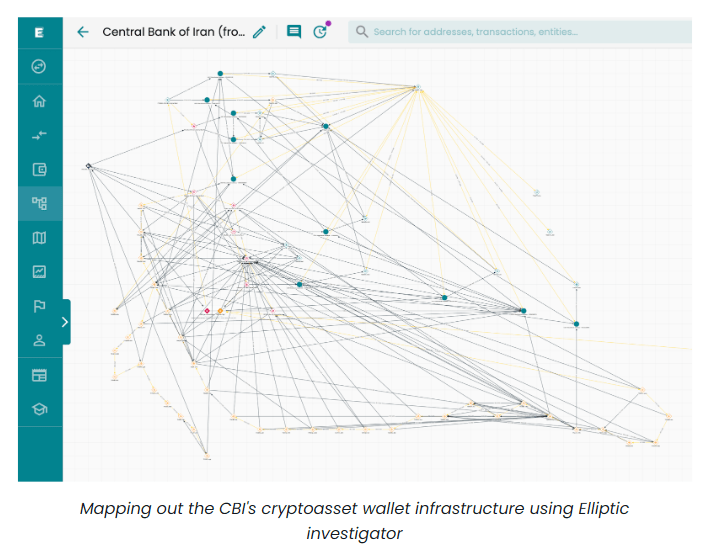

The findings suggest that the Iranian regime used these cryptoassets to evade sanctions and support the plummeting value of Iran’s currency,… pic.twitter.com/I7NHGO0wtP

— Elliptic (@elliptic) January 21, 2026

How The Money Flowed

Elliptic’s tracing shows an early flow of USDT into Nobitex, Iran’s biggest crypto exchange, where the coins could be swapped into rials and fed into the market. After a breach and growing scrutiny in mid-2025, other paths were used, including cross-chain bridges and decentralized exchanges, to move and convert funds.

A Freeze And A Warning

That open ledger also left the transactions visible to outside observers. On June 15, 2025, Tether blacklisted several wallets linked to the central bank and froze about $37 million in USDT, showing that stablecoins can be cut off when issuers or regulators step in. That intervention narrowed some options for on-chain liquidity.

This episode matters for two reasons. First, it shows how a state institution can use stablecoins to gain access to dollar value when normal banking routes are closed.

Second, it highlights a weakness: if a private issuer can freeze balances, those reserves are not the same as cash held in hard foreign accounts.

Trade, Sanctions, And A New Tool

Reports note the purchases likely served a twin goal — to smooth domestic exchange rates and to help settle trade with partners who avoid direct dollar banking.

The method is blunt. It gives a way to move value, but it also creates new points of control and exposure that can be tracked on public ledgers.

Analysts will be watching how regulators and stablecoin issuers respond. They will also track whether other countries under pressure turn to similar mixes of centralized and decentralized tools.

The public tracing of these flows makes it harder to hide big moves, even when actors try to obscure them across chains and exchanges.

Featured image from Unsplash, chart from TradingView

Circle CEO Rejects Claims Stablecoin Yields Threaten Banks

Circle CEO Jeremy Allaire dismissed banking industry warnings that stablecoin rewards could destabilize traditional finance, calling such concerns “totally absurd” during a World Economic Forum panel discussion on Thursday.

His remarks came amid escalating tensions between crypto platforms and banks over provisions in pending U.S. market structure legislation.

Speaking at the Davos summit, Allaire defended the stablecoin industry’s growth trajectory while addressing claims from Bank of America CEO Brian Moynihan that yield-bearing digital dollars could trigger massive deposit flight from commercial banks.

The panel, which included International Monetary Fund First Deputy Managing Director Dan Katz and development finance expert Vera Songwe, examined stablecoins’ expanding role in global payments following last year’s passage of the GENIUS Act.

Banks Warn of “Parallel Banking System”

Banking executives have intensified lobbying against stablecoin rewards programs, with JPMorgan CFO Jeremy Barnum recently warning that interest-paying tokens create “a parallel banking system that sort of has all the features of banking, including something that looks a lot like a deposit that pays interest, without the associated prudential safeguards.

The Community Bankers Council of the American Bankers Association also urged Congress earlier this month to close what it called a “loophole” allowing stablecoin issuers to indirectly fund yield through exchange partners.

Community bankers warned that large-scale deposit outflows could reduce credit availability for small businesses and homebuyers.

⚠ @JPMorgan backs blockchain innovation but warns yield-bearing stablecoins mimic bank deposits without oversight.#JPMorgan #Stablecoinhttps://t.co/4Fbu8pMOwk

— Cryptonews.com (@cryptonews) January 14, 2026

Allaire countered that such arguments ignore financial market history and mischaracterize how stablecoins function within regulatory frameworks.

Rewards around financial products exist in every balance that you have with a credit card that you use,” he said, noting these incentives help with customer retention without functioning as monetary policy dampeners.

Money Market Funds Precedent Cited

The Circle chief executive drew parallels to government money market funds, which banking groups once claimed would devastate deposit bases.

The exact same arguments were made,” Allaire stated, pointing out that roughly $11 trillion in money market funds has grown without preventing lending activity.

He argued that lending itself has shifted toward private credit markets, with “the vast vast majority of GDP growth in the United States” historically funded through capital market formation around junk bonds rather than bank credit.

Allaire emphasized that all major stablecoin regulations (including the GENIUS Act, Europe’s MiCA framework, and laws in Japan, UAE, Hong Kong, and Singapore) explicitly prohibit stablecoin issuers from paying interest.

Circle CEO Stablecoin Yields Threaten Banks - Jeremy Allaire Image
Source: YouTube

Payment stablecoins” are legally defined as cash instruments used for settlement and require cash-level safeguards under supervision by central bankers and global standard-setters.

While Circle generates income from reserves and revenue-sharing partnerships with platforms like Coinbase, Binance, and Visa, the company itself cannot pay interest directly to tokenholders.

Partner platforms may offer rewards based on their own commercial arrangements, but Allaire argued that this mirrors loyalty programs across traditional financial products.

IMF Acknowledges Benefits Amid Risks

The IMF’s Katz acknowledged stablecoins present “very significant potential benefits” for cross-border payments and financial inclusion while noting risks including banking disintermediation and currency substitution in emerging markets.

Transaction volumes reached $33 trillion in 2025, up 72% from the previous year, with USDC processing $18.3 trillion to lead all stablecoins by payment flow.

Stablecoin Transactions Volume Chart
Source: Artemis Analytics

Katz emphasized the importance of international regulatory interoperability, stating that realizing stablecoins’ full benefits requires scale and effective cross-border frameworks.

He pointed out the competitive pressures stablecoins create for traditional finance and weak fiscal regimes alike.

Songwe detailed stablecoins’ transformative impact across Africa, where remittance costs averaging 6% can drop to under $1 with digital dollar transfers that complete in minutes, versus five-day settlement delays.

With 650 million Africans lacking bank accounts and 12-15 countries experiencing inflation above 20%, stablecoins provide dollar-denominated savings accessible via smartphones.

Egypt, Nigeria, and Ethiopia lead African adoption, with most transactions below $1 million, indicating heavy small-business use.

In fact, according to Chainalysis, Sub-Saharan Africa received over $205 billion in on-chain value, up roughly 52% from the previous year between July 2024 and June 2025.

However, Songwe noted that 75% of stablecoin reserves remain dollar-denominated, prompting the development of SDR-backed alternatives to reduce dollar dependency and improve transparency around illicit financial flows.

Allaire concluded that stablecoins should remain “cash instrument money, credentially supervised, very very safe money,” with efficient credit delivery systems built atop them through decentralized finance protocols that can be “safer, more transparent, more efficient, more inclusive, and more globally available than what we have with bank credit today.

The post Circle CEO Rejects Claims Stablecoin Yields Threaten Banks appeared first on Cryptonews.

Ripple’s RLUSD Is Not A Threat To XRP’s Future, Here’s Why

Rumors about XRP suddenly becoming useless and less relevant appear to be spreading across the crypto market following the introduction of Ripple’s stablecoin, RLUSD. Crypto market analyst XFinanceBull recently took to X to debunk these claims, stating that, rather than being a potential threat, RLUSD was created to complement XRP’s functionality and use cases on the ledger.

Why Ripple’s RLUSD Poses No Danger To XRP 

In his post, XFinanceBull revealed that many in the crypto community now see XRP as less useful because of RLUSD. These concerns carry weight given the growing dissatisfaction over XRP’s price struggles. Furthermore, with a stablecoin in place, the perception is that XRP’s use cases could deteriorate, especially given RLUSD’s greater stability. 

Addressing these growing concerns, XFinanceBull emphasized that XRP and RLUSD serve different purposes within the ecosystem. His commentary aims to correct the misconception that RLUSD was introduced to replace XRP. The analyst referenced statements from Ripple’s former Chief Technology Officer (CTO), David Schwartz, who, in a video, clearly explained the distinct roles of XRP and RLUSD, highlighting how the stablecoin benefits the altcoin rather than threatens it. 

According to XFinanceBull, Schwartz stated that RLUSD attracts large, credible flows to the XRP Ledger (XRPL), and this capital provides structural benefits to XRP. The analyst declared that RLUSD does not replace XRP, but instead amplifies its functionality. He added that as liquidity grows through the stablecoin, more payment routes are created, leading to increased XRP burns. 

XFinanceBull also noted that every stablecoin trade within the Ripple ecosystem indirectly drives demand for XRP as a bridge asset. He concluded that the world will eventually realize that utility is not defined by a whitepaper alone, but by real transaction flows. He added that although the XRP price may be declining, its rails are still being built.  

How RLUSD Benefits XRP

In the video shared by XFinanceBull, Schwartz stated that RLUSD is designed to benefit XRP. He explained that RLUSD strengthens XRP by introducing more credible assets onto the XRP Ledger, thereby expanding the network’s use cases and creating more opportunities for developers. 

The former Ripple CTO also revealed that adding trusted assets, such as RLUSD, increases trading activity on XRPL’s DEX. According to him, higher trading volume generates both direct and indirect benefits for the decentralized network and its native token, XRP. 

A key advantage of the XRPL DEX is its auto-bridging feature, which uses XRP to facilitate trades between different assets. Schwartz said that this mechanism allows XRP to act as an intermediary, helping users find the most efficient trading routes. He added that RLUSD and XRP are designed to complement each other, given their different roles within the ecosystem. While the stablecoin offers price stability, the altcoin functions as a bridge currency within Ripple’s payment products. This means that as RLUSD usage grows, demand for XRP is reinforced.

Ripple

Circle Issues Grant to Fund UN Initiative to Streamline Humanitarian Aid Payments

By: Amin Ayan

Stablecoin issuer Circle has awarded a grant to support the United Nations’ push to modernize its internal payment systems, aiming to make humanitarian aid transfers faster, cheaper and more transparent.

Key Takeaways:

  • Circle is funding a UN initiative to modernize humanitarian payments using stablecoin-based infrastructure.
  • The grant builds on earlier USDC aid programs, including payments to Ukrainians displaced by war in 2022.
  • UN officials say blockchain payments could reduce costs, delays and inefficiencies tied to legacy financial systems.

The grant was announced Wednesday at the World Economic Forum in Davos, Switzerland. Circle did not disclose the size or structure of the grant.

The Circle Foundation said the funding would support the UN’s Digital Hub of Treasury Solutions (DHoTS), a program focused on improving how money moves across the UN’s global operations.

Circle Expands UN Stablecoin Aid Efforts

The initiative builds on earlier cooperation between Circle and the United Nations.

In 2022, Circle partnered with the UN Refugee Agency and DHoTS to facilitate USDC stablecoin payments to Ukrainians displaced by the war, marking one of the first large-scale uses of stablecoins in humanitarian aid distribution.

UN Development Programme administrator Alexander De Croo said digital payments could help stretch limited resources further at a time when humanitarian budgets are under strain.

“Stablecoin payments allow us to make every dollar work harder,” he said, pointing to inefficiencies tied to legacy banking infrastructure.

According to Circle, roughly $38 billion in humanitarian funding flows through outdated financial rails each year, often resulting in delays, high transaction fees and limited transparency.

Digital financial infrastructure, including blockchain-based payments, could help address those issues while improving accountability.

Circle Foundation is supporting the United Nations in their efforts to modernize global aid delivery.

The humanitarian system moves more than $38B every year, yet much of that aid still relies on slow, costly legacy financial rails.

Through its first international grant, Circle… pic.twitter.com/JwWXdmh55F

— Circle (@circle) January 21, 2026

UN High Commissioner for Refugees Barham Salih said the use of new technology was about more than efficiency.

“This is about using technology to uphold dignity and choice for people forced to flee, while maximizing impact for every dollar entrusted to us,” he said.

The grant comes shortly after Circle launched the Circle Foundation in December, a philanthropic arm focused on financial inclusion and resilience.

Supporting public-sector use cases for stablecoins appears to be an early priority.

Stablecoins are playing an increasingly prominent role in global payments. The sector has grown into a $312.7 billion market, with tokens widely used for remittances, business settlements and savings in regions facing currency instability.

Bermuda Unveils Plan for Fully On-Chain Economy With Coinbase and Circle

As reported, Bermuda has announced plans to place blockchain infrastructure at the core of its financial system, partnering with Coinbase and Circle to develop what officials describe as a fully on-chain economy.

The initiative was unveiled at the World Economic Forum in Davos, where Premier David Burt outlined a model that would integrate digital assets into everyday payments, financial services and government operations.

The push reflects long-standing challenges faced by the island’s economy, including high transaction fees, limited banking access and slow settlement times caused by global bank de-risking.

By using dollar-denominated stablecoins and blockchain-based settlement, Bermuda aims to bypass traditional correspondent banking networks and reduce costs for businesses, particularly small and medium-sized firms.

The rollout will begin with a pilot using Circle’s USDC stablecoin and Coinbase’s Base infrastructure, focusing on government and commercial payments, tokenization tools for financial institutions and nationwide digital literacy programs.

The post Circle Issues Grant to Fund UN Initiative to Streamline Humanitarian Aid Payments appeared first on Cryptonews.

Bank of Italy Chief Warns Banks Must Tokenize Money to Compete with Stablecoins

Bank of Italy Governor Fabio Panetta told the country’s banking association on Wednesday that commercial banks must convert their money into digital tokens to remain competitive as stablecoins gain momentum, backed by what he described as strong support from the United States administration.

According to Reuters, the European Central Bank policymaker’s comments come as European officials debate how to preserve the continent’s monetary sovereignty while American policymakers accelerate efforts to establish dollar-backed digital assets as a global payment standard.

Addressing bankers in Milan, Panetta said traditional money would continue to anchor the financial system, but warned that both central bank and commercial bank money must become fully digital.

I expect commercial bank money will also become mostly tokenised,” he stated, referring to the process of converting financial assets into digital tokens issued on distributed ledgers such as blockchain.

Banks Stablecoins - Fabio Panetta Image
Source: Bloomberg

U.S. Push Drives Stablecoin Expansion

Panetta acknowledged that stablecoin use would grow substantially in line with Washington’s strategic priorities.

They’ll definitely develop because there’s a big push by the U.S. administration,” he said, explaining that American officials view digital assets as tools to reinforce global dollar demand.

The governor emphasized uncertainty around stablecoins’ ultimate role but insisted they would not displace traditional money, which he called the financial system’s only stable anchor.

It’s not clear what role they’ll have … but I expect the system will remain centred around central bank and commercial bank money, both of which will need to become digital,” Panetta added during his address to Italy’s banking leaders.

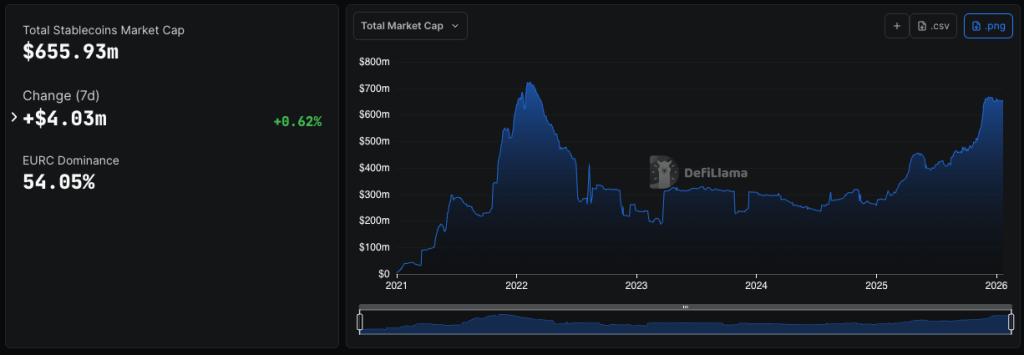
His warning arrives amid escalating European concerns about dollar-denominated stablecoins controlling 99.58% of the $300 billion global market while euro-backed alternatives remain marginal at just $680 million.

Banks Stablecoins - Euro Stablecoins Marketcap Chart
Source: DefiLlama

The ECB has repeatedly flagged systemic risks from rapid stablecoin growth, particularly as leading issuers now rank among the world’s largest U.S. Treasury holders, creating potential spillover effects into traditional markets during stress events.

The ECB seeks to launch a digital euro by 2029 to maintain the relevance of central bank money in an increasingly digital economy and to protect Europe’s monetary sovereignty.

Panetta noted recent geopolitical developments showed Europe’s risky dependence on American firms like Visa, Mastercard, and PayPal for over two-thirds of its payments.

Banks Resisted Digital Euro Over Competition Fears

The digital euro project has faced strong opposition from commercial banks, particularly in Germany, which fear competition from the ECB for deposits.

Panetta addressed this resistance directly, recounting discussions with banks in a large European country that opposed the project because they worried about losing 30% of the payments they handled digitally.

When I discussed this with the banks of a large European country that opposed the digital euro because they worried they’d lose the 30% of payments they handled digitally, I told them: instead of worrying about the 30% think about who controls the 70% you’ve already lost,” Panetta said.

His remarks contrast sharply with a December open letter from 70 European economists who urged EU lawmakers to prioritize public digital currency over private stablecoins, warning that poor design choices could leave Europe dependent on foreign payment systems.

🇪🇺 Seventy European economists warn that weak digital euro design could leave Europe reliant on US payment systems and dollar-backed stablecoins.#DigitalEuro #EU #Stablecoinhttps://t.co/FqcWLtAyEG

— Cryptonews.com (@cryptonews) January 12, 2026

The academics, including Thomas Piketty and Paul De Grauwe, demanded that the digital euro serve as “the backbone of a sovereign, resilient European payment infrastructure,” with generous holding limits and broad accessibility.

Meanwhile, ten major European banks, including BNP Paribas, ING, and UniCredit, formed a consortium in December to launch a euro-backed stablecoin by mid-2026 through a Dutch entity called Qivalis.

The initiative directly addresses concerns about dollar dominance, with euro-denominated stablecoins accounting for less than 1% of the global market despite the eurozone’s economic scale.

Panetta’s tokenization call reflects growing recognition that traditional banks risk irrelevance if they do not adapt to blockchain-based payment systems.

The ECB confirmed last month it would begin allowing distributed ledger technology transactions to settle in central bank money in 2026, marking concrete progress toward integrating digital assets into Europe’s monetary infrastructure while political negotiations continue over the digital euro’s final regulatory framework.

The post Bank of Italy Chief Warns Banks Must Tokenize Money to Compete with Stablecoins appeared first on Cryptonews.

Hong Kong Plans First Stablecoin Issuer Licences in Q1 Amid Crypto Push

By: Amin Ayan

Hong Kong is preparing to issue its first batch of stablecoin issuer licences in the first quarter of the year, stepping up efforts to position itself as a regional hub for digital assets amid growing global competition.

Key Takeaways:

  • Hong Kong will issue its first stablecoin licences in Q1 to advance its digital asset strategy.
  • Issuers must meet strict reserve, redemption, and risk management standards.
  • The push coincides with wider crypto regulation and tokenization initiatives.

Speaking at the World Economic Forum in Davos, Hong Kong Financial Secretary Paul Chan said the city’s approach to crypto regulation remains “responsible and sustainable,” according to the South China Morning Post.

Chan reportedly confirmed that the initial round of stablecoin licences is expected to be granted in the coming months.

Hong Kong Positions Stablecoins at the Core of Its Digital Finance Strategy

Chan framed stablecoins as part of a broader push to build a full digital asset ecosystem in Hong Kong, spanning regulated stablecoin issuance, licensed trading platforms, and tokenized financial products.

He described digital finance as a strategic growth pillar as the city seeks to maintain its status as a global financial center.

The stablecoin licensing regime, passed in 2025, sets out strict requirements for fiat-referenced stablecoin issuers.

These include rules on reserve backing, redemption rights, governance, and risk management, reflecting regulators’ focus on financial stability and consumer protection following volatility in global crypto markets.

Hong Kong’s stablecoin plans sit alongside an already active framework for crypto trading platforms.

Under rules enforced by the Securities and Futures Commission, 11 virtual asset trading platforms have received licences to date.

Approved operators include OSL, HashKey, and Bullish, according to the regulator’s public disclosures.

Beyond trading and stablecoins, Hong Kong is also pushing deeper into tokenization.

In November 2025, the Hong Kong Monetary Authority launched a pilot under Project Ensemble to test real-value transactions using tokenized deposits and digital assets, involving major banks and asset managers.

Hong Kong’s digital asset vision on the global stage. Financial Secretary Paul Chan continued his engagements at the World Economic Forum Annual Meeting in Davos yesterday (Jan 20), joining Vice Premier of the State Council He Lifeng’s Special Address and connecting with senior… pic.twitter.com/mcdKNGrf4T

— BrandHongKong 香港亞洲國際都會 (@Brand_HK) January 21, 2026

At the same time, regulators are consulting on additional proposals that would introduce new licensing regimes for crypto asset dealing, advisory, and management services.

Earlier this week, the Hong Kong Securities and Futures Professionals Association warned that tighter virtual asset management rules could deter traditional asset managers by raising compliance costs and slowing institutional participation.

Hong Kong Asset Managers Warn Crypto Rule Change Could Deter Traditional Funds

As reported, the Hong Kong securities industry is urging regulators to rethink proposed changes that would tighten rules around crypto exposure in traditional investment portfolios, warning the move could discourage mainstream asset managers just as the city seeks to expand its digital-asset market.

In a submission to the Securities and Futures Commission, the Hong Kong Securities and Futures Professionals Association argued against removing the long-standing “de minimis” exemption for Type 9 licensed managers, which currently allows limited crypto exposure without triggering a separate virtual asset management licence.

The proposal comes as Hong Kong broadens its digital-asset framework, with authorities consulting on new licensing regimes for virtual asset dealing, advisory, and management services.

The post Hong Kong Plans First Stablecoin Issuer Licences in Q1 Amid Crypto Push appeared first on Cryptonews.

Blockchain Adoption Pushes Ahead Despite U.S. Regulatory Uncertainty: Analyst

Blockchain adoption continues to expand across institutional finance even as U.S. regulatory clarity remains elusive, according to a new analyst note from Clear Street.

The firm argues that while delays to the proposed Clarity Act may slow parts of the domestic crypto market, they have not derailed broader institutional engagement with tokenization, stablecoins and on-chain financial infrastructure.

The Senate Banking Committee postponed a scheduled markup of the Clarity Act following opposition from Coinbase. Although the Senate Agriculture Committee is still expected to review the bill on January 27, Clear Street analyst Owen Lau warns that the overall legislative timeline could slip to March or later.

Concerns Over Stablecoin Competition

In comments cited by Clear Street, Coinbase CEO Brian Armstrong outlined several concerns with the draft legislation, most notably the risk that bank lobbying could limit the ability of crypto exchanges to pass stablecoin rewards through to users.

Clear Street views this outcome as increasingly likely outside of narrowly defined activity-based rewards such as payments, loyalty programs, wallets or staking.

Such restrictions, the firm argues, would tilt the competitive landscape in favor of traditional banks by allowing them to retain interest spreads while reducing consumer benefits associated with stablecoins.

“In our view the bill risks shifting from its original goal of promoting crypto innovation toward protecting bank margins and constraining competition,” writes Lau.

Clear Street sees two possible paths forward: the crypto industry either accepts legislation with unfavorable terms or disengages from the process entirely. Either scenario could slow U.S. blockchain adoption and weaken the global competitiveness of U.S.-issued stablecoins.

Institutional Momentum Continues Without a Market Structure Bill

Despite these regulatory headwinds, Clear Street stressed that blockchain adoption has continued to advance even in the absence of a comprehensive U.S. market structure framework.

Major financial institutions including Vanguard, Charles Schwab, Bank of America, Morgan Stanley, JP Morgan Chase, the New York Stock Exchange and Bermuda-based entities have all expanded their engagement with blockchain-based products and infrastructure.

Growth areas highlighted by the firm include tokenized money market funds, tokenized equities and prediction markets. Clear Street added that while a supportive policy backdrop would likely accelerate adoption, institutional participation has proven resilient without favorable legislation.

Revised Outlooks for Crypto-Exposed Firms

Reflecting both regulatory uncertainty and evolving market conditions, Clear Street updates its forecasts and price targets for several crypto-linked companies.

For Bakkt (BLSH), the firm raised its fourth-quarter 2025 adjusted EBITDA estimate to $37.8 million from $35.5 million, driven by stronger-than-expected transaction revenue.

Full-year 2026 and 2027 adjusted EBITDA estimates were also modestly increased on continued strength in subscription and services revenue. However, Clear Street lowered its price target to $50 from $57 while maintaining a Buy rating.

For Coinbase, Clear Street reduced its fourth-quarter 2025 adjusted EBITDA estimate to $630 million from $748 million citing weaker-than-expected December trading volumes. While consensus estimates of $731 million appear optimistic, the firm notes that the long-term blockchain adoption thesis remains intact.

Coinbase’s price target was cut to $344 from $415 to reflect lower earnings expectations and a compressed industry valuation multiple with the Buy rating unchanged.

Stablecoin Growth Still Intact

Clear Street also updated its outlook for Circle (CRCL), lowering its fourth-quarter 2025 adjusted EBITDA estimate to $112 million from $116 million due to a lower-than-expected average USDC market capitalization. The firm estimates that USDC’s ending market cap rose 72% year-on-year and 2% quarter-on-quarter during the period.

While near-term estimates were trimmed, Clear Street said longer-term adoption drivers remain intact, including prediction markets, tokenization, artificial intelligence applications and cross-border payments. Growth in non-core income streams could also provide upside, the firm added. Circle’s price target was reduced to $85 from $110 with a Hold rating maintained.

Outlook

Clear Street concludes that while regulatory delays and political compromise may weigh on sentiment in the near term, blockchain adoption is increasingly being driven by institutional demand rather than legislative momentum alone.

“Institutional use cases continue to expand even without a favorable Clarity Act,” the firm said, adding that clearer policy would accelerate adoption — but its absence has not stopped it.

The post Blockchain Adoption Pushes Ahead Despite U.S. Regulatory Uncertainty: Analyst appeared first on Cryptonews.

US Dollar At Risk? Stablecoin Yield Ban Gives Digital Yuan The Upper Hand: Scaramucci

Anthony Scaramucci has warned that a new US rule could hand the upper hand to Beijing. Reports say he believes a ban on paying yield to holders of dollar stablecoins will make dollar-linked digital rails less attractive than the digital yuan, which is moving toward paying interest on wallets.

Stablecoin Yield Ban And Dollar Competitiveness

Lawmakers in Congress are considering a bill that would reshape how digital assets are treated in the United States.

“The whole system is broken,” Scaramucci said on X, reacting to the Clarity Act’s restriction that blocks crypto exchanges and service providers in the US from paying yield to stablecoin holders.

According to the bill text, the proposed Clarity Act would bar certain kinds of yield or interest from being paid in connection with holding payment stablecoins, closing off a path some platforms use to offer rewards. This change is woven into a broader effort to define which digital tokens fall under which regulators.

The whole system is broken: The Banks do not want the competition from the stable coin issuers so they’re blocking the yield in the meantime the Chinese are issuing yield so what do you think the emerging countries will choose as a rail system the one with or without yield?

— Anthony Scaramucci (@Scaramucci) January 16, 2026

Banks And Exchanges Push Back

Reports note the move has split industry players. Some banks have warned that easy access to yield outside the banking system could drain deposits and change lending patterns.

At the same time, major crypto firms have voiced concern that a hard ban on yield will blunt the competitiveness of US dollar-based token services and could push global users toward alternatives that offer returns.

The debate has also strained support for the bill, with at least one high-profile exchange pulling its backing amid disagreement.

China’s Move To Pay Interest On e-CNY

China is already acting on a different path. Based on reports, commercial banks there will be allowed to pay interest on digital yuan holdings, a step meant to boost use of the state’s central bank digital currency.

The change went into effect around the start of this year and was presented as a way to encourage people and institutions to try the e-CNY more often.

Why This Matters For Smaller Economies

Money flows respond to yield. If a digital yuan offers returns while US dollar tokens cannot, some governments and firms in emerging markets might favor the payment rails that provide a financial edge.

That is the central point behind Scaramucci’s warning. It’s not just about finance and stablecoins; it is also about which systems gain traction for trade and cross-border payments.

Regulators now face a tough call. Reports say the choice is between strict limits that curb certain crypto yields and looser rules that could pressure bank deposits. Either route carries tradeoffs for stability, competition, and the global reach of the dollar.

Featured image from Unsplash, chart from TradingView

Investment Manager Predicts XRP Will Dominate This Trillion-Dollar Sector

Canary Capital’s CEO, Steven McClurg, has predicted that XRP will be the leading token in real-world assets (RWAs), which is projected to be a trillion-dollar sector. This came as he highlighted recent developments that put the altcoin on course to dominate the industry.

Canary Capital CEO Predicts XRP Will Dominate RWAs

During an interview, the investment manager opined that XRP will be the leading token for real-world assets, based on Ripple’s moves over the last two years. He noted that the crypto firm has done a great job of integrating the XRP Ledger (XRPL) into many transactions and into Wall Street, which has led to institutional adoption.

The Canary Capital CEO further noted that the XRP Ledger is moving assets such as stablecoins, including Ripple’s RLUSD stablecoin, and other tokenized real-world assets. Notably, Ondo Finance has also tokenized its U.S. treasury fund (OUSG) on the XRPL, while Ripple has partnered with Securitize to add RLUSD access for BlackRock’s BUIDL fund. 

Furthermore, Ripple partnered with Archax and UK-based asset manager abrdn to introduce the first tokenized money market fund on the XRP Ledger. There are also plans for the network to get a tokenized gold upgrade, even as demand for precious metals rises. It is also worth noting that Ripple has previously predicted that the XRP Ledger could dominate the real-world assets industry, putting XRP at the heart of the industry, as McClurg has also predicted. 

Interestingly, McClurg’s prediction comes as the XRP ETFs draw institutional investors into the altcoin’s ecosystem. These ETFs have been a success since their launch, recording only one net outflow since November. Coincidentally, McClurg’s Canary Capital is currently the largest XRP ETF issuer, with $374 million in total net assets, according to SoSoValue data

New Features To Onboard TradFi Onto The XRPL

Ripple and XRP Ledger developers continue to work on introducing new features on the network to attract traditional finance (TradFi) institutions. XRPL validator Vet recently revealed that compliance features for TradFi are coming to the network. This includes on-chain compliance tools such as KYC, AML, and other credentials, which will be used by lending protocols, as well as the XRPL DEX and the Permissioned DEX.

Meanwhile, Ripple developers also described Permissioned Domains, which are part of the amendments, as a game-changer for the XRP Ledger because they will bring institutional-grade controls to a public network, without sacrificing the trade-offs of a private chain. The developers further noted that this will set the stage for financial institutions to engage in permissioned flows on a fast, scalable, and resilient blockchain network such as the XRPL. 

At the time of writing, the XRP price is trading at around $2.06, down in the last 24 hours, according to data from CoinMarketCap.

XRP

💾

Is Bitcoin headed back into the $60Ks — and does that mean the four-year cycle is broken? 🤔Stephen McClurg, CEO of Canary Capital, explains why Bitcoin coul...

XRP Poised To Move On Its Own, Separate From Bitcoin: CEO

For a market that usually moves in one direction, some voices are starting to say this time might look a little different. Canary Capital CEO Steven McClurg said XRP could move on a different path from Bitcoin this year, pointing to enterprise use cases as a key reason.

He made the remarks during a podcast with host Paul Barron, and outlined a cautious view of Bitcoin while singling out protocols tied to real-world tokenization.

According to McClurg, the shift in focus toward practical applications may help a small set of tokens behave differently than the wider market.

XRP And Hedera Seen As Practical Picks

McClurg named the XRP Ledger and Hedera as examples of networks that could benefit from enterprise adoption and tokenization efforts.

He argued that platforms with clear utility — like payment rails, tokenized assets, or stablecoin infrastructure — have a better chance of holding value when speculative momentum fades.

Reports have disclosed that he does not expect these assets to race higher; instead, modest gains are the likeliest outcome, with growth described as low double-digit rather than explosive.

Bitcoin Faces Additional Downside

McClurg turned more negative on Bitcoin. He said he believes Bitcoin peaked on October 6, 2025, at $126,200. Since that date Bitcoin has slipped roughly 35% to about $95,800.

He warned that prices could fall another 20–30% over the next six to nine months, which would place BTC roughly between $65,000 and $77,000 before the end of the cycle.

Based on his view, a new all-time high is not expected in 2026 and the market may be entering a deeper correction.

Markets Could Still Move Together

Critics point out that altcoins often suffer greater losses when the market experiences a downturn, and history supports that caution.

Liquidity tends to dry up during big Bitcoin sell-offs, and even assets with real use cases can be pushed lower in a broad risk-off episode.

In layman’s phrasing, XRP might fall less than Bitcoin and therefore look stronger in comparison, but outright independence from Bitcoin is rare and usually temporary.

Relative Outperformance The More Likely Outcome

According to McClurg’s perspective, what is most realistic is relative outperformance rather than complete separation. That means XRP and similar tokens could remain flat or show modest positive returns while Bitcoin weakens.

Such a pattern would still be notable for holders and for enterprises planning tokenization projects, but it falls short of a dramatic price surge.

Featured image from Bitpanda Blog, chart from TradingView

❌