❌

Reading view

There are new articles available, click to refresh the page.

The NYC Token Crash: Allegations Of Rug Pull After $2.5 Million Liquidity Withdrawal

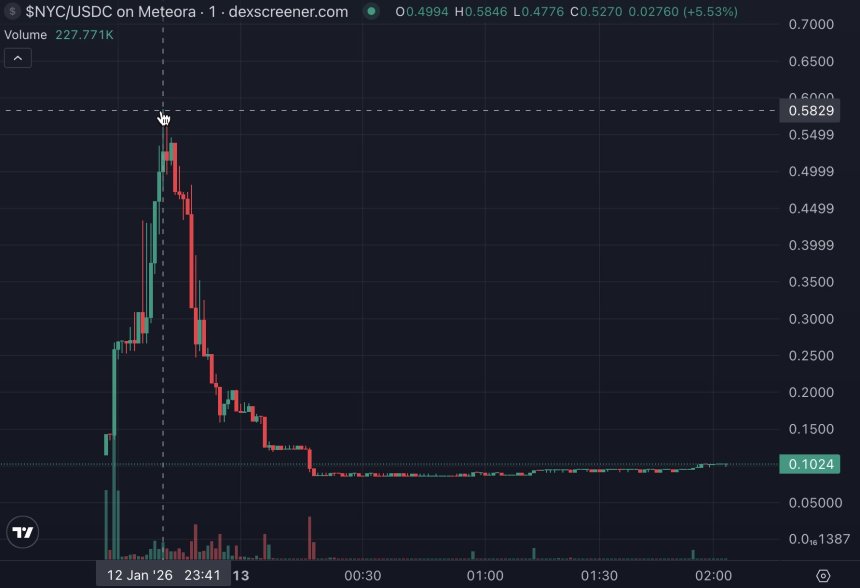
Former New York City Mayor Eric Adams is facing significant backlash after the crash of his newly launched cryptocurrency, the NYC Token, shortly after its debut on Monday. The token initially soared to a market cap of $580 million but has since fallen sharply to approximately $133 million.

Eric Adams Under Fire

In a promotional video, Adams declared, β€œWe’re about to change the game. This thing is about to take off like crazy.” However, the excitement was short-lived as evidence surfaced suggesting that the steep decline in value resulted from a significant sell-off involving a user connected to the NYC Token’s development team.

Blockchain analysis platform Bubblemaps flagged potentially concerning activity linked to the NYC Token. Notably, a wallet associated with the token’s deployer withdrew around $2.5 million in liquidity when the token peaked.Β 

Although about $1.5 million was returned after the token’s value dropped by 60%, approximately $900,000 remains unreturned. This has led users on social media platform X (formerly Twitter) to accuse Adams of orchestrating a crypto rug pull.Β 

NYC Token

Adams, who has been an outspoken proponent of cryptocurrency, stated during a Monday event that some of the funds generated by the NYC Token would be directed towards nonprofits focused on combating antisemitism and β€œanti-Americanism.” Additionally, he expressed intentions to use the proceeds to β€œteach our children about embracing blockchain technology.”

The NYC Token’s official website states there is a total supply of one billion tokens in circulation, and details reveal that 10 percent of profits are allocated to the team’s activities, though the identities of those involved were not disclosed.Β 

NYC Token Team RespondsΒ 

In response to criticism, the NYC Token team acknowledged the liquidity withdrawal, stating, β€œGiven the overwhelming support and demand for the token at launch, our partners had to rebalance the liquidity.” They added, β€œWe’re in it for the long haul!” 

However, there remains uncertainty about the details surrounding the token’s launch, with a recently listed entity, C18 Digital, associated with the project. Delaware corporation records show that C18 Digital was incorporated on December 30, 2025.

Typically, when a cryptocurrency launches, developers create a liquidity pool using various assets, such as Circle’s USDC or Solana (SOL), to allow users to buy and sell the new token. The NYC Token took a different approach by establishing a one-sided liquidity pool comprised solely of the token itself.Β 

As users began purchasing the token, they injected liquidity into the pool using USDC, which was followed by the significant withdrawal of $2.5 million. This tactic, described by analyst Vaiman, can be more subtle than direct token sell-offs.

Following the viral reports of the alleged rug pull, a new account associated with the NYC Token announced that additional funds had been injected into the liquidity pool.Β 

NYC Token

Featured image from CNN, chart from TradingView.comΒ 

Out Of Office, Into Crypto: Ex-NYC Mayor Debuts β€˜NYC Token’ Memecoin

Former New York City Mayor Eric Adams unveiled a new cryptocurrency called β€œNYC Token” on January 12, 2026, drawing quick attention and equally fast criticism.

According to reports, Adams presented the project in Times Square and framed it as a way to support education and to fight anti-semitism and anti-American sentiment. The token is built on the Solana blockchain, based on information released at the launch.

Token Launch And Purpose

According to the official pitch and subsequent statements, proceeds from the token were to help fund scholarships and blockchain training programs for underserved communities.

Adams described the coin as a civic symbol tied to New York’s identity and global reach. The launch was promoted with promises of community benefits, but critics said the public information about governance and fund handling was thin.

Market Moves

The market reacted in a rush. Based on reports, the token briefly showed an implied market cap of about $580 million–$730 million in the first hours after trading began. Then prices tumbled.

Proud to launch @buynyctoken, a new token built to fight the rapid spread of antisemitism and anti-Americanism across this country and now in New York City.

Now live at https://t.co/zowY9Ri3aK pic.twitter.com/qBMzV88Tmj

β€” Eric Adams (@ericadamsfornyc) January 12, 2026

Trades showed a fall of roughly 80% as the token’s price dropped from near $0.46 to about $0.10 shortly after markets opened for the asset. Trading volume spiked and then collapsed, leaving many traders facing big losses.

Liquidity And Allegations

On-chain observers and crypto analysts flagged sudden withdrawals of liquidity minutes after the token’s debut. Reports have disclosed that millions of dollars were pulled from trading pools, which prompted accusations of a rug pull from some corners of the crypto community.

The token’s official website was also criticized for missing or nonfunctional links to key documents, and there was little detail about which groups would receive funds or how decisions would be made.

Adams’ Crypto Record: Political Context

Eric Adams is no stranger to digital assets. During his time in office he converted parts of his salary to Bitcoin and Ethereum and pushed policies to attract blockchain firms to the city.

His successor, Mayor Zohran Mamdani, declined to take part in the token project and did not endorse it. That split in approach raised questions about whether a former official should use his public profile to promote a privately issued coin.

Public Response

Analysts called for transparency and urged a closer look at on-chain data. Based on reports from blockchain trackers, some transfers and liquidity extractions were visible publicly on the Solana network, which added to the scrutiny.

Community groups and investors asked for clearer disclosures, while legal experts warned that investigations or regulatory attention could follow if money was moved in ways that harmed ordinary buyers.

Featured image by ThomasShanahan / iStock.com, chart from TradingView

❌