Reading view

There are new articles available, click to refresh the page.

Bitcoin Adoption In West Virginia Sets A New Regional Benchmark

Bitcoin literacy and community growth are accelerating in West Virginia, and it’s starting to reshape how communities across the state engage with digital finance. What was once viewed as a niche interest among tech enthusiasts is now gaining traction across broader segments of the state’s population. As residents become more curious about digital assets, conversations are shifting from speculation to understanding how BTC works and what it could mean for personal and regional economic resilience.

Bitcoin As A Tool For Regional Economic Growth

West Virginia has been making headlines in the Bitcoin space recently, particularly with fresh legislative moves as of January 2026. MartyParty revealed on X that the biggest current development is Senator Bill 143 (SB143), which was introduced this week by State Senator Chris Rose.

This is officially titled the Inflation Protection Act of 2026, which would allow the state’s Board of Treasury Investment to allocate up to 10% of public funds into precious metals like gold, silver, and platinum. The bill requires any qualifying digital asset to have maintained an average market capitalization of at least $750 billion over the prior year, which qualifies only BTC. In addition, the bill also allows for regulated stablecoins, but only the US federal or state regulators can approve the assets.

Bitcoin

However, the bill frames this as a hedge against inflation and currency depreciation, and empowering the state treasurer to invest in BTC without directly naming it in most of the statute. Although the purpose section explicitly mentions empowering investment in gold, silver, and BTC. These assets would need to be made through qualified custodians, ETFs, or other secure frameworks.

What Pension Funds And Endowments Think About Bitcoin

The Bitcoin price prediction by funds indicates a bullish outlook for 2026. CryptoRank.io has mentioned that the institutional analysts are pricing in a bullish scenario for BTC in 2026. The average target across the forecasts shown is around $150,000 per BTC, implying roughly 75% upside from current levels.

At the same time, longer-term valuation models assume a more gradual growth path. Popular asset manager VanEck predicts BTC could reach approximately $2.9 million by 2050, which equates to around 15% annualized growth broadly in line with the BTC historical long-term performance as a macro asset.

In contrast to institutional forecasts, prediction markets maintain a more conservative outlook. On Polymarket, the pricing base-case range between $110,000 to $130,000. This consensus could shift toward the institutional targets if spot ETF inflows remain strong and if the US regulatory uncertainty continues to decline, including initiatives such as the Blockchain Regulatory Certainty Act.

Bitcoin

Risk-on is back, says VanEck, as Bitcoin decouples and short-term signals fade

  • VanEck noted that Bitcoin has decoupled from stock and gold markets after the October deleveraging.
  • Justin d’Anethan said Bitcoin’s rise in a low-leverage environment shows excess speculation has eased.
  • Michaël van de Poppe predicted bitcoin could hit $100,000 after a clean move above $92,000.

Global investment management firm VanEck believes the first three months of 2026 could favour a risk-on environment, as investors regain something markets have lacked for years: clearer direction on key policy forces.

In a Q1 2026 outlook published on Tuesday, the firm pointed to improving visibility around US fiscal conditions, monetary policy expectations, and major investment themes.

That set-up is typically supportive for riskier corners of the market, such as AI and tech stocks, as well as crypto.

However, VanEck said Bitcoin is sending a different message, with short-term signals becoming harder to trust after a break in its usual cycle behaviour.

VanEck sees clearer policy conditions for early 2026

VanEck said markets are entering 2026 with “visibility,” framing it as a more stable phase compared to the uncertainty that dominated previous years.

The firm’s base case is that investors will face fewer shocks linked to fiscal and monetary decisions, creating a backdrop where risk assets can perform more confidently.

It added that improved clarity around policy direction is part of what makes the first quarter attractive for risk-taking.

At the same time, VanEck stressed that its views are medium-term in nature, rather than based on short-lived market events.

Bitcoin cycle break complicates the near-term picture

Despite expecting supportive conditions for risk assets, VanEck said bitcoin’s typical four-year cycle “broke in 2025,” making it difficult to rely on traditional timing signals.

The firm said this has contributed to a more cautious stance over the next three to six months.

VanEck also noted that not everyone inside the company shares the same level of caution, with some executives still taking a more constructive view on bitcoin’s immediate cycle.

The split highlights how unclear the near-term set-up has become, even as broader macro direction appears easier to read.

Bitcoin decouples after October deleveraging

VanEck also flagged that bitcoin has decoupled from stock and gold markets in recent months.

The move followed a major deleveraging event in October, which changed how bitcoin has traded relative to both equities and traditional safe-haven assets.

This matters because bitcoin’s correlation with other markets has often shaped how investors position it in a broader portfolio.

If those relationships weaken, it becomes harder to treat bitcoin as a simple extension of risk sentiment, particularly when leverage conditions shift.

Analysts debate the next move as BTC retests $92,000

Crypto investor Will Clemente said the current mix of market and geopolitical conditions is closely aligned with what Bitcoin was built for.

He pointed to pressure on the Fed chair, rising metals as countries diversify reserves, record highs in stocks and risk assets, and increasing geopolitical risk.

Meanwhile, crypto analyst Michaël van de Poppe said he expects Bitcoin to reclaim six figures before the end of January.

He noted there has been no dip below the 21-day moving average, with buyers stepping in to accumulate around these levels.

He added that a clear move above $92,000 could push BTC to $100,000 within a maximum of 10 days.

The post Risk-on is back, says VanEck, as Bitcoin decouples and short-term signals fade appeared first on CoinJournal.

Bitcoin Could Hit $2.9 Million by 2050, VanEck Says

Bitcoin Magazine

Bitcoin Could Hit $2.9 Million by 2050, VanEck Says

VanEck released a new report on Bitcoin’s long-term capital market assumptions today, projecting strong growth over the next several decades and outlining how institutional investors might use the asset in diversified portfolios.

The report, authored by VanEck’s Head of Digital Assets Research Matthew Sigel and Senior Analyst Patrick Bush, models BTC reaching $2.9 million per coin by 2050 under a base-case scenario. 

This represents a 15% compound annual growth rate (CAGR) from today’s prices. The model assumes BTC captures 5–10% of global trade and becomes a reserve asset making up 2.5% of central bank balance sheets.

Bitcoin at $53.4 million per coin in 2050

VanEck also provided a range of outcomes. In a conservative “bear” scenario, Bitcoin grows at just 2% per year, reaching around $130,000 per coin. 

In a bullish “hyper-bitcoinization” scenario, where BTC captures 20% of global trade and 10% of domestic GDP, the asset could theoretically reach $53.4 million per coin, a 29% CAGR.

The report emphasizes Bitcoin’s potential as a strategic, low-correlation asset for institutional portfolios.

VanEck recommends a 1–3% allocation for most diversified portfolios. For higher risk-tolerant investors, allocations up to 20% historically optimize returns, according to their analysis.

$161 billion investment firm VanEck is predicting a $2.9 million #Bitcoin price by 2050 and you're bearish? 🚀 pic.twitter.com/c2EtXG7Yo0

— Bitcoin Magazine (@BitcoinMagazine) January 8, 2026

VanEck argues that BTC’s role is becoming more than speculative. It could function as a reserve asset and hedge against monetary debasement, particularly as developed markets face high sovereign debt. 

“The risk of zero exposure to the most established non-sovereign reserve asset may now exceed the volatility risk of the position itself,” the report notes.

The firm’s research also addresses volatility and market structure. Annualized BTC volatility is modeled at 40–70%, comparable to frontier equities or early-stage tech, though realized volatility recently hit multi-year lows near 27%. 

VanEck attributes much of Bitcoin’s short-term price swings to futures leverage and derivatives, rather than fundamental adoption issues. They also highlight BTC’s historically low correlation to stocks, bonds, and gold, with a long-term negative correlation to the U.S. dollar.

For tactical investors, VanEck tracks blockchain metrics such as the Relative Unrealized Profit (RUP). As of December 31, 2025, Bitcoin’s RUP was 0.43 — mid-cycle — suggesting room for further gains before a market peak. 

Futures funding rates remain moderate at 4.9%, below levels that typically signal market tops.

On portfolio impact, VanEck’s simulations show that even small BTC allocations can improve efficiency. In a traditional 60/40 equity-bond portfolio, replacing 1–3% with Bitcoin increased the Sharpe Ratio, capturing the asset’s “convex return” without adding proportional risk.

A 3% allocation historically yielded the highest return per unit of risk in their analysis.

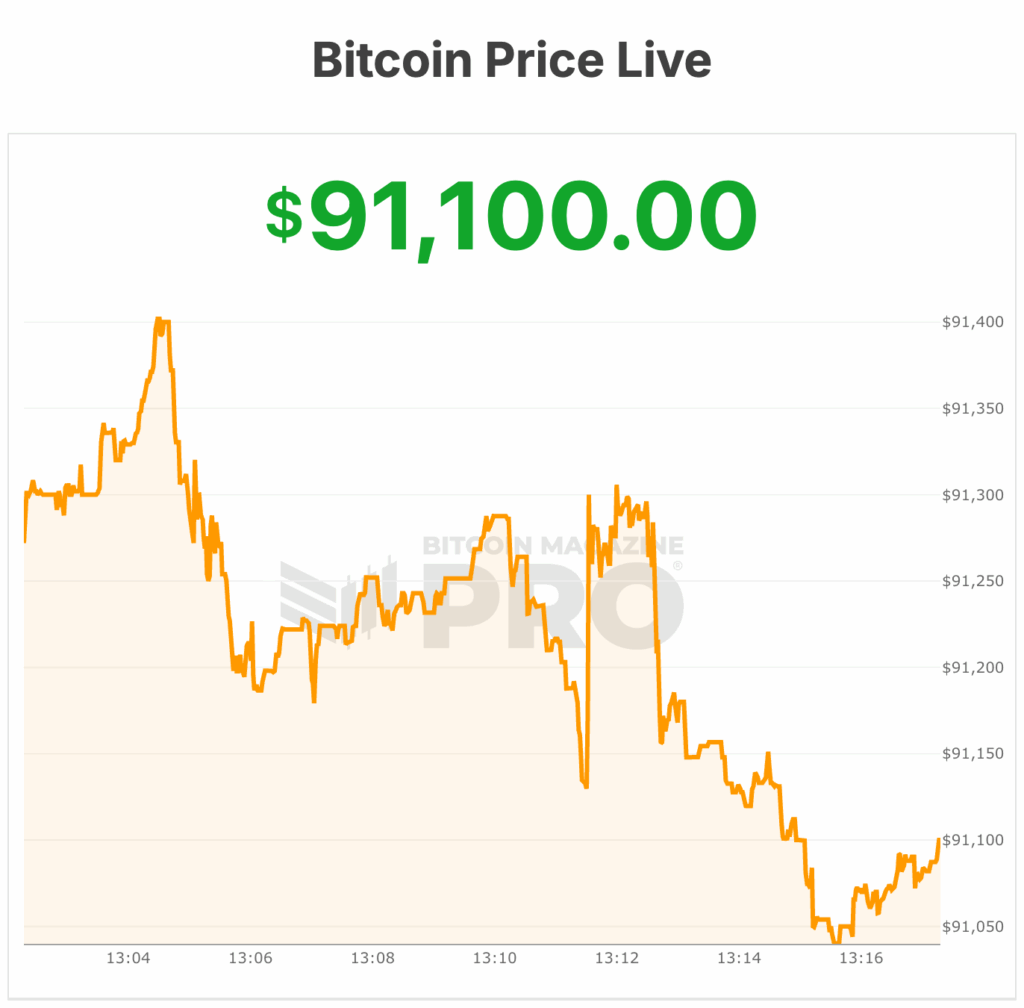
At the time of writing, Bitcoin is near $91,000.

bitcoin

This post Bitcoin Could Hit $2.9 Million by 2050, VanEck Says first appeared on Bitcoin Magazine and is written by Micah Zimmerman.

Despite a Volatile December For Bitcoin, Bullish Signals Are Emerging: VanEck

Bitcoin Magazine

Despite a Volatile December For Bitcoin, Bullish Signals Are Emerging: VanEck

It’s been a turbulent and volatile fourth quarter for Bitcoin in 2025. BTC has endured a turbulent December, with prices dropping nearly 9% and volatility spiking to levels not seen since April 2025.

In its latest mid-December “ChainCheck” report, VanEck’s digital asset analysts painted a nuanced picture: while on-chain activity remains weak, liquidity conditions are improving, and speculative leverage appears to be resetting, offering cautious optimism for long-term holders.

The firm highlighted the contrasting behaviors between different investor groups. Digital Asset Treasuries (DATs) have been actively buying the dip, accumulating 42,000 BTC — their largest addition since July — bringing aggregate holdings above one million BTC. 

This contrasts with Bitcoin exchange-traded product (ETP) investors, who have reduced exposure, underscoring a shift toward corporate accumulation over retail-led speculation. 

Analysts at VanEck noted that some DATs are exploring alternative financing methods, including issuing preferred shares rather than common stock, to fund purchases and operations, reflecting a more strategic, long-term approach.

Onchain data also revealed a divergence between medium- and long-term holders. Tokens held for one to five years have seen significant movement, suggesting profit-taking or portfolio rotation, while coins held for more than five years remain largely untouched. 

VanEck interprets this as a signal that cyclical or shorter-term participants are offloading assets, whereas the oldest cohorts maintain conviction in Bitcoin’s future.

Bitcoin miners are facing a falling hashrate

Miners, meanwhile, have faced a particularly challenging environment. Network hash rates fell 4% in December, says VanEck — the sharpest decline since April 2024 — as high-capacity operations in regions such as Xinjiang reduced output amid regulatory pressures. Breakeven electricity costs for major mining rigs have also dropped, reflecting tighter profit margins. 

Historically, however, VanEck notes that falling hash rates can serve as a bullish contrarian indicator: periods of declining network power have often preceded positive 90- to 180-day forward returns.

The VanEck team frames its analysis within the GEO (Global Liquidity, Ecosystem Leverage, Onchain Activity) framework, designed to assess Bitcoin’s structural health beyond daily price fluctuations. 

Under this lens, improving liquidity and the accumulation by DATs provide a counterweight to softer on-chain metrics, including stagnating new addresses and declining transaction fees.

Broader macro trends add complexity to Bitcoin’s outlook. The U.S. dollar has weakened to near three-month lows, rallying precious metals, but Bitcoin and other crypto assets have remained under pressure. 

In parallel, the evolving financial ecosystem may offer new support. Market observers point to the rise of “everything exchanges,” platforms aiming to integrate stocks, crypto, and prediction markets, leveraging AI-driven trading and settlement systems. 

Just last week, Coinbase made an ‘everything exchange’ like move and launched an expansion of its platform, introducing stock trading, prediction markets, futures, and other features. Companies entering this space — ranging from traditional brokerages to crypto-native firms — are vying for market share, potentially increasing Bitcoin’s liquidity and utility over time, VanEck says. 

Bitcoin price volatility 

Despite this, volatility remains a defining feature. While Bitcoin has doubled in value over the past two years and nearly tripled over three, the absence of extreme blow-off tops or drawdowns has tempered expectations. Future bitcoin moves may be more measured, with midterm investors likely to see smaller cyclical peaks and troughs rather than the dramatic swings of prior cycles.

VanEck said the broader market is in correction. Short- to medium-term speculative activity is retreating, long-term holders are holding steady, and institutional accumulation is rising. Coupled with signs of miner capitulation, subdued volatility, and macroeconomic dynamics, the firm frames the current environment as one of structural recalibration. 

As 2025 draws to a close, Bitcoin may be in a period of consolidation that reflects broader market maturation, VanEck said. This may result in some strong positive price moves in the first quarter of next year.

bitcoin

This post Despite a Volatile December For Bitcoin, Bullish Signals Are Emerging: VanEck first appeared on Bitcoin Magazine and is written by Micah Zimmerman.

❌