Reading view

There are new articles available, click to refresh the page.

Can Bitcoin Revisit $97,600? Glassnode Says Watch This

Bitcoin’s push to $97,600 last week drew a burst of bullish options activity, but Glassnode argues the derivatives tape looked more like short-dated positioning than broad-based conviction. In a Jan. 23 thread, the on-chain analytics firm pointed to a split between front-end call demand and longer-dated risk pricing that stayed anchored in downside protection.

“Let’s deep dive into options market behavior during last week’s move to 97.6K, and how options metrics help gauge conviction behind the move,” Glassnode wrote. The core takeaway: upside flow showed up, but it didn’t meaningfully change how the market priced risk further out the curve.

What Bitcoin Traders Can Learn From Last Week’s Rally

Glassnode first focused on near-term skew. Around mid-January, BTC rose roughly 8% over a few days, and the 1-week 25-delta skew moved sharply toward neutral from “deep put territory.” That kind of front-end shift can look like a market flipping bullish—until you check whether the same repricing is happening in longer expiries.

“Careful though,” Glassnode warned. “Near-dated call demand is often misread as directional conviction.” The thread paired that point with flow data: the options volume put/call ratio dropped from 1 to 0.4, signaling a surge in call activity. But, as Glassnode framed it, the question is not whether calls were bought, but how short-dated that demand actually was.

The longer-dated picture was notably less enthusiastic. Glassnode said the 1-month 25-delta skew “only moved from 7% to 4% at the low,” staying in put asymmetry even as the 1-week skew fell from 8% to 1%. On the 3-month 25-delta skew, the shift was even smaller (less than 1.5%) and it “stayed firmly in put territory,” continuing to price asymmetric downside.

For Glassnode, that divergence matters because it separates “flow” from “risk pricing.” Upside participation can be real, but if the market does not reprice skew across maturities, it suggests traders are not extending that optimism into a higher-conviction, longer-horizon view.

The volatility tape reinforced the same message. “Layering in ATM implied volatility, we see vol being sold as price moved higher,” Glassnode wrote. “Gamma sellers monetized the rally. This is not the volatility behavior typically associated with sustained breakouts.”

That combination: front-end call demand alongside vol supply can align with tactical positioning rather than a regime change. It can also leave spot moves more vulnerable if follow-through buying does not materialize once short-dated structures roll off.

Glassnode closed with a checklist for what a cleaner breakout would look like: “An ideal breakout setup combines spot pressing key levels, skew pointing higher with conviction across maturities, and volatility being bid. Last week’s move didn’t meet those conditions.”

For traders watching whether BTC can revisit $97,600, the thread’s implication is straightforward: monitor whether longer-dated skew begins to lift out of put territory and whether implied volatility starts to get bid, not sold, as spot tests key levels again.

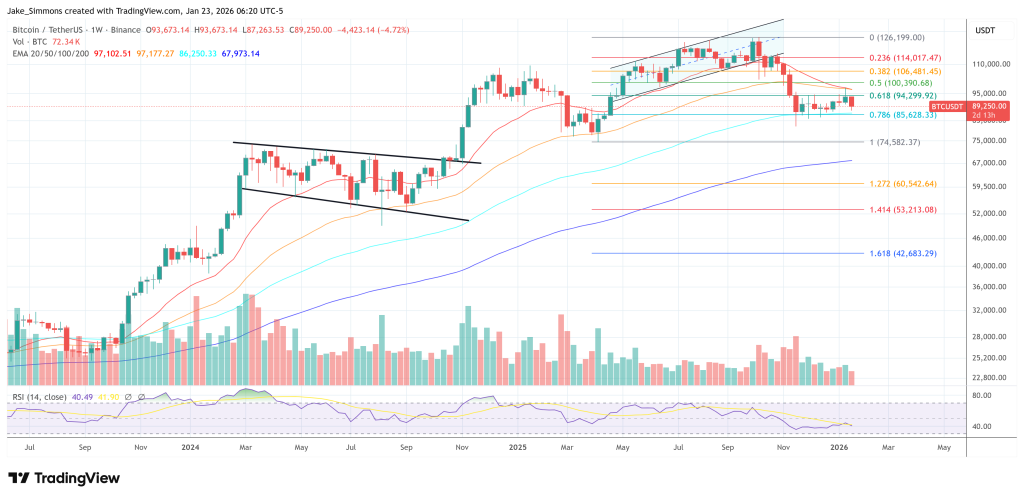
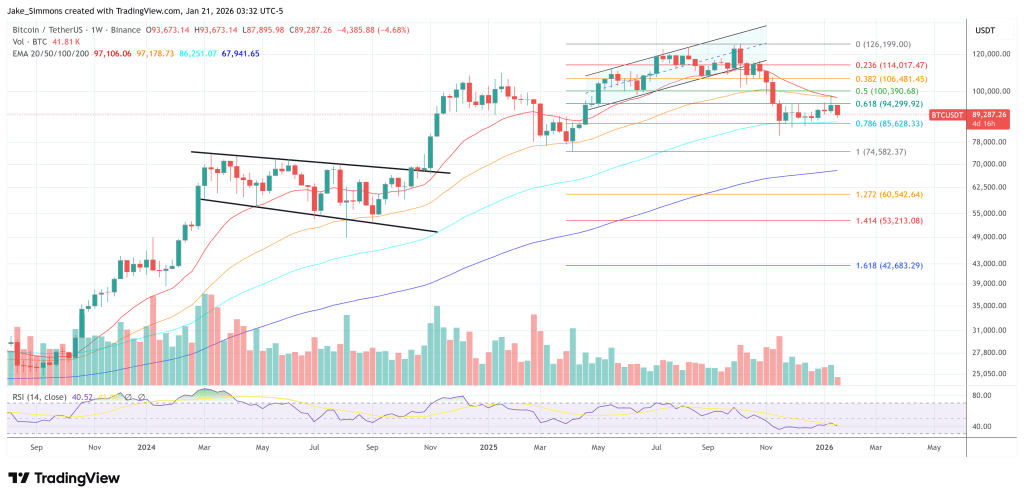
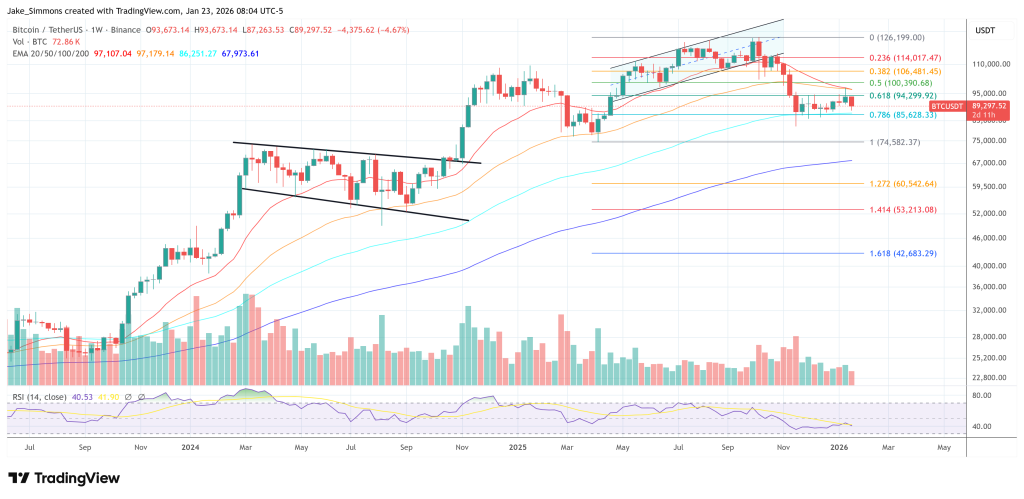
At press time, BTC traded at $89,297.
Bitcoin price chart

Strategy Is Becoming Bitcoin’s Central Bank Proxy, Says Michael Saylor

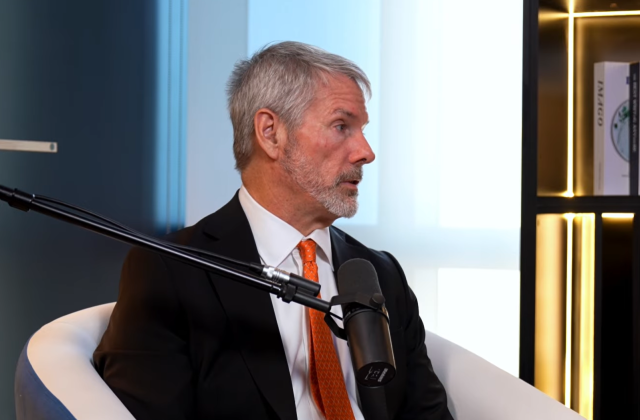
Michael Saylor says Strategy’s evolving capital-markets machine is starting to resemble a “central bank of Bitcoin,” positioning the company as a conduit between traditional money markets and the Bitcoin network. In an interview with Gatecast, the Strategy executive chairman argued the firm’s shift toward perpetual preferred equity and “digital credit” instruments is designed to fund continuous bitcoin accumulation while stripping out refinancing risk.

Saylor traced the company’s pivot to the COVID-era shock of 2020, when “the physical economy of the world came to a grinding halt and the financial system was turned upside down.” Facing what he framed as an existential decision, he said Strategy discovered Bitcoin during “the war on COVID and the war on currency,” and used it to “escape a pretty miserable existence and turned into something digital and modern and much better.”

Strategy Is Building A ‘Central Bank of Bitcoin’

That transformation now sits on a scale Saylor claims is often misunderstood. Addressing criticism that Strategy is simply levering up to buy more Bitcoin, he said the firm has raised roughly $44 billion over the past year and a half and characterized “most of that” as equity rather than debt. “There isn’t really leverage,” Saylor said. “Equity is capital that you have forever. We’re funneling that capital into the crypto economy. We’re buying Bitcoin.” He added that Strategy has acquired “about $48 billion worth of Bitcoin” across “like 88 different transactions,” purchasing “as soon as we raise the capital.”

When asked whether Strategy is still just a buyer or something closer to a “shadow central bank of Bitcoin” given its holdings, Saylor leaned into the analogy. “Bitcoin is digital capital. It is the world reserve capital network. It’s replaced gold as the global non-sovereign store of value for the human race,” he said. Then came the framing: “Banks normally buy credit. We actually sell credit. So what we’re doing is the reverse of commercial banking, retail banking. It is sort of like central banking. We are sort of like the central bank of Bitcoin.”

Saylor’s “central bank” claim hinges on a product stack meant to translate Bitcoin’s balance-sheet asset into yield-bearing instruments for investors who won’t hold BTC directly. He described STRC as “a currency that’s pegged to the dollar” and “backed […] with Bitcoin,” with proceeds recycled into BTC purchases. In his telling, that mechanism links “the Bitcoin economy” to “the traditional finance economy and to the money markets of the world.”

Michael Saylor: “We are sort of like the central bank of Bitcoin.” pic.twitter.com/IyZ9EHLAQn

— TFTC (@TFTC21) January 22, 2026

The more material shift, he argued, is Strategy’s progression away from maturity-driven debt toward perpetual structures. Saylor laid out a four-stage evolution: initial use of credit and leverage, a senior note secured by BTC collateral that the company later refinanced and vowed not to repeat, then non-recourse convertible bonds, an approach he said became constrained by market size and retail inaccessibility and finally “digital credit,” which he described as “an equity […]a perpetual preferred equity.”

In one of his clearest statements of intent, Saylor said Strategy’s priority is to prevent principal from ever coming due. “We don’t want to have leverage. We want to have amplification via equity. We never want the principal to come due. We’d rather pay a higher dividend forever,” he said. “I’d rather pay 10% forever than pay 5% for 5 years.” Strategy, he added, has “announced a $1.44 billion cash reserve for the dividends,” giving it “the option to not raise any capital in the capital markets for up to two years,” and in his view “effectively stripped the credit risk off of the business.”

Saylor also pitched liquidity as a differentiator. He said Strategy has raised $7 billion over the last nine months via these instruments and described an emerging market of about $8 billion outstanding. Where preferred stocks typically trade thinly, he argued Strategy’s “digital credit instruments were trading 30 million a day,” with “Stretch […] more than a hundred million a day,” which he framed as a step-change in market access.

The firm’s investor pitch, as Saylor described it, splits the world into capital and credit buyers. “Bitcoin is digital capital. The world will be built on digital capital. But the world will run on digital credit,” he said, arguing that products like Stretch can offer a money-market-like alternative “powered by digital capital” while sidestepping Bitcoin’s volatility.

At press time, BTC traded at $89,250.

Bitcoin price chart

Dogecoin Is A ‘Client-Statement Risk’ For Advisers, ETF Experts Say

Dogecoin’s attempt to join the institutional ETF lineup is running into a basic problem: institutions may not want it. In a Jan. 22 conversation on the Crypto Prime podcast, Bloomberg Intelligence ETF analyst James Seyffart and host Nate Geraci who is also the President of NovaDius Wealth Management said spot Dogecoin ETFs have attracted “near zero” demand so far, an outcome they tied to who typically buys DOGE, and how financial advisers think about reputational risk inside client portfolios.

The Dogecoin datapoint landed inside a broader discussion about a crowded crypto ETF pipeline. Seyffart said his running tally of crypto ETF filings has climbed “over 150 unquestionably,” with many products spanning spot and derivatives, income overlays, buffers, and multi-asset structures. The surge, he argued, looks like issuers “throw[ing] the spaghetti at the wall” in 2026.

Dogecoin ETF Reality Check

But volume of filings doesn’t guarantee demand, and Dogecoin is the clearest example offered of that gap thus far. Pressed on which existing products stood out, Seyffart said “nothing really stands out,” before singling out Dogecoin as the exception, precisely because it has not resonated.

“The real honest answer is like nothing really stands out to me […] honestly if I have to pick one thing that kind of stands out, it’s probably that the Doge ETFs have gotten almost no interest whatsoever,” he said. He added that while some newer altcoin products have done “decently well,” Dogecoin has not.

My conversation w/ @JSeyff on current state of crypto ETFs…

We discuss: -Crypto ETF sentiment -150+ crypto-related ETF filings -Morgan Stanley crypto ETFs -BlackRock’s next move -Index & active crypto ETFs -Recent flows -What’s nexthttps://t.co/2TzJAnKXuK

via @CryptoPrimePod pic.twitter.com/mtDuuDirB7

— Nate Geraci (@NateGeraci) January 22, 2026

Seyffart and Geraci converged on a demand thesis: the marginal buyer of DOGE likely already has the tooling and habit set to buy it directly, rather than through an ETF wrapper.

“I remember talking to the guys at Bitwise. I was like, I don’t think anyone’s going to buy this,” Seyffart said. “But maybe I’m wrong. I’ve been wrong plenty of times before. But I mean, literally no one has bought like the Doge ETFs […] I had pretty low expectations, but I thought maybe they could get to a point where they’re slightly profitable.”

Seyffart pointed to Bitwise’s product—ticker BWOW—as an early scoreboard: “it’s under a million in assets right now,” he said, calling that “near zero demand.” He cautioned the funds are still new, noting the Bitwise product launched at the end of November, but framed the initial traction as “very minuscule.”

Geraci’s explanation was blunter: ”The people who buy that, in general, these are degens and they already know how to access this. They already have digital wallets. They don’t need an ETF to access this […]. And I think that’s going to be a lot of these other coins that are much further down the market cap spectrum.”

Geraci argued Dogecoin faces an additional headwind that doesn’t show up in crypto-native narratives but matters in the ETF market: advisers.

“The other aspect here […] is what I call client statement risk,” Geraci said. “So financial advisors, they’re the biggest driver of ETF flows. And so let’s take Dogecoin as an example […] If you’re a financial adviser and you have a Dogecoin ETF show up on a client statement […] it’s like a flashing red light saying, ‘Please fire me and go find another adviser.’”

That framing matters because the episode repeatedly returned to distribution realities. Seyffart said he’s most excited about basket and index-style crypto ETFs, in part because advisers don’t want to “pick those winners and losers” across a growing long tail of assets. In Geraci’s view, a basket is the “easy button” for professional allocators who want crypto exposure without underwriting each token’s story or defending it to clients.

Seyffart also suggested “what the actual chain is doing” can shape adviser appetite, contrasting niche infrastructure plays such as Chainlink, which he described as connecting DeFi and TradFi, against meme assets like DOGE, which he implied may be less “appetizing” for ETF buyers.

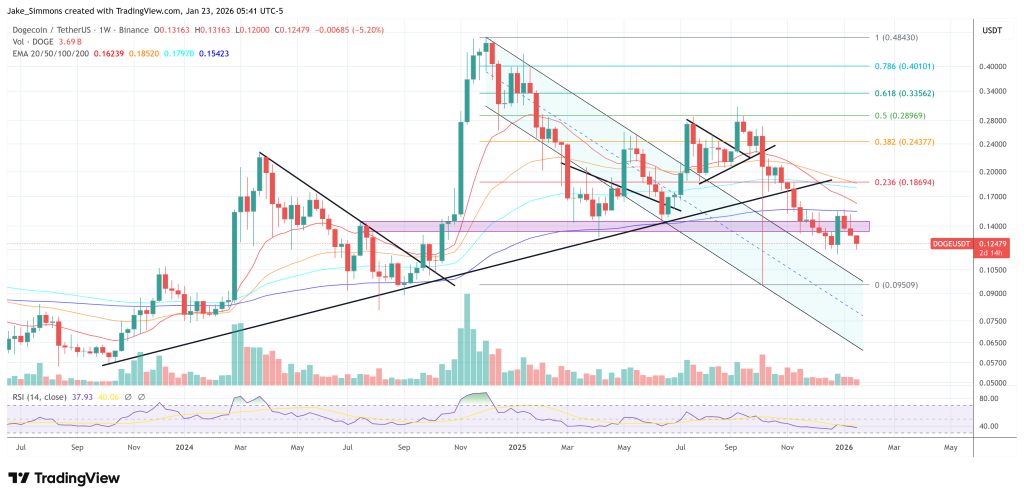
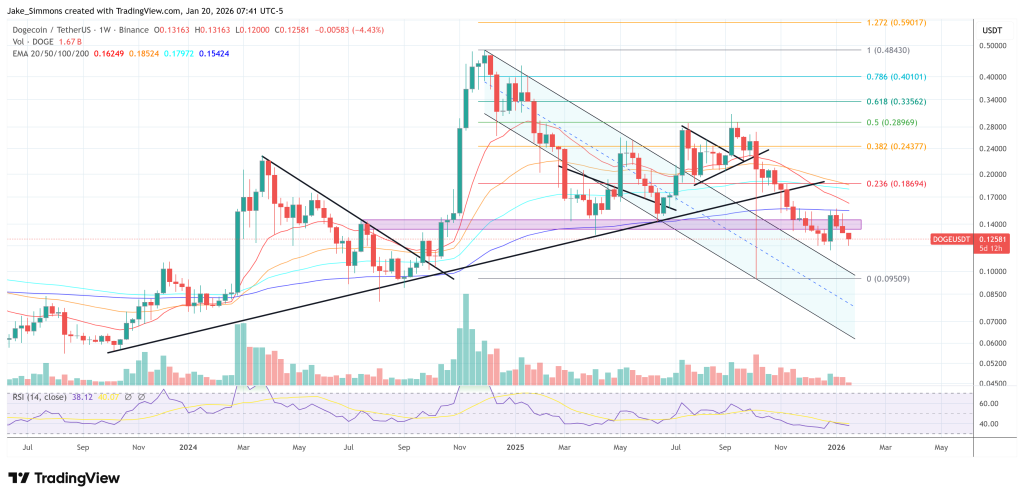
At press time, DOGE traded at $0.12479.

Dogecoin price chart

Cardano Founder Hoskinson Plots Japan Tour, Teases New Deals

Cardano founder Charles Hoskinson said he will fly to Japan this week for a multi-city community tour focused on Midnight, the privacy-focused network being developed in Cardano’s orbit, while hinting that new “commercially critical integrations” and major launch partners are nearing the finish line.

In a Jan. 22 video recorded from Colorado, Hoskinson framed the trip as both a reconnection with what he called Cardano’s “most critical component” and a staging ground for the next execution phase he wants the ecosystem to pursue: making leading applications meaningfully more competitive by combining Cardano and Midnight capabilities.

Midnight, Privacy, And A Cardano DeFi Push

Hoskinson said the tour will span Sapporo, Osaka, Fukuoka, Naha, and Tokyo, covering “the entire Japanese archipelago” over roughly two weeks. He described the agenda as part Midnight introduction, part Cardano status update, and part technical pitch for what builders can do when the two stacks interoperate.

“As many of you know, Japan is why Cardano exists. There would be no Cardano if there was no Charles and there would be no Cardano if there was no Japan,” Hoskinson said. “I went to Japan in 2015 and with our partners from Emurgo amongst others we were able to go about all of Japan and convinced them that Cardano needs to exist. So they put up the money we built it and the Japanese community still is the largest and strongest Cardano community in the entire world with more than half the supply there.”

That legacy, in Hoskinson’s telling, makes Japan a natural first stop for positioning Midnight not as a side project but as a strategic lever for Cardano adoption.

Hoskinson said that “about [the] middle part of this year” he intends to “aggressively push for the top 15 Cardano dapps to go through a overhaul and get some additional resources.” His stated goal is not incremental polish, but step-function improvements in usage and distribution.

“In my view the best place to take it is to focus on the DeFi ecosystem and the Cardano dapp ecosystem and ask the question how do we make those Cardano dapps more competitive? How do we 10x their TVL and their transactions?” he said. “Get them listed on major exchanges and get them where they need to go.”

The connective tissue, he argued, is Midnight’s privacy mandate, paired with new infrastructure components he referenced, including “new bridges,” “new stablecoins,” and “new oracles.” The pitch is that dapps cannot win on throughput and fees alone; they need new product surfaces that attract users and transactions from other ecosystems.

“My view is Midnight is going to be an indispensable component in that because it’s not good enough just to make them better, faster, and cheaper,” Hoskinson said. “The dapps have to offer new things and being able to combine Cardano technology and Midnight technology together. What that means is that we can actually offer privacy to the masses to Solana, to Ethereum, to Bitcoin and other places.”

Hoskinson also linked the push to Cardano’s broader engineering roadmap, citing Hydra progress while using a roads-and-traffic analogy to argue that application demand, not base-layer capability, needs to be the next constraint to break.

Japan Tour https://t.co/MTq8Trp0UP

— Charles Hoskinson (@IOHK_Charles) January 22, 2026

After Tokyo, Hoskinson said he will head to Hong Kong for Consensus, where he plans to keynote and “have some cool announcements for Midnight along with some big big partners” tied to the network’s mainnet launch. He stressed he would not disclose counterparties until agreements are finalized, saying he expects people to be “very happy” with upcoming “commercially critical integrations.”

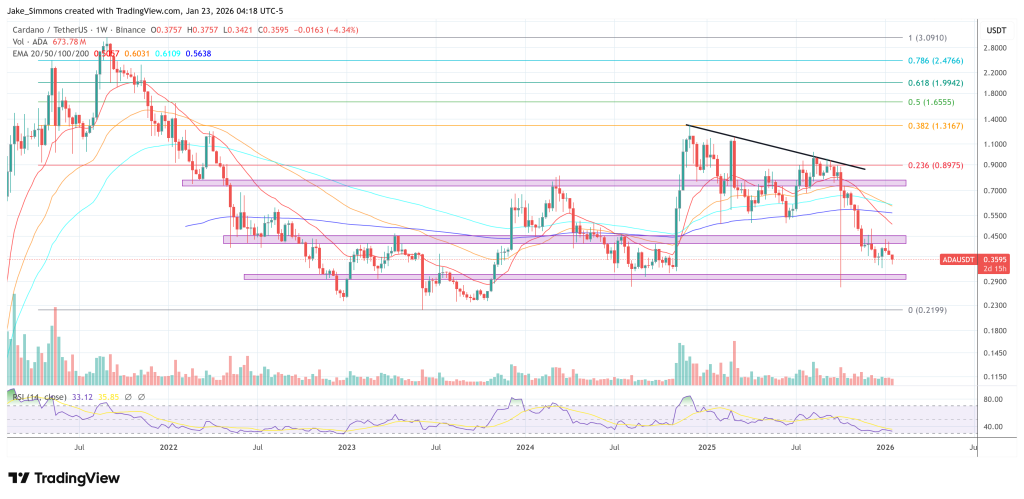
At press time, ADA traded at $0.3595.

Cardano price chart

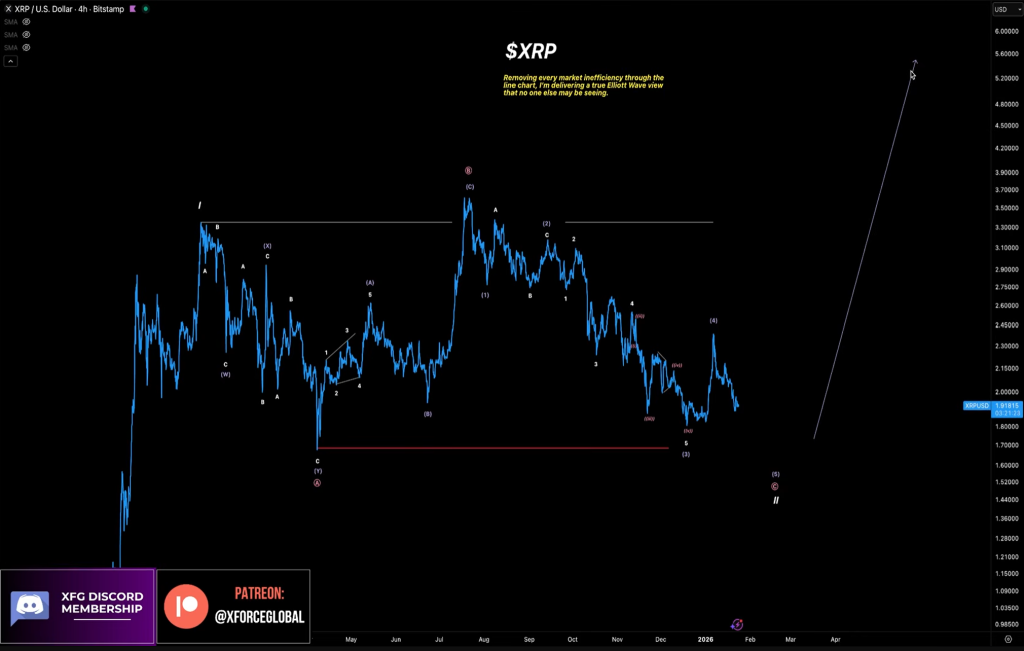
XRP Targets $6–$14 After Final Shakeout: Certified Elliott Wave Analyst

Certified Elliott Wave analyst XForceGlobal (@XForceGlobal) told followers on X that “$5+ remains on the horizon,” arguing that the token’s past year of range-bound trading is validating an Elliott Wave “flat” correction that typically resolves with a sharp, final move before a continuation higher.

In a 10-minute video shared alongside the post, the analyst framed XRP’s recent price action as the late stage of a flat pattern, an extended period where neither bulls nor bears can force a clean trend. “A flat occurs when the market fails to trend on both sides. They’re basically evenly matched,” he said. “And that’s not a sign of weakness, it’s a sign of balance.”

XRP Traders ‘Exhausted’ As Breakout Nears

XForceGlobal positioned the structure as a corrective phase within a larger bullish sequence, describing the market as forming a new floor rather than breaking down. “This is where the buyers and sellers enter a Mexican standoff with each other, creating a new price floor,” he said, adding that the sideways feel is the point: “They’re not designed to go anywhere, basically. And the markets naturally alternate between expansion and compression.”

The analyst emphasized the psychological aspect of prolonged consolidation, arguing that flats tend to “eliminate even the leverage traders through time rather than price” by exhausting both sides. “By the time the flat actually resolves, which is very close, in my opinion, most traders are emotionally already exhausted,” he said. “Positioning has been pretty much neutralized, and the path for continuation, to me, becomes very clear.”

XRP Elliott Wave analysis

In Elliott Wave terms, XForceGlobal described the flat as a three-part A-B-C structure, with waves A and B unfolding as corrective “three-wave” moves and wave C completing as an impulsive “five-wave” move. He argued that this final phase is the moment the market stops drifting and forces a resolution.

“Wave C must be impulsive because it represents the resolution of the balance that we have for waves A and B,” he said. “It’s not the continuation of a larger structure to the downside.” He framed impulsiveness as behavioral rather than directional, attributing it to urgency and follow-through once one side “decisively gives up,” clearing out the range that built during the earlier legs.

That distinction matters for positioning, because his base case anticipates one more decisive shakeout before a move higher. He said the market is currently in an “expanded flat” configuration where wave B pushed above the prior high, and he expects a break of local structure “once” before the market turns up. He highlighted $1.70 as a prior low that could be undercut as part of the process without invalidating the larger setup, so long as broader support holds.

XForceGlobal’s post leaned heavily on conviction built over time—“I didn’t spend 2,000+ days accumulating XRP for no reason!”—while also stressing that he has already taken some profit. In the transcript, he said he “personally took some profits around the $2.70 level” and would continue to “sell into strength.”

On upside expectations, he called for higher levels “in this current cycle,” tying potential targets to the duration of the consolidation. “The longer that we distribute here, the higher the targets are going to be,” he said, adding that “a minimum of a $6 range all the way up to even the $14 range is my personal target.”

He also flagged conditions that would change the trade management. If the market shows “red flags” and breaks further structure than he expects, he suggested that is where risk management should take priority.

For XRP traders, the practical takeaway from his framework is timing and path, not direction: a final, forceful leg lower could still be consistent with a bullish continuation thesis while a deeper structural breakdown would challenge it.

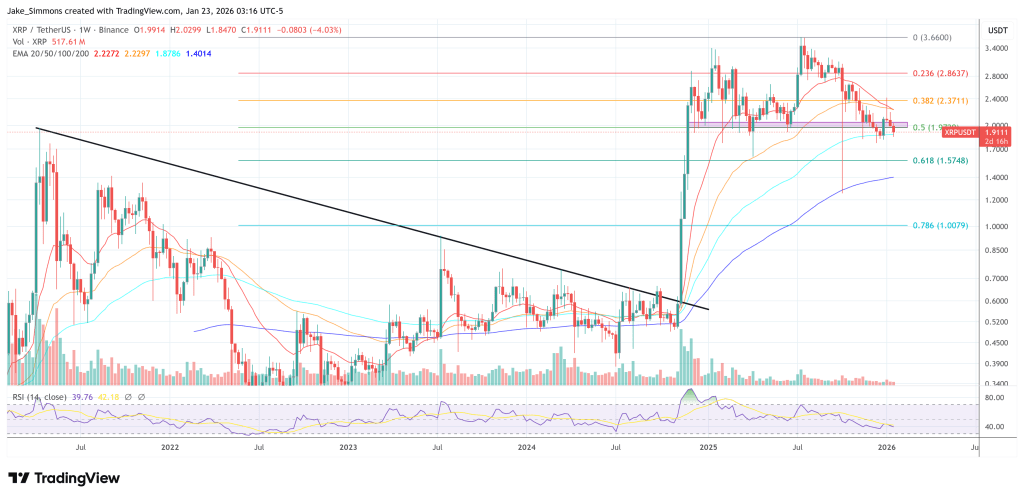
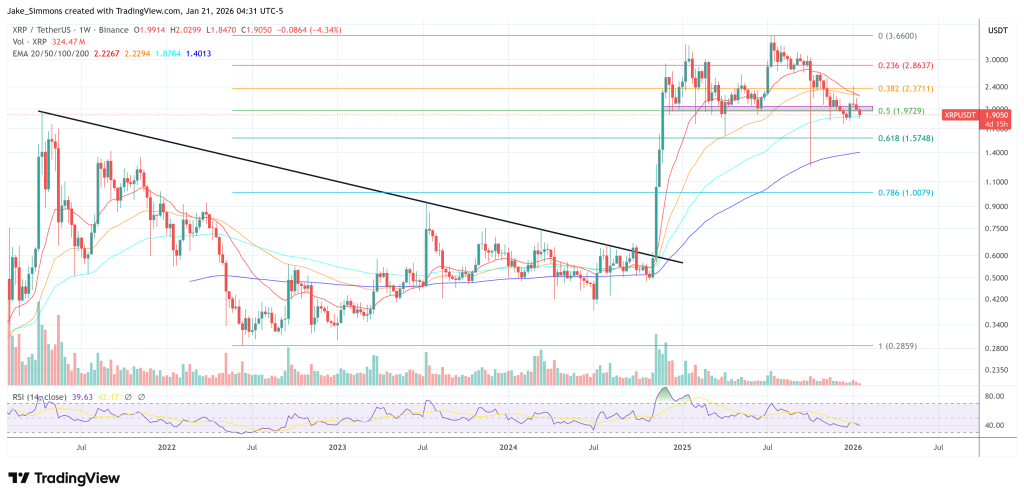
At press time, XRP traded at $1.91.

XRP price analysis

Qubic Says Dogecoin Mining Build Is Underway, Revives 51% Attack Fears

Qubic says it is now building a Dogecoin mining integration, a step that moves the project’s post-Monero “attention” narrative into an implementation phase and reopens a familiar set of security questions around majority-hashrate risk.

In an X post shared Thursday, Qubic wrote: “The community didn’t hesitate. The vote was decisive: DOGE won with 301 votes. This isn’t a plug-and-play upgrade. Integrating ASIC hardware into uPoW requires real engineering, deep protocol work, and time to do it right. But the upside is significant. DOGE represents one of the largest and most established mining economies in crypto. Bringing it into Qubic’s useful Proof-of-Work model extends uPoW beyond theory, into scale. […] Development is underway. This is just the beginning of what is to come.”

Dogecoin mining integration is actively in development.

The community didn’t hesitate. The vote was decisive: #DOGE won with 301 votes.

This isn’t a plug-and-play upgrade.

Integrating ASIC hardware into uPoW requires real engineering, deep protocol work, and time to do it… pic.twitter.com/7aBgxfLdDR

— Qubic (@_Qubic_) January 22, 2026

Could Dogecoin Suffer A 51% Attack?

The announcement lands with baggage. In August 2025, Qubic ran what it publicly described as a Monero “takeover demonstration,” claiming it had achieved “over 51% hashrate dominance” during parts of the experiment and reporting a brief chain disruption that included a six-block reorganization and orphaned blocks. That episode became a lightning rod for the broader PoW security debate: how quickly external incentives can concentrate hashpower, and how markets react when “51%” enters the conversation.

Subsequent research challenged the strongest interpretation of those claims. A December 2025 paper reconstructing Qubic-attributed activity on Monero describes the operation as an advertised “selfish mining campaign,” finding Qubic’s hashrate share rising into the 23–34% range in detected intervals, while “sustained 51% control is never observed.”

Dogecoin’s mining economy is structurally unlike Monero’s CPU-oriented RandomX landscape. Dogecoin uses Scrypt and has, since 2014, supported merged mining alongside Litecoin, an architecture that has historically helped bolster its security budget by tapping into a broader Scrypt ASIC miner base.

That hardware reality is central to Qubic’s own messaging. The project said “integrating ASIC hardware into uPoW requires real engineering, deep protocol work, and time to do it right,” explicitly acknowledging that this is not a simple pool launch.

It is also where most of the immediate 51% attack fears run into friction. In an August 2025 research note, published when Qubic first began floating Dogecoin as the “next” network after Monero, 21Shares argued that a brute-force Dogecoin majority would be economically prohibitive, estimating that Qubic would need to match and then exceed roughly 2.78 PH/s, implying about $2.85 billion in hardware plus roughly $2.5 million per day in electricity (before logistics).

The more plausible risk vector, if any, is not Qubic buying its way to majority hashrate, but whether it can engineer incentives and integrations that convince existing Scrypt ASIC operators to route meaningful hashpower through a Qubic-mediated setup, an approach 21Shares characterized as “vampire mining.”

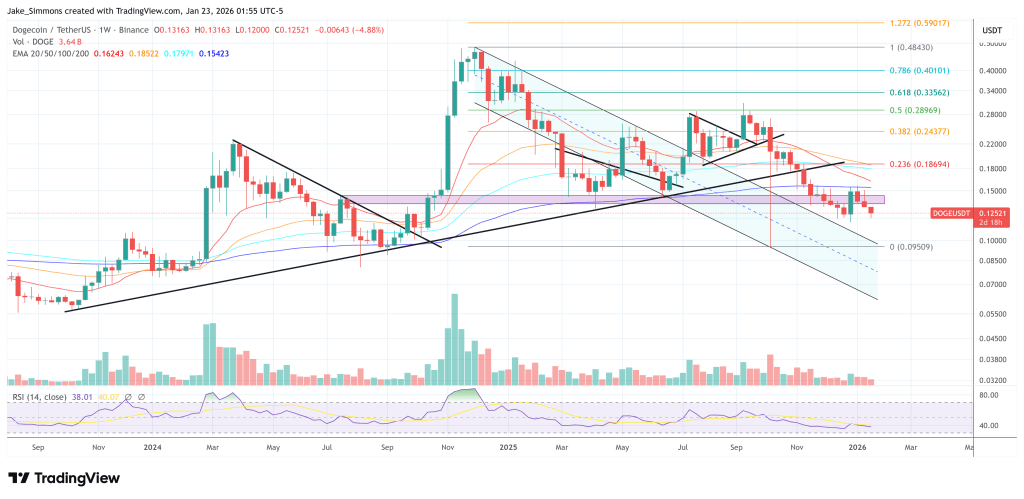
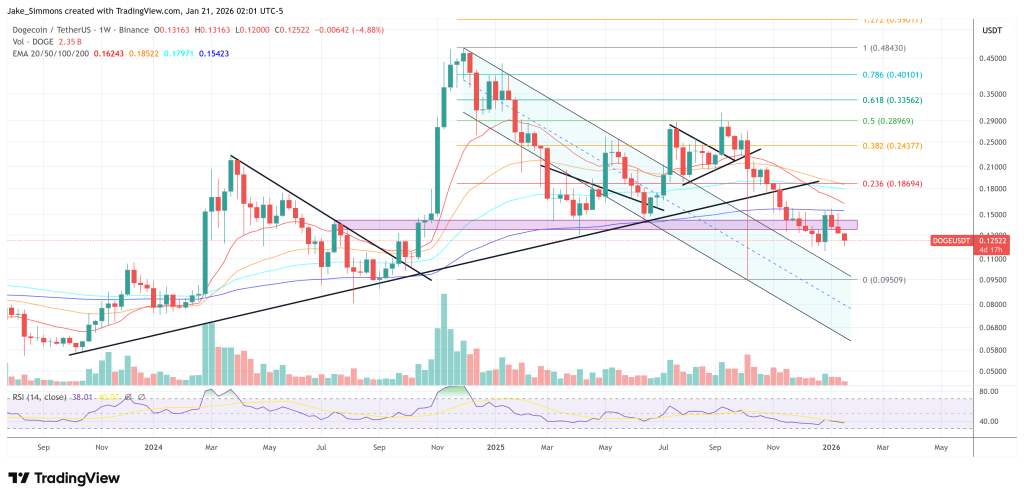
At press time, DOGE traded at $0.12521.

Dogecoin price chart

Bitwise Says Crypto Has Likely Bottomed, Echoing Q1 2023 Setup

Bitwise Asset Management is arguing that crypto’s current drawdown has the fingerprints of a cyclical low: weak prices alongside strengthening on-chain and business fundamentals, a pattern the firm says last appeared in Q1 2023 before a multi-year rally.

In its Q4 2025 “Crypto Market Review,” Bitwise Chief Investment Officer Matt Hougan frames the quarter as an unusually important inflection point precisely because the signals are not all moving in the same direction. “But sometimes—every once in a while—the charts are mixed,” Hougan wrote. “The last one I remember was Q1 2023. At the time, we were starting to rebound post-FTX, and the data was topsy-turvy; some up, some down, some sideways. In the two years that followed, crypto prices soared.”

Bitwise’s core claim rests on a divergence between market performance and usage metrics in Q4. The firm notes that Ethereum fell 29% over the quarter, even as Ethereum and Layer 2 transactions “soared to new all-time highs (up 24.5%).” Crypto equities also sold off, down 20% in Q4 by Bitwise’s measure while the underlying companies’ revenues were “on pace to grow 3x faster than any other sector of the stock market,” according to the report.

The price tape was undeniably heavy. The Bitwise 10 Large Cap Crypto Index fell 26.29% in Q4 and finished 2025 down 10.64% year-to-date; Bitcoin was down 23.48% in Q4 (down 6.26% in 2025), while Ethereum fell 28.59% in Q4 (down 11.03% in 2025).

Yet the report also shows the market retaining scale: total crypto market capitalization stood at roughly $2.78 trillion as of Dec. 31, with bitcoin representing 63.6% and ether about 12.9%.

Where Bitwise sees “green shoots” is in rails and revenue. The executive summary argues that “both stablecoin AUM and stablecoin transaction activity soared to new all-time highs,” presenting that as evidence a durable adoption wave is underway.

Four Crypto Catalysts Bitwise Is Watching In 2026

Bitwise argues the market’s next leg will be shaped less by narrative rotation and more by identifiable catalysts, starting with US market-structure legislation. “All eyes are on the CLARITY Act,” the report says, describing it as a Senate-moving bill that could provide a “strong regulatory foundation” but also carries the risk of a weaker outcome or no bill at all.

The second catalyst is what the firm calls a “stablecoin supercycle,” positioning stablecoins as payment infrastructure that is increasingly decoupled from directional crypto beta. Bitwise writes that 2025 annual stablecoin transaction volume topped $32 trillion, up 73% year-over-year, “more than doubling Visa’s volume through the first nine months of the year,” and says that data “confirm[s] their arrival in the mainstream.”

The third is macro, specifically the coming change at the Federal Reserve. Bitwise notes Chair Jerome Powell’s “looming departure in May,” giving President Trump an opportunity to appoint new leadership. Between named candidates Kevin Warsh and Kevin Hassett, Bitwise says Hassett is viewed as the more dovish on rates and fiscal policy, adding that a dovish appointment would increase the likelihood of rate cuts and “should drive crypto assets higher.”

The fourth is plumbing: distribution at major US wealth platforms. Bitwise points to “initial wirehouse ETF flows” following Q4 approvals, writing that financial advisors at three of the four major wirehouses gained access to crypto ETFs in Q4 after previously being barred from recommending exposure. Those advisors “control ~$16 trillion in assets,” and Bitwise expects early flows to start slowly in Q1 before accelerating.

Hougan stops short of calling any single variable decisive, but ties the bottom thesis to whether the underlying data keeps improving. He wrote he was drafting the memo on Jan. 16 after crypto had already begun posting strong early-year returns and added: “If the fundamental data in this report stays steady, I think that trend could continue.”

At press time, the total crypto market cap stood at $3.00 trillion.

Total crypto market cap chart

Bitcoin Should Wait On Quantum Fixes, Says Epoch Ventures

Epoch Ventures founder Erik Yakes is urging bitcoin investors and protocol watchers to slow down on quantum “panic” and resist premature upgrades, arguing that the practical threat to Bitcoin’s cryptography remains unproven and that moving too early could lock the network into inefficient signature schemes for years.

In a section on quantum risk in his 2026 Bitcoin Ecosystem report, Yakes framed the late-2025 flare-up in quantum anxiety as something closer to a behavioral event than a technical one. He wrote that “a focus on quantum computing risks to bitcoin’s underlying cryptography potentially drove an institutional investor sell-off,” and attributed that reaction to “loss aversion, herd mentality, and availability.” The core of his argument is not that quantum computing is irrelevant, but that the market’s implied timeline is being built on expectations rather than observable progress.

At the center of the debate is “Neven’s law,” the idea that quantum computational power grows at a doubly exponential rate relative to classical computing, sometimes translated into a claim that the clock to break Bitcoin’s cryptography could be “as short as 5 years.” Yakes pushed back on treating that as an empirical trajectory. He compared it to Moore’s law, but drew a sharp distinction: “Moore’s law was an observation. Neven’s law is not an observation because logical qubits are not increasing at such a rate. Neven’s law is an expectation of experts.”

Yakes’ skepticism is anchored in what he characterizes as the gap between lab metrics and real-world cryptographic capability. “Today, quantum computers have not observably factored a number greater than 15,” he wrote, arguing that the industry has yet to demonstrate the kind of scaling evidence that would make the threat tangible to Bitcoin. Progress, in his view, has been largely confined to “physical (not logical) qubits” and declining error rates, without translating into the logical-qubit reliability needed for meaningful factorization. Rising physical qubits and lower error rates are not increasing logical qubits and factorization,” he said.

He also highlighted a compounding problem that could limit practical breakthroughs even if headline qubit counts climb: “a potentially existential issue for quantum computing is that error rates scale exponentially with the number of qubits.” If that relationship persists, Yakes suggested, quantum systems may not convert theoretical scaling into usable cryptographic attacks. He went further, arguing that in a world where algorithmic improvements and classical hardware continue to advance, “it may even be more likely that classical computers, through Moore’s law and algorithm improvements, break the cryptography used by Bitcoin before quantum computers do.”

Bitcoin Could Pay A High Price If It Rushes Quantum Signatures

Where Yakes becomes most concrete is in describing the trade-offs of “quantum-resistant” mitigation. He doesn’t argue the ecosystem lacks candidate solutions, he argues the network should be careful about choosing the wrong one too early. “Quantum-resistant signature algorithms exist — implementing one of them is not the issue,” he wrote. “The issue is that they’re all too large for Bitcoin and would consume block space, thereby lowering transaction throughput on the network. New signatures emerging today are being tested and are increasingly data-efficient.”

That sizing problem is central to his warning about premature action. In a network where block space is scarce and transaction throughput is a persistent constraint, large signature schemes don’t just change security posture; they reshape the economics of using the chain. Yakes called out what he sees as the “worst-case scenario” for quantum risk planning: not a sudden cryptographic collapse, but a rushed upgrade that hard-codes an avoidable performance penalty.

“The worst-case scenario we see for quantum risk is that a solution is implemented prematurely, with an exponentially lower efficiency trade-off had we waited longer before implementing,” he wrote.

Yakes pointed to existing research and mitigation pathways that could buy time if quantum progress suddenly accelerates. He cited Chaincode Labs’ work recommending “a 2-year contingency plan and a 7-year comprehensive plan,” and described a near-term lever tied to modern Bitcoin script and address design.

“For the short-term contingency plan, we know that taproot address types can make commitments to spend before the public key is revealed — thus hiding the public key from a quantum computer and protecting quantum-vulnerable public keys,” he wrote. “Basically, modern address types have a hidden form of quantum resistance that can be unlocked, and this could be used if quantum factorization suddenly grows exponentially.”

The harder question, in his telling, is governance and coordination. Bitcoin’s bar for consensus is deliberately high, and “achieving bitcoin consensus for improvement proposals is very challenging,” Yakes noted, emphasizing the ecosystem’s history of adopting soft forks. If an existential threat materialized, he expects a broader stakeholder alignment could emerge, yet he still flags the risk that any adopted signature transition “would materially decrease the efficiency of the blockchain,” pointing to ongoing work by “the BIP360 team” on such proposals.

For investors, Yakes’ bottom line is to triage: quantum is worth understanding, but not worth displacing more immediate risks in a “geopolitical environment with monetary commodities and fiat currencies.” “We do not view quantum computing as a primary risk for the reasons above,” he wrote. “If you’re reducing your allocation because of quantum risk, you’re being driven by behavioral bias and failing to see the benefits of a bitcoin allocation on net.”

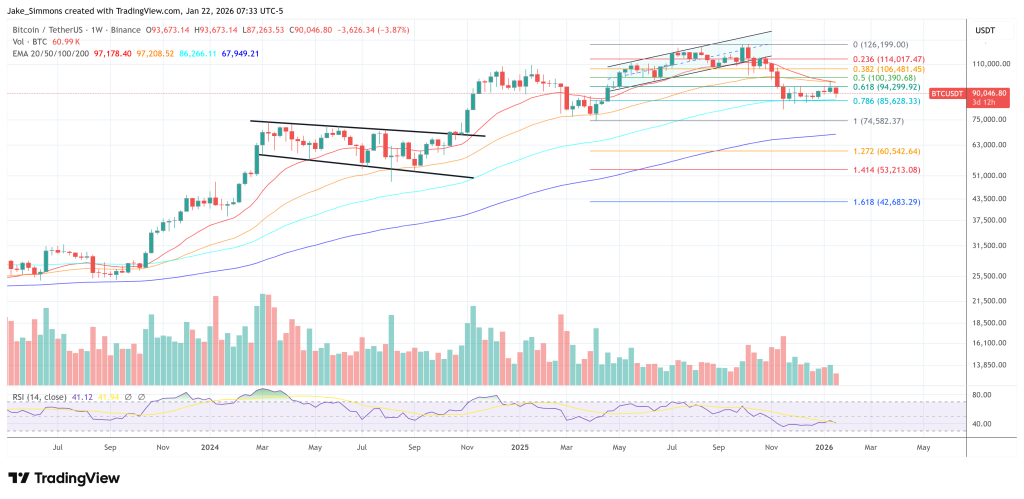
At press time, BTC traded at $90,046.

Bitcoin price chart

This Bitcoin Price Level Must Hold Or It’s Mid-$50,000s: Veteran Analyst

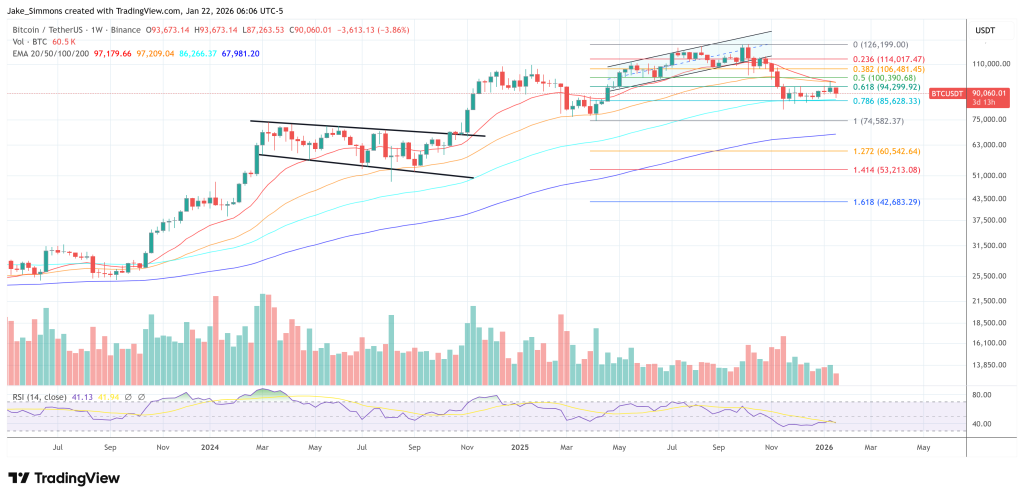
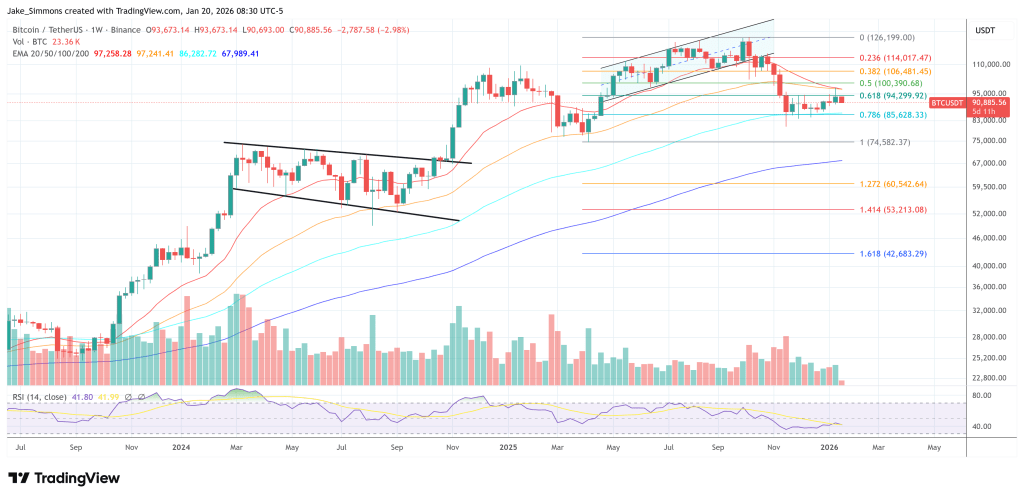
Bitcoin’s April 2025 swing low around $73,000 has become the make-or-break line for 2026, according to veteran professional trader and commentator Nik Patel, who argues that a higher-timeframe break below that level would likely open the door to a prolonged grind in the mid-$50,000s.

In Part Three of his “2026 Outlook” published Jan. 21, Patel laid out a high-conviction call that Bitcoin prints fresh all-time highs in the first half of 2026, framing it as further evidence the market has shifted away from the clean, narrative-driven four-year cycle. “Bitcoin trades new all-time highs in H1 — the 4-year cycle is dead,” he wrote, summarizing his regime view as “higher for longer,” potentially stretching into 2027.

Why Bitcoin Must Hold $73,000 Or Risk A Slide

Patel’s core technical claim is simple: as long as Bitcoin does not close key higher timeframes below the April 2025 low, the broader structure remains intact and the base case is continuation higher. He acknowledged that he expected a sharper reversal earlier: “Timing-wise, I was wrong on my expectations for a more immediate reversal,” but stressed that price has continued to hold above the April lows “despite having every reason to break and close below.”
That resilience, in his view, matters more than moving averages or anchored references. “Since 2022, we have not made fresh lows on a weekly timeframe below the bottoms that preceded the next highs (or, more plainly, weekly structure in the most technical sense has remained bullish with higher-highs and higher-lows),” Patel wrote. “This has not changed and I place less weight on MAs, VWAPs etc. than I do on price itself, and whilst the $73k April lows that preceded the $126k all-time highs are protected, weekly structure is still bullish.”

His forecast leans heavily on a macro and positioning backdrop he describes as inconsistent with a deep-cycle crypto bear market. Patel cited “Goldilocks into reflation,” rising inflation breakevens, falling real rates, midterm dynamics, and bearish sentiment and positioning as part of the setup that makes a 2018- or 2022-style unwind less likely in his framework.

Patel’s downside map is unusually explicit for a discretionary macro-technical thesis. “If I’m wrong — and we close the higher timeframes below $73k — we likely trade mid-$50ks this year, consolidate there for many months and produce no new highs in 2026,” he wrote, outlining a scenario where a structural failure forces a wholesale reassessment.

Bitcoin price analysis

He reiterated that the trigger is not an intraday wick but timeframe closes. In his year-ahead playbook, he described being “invalidated on a weekly close below $73k but with a view to re-entering on an immediate reclaim,” while “fully” cutting exposure if Bitcoin prints a monthly close below $73,000, in which case he would “prepare for mid-$50ks.”

Patel also pushed back on the idea that the drawdown from the highs represents a new, uniquely bearish regime. “Where many view the most recent move off the highs into $80k as a ‘structural shift unlike prior corrections’, I disagree and continue to view this as a ‘higher for longer’ regime within which we have these 30-40% corrections, range-bound price-action chewing through supply and subsequently continue higher,” he wrote.

He added that the correction “felt different” in part because it coincided with what he called “the largest liquidation event in crypto history,” alongside forced selling dynamics and long-term holder supply, yet it has still only produced a drawdown modestly larger than prior pullbacks in the broader uptrend.

Even so, Patel allowed for near-term turbulence. He said there is “a decent chance we sweep the November low in early Q1,” but maintained he “categorically” does not expect a higher-timeframe close below the April lows in the first half of the year. His base case remains new highs in H1 2026—“perhaps in late Q1 but likely in early Q2.”

At press time, BTC traded at $90,060.

Bitcoin price chart

Is It Ethereum? BlackRock CEO Wants ‘One Blockchain’ For Tokenization

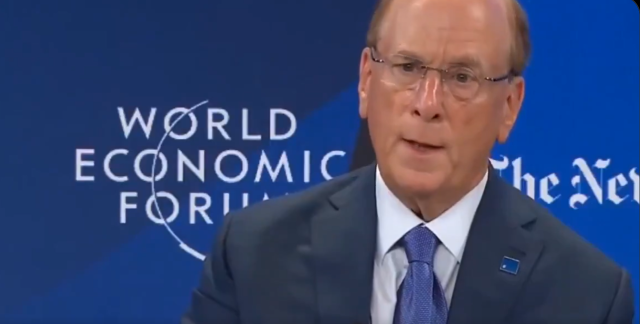
BlackRock CEO Larry Fink used the World Economic Forum stage to argue that tokenization needs to move from pilot programs to market plumbing and suggested that a shared blockchain standard could cut costs and even “reduce corruption,” a framing that immediately reignited the “which chain?” debate across crypto and specifically inside the Ethereum community.

Fink didn’t name a network. But the combination of BlackRock’s onchain product footprint and its own research positioning makes Ethereum the most natural candidate for the “one common blockchain” he alluded to, even if he kept it implicit.

Fink’s remarks, delivered in the language of infrastructure rather than crypto evangelism, leaned heavily on the operational case for digitized assets and interoperable settlement rails.

“I think the movement towards tokenization, decimalization is necessary. It’s ironic that we see two emerging countries leading the world in the tokenization and digitization of their currency, that’s Brazil and India. I think we need to move very rapidly to doing that.”

He then pushed the argument beyond payments and into capital markets: “We would be reducing fees, we would do more democratization by reducing more fees if we had all investments on a tokenized platform that can move from a tokenized money market fund to equities and bonds and back and forth.”

The most provocative line was his call for standardization and the trade-off he implied comes with it. “[If] we have one common blockchain, we could reduce corruption. So I would argue that, yes, we have more dependencies on maybe one blockchain, which we could all talk about, but that being said, the activities are probably processed and more secure than ever before.”

BlackRock CEO Larry Fink told the World Economic Forum he thinks the movement toward tokenization and digitization is necessary. We need to move very rapidly to doing that. With one common blockchain, we can reduce corruption.

The “one common blockchain” Larry Fink referenced… https://t.co/sMMcg4oyN1 pic.twitter.com/VhRvuwCx00

— Ethereum Daily (@ETH_Daily) January 22, 2026

Why Ethereum Is Coming Up

In the abstract, “one common blockchain” could be read as a generic appeal for shared rails. In practice, BlackRock’s public-market crypto lineup and its tokenization work have concentrated around Bitcoin and Ethereum.

On the ETF side, BlackRock’s flagship US spot products track bitcoin and ether — iShares Bitcoin Trust (IBIT) and iShares Ethereum Trust (ETHA) — with ETHA launching in 2024 and now sitting in the center of the firm’s public-facing Ethereum exposure.

On the tokenization side, BlackRock’s first tokenized fund, the BlackRock USD Institutional Digital Liquidity Fund (BUIDL), debuted on Ethereum via Securitize in March 2024, making Ethereum the original issuance network for what has become one of the market’s most closely watched institutional RWAs.

While BUIDL has expanded across multiple networks over time, the key point for Fink’s “common blockchain” framing is that Ethereum has been BlackRock’s default starting point for public-chain issuance, a meaningful signal in a market where “standards” tend to follow whoever already has the deepest liquidity, the broadest integration surface, and the most conservative counterparties.

The stronger tell came this week from BlackRock research rather than Davos soundbites. In its 2026 thematic outlook, BlackRock explicitly floats the idea of Ethereum as the infrastructure layer that collects the “toll” as tokenization scales. One slide asks: “Could Ethereum represent the ‘toll road’ to tokenization?” and adds that stablecoin adoption may be an early proxy for tokenization “in action,” with “blockchains like Ethereum” positioned to benefit.

In the same section, BlackRock cites RWA data “as of 1/5/2026” and notes that “of tokenized assets 65%+ are on Ethereum,” underscoring the network’s lead in today’s tokenized-asset stack.

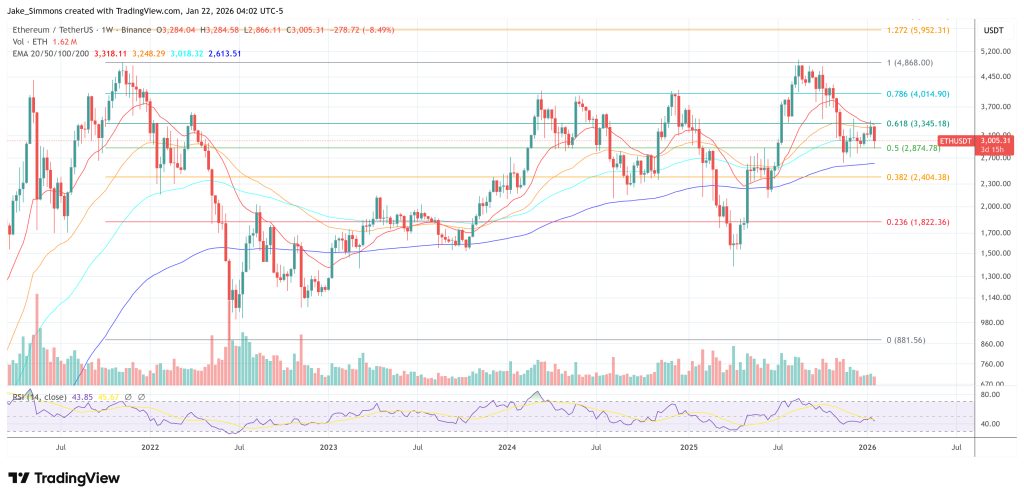
At press time, ETH traded at $3,005.

Ethereum price chart

Santiment Says XRP Social Sentiment Hits ‘Extreme Fear’: Buy Signal?

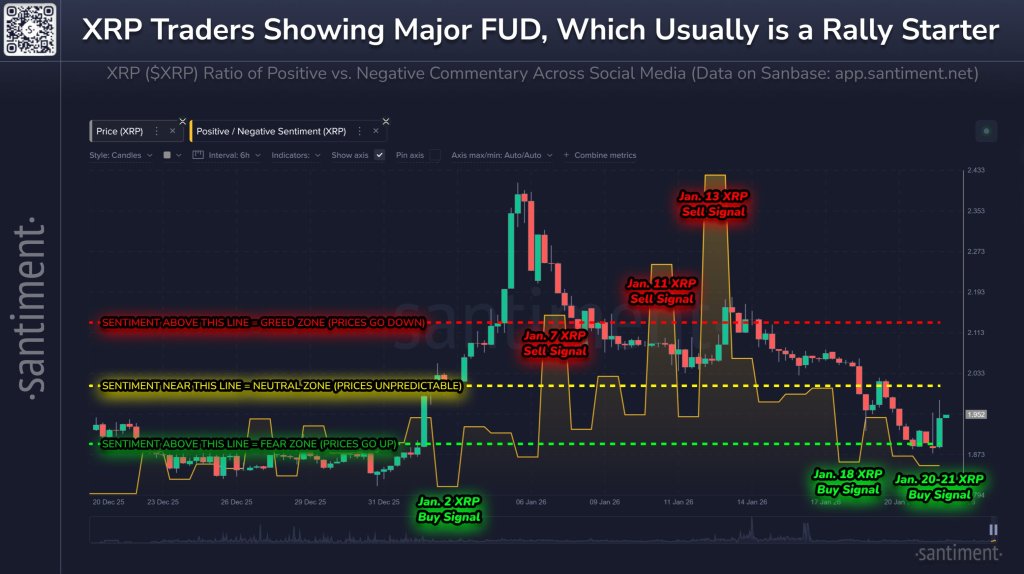
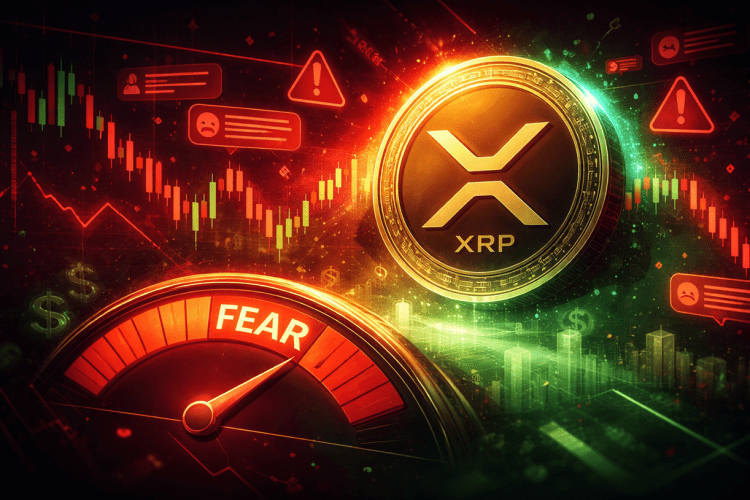
XRP is back in a familiar spot: social chatter has turned sharply bearish even as the market probes support after an early-January surge. Analytics firm Santiment said its social data shows XRP slipping into “Extreme Fear” after a roughly 19% pullback from its early-month high, a setup it argues has historically preceded rallies.

Santiment wrote on Jan. 22 via X: “According to our social data, XRP has fallen into ‘Extreme Fear’ territory. Small retail traders have become pessimistic toward the #5 market cap cryptocurrency after a -19% drop since the high back on January 5th. Historically, this high level of bearish commentary leads to rallies. Prices move the opposite to retails’ expectations more often than not.”

The chart Santiment shared pairs XRP’s 6-hour candles with a social ratio measuring positive versus negative commentary, and overlays three “buy” and three “sell” markers tied to sentiment bands. Those bands are explicitly labeled as a “fear zone” (where prices “go up”), a neutral zone, and a “greed zone” (where prices “go down”).

XRP social sentiment

How Reliable Is The XRP Social Sentiment Signal?

To check the timing, daily XRP spot data for the same late-December-to-January window broadly supports the chart’s claim that extreme sentiment readings often show up near inflection points, with an important caveat: not every signal front-runs a turn cleanly, and some arrive early.

The first “buy” marker on the chart is dated Jan. 2. On that day, XRP closed around $2.01 after trading as low as roughly $1.87, and the market proceeded to accelerate into the week’s blow-off move: by Jan. 5 XRP closed near $2.35, and the Jan. 6 session printed a high around $2.42. In other words, the Jan. 2 “buy” call landed ahead of the sharp leg higher that set the period’s high.

The first “sell” marker is dated Jan. 7, immediately after the peak. XRP closed around $2.16 that day and then bled lower across the next sessions, sliding toward the low-$2.00s by Jan. 12. On sequence alone, that sell signal aligns with the market shifting from post-spike distribution into a steadier downtrend.

The second “sell” marker, Jan. 11, is less straightforward. XRP closed near $2.07 on Jan. 11 and dipped again on Jan. 12, but then logged a sharp rebound on Jan. 13, closing around $2.17. Traders treating the Jan. 11 marker as an immediate top signal would have faced a short-term whipsaw before downside resumed.

That brings the chart’s third “sell” marker (Jan. 13) which appears to target that rebound itself. From Jan. 13’s close near $2.17, XRP rolled back over: it faded through mid-month and ultimately slid into the Jan. 20 low around $1.87 (intraday), which maps cleanly to the chart’s contention that “greed-zone” sentiment can coincide with local exhaustion.

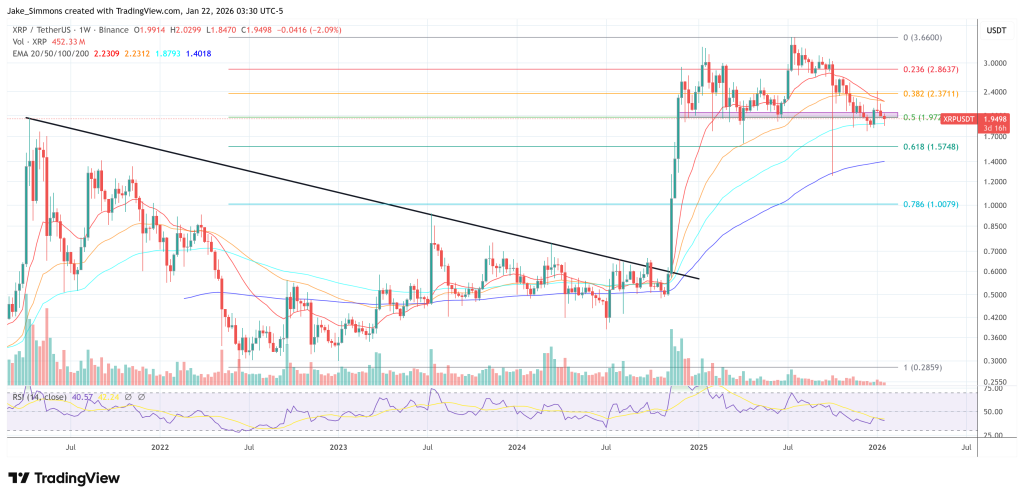
On the “buy” side late in the window, Santiment flags Jan. 18 and Jan. 20–21. The Jan. 18 marker arrived early: XRP closed around $1.99 on Jan. 18 but continued lower into Jan. 20 before rebounding. The current Jan. 20–21 marker fits better in the short term, with XRP bouncing from the Jan. 20 close near $1.89 to roughly $1.95 by today. Even so, that rebound has so far been modest relative to the broader drawdown from the $2.4 area peak.

Santiment’s broader point is contrarian: when social feeds tip into one-sided pessimism, marginal selling pressure may already be exhausted, setting up mean reversion. The recent signal history partially supports that while also showing the practical risk: entries can be early, and “extreme fear” can persist if trend conditions remain heavy.

At press time, XRP traded at $1.9498.

XRP price

What Ripple CEO Garlinghouse Said At WEF Davos 2026

Ripple CEO Brad Garlinghouse used a Davos stage at the World Economic Forum’s 2026 annual meeting to make a pragmatic case for tokenization: stablecoins are already the lead use case, momentum has shifted sharply in the US, and the industry’s job now is to deliver measurable benefits rather than tokenize assets for novelty.

Why Ripple Is Building Bridges Between TradFi and DeFi

Garlinghouse’s remarks came on a panel titled “Is Tokenization the Future?” after the moderator cited Ripple-linked traction: tokenized assets on the XRP Ledger surged more than 2,200% last year. From there, Garlinghouse largely aligned with the panel’s theme that tokenization is moving from pilots toward mainstream financial plumbing, while drawing a clear boundary around monetary sovereignty.

“I do think the first poster child of tokenization is really stablecoins,” Garlinghouse said, arguing that usage growth has been decisive. He cited stablecoin transaction volumes rising from “$19 trillion of transactions on stablecoins in 2024” to “33 trillion in 2025,” describing that as “about 75% growth” and adding that “many in our industry would say that’s going to continue.”

Where the discussion turned to a “Bitcoin standard” framing, Garlinghouse emphasized the political reality of state money. “Sovereignty of fiat currencies, I believe, is for many countries sacrosanct,” he said, before invoking a line he attributed to Ben Bernanke from a prior Ripple event: “Governments will roll tanks into the street before giving up monetary supply, giving up the control of monetary supply, which stuck with me as yeah, that makes sense.”

That worldview shaped how Garlinghouse positioned Ripple’s strategy. “At Ripple, we very much focused on building the bridges between traditional finance and decentralized finance,” he said, describing work “with a lot of the banks around the world” as the practical path to scale rather than attempting to displace existing monetary regimes.

Garlinghouse also framed 2026 as a momentum year, not just a technology year. He argued that the political climate in the US has turned materially more constructive after a period he described as open hostility. “The US, the largest economy in the world, has been pretty openly hostile towards facets of crypto and blockchain technologies,” he said. “And that has shifted dramatically, you know, starting with the White House… [and] helped elect a much more pro-crypto pro-innovation Congress, and you’re seeing that play out.”

But the Ripple CEO repeatedly cautioned that narrative tailwinds are not enough. “Part of the tokenization topic […] is like we shouldn’t tokenize everything just to tokenize something,” Garlinghouse said. “There has to be a positive outcome of efficiency or transparency […] otherwise it’s just like okay it’s a nice science experiment.”

On regulation, Garlinghouse reiterated his pragmatic tone, arguing that the push for US crypto legislation should prioritize workable clarity over theoretical perfection. “What’s going on in the US right now is a classic dynamic of when you create new law, it’s never going to be perfect,” he said. “I subscribe to the idea that perfection is the enemy of good.”

He pointed to Ripple’s own history: “a five-year battle with the US government being sued because of the lack of clarity” to underline the stakes, adding: “We are very much an advocate of clarity is better than chaos.”

When pressed on whether stablecoins should pay rewards, one of the live fault lines in US policy debate, Garlinghouse positioned Ripple as less directly exposed than some peers, while still endorsing competitive symmetry. “Ripple doesn’t have as much of a dog in that fight as others in the industry,” he said, but added that a “level playing field goes two ways,” arguing that crypto firms and banks should face comparable standards when competing for the same activity.

Garlinghouse also addressed energy concerns around blockchain-based infrastructure, pushing back on a one-size-fits-all critique. “Not all layer 1 blockchains are created equal,” he said, contrasting proof-of-work systems with proof of stake and other consensus models, and arguing that stablecoin activity is already skewing toward “more power efficient blockchains.”

Spirited dialogue during today’s WEF session (to say the least), but one important point of agreement across the panelists was that innovation and regulation aren’t on opposite sides.

I firmly believe this is THE moment to use crypto and blockchain technology to enable economic… https://t.co/4d3jNeNC4h

— Brad Garlinghouse (@bgarlinghouse) January 21, 2026

On tokenization’s social and market impact, Garlinghouse reframed a question about speculation as a question about access. He said he sees the opportunity in “the democratization of access to investment less so on the speculation side,” pointing to the idea that smaller investors could gain exposure to assets that are effectively inaccessible at modest ticket sizes today.

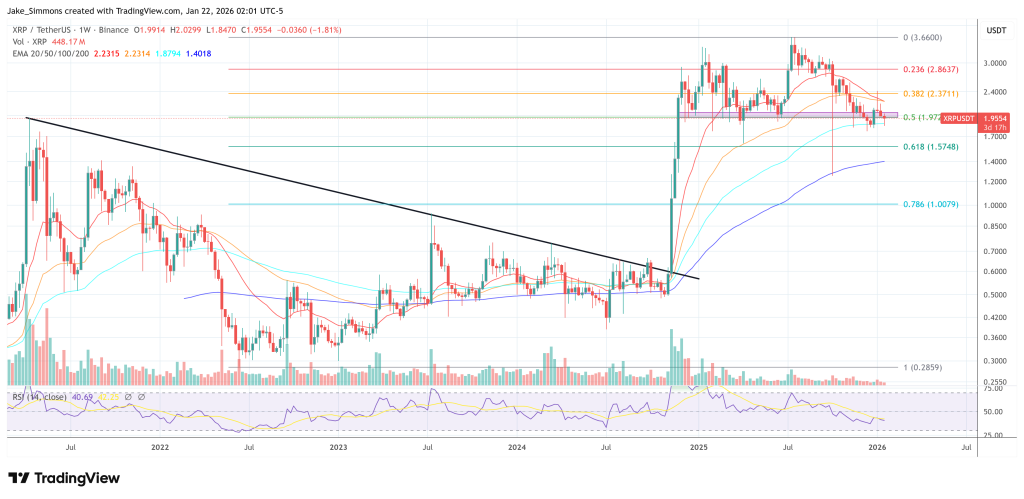
At press time, XRP traded at $1.9554.

XRP price chart

Is Bitcoin Selling Off On Quantum Fears? A Reality Check

Bitcoin’s Tuesday slide to $87,895 has revived a familiar market habit: attaching a single, clean narrative to messy positioning, flows, and reflexive price action. This time, the culprit making the rounds is quantum computing, a potentially “existential threat” that’s supposedly explaining Bitcoin’s underperformance versus gold which has printed a new all-time high at $4,888.

The quantum angle picked up steam after a post by Nic Carter, a partner at Castle Island Ventures. Carter wrote: “Bitcoin’s “mysterious” underperformance (due to quantum) is the only story that matters this year. The market is speaking the devs aren’t listening,” and shared a tweet about the news that Wall Street strategist Christopher Wood removed a 10% Bitcoin allocation from a model portfolio due to concerns that quantum computing could undermine Bitcoin’s long-term value proposition.

Is Bitcoin Falling On Quantum Fears?

Not everyone buying the premise is buying the price-action conclusion. Well-known Bitcoin advocate Vijay Boyapati, while acknowledging quantum computing as a real issue, pushed back on using it as the primary explanation for why Bitcoin is stalling and selling off.

“While I agree QC is a legitimate concern… I think the price stalling invites narratives to fill the explanatory void when, imo, the real explanation is really just the unlocking of an enormous supply once we hit a magic number for a lot of whales (100k),” Boyapati wrote. “Prices increasing are like waves hitting a glacier – eventually a chunk of supply breaks off and crashes onto the order books.”

Boyapati’s broader point is that market structure can do plenty of damage on its own once a big level triggers distribution and confidence cracks.

“Given the path dependent nature and feedback loops involved in a bull run sustained on narratives… the price stalling then causes people to doubt that Bitcoin will continue to go up and this then results in more selling until you get an equilibrium of supply and demand at some lower price point,” he added. “This is what happens during Bitcoin bear markets – and I think we’re in one.”

James Check, a prominent Bitcoin on-chain analyst, co-founder of Check on Chain, and former Lead Analyst at Glassnode, largely sided with the view that quantum risk may be a background constraint on some capital, but not the dominant driver of the gold-versus-Bitcoin divergence.

“QC keeps some capital away, but this argument that gold is up and Bitcoin is down because of it just isn’t it,” he wrote. “Gold has a bid because sovereigns are buying it in place of treasuries. The trend has been in place since 2008, and accelerates after Feb-22.”

He also highlighted the supply-side pressure Bitcoin has already absorbed. “Bitcoin saw sell-side from HODLers in 2025 which would have killed every prior bull thrice over, and then once more,” Checkmate said. The policy takeaway, in his view, is practical but limited: quantum preparedness matters, but attributing every downturn to it doesn’t help traders understand what’s actually clearing the market.

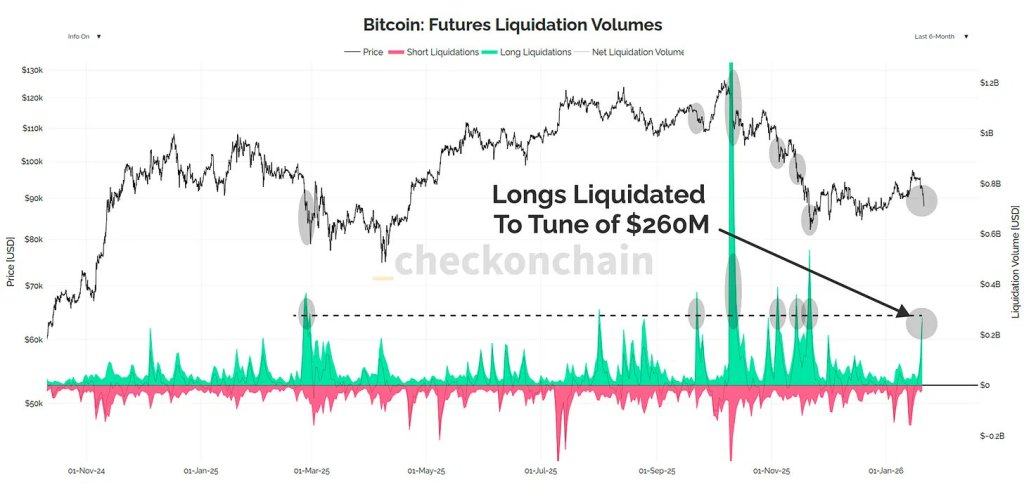
In a short market update posted via Checkmate’s analytics brand Checkonchain, the immediate trigger for the move was described in leverage terms rather than existential risk. Bitcoin “sold back down into the high $80ks,” with “the bears taking a bunch of leveraged long traders out to the woodshed,” the note said, estimating that around $260 million in leveraged long exposure was wiped.

Bitcoin futures liquidation volumes

Technically, the desk framed the structure as still resembling a bear flag, with a “clear supply air-pocket” between $70,000 and $81,000, language that points to thin bid support if sellers regain control.

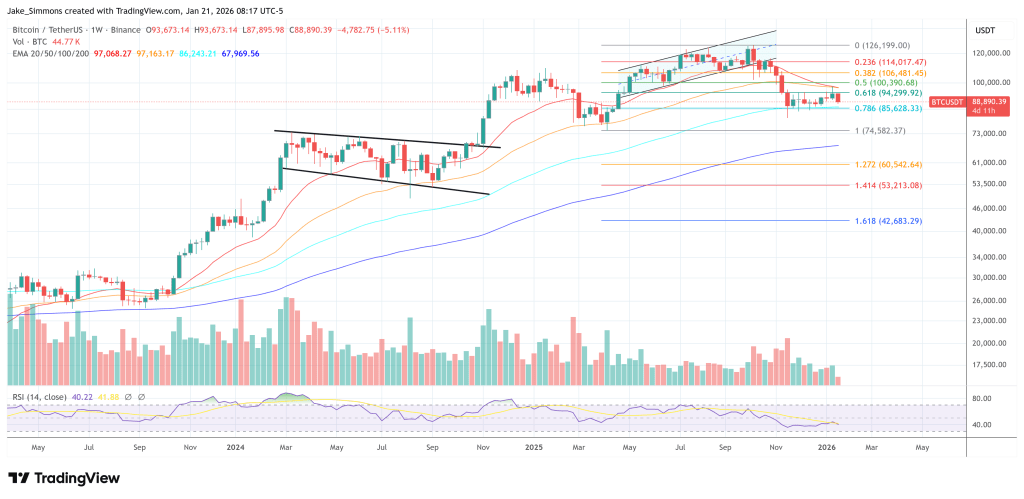
At press time, BTC traded at $88,890.

Bitcoin price chart

Cardano Foundation Reaches First Milestone In New Governance Roadmap

The Cardano Foundation said it has hit the first milestone in its updated governance roadmap, expanding delegation to a new set of community representatives as the ecosystem leans further into on-chain decision-making. The move matters because it shifts meaningful voting weight toward delegated representatives (DReps) whose mandates emphasize adoption and day-to-day network operations rather than purely technical development.

Cardano Foundation Expands DRep Delegation

In a post on X and an accompanying blog update, the Foundation said it has delegated an additional 220 million ADA to 11 selected DReps, roughly 20 million ADA each, focused on the pillars of Adoption and Operations. The Foundation framed the step as a continuation of earlier delegations to “Developer & Builder DReps,” and said the new allocation brings total delegation to community DReps to 360 million ADA.

Alongside the additional community delegation, the Foundation said it is revising how it handles its remaining stake in governance. “Rather than leaving a portion of our funds on auto-abstain as initially planned, we will self-delegate the remaining balance (approximately 171 million ADA),” the Foundation wrote. “While this exceeds our initial estimate, it ensures no ADA remains passive and still results in a net reduction of our overall voting power by approximately 43 million ADA, with the clear majority of our holdings now empowering community DReps.”

The Foundation emphasized that the delegations are intended to distribute voting power without imposing direction. “This delegation is not a blind bet, rather it’s a show of trust in a proven history of sound decision-making,” it said. “As always, it’s also a show of good faith: These new delegations come without any expectation regarding voting outcomes. We will not direct these DReps on how to vote, nor will we provide a voting manual.”

That posture, explicitly accepting dissent from its own views, was positioned as a feature rather than a risk. The Foundation said it expects “differing opinions” between the newly selected DReps and the Foundation itself, describing that divergence as evidence of “a healthy, decentralized governance system.”

The Foundation’s rationale for targeting adoption and operations reads as a governance design choice: broaden the expertise mix beyond protocol engineering. “To build a resilient governance system, we need more than just technical expertise—We need business acumen and operational stability,” it wrote, arguing that Adoption DReps can represent real-world utility, onboarding, and enterprise needs, while Operations DReps reflect the practical constraints faced by stake pool operators, toolmakers, and infrastructure providers.

In the published list, the Adoption cohort includes figures tied to community growth and product-building across the ecosystem, from regional community leadership to DeFi and stablecoin infrastructure, while the Operations cohort highlights long-running infrastructure roles such as block explorer analytics, stake pool operations, and SPO tooling.

The Foundation said all eleven delegations were completed in a single on-chain transaction, linking to the Cardano Explorer entry, and noted the delegations are effective immediately. It also encouraged the broader community to “follow and interact with these DReps,” including engaging with their voting rationales and participating in governance actions.

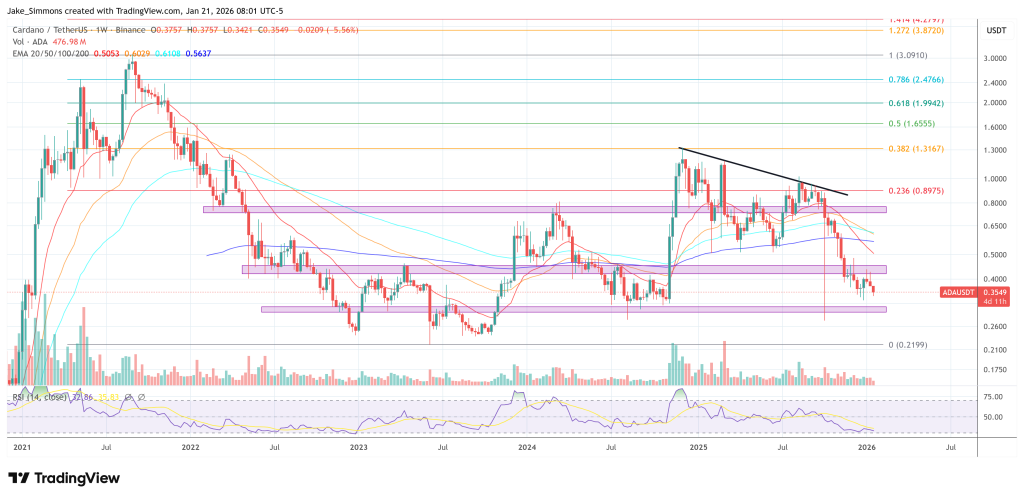
At press time, Cardano traded at $0.3549.

Cardano price

Solana Will Become A ‘Decentralized Nasdaq’ In 2026, Delphi Digital Predicts

Delphi Digital is betting that Solana’s next major upgrade cycle will reposition the network as an “exchange grade” environment capable of supporting onchain order books that can realistically contend with centralized venues on latency, liquidity depth, and market structure. In a Jan. 20 post on X titled “2026 is the Year of Solana”, the research firm argued Solana’s 2026 roadmap is its “most aggressive upgrade cycle” yet, one that “overhaul[s] everything from consensus to infrastructure to become the decentralized Nasdaq.”

Why Delphi Digital Calls 2026 “The Year Of Solana”

Delphi framed the roadmap less as a grab bag of performance enhancements and more as a capital-markets push: “Solana’s roadmap is about transforming it into an exchange grade environment where a native onchain CLOB can viably compete with CEX latency, liquidity depth, and fairness. Here are all the upgrades making this possible.” In that view, shaving milliseconds matters only insofar as it produces predictable, enforceable execution outcomes for applications like high-frequency trading and central limit order books.

The centerpiece, Delphi wrote, is Alpenglow, a consensus redesign it called “the most significant protocol level change in Solana’s history.” The firm said Alpenglow introduces a new architecture built around Votor and Rotor, with Votor changing how validators reach agreement. Rather than “chaining multiple voting rounds together,” validators would aggregate votes offchain and “commit to finality in one or two rounds,” producing “theoretical finality in the 100-150 millisecond range, down from the original 12.8 seconds.”

Delphi emphasized Votor’s parallel finalization paths as a resilience feature, not just a speed play. If a block gets “overwhelming support (80%+ stake)” it finalizes immediately; if support is between 60% and 80%, a second round triggers, and finality follows if that also clears 60%. The goal, Delphi argued, is to preserve finality even with unresponsive segments of the network.

Alpenglow also introduces what Delphi called a “20+20” resilience model: safety holds as long as no more than 20% of stake is malicious, while liveness persists even if another 20% is offline, “tolerat[ing] up to 40% of the network being either malicious or inactive while still maintaining finality.” Under this design, Proof of History is “effectively deprecated,” replaced by deterministic slot scheduling and local timers. Delphi said the upgrade is expected to roll out in early to mid 2026.

Delphi also pointed to Firedancer, Jump’s C++ validator client, as a structural upgrade aimed at reducing a long-standing operational risk. Solana has historically relied on a single client, now known as Agave, and Delphi described that “monoculture” as a central weakness because client-level faults can cascade into broader network halts.

Firedancer’s objective, Delphi said, is a deterministic, high-throughput engine that can process “millions of TPS with minimal latency variance.” Ahead of full readiness, Delphi highlighted “Frankendancer,” a transitional build that combines Firedancer’s networking and block production modules with Agave’s runtime and consensus components, as a bridge to “substantially” increased client diversity.

On infrastructure, Delphi spotlighted DoubleZero as a private fiber overlay for validators, likening its transmission profile to traditional exchange connectivity: “the same infrastructure traditional exchanges like Nasdaq and CME rely on for microsecond level transmission.” The argument is that as validator sets expand, propagation variance becomes the enemy of tight finality windows. By routing messages along “optimal paths” and supporting multicast delivery, Delphi said DoubleZero can narrow latency gaps across validators—an enabler for both Votor’s quorum formation and Rotor’s propagation design.

Delphi also framed Solana’s block-building roadmap as a market-structure project. It described Jito’s BAM (Block Assembly Marketplace) as separating ordering from execution via a marketplace and privacy layer, with transactions ingested into TEEs so “neither validators nor builders can see raw transaction content before ordering takes effect,” reducing pre-execution behavior like frontrunning.

Harmonic, meanwhile, targets builder competition by introducing an open aggregation layer so validators can accept proposals from “multiple competing builders in real time,” with Delphi summarizing: “Think of Harmonic as a meta-market and BAM as a micro-market.”

Raiku rounds out the thesis by adding deterministic latency and programmable execution guarantees adjacent to Solana’s validator set, using Ahead-of-Time (AOT) transactions for pre-committed workflows and Just-in-Time (JIT) transactions for real-time needs—without modifying L1 consensus.

Delphi ultimately tied the technical roadmap to market demand: Solana’s spot trading gravity, the consolidation of onchain perps toward a handful of venues, and the need to reach performance parity with centralized platforms. It cited expectations for “new Solana native perps like Bulk Trade coming early next year,” and pointed to products like xStocks bringing “onchain equities directly to Solana,” arguing that liquidity and attention are consolidating toward a chain with faster settlement, better UX, and denser capital.

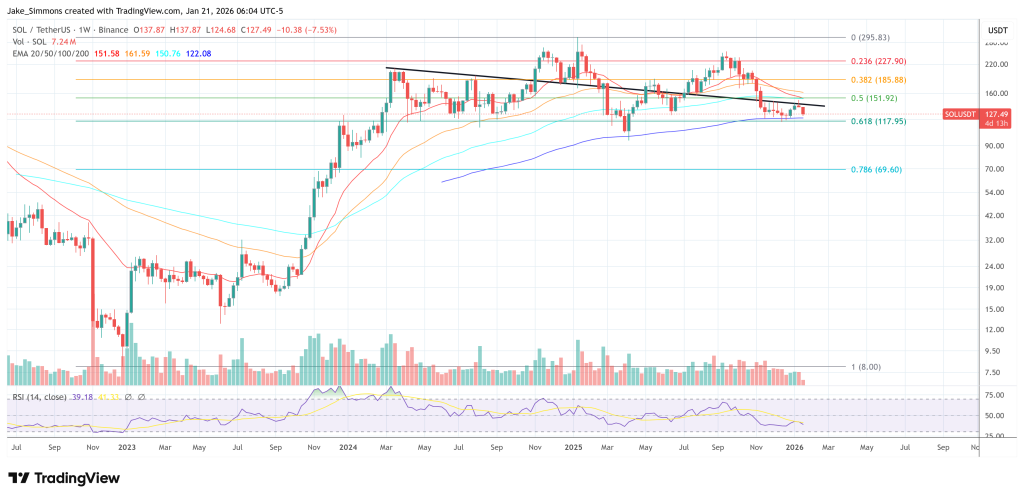
At press time, SOL traded at $127.

Solana price chart

Ripple President Long Unveils Her 2026 Crypto Predictions

Ripple President Monica Long says 2026 will be the year institutional crypto usage shifts decisively from pilots to production, as regulated infrastructure and clearer rules pull banks, corporates, and market intermediaries deeper onchain. In a January 20 blog post, Long frames the next leg of adoption around four forces: stablecoins, tokenized assets, custody consolidation, and automation powered by AI.

#1 Stablecoins (Ripple USD) As The Settlement Layer

Long’s central prediction is that stablecoins will stop being treated as an “alternative rail” and become foundational to global settlement. “Within the next five years, stablecoins will become fully integrated into global payment systems—not as an alternative rail, but as the foundational one,” she wrote. “We’re seeing this shift not in theory, but in practice, as heavyweights like Visa and Stripe hard-wire these rails into incumbent flows.”

She ties that trajectory to US policy momentum, arguing the GENIUS Act “inaugurated the digital dollar era,” and positioning “highly compliant, US issued stablecoins, including Ripple USD (RLUSD)” as a standard for programmable, 24/7 payments and collateral use in markets. Long also points to “conditional approval from the OCC to charter the Ripple National Trust Bank” as part of Ripple’s compliance strategy.

The near-term demand driver, in her telling, is B2B, not retail. Long cites research claiming B2B payments became the largest real-world stablecoin use case last year, reaching an annualized $76 billion run-rate—up sharply from early 2023 levels. She argues stablecoins can unlock liquidity and reduce working-capital drag, citing “over $700 billion” of idle cash on S&P 1500 balance sheets and “more than €1.3 trillion across Europe.”

#2 Institutional Exposure And Tokenization

Long argues crypto is increasingly used as financial infrastructure rather than just a speculative asset. “Crypto has evolved from a speculative asset into the operating layer of modern finance,” she wrote. “By the end of 2026, balance sheets will hold over $1 trillion in digital assets, and roughly half of Fortune 500 companies will have formalized digital asset strategies.”

She points to a 2025 Coinbase survey she says found 60% of Fortune 500 companies are working on blockchain initiatives, and notes “more than 200 public companies” holding bitcoin in treasury. She also highlights the rise of “digital asset treasury” firms, claiming they grew from four in 2020 to more than 200 today, with nearly 100 formed in 2025 alone.

On market structure, Long forecasts “collateral mobility” as a key institutional use case, with custodians and clearing houses using tokenization to modernize settlement. Her stated expectation is that “5–10% of capital markets settlement” moves onchain in 2026, supported by regulatory momentum and stablecoin adoption by systemically important institutions.

#3 Custody Consolidation Accelerates

Long frames digital asset custody as the institutional on-ramp and predicts consolidation as custody offerings commoditize. “M&A activity in this space is a signal of maturity, not just momentum,” she wrote, citing $8.6 billion in crypto M&A in 2025. She argues regulation will push banks toward multi-custodian setups and predicts “more than half of the world’s top 50 banks” will add at least one new custody relationship in 2026.

She also points to convergence between crypto and traditional finance through deals such as Kraken’s purchase of NinjaTrader and Ripple’s acquisitions of GTreasury and Hidden Road, positioning them as steps toward safer, more integrated institutional workflows.

#4 Blockchain And AI Converge

Long’s final theme is automation: smart contracts paired with AI models running treasury and asset-management processes continuously. “Stablecoins and smart contracts will enable treasuries to manage liquidity, execute margin calls and optimize yield across onchain repo agreements, all in real-time without manual intervention,” she wrote.

She argues privacy tech is critical for regulated deployment, pointing to zero-knowledge proofs as a way for AI to assess risk or creditworthiness without exposing sensitive data.

Long’s overarching claim is that 2026 marks a transition from experimentation to infrastructure: stablecoins as settlement and collateral, tokenization in core market plumbing, custody as a trust anchor, and AI-driven automation as the efficiency layer.

At press time, XRP traded at $1.905.

XRP price chart

Tom Lee Still Sees Bitcoin At $250,000 But Warns 2026 Gets ‘Jagged’

Fundstrat’s Tom Lee reiterated his $250,000 Bitcoin target while cautioning that 2026 could be a “jagged” year for crypto adoption and a turbulent one for broader risk assets, framing any major pullback as a buying window rather than a signal to de-risk.

Speaking on The Master Investor Podcast with Wilfred Frost in an interview released Jan. 20, Lee said he expects 2026 to ultimately “look like a continuation of the bull market that started in 2022,” but argued markets must first digest several transitions that could deliver a drawdown large enough to “feel like a bear market.”

$250,000 Bitcoin Call Comes With A 2026 Warning

Lee pointed to what he described as a “new Fed” dynamic, arguing markets tend to “test” a new chair and that the sequencing of identification, confirmation, and reaction can catalyze a correction. He also warned that the White House could become “more deliberate in picking winners and losers,” expanding the set of sectors, industries, and even countries “in the bullseye,” which he said is already visible in gold’s strength.

A third friction point, in his telling, is AI positioning: the market is still calibrating “how much is priced into AI,” from energy needs to data-center capacity, and that uncertainty could linger until other narratives take the baton.

Pressed on magnitude, Lee said with regards to the S&P 500, the drawdown “could be 10%,” but also “could be 15% or 20%,” potentially producing a “round trip from the start of the year,” before finishing 2026 strong. He added that his institutional clients did not appear aggressively positioned yet, and flagged leverage as a tell: margin debt is at an all-time high, he said, but up 39% year-over-year—below the 60% pace he associates with local market peaks.

For crypto, Lee leaned on a market-structure explanation for why gold outperformed: he said crypto tracked gold until Oct. 10, when the market suffered what he called “the single largest deleveraging event in the history of crypto,” “bigger than what happened in November 2022 around FTX.”

After that, he said, Bitcoin fell more than 35% and Ethereum almost 50%, breaking the linkage. “Crypto has periodic deleveraging events,” Lee said. “It really impairs the market makers and the market makers are essentially the central bank of crypto. So many of the market makers I would say maybe half got wiped out on October 10th.”

That fragility, he argued, doesn’t negate the “digital gold” framing so much as it limits who treats it that way today. “Bitcoin is digital gold,” Lee said, but added that the set of investors who buy that thesis “is not the same universe that owns gold.”

Over time, Lee expects the ownership base to broaden, though not smoothly. “Crypto still has a, I think, future adoption curve that’s higher than gold because more people own gold than own crypto,” he said. “But the path to getting that adoption rate higher is going to be very jagged. And I think 2026 will be a really important test because if Bitcoin makes a new all-time high, we know that that deleveraging event is behind us.”

Within that framework, Lee reiterated his high-conviction upside call: “We think Bitcoin will make a new high this year,” he said, confirming a $250,000 target. He tied the thesis to rising “usefulness” of crypto, banks recognizing blockchain settlement and finality, and the emergence of natively crypto-scaled financial models.

Lee cited Tether as a proof point, claiming it is expected to generate nearly $20 billion in 2026 earnings with roughly 300 employees, and argued that the profit profile illustrates why blockchain-based finance can look structurally different from legacy banking.

Lee closed with advice that intentionally cuts against short-horizon reflexes. “Trying to time the market makes you an enemy of your future performance,” he said. “As much as I’m warning about 2026 and the possibility of a lot of turbulence, they should view the pullback as a chance to buy, not the pullback as a chance to sell.”

At press time, Bitcoin traded at $89,287.

Bitcoin price chart

Dogecoin Foundation’s Corporate Arm Reveals Consumer Push With New App

House of Doge, the Dogecoin Foundation’s official corporate arm, says it is building a new mobile app called “Such” that aims to make it easier for users to hold and spend DOGE while giving small merchants and independent sellers tools to accept it in day-to-day commerce.

In a post on X and a January 20 press release, House of Doge said Such is expected to launch in the first half of 2026 and will pair a self-custodial wallet with transaction tracking and a commerce feature branded “Hustles,” positioned as a simple on-ramp for people looking to sell products and services for DOGE.

Dogecoin Foundation Arm, Brag House Tease ‘Such’

House of Doge framed Such as its “first product,” with additional launches planned in the first half of 2026. The company described the app as an attempt to reduce friction on both sides of a DOGE transaction: helping holders spend more easily and helping sellers add Dogecoin payments in a way that fits routine retail activity.

Timothy Stebbing, CTO of House of Doge and a Dogecoin Foundation director, tied the product thesis directly to the DOGE community’s informal commerce culture. “I’ve seen so many people in the Dogecoin Community try to start something themselves. Be it an artist selling prints or a person offering lawn care services, everyone has a side hustle these days,” Stebbing said. “We want to enable anyone to start their hustle with Dogecoin through the Such app. We’re planning to enable anyone to start selling their hustle in as few clicks as possible.”

The DOGE Foundation account echoed that positioning on X, describing Such as “coming in the first half of 2026” and highlighting a launch scope centered on self-custodial wallets, real-time transaction tracking, and merchant tools for selling goods and services.

The dev team at @DogecoinFdn and @Houseofdoge is proud to announce the Such app, coming in the first half of 2026. The Such app brings new ways to interact with and bring further utility to Dogecoin.

At launch Such will have: – Self-custodial Dogecoin wallets – Real-time…

— Dogecoin Foundation (@DogecoinFdn) January 20, 2026

According to the press release, Such is being developed by a team of twenty headquartered in Melbourne, Australia, led by Stebbing. House of Doge said development began in March 2025, using open-source technology developed by the Foundation, with an initial launch targeted for the first half of 2026.

House of Doge CEO Marco Margiotta argued the app is intended to be more than another on-ramp-plus-wallet bundle. “We’re planning to offer more by going beyond another wallet app that lets you buy Dogecoin. We have unique features we’re expecting to release, all with the quality and ease of use through the wealth of experience our development team brings,” Margiotta said. “We want to see Dogecoin become a widely used global decentralized currency. By building our own solution, we’re able to bring people on that journey together with our many strategic partnerships.”

The Such app account on X introduced a character named “Kubo” as a guide and leaned into the same pitch, saying Such is “more than just a wallet” and is designed to let users “start a side-hustle and sell your products and services for Dogecoin” by the time it launches.

The announcement also ties Such to Brag House Holdings Inc., described as House of Doge’s merger partner and identified in the release as Nasdaq-listed under ticker TBH. Brag House CEO Lavell Juan Malloy II positioned the app as a bridge from community engagement to monetization. “The Such app represents the next frontier for how communities connect, create, and transact in a digital-first economy,” he said. “This gives users the freedom to build, earn, and engage using Dogecoin, not as a concept, but as a real, usable currency. This is more than just innovation; it’s about democratizing access to opportunity for everyone through digital technology.”

At press time, DOGE traded at $0.12522.

Dogecoin price chart

Bitcoin Whale Panic Fades: Sell Pressure On Binance Falls Off A Cliff

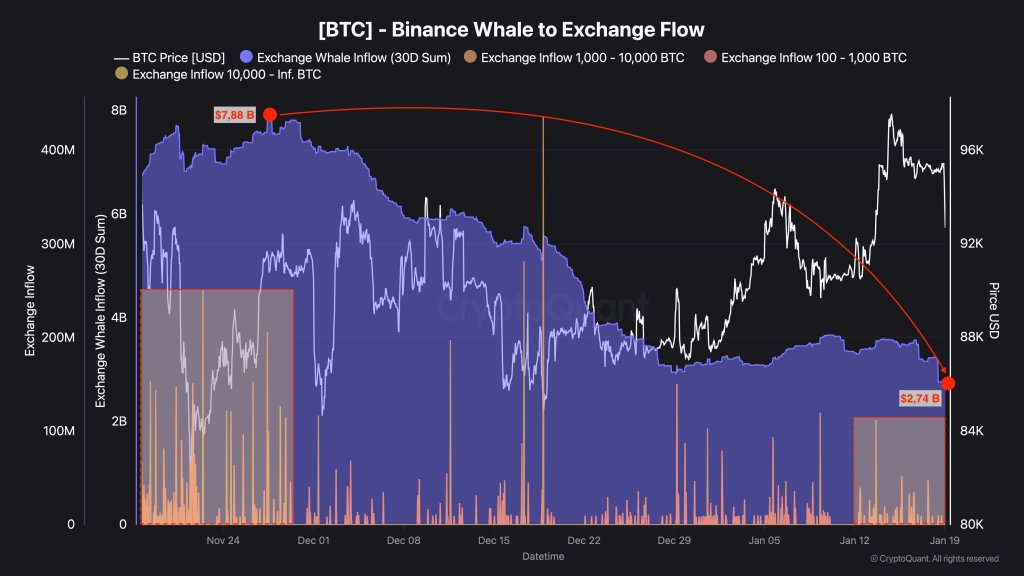
Bitcoin’s exchange-side supply signal is flashing a notable change: whale-sized transfers into Binance have dropped sharply from late-November panic levels, suggesting large holders are no longer leaning on the sell button with the same urgency.

Selling Pressure From Bitcoin Whales Fade

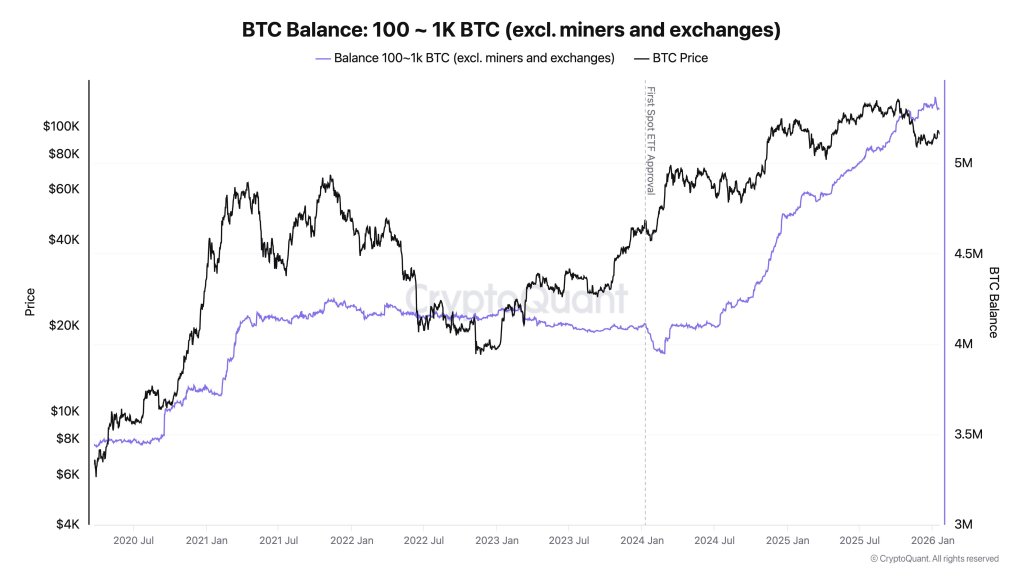
CryptoQuant contributor Darkfost said current data shows a “clear decline in whale transactions,” specifically BTC inflows to exchanges, meaning “large holders are sending significantly less BTC to trading platforms than before.”

In the post, the chart focus was Binance inflows segmented by transaction size, spanning transfers from 100 BTC up to the largest prints above 10,000 BTC, flows that are commonly interpreted as potential sell-side positioning when they hit an exchange.

The key backdrop in Darkfost’s thread is how quickly whale behavior shifted around the market’s late-2025 drawdown. “December has been particularly challenging, even for these investors,” the analyst wrote, adding that whales are typically “more cautious” and “less sensitive to market movements than retail participants,” often acting with “greater discipline and patience.”

That discipline appeared to crack as Bitcoin rolled over from its latest all-time high near $126,000. Darkfost described a surge in whale inflows to Binance at the end of November as BTC “continued its correction,” with the “average monthly total” reaching “nearly $8 billion” during a period when BTC “fell back below the $90,000 level.”

“This phase clearly triggered a panic-driven move,” the post said. “Transactions ranging between 100 and 10,000 BTC increased significantly, especially as price broke below the $85,000 level. This behavior reflects real stress among certain whales, who chose to sell quickly in order to limit losses, thereby reinforcing selling pressure on the market.”

The crux is what changed since that cluster. “Today, the situation looks very different,” Darkfost wrote. Those Binance inflows “have been divided by three and now stand at around $2.74 billion,” with “daily movements” becoming “far less frequent than during the cluster observed at the end of November.”

The analyst framed the drop as an observable behavioral pivot rather than a single-day anomaly. “This shift in dynamics suggests that whales have changed their behavior,” Darkfost wrote. “They are no longer selling aggressively and now appear to favor waiting.”

Bitcoin Whale to Exchange Flows

Institutional Demand Side Remains Robust

While Darkfost’s post focuses on whale-associated inflows as a proxy for potential sell pressure, CryptoQuant CEO Ki Young Ju pointed investors to the other side of the ledger: institutional accumulation.

Institutional demand for Bitcoin remains strong,” Ki wrote on X. “US custody wallets typically hold 100–1,000 BTC each. Excluding exchanges and miners, this gives a rough read on institutional demand. ETF holdings included.”

Ki added that “577K BTC ($53B) [was] added over the past year, and still flowing in,” characterizing the trend as ongoing rather than a completed wave.

Bitcoin Balance: 100-1,000 BTC

At press time, Bitcoin traded at $90,885.

Bitcoin price chart

Nvidia Vs. Dogecoin: A Historic Ratio Suggests A Possible Rotation, Says Trader

Trader Cryptollica (@Cryptollica) is arguing that an old relative-value signal is “back” in crypto markets, pointing to the DOGE/NVIDIA ratio and an unusually depressed Dogecoin RSI reading as evidence that capital could rotate from AI-linked equities into high-beta meme coins.

Dogecoin Vs. Nvidia: Rotation Incoming?

In a post on X, Cryptollica said the DOGE/NVIDIA chart has returned to a long-term support zone that previously preceded outsized Dogecoin outperformance versus Nvidia in prior cycles. “THE SIGNAL IS BACK. IT’S HAPPENING AGAIN (2017… 2021… NOW),” the trader wrote.

“The last two times this specific signal flashed on the DOGE/NVIDIA chart, we saw the biggest wealth transfer in history. The crowd is chasing the AI top. The algorithm is loading the Meme bottom. (Altcoin bottom).”

Dogecoin vs Nvidia chart

The core claim is less about Dogecoin in isolation and more about positioning on a ratio between what Cryptollica framed as two cultural extremes: “You are watching the wrong chart. This is the ratio of ‘The World’s Most Valuable Company’ (AI) vs. ‘The World’s Most Famous Meme’.” From that framing, the trader leans into a cycle-rhymes narrative, asserting that the ratio has repeatedly found channel support before a DOGE-led surge.

“Structure is repeating history,” Cryptollica wrote, attaching specific historical comparisons. “2017: Ratio hit channel support – DOGE outperformed NVDA by 100x. 2021: Ratio hit channel support – DOGE outperformed NVDA by 50x. NOW: We are back at the exact same support line.”

The posts also attach a broader liquidity-rotation story that has circulated in various forms across risk markets: when one trade stops working, capital seeks the next high-beta outlet: “When the AI Bubble exhales, that liquidity doesn’t vanish. It rotates into High-Beta Speculation,” the trader wrote. “The crowd is buying NVDA at the top. The algorithm is positioning for the DOGE reversal.”

Is Dogecoin An ‘Epic Buying Opportunity’?

In another post, Cryptollica shifted from the ratio to Dogecoin’s weekly momentum indicator, sharing a second chart highlighting RSI levels and labeling prior cycle lows. “Here you are witnessing an opportunity that only comes around once every 12 years,” the trader wrote. “Over the past 12 years (2014–2026), Dogecoin’s RSI has dropped this low only 4 times. Every single one was an epic buying opportunity.”

The post describes those four moments as a sequence of cycle bottoms, including an “all-time low” first cycle bottom, a “cycle bottom + COVID crash,” a “last cycle bottom,” and “RIGHT NOW!” Cryptollica concluded with a blunt decision frame: “Math or emotions — which one decides for you?”

Dogecoin weekly chart

While neither post includes an explicit price target, the analyst said in early December that he expects Dogecoin to reach $1.30 over the medium term, citing a parallel channel top on the 3-day DOGE/USD chart.

At press time, DOGE traded at $0.12581.

Dogecoin price news

❌