
 Login
LoginEthereum Outlook Has Improved, And It Could Outperform Bitcoin – Here’s What To Know
Ethereum’s outlook has been improving its case. After a prolonged period of underperformance and skepticism, the network is starting to exhibit signs of renewed structural and fundamental strength. While BTC continues to anchor the market as the primary store of value and digital gold, conditions are emerging that could allow ETH to outperform BTC over the coming period.
Why The Ethereum Narrative Is Gaining Strength
Ethereum has been seen outperforming Bitcoin. In a recent post on X, Walter Bloomberg revealed that Standard Chartered says that the ETH outlook has improved, and now ETH might outperform BTC, citing rising institutional demand and stronger fundamental positioning across key on-chain sectors.
While weakness in BTC has weighed on the broader crypto market, ETH has continued to benefit from institutional-driven demand, and its dominance in stablecoins, decentralized finance (DeFi), and real-world assets (RWA) tokenization.
Standard Chartered also points to the increased throughput and potential US regulatory clarity that it could provide additional upside. In terms of valuation, the bank forecasts ETH at $7,500 this year and $30,000 by 2029, reflecting the expectations of sustained network growth.
The Co-founder of PinkBrains_io, a DeFi Creator Studio, DefiIgnas, has highlighted that Ethereum could outperform Bitcoin this year, and the reason is roadmap execution. While BTC will likely keep facing recurring waves of quantum FUD into 2026, ETH has a clear roadmap to prepare for future cryptographic risks.
Furthermore, ETH is actually scaling. Gas limits on layer 1 keep rising, and zkEVMs will get full production readiness, making ETH cheap and fast enough for high-value transactions, while layer 2s will handle most of the trading and high-frequency activity.
Related Reading: Bitcoin And Ethereum Market Structure Points To Crypto Winter – Details
These upgrades are incremental, which means there’s no breaking news moment for ETH, but progress is happening fast. Early in the cycle, a lot of Degens loaded up on ETH before the bull run, but many got disillusioned and sold their ETH for BTC. “It would be fun to see the playbook reverse higher,” DefiIgnas noted.
A Different Liquidity Cycle Than Previous Bull Markets
Crypto liquidity quality witnessed a change in 2025. A technical analyst and show host of Crypto Banter, Kyledoops, reported that Wintermute noted that capital in 2025 stopped rotating broadly across the market. Instead, liquidity is concentrated into Bitcoin, Ethereum, and a small group of large-cap tokens. As a result, the long-anticipated wave of altcoin-wide liquidity never really arrived.
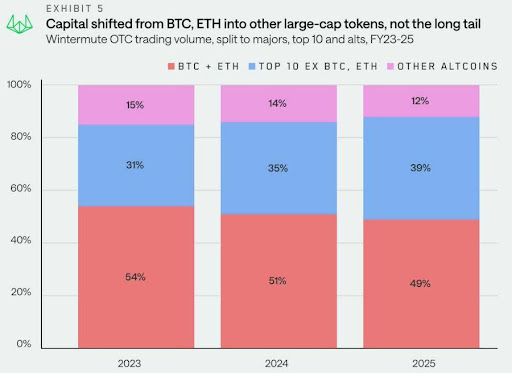
Meanwhile, the rise of spot ETFs and crypto treasury vehicles created a new, highly structured inflow channel that funneled flow into the top of the market. These vehicles break the crypto’s oldest playbooks. Price action is no longer driven by broad market expansion. It’s driven by where new liquidity can actually enter.


