
 Login
LoginBitcoin Stuck In Bear Mode For 83 Days: Trend Pulse Confirms Structural Weakness
Bitcoin continues to struggle as it attempts to reclaim the $90,000 level, with traders facing a market defined by hesitation rather than conviction. After yesterday’s bearish breakdown below $90K, price action has slipped back into indecisive territory, raising fresh questions about whether this pullback is a temporary shakeout or the start of a deeper corrective phase.
According to top analyst Axel Adler, a macro indicator called Trend Pulse helps explain why momentum has faded. Adler notes that since January 19, the market has remained in Bear Mode, with the Bull phase absent for 83 consecutive days. Two separate charts reinforce this shift, showing that both short-term momentum and quarterly performance have turned negative at the same time.

Trend Pulse recently shifted from Neutral to Bear, driven by a double-negative setup: the 14-day return has flipped red, and the SMA30 versus SMA200 trend signal is also negative. Meanwhile, Bitcoin’s quarterly return sits at -19%, confirming macro weakness, but without the kind of extreme that often signals a definitive bottom.
Bitcoin Remains Stuck In Bear Mode As Macro Signals Stay Negative
Adler notes that Bitcoin’s last Bull Mode signal was printed on November 2, 2025, when BTC traded near $110,000—roughly 83 days ago. Since then, the market has failed to regain structural strength. Even the Neutral stretch between December 30 and January 18 proved too short and too weak to restore the long-term trend, leaving Bitcoin vulnerable once selling pressure returned.
Adler explains that the first trigger for improvement is the 14-day return moving back above 0, which would shift the regime from Bear to Neutral. However, a full transition back into Bull Mode requires a second condition: SMA30 breaking above SMA200. Given the current divergence between the two averages, that crossover would likely demand 3–4 weeks of sustained upside rather than a short-lived bounce.
The Bitcoin Price Performance chart adds macro context by tracking quarterly return (90D) as a sentiment proxy. Historically, readings above +75% align with euphoria, while values below 0% signal pessimism, and drops below -30% reflect capitulation.

Bitcoin’s quarterly return sits near -19%, negative but far from deep bear-market extremes. Yet the 7-day change (-6.8%) suggests downside momentum is accelerating after the $90K breakdown.
Together, Trend Pulse and quarterly returns point to moderate pessimism without final capitulation, leaving the market at a decision point.
BTC Moving Averages Cap Recovery
Bitcoin is trading near $89,000 after failing to hold above the $90,000 psychological level, reinforcing the market’s current indecision. The chart shows BTC printing a lower-high structure since the early November peak, followed by a sharp selloff that reset price into a wide consolidation range. After bottoming in late November, Bitcoin rebounded but struggled to build sustained momentum, repeatedly stalling on push attempts toward the mid-$90K zone.
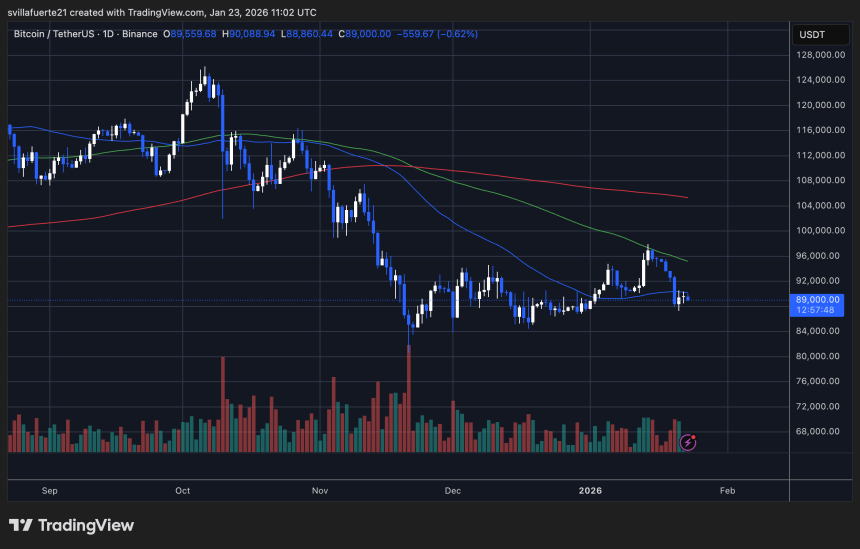
From a trend perspective, BTC remains pressured beneath its key moving averages. Price is trading below the green long-term average and the blue mid-term average, both of which are now sloping downward, signaling that broader momentum continues to lean bearish.
The most recent rejection occurred as BTC briefly pushed into the $95K–$97K area, only to roll over and break back down toward the range lows. Meanwhile, the red long-term average remains well above price near the low-$100Ks, highlighting how far BTC would need to recover to reestablish a stronger macro uptrend.
Volume has picked up on selloffs relative to bounces, suggesting that downside moves are still being met with more urgency. For bulls, reclaiming $90K and then holding above $92K–$94K is key. Otherwise, the chart keeps risk open for a deeper pullback toward the mid-$80K region.
Featured image from ChatGPT, chart from TradingView.com


