Reading view

There are new articles available, click to refresh the page.

NASA Selects Participants to Track Artemis II Mission

4 Min Read

NASA Selects Participants to Track Artemis II Mission

When NASA's Artemis I launches next week on a journey to the moon, no animals or people will be onboard, but it will still carry biology investigations to see how living things react to the deep space environment.
A visual representation of NASA’s Artemis I mission.
Credits: NASA

NASA has selected 34 global volunteers to track the Orion spacecraft during the crewed Artemis II mission’s journey around the Moon.

The Artemis II test flight will launch NASA’s Space Launch System (SLS) rocket, carrying the Orion spacecraft and a crew of four astronauts, on a mission into deep space. The agency’s second mission in the Artemis campaign is a key step in NASA’s path toward establishing a long-term presence at the Moon and confirming the systems needed to support future lunar surface exploration and paving the way for the first crewed mission to Mars.

While NASA’s Near Space Network and Deep Space Network, coordinated by the agency’s SCaN (Space Communication and Navigation) program , will provide primary communications and tracking services to support Orion’s launch, journey around the Moon, and return to Earth, participants selected from a request for proposals published in August 2025, comprised of established commercial service providers, members of academia, and individual amateur radio enthusiasts will use their respective equipment to passively track radio waves transmitted by Orion during its approximately 10-day journey.
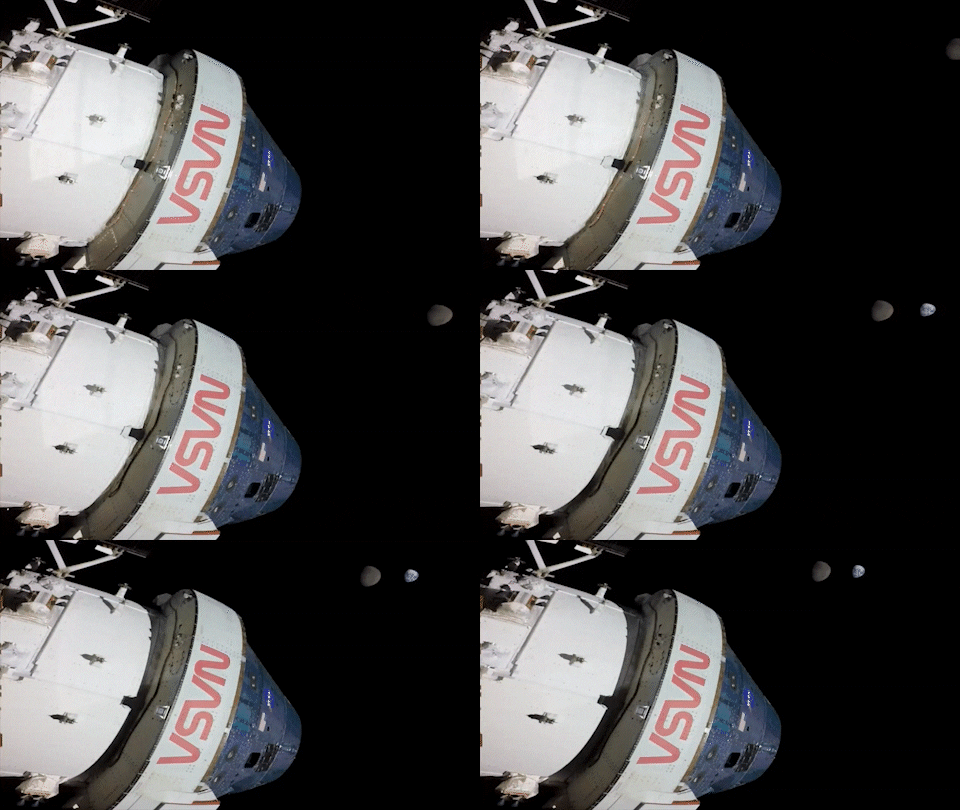
The Orion capsule viewing the Moon during Artemis I.
NASA

“The Artemis II tracking opportunity is a real step toward SCaN’s commercial-first vision. By inviting external organizations to demonstrate their capabilities during a human spaceflight mission, we’re strengthening the marketplace we’ll rely on as we explore farther into the solar system,” said Kevin Coggins, deputy associate administrator for SCaN at NASA Headquarters in Washington. “This isn’t about tracking one mission, but about building a resilient, public-private ecosystem that will support the Golden Age of innovation and exploration.”

This isn’t about tracking one mission, but about building a resilient, public-private ecosystem that will support the Golden Age of innovation and exploration.”

KEvin Coggins

KEvin Coggins

NASA Deputy Associate Administrator for SCaN

These volunteers will submit their data to NASA for analysis, helping the agency better assess the broader aerospace community’s tracking capabilities and identify ways to augment future Moon and Mars mission support. There are no funds exchanged as a part of this collaborative effort.

This initiative builds on a previous effort in which 10 volunteers successfully tracked the Orion spacecraft during Artemis I in 2022. That campaign produced valuable data and lessons learned, including implementation, formatting, and data quality variations for Consultative Committee for Space Data Systems, which develops communications and data standards for spaceflight. To address these findings, SCaN now requires that all tracking data submitted for Artemis II comply with its data system standards.

Compared to the previous opportunity, public interest in tracking the Artemis II mission has increased. About 47 ground assets spanning 14 different countries will be used for to track the spacecraft during its journey around the Moon.   

Participants List:

Government:

  • Canadian Space Agency (CSA), Canada
  • The German Aerospace Center (DLR), Germany

Commercial:

  • Goonhilly Earth Station Ltd, United Kingdom
  • GovSmart, Charlottesville, Virginia
  • Integrasys + University of Seville, Spain
  • Intuitive Machines, Houston
  • Kongsberg Satellite Services, Norway
  • Raven Defense Corporation, Albuquerque, New Mexico
  • Reca Space Agency + University of Douala, Cameroon
  • Rincon Research Corporation & the University of Arizona, Tucson
  • Sky Perfect JSAT, Japan
  • Space Operations New Zealand Limited, New Zealand
  • Telespazio, Italy
  • ViaSat, Carlsbad, California
  • Von Storch Engineering, Netherlands

Individual:

  • Chris Swier, South Dakota
  • Dan Slater, California
  • Loretta A Smalls, California
  • Scott Tilley, Canada

Academia:

  • American University, Washington
  • Awara Space Center + Fukui University of Technology, Japan
  • Morehead State University, Morehead, Kentucky
  • Pisgah Astronomical Research Institute, Rosman, North Carolina
  • University of California Berkeley, Space Sciences Laboratory, California
  • University of New Brunswick, ECE, Canada
  • University of Pittsburgh, ECE, Pittsburgh
  • University of Zurich – Physics Department, Switzerland

Non-Profit & Amateur Radio Organizations:

  • AMSAT Argentina, Argentina
  • AMSAT Deutschland, Germany
  • Amateur Radio Exploration Ground Station Consortium, Springfield, Illinois
  • CAMRAS, Netherlands
  • Deep Space Exploration Society, Kiowa County, Colorado
  • Neu Golm Ground Station, Germany
  • Observation Radio Pleumur-bodou, France

Artemis II will fly around the Moon to test the systems which will carry astronauts to the lunar surface for economic benefits and scientific discovery in the Golden Age of exploration and innovation.

The networks supporting Artemis receive programmatic oversight from NASA’s SCaN Program office. In addition to providing communications services to missions, SCaN develops the technologies and capabilities that will help propel NASA to the Moon, Mars, and beyond. The Deep Space Network is managed by NASA’s Jet Propulsion Laboratory in Southern California, and the Near Space Network is managed by NASA’s Goddard Space Flight Center in Greenbelt, Maryland. 

Learn more about NASA’s SCaN Program:  

https://www.nasa.gov/scan

About the Author

Katrina Lee

Katrina Lee

Katrina Lee is a writer for the Space Communications and Navigation (SCaN) Program office and covers emerging technologies, commercialization efforts, exploration activities, and more.
NASA’s Push Toward Commercial Space Communications Gains Momentum 

6 Min Read

NASA’s Push Toward Commercial Space Communications Gains Momentum 

An artist’s concept of a near-Earth satellite relay constellation.
Credits: NASA/Chase Leidy 

NASA’s commercial partners are actively demonstrating next-generation satellite relay capabilities for spaceflight missions, marking a significant step toward retiring the agency’s Tracking and Data Relay Satellite (TDRS) system and adopting commercial services. The demonstrations – ranging from real-time spacecraft tracking during launch to transmitting mission commands and scientific data – are part of NASA’s Communications Services Project, which is modernizing how the agency communicates with its science missions in near-Earth orbit. 

Managed by the agency’s SCaN (Space Communications and Navigation) Program, the project awarded funded Space Act Agreements in 2022 to six U.S. companies that are developing and testing commercial satellite communications services. The initiative supports NASA’s broader strategy to retire the TDRS constellation and adopt a commercial-first model for near-Earth communications. 

“In collaboration with our commercial partners, SCaN is ushering in a new era of space exploration that will deliver powerful, forward-thinking solutions that reduce cost, increase adaptability, and increase mission success,” said Kevin Coggins, deputy associate administrator for SCaN at NASA Headquarters in Washington. “This work advances our commitment to expanding the low Earth orbit economy, and our commercial space partners are leading the charge through these groundbreaking demonstrations, proving for the first time that commercial satellite relay services can work for NASA missions.” 

This work advances our commitment to expanding the low Earth orbit economy, and our commercial space partners are leading the charge through these groundbreaking demonstrations.

Kevin Coggins

Kevin Coggins

Deputy Associate Administrator for SCaN

By leveraging private-sector innovation, NASA aims to establish a more flexible, cost-effective, and scalable communications infrastructure for future science missions. 

Amazon

Amazon Leo for Government, a subsidiary of Amazon, is demonstrating high-rate data exchanges over optical links using its satellite network in low Earth orbit  

Amazon has developed the hardware and software components necessary to support optical communication links within its Amazon Leo satellite relay network. Optical communications, also known as laser communications, use infrared light to transmit data at a higher rate compared to standard radio frequency systems. The Amazon Leo demonstrations, scheduled to begin in early 2026, will test the pointing, acquisition, and tracking capabilities of their optical communications systems to ensure the technology can accurately locate, lock onto, and stay connected with a mission as it travels through space. 

An image of the view from an Amazon Leo satellite overlooking the Earth.
Credit: Amazon 

SES Space & Defense  

SES Space & Defense is demonstrating high-rate data exchanges as well as tracking, telemetry, and command services using its O3b mPOWER satellite network in medium Earth orbit and its satellites in geosynchronous Earth orbit.  

Over the last two months, in collaboration with Planet Labs, SES conducted multiple flight tests of its near-Earth space relay services. These demonstrations showcased uninterrupted, high-capacity connectivity between a Planet Labs satellite in low Earth orbit and SES communications satellites in geosynchronous Earth orbit and medium Earth orbit, demonstrating the ability to deliver real-time data relay across multiple orbits. SES has validated two relay services, one for low-rate tracking, telemetry, and command applications via its C-band satellites, and one for high-rate data applications over its Ka-band constellation. Additional flight demonstrations are planned for early 2026. 

An artist’s concept of SES Space and Defense’s satellite relay demonstration. 
Credit: SES Space and Defense  

SpaceX 

SpaceX is demonstrating high-rate data exchanges over optical links using its Starlink network in low Earth orbit.  

Since 2024, SpaceX has completed multiple demonstrations of on-orbit optical communications services. During two human spaceflight missions, Polaris Dawn and Fram2, SpaceX leveraged the Starlink satellite constellation and an optical communications terminal installed on the Dragon spacecraft to demonstrate high-rate data relay services. Optical communications technology is not currently available through TDRS. By demonstrating optical relay services with multiple commercial partners, the agency is unlocking new capabilities for emerging missions.  

An image of the view from an Amazon Leo satellite overlooking the Earth. Credit: Amazon
An artist’s concept of SpaceX’s commercial satellite relay demonstration using the Dragon spacecraft and Starlink network.
Credit: SpaceX 

Telesat 

Telesat U.S. Services LLC, doing business as Telesat Government Solutions, is demonstrating high-rate data exchanges over optical links using its anticipated Telesat Lightspeed network in low Earth orbit. 

Development of the Telesat Lightspeed satellite network is currently underway, with satellite launches planned for late 2026. These satellites will use innovative technologies, like optical inter-satellite links and advanced onboard processing, to establish a global, mesh network in space. Software-defined networks aim to enable robust and reliable routing of traffic from a space-based or terrestrial terminal to its final destination autonomously. In 2027, Telesat plans to complete multiple demonstrations of space-to-space connectivity, including an optical data exchange from a Planet Labs spacecraft in low Earth orbit to the Telesat Lightspeed constellation. The data will then be routed over optical links before getting downlinked to a Telesat landing station on Earth, representing a full end-to-end capability. 

An artist illustration showing Telesat's Lightspeed satellite network. The Earth taking up most of the frame and there are grey and blue satellites above the Earth connected with yellow lines showing communication links
An artist illustration of Telesat’s planned commercial relay demonstration using its Lightspeed satellite network.
Credit: Telesat 

Viasat  

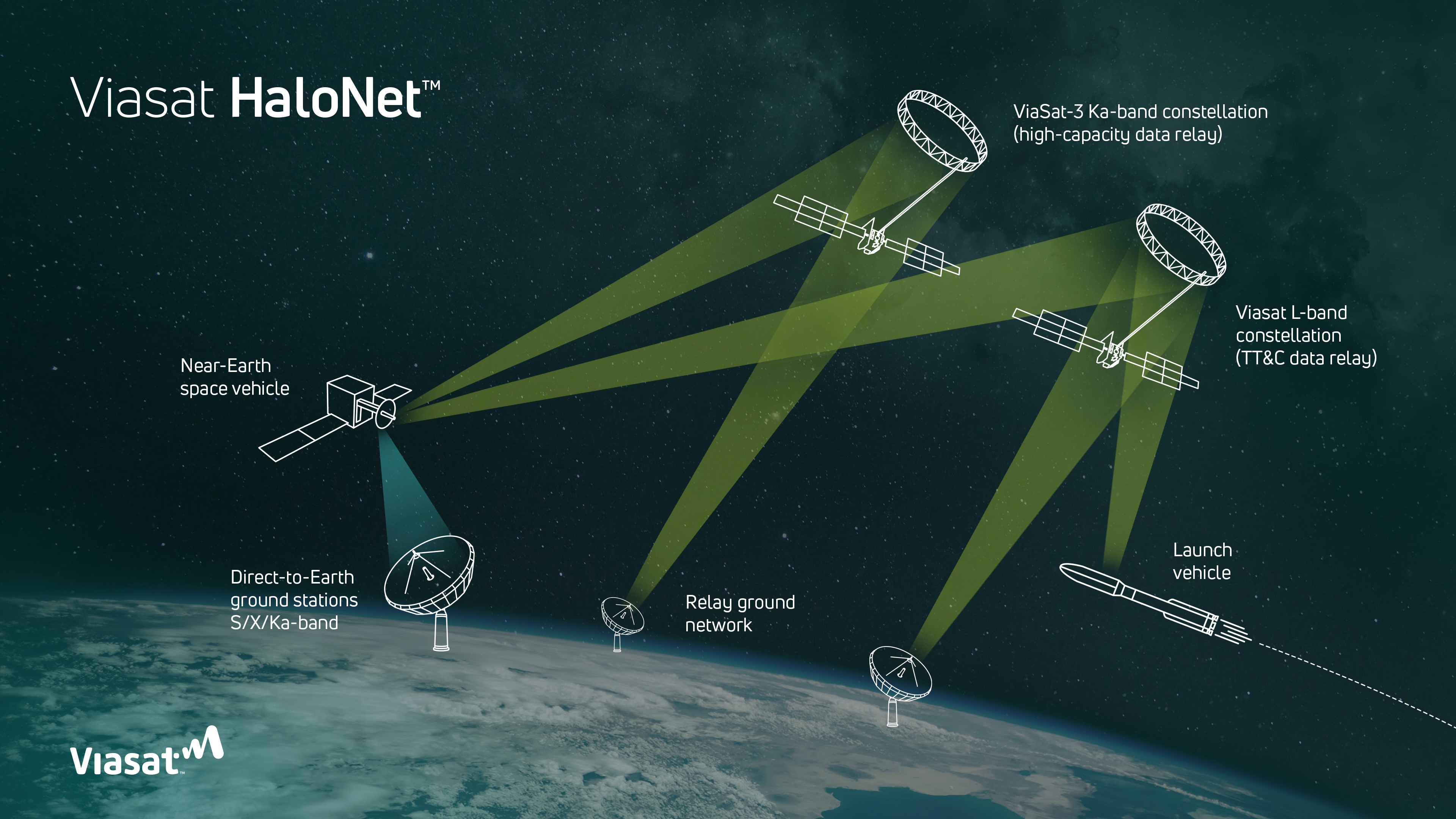
Viasat Inc. is demonstrating launch, tracking, telemetry, command, and high-data rate exchanges for launch vehicles and low Earth orbit operations. In May 2023, Viasat completed the acquisition of Inmarsat, the sixth satellite communications company to win a contract award from NASA, combining the resources of both companies to form a unified global communications provider. 

Viasat’s space demonstrations will use its established satellite networks in geostationary orbit to validate three primary capabilities: launch telemetry over the L-band radio frequency to track and monitor spacecraft during ascent; command and control over L-band to maintain continuous spacecraft custody and enable real-time operations; and high-speed Ka-band data relay to transfer large volumes of mission data through next-generation spacecraft terminals. Flights test began in November, when Viasat used its satellite network to successfully track the telemetry of Blue Origin’s New Glenn rocket as it launched into low Earth orbit. Follow-on demonstrations are planned for 2026, including additional L-band launch services as well as high-capacity services over Ka-band frequencies. 

An artist’s concept outlining Viasat’s satellite relay capabilities.
Credit: Viasat

Commercializing communications services for future near-Earth science missions enables NASA to focus resources on deep space missions to the Moon as part of the Artemis campaign, in preparation for future human missions to Mars. The agency will continue to work with these commercial partners to demonstrate next-generation services through 2027. By 2031, NASA plans to purchase satellite relay services for science missions from one or more U.S. satellite communications providers.   

To learn more about the decision to use commercial satellite relay services in low Earth orbit, visit: 

Embracing Commercial Relay Services – NASA 

The Communications Services Project is managed by NASA’s Glenn Research Center in Cleveland, under the direction of the Space Communications and Navigation Program within NASA’s Space Operations Mission Directorate.  

❌