
Reading view

There are new articles available, click to refresh the page.

The Rise and Fall of The In-Car Fax Machines

By: Lewin Day

Once upon a time, a car phone was a great way to signal to the world that you were better than everybody else. It was a clear sign that you had money to burn, and implied that other people might actually consider it valuable to talk to you from time to time.

There was, however, a way to look even more important than the boastful car phone user. You just had to rock up to the parking lot with your very own in-car fax machine.

Dial It Up

Today, the fax machine is an arcane thing only popular in backwards doctor’s offices and much of Japan. We rely on email for sending documents from person A to person B, or fill out forms via dedicated online submission systems that put our details directly in to the necessary databases automatically. The idea of printing out a document, feeding it into a fax machine, and then having it replicated as a paper version at some remote location? It’s positively anachronistic, and far more work than simply using modern digital methods instead.
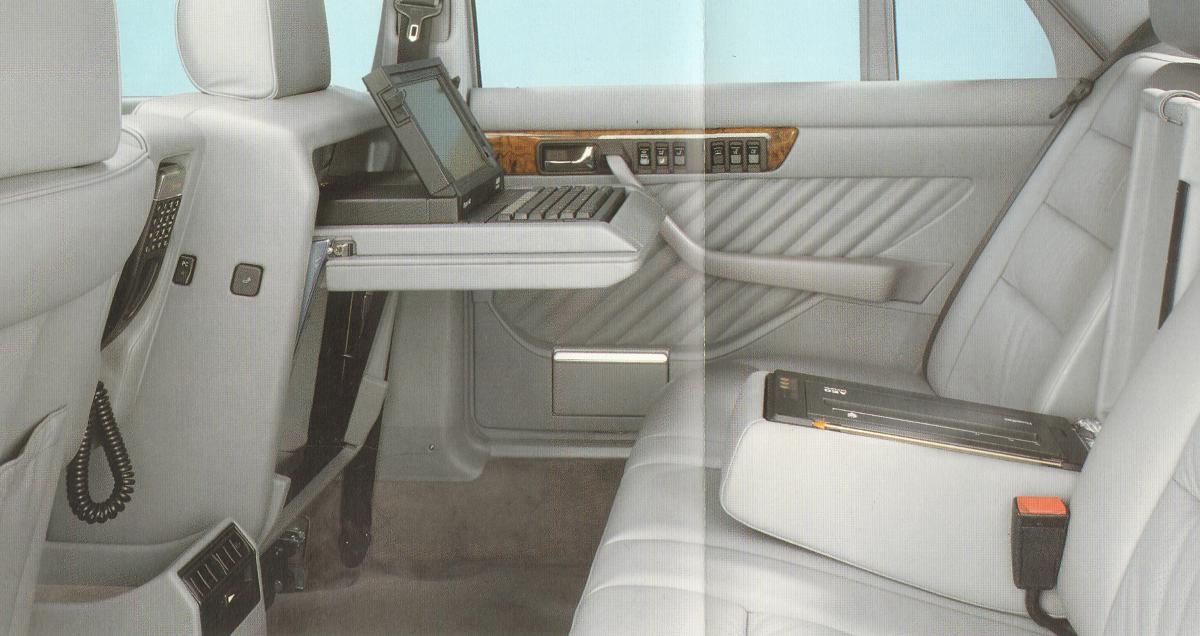
In 1990, Mercedes-Benz offered a fully-stocked mobile office in the S-Class. You got a phone, fax, and computer, all ready to be deployed from the back seat. Credit: Mercedes-Benz

Back in the early 90s though, the communications landscape looked very different. If you had a company executive out on the road, the one way you might reach them would be via their cell or car phone. That was all well and good if you wanted to talk, but if you needed some documents looked over or signed, you were out of luck.

Even if your company had jumped on the e-mail bandwagon, they weren’t going to be able to get online from a random truck stop carpark for another 20 years or so. Unless… they had a fax in the car! Then, you could simply send them a document via the regular old cellular phone network, their in-car fax would spit it out, and they could go over it and get it back to you as needed.

Of course, such a communications setup was considered pretty high end, with a price tag to match. You could get car phones on a wide range of models from the 1980s onwards, but faxes came along a little later, and were reserved for the very top-of-the-line machines.
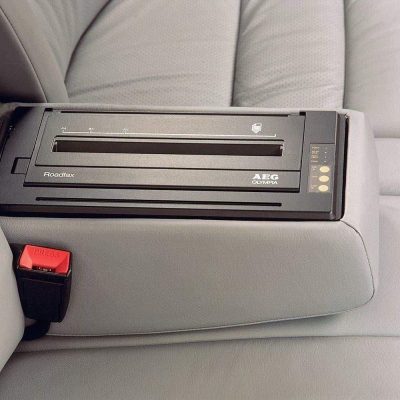
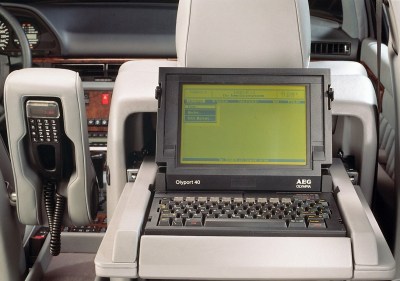
Mercedes-Benz was one of the first automakers to offer a remote fax option in 1990, but you needed to be able to afford an S-Class to get it. With that said, you got quite the setup if you invested in the Büro-Kommunikationssystem package. It worked via Germany’s C-Netz analog cellular system, and combined both a car phone and an AEG Roadfax fax machine. The phone was installed in the backrest of one of the front seats, while the fax sat in the fold-down armrest in the rear. The assumption was that if you were important enough to have a fax in the car, you were also important enough to have someone else driving for you. You also got an AEG Olyport 40/20 laptop integrated into the back of the front seats, and it could even print to the fax machine or send data via the C-Netz connection.
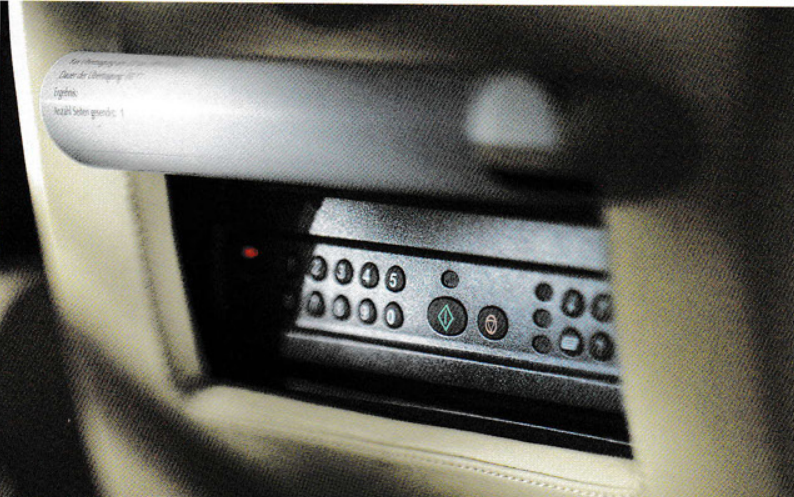
BMW would go on to offer faxes in high-end 7 Series and limousine models. Credit: BMW

Not to be left out, BMW would also offer fax machines on certain premium 7 Series and L7 limousine models, though availability was very market-dependent. Some would stash a fax machine in the glove box, others would integrate it into the back rest of one of the front seats. Toyota was also keen to offer such facilities in its high-end models for the Japanese market. In the mid-90s, you could purchase a Toyota Celsior or Century with a fax machine secreted in the glove box. It even came with Toyota branding!

Ultimately, the in-car fax would be a relatively short-lived option in the luxury vehicle space, for several reasons. For one thing, it only became practical to offer an in-car fax in the mid-80s, when cellular networks started rolling out across major cities around the world.

By the mid-2000s, digital cell networks were taking over, and by the end of that decade, mobile internet access was trivial. It would thus become far more practical to use e-mail rather than a paper-based fax machine jammed into a car. Beyond the march of technology, the in-car fax was never going to be a particularly common selection on the options list. Only a handful of people ever really had a real need to fax documents on the go. Compared to the car phone, which was widely useful to almost anyone, it had a much smaller install base. Fax options were never widely taken up by the market, and had all but disappeared by 2010.

The Toyota Celsior offered a nice healthy-sized fax machine in the 1990s, but it did take up the entire glove box.

These days, you could easily recreate a car-based fax-type experience. All you’d need would be a small printer and scanner, ideally combined into a single device, and a single-board computer with a cellular data connection. This would allow you to send and receive paper documents to just about anyone with an Internet connection. However, we’ve never seen such a build in the wild, because the world simply doesn’t run on paper anymore. The in-car fax was thus a technological curio, destined only to survive for maybe a decade or so in which it had any real utility whatsoever. Such is life!

How Data Brokers Sell Your Identity

Data Privacy Week is here, and there’s no better time to shine a spotlight on one of the biggest players in the personal information economy: data brokers. These entities collect, buy, and sell hundreds—sometimes thousands—of data points on individuals like you. But how do they manage to gather so much information, and for what purpose? From your browsing habits and purchase history to your location data and even more intimate details, these digital middlemen piece together surprisingly comprehensive profiles. The real question is: where are they getting it all, and why is your personal data so valuable to them? Let’s unravel the mystery behind the data broker industry.

What are data brokers?

Data brokers aggregate user info from various sources on the internet. They collect, collate, package, and sometimes even analyze this data to create a holistic and coherent version of you online. This data then gets put up for sale to nearly anyone who’ll buy it. That can include marketers, private investigators, tech companies, and sometimes law enforcement as well. They’ll also sell to spammers and scammers. (Those bad actors need to get your contact info from somewhere — data brokers are one way to get that and more.)

And that list of potential buyers goes on, which includes but isn’t limited to:

  • Tech platforms
  • Banks
  • Insurance companies
  • Political consultancies
  • Marketing firms
  • Retailers
  • Crime-fighting bureaus
  • Investigation bureaus
  • Video streaming service providers
  • Any other businesses involved in sales

These companies and social media platforms use your data to better understand target demographics and the content with which they interact. While the practice isn’t unethical in and of itself (personalizing user experiences and creating more convenient UIs are usually cited as the primary reasons for it), it does make your data vulnerable to malicious attacks targeted toward big-tech servers.

How do data brokers get your information?

Most of your online activities are related. Devices like your phone, laptop, tablets, and even fitness watches are linked to each other. Moreover, you might use one email ID for various accounts and subscriptions. This online interconnectedness makes it easier for data brokers to create a cohesive user profile.

Mobile phone apps are the most common way for data brokerage firms to collect your data. You might have countless apps for various purposes, such as financial transactions, health and fitness, or social media.

A number of these apps usually fall under the umbrella of the same or subsidiary family of apps, all of which work toward collecting and supplying data to big tech platforms. Programs like Google’s AdSense make it easier for developers to monetize their apps in exchange for the user information they collect.

Data brokers also collect data points like your home address, full name, phone number, and date of birth. They have automated scraping tools to quickly collect relevant information from public records (think sales of real estate, marriages, divorces, voter registration, and so on).

Lastly, data brokers can gather data from other third parties that track your cookies or even place trackers or cookies on your browsers. Cookies are small data files that track your online activities when visiting different websites. They track your IP address and browsing history, which third parties can exploit. Cookies are also the reason you see personalized ads and products.

How data brokers sell your identity

Data brokers collate your private information into one package and sell it to “people search” websites. As mentioned above, practically anyone can access these websites and purchase extensive consumer data, for groups of people and individuals alike.

Next, marketing and sales firms are some of data brokers’ biggest clients. These companies purchase massive data sets from data brokers to research your data profile. They have advanced algorithms to segregate users into various consumer groups and target you specifically. Their predictive algorithms can suggest personalized ads and products to generate higher lead generation and conversation percentages for their clients.

Are data brokers legal?

We tend to accept the terms and conditions that various apps ask us to accept without thinking twice or reading the fine print. You probably cannot proceed without letting the app track certain data or giving your personal information. To a certain extent, we trade some of our privacy for convenience. This becomes public information, and apps and data brokers collect, track, and use our data however they please while still complying with the law.

There is no comprehensive privacy law in the U.S. on a federal level. This allows data brokers to collect personal information and condense it into marketing insights. While not all methods of gathering private data are legal, it is difficult to track the activities of data brokers online (especially on the dark web). As technology advances, there are also easier ways to harvest and exploit data.

As of March 2024, 15 states in the U.S. have data privacy laws in place. That includes California, Virginia, Connecticut, Colorado, Utah, Iowa, Indiana, Tennessee, Oregon, Montana, Texas, Delaware, Florida, New Jersey, and New Hampshire.[i] The laws vary by state, yet generally, they grant rights to individuals around the collection, use, and disclosure of their personal data by businesses.

However, these laws make exceptions for certain types of data and certain types of collectors. In short, these laws aren’t absolute.

Can you remove yourself from data broker websites?

Some data brokers let you remove your information from their websites. There are also extensive guides available online that list the method by which you can opt-out of some of the biggest data brokering firms. For example, a guide by Griffin Boyce, the systems administrator at Harvard University’s Berkman Klein Center for Internet and Society, provides detailed information on how to opt-out of a long list of data broker companies.

Yet the list of data brokers is long. Cleaning up your personal data online can quickly eat up your time, as it requires you to reach out to multiple data brokers and opt-out.

Rather than removing yourself one by one from the host of data broker sites out there, you have a solid option: our Personal Data Cleanup.

Personal Data Cleanup scans data broker sites and shows you which ones are selling your personal info. It also provides guidance on how you can remove your data from those sites. And if you want to save time on manually removing that info, you have options. Our McAfee+ Advanced and Ultimate plans come with full-service Personal Data Cleanup, which sends requests to remove your data automatically.

If the thought of your personal info getting bought and sold in such a public way bothers you, our Personal Data Cleanup can put you back in charge of it.

[i] https://pro.bloomberglaw.com/insights/privacy/state-privacy-legislation-tracker/


The post How Data Brokers Sell Your Identity appeared first on McAfee Blog.

❌