Reading view

There are new articles available, click to refresh the page.

Stablecoins Gain Ground In Africa As Remittances Outpace Aid, Ex-UN Official Says

Africa is seeing a quiet shift in how people send and hold value. Mobile phones are central. According to Vera Songwe, a former UN under-secretary-general, millions who lack bank accounts can use stablecoins to protect savings and move money faster. That access matters in places where inflation has been high and bank fees are steep.

Use By Businesses And Everyday People

Reports have disclosed that stablecoins now make up around 43% of all crypto transaction volume in sub-Saharan Africa. Nigeria alone processed nearly $22 billion in dollar-linked stablecoin activity over a recent 12-month span.

That money is used for remittances, payroll and business settlements. Firms and market traders are among the biggest users, but many everyday people are joining in too.

In countries such as Egypt, Nigeria, Ethiopia and South Africa, demand is driven by volatile local currencies and rules that limit access to dollars. Mobile money networks help push adoption along.

Stablecoins Speed Up Cross-Border Payments

Traditional remittances can be costly. At a World Economic Forum panel in Davos, Switzerland on Thursday, Songwe noted that sending $100 through traditional money transfer services in Africa often costs around $6, making cross-border payments both slow and costly.

Stablecoins cut those costs and shorten wait times from days to minutes for many transfers. Small payments and wages can be settled quickly, and that speed changes how businesses plan cash flow.

Local Rules Are Changing Fast

Governments are reacting in different ways. Ghana passed a Virtual Asset Service Providers law to bring trading into a formal framework. On January 13, Nigeria required crypto platforms to link transactions to tax ID numbers, a move meant to bring activity into official records.

South Africa’s central bank has warned that stablecoins and other tokens could pose risks to financial stability as use grows. Policy is being written while users and tech firms keep pushing ahead.

Risks And The Road Ahead

High inflation remains a core reason people are turning to stablecoins. Reports say inflation has exceeded 20% in 12 to 15 countries since the pandemic, and that reality pushes people to look for alternatives to local notes.

Everyday Use, Measured Change

What started as a tech niche has grown into a practical tool for many across the continent. For small and medium businesses, the benefit is clear: faster settlements and lower costs.

For people without bank accounts, a smartphone can now open a route to store value in currencies less tied to local inflation. Adoption will likely keep rising, but how quickly it becomes part of mainstream finance will depend on stronger rules, better safeguards, and the continued spread of simple mobile services that people trust.

Featured image from Unsplash, chart from TradingView

💾

With more stablecoin transfers in 2024 than Visa and Mastercard combined, the asset-pegged token is shifting from niche crypto instrument to a foundational e...

Binance Seeks MiCA Approval in Greece Ahead of EU Regulatory Deadlines

Binance, the world’s largest cryptocurrency exchange, confirmed it has submitted an application for a Markets in Crypto-Assets (MiCA) license in Greece as crypto firms across Europe speed up their efforts to secure regulatory approval before the transitional period expires.

The move adds Greece to the list of EU member states being considered by large digital asset platforms looking to preserve access to the bloc’s single market once MiCA’s licensing regime comes into force. Companies have until June 2026 to secure the license.

Engagement With Greek Authorities Begins

A Binance spokesperson confirmed to CryptoNews that the company has formally lodged its MiCA application and has begun discussions with the Hellenic Capital Market Commission (HCMC), the country’s financial regulator.

“We have submitted our MiCA application and are actively engaging with the Hellenic Capital Market Commission (HCMC),” the spokesperson said.

“We view MiCA as an important milestone for the crypto industry, bringing regulatory clarity, stronger consumer safeguards, and a clearer framework for responsible innovation.”

The spokesperson adds that Binance welcomes collaboration with Greek regulators as the EU-wide regime is implemented, noting the firm’s intention to support the long-term development of Europe’s digital finance ecosystem.

Unified EU Rules Drive Licensing Push

MiCA seeks to form a harmonized regulatory system for crypto-asset service providers operating in the European Union, replacing the fragmented national registration models.

Once authorized, member state firms can offer services across all 27 EU countries through passporting rights. With compliance timelines approaching, exchanges face mounting pressure to secure approval.

MiCA represents one of the most comprehensive regulatory frameworks for crypto-assets globally, intended to provide legal certainty, protect investors, and push innovation in the rapidly evolving digital finance space.

France Steps Up Oversight of Crypto Sector

Binance’s application in Greece comes as regulators in France intensify oversight of the crypto industry. In October, the French authorities launched anti-money laundering inspections covering dozens of crypto firms, including Binance and domestic exchange Coinhouse.

🇫🇷 France conducts AML inspections on Binance and Coinhouse among 100+ entities for MiCA licenses with only 4 firms approved before June 2026 deadline.#France #Binance #Coinbasehttps://t.co/AhYNEuNmzi

— Cryptonews.com (@cryptonews) October 17, 2025

The inspections were being led by France’s prudential supervision authority, the Autorité de Contrôle Prudentiel et de Résolution (ACPR), as it evaluates which of more than 100 registered entities will qualify for EU-wide authorization under MiCA.

As MiCA reshapes Europe’s crypto regulatory environment, the outcome of licensing applications over the coming months is expected to play a decisive role in determining which global platforms maintain access to one of the world’s most important digital asset markets.

The post Binance Seeks MiCA Approval in Greece Ahead of EU Regulatory Deadlines appeared first on Cryptonews.

Retrotechtacular: RCA Loses Fight to IBM

If you follow electronics history, few names were as ubiquitous as RCA, the Radio Corporation of America. Yet in modern times, the company is virtually forgotten for making large computers. [Computer History Archive Project] has a rare film from the 1970s (embedded below) explaining how RCA planned to become the number two supplier of business computers, presumably behind behemoth IBM. They had produced other large computers in the 1950s and 1960s, like the BIZMAC, the RCA 510, and the Spectra. But these new machines were their bid to eat away at IBM’s dominance in the field.

RCA had innovative ideas and arguably one of the first demand paging, virtual memory operating systems for mainframes. You can hope they were better at designing computers than they were at making commercials.

The BIZMAC was much earlier and used tubes (public domain).

In 1964, [David Sarnoff] famously said: “The computer will become the hub of a vast network of remote data stations and information banks feeding into the machine at a transmission rate of a billion or more bits of information a second … Eventually, a global communications network handling voice, data and facsimile will instantly link man to machine — or machine to machine — by land, air, underwater, and space circuits. [The computer] will affect man’s ways of thinking, his means of education, his relationship to his physical and social environment, and it will alter his ways of living. … [Before the end of this century, these forces] will coalesce into what unquestionably will become the greatest adventure of the human mind.”

He was, of course, right. Just a little early.

The machines in the video were to replace the Spectra 70 computers, seen here from an RCA brochure.

The machines were somewhat compatible with IBM computers, touted virtual memory, and had flexible options, including a lease that let you own your hardware in six years. They mention, by the way, IBM customers who were paying up to $60,000 / month to IBM. They mentioned that an IBM 360/30 with 65K was about $13,200 / month. You could upgrade with a 360/30 for an extra $3,000 / month, which would double your memory but not double your computing power. (If you watch around the 18-minute mark, you’ll find the computing power was extremely slow by today’s standards.)

RCA, of course, had a better deal. The RCA 2 had double the memory and reportedly triple the performance for only $2,000 extra per month. We don’t know what the basis for that performance number was. For $3,500 a month extra, you could have an RCA 3 with the miracle of virtual memory, providing an apparent 2 megabytes per running job.

There are more comparisons, and keep in mind, these are 1970 dollars. In 1970, a computer programmer probably made $10,000 to $20,000 a year while working on a computer that cost $158,000 in lease payments (not to count electricity and consumables). How much cloud computing could you buy in a year for $158,000 today? Want to buy one? They started at $700,000 up to over $1.6 million.

By their release, the systems were named after their Spectra 70 cousins. So, officially, they were Spectra 70/2, 70/3, 70/5, and 70/6.

Despite all the forward-looking statements, RCA had less than 10% market share and faced increasing costs to stay competitive. They decided to sell the computer business to Sperry. Sperry rebranded several RCA computers and continued to sell and support them, at least for a while.

Now, RCA is a barely remembered blip on the computer landscape. You are more likely to find someone who remembers the RCA 1800 family of CPUs than an actual RCA mainframe. Maybe they should have throw in the cat with the deal.

Want to see the IBM machines these competed with? Here you go. We doubt there were any RCA computers in this data center, but they’d have been right at home.

U.S. approves P-8A patrol aircraft and torpedo sale to Singapore

The United States State Department has approved a possible $2.316 billion Foreign Military Sale to Singapore for P-8A maritime patrol and reconnaissance aircraft, MK 54 lightweight torpedoes, and associated systems, the Defense Security Cooperation Agency said as it formally notified Congress of the decision. According to the certification delivered to lawmakers, the Government of Singapore […]

Africa’s Bitcoin Mining Map Expands As Ethiopia Seeks Global Partner

Ethiopia has announced it is looking for a global partner to build a state-backed Bitcoin mining operation, moving from a model of hosting private miners toward something run with government involvement.

The call for partners was made at the Finance Forward Ethiopia 2026 event and signals a clearer role for the state in the country’s crypto plans.

State Seeks Global Partner

Reports say Ethiopian Investment Holdings, the country’s sovereign fund, will lead the search and help set up the project with outside capital and technical know-how.

This shift aims to turn cheap, surplus hydropower into a steady source of foreign income instead of leaving it unused.

The move is simple on paper. Use local power. Create jobs. Bring in money. But the reality is quite complex. Ethiopia has already seen miners move in, drawn by low rates and access to hydroelectric plants.

Some deals have been quietly signed. The government hopes that a formal partner will bring better oversight and clearer returns to the state rather than the piecemeal contracts that came earlier.

Hydropower And Money

Large miners have started running rigs in Ethiopia, and one company from the UAE brought a 30MW facility online late last year, tapping into hydropower near Addis Ababa. That project is one example of how outside firms are already scaling operations in the country.

For Ethiopia, this is a revenue play. Reports show the state power utility earned tens of millions of dollars by selling electricity to miners in a recent period, money that would otherwise not have been realized. Those receipts helped make the argument that mining can be folded into national plans for growth.

Some observers worry about tradeoffs. Mining uses lots of equipment and steady power. That can crowd out industrial customers if not managed well. It can also tie a portion of the grid to a business whose income swings with Bitcoin prices.

Still, the government says it wants a partner to reduce these risks and to share expertise so the country benefits more directly.

What Comes Next

Finding the right partner will take time. Reports list interest from firms across the Middle East and Asia, and the government will need to balance foreign deals with local priorities.

The plan also sits inside the wider Digital Ethiopia 2030 effort, which links technology projects to economic goals.

Featured image from Unsplash, chart from TradingView

Revolut Applies for Full Banking License in Peru in Latin America Push

By: Amin Ayan

Revolut has applied for a full banking license in Peru as it steps up its expansion across Latin America, according to a report by Bloomberg.

Key Takeaways:

  • Revolut is applying for a banking license in Peru to expand its regulated footprint in Latin America.
  • The company is targeting remittances in a highly concentrated banking market dominated by incumbents.
  • Growing crypto and stablecoin adoption is reinforcing Revolut’s regional strategy.

If approved, the move would allow the London-based digital bank to operate as a fully regulated lender in the country, adding Peru to a growing regional footprint that already includes Mexico, Colombia, Argentina and Brazil.

The company said the license would enable it to roll out localized banking products and compete directly with Peru’s incumbent banks rather than newer fintech challengers.

Revolut Targets Peru’s Concentrated Banking Market With Remittance Push

Peru’s financial system is highly concentrated, with the four largest banks accounting for roughly 82% of total loans, based on data from the national banking regulator SBS.

Revolut Peru CEO Julien Labrot said the company sees an opportunity to increase competition and improve access to financial services, particularly for underserved users.

Remittances are expected to play a central role in the strategy, with Labrot noting that around one million people in Peru rely on money sent from abroad.

According to the World Bank, personal remittances to Peru reached $4.93 billion in 2024.

The license application comes as Revolut continues to scale its broader platform, including its crypto and digital asset services.

Founded in 2015, the neobank reported a record year in April 2025, with 2024 net profit rising 130% to 790 million pounds ($1.06 billion), driven by customer growth and a rebound in cryptocurrency trading.

In October 2025, Revolut introduced 1:1 U.S. dollar conversions for stablecoins, allowing users to exchange dollars directly into USDC and USDT.

Revolut has applied for a full banking license in Peru, the 5th country in Latin America.

The license would allow the company to “roll out a comprehensive range of localised products and services, offering Peruvians greater control over their finances,” Revolut said in a… pic.twitter.com/BqUavQaEk0

— Max Karpis (@maxkarpis) January 19, 2026

Revolut’s push reflects a wider trend among fintech firms in Latin America moving deeper into crypto and stablecoin-based services.

Mercado Libre launched a dollar-pegged stablecoin in Brazil in 2024, while Nubank is developing stablecoin payments linked to its credit products.

A report from Chainalysis shows the region generated nearly $1.5 trillion in crypto transaction volume between July 2022 and June 2025, showing why global players like Revolut are accelerating their Latin America ambitions.

Stablecoin Payments on Revolut Surge as Everyday Use Gains Momentum

As reported, stablecoin usage on Revolut accelerated sharply in 2025, with payment volumes estimated to have jumped 156% year over year to about $10.5 billion.

While Revolut has not published official figures, onchain data suggests stablecoins nearly doubled their share of total payments on the platform compared with 2024, pointing to growing adoption beyond trading and transfers.

Blockchain data compiled via Dune Analytics shows that growth was steady throughout the year rather than driven by short-term spikes.

Much of the activity came from routine transactions, with transfers between $100 and $500 accounting for roughly 30% to 40% of stablecoin payments, indicating that users are increasingly relying on digital dollars for everyday spending.

The post Revolut Applies for Full Banking License in Peru in Latin America Push appeared first on Cryptonews.

Crypto Rules Are Coming — And Moldova Is Following The EU

Reports say Moldova will roll out its first full crypto law by the end of 2026. The move aims to copy much of the European Union’s Markets in Crypto-Assets rules. This is not a sudden idea. It comes as Moldova continues to line up its laws to match EU standards while it works on closer ties with the bloc.

Moldova Will Mirror EU Rules

According to the finance minister, the plan is to shape a law that looks a lot like MiCA, the EU rulebook for digital assets. That means platforms will need licenses, and services will face rules on how to protect users and stop dirty money.

People in Moldova will be allowed to hold and trade crypto, but using crypto to pay for everyday goods and services will be kept off the table.

What This Means For People And Firms

Reports note the legislation will clarify which firms can convert crypto to the local currency and which cannot. Local authorities say they want to reduce risk for ordinary savers while also giving firms a clear path to operate legally.

Banks and regulators will have a role in writing the details, which will include how exchanges report to tax and anti-money-laundering units.

A Slow Step Toward Openness

Some see this as a cautious opening. By legalizing ownership and trading under tight rules, Moldova hopes to attract clearer investment flows without making crypto a substitute for money.

Reports also mention stricter AML/KYC checks and transparency measures to prevent illicit flows. These parts of the plan are meant to reassure both local users and international partners.

The law is expected to be drafted with input from the finance ministry, the central bank, market regulators, and anti-money-laundering officials.

That mix of voices could slow the process, but it also makes it likelier that the rules will fit the country’s wider financial system. Drafting will be followed by debate and possible revisions before anything becomes final.

A Regional Signal

Based on reports, Moldova’s choice to follow EU templates sends a clear message to neighboring states: align with the EU’s standards and you get legal certainty.

For citizens who trade crypto today in informal ways, the change could mean safer options and official channels to move money. For companies, it means new compliance costs — but a path to operate openly.

Featured image from Reuters/Vladislav Bachev/File Photo, chart from TradingView

Ethereum Maintains Structural Strength Despite Resistance Near $3,400

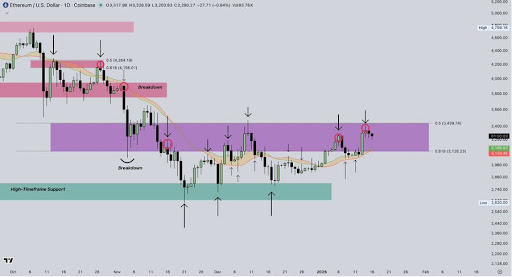
Ethereum continues to show resilience, holding its ground above key support levels even as price faces firm resistance near the $3,400 zone. The ability to sustain strength after recent gains highlights improving market structure, suggesting that buyers remain in control. As long as ETH stays supported above its critical trend levels, the broader upside narrative remains intact despite near-term hesitation.

Daily Bull Market Support Band Holds As Key Reversal Zone

Luca, in a recent ETH update shared on X, pointed out that Ethereum’s market structure has strengthened considerably over the past several days. The price has been able to hold above the 1D Bull Market Support Band, a level that has acted as a reliable reversal zone multiple times over the last couple of months. This sustained hold suggests improving market confidence and a reduction in immediate downside risk.

Alongside this structural improvement, ETH successfully reclaimed the 0.618 Fibonacci point of interest around the $3,100 region. This level is often viewed as a critical threshold in corrective phases, and holding above it typically signals that buyers are gaining the upper hand. 

Ethereum

Despite the positive developments, Ethereum has not moved higher without hesitation. ETH’s price recently faced rejection near the 0.5 Fibonacci level around $3,400, an outcome Luca noted was largely expected. Historically, this area has acted as a significant decision point, often attracting selling pressure and temporary pullbacks before the market decides on its next direction.

Looking forward, Luca believes the overall outlook remains constructive as long as ETH continues to trade above the 1D Bull Market Support Band and the 0.618 Fibonacci level. Maintaining these supports would keep the path open for renewed upside attempts, even if short-term consolidations occur, and the analyst’s positioning remains unchanged.

ETH Above Daily 200MA, Structure Remains Constructive

According to a recent post by Daan Crypto Trades, Ethereum is still advancing gradually while respecting the Daily 200-day moving average against Bitcoin. This type of slow, methodical grind often signals strength beneath the surface, suggesting that buyers remain in control even without aggressive momentum.

The analyst explained that prolonged consolidations and steady climbs like this typically resolve with an acceleration phase. Should ETH break out with stronger upside momentum, it could serve as a trigger for renewed interest across the altcoin market, helping lift sentiment and price action.

However, the structure remains conditional. Holding the Daily 200MA, highlighted in purple, is critical to maintaining this constructive setup. In parallel, Bitcoin must stay above the $94,000 level to maintain the broader low-timeframe bullish structure. As long as these conditions are met, the path of least resistance continues to favor further upside.

Ethereum

Dogecoin RSI Just Entered Historical Oversold Levels Again, Will It Repeat 2021?

The Dogecoin Relative Strength Index (RSI) is said to have entered historical oversold levels. This has raised the possibility that the foremost meme coin could repeat its parabolic rally in the 2021 bull cycle

Dogecoin Eyes Parabolic Rally As RSI Enters Oversold Levels

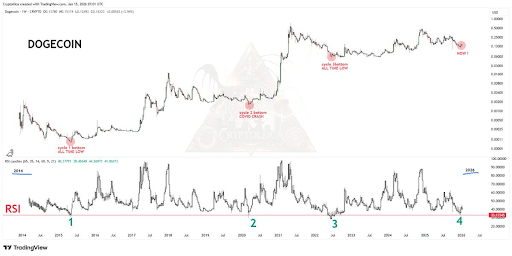
Crypto analyst Cryptollica has indicated that the Dogecoin price could record another parabolic rally as the RSI enters oversold levels. In an X post, the analyst noted that this is the fourth time in 12 years that the DOGE RSI has been this oversold, and that every time this has happened, it has been life-changing. 

Cryptollica further remarked that the drop in Dogecoin’s RSI to this low has always been an “epic buying opportunity” and that those who loaded up made insane gains. In line with this, the analyst remarked that this is another massive opportunity. Meanwhile, Cryptollica alluded to previous times when the RSI dropped this low, including during the last cycle bottom, when DOGE dropped to $0.5. 

Dogecoin

Dogecoin rallied to a new all-time high (ATH) of $0.74 after bottoming at $0.05, recording massive gains in the process. Cryptollica noted that these setups don’t come often and urged market participants not to miss this one. His accompanying chart suggested that DOGE could rally to the psychological $1 level this time around, marking a new ATH for the foremost meme coin. 

DOGE Mirroring Past Accumulation Pattern

In another X post, Cryptollica highlighted a similar DOGE/BTC pattern between the 2014-2017 and 2021-2026 accumulations. The analyst stated that the structure is identical and assured that the bleed against Bitcoin is not “death” but the necessary energy compression before the rotation. Cryptollica added that when the green line breaks, risk appetite changes instantly. 

Meanwhile, Cryptollica declared that the fractal was loading, with Dogecoin set to be the heartbeat of the altcoin cycle. The analyst claimed that this is the final stage of a multi-year compression against Bitcoin. This historically leads to a specific volatility squeeze that precedes a massive capital rotation from BTC to altcoins. 

Crypto analyst Bitcoinsensus raised the possibility of a Dogecoin rally to $0.70, which could be near. This came as the analyst noted that DOGE has been moving in a nice way up throughout this entire bull cycle. This is said to be evident in the mini cycles, with the foremost meme coin tapping the dotted line, followed by a slow retrace. Based on this pattern, Bitcoinensus noted that DOGE could soon target the $0.70 range if the strong momentum in the crypto market returns. 

At the time of writing, the Dogecoin price is trading at around $0.137, down in the last 24 hours, according to data from CoinMarketCap.

Dogecoin

Bank Of America CEO Issues $6T Stablecoin Rewards Warning As Regulatory Debate Heats Up

The CEO of Bank of America has warned that trillions of dollars could flee from bank deposits to the stablecoin sector if the upcoming crypto market structure bill allows interest payments on the tokens.

Banking System Could Face $6 Trillion Problem

On Wednesday, Bank of America CEO Brian Moynihan told investors that the banking industry could face significant challenges if the US Congress does not prohibit interest-bearing stablecoins.

During its Q4 earnings call, the executive affirmed that up to $6 trillion in deposits, around 30% to 35% of all US commercial bank deposits, could flow out of the banking system and into the stablecoin sector, citing Treasury Department studies.

The banking sector has heavily criticized the US’s landmark stablecoin legislation, the GENIUS Act, for months, claiming that it has loopholes that could pose risks to the financial system. Notably, the crypto framework prohibits interest payments on the holding or use of payment-purpose stablecoins but only addresses issuers.

Multiple banking associations across the US sent a joint letter to the Senate Banking Committee urging Congress to amend the law to include digital asset exchanges, brokers, dealers, and related entities.

According to the call’s transcript, Moynihan compared the digital assets to money market mutual funds, which require reserves to be held in short-term instruments, such as US Treasuries, thereby reducing lending capacity in the system.

That is the bigger concern that we’ve all expressed to Congress as they think about this, if you move it outside the system, you’ll reduce the lending capacity of banks. (…) And if you take out deposits, (…) they’re either not going to be able to loan or they’re going to have to get wholesale funding and that wholesale funding will come at a cost that will increase the cost of borrowing.

The CEO asserted that Bank of America would not be affected by this issue, as the institution would be able to “meet customer demand, whatever may surface.” However, he noted that it would particularly hurt small- and medium-sized businesses, as they’re “largely lent to end consumers by the banking industry.”

Stablecoin Rewards Debate Intensifies

Moynihan’s remarks come amid the Senate’s struggles with the long-awaited market structure bill. The recently shared draft, which was scheduled for a markup today, has raised concerns among crypto industry leaders, who have outlined multiple problems with the bill.

Coinbase’s CEO, Brian Armstrong, took to X to share his disappointment with the legislation, affirming that “this version would be materially worse than the current status quo. We’d rather have no bill than a bad bill.”

He affirmed that, after reviewing the bill’s draft, Coinbase could not support it in its current state, arguing that there were “too many issues.” Among the problems, he noted the de facto ban on tokenized equities, crucial DeFi prohibitions, the “erosion” of the Commodity Futures Trading Commission (CFTC)’s authority, and the policies regarding the payment of interests on stablecoins.

As reported by Bitcoinist, this version of the market structure bill introduced key restrictions for stablecoin issuers. Under the proposed changes, issuers would be able to offer rewards for specific actions, such as account openings and cashback.

However, they are prohibited from offering interest payments to passive token holders. To Armstrong, this “would kill rewards on stablecoins,” and allow banks to “ban their competition.”

Amid the intensified backlash, Senate Banking Committee Chairman Tim Scott announced on Wednesday that the bill’s markup had been postponed to “deliver clear rules of the road that protect consumers, strengthen our national security, and ensure the future of finance is built in the United States.”

Total, stablecoin

Is Bank Of America Currently Running Tests With Ripple’s XRP? Here’s What We Know

Crypto pundit X Finance Bull has alleged that the Bank of America (BofA) is running tests for cross-border payments using Ripple-linked XRP. This follows an earlier statement from Ripple’s President, Monica Long, about the bank and the potential adoption of crypto. 

Crypto Pundit Alleges That Bank of America Is Using Ripple’s XRP

In an X post, X Finance Bull claimed that the Bank of America is already running tests with Ripple and that cross-border payments are being rewritten. He added that Ripple provides the technology, the bank runs the tests, and the U.S. ensures legality. In line with this, he remarked that XRP is becoming the core financial plumbing. 

In a video shared by crypto pundit Xaif last year, Ripple President Monica Long had mentioned that Bank of America was one of their early partners when they were developing the messaging software online payment solution. However, she didn’t say whether the partnership still exists till now. 

Bank of America notably filed a patent for real-time net settlement using a distributed ledger system, which appeared to be based on Ripple’s payment network. This plan has since been abandoned as the bank never moved forward with the application. The bank has, however, opened up to crypto as it now allows its wealth clients to allocate up to 4% to crypto. The bank is also exploring issuing its stablecoin, which could make it a direct competitor to Ripple. 

Meanwhile, Long also mentioned how several banks had contacted Ripple for payments and custody services after Donald Trump won the U.S. presidential elections. Ripple’s CEO, Brad Garlinghouse, had also previously mentioned that they secured more partnerships following Trump’s victory, as the U.S. president paved the way for a more regulatory-friendly environment. 

Ripple’s Major Existing Banking Partners

Ripple has notably secured partnerships with other major banking institutions in recent times, as several nations provide a more regulatory-friendly environment. The crypto firm has partnered with Bank of New York Mellon (BNY), which is the largest custodian. The bank serves as the primary reserve custodian of Ripple’s RLUSD stablecoin

Furthermore, Ripple recently announced that its Ripple Prime is an early adopter of BNY’s tokenized deposit services for institutional clients. These tokenized deposits operate on the bank’s private blockchain and don’t involve the XRP Ledger or XRP. Other major banks such as AMINA Bank, Absa, and SBI have also partnered with Ripple. 

AMINA recently became the first European bank to integrate Ripple payments into its operations. SBI has also adopted Ripple payments. Meanwhile, the crypto firm provides custody services to Absa, one of South Africa’s largest banks.

At the time of writing, the XRP price is trading at around $2.10, down over 3% in the last 24 hours, according to data from CoinMarketCap.

Ripple

Ruling Venezuela with a 2,000 Mile Hammer is Not Likely to End Well

EXPERT OPINION — Rule by proxy just isn’t as simple as the Trump Administration wants to make it sound. While the long-term goals of the Administration in Venezuela are unclear, the tools they appear to want to use are not.

First, the Administration seems to want to dictate policy to the Delcy Rodriguez government through threats of force, which President Trump recently highlighted by suggesting that he had called off a second strike on Venezuela because the regime was cooperating.

Second, the Trump Administration has stated that it will control the oil sales “indefinitely” to, in the words of the Secretary of Energy, “drive the changes that simply must happen in Venezuela.”

Leaving aside the legality and morality of using threats of armed force to seize another country’s natural resources and dictate an unspecified set of “changes”, this sort of rule from a distance is unlikely to work out as intended.

First, attempting to work through the Venezuelan regime will drive a number of choices that the Administration does not appear to have thought through. Propping up an authoritarian regime that is deeply corrupt, violent, and wildly unpopular will over time increasingly alienate the majority of the Venezuelan people and undermine international legitimacy.

Regime leaders, and the upper echelons of their subordinates, are themselves unlikely to quietly depart power or Venezuela itself without substantial guarantees of immunity and probably wealth somewhere else. Absent that, they will have every incentive to throw sand in the works of any sort of process of political transition. Yet facilitating their escape from punishment for their crimes with some amount of their ill-gotten gains is unlikely to be acceptable to the majority of the Venezuelan people.

Elements of the regime have already taken steps to crack down on opposition in the streets. The Trump Administration is going to decide how much of this sort of repression is acceptable. Too much tolerance of repression will harm the already-thin legitimacy of this policy, particularly among the Venezuelan people, the rest of the hemisphere, and those allies the Administration hasn’t managed to alienate. Too little tolerance will encourage street protests and potentially anti-regime violence and threaten regime stability.

The Cipher Brief brings expert-level context to national and global security stories. It’s never been more important to understand what’s happening in the world. Upgrade your access to exclusive content by becoming a subscriber.

Opposition leader Maria Corina Machado has announced that she plans to return to Venezuela in the near future, which could highlight the choices the Administration faces. Some parts of the Rodriguez government will want to crack down on her supporters and make their lives as difficult as possible. The Trump Administration is going to have to think hard about how to react to that.

The tools of violence from a distance, or even abductions by Delta Force from over the horizon, are not well calibrated to deal with these dilemmas.

The Venezuelan regime appears to be heavily factionalized and punishing Delcy Rodriguez, which President Trump has threatened, could benefit other factions, for example, the Minister of the Interior or the Minister of Defense, both allegedly her rivals for power.

Unless the Administration can count on perfect intelligence about what faction is responsible for each disfavored action and precisely and directly respond, we are likely to see different factions, and even elements of the opposition, undertake “false flag” activity intended to cause the U.S. to strike their rivals.

Actions to punish or compel the regime also run the risk of collateral damage, in particular civilian casualties which will undermine support for U.S. policy both in Venezuela and abroad and potentially bolster support for the regime. And intelligence on the ground is not going to be perfect and airstrikes or raids will almost certainly cause collateral damage despite the incredible capabilities of the U.S. intelligence community and the U.S. military.

Need a daily dose of reality on national and global security issues? Subscriber to The Cipher Brief’s Nightcap newsletter, delivering expert insights on today’s events – right to your inbox. Sign up for free today.

Secondly, assuming that the Administration doesn’t intend to use the proceeds of sales of Venezuelan oil to build the White House ballroom, it’s unclear what mechanisms they plan to use to ensure that those proceeds benefit the Venezuelan people.

The Venezuelan regime is deeply corrupt. Utilizing the Venezuelan government to distribute proceeds from oil sales is just a way of ensuring that regime elites continue to siphon off cash or use that money to reward their followers, punish their opponents, or coopt potential rivals by buying them off.

Assuming that the U.S. could, in fact, somehow track the vast majority of the funds from oil sales and ensure that they are not misused, this would again undermine the unity and inner workings of a regime built on buying off factions and elites. That would likely encourage those factions to find other ways of extracting funds—for example, increased facilitation of drug shipments or shakedowns of local firms supporting the reconstruction of the oil sector.

Yet the U.S. is not at all likely to have a granular view of what happens to that money. The U.S. intelligence community, while capable of a great many things, cannot track where most of these funds go or who is raking off how much.

In Iraq and Afghanistan, where the U.S. had tens of thousands of soldiers, spies, advisors, and bureaucrats and was directly funding large parts of those governments, staggering levels of corruption existed and at times, helped fund warlords and faction leaders who undermined stability. We even managed to fund our adversaries at times.

In Venezuela, by contrast, we might have an embassy.

Unless the problem of how to monitor where the money goes can be solved, the U.S. will be supporting and funding a corrupt regime that feathers its own nest and undermines the transition to democracy.

Ruling from a distance, or even trying to force a political transition from a distance, drives a number of choices that the Administration clearly hasn’t thought through. And the tools the Administration is choosing to use; force from over the horizon and the control over the flow of some funds, aren’t matched well enough or sufficiently nuanced to accomplish the ends they claim to want to achieve.

Given that, it’s unlikely this will end well.

The Cipher Brief is committed to publishing a range of perspectives on national security issues submitted by deeply experienced national security professionals.

Opinions expressed are those of the author and do not represent the views or opinions of The Cipher Brief.

Have a perspective to share based on your experience in the national security field? Send it to Editor@thecipherbrief.com for publication consideration.

Read more expert-driven national security insights, perspective and analysis in The Cipher Brief, because national security is everyone’s business.

DZ Bank Secures MiCAR Approval, Prepares Nationwide Retail Crypto Trading Rollout

Bitcoin Magazine

DZ Bank Secures MiCAR Approval, Prepares Nationwide Retail Crypto Trading Rollout

Germany’s second-largest lender DZ Bank has received authorization under the European Union’s Markets in Crypto-Assets Regulation, clearing the way for the launch of a retail crypto trading platform across the country’s cooperative banking sector.

The German Federal Financial Supervisory Authority, BaFin, granted the MiCAR license at the end of December. 

With the approval, DZ Bank will roll out “meinKrypto,” a digital asset trading platform designed for customers of Volksbanken and Raiffeisenbanken, Germany’s network of cooperative banks.

The platform allows local cooperative banks to offer retail clients access to cryptocurrency trading within an existing banking environment.

DZ Bank acts as the central institution, while each cooperative bank must submit its own MiCAR notification to BaFin before activating the service for customers.

Once approved and integrated into the VR Banking App, meinKrypto will function as a wallet and trading interface for self-directed investors. At launch, the platform will support Bitcoin and other crypto.

Germany’s crypto cooperative banks

DZ Bank said additional assets could be added later, subject to regulatory review.

The rollout will follow a decentralized model. Each cooperative bank will decide whether to offer crypto trading based on its own strategy and risk assessment. 

Customers will be able to buy, sell, and hold digital assets without using external exchanges, keeping activity within the regulated banking system.

The technical infrastructure behind meinKrypto was developed by Atruvia, the IT provider for the cooperative financial group, in partnership with DZ Bank. Stuttgart Stock Exchange Digital will provide crypto custody services, ensuring asset safekeeping under German and EU regulatory standards.

The move reflects growing interest in digital assets across Germany’s cooperative banking sector. 

A September 2025 survey by the German Cooperative Banking Association found that 71% of Volksbanken and Raiffeisenbanken were considering crypto services, up from 54% the previous year. 

About one-third of banks exploring crypto said they planned to launch offerings within five months.

DZ Bank’s entry into retail crypto trading follows earlier efforts focused on institutional clients. The Frankfurt-based lender began offering digital asset services for institutions through partnerships with regulated market infrastructure providers. The new MiCAR license extends that strategy to private customers through the cooperative network.

In a separate development, DZ Bank announced this week that it has joined Qivalis, a European banking consortium working on a regulated euro-denominated stablecoin. 

The group of 11 banks plans to launch the stablecoin next year through a new Dutch entity under the same name.

Qivalis is seeking approval from the Dutch central bank to operate as an e-money institution, with a target market entry in the second half of 2026. The consortium says the project aims to support payments and settlement for European businesses and consumers within a regulated framework.

Together, the meinKrypto rollout and the stablecoin initiative signal a broader push by Germany’s cooperative banking sector to integrate digital assets into mainstream financial services under MiCAR.

This post DZ Bank Secures MiCAR Approval, Prepares Nationwide Retail Crypto Trading Rollout first appeared on Bitcoin Magazine and is written by Micah Zimmerman.

Tech Moves: Acumatica hires CPO; former Amazon manager named new mayor of Bellevue

Jon Pollock. (Acumatica Photo)

Jon Pollock is now chief product officer of Acumatica, the Bellevue, Wash.-based enterprise software giant that was acquired last year by Vista Equity Partners.

Pollock joins Acumatica from childcare management software company Procare Solutions, where he was CPO and general manager of Procare’s ChildPlus division. He previously held leadership roles with Worldpay, Asurion, Dell, Polaroid and others.

“Jon has the experience, vision, and strong track record of leading dynamic teams to execute our product strategy and empower the people who use our software every day,” John Case, CEO of Acumatica, said in a statement.

Case succeeds Ali Jani, who was with the company for 16 years. Early in his career, Jani co-founded a PC manufacturing startup and a company providing software for business management operations.

Mo Malakoutian. (LinkedIn Photo)

Mo Malakoutian is now the mayor of the City of Bellevue. Malakoutian joined the Bellevue City Council in 2023, was elected by his colleagues to serve as deputy mayor beginning in 2024, and was chosen as mayor this month.

Malakoutian previously worked at Amazon for more than eight years, leaving the role of senior manager of learning and development in October. He is currently the executive director of the University of Washington’s Consulting and Business Development Center with the Foster School of Business.

Malakoutian replaces Lynne Robinson, who was mayor since 2020. She remains on the Bellevue City Council.

City councilmember Dave Hamilton was appointed deputy mayor of Bellevue.

David Bettis. (LinkedIn Photo)

— Software engineering leader David Bettis is leaving Amazon after two decades. Bettis was most recently with Amazon Web Services, including roles focused on the company’s telehealth initiative. Earlier in his career, Bettis worked on the company’s Halo product, Amazon Go’s cashierless “Just Walk Out” technology, Kindle and other initiatives.

Bettis said on LinkedIn that he stayed at Amazon for so long because of the opportunity to work on emerging businesses, which provided “new and exciting opportunities, while staying under the same roof.”

More recently he had “explored a couple paths internally, but nothing sparked the same excitement I’d felt in previous roles. That’s when I realized it was time for a bigger change.”

The engineer added that he’ll spend most of this year deciding what full-time role comes next — maybe a smaller company, teaching, something entrepreneurial — and that he’ll be staying in Seattle.

Steven Hatch. (LinkedIn Photo)

— In another Amazon departure, Steven Hatch has resigned from his role as head of engineering with AWS Bedrock. Hatch, based in New York City, has been with Amazon for nearly 18 years, working in areas including with Audible, Amazon Prime delivery experience, computer vision and most recently in AI.

Hatch said on LinkedIn that he’s “closing a chapter that changed how I think, lead, and build. I’m proud of my achievements. But the real story was about the people, the learning, and the craft.”

Hatch did not disclose his next move, but said there would be “more soon.”

Warren McNeel left T-Mobile after more then 25 years with the Bellevue-based telecom juggernaut. McNeel has been in the wireless sector for three decades, and most recently served as T-Mobile’s senior vice president of information technology.

McNeel said on LinkedIn that he wanted to spend time with his family “and begin thinking about the next chapter of my professional journey.”

“I’ve had the privilege of leading some of the best technology and product teams in the industry,” he added. “I couldn’t be more proud of the innovations, technology transformations, and results these teams delivered.”

Sri Mulyani Indrawati. (Gates Foundation Photo)

— Seattle-based Gates Foundation appointed Sri Mulyani  Indrawati to its governing board. Indrawati was Indonesia’s first female minister of finance and the former managing director and chief operating officer of the World Bank.

“She adds fresh perspective for the board as it guides the foundation’s direction over the next 20 years,” said CEO Mark Suzman.

The Gates Foundation announced two additional leadership changes:

  • Hari Menon is now president of the organization’s Global Growth and Opportunity Division. Menon has been with the foundation for nearly 20 years.
  • Ankur Vora is president of the newly-created Africa and India Offices Division as well as retaining his role as chief strategy officer.

Reverb, a Seattle-based HR consulting and leadership development firm, is officially expanding into the Colorado market with the hiring of Renee Fischer. Fischer, who resides in Denver, is a business development and human resources consultant.

Sabah Öney joined the board of directors of Seattle’s Fred Hutch Cancer Center. Öney is the president and CEO of Dispatch Bio, a Bay Area startup that is developing a treatment for solid tumors. He is also a co-founder of the protein design company Vilya.

— Seattle-based Cascadia Capital, an investment bank serving clients globally, promoted Kerri Hagen to managing director within the its Financial Sponsors Group. Hagen has been with the firm for more than three years.

— Seattle software engineering startup FlintLab named Diwakar as its head of engineering. Diwakar, who was previously based in India, joins from the semiconductor company AMD. Past employers include Ericsson, RSA Security and others.

FlintLab launched in 2024 and describes itself as an “AI-powered infrastructure platform as a service” company. Co-founders Krishna Seerapu and Jinesh M.D previously held roles at Amazon and elsewhere.

Life Science Washington announced four new members of its board of directors:

  • Arden Yang, vice president of Innovation at the Allen Institute
  • LisaMarie Curda, a partner focused on audit and assurance with Deloitte
  • Jie D’Elia, CEO of the bio-pharmaceutical company SystImmune
  • Chris Holt, vice president of cell therapy external manufacturing with Bristol Myers Squibb

Now Comes the Hard Part in Venezuela

EXPERT PERSPECTIVE — Now comes the hard part in Venezuela. Dictator Nicolas Maduro and his wife are gone but the regime is still in power. Most Venezuelans, particularly in the diaspora, are pleased and relieved. Many are also apprehensive.

The Trump administration has decided to compel the cooperation of Maduro’s Vice President, Delcy Rodriguez, now interim president. It is not at all assured that she will be a reliable partner. The U.S. decision to work with those still in control was logical even if disappointing to some in the democratic opposition which, after all, won the presidential election overwhelmingly in late July of 2024. The opposition’s base of support dwarfs that of the regime but the military, intelligence services and police are all still loyal to the regime - at least for the time being. The Trump administration believes the cooperation of these elements of the regime will be necessary for the Trump administration to implement its plans for the country without further U.S. police and military actions on the ground.

Need a daily dose of reality on national and global security issues? Subscriber to The Cipher Brief’s Nightcap newsletter, delivering expert insights on today’s events – right to your inbox. Sign up for free today.

The Trump administration has said we will be taking over the oil sector and President Trump himself has announced his intention to persuade the U.S. private sector to return to Venezuela to rebuild the sector. Oil production in Venezuela has declined by two thirds since Hugo Chavez, Maduro’s predecessor, was elected in 1998. This unprecedented decline was due to incompetent management, undercapitalization and corruption. Had Chevron not opted to stay in the country under difficult circumstances, the production numbers would look even worse. Resurrecting the oil sector will take time, money and expertise. The return of the U.S. oil companies and the infusions of cash that will be required will only happen if an appropriate level of security can be established — and that will require the cooperation of the Venezuelan armed forces and police. Many senior leaders in those sectors are believed to have been deeply complicit in both the abuses and corruption of a government the United Nations said was plausibly responsible for “crimes against humanity.” Two of the regime figures most widely believed to have been, along with Maduro himself, the architects of the Bolivarian regime’s repressive governance are still in power, Minister of the Interior Diosdado Cabello and Minister of Defense General Vladimir Portino Lopez. They will need to be watched and not permitted to undermine U.S. efforts to rehabilitate the oil sector and orchestrate a return to legitimate, popularly supported and democratic government.

The Cipher Brief brings expert-level context to national and global security stories. It’s never been more important to understand what’s happening in the world. Upgrade your access to exclusive content by becoming a subscriber.

There are several considerations that the U.S. will need to keep in mind going forward. First, more than 80 percent of Venezuelans now live below the poverty line. Their needs must be addressed . Even the shrinking number of Venezuelans who aligned with the regime are hoping to see their lives improve. Between 2013 and 2023, the country’s GDP contracted by around 70 percent, some believe it may have been as much as 75 percent. As most of Venezuela’s licit economy is essentially moribund and the U.S. will be controlling oil exports, the poor will naturally look to the United States for help. Heretofore, the regime employed food transfers to keep the populace in line. That role should move to the NGO community, the church or even elements of the democratic opposition.

Indeed, it will be important to secure the cooperation of the opposition, notwithstanding the Trump administrations to work with Delcy Rodriguez and company as the opposition represents the majority of Venezuelans inside the country as well as out. It will also be necessary to pay the military and it is not at all clear that the regime elements still in place will have the money to do so once oil receipts are being handled by the United States. If the U.S. is to avoid the mistakes that followed the fall of Saddam Hussein, attending to the needs of the populace and paying the rank and file of the military should be priorities.

The Trump administration should also move as quickly as the security situation permits to reopen the U.S. embassy in Caracas. There is reporting out of Colombia that the U.S. Charge in Bogota has already made a trip to Caracas to evaluate the situation. This is a good thing. There is no substitute for on-the-ground engagement and observation.

The Cipher Brief is committed to publishing a range of perspectives on national security issues submitted by deeply experienced national security professionals. Opinions expressed are those of the author and do not represent the views or opinions of The Cipher Brief.

Have a perspective to share based on your experience in the national security field? Send it to Editor@thecipherbrief.com for publication consideration.

Read more expert-driven national security insights, perspective and analysis in The Cipher Brief, because national security is everyone’s business.

❌