
Reading view

There are new articles available, click to refresh the page.

New Florida Bill Would Legalize Recreational Marijuana And End 'Monopolies' In Medical Cannabis With Expanded Business Licensing

A Florida lawmaker has introduced a new bill to legalize recreational marijuana that also aims to break up what he calls “monopolies” in the state's current medical cannabis program by revising the business licensing structure.

The legislation, filed by Sen. Carlos Guillermo Smith (D), comes as the state Supreme Court reviews the constitutionality of proposed adult-use legalization initiative that an industry-funded campaign is seeking to place on the November ballot.

Under the new bill, adults over 21 years of age could legally possess up to four ounces of smokable marijuana or cannabis products containing up to 2,000 milligrams of THC. Medical cannabis patients would be allowed to grow up to six flowering plants at home for personal use.

Medical marijuana businesses that apply for adult-use licenses could begin selling cannabis for recreational purposes beginning next January.

“We can't call ourselves the 'Free State of Florida' while continuing to criminalize cannabis use by grown adults,” Smith told Marijuana Moment on Thursday, adding that a majority of voters approved a legalization initiative at the ballot in 2024 that wasn't enacted after “falling just short of the state's arbitrary 60 percent threshold.”

“The message from voters was unmistakable: they want change,” he said. “Senate Bill 1398 answers that call by legalizing cannabis for adults 21 and over in a safe, responsible, and tightly regulated way.”

“It also ends state-created medical marijuana monopolies by opening the market to small businesses and gives Floridians the freedom to cultivate their own cannabis if they choose,” the senator said. “It's time for the Legislature to stop ignoring the will of the people, end draconian criminalization laws, and finally deliver a fair, legal, and accountable cannabis system for Florida.”

Under the new bill, current medical cannabis dispensaries—known as medical marijuana treatment centers (MMTCs)—could apply for retail licenses to sell recreational marijuana. And only cannabis purchased from licensed businesses would be legal to possess.

People with prior convictions for activity made legal under the bill would also be given an opportunity for resentencing and expungement.

The legislation stipulates marijuana and paraphernalia would be exempt from being taxed—but only for medical cannabis patients and caregivers. Additionally, local governments would be able to levy a business tax on dispensing facilities.

There's been some criticism among advocates about the current medical marijuana system, specifically around the idea that vertical integration and licensing caps have effectively created a marijuana monopoly in the state.

In an attempt to address that issue, the bill would break out licensing categories. In contrast to the current system of seed-to-sale businesses, regulators would offer individual licenses to cultivate, manufacture, transport and sell cannabis products.

There isn't a specific mandate for an increase in the number of licensed marijuana businesses, but the measure would direct the state Department of Health to adopt rules on “procedures and requirements for…the registration and registration renewal of MMTCs.” Depending on the outcome of that rulemaking process, new businesses could enter the market.

Also, registered cultivator and processors would be able to do wholesale transactions with other MMTCs, which is not currently permitted under Florida's medical cannabis program.

The legislation would also task the Department of Agriculture and Consumer Services to adopt rules adopt “regulating the cultivation of marijuana by members of the public for their private use, including rules regulating the use of a cooperative model for cultivation.”

Here's an overview of additional Florida marijuana developments:

In the background, a campaign is working against the clock to collect enough signatures to again put the question of adult-use marijuana legalization to voters at the ballot. But there have been complications.

Most recently, the Republican attorney general of Florida and several business and anti-marijuana groups urged the state Supreme Court to block the legalization initiative, calling it “fatally flawed” and unconstitutional.

The attorney general's office last month asked the state Supreme Court to review the constitutionality of the legalization initiative. The court accepted the request and set a schedule for state officials and the cannabis campaign to file briefs this month. Proponents of the measure have until January 12 to submit response briefs, then the opposition has until January 20 to reply.

The briefs were filed days after Smart and Safe Florida filed a new lawsuit against state officials, alleging that they improperly directed the invalidation of about 71,000 signatures as a turn-in deadline approaches.

In March, meanwhile, two Democratic members of Congress representing Florida asked the federal government to investigate what they described as “potentially unlawful diversion” of millions in state Medicaid funds via a group with ties to Gov. Ron DeSantis (R). The money was used to fight against the 2024 citizen ballot initiative, vehemently opposed by the governor, that would have legalized marijuana for adults.

The lawmakers' letter followed allegations that a $10 million donation from a state legal settlement was improperly made to the Hope Florida Foundation, which later sent the money to two political nonprofits, which in turn sent $8.5 million to a campaign opposing Amendment 3.

The governor said last February that the newest marijuana legalization measure is in “big time trouble” with the state Supreme Court, predicting it would be blocked from going before voters this year.

“There's a lot of different perspectives on on marijuana,” DeSantis said. “It should not be in our Constitution. If you feel strongly about it, you have elections for the legislature. Go back candidates that you believe will be able to deliver what your vision is on that.”

“But when you put these things in the Constitution—and I think, I mean, the way they wrote, there's all kinds of things going on in here. I think it's going to have big time trouble getting through the Florida Supreme Court,” he said.

In 2023, the governor accurately predicted that the 2024 cannabis measure from the campaign would survive a legal challenge from the state attorney general. It's not entirely clear why he feels this version would face a different outcome.

While there's uncertainty around how the state's highest court will navigate the measure, a poll released last February showed overwhelming bipartisan voter support for the reform—with 67 percent of Florida voters backing legalization, including 82 percent of Democrats, 66 percent of independents and 55 percent of Republicans.

Separately, Florida medical marijuana officials are actively revoking the registrations of patients and caregivers with drug-related criminal records. The policy is part of broad budget legislation signed into law last year by DeSantis. The provisions in question direct the state Department of Health (DOH) to cancel registrations of medical marijuana patients and caregivers if they're convicted of—or plead guilty or no contest to—criminal drug charges.


Written by Kyle Jaeger for Marijuana Moment | Featured image by Gina Coleman/Weedmaps

The post New Florida Bill Would Legalize Recreational Marijuana And End 'Monopolies' In Medical Cannabis With Expanded Business Licensing appeared first on Weedmaps News.
Trump Signs Executive Order To Reclassify Marijuana By Removing It From Schedule I

Marijuana will be federally rescheduled under an executive order signed by President Donald Trump on Thursday.

The directive also aims to address federal hemp laws to promote access to full-spectrum CBD that could be covered under federal health insurance plans.

Months after Trump said a decision on the cannabis reform proposal was imminent, the president issued the directive for agencies to begin moving forward with the plan to transfer cannabis from Schedule I to Schedule III of the Controlled Substances Act (CSA).

“We have people begging for me to do this, people that are in great pain for decades,” Trump said. “This action has been requested by American patients suffering from extreme pain, incurable diseases, aggressive cancers, seizure disorders, neurological problems, and more—including numerous veterans with service-related injuries and older Americans who live with chronic medical problems that severely degrade their quality of life.”

This marks one of the most significant developments in federal marijuana policy since its prohibition a half a century ago, with a Schedule III reclassification recognizing that marijuana has medical value and a lower abuse potential compared to other Schedule I drugs like heroin.

Rescheduling will not federally legalize cannabis. However, the policy change will enable state-licensed marijuana businesses to claim federal tax deductions that they've been previously denied under an Internal Revenue Service (IRS) code known as Section 280E. It will also remove certain research barriers applied to Schedule I drugs.

The change may also spur additional states to modernize their own policies on cannabis, as some lawmakers have cited the federal government's restrictive classification of marijuana as a reason they have been uncomfortable with enacting legalization or at least allowing medical use.

In addition to directing the attorney general to expedite the completion of the process of rescheduling marijuana to Schedule III of the CSA, the executive order also includes a novel proposal to allow Medicare recipients to access non-intoxicating CBD that'd be covered under the federal health care plan.

That is a policy Trump seemed to endorse over the summer when he shared a video calling for that specific reform while promoting the health benefits of cannabidiol, particularly for seniors.

Marijuana Moment first reported on leaked details from a White House briefing about the plan on Thursday ahead of the signing event. That includes a directive for top White House staff to work with Congress to give patients access to full-spectrum CBD products, “while still restricting the sale and access to products that cause serious and potentially life-threatening health risks.”

The order also urges Congress to examine updating the definition of hemp to ensure that full-spectrum CBD is accessible to patients—a policy change that could mitigate some concerns in the sector about a recent spending bill Trump signed with provisions that would broadly ban consumable hemp products.

Separate from Trump's order, Mehmet Oz, administrator for the Centers for Medicare & Medicaid Services (CMS), will also be announcing “a model that will allow a number of CMS beneficiaries to benefit from receiving CBD under doctor recommendation at no cost,” a White House official said during the briefing.

Trump endorsed rescheduling—as well as industry banking access and a Florida adult-use legalization initiative—on the campaign trail last year. The president had been largely silent on the issue since taking office during his second term, until an August briefing, where, in response to a reporter's question, he announced that the administration would decide on rescheduling within weeks.

By moving forward with the plan, Trump is completing a process initiated under the Biden administration. That involved a scientific review by the U.S. Department of Health and Human Services (HHS)—which concluded that Schedule III is a more appropriate category for marijuana—as well as the Drug Enforcement Administration (DEA).

Recent news reports revealed that Trump was planning to issue the executive order directing federal agencies to move ahead with cannabis rescheduling following a meeting with marijuana industry executives, HHS Secretary Robert F. Kennedy Jr., and Centers for Medicare and Medicaid Services Administrator Mehmet Oz. During that meeting, Trump reportedly phoned House Speaker Mike Johnson (R-LA), who expressed his opposition to rescheduling cannabis.

The rescheduling announcement comes weeks after the president signed a key spending bill that would effectively ban most consumable hemp products, drawing criticism from stakeholders in the hemp industry who argue the policy change would eradicate the market.

Meanwhile, amid the heightened rumors that the Trump administration would be moving forward on marijuana rescheduling, multiple top congressional Democrats made the case that the reform would not go far enough—including one senator who said the move is only an attempt by the president to “gaslight” voters into thinking he legalized cannabis to boost his “pathetic” approval ratings.

Dozens of Republican members of Congress have urged Trump not to reschedule marijuana, arguing that it would harm public health and safety.


Written by Kyle Jaeger for Marijuana Moment | Featured image by Gina Coleman/Weedmaps

The post Trump Signs Executive Order To Reclassify Marijuana By Removing It From Schedule I appeared first on Weedmaps News.

Massachusetts Officials Approve Rules Allowing Marijuana Social Consumption Lounges To Open

Massachusetts marijuana regulators have unanimously approved rules to license and regulate cannabis social consumption lounges in the state.

Members of the Cannabis Control Commission (CCC) voted 4-0 on Thursday to approve the rule, which was unveiled over the summer.

The rules create three new license types related to social consumption: One would let existing dispensaries build upon their business by allowing marijuana use at their facilities, another would permit “hospitality” services by non-cannabis businesses such as cafes and theaters, and another would create an “event organizer” category for entities wishing to allow marijuana consumption at events such as music festivals.

“The Commonwealth has been eagerly waiting social consumption, so we're proud to move this effort across the finish line,” Shannon O'Brien, chair of the commission, said in a press release. “We look forward to the economic opportunities these new license types will offer to small businesses and entrepreneurs who have been disproportionately harmed by the War on Drugs.”

Bruce Stebbins, co-chair of the CCC social consumption working group, said the finalized regulatory package “reflects years of stakeholder engagement, research, and policy discussion and deliberation.”

“Next steps will include ongoing engagement with municipalities that must opt-in to hosting social consumption and educating residents to ensure the Commonwealth is prepared for this expansion of our $8 billion regulated cannabis industry,” he said.

The enactment of the policy makes Massachusetts the first state in New England to allow cannabis social consumption facilities to open.

Today Commissioners voted unanimously to approve three new license types that will allow the on-site consumption of cannabis in Massachusetts for the first time. Learn about the final policies and next steps here: https://t.co/tsE2Wlggtb

— Massachusetts Cannabis Control Commission (@MA_Cannabis) December 11, 2025

Kimberly Roy, another member of the commission, said the vote to advance the package “marks a long-awaited and carefully considered milestone for Massachusetts' regulated cannabis industry.”

“By finalizing the Social Consumption license-type, the Commission is honoring the will of the voters who envisioned safe, legal spaces for adult-use cannabis, while maintaining strong safeguards to protect public health and public safety,” she said. “This achievement represents years of collaboration among stakeholders, policymakers, and communities across the Commonwealth.”

However, she added, the vote on Thursday “does not conclude the Commission's work; it begins a new chapter of consumer and public education to ensure this emerging sector operates safely and responsibly.”

Commissioner Carrie Benedon said the “finalization of these social consumption reforms represents a significant milestone for legal cannabis in the Commonwealth.”

“Commissioners and staff have put significant thought and care into crafting a program that will provide economic opportunities for equity participants and small businesses while emphasizing public health and safety,” she said.

Travis Ahern, executive director of CCC, said the social consumption license option “offers the Commonwealth significant regional tourism opportunities, safe spaces for those who cannot consume cannabis at home, the ongoing transition of legacy operators to the legal market,” he said. “Commission staff have worked hard to support the creation of each license type, and we're excited to get to work setting up the internal infrastructure that will enable these new businesses to serve Massachusetts residents.”

The policy change around social consumption lounges comes amid a push by anti-legalization activists to put an initiative on the ballot next year that would roll back the state's adult-use legalization law.

An association of Massachusetts marijuana businesses recently urged voters to tell local officials about any cases of misleading signature gathering tactics and “fraudulent messaging” by the campaign behind that effort.

There have been allegations piling up that petitioners working on behalf of Coalition for a Healthy Massachusetts have shared false information about what the measure would accomplish, with claims that paid petitioners have used fake cover letters for other ballot measures on issues like affordable housing and same-day voter registration. The state attorney general's office has confirmed that it has received complaints to that effect, but the campaign has denied sanctioning such activities.

Under the proposed initiative, adults 21 and older could still possess up to an ounce of cannabis, only five grams of which could be a marijuana concentrate product. Possession of more than one ounce but less than two ounces would be effectively decriminalized, with violators subject to a $100 fine. Adults could also continue to gift cannabis to each other without remuneration.

But provisions in the state's voter-approved marijuana law that allow for commercial cannabis retailers and access to regulated products by adults would be repealed under the proposal. Adults' right to cultivate cannabis at home would also be repealed. The medical cannabis program would remain intact, however.

Massachusetts Attorney General Andrea Campbell's (D) office—which cleared the campaign for signature gathering in September—has stressed to voters the importance of reading their summary, which is required to go at the top of the signature form, before signing any petitions.

Meanwhile, the head of Massachusetts's marijuana regulatory agency recently suggested that the measure to effectively recriminalize recreational cannabis sales could imperil tax revenue that's being used to support substance misuse treatment efforts and other public programs.

Whether the cannabis measures will be approved is yet to be seen. Voters approved legalization at the ballot in 2016, with sales launching two years later. Over the past decade, the market has evolved and expanded. As of August, Massachusetts officials reported more than $8 billion in adult-use marijuana sales.

In November, the Massachusetts Senate approved a bill that would double the legal marijuana possession limit for adults and revise the regulatory framework for the state's adult-use cannabis market. Similar legislation also advanced through the House earlier this year.


Written by Kyle Jaeger for Marijuana Moment | Featured image by Gina Coleman/Weedmaps

The post Massachusetts Officials Approve Rules Allowing Marijuana Social Consumption Lounges To Open appeared first on Weedmaps News.

Massachusetts Would Recriminalize Recreational Marijuana Sales Under 2026 Ballot Initiatives Being Reviewed By Attorney General

The attorney general of Massachusetts has published dozens of proposed initiatives for the 2026 ballot—including a pair that would roll back adult-use marijuana legalization in the state.

Attorney General Andrea Joy Campbell's (D) office released 47 initiative petitions filed by 19 groups ahead of a Wednesday deadline. It will now review each petition to determine whether it can be legally certified.

The two marijuana measures, which would eliminate the commercial adult-use market while maintaining patient access under the medical cannabis program and continuing to allow lawful possession of up to an ounce of recreational marijuana, are being spearheaded by Caroline Cunningham, who previously fought against a psychedelics legalization ballot initiative that voters ultimately rejected last year.

Under the new measures—titled “An Act to Restore A Sensible Marijuana Policy”—adults 21 and older could still possess up to an ounce of cannabis, only five grams of which could be a marijuana concentrate product.

Possession of more than one ounce but less than two ounces would be effectively decriminalized, with violators subject to a $100 fine. Adults could also continue to gift cannabis between each other without remuneration.

But provisions in the state's voter-approved marijuana law that allow for commercial cannabis retailers and access to regulated products by adults would be repealed under the proposal.

Adults' right to cultivate cannabis at home would also be repealed.

There are two versions of the initiative. They're largely identical—except that one would set THC potency limits on medical marijuana, requiring the Cannabis Control Commission (CCC) to prohibit flower in excess of 30 percent THC and concentrates over 60 percent THC or that have more than 5mg THC per metered serving. There would also be a ban on cannabis concentrates that “fail to clearly provide metered, or otherwise measured, standard delivered servings” of 5 mg THC and on packages of concentrate that exceed 20 metered or measured servings.

After reviewing all of the proposed initiatives to determine if they're consistent with constitutional requirements for ballot placement, the attorney general's office will then certify them and issue finalized summaries, clearing proponents to start signature gathering.

They will need to turn in 74,574 valid signatures from registered voters to the secretary of state's office by December 3, initiating a separate verification process to certify the signatures.

Whether the cannabis measures make the cut is yet to be seen. Voters approved legalization at the ballot in 2016, with sales launching two years later. And the past decade has seen the market evolve and expand. As of last month, Massachusetts officials reported more than $8 billion in adult-use marijuana sales.

Regulators are also working to finalize rules to allow for a new cannabis consumption lounge license type, which they hope to complete by October.

Separately, in May, CCC launched an online platform aimed at helping people find jobs, workplace training, and networking opportunities in the state's legal cannabis industry.

State lawmakers have also been considering setting tighter restrictions on intoxicating hemp-derived products and a plan to allow individual entities to control a larger number of cannabis establishments.

Also in Massachusetts, legislators who were working on a state budget butted heads with CCC officials, who've said they can't make critical technology improvements without more money from the legislature.


Written by Kyle Jaeger for Marijuana Moment | Featured image by Gina Coleman/Weedmaps

The post Massachusetts Would Recriminalize Recreational Marijuana Sales Under 2026 Ballot Initiatives Being Reviewed By Attorney General appeared first on Weedmaps News.

California Delays Cannabis Tax Hike for 5 Years After Vote

The California Assembly has unanimously approved a bill to delay the implementation of a planned hike on marijuana taxes.

About a month after state officials announced that the cannabis excise tax rate would increase from 15 percent to 19 percent on July 1, the Assembly voted 74-0 to pass legislation from Assemblymember Matt Haney (D) to delay the change for five years.

The bill now goes to the Senate for consideration, but advocates hope to see its language incorporated into a separate budget trailer measure that would take effect upon enactment — as opposed to at the beginning of next year as would be the case under Haney's bill.

While the legislation as introduced would have outright repealed the proposed tax hike, it has since been amended to delay its implementation until the 2030-2031 fiscal year.

The United Food and Commercial Workers (UFCW) officials applauded the Assembly's vote.

Joe Duffle, president of UFCW Local 1167, said raising the tax rate would “only increase the number of failed legal cannabis businesses” in the state.

AB 564 freezes the cannabis excise tax at 15 percent and gives legal cannabis businesses a fighting chance to stay afloat in an industry that is contracting every day,” he said. “Without this bill, the illicit cannabis industry will only flourish more and keep putting untested, untaxed and unregulated cannabis products into the hands of consumers.”

https://www.instagram.com/p/DKa13eoNrwI

Under the legislation, the California Department of Tax and Fee Administration (CDTFA), working with the Department of Finance, would be required to “adjust the cannabis excise tax rate upon purchasers of cannabis or cannabis products” based on the “additional percentage of the gross receipts of any retail sale by a cannabis retailer that the department estimates will generate an amount of revenue equivalent to the amount that would have been collected in the previous fiscal year,” the bill text says.

The department would need to “estimate the amount of revenue that would have been collected in the previous fiscal year pursuant to the weight-based cultivation tax” and “estimate this amount by projecting the revenue from weight-based cultivation taxes that would have been collected in the previous calendar year based on information available to the department.”

“The specific goal of the cannabis excise tax rate reduction is to provide immediate tax relief to the cannabis industry,” the measure states. “The efficacy of this goal may be measured by the Legislature by the amount of gain or loss in cannabis excise tax revenues resulting from the cannabis excise tax rate reduction allowed by this act.”

It also mandates that CDTFA, on or before December 1, 2026, and each subsequent year, California “submit a report to the Legislature…detailing the amount of gain or loss in cannabis excise tax revenues resulting from the cannabis excise tax rate reduction allowed by this act.”

Meanwhile, California officials last month awarded another round of community reinvestment grants to nonprofits and local health departments, funded by marijuana tax revenue.

California's Supreme Court separately delivered a victory for the state's marijuana program last month, rescinding a lower court ruling in a case that suggested federal prohibition could be used locally to undermine the cannabis market.

The state Supreme Court ruling also came just weeks after California officials unveiled a report on the current status and future of the state's marijuana market, with independent analysts hired by regulators concluding that the federal prohibition on cannabis that prevents interstate commerce is meaningfully bolstering the illicit market.

Gov. Gavin Newsom (D) did sign a bill in 2022 that would have empowered him to enter into interstate cannabis commerce agreements with other legal states, but that power was incumbent upon federal guidance or an assessment from the state attorney general that sanctioned such activity.

Meanwhile, a California Senate committee recently declined to advance a bipartisan bill that would have created a psilocybin pilot program for military veterans and former first responders.


Written by Kyle Jaeger for Marijuana Moment | Featured image by Weedmaps

The post California Delays Cannabis Tax Hike for 5 Years After Vote appeared first on Weedmaps News.

U.S. Marijuana Consumers Have Spent More Than $4.1 Billion On Pre-Rolled Joints In The Past Year And A Half, Industry Report Finds

American marijuana consumers have spent more than $4.1 billion on pre-rolled joints over the past year and a half, according to a new industry report, with the products now making up about 15.9 percent of the cannabis market.

Among the latest trends in the pre-roll market, it adds, is the continued growth of specialty infused pre-rolls, which are sold as a premium product and typically contain marijuana concentrate. Those products, which command higher price points than standard pre-rolls, accounted for almost half (44 percent) of the pre-roll market during the first half of 2024.

The findings were compiled by product manufacturer Custom Cones USA using data from the cannabis intelligence firm Headset, which collects point-of-sale data in a dozen U.S. states. It's Custom Cones's third year releasing a white paper on the current state of the pre-roll market.

“Every year we like to hunker down and look at the story the data is telling,” Harrison Bard, the company's co-founder and CEO, said in a press release. “Thanks to the help of our partners at Headset, we can now see even more clearly that pre-rolls are continuing to dominate the market on an upward trajectory that confirms our belief that pre-rolls remain a potent and profitable symbol of the cannabis industry as a whole.”

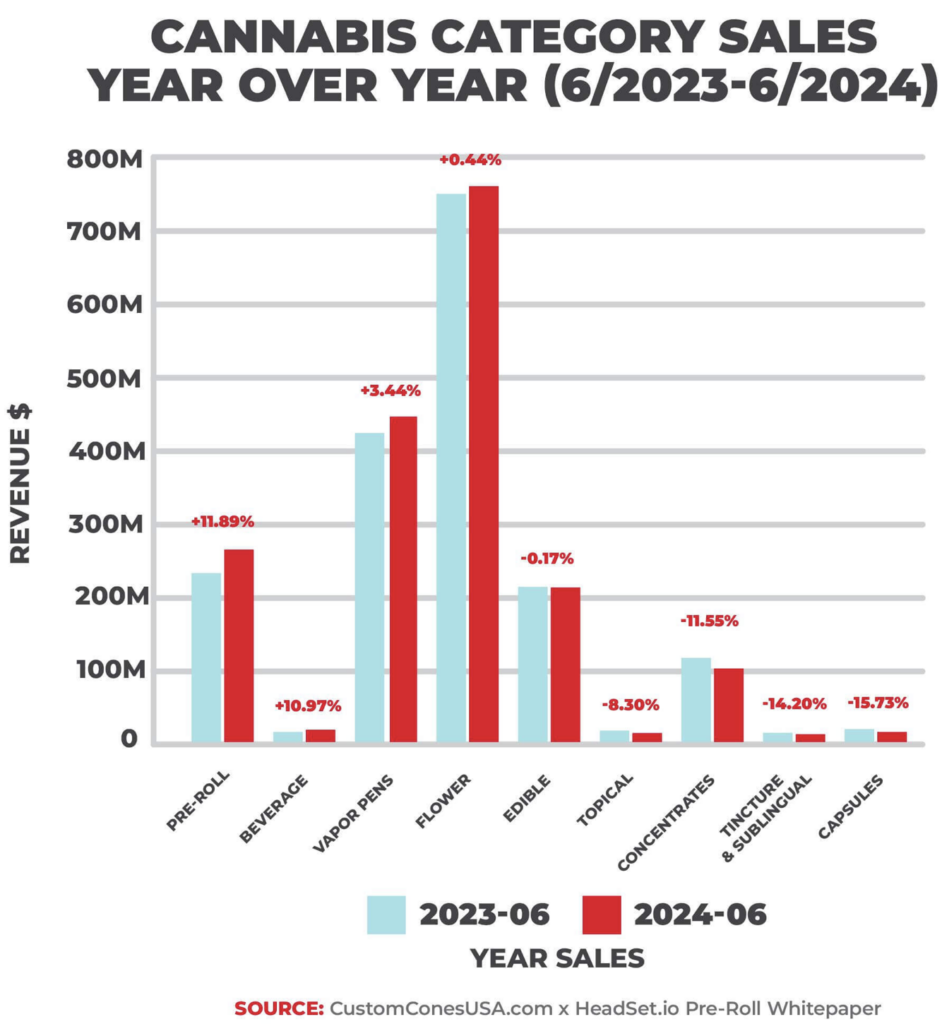
The data put pre-rolls in third place in terms of product form factors at marijuana retailers, following raw flower and vape pens. The report notes that in June 2024, sales revenue from pre-rolls was almost 12 times that of infused beverages.

Graphic of year-over-year cannabis sales.Courtesy of Custom Cones USA via Marijuana Moment
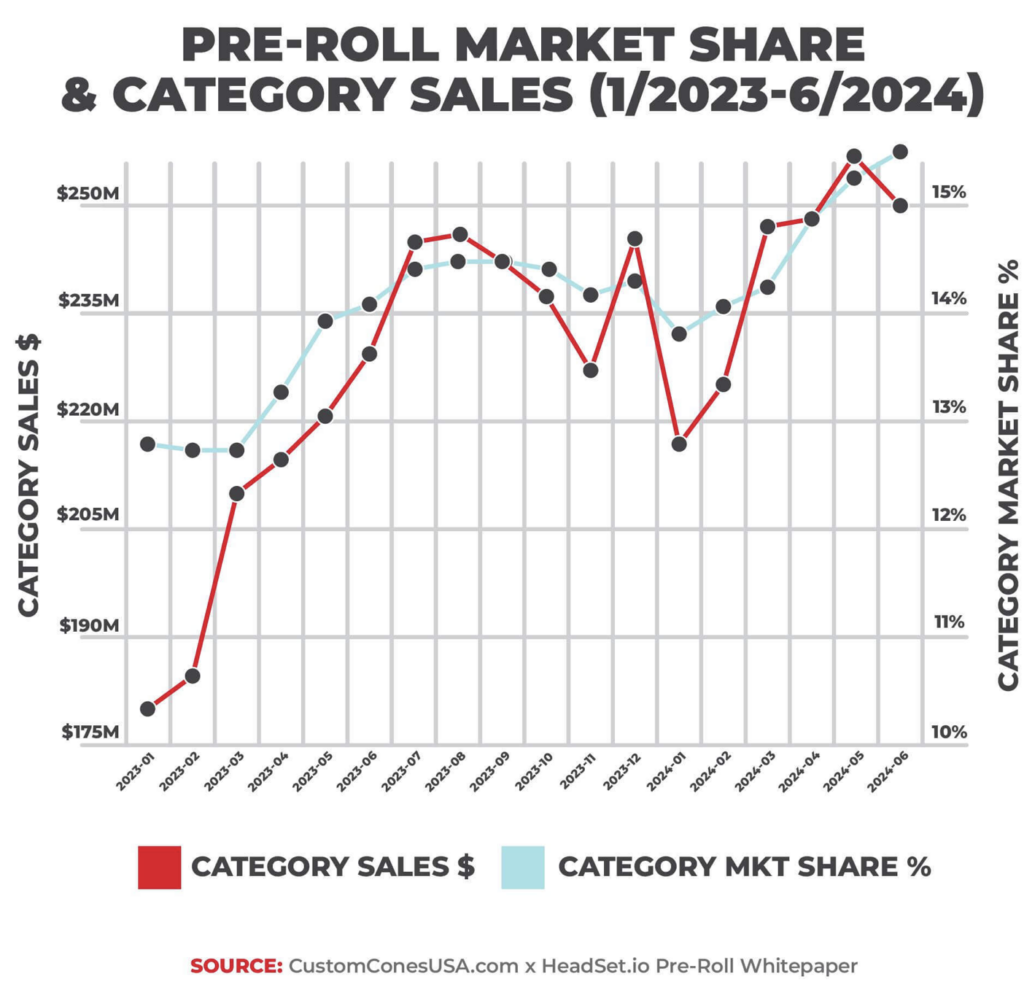
From January 2023 to June 2024, pre-rolls saw “a meteoric increase in market share,” Custom Cones said, rising from 13.2 percent to 15.9 percent over that time period.

“The rise of the pre roll market is even more impressive when looking back even further,” the company noted. “Pre roll market share has increased every year since 2020 – when it stood at just 9.8%. The increase in sales revenue in the last five years is nothing short of remarkable: annual pre roll sales revenue went from $469 million in 2019 to $2.7 billion in 2023. That's nearly a sixfold increase in annual revenue.”

Prices on pre-rolls have also been falling, dropping from $7.80 per unit in January 2023 to $6.50 per unit in June 2024, a reduction of about 16.7 percent. But the overall size of the market is growing thanks to greater sales volume.

“Although average item price is on the decline, total pre roll items sold are skyrocketing – going from 15.9 million items sold in January 2023 to a record 26 million units sold in June 2024,” the report says.

Graphic of pre-roll sales from the last year.Courtesy of Custom Cones USA via Marijuana Moment

Headset data from the report came from Arizona, California, Colorado, Illinois, Massachusetts, Maryland, Michigan, Missouri, Nevada, New York, Oregon and Washington. That information was combined with other findings, such as a Custom Cones USA sample of about 1,000 pre-roll consumers.

Both consumers and businesses, the report says, choose pre-rolls predominantly based on price point and THC potency. Other factors include the strain of cannabis, paper type, packaging and brand loyalty.

The shift toward what Custom Cones calls the “connoisseur/infused” pre-roll segment has been happening for years, with producers marketing more high-end, indulgent products.

“Since 2019, the segment has maintained an average 34.4% share of the pre roll category across the 12 tracked markets,” says the company's press release. “This share has recently experienced a rapid acceleration, reaching 41.5% in 2023 and climbing further to 44.4% in the first half of 2024. This trend suggests a growing consumer preference for these premium products (that also command premium prices).”

As part of its effort to monitoring the latest in the cannabis pre-roll market, Custom Cones USA and its DaySavers brand have also launched notable efforts to drive engagement with consumers. In June, it announced it would pay 200 volunteers $4.20 apiece to smoke two free pre-rolls and provide feedback for a so-called “Science of Smokeability” study—a collaboration with the Cannabis Research Coalition and the Network of Applied Pharmacognosy.

Pre-rolls in a pile on white background.Gina Coleman/Weedmaps

“This research not only has the potential to improve product quality and consistency, but also promote sustainability, profitability, and a deeper scientific understanding of cannabis as a medicinal and recreational product,” the company said at the time.

The study results are set to be shared with the standards organization ASTM International, which last year helped to add a pair of new marijuana items to a federal handbook that are meant to provide model standards for cannabis definitions, packaging and labeling requirements and best storage practices to control for moisture loss in marijuana flower.

DaySavers separately launched a campaign in March to hire for what it calls the “ultimate stoner dream job,” seeking a content creator to “get paid to smoke weed.” The full-time social media creator and event marketer job pays $70,420 with perks including cannabis product testing and all expenses paid travel to marijuana events.

The campaign is reminiscent of the time that cannabis icon Snoop Dogg disclosed in 2019 that he pays a person between $40,000-$50,000 per year to roll blunts for him.

Separate reporting from Headset, meanwhile, analyzed public comments related to the federal government's planned rescheduling of marijuana. It found that approximately 35 percent of comments submitted to the Drug Enforcement Administration (DEA) agreed with the Biden administration plan, but most—57 percent—said cannabis should be entirely descheduled.

“These numbers paint a clear picture: over 9 out of 10 individuals who took the time to comment believe that cannabis should not remain a Schedule I substance,” Headset said at the time. “Moreover, the majority of commenters went beyond the proposed rescheduling to Schedule III, arguing for complete removal from the controlled substances list.”


Written by Ben Adlin for Marijuana Moment | Featured image by Gina Coleman/Weedmaps

The post U.S. Marijuana Consumers Have Spent More Than $4.1 Billion On Pre-Rolled Joints In The Past Year And A Half, Industry Report Finds appeared first on Weedmaps News.

❌