Reading view

There are new articles available, click to refresh the page.

Loosening the Gordian Knot of Global Terrorism: Why Legitimacy Must Anchor a Counterterrorism Strategy

OPINION The global terrorism landscape in 2026 — the 25th anniversary year of the 9/11 terrorism attacks — is more uncertain, hybridized, and combustible than at any point since 9/11. Framing a sound U.S. counterterrorism strategy — especially in the second year of a Trump administration — will require more than isolated strikes against ISIS in Nigeria, punitive counterterrorism operations in Syria, or a tougher rhetorical posture.

A Trump administration counterterrorism strategy will require legitimacy: the domestic, international, and legal credibility that leverages a wide-range of counterterrorism tools, while engendering international counterterrorism cooperation. Without legitimacy, even tactically successful counterterrorism operations risk becoming illusory, politicized, and ultimately self-defeating.

The terrorist threat landscape

Extremist violence no longer conforms to clean ideological lines. Terrorist objectives and drivers are muddled in ways that are hard to understand — but evolving. There’s little ideological purity with those radicalizing in today’s extremist milieu.

At the same time, state-directed intelligence officers increasingly behave like terrorists. Russian intelligence-linked sabotage plots blur the line between terrorism and hybrid warfare. Islamic Revolutionary Guard Corps officers provide hands-on training to Lebanese Hizballah commanders. Addressing these kinds of risks requires legitimacy, too, especially among allies whose intelligence cooperation, legal authorities, and public support are indispensable.

Nowhere is this threat picture more tenuous than in the Middle East. Hamas’s October 7, 2023, attacks triggered a profound rebalancing of power in the region. Yet, Syria remains unfinished business. Power vacuums there invite foreign jihadists, threaten Israel's border communities, and create future opportunities for Iranian influence to rebound.

A modest but persistent U.S. presence in Syria with a friendly Ahmed al-Sharaa-led government remains a strategic hedge against an Islamic State resurgence, and is a strong signal of U.S. commitment that helps sustain partner confidence. The U.S. counterterrorism presence and alignment with al-Sharaa is not without its risks, though: in December, three Americans were killed by a lone ISIS gunman in central Syria. The country is, and will continue to be, plagued by sectarianism and terrorism, which means that restoring control over a deeply fractured Syria remains fraught.

Taken together, the current transnational terrorism threat landscape is volatile and difficult to predict, a challenge compounded by resource constraints. In such an environment, legitimacy becomes a force multiplier. A belief that America is a ‘force for good’, credible messaging, and confidence that U.S. government action is perceived as just, can go a long way.

This is not an abstract concern. Terrorism today thrives in contested information environments, polarized societies, and fragile states. In short, transnational jihadist networks now coexist with domestic violent extremists, and online radicalization ecosystems that blur the line between terrorism, insurgency, and hybrid warfare. Terrorist propaganda continues to resonate with individuals in the West, especially younger generations who radicalize online. In this environment, legitimacy is no longer a secondary benefit of sound strategy—it is a core guiding principle.

The Trump administration's counterterrorism approach

We are looking for more clarity on the trajectory of Trump 2.0 counterterrorism efforts. It’s still, premature to consider a strategy that has yet to be formally articulated, as many in the counterterrorism community eagerly await its release. History offers a useful reminder. The first Trump administration did not publish its National Strategy for Counterterrorism until its second year. When it appeared in 2018, critics and supporters alike acknowledged that it reflected professional judgment rather than ideological excess. That document recognized terrorism’s evolution and called for strengthening counterterrorism partnerships within the U.S. government, but abroad as well, with a range of longstanding allies.

What gave that strategy durability was its legitimacy. Authorities were grounded in law, threat assessments were evidence-based, policies were stress-tested for faulty assumptions, and foreign partnerships were treated as strategic assets rather than transactional relationships.

When the Biden administration publicly released a set of redacted rules secretly issued by President Trump in 2017 for counterterrorism operations — such as “direct action” strikes and special operations raids outside conventional war zones — those guidelines explicitly acknowledged the power of legitimacy. Counterterrorism succeeds when allies trust the U.S., and the American public believes force is used proportionately and lawfully.

That legacy of trust matters now more than ever, given signals that a second Trump administration could overcorrect on its counterterrorism priorities by redirecting and focusing resources on far-left extremist groups such as the Turtle Island Liberation Front (TILF) or Antifa, while downplaying far-right extremism—or being distracted from the more dangerous terrorism threats from ISIS and other violent jihadists. As the world recently witnessed during the holidays, from Bondi Beach to Syria, ISIS remains a threat. Far-Left terrorism in the U.S. is on the rise, but far-right terrorism accounts for greater lethality than did the left. And still, after 25 years, it’s ISIS and al-Qa’ida that remain the most persistent and enduring transnational terrorism threat against U.S interests.

The Trump National Security Strategy

It’s concerning that the recently published National Security Strategy (NSS) only tepidly addresses transnational terrorism, but notably links terrorism with cross-border threats and hemispheric cooperation against things like “narco-terrorists,” blurring the traditional separation between transnational organized crime and terrorism.

Still, the Trump administration’s emphasis on drug cartels is justifiable, if it does not detract from broader counterterrorism objectives, such as the ISIS or hybridizing terrorist threats that continue to emerge. Commentators claim, however, that the Trump administration is already losing sight of the ISIS and al-Qa’ida threats, though settling that debate here is quixotic at best — only time will tell.

Besides jihadi threats, the U.S. does not need the unintended consequences and risks of triggering a cycle of cartel retaliation – or provoking greater far-left violence – down-the-line in the U.S. homeland.

Contrastingly, the 2017 National Security Strategy saw radical Islamist terrorism as one of the priority transnational threats that could undermine U.S. security and stability. The strategy highlighted groups such as ISIS and al-Qa’ida as continuing dangers, stressing that terrorists had taken control of parts of the Middle East and remained a threat globally.

The Cipher Brief brings expert-level context to national and global security stories. It’s never been more important to understand what’s happening in the world. Upgrade your access to exclusive content by becoming a subscriber.

Addressing transnational terrorism during the first Trump administration required discipline and steadiness amid predictable frictions at the National Security Council (NSC) among policymakers who wanted a more rapid shift toward other priorities, such as great power competition. Still, terrorist labeling and designations, strategic messaging, and resource allocation for counterterrorism were grounded in evidence rather than politics.

So, overhyping some threats while minimizing others undermines legitimacy, invites backlash, and weakens the very moral authority needed to operationalize a cogent, thoughtful national security strategy. It also erodes trust between the government and the public and leads citizens to second-guess whether they are being told the truth or being led astray. The 2017 NSS carried weight precisely because it was grounded in intelligence, not politics. Moreover, the NSS helped frame the counterterrorism strategy that followed and proved highly effective in keeping Americans safe.

Drawing lessons from the 2018 National Strategy for Counterterrorism

The 2018 National Strategy for Counterterrorism (NSCT) remains a useful foundation for the second Trump administration—not because the world is unchanged, but because it embraced balance. The strategy emphasized foreign partnerships, non-military tools, and targeted direct action when necessary. It recognized a central legitimacy principle: the United States cannot and should not fight every terrorist everywhere with American troops when capable counterterrorism partners can do so in their own backyards, with local consent, and a more granular understanding of the grievances that motivate these terrorist groups and their supporters.

And still, U.S. counterterrorism pressure through direct action remains a necessary tool to disrupt terrorism planning. It seems that the second Trump Administration is following the playbook of the first Trump administration in terms of aggressive counterterrorism kinetic strikes in places like Somalia, Yemen, and Iraq.

President Trump rescinded Biden-era limits on counterterrorism drone strikes, allowing the kind of flexible operational framework used for counterterrorism throughout the President’s first term. Thus far, in the aggressive counter-narcotic campaign in international waters off Venezuela, the standoff U.S. strikes resemble counterterrorism operations in Yemen and Somalia during the first Trump administration. Operationally, direct action remains an indispensable counterterrorism tool for disrupting terror groups overseas, and more U.S. direct action will likely be necessary in West Africa and the Sahel to keep jihadist groups operating there off balance, forcing them to devote more time and resources to operational security.

But pressure without legitimacy is counterproductive. What works against jihadist networks does not necessarily translate cleanly to drug cartels or transnational criminal gangs. So, policymakers must be circumspect that expanding the scope of counterterrorism authorities and terrorist designations to canvas drug cartels, risks the unintended consequences of triggering destabilizing cycles of violence in the future, and straining more traditional counterterrorism resources.

Coming full circle, in light of the U.S. capture of Nicolás Maduro for narcoterrorism-related offenses, the idea of legitimacy will be fiercely debated in the days and weeks ahead. If the Trump National Security Strategy is the roadmap for focusing on narcoterrorism in the Western Hemisphere, then the need for publishing a clarifying and rational U.S. counterterrorism strategy for the rest of the world takes on even greater sense of urgency.

Pushing a boulder uphill

Drawing on past counterterrorism lessons to find a comprehensive strategy—from the Bush administration’s wartime footing, through 8 years of Obama counterterrorism work, to President Trump’s "war on terror" — is a Sisyphean task. But, in the wake of over two decades of relentless overseas counterterrorism work, a few ideas have come into sharper focus:

After more than two decades of counterterrorism, loosening the Gordian knot of modern terrorism requires balance, far greater clarity, and consistent, predictable national leadership.

Above all, counterterrorism strategy requires legitimacy. Without it, counterterrorism becomes reactive and politicized. With it, a Trump 2.0 counterterrorism strategy can still be firm, flexible, and credible in a far more dangerous world.

The Cipher Brief is committed to publishing a range of perspectives on national security issues submitted by deeply experienced national security professionals. Opinions expressed are those of the author and do not represent the views or opinions of The Cipher Brief.

Have a perspective to share based on your experience in the national security field? Send it to Editor@thecipherbrief.com for publication consideration.

Read more expert-driven national security insights, perspective and analysis in The Cipher Brief, because national security is everyone’s business.


Mass Data, Mass Surveillance, and the Erosion of Particularity: The Fourth Amendment in the Age of Geofence Warrants and Artificial Intelligence

geofence, Google, data, data privacy, data revenue, abstract, telemetry, data, security, classification, risk, TikTok, Clover, dope.security, sensitive data, Chorology, ACE, Baffle, data, Capitol Hill staffers data leak

The Supreme Court’s review of United States v. Chatrie puts geofence warrants and mass digital data seizures under Fourth Amendment scrutiny, raising urgent questions about particularity, AI-driven searches, and constitutional limits in the digital age.

The post Mass Data, Mass Surveillance, and the Erosion of Particularity: The Fourth Amendment in the Age of Geofence Warrants and Artificial Intelligence appeared first on Security Boulevard.

The Long Arc Of American Power

OPINION — “We [the U.S.] began as a sliver of a country and next thing you know we're a continental power, and we did not do that primarily through our great diplomacy and our good looks and our charm. We did that primarily by taking the land from other people.”

That was Michael O’Hanlon, the Brookings Institution’s Director of Research in the Foreign Policy program, speaking January 12, about his new book, To Dare Mighty Things: U.S. Defense Strategy Since the Revolution, on a panel with retired-Gen. David Petraeus and Historian Robert Kagan.

O’Hanlon continued, “Now, this is not a revisionist history that's meant to beat up on the United States for having become a world power, because if we hadn't done that, if we hadn't become this continental power, then we could never have prevailed in the World Wars…The world would have been a much worse place and we could never have played the role we did in the Cold War and at least up until recent times, the post-Cold-War world. So generally speaking, I'm glad for this American assertiveness, but to me, it's striking just how little we understand that about ourselves.”

Listening to that event eight days ago at Brookings, and looking around at what the Trump administration is doing at home and abroad today, I thought elements of what I heard from these three were worth repeating and reviewing.

For example, O’Hanlon pointed out a great amount of U.S. grand strategy and national security thinking took place during historic periods considered times of American isolationism and retrenchment.

O’Hanlon said, “A lot of the institutional machinery, a lot of the intellectual and leadership development capability of the United States began in this period starting in the late 19th century and accelerating into the inner [World] War years [1918-to-1941]. And without that, we would not have had the great leaders like [Gen. Dwight D.] Eisenhower, and [Gen. George C.] Marshall, trained in the way they were. I think that made them ready for World War II.”

He added, “We would not have had many of the innovations that occurred in this period of time -- so whether it's [Rear Admiral William A.] Moffett and [Navy] air power and [aircraft] carrier power, [Army Brig. Gen.] Billy Mitchell and the development of the Army Air Corps, [Marine Maj. Gen. John A.] Lejeune and the thinking about amphibious warfare. A lot of these great military leaders and innovators were doing their thing in the early decades of the 20th century and including in the inner war years in ways that prepared us for all these new innovations, all these new kinds of operations that would prove so crucial in World War II.”

“To me it's sort of striking,” O’Hanlon said, “how quickly we got momentum in World War II, given how underprepared we were in terms of standing armies and navies and capabilities. And by early 1943 at the latest, I think we're basically starting to win that war, which is faster than we've often turned things around in many of our conflicts in our history.”

Kagan, a Brookings senior fellow and author of the 2012 book The World America Made, picked up on American assertiveness. “Ideologically, the United States was expansive,” Kagan said, “We had a universalist ideology. We got upset when we saw liberalism being attacked, even back in the 1820s. You know, a lot of Americans wanted to help the Greek rebellion [against the Ottoman Empire]. The world was very ideological in the 19th century and we saw ourselves as being on the side of liberalism and freedom versus genuine autocracies like Russia and Austria and Prussia. And so we always had these sympathies. Now everybody would say wait a second it's none of our business blah blah blah blah, but nevertheless the general trend was we cared.”

Kagan went on, “People keep doing things out there that we're finding offensive in one way or another. And so we're like wanting to do something about it. So then we get dragged into, [or] we drag ourselves into these conflicts and then we say, ‘Wait a second, we're perfectly safe here [protected east and west by the Atlantic and Pacific Oceans]. Why are we involved in all this stuff?’ And then we want to come back. And so this tension between our essential security on the one hand and…our kind of busy bodyness in the world has just been has been a constant -- and I think explains why we have vacillated in terms of our military capability.”

Petraeus, began by saying, “I'm a soldier not a historian here,” and then defended some past U.S. interventions as “basically when we've been attacked,” citing Pearl Harbor and ships being sunk in the Atlantic. He added, “Sometimes it's and/or when we fear hostile powers especially, if they're aligned as it was during the Cold War with the communists, or now arguably with China and/or Russia or both taking control of again Eurasia, Southeast Asia, East Asia.”

Petraeus admitted, “We have sometimes misread that. You can certainly argue that Vietnam was arguably more nationalist [North Vietnamese seeking independence from France] maybe than it was communist. But that I think still applies. I think one of the motivations with respect to [Venezuelan President Nicolas] Maduro is that they [the Maduro Venezuelan leadership] were more closely than ever aligning with China, Iran to a degree, Russia and so forth. And we've seen that play out on a number of occasions as well.”

The Cipher Brief brings expert-level context to national and global security stories. It’s never been more important to understand what’s happening in the world. Upgrade your access to exclusive content by becoming a subscriber.

Petraeus, who played several roles in Iraq, said the U.S. had “to be very measured in what your objectives are if you're going to use force, and…try to avoid boots-on-the-ground. If they're going to be on the ground, then employ advise, assist, and enable operations where it's the host nation forces or partner forces that are on the front lines rather than Americans.”

Looking back, Petraeus said, “I think we were unprepared definitely intellectually for these operations after toppling regimes in Iraq and Afghanistan and not just [in] the catastrophically bad post-conflict as phase,” citing “horrific decisions to fire the entire Iraqi military without telling them what their future was. And then firing the Baath Party down to the level of bureaucrats. That meant that tens of thousands [of Iraqis] without an agreed reconciliation process are literally cast out. And by the way, they're the bureaucrats that we needed to actually help us run a country [Iraq] we didn't sufficiently understand.”

Describing another lesson learned, Petraeus said, “In looking back on Afghanistan, trying to distill what happened, what we did wrong, what we did right, I really concluded that we were never truly committed to Afghanistan nation building. Rather, we were repeatedly committed to exiting. And that was a huge challenge [for the 20 years the U.S. was there], because if you tell the enemy that you're going to draw down on a given date, during the speech in which you announce a buildup, really undermines the enemy's sense of your will in what is a contest of wills at the end of the day. Not saying that we didn't want to draw down, but to do it according to the right conditions. And of course then the other challenge was that the draw-down became much more based on conditions in Washington than it did on conditions in Afghanistan, which is again another pretty fatal flaw.”

Kagan gave his view on past American interventions with U.S. troops in foreign countries, and tied them sharply to today’s situation, not only in Caracas, but also in Washington. “You know, the United States did not go to war in Iraq to promote democracy despite the vast mythology that has grown up about that,” Kagan began.

He then continued, “It was primarily fear of security. Saddam was a serial aggressor. He certainly was working on weapons of mass destruction. Rightly or wrongly that was the primary motive [of the George W. Bush administration]. But then Americans, as always the case, and you know, all you have to do is look at what we did in Germany after World War II, what we did in Japan after World War II. Americans never felt very comfortable about moving into some country, taking it over for whatever reason and then turning it over to some dictator. We wanted to be able to say that we left something like democratic governance behind. Until now that has been such a key element of our self-perception and our character.”

Need a daily dose of reality on national and global security issues? Subscriber to The Cipher Brief’s Nightcap newsletter, delivering expert insights on today’s events – right to your inbox. Sign up for free today.

Kagan said the Bush administration then sent U.S. troops into Iraq “was not because we were dying to send troops into Iraq, but because we had concluded you cannot control countries from the air. And so we're now [with Venezuela] we’re back in that mode.”

But here, Kagan gave his view of an important change from the past. He said, “So here's what's different. We did not want to leave in Iraq Saddam's number two. Go ahead, take over. In Venezuela, we've gone after a regime head…[but] this isn't regime change. This is decapitation and now we've turned it over to the next, you know, part of the Maduro regime and said you take care of it. We'll run it, but you take care of it. That is a departure from American history and I think it is directly a consequence of the fact that for the first time I can say without any doubt we do not have a president who believes in the American principles of liberalism, but is actively hostile to them here in the United States as well as internationally. He is on the side of anti-liberalism. He is on the side of authoritarianism, both here and abroad. That, to my mind, it's not do we intervene in Latin America, Yes, we do, but for what purpose? And I think that is the huge break [from the past] that we're witnessing right now.”

To my mind and others, Kagan has it right. President Trump, facing political problems at home – affordability, the Epstein files, the upcoming November House and Senate elections – has tried to show expanding power abroad. Based on past success in Iran bombing nuclear sites and removing Maduro from Venezuela, Trump wants to absorb Greenland, send U.S. forces into Mexico after drug cartels, and threaten attacking the faltering regime in Iran.

Let me add a final element to Trump’s current eagerness to show power abroad. The one thing he doesn’t want is the death of any U.S. military personnel he sends into harm’s way. Trump and his top aides have repeatedly pointed out, whether it was in blowing up narco-trafficking boats or the Iran bombing or the Maduro snatch, no American lives were lost.

The Cipher Brief is committed to publishing a range of perspectives on national security issues submitted by deeply experienced national security professionals. Opinions expressed are those of the author and do not represent the views or opinions of The Cipher Brief.

Have a perspective to share based on your experience in the national security field? Send it to Editor@thecipherbrief.com for publication consideration.

Read more expert-driven national security insights, perspective and analysis in The Cipher Brief, because national security is everyone’s business.

What U.S. – China Cooperation Means for the World

OPINION -- China was very critical of the capture of Venezuelan President Nicolas Maduro last week. The spokesperson for the Ministry of Foreign Affairs said the U.S. action was “blatant interference” in Venezuela and a violation of international law.

Mr. Maduro was accused of working with Columbian guerrilla groups to traffic cocaine into the U.S. as part of a “narco-terrorism” conspiracy. Of all countries, China should appreciate the need to stop Mr. Maduro from smuggling these illicit drugs into the U.S., killing tens of thousands of Americans. China experienced this in the Opium War of 1839-1842, when Great Britain forced opium on China, despite government protestations, resulting in the humiliating Treaty of Nanjing, ceding Hong Kong to Great Britain. Mr. Maduro was violating U.S. laws, in a conspiracy to aid enemies and kill innocent Americans. Fortunately, the U.S. had the political will, and military might, to quickly and effectively put an end to this assault. China should understand this and withhold criticism, despite their close relationship with Mr. Maduro and Venezuela.

The scheduled April meeting of presidents Donald Trump and Xi Jinping will hopefully ease tension related to the South China Sea and Taiwan. The meeting will also offer an opportunity of the two presidents to elaborate on those transnational issues that the U.S. and China can work together on, for the common good.

The National Security Strategy of 2025 states that deterring a conflict over Taiwan is a priority and does not support any unilateral change to the status quo in the Taiwan Strait. It also states that one-third of global shipping passes annually through the South China Sea and its implications for the U.S. economy are obvious.

The Cipher Brief brings expert-level context to national and global security stories. It’s never been more important to understand what’s happening in the world. Upgrade your access to exclusive content by becoming a subscriber.

The April meeting will permit Messrs. Trump and Xi to candidly discuss the South China Sea and Taiwan and ensure that there are guardrails to prevent conflict. Quiet and effective diplomacy is needed to address these issues, and the Trump – Xi meeting could establish the working groups and processes necessary to ensure the U.S. and China do not stumble into conflict.

Also important are the transnational issues that require the attention of the U.S. and China. This shouldn’t be too difficult, given the history of cooperation between the U.S. and China, primarily in the 1980s and 1990s.

Indeed, it was China’s Chairman Deng Xiaoping who approved cooperation with the U.S. on the collection and sharing of intelligence on the Soviet Union.

China opposed the December 1979 Soviet Union invasion of Afghanistan and worked with the U.S. to provide weapons and supplies to the resistance forces in Afghanistan – who eventually prevailed, with the Soviet Union admitting defeat and pulling out of Afghanistan in 1989. The war in Afghanistan cost the Soviet Union immense resources, lives and prestige, weakening the Soviet Union and contributing to its later dissolution.

After the 1979 normalization of relations, the U.S. and China cooperated on a few transnational issues: nuclear nonproliferation; counternarcotics, focusing on Southeast Asia’s Golden Triangle and the heroin from Burma going into China and the U.S.; counterterrorism and the sharing of intelligence on extremist networks.

In 2002, Secretary of State Colin Powell asked China to assist with the denuclearization of North Korea. The following year, China hosted the Six-Party Talks on North Korea’s nuclear program and actively assisted convincing North Korea, in the Joint Statement of September 19, 2005, to commit to complete and verifiable dismantlement of all nuclear weapons and nuclear weapons programs.

China also cooperated with the U.S. on public health issues, like SARS and the avian flu.

Cooperation on these transnational issues was issue-specific, pragmatic, and often insulated from political tensions. Indeed, even during periods of rivalry, functional cooperation persisted when interests overlapped.

Opportunities to Further Enhance Bilateral Cooperation for the Common Good

Although U.S. – China cooperation on counternarcotics is ongoing, specifically regarding the fentanyl crisis, trafficking in cocaine, heroin and methamphetamines also requires close attention. More can be done to enhance bilateral efforts on nuclear nonproliferation, starting with China agreeing to have a dialogue with the U.S. on China’s ambitious nuclear program. Extremist militant groups like ISIS continue to be active, thus requiring better cooperation on counterterrorism. Covid-19 was a wakeup call: there needs to be meaningful cooperation on pandemics. And ensuring that the space domain is used only for peaceful purposes must be a priority, while also ensuring that there are acceptable guidelines for the lawful and moral use of Artificial Intelligence.

U.S. – China cooperation today is more about preventing a catastrophe. The Belgrade Embassy bombing in 1999, when the U.S. accidentally bombed China’s embassy in Belgrade, killing three Chinese officials and the EP-3 incident of 2001, when a Chinese jet crashed into a U.S. reconnaissance plane, killing the Chinese pilot, and China detaining the U.S. crew in Hainan Island are two examples of incidents that could have spiraled out of control. Chinas initially refused to take the telephone calls from Presidents Bill Clinton and George W. Bush, both hoping to deescalate these tense developments.

Need a daily dose of reality on national and global security issues? Subscriber to The Cipher Brief’s Nightcap newsletter, delivering expert insights on today’s events – right to your inbox. Sign up for free today.

Thus, crisis management and military de-confliction should be high on the list of subjects to be discussed, with a robust discussion of nuclear risk reduction. Stability in Northeast Asia and a nuclear North Korea, aligned with Russia and viewing the U.S. and South Korea as the enemies, should also be discussed, as well as nuclear nonproliferation.

The April summit between Messrs. Trump and Xi will be an opportunity to candidly discuss Taiwan and the South China Sea, to ensure we do not stumble into conflict.

The summit is also an opportunity to message to the world that the U.S. and China are working on a myriad of transnational issues for the common good of all countries.

The author is the former associate director of national intelligence. All statements of fact, opinion or analysis expressed are those of the author and do not reflect the official positions or views of the U.S. government. Nothing in the contents should be construed as asserting or implying U.S. government authentication or information or endorsement of the author’s views.

The Cipher Brief is committed to publishing a range of perspectives on national security issues submitted by deeply experienced national security professionals. Opinions expressed are those of the author and do not represent the views or opinions of The Cipher Brief.

Have a perspective to share based on your experience in the national security field? Send it to Editor@thecipherbrief.com for publication consideration.

Read more expert-driven national security insights, perspective and analysis in The Cipher Brief, because national security is everyone’s business.

Lawmakers push to overhaul complex reserve duty status system

The Defense Department has long tried to simplify and reform the reserve duty status system, which has expanded to more than 30 separate statutes scattered across about 20 different titles of federal law. 

This complex system has created pay and benefits inequities and frequent administrative delays when National Guard members and reservists shift between duty statuses.

A new bipartisan bill now seeks to consolidate dozens of duty statuses under which National Guard members and reservists are called to service to just four.

If passed, the Duty Status Reform Act would ensure service members performing assignments in the same category receive the same pay and benefits. 

Rep. Gil Cisneros (D-Calif.), the bill’s sponsor, said the effort is his “number one priority returning to Congress.”

“With the current duty status system, service members doing similar jobs often receive significantly less benefits due to them being under different duty statuses. Currently, at any point during activation, a Guardsman can go between up to 10 different duty statuses, resulting in lapses of pay and administrative hurdles. This bipartisan bill fixes existing problems like this and puts active duty under our one category,” Cisneros, a Navy veteran who returned to the House in 2025 after serving from 2019 to 2021, said at a Jan. 8 press conference.

The current system is a product of decades of patch fixes done by Congress spanning from World War II to the Global War on Terror. And while the Defense Department has attempted to overhaul the system over the last two decades, most efforts have failed to gain traction.

“It’s been a very gradual build up process, and so over time, there have been these gaps that have been developed where a reserve component member may be doing duty of one sort right next to reserve component duty person doing that kind of duty right next to them and they’re receiving potentially different pay and benefits. Or it could be the case where they’re on one sort of duty, they come to do their next day of duty, and they’re on a different status, and their underlying pay and benefits may change,” Lisa Harrington, senior operations researcher at RAND, told Federal News Network in August.

The bill builds on a Defense Department–commissioned RAND report that recommended consolidating the reserve duty status system into four categories, including contingency duty, training and support, reserve component duty and remote assignments.

Contingency duty covers deployments and mobilizations where reservists and National Guard members are called to serve, usually involuntarily, for combat operations, national emergencies, disaster response or other missions requiring additional manpower. 

Training and support assignments include required training, administrative assignments or support to other units. 

Reserve component duty, which is most commonly associated with traditional reserve service, includes training periods, administrative assignments and support activities.

Remote assignments are designed to account for duty that can be completed virtually, such as online courses.

“Let me be clear about what this bill does and what this bill does not do. It does not create new entitlements, new pay or new benefits. It does align existing benefits so service members performing the same mission alongside their active duty counterparts receive the same rights, protections and predictability. This is about parity and fairness, not expansion,” retired Maj. Gen. Francis M. McGinn, president of the National Guard Association of the United States, said at the press conference.

It is unclear what strategy the lawmakers plan to pursue to pass the measure, but Cisneros said he has spoken with Rep. Adam Smith (D-Wash.), ranking member on the House Armed Services Committee, and plans to meet with HASC Chair Mike Rogers (R-Ala.).

“I think now is the time to move it forward, and we’re going to keep working to make sure that it does get over across the finish line,” Cisneros said.

Rep. Jack Bergman (R-Mich.), the bill’s cosponsor, said he is “more than cautiously optimistic on the timing that we have here.”

“When you think of a defense dollar, we don’t talk about the totals, but how do we spend a defense dollar in the right way without overspending? But also the very subtle part of this — in the end, if we do it right, it’s about our readiness, but it’s also about the recruiting and retention of those men and women who have not even yet thought about serving,” Bergman said. 

Harrington said the potential cost of the reform might be one of the concerns since accurately predicting how much the reform would ultimately cost is difficult.

“The costs we think are not something that would stop the reform from happening when people understand exactly how the costs play out,” she said.

If you would like to contact this reporter about recent changes in the federal government, please email anastasia.obis@federalnewsnetwork.com or reach out on Signal at (301) 830-2747.

The post Lawmakers push to overhaul complex reserve duty status system first appeared on Federal News Network.

© Getty Images/iStockphoto/horkins

A row of Army soldiers Selective focus on hands.

Trump’s Power Doctrine: A $1.5 Trillion Military, Greenland Ambitions, and a World Ruled by Force

OPINION — “After long and difficult negotiations with Senators, Congressmen, Secretaries, and other Political Representatives, I have determined that, for the Good of our Country, especially in these very troubled and dangerous times, our Military Budget for the year 2027 should not be $1 Trillion Dollars, but rather $1.5 Trillion Dollars. This will allow us to build the ‘Dream Military’ that we have long been entitled to and, more importantly, that will keep us SAFE and SECURE, regardless of foe.”

That was part of a Truth Social message from President Trump posted last Wednesday afternoon and illustrates the emphasis on increasing U.S. military power by him and top administration officials since the successful U.S. January 3, raid in Venezuela that captured its former-President Nicolas Maduro and his wife.

As it should, public attention has been focused on Trump’s apparent desire to project force as he publicly savors the plaudits arising from not only the Venezuela operation, but also the June 2025 Operation Midnight Hammer bombing of three Iranian nuclear facilities.

Most focus this past week has been paid to remarks Trump made to New York Times reporters during their more than two hour interview last Thursday.

At that time, when asked if there are any limits on his global powers, Trump said, "Yeah, there is one thing. My own morality. My own mind. It’s the only thing that can stop me.”

Trump added, “I don’t need international law. I’m not looking to hurt people.” Asked about whether his administration needed to abide by international law, Trump said, “I do,” but added, “it depends what your definition of international law is.”

Attention is also correctly being paid to remarks Trump’s Deputy Chief of Staff Stephen Miller made last Tuesday during an interview with CNN.

“We live in a world in which you can talk all you want about international niceties and everything else,” Miller told CNN’s Jake Tapper, “But we live in a world, in the real world … that is governed by strength, that is governed by force, that is governed by power. These are the iron laws of the world.”

It is against that Trump open-stress-on-power background that I will discuss below a few other incidents last week that could indicate future events. But first I want to explore Trump’s obsession with taking over Greenland, which was also illustrated during the Times interview.

The Cipher Brief brings expert-level context to national and global security stories. It’s never been more important to understand what’s happening in the world. Upgrade your access to exclusive content by becoming a subscriber.

In 1945, at the end of World War II fighting in Europe, the United States had 17 bases and military installations in Greenland with thousands of soldiers. Today, there is only one American base – U.S. Pituffik Space Base in northwest Greenland, formerly known as Thule Air Base.

From this base today some 200 U.S. Air Force and Space Force personnel, plus many more contractors, carry out ballistic missile early warnings, missile defense, and space surveillance missions supported by what the Space Force described as an “Upgraded Early Warning Radar weapon system.” That system includes “a phased-array radar that detects and reports attack assessments of sea-launched and intercontinental ballistic missile threats in support of [a worldwide U.S.] strategic missile warning and missile defense [system],” according to a Space Force press release.

The same radar also supports what Space Force said is “Space Domain Awareness by tracking and characterizing objects in orbit around the earth.”

Under the 1951 U.S.-Denmark defense agreement, the U.S., with Denmark’s assent, can create new “defense areas” in Greenland “necessary for the development of the defense of Greenland and the rest of the North Atlantic Treaty area, and which the Government of the Kingdom of Denmark is unable to establish and operate singlehanded.”

The agreement says further: “the Government of the United States of America, without compensation to the Government of the Kingdom of Denmark, shall be entitled within such defense area and the air spaces and waters adjacent thereto to improve and generally to fit the area for military use.”

That apparently is not enough freedom for President Trump, still a real estate man. As he explained last week to the Times reporters, “Ownership is very important, because that’s what I feel is psychologically needed for success. I think that ownership gives you a thing that you can’t do with, you’re talking about a lease or a treaty. Ownership gives you things and elements that you can’t get from just signing a document.”

This long-held Trump view that he must have Greenland was explored back in 2021. After his first term as President, Trump was interviewed by Susan Glasser and Peter Baker for the book they were writing, and they asked Trump at that time why he wanted Greenland.

Four years ago, Trump explained, “You take a look at a map. So I’m in real estate. I look at a [street] corner, I say, ‘I gotta get that store for the building that I’m building,’ et cetera. You know, it’s not that different. I love maps. And I always said, ‘Look at the size of this [Greenland], it’s massive, and that should be part of the United States.’ It’s not different from a real-estate deal. It’s just a little bit larger, to put it mildly.”

For all Trump’s repeated threats to seize Greenland militarily, it’s doubtful that will happen. Secretary of State Marco Rubio is scheduled to meet with Danish and Greenland counterparts this week, and afterwards the situation should become clearer.

Context is another test for analyzing Trump statements, and that seems to be the case when looking at his call for a $1.5 trillion fiscal 2027 defense budget.

Need a daily dose of reality on national and global security issues? Subscriber to The Cipher Brief’s Nightcap newsletter, delivering expert insights on today’s events – right to your inbox. Sign up for free today.

Last Wednesday, hours before Trump made his Truth Social FY 2027 budget statement, the White House released an Executive Order (EO) entitled, Prioritizing The Warfighter In Defense Contracting. The EO called for holding defense contractors accountable and targeted those who engaged in stock buybacks or issued dividends while “underperforming” on government contracts. According to one Washington firm, the Trump EO represented “one of the most aggressive federal interventions into corporate financial decisions in recent memory.”

The EO caused shares of defense stocks to fall. Lockheed Martin fell 4.8%, Northrop Grumman 5.5%, and General Dynamics 3.6% during that afternoon’s stock exchange trading in New York. After the stock market closed, Trump released his Truth Social message calling for the $1.5 trillion FY 2027 defense budget and the next day, January 8, defense stocks experienced a sharp rebound. Lockheed Martin rebounded with gains of around 7%; Northrop Grumman rose over 8%; and General Dynamics gained around 4%.

Trump has not spoken publicly about the $1.5 trillion for FY 2027, but in his first message, he said the added funds would come from tariffs. He wrote, “Because of tariffs and the tremendous income that they bring, amounts being generated, that would have been unthinkable in the past, we are able to easily hit the $1.5 trillion dollar number.”

If that were not enough, Trump added that the new funding would produce “an unparalleled military force, and having the ability to, at the same time, pay down debt, and likewise, pay a substantial dividend to moderate income patriots within our country!”

What can be believed?

The nonpartisan Committee for a Responsible Federal Budget (CRFB) said the $500 billion annual increase in defense spending would be nearly twice as much as the expected yearly tariff revenue, and the spending increase would push the national debt $5.8 trillion higher over the next decade. CRFB added, “Given the $175 billion appropriated to the defense budget under the [2025] One Big Beautiful Bill Act (OBBBA), there is little case for a near-term increase in military spending.”

I should point out that the FY 2026 $901 billion defense appropriations bill has yet to pass the Congress.

One more event from last week needing attention involves Venezuela.

Last Tuesday January 6, 2026, as Delcy Rodriguez, former Vice President, was sworn in as Venezuela's interim president, General Javier Marcano Tabata. the military officer closest to Maduro as his head of the presidential honor guard and director of the DGCIM, the Venezuelan military counterintelligence agency, was arrested and jailed, according to El Pais Caracas.

Marcano Tabata was labeled a traitor and accused of facilitating the kidnapping of Maduro by providing the U.S. with exactly where Maduro and First Lady Cilia Flores were sleeping, and identifying blind spots in the Cuban-Venezuelan security ring protecting them, according to El Pais Caracas.

What’s the U.S. responsibility toward Marcano Tabata if the El Pais Caracas facts are correct ?

I want to end this column with another Trump statement last week that stuck in my mind because of its implications.

It came up last Friday after Trump, in the White House East Room, started welcoming more than 20 oil and gas executives invited to discuss the situation in Venezuela.

“We have many others that were not able to get in…If we had a ballroom, we'd have over a thousand people. Everybody wanted. I never knew your industry was that big. I never knew you had that many people in your industry. But, here we are.”

Trump then paused, got up and turned to look through the glass door behind him that showed the excavation for the new ballroom saying, “I got to look at this myself. Wow. What a view…Take a look, you can see a very big foundation that's moving. We're ahead of schedule in the ballroom and under budget. It's going to be I don't think there'll be anything like it in the world, actually. I think it will be the best.”

He then said the remark I want to highlight, “The ballroom will seat many and it'll also take care of the inauguration with bulletproof glass-drone proof ceilings and everything else unfortunately that today you need.”

Who, other than Trump, would think that the next President of the United States would need to hold his inauguration indoors, inside the White House ballroom, with bullet-proof windows and a roof that protects from a drone attack?

The Cipher Brief is committed to publishing a range of perspectives on national security issues submitted by deeply experienced national security professionals. Opinions expressed are those of the author and do not represent the views or opinions of The Cipher Brief.

Have a perspective to share based on your experience in the national security field? Send it to Editor@thecipherbrief.com for publication consideration.

Read more expert-driven national security insights, perspective and analysis in The Cipher Brief, because national security is everyone’s business.

Human Agency in a Technology-Mediated World

EXPERT PERSPECTIVE — Occasionally, a speech does more than mark a leadership transition or outline institutional priorities. It captures, with unusual clarity, the nature of the moment we are living through and the choices it demands.

Blaise Metreweli’s recent inaugural address as Chief (or more colloquially, C) of the UK’s Secret Intelligence Service was one of those moments. Rather than offering a conventional tour of threats or capabilities, she chose a more demanding path. She spoke about human agency in a world increasingly shaped by machines. About trust, judgment, and integrity at a time when technology is accelerating every dimension of competition and conflict.

I had the pleasure of working with Metreweli while serving as Deputy Director of the CIA for Digital Innovation. I watched her navigate the intersection of operations and technology with a rare combination of rigor and imagination. Her speech reflects that same sensibility. It is operationally grounded, intellectually disciplined, and quietly ambitious in what it asks of an intelligence service. Just as it should be.

What struck me most, reading her remarks, was not simply their alignment with themes I have been working on for years, both inside government and since my departure in 2024. It was the way she wove those themes together into a coherent vision of intelligence suited to the world as it is, not the world we might wish it to be.

At the center of Metreweli’s speech is a proposition that may sound self-evident, yet is increasingly contested in practice: even in a technology-mediated world, human beings must still decide outcomes.

Artificial intelligence can surface patterns, illuminate possibilities, even accelerate analysis. It cannot decide what matters. It cannot weigh moral tradeoffs. It cannot assume responsibility for consequences. Intelligence, in her framing, remains a human endeavor, even as it becomes ever more technologically enabled.

This is a conclusion I reached years ago while leading digital transformation efforts inside the CIA. As our tools became more powerful, the temptation to treat output as authority grew stronger. We resisted that instinct deliberately. The most effective systems we built were those designed explicitly to support human judgment, not replace it. They forced users to ask better questions or to challenge assumptions, and to understand context before acting.

The Cipher Brief brings expert-level context to national and global security stories. It’s never been more important to understand what’s happening in the world. Upgrade your access to exclusive content by becoming a subscriber.

I have described this in multiple speeches and articles as human–machine partnering, and Metreweli’s speech reflects the same conviction. The future of intelligence is not technological supremacy alone. Nor is it the return to a romanticized vision of the intelligence mission before the digital revolution. It is the disciplined integration of technology into human decision-making, with clarity about where judgment must reside.

Metreweli is equally clear about the character of modern conflict. We are no longer operating in a world neatly divided between war and peace. Instead, we inhabit a persistent space between the two, where states seek advantage through pressure that is continuous, deniable, and often difficult to attribute.

Cyber operations, sabotage, influence campaigns, and coercive economic measures all live comfortably in this grey zone. They are designed to intimidate and to erode confidence without triggering a conventional response.

One aspect of this competition that deserves particular attention is the emergence of what I have called digital chokepoints. These are points of leverage embedded in digital infrastructure, data ecosystems, platforms, standards, and supply chains. They do not announce themselves boldly as instruments of power, yet they have increasingly come under attack in recent years as a tool of geopolitical competition. In 2024-2025 alone, there were numerous anomalous “incidents” that damaged or cut 13 undersea cables around Taiwan and the Baltic Sea.

Grey-zone conflict, viewed through this lens, is not episodic. It is cumulative. And we will see more of it. Intelligence services must therefore understand not just individual operations, but the architecture of pressure that builds quietly and persistently across domains.

The convergence of artificial intelligence, biotechnology, and quantum computing, and the way these advances are reshaping both opportunity and risk was featured prominently in Metreweli’s speech. She avoids the dual traps of easy optimism and easy alarmism alike.

I have often framed technology as both shield and sword. It accelerates intent, but it does not generally determine outcomes. Technology itself is neutral. What matters is how it is governed, deployed, and constrained by human choice, as well as which values are encoded into its digital foundations

This distinction is not academic. The same AI system that accelerates medical discovery can enable surveillance at scale. The same digital infrastructure that connects societies can be (and is) used to monitor and control them. Metreweli’s speech is careful to emphasize mastery of technology alongside responsibility for its effects.

That balance is essential. Technological determinism strips leaders of agency and excuses poor judgment. Metreweli’s approach does neither.

One of the most sobering elements of Metreweli’s address is her discussion of trust. Information, once a unifying force, is now routinely weaponized. Falsehood spreads faster than fact. Algorithms reward outrage and reinforce bias. Shared reality seems increasingly elusive.

I have spent significant time in recent years examining the implications of synthetic media, deepfakes, and AI-enabled influence operations. Today, identity itself has become contested space. Voice, image, and presence can be fabricated convincingly and at scale. Seeing is no longer believing.

This presents intelligence services with challenges that extend well beyond traditional counterintelligence or cyber defense. When trust collapses, when one can no longer discern truth from fiction, societies risk losing much more than confidence in institutions. They risk losing the ability to reason collectively about the world they inhabit.

Metreweli’s insistence that defending the space where truth can still stand as a core intelligence mission reflects a deep understanding of what is at stake.

Another strength of Metreweli’s speech is her refusal to treat today’s challenges as isolated problems. She describes an interlocking threat landscape that spans physical and digital domains, from seabed cables to space systems, from code to cognition.

This holistic view is critical. Too often, Western governments have approached cross-domain issues in separate policy lanes. Next-generation communications, artificial intelligence, digital infrastructure, cyber intrusions, disinformation campaigns. All treated as distinct, individual issues. Our principal strategic competitor, the People’s Republic of China, has not made that mistake. These domains are understood as mutually reinforcing components of a comprehensive national digital strategy tied directly to a grand geopolitical ambition.

Sign up for the Cyber Initiatives Group Sunday newsletter, delivering expert-level insights on the cyber and tech stories of the day – directly to your inbox. Sign up for the CIG newsletter today.

I have argued for years that we must respond in kind, not by mirroring authoritarian models, but by approaching this competition in a more holistic fashion and by offering global partners a credible alternative. Countries around the world want to harness new technologies to accelerate development and improve lives. Many also want to protect sovereignty and human freedom. Meeting that demand requires seeing the digital contest as a whole, not as a collection of technical projects about which individual and disconnected policy decisions are made.

Though not stated in such terms, Metreweli’s framing reflects this reality.

As an operational commander who became a technical leader, Metreweli brings unusual authority to her discussion of technology within intelligence tradecraft. She envisions a service where officers are as comfortable using digital tools as they are recruiting and running human sources.

This is not about turning intelligence officers into engineers. It is about understanding technology as both a tool and a terrain. Digital literacy becomes foundational, not because everyone must code, but because everyone must grasp how technology shapes the operational environment and adversary behavior. In modern intelligence, ignorance of technology becomes a vulnerability.

Metreweli also speaks directly to the question of legitimacy. Intelligence services in democracies operate with extraordinary authorities. Their effectiveness ultimately depends on trust.

Her commitment to openness, where it can responsibly exist, is not about transparency for its own sake. It is about sustaining a relationship with the public rooted in shared values. Accountability, in her formulation, is a strength, not a constraint.

This is a principle I championed consistently inside the Agency and since my departure. In democratic societies, trust can never be taken for granted. It must be earned and maintained, especially as intelligence services operate in the shadows, out of view of the citizens they serve.

A particularly powerful portion of Metreweli’s speech focuses on audacity and “hustle,” reflecting a clear understanding of the environment intelligence services face today. In a world defined by exponential change, moving slowly does not preserve relevance. It accelerates decline.

I have spoken often about urgency, about the reality that institutions unwilling to adapt will become obsolete. That does not mean abandoning discipline or ethics. It means recognizing that delay carries its own significant risks. In today’s dynamic, high-threat landscape, inaction is perhaps the biggest risk.

Metreweli closes her speech where she began, with values. Courage. Creativity. Respect. Integrity. She recounts a conversation with a long-term foreign agent who worked with the UK precisely because of these values. This is not a sentimental anecdote. It is a strategic insight into how intelligence services in western democracies must navigate today’s complexity. Leveraging our core strength. Values.

We are living through the rise of digital authoritarianism, where technology is used to monitor, manipulate, and control populations at unprecedented scale. The most profound threat this poses is not technical. It is moral. It erodes human agency incrementally, often invisibly, until freedom becomes difficult to reclaim.

I have warned repeatedly that societies rarely lose freedom in dramatic moments. They lose it through systems that optimize for efficiency or security while stripping away consent, accountability, and choice.

Metreweli’s insistence that none of us have a future without values is therefore a statement of strategic reality, and it gets to the very heart of the issue.

Blaise Metreweli’s speech deserves close reading, not because it is eloquent (though it is), but because it is consequential. It articulates a vision of intelligence that is technologically fluent without being technologically captive, operationally aggressive without abandoning principle, and deeply human in a world that increasingly tempts us to forget what that means.

For intelligence professionals, policymakers, and citizens alike, it is a reminder that even as our tools evolve, the most important choices remain ours to make.

Read the full speech here.

All statements of fact, opinion, or analysis expressed are those of the author and do not reflect the official positions or views of the US Government. Nothing in the contents should be construed as asserting or implying US Government authentication of information or endorsement of the author’s views.

The Cipher Brief is committed to publishing a range of perspectives on national security issues submitted by deeply experienced national security professionals.

Opinions expressed are those of the author and do not represent the views or opinions of The Cipher Brief.

Have a perspective to share based on your experience in the national security field? Send it to Editor@thecipherbrief.com for publication consideration.

Read more expert-driven national security insights, perspective and analysis in The Cipher Brief

Indiana Lawmakers Push Bill to Make State a Bitcoin Leader

Bitcoin Magazine

Indiana Lawmakers Push Bill to Make State a Bitcoin Leader

Indiana lawmakers are taking a bold step toward embracing bitcoin. A new proposal would let the state invest in digital assets like Bitcoin through regulated funds while blocking local governments from restricting crypto companies.

The measure, House Bill 1042, reflects growing political and financial interest in crypto. Digital assets once seen as fringe now have backing from top U.S. leaders, including President Donald Trump, and major financial institutions. 

Congress also passed its first major crypto bill earlier this year.

Indiana wants in. Lawmakers gave HB 1042 an early hearing as they juggle redistricting, signaling the issue is a top priority for Republicans.

“Digital assets are quickly becoming part of everyday finances, and Indiana should be ready to engage in a smart, responsible way,” said bill author Rep. Kyle Pierce, R-Anderson. “This bill gives Hoosiers more investment choices while establishing guardrails and helping us explore how blockchain and digital asset technology can benefit communities across our state.”

A cautious bitcoin and crypto approach

The Indiana bill would let public investment funds gain exposure to digital assets, but only indirectly. It does not allow direct crypto purchases. 

Instead, it authorizes cryptocurrency exchange-traded funds, or ETFs. These funds track crypto prices and operate under federal oversight.

ETFs offer more stability than holding tokens directly, but risks remain. The SEC has warned that crypto markets still lack strong safeguards and are vulnerable to fraud and manipulation.

That concern surfaced in testimony from Tony Green, deputy executive director of the Indiana Public Retirement System. He said INPRS was neutral on the bill but would want clear disclaimers about volatility. He also noted members have shown little interest in crypto options.

Under the bill, several major programs in Indiana must offer at least one crypto ETF. That list includes the 529 education savings plan, the Hoosier START plan, and retirement systems for teachers, public employees, and lawmakers. 

Other state funds would also gain authority to invest in crypto ETFs. The state treasurer could place assets in stablecoin ETFs as well.

Guardrails and a task force

The bill goes beyond investments. It would restrict how Indiana state agencies and local governments regulate digital assets. Pierce said the aim is fairness. The measure bars local rules that target crypto use, mining operations, or self-custody.

It also protects private keys as privileged information.

The proposal creates a Blockchain and Digital Assets Task Force. The group would study potential government and consumer uses of the technology. It would also recommend pilot projects across the state.

Bitcoin is a national trend

States are increasingly exploring crypto in pension funds and public accounts. The push comes as Bitcoin gains traction as a potential store of value for governments. Some federal proposals have even floated using Bitcoin reserves to offset national debt.

Last week, Texas became the first U.S. state to purchase Bitcoin through a spot ETF, buying $5 million worth via BlackRock’s iShares Bitcoin Trust, according to Texas Blockchain Council President Lee Bratcher. 

The acquisition is the state’s first move under its new Strategic Bitcoin Reserve, created by legislation signed in June. 

Texas plans to eventually self-custody its BTC but used IBIT for the initial allocation while the procurement process continues. The purchase highlights rising state and institutional interest in Bitcoin as a reserve asset. 

Harvard University recently tripled its IBIT holdings to $442.8 million, while Emory University and Abu Dhabi’s Al Warda Investments have also boosted exposure. 

Texas had previously explored a Bitcoin reserve proposal that called for cold storage, resident donations, and annual audits.

Meanwhile, New Hampshire approved a $100 million Bitcoin-backed municipal bond, the first of its kind globally, requiring borrowers to over-collateralize with BTC.

At the time of writing, the bitcoin price is flirting with $90,000.

Indiana

This post Indiana Lawmakers Push Bill to Make State a Bitcoin Leader first appeared on Bitcoin Magazine and is written by Micah Zimmerman.

Spamouflage’s advanced deceptive behavior reinforces need for stronger email security

By: slandau

EXECUTIVE SUMMARY:

Ahead of the U.S. elections, adversaries are weaponizing social media to gain political sway. Russian and Iranian efforts have become increasingly aggressive and transparent. However, China appears to have taken a more carefully calculated and nuanced approach.

China’s seeming disinformation efforts have little to do with positioning one political candidate as preferable to another. Rather, the country’s maneuvers may aim to undermine trust in voting systems, elections and America, in general; amplifying criticism and sowing discord.

Spamouflage

In recent months, the Chinese disinformation network, known as Spamouflage, has pursued “advanced deceptive behavior.” It has quietly launched thousands of accounts across more than 50 domains, and used them to target people across the United States.

The group has been active since 2017, but has recently reinforced its efforts.

Fake profiles

The Spamouflage network’s fake online accounts present fake identities, which sometimes change on a whim. The accounts/profiles have been spotted on X, TikTok and elsewhere.

For example:

Harlan claimed to be a New York resident and an Army veteran, age 29. His profile picture showed a well-groomed young man. However, a few months later, his account shifted personas. Suddenly, Harlan appeared to be from Florida and a 31 year-old
Republican influencer. 

At least four different accounts were found to mimic Trump supporters – part of a tactic with the moniker “MAGAflage.”

The fake profiles, including the fake photos, may have been generated through artificial intelligence tools, according to analysts.

Accounts have exhibited certain patterns, using hashtags like #American, while presenting themselves as voters or groups that “love America” but feel alienated by political issues that range from women’s healthcare to Ukraine.

In June, one post on X read “Although I am American, I am extremely opposed to NATO and the behavior of the U.S. government in war. I think soldiers should protect their own country’s people and territory…should not initiate wars on their own…” The text was accompanied by an image showing NATO’s expansion across Europe.

Email security implications

Disinformation campaigns that create (and weaponize) fake profiles, as described above, will have a high degree of success when crafting and distributing phishing emails, as the emails will appear to come from credible sources.

This makes it essential for organizations to implement and for employees to adhere to advanced verification methods that can ensure the veracity of communications.

Advanced email security protocols

Within your organization, if you haven’t done so already, consider implementing the following:

  • Multi-factor authentication. Even if credentials are compromised via phishing, MFA can help protect against unauthorized account access.
  • Email authentication protocols. Technologies such as SPF, DKIM and DMARC can assist with verifying the legitimacy of email senders and spoofing prevention.
  • Advanced threat detection. Advanced threat detection solutions that are powered by AI and machine learning can enhance email traffic security.
  • Employee awareness. Remind employees to not only think before they click, but to also think before they link to information – whether in their professional roles or their personal lives.
  • Incident response plans. Most organizations have incident response plans. But are they routinely updated? Can they address disinformation and deepfake threats?

Further thoughts

To effectively counter threats, organizations need to pursue a dynamic, multi-dimensional approach. But it’s tough.

To get expert guidance, please visit our website or contact our experts. We’re here to help!

The post Spamouflage’s advanced deceptive behavior reinforces need for stronger email security appeared first on CyberTalk.

NetWalker ransomware operator extradited to the US, over $28M in bitcoin seized

A former Canadian government employee accused of carrying out dozens of ransomware attacks has been extradited to the United States, with more than $28 million in bitcoin seized in connection with the case. Sebastien Vachon-Desjardins, who worked as an IT consultant for Public Works and Government Services in Canada, according to his LinkedIn profile, was […]

Ring’s latest security updates are good, but still opt-in

Ring, the video doorbell maker dubbed the “largest civilian surveillance network the U.S. has ever seen,” is rolling out new but long overdue security and privacy features. The Amazon-owned company’s reputation was bruised after a spate of account breaches in late 2019, in which hackers broke into Ring user accounts and harassed children in their own […]

ICE used ‘stingray’ cell phone snooping tech hundreds of times since 2017

Newly released documents show U.S. immigration authorities have used a secretive cell phone snooping technology hundreds of times across the U.S. in the past three years.

The documents, obtained through a public records lawsuit by the American Civil Liberties Union and seen by TechCrunch, show that U.S. Immigration and Customs Enforcement (ICE) deployed cell site simulators — known as stingrays — at least 466 times between 2017 and 2019, which led to dozens of arrests and apprehensions. Previously obtained figures showed ICE used stingrays more than 1,885 times over a four-year period between 2013 and 2017.

The documents say that stingrays were not deployed for civil immigration investigations, like removals or deportations.

Although the numbers offer a rare insight into how often ICE uses this secretive and controversial technology, the documents don’t say how many Americans also had their phones inadvertently ensnared by these surveillance devices.

“We are all harmed by government practices that violate the Constitution and undermine civil liberties,” said Alexia Ramirez, a fellow with the ACLU’s Speech, Privacy, and Technology Project. “ICE’s use of cell site simulators affects all people, regardless of their immigration status.”

“When cell site simulators search for an individual, they necessarily also sweep in sensitive, private information about innocent bystanders,” said Ramirez. “This is part of the reason courts have said there are serious Fourth Amendment concerns with this technology.”

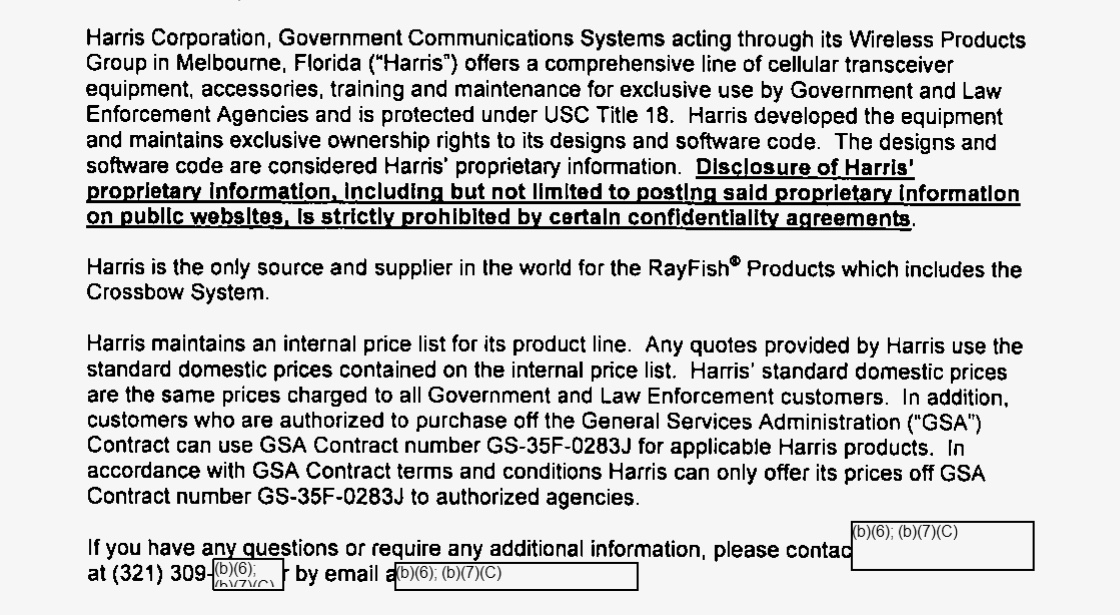
A letter from Harris Corp., which builds cell site simulators — known as “stingrays,” describing the non-disclosure terms for its Crossbow cell site simulator. (Source: ACLU)

Stingrays impersonate cell towers and capture the calls, messages, location and in some cases data of every cell phone in their range. Developed by Harris Corp., stingrays are sold exclusively to law enforcement. But their purchase and use are covered under strict non-disclosure agreements that prevent police from discussing how the technology works. These agreements are notoriously prohibitive; prosecutors have dropped court cases rather than disclose details about the stingrays.

The newly released documents are heavily redacted and offer little more about what we know of how stingrays work. One document did, however, reveal for the first time the existence of Harris’ most recent stingray, Crossbow. An email from 2012 refers to Crossbow as the “latest, most technologically up-to-date version of a Stingray system.”

But the civil liberties group said its public records lawsuit is not over. Customs and Border Protection (CBP), which was also named in the suit, has not yet turned over any documents sought by the ACLU, despite spending $2.5 million on buying at least 33 stingrays, according to a 2016 congressional oversight report.

“We are deeply skeptical of CBP’s assertion that they do not possess records about cell site simulators,” said Ramirez. “Given public information, the agency’s claim just doesn’t pass the sniff test.”

CBP has until June 12 to respond to the ACLU’s latest motion.

When reached, a spokesperson for CBP was unable to comment by our deadline. ICE did not respond to a request for comment.

ICE used ‘stingray’ cell phone snooping tech hundreds of times since 2017 by Zack Whittaker originally published on TechCrunch

❌