Reading view

There are new articles available, click to refresh the page.

XRP Ledger Enters The AI Era As Ripple Merges Two Mega Trends

The XRP Ledger has entered a new phase of innovation as Ripple integrates to bring together two of the most powerful technology trends shaping the global economy. Long known for its speed, low transaction costs, and enterprise-grade reliability, the Ledger is now expanding beyond payments to data-driven and automated financial applications. By merging AI with decentralized settlement, Ripple is positioning the Ledger to support smarter workflows and more efficient liquidity management.

How Ripple Is Embedding Intelligence Into On-Chain Systems

An analyst known as SMQKE on X has shared a case study of an AI implementation in the cross-border payment, in which Ripple has successfully combined blockchain technology and artificial intelligence to enhance the efficiency, speed, and cost-effectiveness of global transactions.  As a leading provider of real-time cross-border payment solutions, Ripple leverages the XRP Ledger, a decentralized blockchain that enables real-time cross-border settlement. 

Related Reading: Surge In XRP Transactions: 1.45 Million Daily Users Could Signal Price Rally Ahead, Says Expert

What sets this integration apart is the use of AI to optimize transaction flows and routing decisions in real time. Ripple AI-powered systems continuously process large volumes of payment data in real time, allowing financial institutions to make dynamic decisions on the most effective payment paths. 

BlackRock is now using Ripple’s RLUSD as collateral, which is extremely bullish for XRP. JackTheRippler revealed that the altcoin is being positioned as the future infrastructure, which is being built with the potential to hit over $10,000 per coin. With the REAL token launching on January 26th, trillions in global capital could flood into the XRP Ledger. According to JackTheRippler, some projections suggest up to $800 billion could flow into the REAL token on XRP Ledger, potentially sparking a powerful supply shock.

Why The Comeback Feels Different This Time

The rise of the phoenix XRP is here. Crypto analyst Xfinancebull highlighted that Caroline Pham isn’t just another name in crypto. Pham played a role in pushing utility regulation into the Commodity Futures Trading Commission (CFTC), helping shift policy toward real-world use cases. Currently, she is at MoonPlay and posting about the phoenix on X.

Related Reading: How Donald Trump’s Latest Crypto Move Will Boost Demand For XRP

Years ago, Brad Garlinghouse drew that same phoenix, and it became one of the biggest pieces of XRP lore. While the market chased narratives, Ripple has been building institutional-grade crypto products for years. Meanwhile, the token, RLUSD, and the XRP Ledger are now live operating, and recognized among the most compliant blockchain assets in the crypto world.

This is the same asset that survived the SEC’s biggest regulatory battles in crypto history, and is now on the other side with legal clarity, growing integration, and increasing relevance to government infrastructure in its favor. Xfinancebull concluded that Caroline has helped clear the regulatory path, Brad and Ripple built what actually runs on that path, and they have been aligning all along, which is how the real adoption happens.
XRP

How Donald Trump’s Latest Crypto Move Will Boost Demand For XRP

Crypto pundit X Finance Bull has explained how Donald Trump’s push to sign the crypto bill into law will boost demand for XRP. This follows White House Crypto Czar David Sack’s prediction about how banks will come into crypto once the CLARITY Act passes.

How Donald Trump’s Crypto Push Will Boost XRP’s Demand

In an X post, X Finance Bull shared a video in which Donald Trump’s crypto adviser, David Sacks, stated that banks will begin to adopt crypto once the crypto bill passes. The pundit noted that this means banks are already positioned, while Ripple has the stack and XRP has the liquidity, and the rails are in place. As such, he believes that the token will be the go-to crypto once these banks enter the crypto industry. 

X Finance Bull further mentioned that institutions that have been waiting over the past few years will return and announce their buys and use of XRP once Donald Trump signs the CLARITY Act into law. The pundit added that this moment resets who is early and that he never needed hype to hold the altcoin. “Research and study were always enough,” he said. 

X Finance Bull also questioned why market participants were panic-selling if banks are going all in once Donald Trump signs the crypto bill into law. The pundit’s statements come just as Ripple partnered with DXC to integrate the token and RLUSD into DXC’s Hogan core banking platform. 

The banking platform powers more than 300 million deposit accounts and over $5 trillion in deposits globally. As such, this is a major step in XRP’s adoption, as the partnership will integrate Ripple’s payment technology into large-scale banking environments.

Trump’s Tariff Move Will Also Boost The Altcoin

In another X post, X Finance Bull claimed that Donald Trump’s move with tariffs will also boost XRP’s demand.  He shared a video of how the U.S. president said that $18 trillion is flowing into the U.S. economy thanks to these tariffs. The pundit asserted that such money flows put pressure on banks, payroll systems, FX rails, and settlement speed. 

X Finance Bull further noted that this creates nonstop cross-border payments and liquidity needs, and this is where Ripple and XRP come in. He explained that while old rails leak money, Ripple and the altcoin were built to stop that. The pundit also alluded to Ripple executives meeting with Donald Trump and to the token being mentioned as part of the digital asset stockpile. He added that the CLARITY Act is next and that when rules lock in, the U.S. capital will need U.S. rails. 

At the time of writing, the XRP price is trading at around $1.92, down almost 2% in the last 24 hours, according to data from CoinMarketCap.

XRP

Ripple’s RLUSD Is Not A Threat To XRP’s Future, Here’s Why

Rumors about XRP suddenly becoming useless and less relevant appear to be spreading across the crypto market following the introduction of Ripple’s stablecoin, RLUSD. Crypto market analyst XFinanceBull recently took to X to debunk these claims, stating that, rather than being a potential threat, RLUSD was created to complement XRP’s functionality and use cases on the ledger.

Why Ripple’s RLUSD Poses No Danger To XRP 

In his post, XFinanceBull revealed that many in the crypto community now see XRP as less useful because of RLUSD. These concerns carry weight given the growing dissatisfaction over XRP’s price struggles. Furthermore, with a stablecoin in place, the perception is that XRP’s use cases could deteriorate, especially given RLUSD’s greater stability. 

Addressing these growing concerns, XFinanceBull emphasized that XRP and RLUSD serve different purposes within the ecosystem. His commentary aims to correct the misconception that RLUSD was introduced to replace XRP. The analyst referenced statements from Ripple’s former Chief Technology Officer (CTO), David Schwartz, who, in a video, clearly explained the distinct roles of XRP and RLUSD, highlighting how the stablecoin benefits the altcoin rather than threatens it. 

According to XFinanceBull, Schwartz stated that RLUSD attracts large, credible flows to the XRP Ledger (XRPL), and this capital provides structural benefits to XRP. The analyst declared that RLUSD does not replace XRP, but instead amplifies its functionality. He added that as liquidity grows through the stablecoin, more payment routes are created, leading to increased XRP burns. 

XFinanceBull also noted that every stablecoin trade within the Ripple ecosystem indirectly drives demand for XRP as a bridge asset. He concluded that the world will eventually realize that utility is not defined by a whitepaper alone, but by real transaction flows. He added that although the XRP price may be declining, its rails are still being built.  

How RLUSD Benefits XRP

In the video shared by XFinanceBull, Schwartz stated that RLUSD is designed to benefit XRP. He explained that RLUSD strengthens XRP by introducing more credible assets onto the XRP Ledger, thereby expanding the network’s use cases and creating more opportunities for developers. 

The former Ripple CTO also revealed that adding trusted assets, such as RLUSD, increases trading activity on XRPL’s DEX. According to him, higher trading volume generates both direct and indirect benefits for the decentralized network and its native token, XRP. 

A key advantage of the XRPL DEX is its auto-bridging feature, which uses XRP to facilitate trades between different assets. Schwartz said that this mechanism allows XRP to act as an intermediary, helping users find the most efficient trading routes. He added that RLUSD and XRP are designed to complement each other, given their different roles within the ecosystem. While the stablecoin offers price stability, the altcoin functions as a bridge currency within Ripple’s payment products. This means that as RLUSD usage grows, demand for XRP is reinforced.

Ripple

Ripple President Long Unveils Her 2026 Crypto Predictions

Ripple President Monica Long says 2026 will be the year institutional crypto usage shifts decisively from pilots to production, as regulated infrastructure and clearer rules pull banks, corporates, and market intermediaries deeper onchain. In a January 20 blog post, Long frames the next leg of adoption around four forces: stablecoins, tokenized assets, custody consolidation, and automation powered by AI.

#1 Stablecoins (Ripple USD) As The Settlement Layer

Long’s central prediction is that stablecoins will stop being treated as an “alternative rail” and become foundational to global settlement. “Within the next five years, stablecoins will become fully integrated into global payment systems—not as an alternative rail, but as the foundational one,” she wrote. “We’re seeing this shift not in theory, but in practice, as heavyweights like Visa and Stripe hard-wire these rails into incumbent flows.”

She ties that trajectory to US policy momentum, arguing the GENIUS Act “inaugurated the digital dollar era,” and positioning “highly compliant, US issued stablecoins, including Ripple USD (RLUSD)” as a standard for programmable, 24/7 payments and collateral use in markets. Long also points to “conditional approval from the OCC to charter the Ripple National Trust Bank” as part of Ripple’s compliance strategy.

The near-term demand driver, in her telling, is B2B, not retail. Long cites research claiming B2B payments became the largest real-world stablecoin use case last year, reaching an annualized $76 billion run-rate—up sharply from early 2023 levels. She argues stablecoins can unlock liquidity and reduce working-capital drag, citing “over $700 billion” of idle cash on S&P 1500 balance sheets and “more than €1.3 trillion across Europe.”

#2 Institutional Exposure And Tokenization

Long argues crypto is increasingly used as financial infrastructure rather than just a speculative asset. “Crypto has evolved from a speculative asset into the operating layer of modern finance,” she wrote. “By the end of 2026, balance sheets will hold over $1 trillion in digital assets, and roughly half of Fortune 500 companies will have formalized digital asset strategies.”

She points to a 2025 Coinbase survey she says found 60% of Fortune 500 companies are working on blockchain initiatives, and notes “more than 200 public companies” holding bitcoin in treasury. She also highlights the rise of “digital asset treasury” firms, claiming they grew from four in 2020 to more than 200 today, with nearly 100 formed in 2025 alone.

On market structure, Long forecasts “collateral mobility” as a key institutional use case, with custodians and clearing houses using tokenization to modernize settlement. Her stated expectation is that “5–10% of capital markets settlement” moves onchain in 2026, supported by regulatory momentum and stablecoin adoption by systemically important institutions.

#3 Custody Consolidation Accelerates

Long frames digital asset custody as the institutional on-ramp and predicts consolidation as custody offerings commoditize. “M&A activity in this space is a signal of maturity, not just momentum,” she wrote, citing $8.6 billion in crypto M&A in 2025. She argues regulation will push banks toward multi-custodian setups and predicts “more than half of the world’s top 50 banks” will add at least one new custody relationship in 2026.

She also points to convergence between crypto and traditional finance through deals such as Kraken’s purchase of NinjaTrader and Ripple’s acquisitions of GTreasury and Hidden Road, positioning them as steps toward safer, more integrated institutional workflows.

#4 Blockchain And AI Converge

Long’s final theme is automation: smart contracts paired with AI models running treasury and asset-management processes continuously. “Stablecoins and smart contracts will enable treasuries to manage liquidity, execute margin calls and optimize yield across onchain repo agreements, all in real-time without manual intervention,” she wrote.

She argues privacy tech is critical for regulated deployment, pointing to zero-knowledge proofs as a way for AI to assess risk or creditworthiness without exposing sensitive data.

Long’s overarching claim is that 2026 marks a transition from experimentation to infrastructure: stablecoins as settlement and collateral, tokenization in core market plumbing, custody as a trust anchor, and AI-driven automation as the efficiency layer.

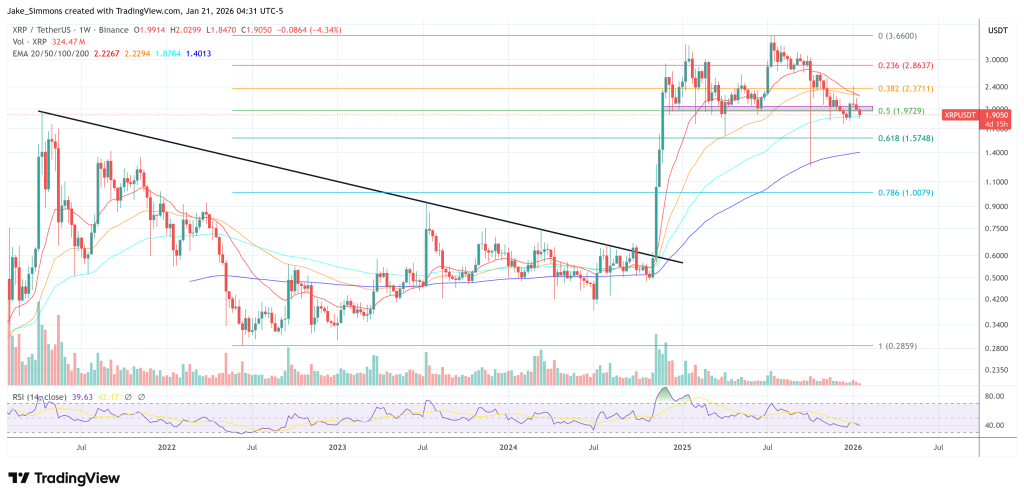
At press time, XRP traded at $1.905.

XRP price chart

Ripple Exec Pushes Central Banks To Back Regulated Stablecoins

Ripple’s UK & Europe policy director Matthew Osborne is urging central banks to stop treating stablecoins as an external threat and instead fold well-regulated issuers into core safeguards, arguing that oversight plus access to official infrastructure can make stablecoins a net stabiliser for payments and settlement.

Writing for the Official Monetary and Financial Institutions Forum on 19 January 2026, Osborne said stablecoins have moved well beyond a niche experiment, citing a market value “in excess of $300bn” and annual transaction volumes that he wrote now surpass Visa and Mastercard combined. He argued momentum could accelerate in the US after the Genius Act, which he said would introduce federal rules and allow banks to issue stablecoins.

The Ripple exec framed the shift as already visible among central banks themselves. He pointed to the European Central Bank’s recent recognition of stablecoins’ benefits for cross-border payments and its view that tomorrow’s financial system will host multiple forms of money. He also cited the Bank of England’s stance that stablecoins could support “faster, cheaper retail and wholesale payments” as part of a “multi-money” system underpinned by central bank money.

Ripple Exec: Bring Stablecoins Into The Safety Net

At the centre of his case is the claim that stablecoins should be treated as an incremental evolution rather than an adversarial replacement. “Regulated stablecoins could play a key role in financial markets alongside other forms of money,” Osborne wrote. “First, stablecoins are more likely to complement the existing financial system than replace it. This is evolution, not revolution.” He then added: “The solution lies in central banks channelling stablecoin momentum, not fighting it.”

Osborne argues central bank money will remain essential as a risk-free settlement asset and safe store of value, but its relative role could shift in digital markets. He pointed to atomic settlement, where legs of a transaction settle simultaneously and conditionally, as reducing the traditional need to use central bank money purely to mitigate settlement risk.

Where stablecoins could be structurally preferred, he wrote, is in cross-border flows and multi-chain markets. “Cross-border payments are one example, given that stablecoins can move value anywhere in the world in seconds,” the Ripple exec said.

“In contrast, central bank money is likely to be less suitable for cross-border payments given access may be geographically limited and adoption of on-chain central bank money is far from universal around the world.” He also argued stablecoins are likely to exist across more blockchain networks than central bank money, making same-chain settlement between tokenized assets and cash more achievable while interoperability remains uneven.

Central banks have repeatedly warned that stablecoins could pull funds from bank deposits, weakening bank credit creation and potentially amplifying stress events. Osborne pushed back, arguing the risk is overstated because markets already accommodate instruments backed by highly liquid assets, money market funds, e-money, and “narrow banks”, without causing sustained deposit runs.

His bigger point is that regulation, while necessary, is insufficient without a backstop. “But regulation alone is not enough,” Osborne wrote. “Stablecoin issuers lack access to the safety net that gives bank deposits their resilience. Without it, even well-managed stablecoins are more vulnerable to shocks – as seen when USDC temporarily lost its peg following exposure to Silicon Valley Bank in 2023.”

He argued central banks should consider extending elements of that safety net, including allowing well-regulated stablecoin issuers to hold part of their backing assets in central bank accounts, offering liquidity insurance against market-wide shocks, and granting more direct payment-system access to reduce tiering risk.

The Ripple exec closed by positioning the choice for central banks as strategic: resist stablecoins and risk the market scaling beyond official influence, or “bring them inside the tent,” shaping development through prudential oversight and infrastructure access as tokenized settlement rails mature.

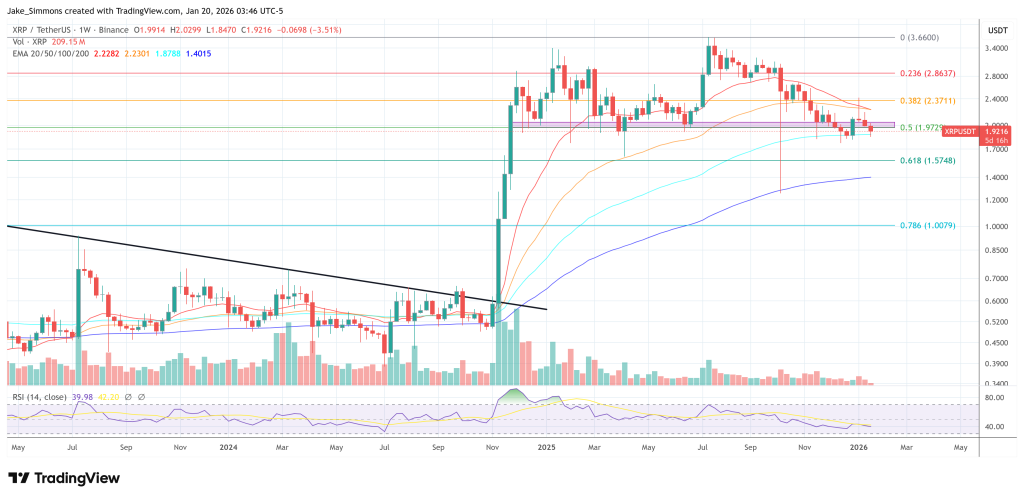
At press time, XRP traded at $1.9216.

XRP price chart

Is Elon Musk Planning To Abandon Dogecoin In Favor Of XRP For X Payments?

X’s owner, Elon Musk, is allegedly considering integrating XRP and RLUSD into the social media platform. This marks a shift from rumors that the world’s richest man could integrate Dogecoin, given his fondness for the foremost meme coin. 

Pundit Claims Rumors of Elon Musk Integrating XRP and RLUSD

In an X post, crypto pundit JackTheRippler claimed that there are rumors that Elon Musk will integrate XRP and RLUSD into X. This came as he shared a video in which the world’s richest man said the social media platform could become half of the global financial system if done right.  

This aligns with Elon Musk’s vision to transform X into an ‘Everything App.’ However, it is worth noting that the world’s richest man didn’t mention anything about integrating XRP or RLUSD on the social media platform. Musk has only once commented on XRP, in 2024, when he said he thinks crypto helps with individual freedom, in response to a question about whether the XRP Ledger could be integrated into financial institutions in the future. 

Before JackTheRippler’s claim about an XRP and RLUSD integration, Dogecoin had been the coin that had been widely rumored to get integrated into X payments when the payments system launches. This is due to Elon Musk’s fondness for the foremost meme coin, with the world’s richest man referencing the meme coin on several occasions. 

However, Elon Musk has never confirmed plans to integrate Dogecoin or any other crypto asset, including the altcoin and RLUSD, into X. There has also been no confirmed date for the X payments launch, which was expected to happen last year. Meanwhile, although Musk has not mentioned integrating cryptocurrencies, the world’s richest man appears to be warming to them, especially Bitcoin. 

Last year, Elon Musk admitted that Bitcoin, alongside Dogecoin, was based on energy. He then stated that one can issue fake fiat currency, which governments have done, but that it is “impossible to fake energy.”

Musk Likely To Integrate Crypto Into X

Market experts, such as SkyBridge founder Anthony Scaramucci, have opined that Elon Musk will integrate cryptocurrencies into X. In an interview, he said the world’s richest man will build a super app and that he will be using crypto. However, Scaramucci admitted that he wasn’t sure how Musk would go about it, whether he would integrate known cryptos like Bitcoin, XRP, Dogecoin. 

He also raised the possibility of Elon Musk creating his own coin, like Telegram’s TON, or that it could be a stablecoin. In the meantime, X’s Head of Product, Nikita Bier, announced that they are building smart cashtags that will allow users to specify the exact crypto asset when posting a ticker. Users will be able to tap these tickers to see real-time pricing for these crypto assets in their timeline.

XRP

Investment Manager Predicts XRP Will Dominate This Trillion-Dollar Sector

Canary Capital’s CEO, Steven McClurg, has predicted that XRP will be the leading token in real-world assets (RWAs), which is projected to be a trillion-dollar sector. This came as he highlighted recent developments that put the altcoin on course to dominate the industry.

Canary Capital CEO Predicts XRP Will Dominate RWAs

During an interview, the investment manager opined that XRP will be the leading token for real-world assets, based on Ripple’s moves over the last two years. He noted that the crypto firm has done a great job of integrating the XRP Ledger (XRPL) into many transactions and into Wall Street, which has led to institutional adoption.

The Canary Capital CEO further noted that the XRP Ledger is moving assets such as stablecoins, including Ripple’s RLUSD stablecoin, and other tokenized real-world assets. Notably, Ondo Finance has also tokenized its U.S. treasury fund (OUSG) on the XRPL, while Ripple has partnered with Securitize to add RLUSD access for BlackRock’s BUIDL fund. 

Furthermore, Ripple partnered with Archax and UK-based asset manager abrdn to introduce the first tokenized money market fund on the XRP Ledger. There are also plans for the network to get a tokenized gold upgrade, even as demand for precious metals rises. It is also worth noting that Ripple has previously predicted that the XRP Ledger could dominate the real-world assets industry, putting XRP at the heart of the industry, as McClurg has also predicted. 

Interestingly, McClurg’s prediction comes as the XRP ETFs draw institutional investors into the altcoin’s ecosystem. These ETFs have been a success since their launch, recording only one net outflow since November. Coincidentally, McClurg’s Canary Capital is currently the largest XRP ETF issuer, with $374 million in total net assets, according to SoSoValue data

New Features To Onboard TradFi Onto The XRPL

Ripple and XRP Ledger developers continue to work on introducing new features on the network to attract traditional finance (TradFi) institutions. XRPL validator Vet recently revealed that compliance features for TradFi are coming to the network. This includes on-chain compliance tools such as KYC, AML, and other credentials, which will be used by lending protocols, as well as the XRPL DEX and the Permissioned DEX.

Meanwhile, Ripple developers also described Permissioned Domains, which are part of the amendments, as a game-changer for the XRP Ledger because they will bring institutional-grade controls to a public network, without sacrificing the trade-offs of a private chain. The developers further noted that this will set the stage for financial institutions to engage in permissioned flows on a fast, scalable, and resilient blockchain network such as the XRPL. 

At the time of writing, the XRP price is trading at around $2.06, down in the last 24 hours, according to data from CoinMarketCap.

XRP

💾

Is Bitcoin headed back into the $60Ks — and does that mean the four-year cycle is broken? 🤔Stephen McClurg, CEO of Canary Capital, explains why Bitcoin coul...

Is Bank Of America Currently Running Tests With Ripple’s XRP? Here’s What We Know

Crypto pundit X Finance Bull has alleged that the Bank of America (BofA) is running tests for cross-border payments using Ripple-linked XRP. This follows an earlier statement from Ripple’s President, Monica Long, about the bank and the potential adoption of crypto. 

Crypto Pundit Alleges That Bank of America Is Using Ripple’s XRP

In an X post, X Finance Bull claimed that the Bank of America is already running tests with Ripple and that cross-border payments are being rewritten. He added that Ripple provides the technology, the bank runs the tests, and the U.S. ensures legality. In line with this, he remarked that XRP is becoming the core financial plumbing. 

In a video shared by crypto pundit Xaif last year, Ripple President Monica Long had mentioned that Bank of America was one of their early partners when they were developing the messaging software online payment solution. However, she didn’t say whether the partnership still exists till now. 

Bank of America notably filed a patent for real-time net settlement using a distributed ledger system, which appeared to be based on Ripple’s payment network. This plan has since been abandoned as the bank never moved forward with the application. The bank has, however, opened up to crypto as it now allows its wealth clients to allocate up to 4% to crypto. The bank is also exploring issuing its stablecoin, which could make it a direct competitor to Ripple. 

Meanwhile, Long also mentioned how several banks had contacted Ripple for payments and custody services after Donald Trump won the U.S. presidential elections. Ripple’s CEO, Brad Garlinghouse, had also previously mentioned that they secured more partnerships following Trump’s victory, as the U.S. president paved the way for a more regulatory-friendly environment. 

Ripple’s Major Existing Banking Partners

Ripple has notably secured partnerships with other major banking institutions in recent times, as several nations provide a more regulatory-friendly environment. The crypto firm has partnered with Bank of New York Mellon (BNY), which is the largest custodian. The bank serves as the primary reserve custodian of Ripple’s RLUSD stablecoin

Furthermore, Ripple recently announced that its Ripple Prime is an early adopter of BNY’s tokenized deposit services for institutional clients. These tokenized deposits operate on the bank’s private blockchain and don’t involve the XRP Ledger or XRP. Other major banks such as AMINA Bank, Absa, and SBI have also partnered with Ripple. 

AMINA recently became the first European bank to integrate Ripple payments into its operations. SBI has also adopted Ripple payments. Meanwhile, the crypto firm provides custody services to Absa, one of South Africa’s largest banks.

At the time of writing, the XRP price is trading at around $2.10, down over 3% in the last 24 hours, according to data from CoinMarketCap.

Ripple

Popular Attorney Reveals Why Ripple Was Unable To Push XRP All These Years

Famous legal expert Bill Morgan has highlighted how Ripple was unable to promote XRP over the past few years due to its former legal battle against the U.S. Securities and Exchange Commission (SEC). 

Why Ripple Was Unable To Promote XRP In The Past

In an X post, Bill Morgan stated that Ripple could not promote XRP or the XRP Ledger in the past for fear of being sued by the SEC for promoting and offering an unregistered security. He noted that despite that, the company was still sued by the regulator. The lawyer’s response followed XRPL stakeholder Wietse’s comments about how the XRPL has a track record of regularly being too early and also being too late. 

Wietse made this comment after XRP community member Crypto Eri pointed out that the XRP Ledger has supported tokenized gold since, though it hasn’t received enough publicity. Wietse added that the network is too early for people to notice and realize how great certain things are, and too late for others, causing too little, too late catch-up. 

However, Bill Morgan believes that XRP and XRP Ledger would have gotten more publicity if Ripple had been able to actively promote the altcoin in the past. He noted that during the SEC lawsuit, the crypto firm barely mentioned XRP. Meanwhile, the lawyer noted that Bitcoin, Ethereum, and other cryptos were promoted with impunity and that former SEC official Bill Hinman effectively promoted ETH while in office.  

The lawyer added that, to this day, Ripple’s promotion of XRP and the XRP Ledger remains muted. He stated that the company does it by stealth under the cover of acquisitions and RLUSD. Morgan believes that this is nothing compared to how Michael Saylor actively talks about and promotes Bitcoin. 

XRP Is Still At The Centre Of Ripple’s Vision

Ripple has, in recent times, reiterated that XRP is at the centre of its vision. In his New Year’s message, the firm’s CEO, Brad Garlinghouse, stated that the altcoin has been and will continue to be the heartbeat of that vision. This came as he noted that their two major acquisitions last year, Ripple Prime and GTreasury, will greatly accelerate and expand their ability to deliver on their vision, which is to enable the Internet of Value. 

He added that building and using crypto infrastructure, updating their global financial plumbing, and rethinking legacy systems don’t happen overnight. As such, they will continue to take the long view of what crypto-based assets such as XRP and RLUSD can do rather than chasing cycles and hype. 

At the time of writing, the XRP price is trading at around $2.16, up over 5% in the last 24 hours, according to data from CoinMarketCap.

Ripple

XRP Saw 4 Major Developments In One Week, So Why Is The Price Still Falling?

XRP has racked up major wins recently, from regulatory breakthroughs to network upgrades, yet its price continues to slide. A crypto analyst has shared insights into why this is happening, outlining several developments this week that would typically act as bullish catalysts for the XRP price, but have so far failed to push the token out of its downtrend and propel its value to new highs. 

XRP Sees Four Major Developments In One Week

Despite experiencing four major developments in just one week, the XRP price has shown little reaction. Crypto market expert Chain Cartel has pointed out that while many traders focus on immediate price movements, Ripple Labs, the developer of XRP, is quietly building the infrastructure that could position it as a key system of record for digital settlements.

The analyst suggested that the market overlooks structural developments, underestimating their impact on long-term growth. He highlighted rumors of Ripple’s collaboration with Amazon Web Services (AWS) as one of this week’s major events, noting that the alleged partnership explores the use of Amazon Bedrock AI for the XRP Ledger (XRPL). 

With this integration, XRPL system logs that used to take days to process can be analyzed in just minutes. According to Cartel, this is not an “hype AI,” but a development focused on improving security and scalability, and on giving institutions better visibility into XRP

In his post, Cartel also highlighted Ripple’s regulatory progress in the UK. He announced that the UK subsidiary of the crypto company has not been registered with the Financial Conduct Authority, which is known as one of the world’s strictest financial regulators. He stressed that this approval is a significant milestone for Ripple, boosting its compliance credentials and international credibility. 

In addition to achieving even greater regulatory clarity, Cartel highlighted Ripple’s partnership with The Bank of New York Mellon (BNY Mellon) as another key development. BNY Mellon recently launched tokenized deposit services for institutional clients, and Ripple Prime, a digital asset prime brokerage platform created after Ripple acquired Hidden Road, is among the first users. Even more important, the analyst said that BNY Mellon remains the primary reserve custodian for RLUSD, showing a direct integration between traditional banking and digital settlement rails. 

Finally, Cartel mentioned the upcoming vote on the CLARITY Act by the US Senate Banking Committee scheduled for January 15. This bill will decide how crypto trading, settlements, and connections to financial systems are regulated in the future. The analyst said that if the bill is passed, it could affect how institutions interact with XRP and the broader crypto market. 

Why The XRP Price Is Still In A  Downtrend

Despite all these developments and milestones, Cartel noted that XRP’s price has barely moved over the week, still trading around $2.0. The analyst stated that the reason the cryptocurrency keeps moving lower is that it reacts less to hype and more to the completion of key infrastructure. 

According to Cartel, these developments are building significant pressure in the market. He described XRP’s situation as a compression before a violent release, suggesting that the cryptocurrency could experience a sharp price rally once the foundational systems are fully in place.

XRP

Why XRP Deserves A Place As Long-Term Wealth And Life-Saving Strategy

In a world where financial systems are becoming fragile, XRP stands out as the intersection of a financial infrastructure designed for instant global value transfer, speed, reliability, and global accessibility. XRP’s ability to move value instantly across borders, with minimal cost and without reliance on fragile banking systems, positions it as both a long-term wealth tool and a potential life-saving instrument.

XRP should be considered as part of life-saving plans. An analyst known as Bird on X has pointed out that most people keep their money in the bank, earning around 4-6% a year, and feel comfortable with it, but they rarely factor in the impact of inflation. Over time, the purchasing power of currencies like the US dollar and the British pound has been quietly eroded to the point where your money can grow on paper while losing value in the real world.

XRP’s Role In The Next Phase Of Global Payments

Although savings accounts are safe, many people are actually standing still or falling massively behind without even realizing it, which is why XRP comes in as a long-term life-saving strategy. XRP has spent years held back by legal uncertainty, and during that time, the technology continued to mature. Currently, there’s clarity, and what was being built has become visible.

Related Reading: XRP Ledger May Get A Tokenized Gold Upgrade, Web3 Founder Reveals

Real-world usage is arriving in cross-border payments, institutions are engaging, stablecoins like RLUSD are being introduced, and real-world assets are being tokenized on the chain. As the utility is increasing, capital is flowing into the ecosystem. More usage creates more demand, and sustained demand is what drives long-term value growth. According to Bird, XRP is to be trusted more than fiat, which is why it is a long-term savings vehicle rather than a short-term trade. 

XRP can be reserved for self-custody, stored on a cold wallet, removing reliance on banks altogether. Instead of earning a few percentages while fighting inflation, you’re holding a digital asset positioned at the centre of growing global financial infrastructure, which is more likely to increase in value over time. In comparison, it is unclear whether inflation will ever pause to make cash worth more.

The analyst views this scenario as a long-term wealth investment and believes that XRP will become one of the most utilised digital assets in the world. Thus, building a savings position now could prove to be one of the smartest financial decisions someone could make over the long run.

A Bridge Between Old Money And New Rails

ChartNerd noted that Ripple is not built to be a traditional crypto company that aims to destroy the old money. Instead, Ripple acts as the bridge between the old and new financial worlds, and this will be a more successful long-term strategy. 

A sustainable financial change will emerge gradually, not through a knee-jerk move or total disruption in just one cycle. XRP is clearly the long-game asset, while 2025 was the most productive year for Ripple, nothing is priced in yet.

❌