Reading view

There are new articles available, click to refresh the page.

Analyst Says You’re Not Bullish Enough On Ethereum – What Does He Mean?

A growing number of analysts believe Ethereum’s current price action is being misunderstood. Although frustration is growing due to Ethereum’s inability to hold above $3,000, some technical analysts are quick to point out that the structure forming beneath the surface tells a very different story. According to one analyst, the real risk right now is not being bullish on Ethereum and trying to short in anticipation of a downside breakout.

Higher Lows And A Structure That Keeps Tightening

The analyst’s technical view on Ethereum is focused less on short-term momentum and more on the structure developing on the chart, which he argues is even clearer than what is currently visible on Bitcoin’s chart.

Notably, Ethereum’s price action is carving out a series of higher lows on the daily candlestick timeframe chart to form a tightening triangular pattern since December 2025. This kind of behavior shows that each pullback is being absorbed at progressively higher levels, which is how strong trends reset before continuation.

Ethereum needs to avoid a breakdown below key support zones in order for this trend continuation setup to still be valid. According to the analyst, a dip under $2,860 would begin to weaken the pattern, while a close below $2,780 would invalidate the higher-low structure. 

At the time of writing, Ethereum is trading around $2,950, which is dangerously close to the lower boundary of this setup. Therefore, some traders will be tempted to short Ethereum at this level, but the analyst called it the dumbest thing to do here.

As long as those levels ($2,860 and $2,780) hold, the analyst sees no technical justification for betting against ETH, especially near the lower boundary of the channel where buyers have repeatedly stepped in. 

If support holds, the next move would be a gradual return to the upper trendline of the channel, which is just below $3,340. A move into that region would bring price back into direct contact with overhead resistance and set the stage for a breakout if buying pressure continues to increase.
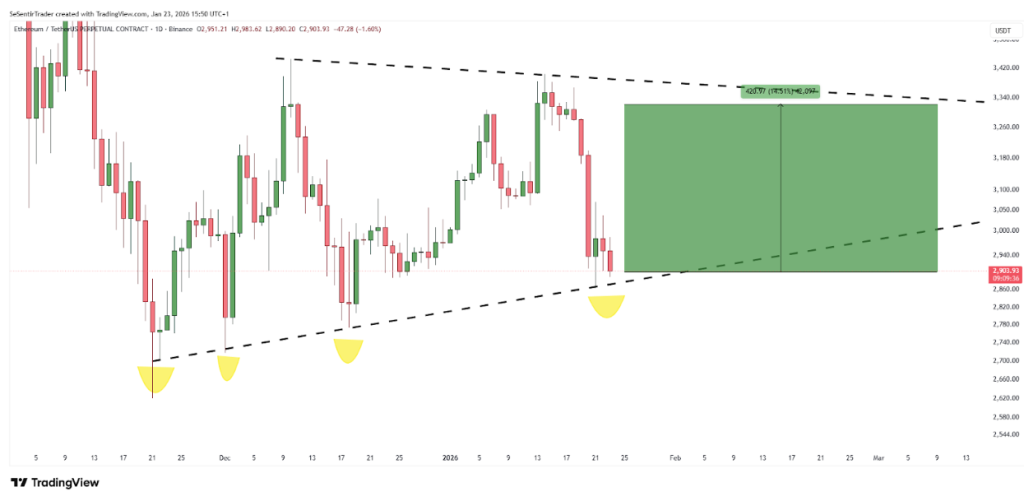
Ethereum Price Chart. Source: @Tryrexcrypto on X

The Bigger Picture Behind Ethereum’s Price Action

Ethereum is entering 2026 without clear bullish momentum, a reality that has dampened sentiment across the spot and derivatives markets. Spot ETF inflows into Ethereum and Bitcoin have slowed down, and issuers have been highlighted with consistent days of outflows.

Nonetheless, major asset managers are still holding huge amounts of Ethereum and are working on diversifying their activities on Ethereum. BlackRock, for example, filed with the SEC in December to launch a staked Ethereum exchange-traded fund, a move that will bring in more institutional investors into the Ethereum ecosystem.

Speaking of staking, BitMine Technologies recently amped up its ETH staking to over $5.71 billion worth of Ethereum. On-chain data from Arkham Intelligence shows that the firm has staked an additional 171,264, worth $503.2 million, pushing its total stake to over 1.94 million ETH.

Featured image from Unsplash, chart from TradingView

$7 Trillion Player Is Moving Into Bitcoin, Can This Trigger A Surge To $200,000?

Swiss banking giant UBS, with assets under management (AuM) of up to $7 trillion, is set to launch Bitcoin trading for some of its clients. This comes amid predictions that regulatory clarity and broader adoption could send the BTC price to as high as $200,000. 

UBS To Offer Bitcoin Trading To Some Wealth Clients

Bloomberg reported that UBS is planning to launch crypto trading for some of its wealth clients, starting with its private bank clients in Switzerland. The bank will reportedly begin by offering these clients the opportunity to invest in Bitcoin and Ethereum. At the same time, the crypto offering could further expand to clients in the Pacific-Asia region and the U.S.

The banking giant is currently in discussions with potential partners, and there is no clear timeline for when it could launch Bitcoin and Ethereum trading for clients. This move is said to be partly due to increased demand from wealth clients for crypto exposure. UBS also faces increased competition as other Wall Street giants are working to offer crypto trading. 

Morgan Stanley, in partnership with Zerohash, announced plans to launch crypto trading in the first half of this year, starting with Bitcoin, Ethereum, and Solana. The banking giant may soon also be able to offer its crypto products, as it has filed with the SEC to launch spot BTC, ETH, and SOL ETFs. 

Furthermore, JPMorgan, another of UBS’ competitors, is considering offering crypto trading to institutional clients, although this plan is still in the early stages. The bank already accepts Bitcoin and Ethereum as collateral from its clients. Last year, it also filed to offer BTC structured notes that will track the performance of the BlackRock Bitcoin ETF.

Can Bank’s Entry Trigger A BTC Rally To $200,000  

Kevin O’Leary predicted that Bitcoin could rally to between $150,000 and $200,000 this year, driven by the passage of the CLARITY Act. His prediction came just as White House Crypto Czar David Sacks said banks would fully enter crypto once the bill passes. As such, there is a possibility that BTC could reach this $200,000 psychological level in anticipation of the amount of new capital that could flow into BTC from these banks once the bill passes. 

BitMine’s Chairman, Tom Lee, also predicted during a CNBC interview that Bitcoin could reach between $200,000 and $250,000 this year, partly due to growing institutional adoption by Wall Street giants. Meanwhile, Binance founder Changpeng “CZ” Zhao said that a BTC rally to $200,000 is the “most obvious thing in the world” to him.

At the time of writing, the Bitcoin price is trading at around $89,600, up in the last 24 hours, according to data from CoinMarketCap.

Bitcoin

End Of This Reaccumulation Phase Could Trigger Most Aggressive XRP Rally Ever

XRP has spent most of the past few months trading with lower highs since July 2025, frustrating traders and compressing price action into an increasingly tight range. 

However, a technical breakdown shared by crypto analyst ChartNerd argued that what looks like stagnation may actually be the final preparation phase before a historic move. The price structure suggests something far bigger that sends XRP on its most aggressive rally in eight years, but the implications only become clear when the full setup is examined.

A 400-Day Rectangular Reaccumulation Still Holding Structure

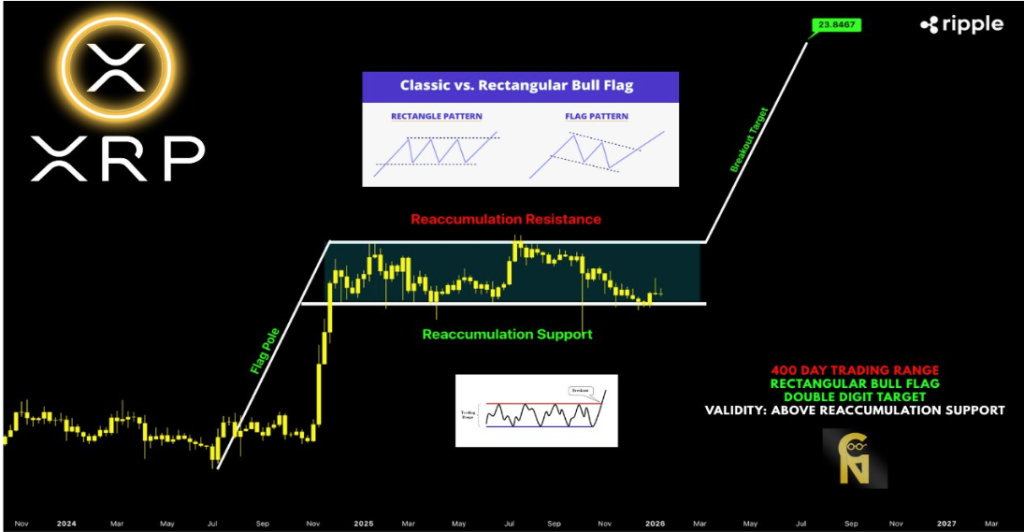
According to technical analysis done by ChartNerd, XRP’s price action has been locked inside a rectangular reaccumulation zone for about 400 days, and this has led to the formation of what looks like a rectangular bull flag on a macro timeframe. The technical chart shows a strong impulsive move from July 2024 to December 2024 acting as the flagpole, right when XRP peaked at the $3.4 price zone back then.

This impulsive flagpole has been followed by a long period of sideways trading where XRP’s price has repeatedly respected a clearly defined support around $1.8 and resistance boundaries around $3.6. This type of structure is associated with reaccumulation within the support and resistance zones, especially when it is playing out after a sharp expansion move and holding for this length of time.

Each dip into reaccumulation support has been absorbed, preventing any sustained breakdown and keeping the broader pattern intact. ChartNerd noted that the rectangular flag will be valid as long as this support level is defended, and this will activate the expansion journey.

XRP Price Chart. Source: @ChartNerdTA on X

Macro Breakout Projection Puts XRP Price Target At $23

According to ChartNerd, bearish participants are increasingly pressured by the fact that this fractal is still holding despite repeated attempts to invalidate it. The longer XRP’s price action is trapped inside the rectangle without breaking down, the more likely it becomes that the eventual resolution favors the dominant trend that preceded the consolidation. In this case, that trend was bullish, which strengthens the case for an upside breakout once resistance is cleared.

If the rectangular bull flag resolves to the upside as projected, the chart outlines a breakout trajectory that would carry XRP into double-digit territory, with a long-term target region near $23. This price target projection is derived from the height of the flagpole extended from the top of the reaccumulation range.

ChartNerd labelled this possible move as one of the most aggressive rallies XRP could see in seven to eight years. At the time of writing, XRP is trading around $1.92, meaning a move toward the $23 region would represent a gain of over 1,000% from current levels, which is a type of percentage expansion XRP has played out well in the past.

Featured image from Unsplash, chart from TradingView

XRP Dev Shares How To Retire In A Few Years

A recent statement from an XRP Ledger (XRPL) developer suggests that XRP could be the key to an early retirement shortcut. Unlike steady paychecks or slow-growing investments in traditional assets, cryptocurrencies have the ability to create generational wealth rapidly, due to their penchant for sudden and explosive price moves. Among the thousands of digital assets on the market, the developer highlighted the token as his primary choice for investors seeking substantial returns, even sharing strategies for how the coin can help them retire in a few years. 

XRP Emerges As Shortcut To Early Retirement

A DropCoin XRPL developer, identified as ‘Bird’ on X, announced on Thursday, January 22, that buying and holding XRP at current prices could help investors retire within a few years. The bold claim quickly caught the attention of many in the crypto community, with some asking the developers to elaborate on the strategies involved and the expected timeline for achieving such wealth. 

Related Reading: XRP Price Obliteration Is Not A Matter Of If, New All-Time Highs Are Coming

Not stopping there, Bird claimed that investing in the token could eliminate the need for a job, suggesting that long-term investors may eventually rely on the potential profits from their holdings as a primary source of income. His statements were in response to a post by Watcher.Guru, which the developer directly referenced to support his optimistic long-term outlook. 

In that post, Watcher Guru quoted a statement reportedly made by Binance’s founder ChangPeng Zhao, who also agreed that holding crypto assets over time could make jobs unnecessary and allow investors to retire sooner than planned. The Ledger developer shared a screenshot of Zhao making similar remarks about Artificial Intelligence, suggesting that the Binance founder views both crypto and AI as powerful tools for achieving long-term financial freedom

A crypto community member who responded to Bird’s post questioned how long an investor has to hold XRP before retiring early. The developer answered humorously that it could be held indefinitely, adding that some investors could reach early retirement this year, while others may need a few more years. He emphasized that the timeline ultimately depends on how many tokens an investor holds.  

How High The Altcoin Could Rise To Enable Early Retirement

Addressing questions from the crypto community members, Bird shared his outlook on how high he believes XRP’s price could rise, helping investors achieve early retirement. He predicted that within the next few years, the cryptocurrency could rise to $100 and beyond—a significant jump from its current market price of around $1.90. 

Related Reading: How Donald Trump’s Latest Crypto Move Will Boost Demand For XRP

The Ledger developer suggested that reaching $100 could be a gradual process for the altcoin, forecasting an initial rally to $10 in the First Quarter (Q1) of 2026. Notably, Bird’s remarks reflect a classic buy-the-dip and hold strategy, where investors accumulate during downtrends and patiently wait for the price to rally explosively before taking profits.

XRP

XRP To $11, And Then $70: The Next Impulse Wave To Watch Out For

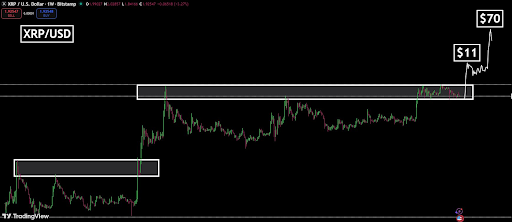
Crypto analyst CryptoBull has highlighted targets that XRP could reach as it eyes double digits. The analyst is confident the altcoin could reach these targets, noting that current price action is mirroring the previous bull run. 

XRP Eyes Rally To $11 And Then $70

In an X post, Crypto Bull stated that the next impulse will take XRP to $11 and that the last wave will take the altcoin to $70. This came as he noted that the price pattern is mirroring the previous bull run, with the only difference being time, which he claimed makes sense, as the altcoin needs longer accumulation to reach higher prices. 

The analyst also indicated that it could take a year of accumulation for XRP to reach the $11 price target, meaning the last wave to $70 could take much longer. This prediction comes despite the current decline in the crypto market, with XRP trading below the psychological $2 price level.  

XRP

Despite the current bearish sentiment, crypto analyst CW has also declared that the XRP rally is about to begin and that the road to $21.5 is just the beginning. He noted that this is the Phase 4 peak while the first goal is for the altcoin to break its current all-time high (ATH)

His accompanying chart showed that XRP could reach this $21 target by year-end. Meanwhile, there is the possibility of the altcoin rallying above $100 in the next Phase 1, which could happen next year. Crypto Pundit X Finance Bull recently highlighted the CLARITY Act and Trump’s tariffs as factors that could boost XRP’s demand and lead to higher prices for the altcoin. 

He expects the CLARITY Act to boost XRP’s demand, especially with Trump’s Crypto Czar predicting that more banks will enter into crypto once the bill passes. X Finance Bull predicts that XRP will be the token of choice for these banks based on his belief that Ripple will provide the rails to onboard them. 

XRP Breaking Out Of Multi-Year Triangle

Crypto analyst XForce revealed in an X post that XRP is breaking out of the largest 6+ year triangle in history, yet people are calling it a fakeout. He added that he is not a permabull or permanbear on the altcoin but that he follows trends and plays macro breakout patterns. His accompanying chart indicated that XRP was on the verge of a move to the upside, with a potential rally above $11.50. 

On the lower timeframe, crypto analyst Chart Nerd stated that XRP is currently breaking out of a two-week falling wedge structure. He noted that this is a bullish reversal pattern that could send the altcoin back to $2.40 in the short term, as this is where the wedge formed. He highlighted a key resistance between $2.13 and $2.20, which the altcoin will need to break above to confirm a reversal. 

At the time of writing, the XRP price is trading at around $1.92, up in the last 24 hours, according to data from CoinMarketCap.

XRP

Bitcoin Pattern From 2022 That Led To Crash To $20,000 Reappears

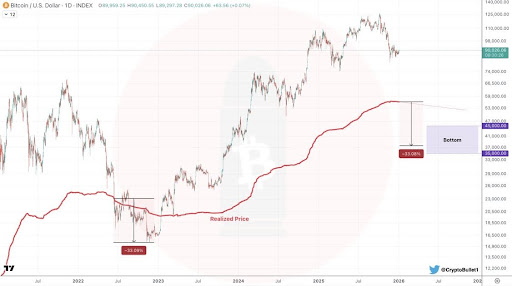
Bitcoin (BTC) is mirroring the same setup from its 2022 bull cycle, which led to a massive price crash to $20,000. According to market expert Crypto Bullet, this recurring structure could signal another major correction for BTC ahead. However, this time the leading cryptocurrency could give up almost a quarter of its current value. 

2022 Bitcoin Chart Pattern Signals Over 20% Crash

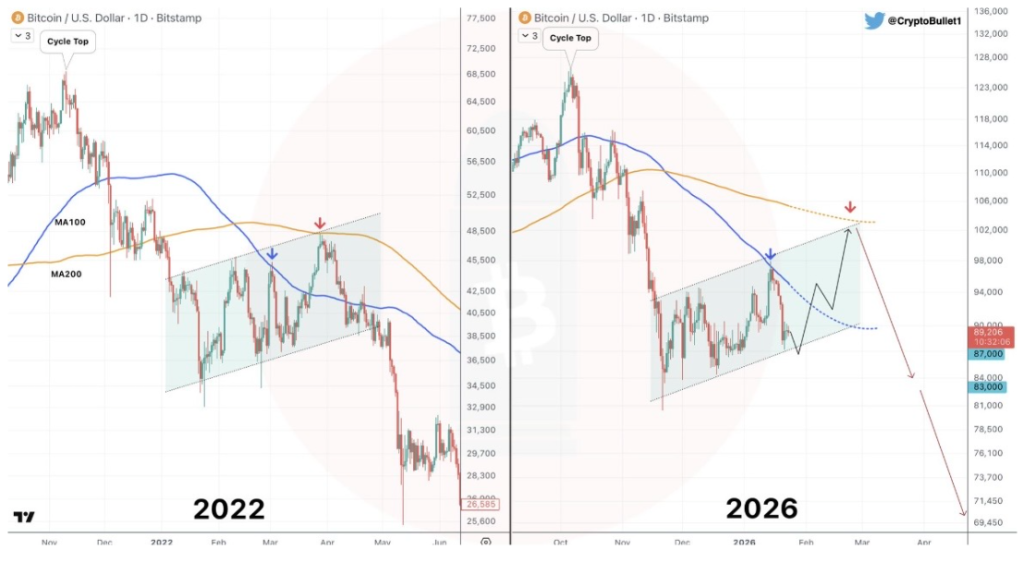
In his technical analysis released on X, Crypto Bullet revealed that Bitcoin is currently repeating a 2022 structure that could lead to a more than 20% decline in its value. To support his bearish outlook, the analyst presented a parallel chart comparing Bitcoin’s price action from 2023-2022 and 2025-2026, highlighting similar technical patterns, price behavior, and Moving Averages (MA). 

During the 2022 cycle, Bitcoin experienced a similar pattern, beginning with a test of the 100-day Moving Average (MA100), highlighted as the blue trendline on the chart. After facing rejection at that level, the price pulled back to a nearby support zone inside a rising channel. From there, BTC staged a sharp rally, surging to fresh highs around $48,500, where it aligned with the 200-day Moving Average (MA200), marked in orange. 

However, the recovery proved short-lived. Bitcoin soon reversed course and failed to reclaim the MA200 as support. Once the cryptocurrency’s price structure was lost, downside momentum accelerated, pushing the price into a much deeper correction toward the $20,000 level. 

According to Crypto Bullet, Bitcoin is repeating this exact pattern in 2026. It has already retested the MA100, gotten rejected, and moved lower into a support zone within a similar ascending channel. The chart also showed that in both cycles, BTC reached a “market cycle top,” first around December 2023 and then again in November 2025, before breaking down and entering a consolidation phase

Given how closely Bitcoin is mirroring its 2022 setup, Crypto Bullet has forecast another dramatic price crash, predicting a more than 23.5% drop from its current price near $89,500 to $68,450. Before this decline happens, the analyst expects BTC to experience a short-term recovery, potentially climbing back above the $100,000 psychological level to reach $102,000. 

Bitcoin Could Still Rally To $92,000

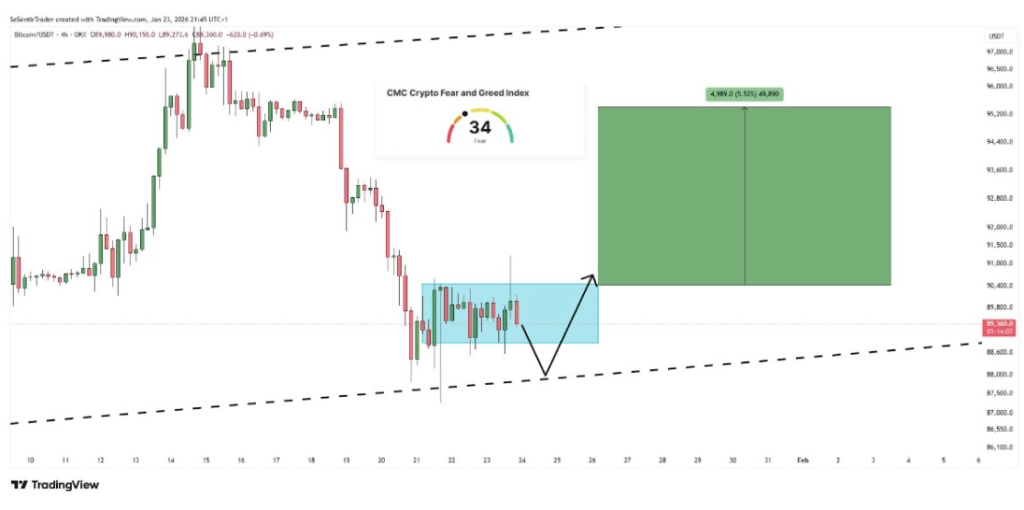
Crypto analyst Tyrex has stated that Bitcoin has been consolidating for the past 48 hours, with price holding above $89,000 for most of that period. Despite the muted price action, he believes that BTC could soon rally to $92,000. The analyst also noted that the broader market is in a state of fear, with many traders anticipating further declines in Bitcoin.

However, the analyst cautions that this expected drop may be a trap. He points out that an ascending channel is forming on Bitcoin’s chart, prompting him to adopt a more bullish outlook despite the prevailing bearish sentiment and sideways price movement.  

Featured image from Unsplash, chart from TradingView
Another Dogecoin ETF Has Gone Live For Trading, How Did It Perform?

The US crypto market has welcomed a new entrant as 21Shares rolls out its Spot Dogecoin ETF, giving investors another avenue to engage with the infamous dog-themed meme coin. Trading kicked off amid a mix of curiosity and caution, with on-chain data already showing how much the DOGE ETF has performed so far. 

21Shares Launches Dogecoin ETF

In a press release on Thursday, January 22, 21Shares announced the official launch of its Spot Dogecoin ETF, TDOG, which began trading on NASDAQ the same day. The new ETF provides investors with direct exposure to Dogecoin through a fully backed, regulated, and transparent vehicle. Each ETF share is also backed 1:1 by DOGE held in institutional-grade custody. 

Notably, the launch of the new TDOG ETF brings the total number of US Dogecoin ETFs to three, joining Grayscale’s GDOG and Bitwise’s BWOW. 21Shares is also the only ETF provider endorsed by House of Doge, the official corporate arm of the Dogecoin foundation, highlighting the global asset manager’s close ties to the meme coin. 

As one of the largest crypto ETF issuers, 21Shares continues to expand its crypto product lineup with the introduction of TDOG. This follows the investment company’s previous ETF offerings, including TSOL, a Solana ETF released in November 2025; ARKB, a Spot Bitcoin ETF launched in January 2024; and TETH, an Ethereum ETF introduced in July of the same year. Together, these products demonstrate 21Shares’ commitment to providing institutional-grade access to high-demand digital assets. 

Federick Brokate, Global Head of Business Development at 21Shares, highlighted DOGE’s large and active global community, calling it a unique digital asset with constantly growing use cases. He added that the new TDOG ETF will give investors regulated, physically backed exposure through a familiar ETF structure they know and trust. 

Marco Margiotta, the CEO of House of Doge, also shared comments on the recently launched 21Shares ETF. He said that TDOG is a step toward making Dogecoin easier to access through traditional financial systems. He also disclosed that House of Doge’s partnership with 21Shares will help more people get involved as the Dogecoin ecosystem grows. 

How 21Shares Dogecoin ETF Has Performed So Far

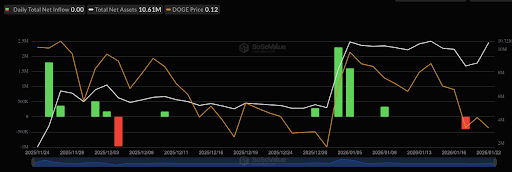
Contrary to expectations, 21Shares’ recently launched Dogecoin ETF saw weak performance on the first day of trading, signaling investors’ lack of interest in the investment product. Data from SoSoValue shows that TDOG experienced no inflows on January 22 and instead declined by about 0.07%. Despite it being the second day of trading, the DOGE ETF has still not registered any flows. 

Dogecoin

This lackluster performance has been observed across all Dogecoin ETFs this week. Grayscales’ GDOG and Bitwise BWOW have reported zero inflows over the last week. The last time GDOG saw positive activity was on January 8, when it received around $333,083 in investments. Before that, the ETF recorded its highest inflows on January 2, totaling roughly $2.3 million. Since its launch in November 2025, GDOG ETF inflows have been unstable, with more days of inactivity than significant investment. 

Dogecoin

XRP Price Recovery Is Possible If It Reclaims This Ichimoku Base

The XRP price may be preparing for a long-overdue recovery, as a crypto analyst has just highlighted a critical area that could flip the cryptocurrency’s downward momentum into a bullish one. According to the market expert, XRP must reclaim the Ichimoku Base before it can resume its upside to new levels. 

XRP Price Recovery To Resume Above Ichimoku Base

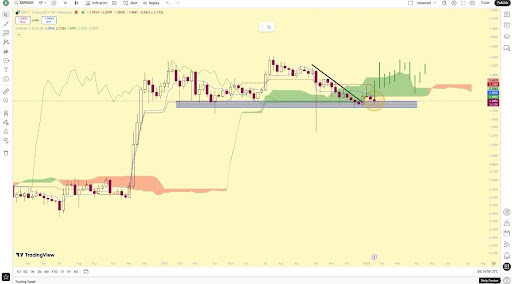
Market analyst Xaif Crypto took to X this Thursday to deliver a fresh weekly update on XRP as the cryptocurrency enters a pivotal technical area after months of downside pressure. The accompanying chart shows price retreating from a prior peak in late 2024 and sliding back into a clearly marked demand zone in the blue box. 

According to the analyst, the recent retreat follows a clear downtrend, with lower highs pushing price back toward a previous consolidation zone. This blue-box area represents the main battleground, as prior trading activity built a base that could act as support if XRP revisits that level. 

So far, XRP appears to be stabilizing within this demand zone. Candles on the chart show hesitation and reduced selling pressure. The chart also draws attention to an Ichimoku structure, with XRP attempting to reclaim its Ichimoku Base. According to Xaif Crypto, this base will determine XRP’s next big move.

XRP

The analyst has suggested that reclaiming this level could signal a potential shift in market sentiment. He disclosed that a strong close above it could favor upside continuation, weakening the ongoing downtrend and giving buyers more room to target upper resistance levels. Conversely, Xaif Crypto predicts that a break below the Ichimoku Base would likely lead to a deeper correction for XRP, as support would be lost and selling could accelerate. 

For now, XRP sits at a make-or-break level that could decide whether it recovers from its current slump. Xaif Crypto’s chart has outlined potential targets if the cryptocurrency manages to reclaim and hold above the Ichimoku Base. Currently hovering around $1.95, XRP faces potential bullish targets at $2.09, $2.20, $2.31, and $2.45. The analyst has also highlighted that traders and investors should closely watch the weekly close for confirmation of a sustained recovery.  

Analyst Says XRP Is Planning A Major Reversal

Despite dropping below $2 earlier this week, analysts remain optimistic about XRP’s price outlook. According to market expert Crypto GVR, XRP could be attempting a major price reversal from the $1-$1.5 range. Based on his chart analysis, the analyst predicts that XRP could decline first from its current price around $1.95 to roughly $1.13 before rebounding sharply to new highs.

He has set a bullish target at $3.25. marking the next upside for XRP. If XRP were to crash to $1.13 and then surge to $3.25, this would represent a staggering 187% increase in value. 

XRP

Ethereum Funding Rates Pushing Towards Negative: What’s Going On?

Ethereum is currently trading under pressure after failing to push above the $3,000 level again over the past 24 hours, a move that is reflecting trader sentiment across the derivatives markets. ETH is currently trading at $2,925, down 2.7% on the day, after moving within a 24-hour range capped at $3,012.99 and finding lows around $2,909.60, according to price data from CoinGecko. 

As price action weakens, a notable change has been developing, with on-chain data showing funding rates drifting toward negative territory and derivative positioning beginning to tilt more defensively.

Funding Rates Slide As Shorts Gain Ground

Ethereum’s failure to hold above $3,000 is an important psychological break for traders, especially after several failed attempts to hold above that level in January. Price action over the past week shows sellers maintaining control after ETH rejected around $3,360 on January 18, followed by a steady push lower toward the high-$2,900s. 

Although the pullback has so far been orderly above $2,900, this decline has come alongside fading momentum across the derivatives market.

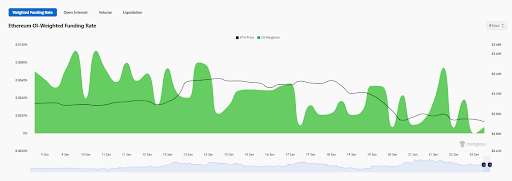
One of the clearest signals for this can be seen in Ethereum’s OI-weighted funding rate, which has been steadily compressing and is now edging toward negative levels. At the time of writing, Ethereum’s OI-weighted is at 0.0008%, close to breaking into negative territory and far below readings around 0.009%, which it registered earlier in the month.

Ethereum

Funding rates turning negative typically indicate that short positions are paying longs, meaning stronger demand for downside exposure. Funding spikes that previously accompanied the price rebound in early January have faded, and the overall trend suggests bearish positioning is slowly gaining the upper hand.

Open Interest, Liquidations, And What’s Next

Although Ethereum’s price action fell below $3,000, derivatives traders have stayed in the market, keeping total open interest at high levels. Data from CoinGlass shows aggregate Ethereum open interest increasing by 0.68% in the past 24 hours, which shows that many traders are not exiting Ethereum entirely. At the time of writing, the total open interest is sitting at about 13.36 million ETH, equivalent to roughly $39.19 billion.

Looking across major exchanges, Binance has the largest share of ETH open interest, accounting for about $8.95 billion, but it is down by 0.8% in the past 24 hours. CME follows with approximately $5.73 billion in open interest, up by 3.72% in the past 24 hours. Gate comes next at around $4.01 billion, while MEXC comes in close at $3.51 billion worth of ETH open interest.

Over the past 24 hours, Ethereum liquidations totaled $64.34 million, with long positions ($52.52 million) accounting for the majority of losses.

A hold above $2,900 could allow Ethereum’s funding rates to normalize and open the door for another rebound attempt to $3,000. However, a continued fall in funding rates into negative territory could see bearish control pushing Ethereum below $2,900.

Ethereum

XRP Price Obliteration Is Not A Matter Of If, New All-Time Highs Are Coming

XRP’s price action over the past several days has been tight and uneasy in a way that tends to make traders impatient. XRP is now drifting sideways just below $2, compressing into a narrower range between $1.9 and $1.96. To some, this looks like weakness. 

To others, it looks like upside pressure is building. One technical analyst believes XRP’s price action is approaching a moment that could redefine the entire structure. That view was shared on X by crypto analyst Archie, who noted that its current consolidation is a precursor to a violent breakout that will send its price into new all-time highs.

Why The Current XRP Structure Matters

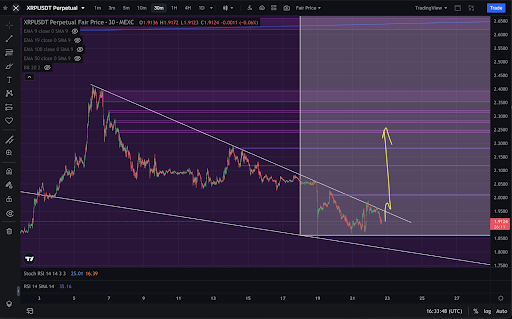
According to the technical analysis in question, XRP has been carving out a tightening pattern directly beneath a descending trendline that has acted as resistance since the beginning of the year. XRP printed a higher high of $2.4 in early January, retraced, and then began compressing into a narrow range of lower highs on the 30-minute candlestick chart. 

The chart shows how the token has repeatedly respected the trendline without collapsing below support at $1.9. This, in turn, has created what Archie describes as a coil right under the resistance trendline. Interestingly, this kind of structure tends to resolve quickly once price makes contact with the trendline again. 

Trendline Obliteration And The Push Beyond $2

According to the analyst’s prediction, the next touch of the trendline will not be another rejection. Instead, the next touch will lead to a clean break that sends XRP decisively through $2, which is a little more than a checkpoint. From his perspective, the repeated tests of resistance have weakened it, increasing the probability of a breakout as opposed to another downward rejection.

At the time of writing, the altcoin is trading at $1.91, down by 2.6% in the past 24 hours. However, looking closely at the chart Archie shared gives structure to what to expect once the trendline breaks.

XRP

The first level is just above the descending trendline itself, around the $2.00 to $2.05 region. In the context of the chart, a clean move through this level is what flips the structure from compression below resistance into expansion above resistance.

Above that, the next highlighted resistance is just below $2.20. The chart then shows a broader resistance cluster between roughly $2.35 and $2.40. Reaching and breaking above this zone is much more significant, as it would show that the breakout is a genuine trend reversal.

At the top end of the projection, the highest marked region is around $2.60. This zone appears to be the final upside target shown on the chart and would place XRP firmly into price discovery territory relative to recent structure.

XRP

How Donald Trump’s Latest Crypto Move Will Boost Demand For XRP

Crypto pundit X Finance Bull has explained how Donald Trump’s push to sign the crypto bill into law will boost demand for XRP. This follows White House Crypto Czar David Sack’s prediction about how banks will come into crypto once the CLARITY Act passes.

How Donald Trump’s Crypto Push Will Boost XRP’s Demand

In an X post, X Finance Bull shared a video in which Donald Trump’s crypto adviser, David Sacks, stated that banks will begin to adopt crypto once the crypto bill passes. The pundit noted that this means banks are already positioned, while Ripple has the stack and XRP has the liquidity, and the rails are in place. As such, he believes that the token will be the go-to crypto once these banks enter the crypto industry. 

X Finance Bull further mentioned that institutions that have been waiting over the past few years will return and announce their buys and use of XRP once Donald Trump signs the CLARITY Act into law. The pundit added that this moment resets who is early and that he never needed hype to hold the altcoin. “Research and study were always enough,” he said. 

X Finance Bull also questioned why market participants were panic-selling if banks are going all in once Donald Trump signs the crypto bill into law. The pundit’s statements come just as Ripple partnered with DXC to integrate the token and RLUSD into DXC’s Hogan core banking platform. 

The banking platform powers more than 300 million deposit accounts and over $5 trillion in deposits globally. As such, this is a major step in XRP’s adoption, as the partnership will integrate Ripple’s payment technology into large-scale banking environments.

Trump’s Tariff Move Will Also Boost The Altcoin

In another X post, X Finance Bull claimed that Donald Trump’s move with tariffs will also boost XRP’s demand.  He shared a video of how the U.S. president said that $18 trillion is flowing into the U.S. economy thanks to these tariffs. The pundit asserted that such money flows put pressure on banks, payroll systems, FX rails, and settlement speed. 

X Finance Bull further noted that this creates nonstop cross-border payments and liquidity needs, and this is where Ripple and XRP come in. He explained that while old rails leak money, Ripple and the altcoin were built to stop that. The pundit also alluded to Ripple executives meeting with Donald Trump and to the token being mentioned as part of the digital asset stockpile. He added that the CLARITY Act is next and that when rules lock in, the U.S. capital will need U.S. rails. 

At the time of writing, the XRP price is trading at around $1.92, down almost 2% in the last 24 hours, according to data from CoinMarketCap.

XRP

Here’s Why The Bitcoin, Ethereum, And Solana Prices Are Still Crashing Hard

Crypto researcher Axel has provided insights into why the Bitcoin, Ethereum, and Solana prices are still crashing. This comes as BTC continues to see a supply overhang, which threatens to put more downward pressure on crypto prices. 

Why The Bitcoin, Ethereum, and Solana Prices Are Still Crashing

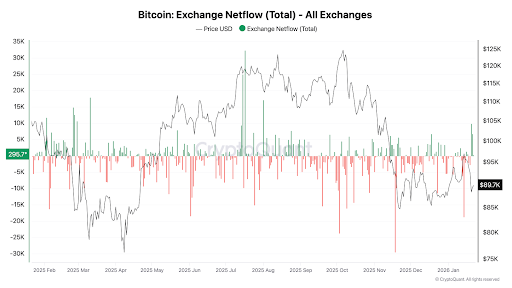
In a research report, Axel noted that anomalous exchange inflows accompanied the BTC breakdown below the $90,000 zone as sellers prepared in advance. The market is also still at risk of further selling pressure as the 1.0 level of the short-term holders’ SOPR is now acting as a resistance rather than support. As such, there is a possibility that Bitcoin, Ethereum, and Solana prices will decline further. 

Further commenting on Bitcoin netflows into exchanges, Axel noted that between January 20 and 21, almost 17,000 BTC flowed into exchanges, coinciding with BTC dropping to as low as $87,000, while Ethereum and Solana prices also dropped. The crypto researcher explained that these anomalously high values followed a period of predominantly negative netflow in the first half of this month. 

Bitcoin

In the context of the falling Bitcoin price, Axel stated that such a spike is more likely to reflect supply preparation than neutral transfers. In other words, the breakdown below $90,000 appears to be structural rather than emotional. Meanwhile, Bitcoin netflow returned to neutral levels yesterday, but the accumulated inflow still creates a supply overhang, which could lead to further declines in the prices of Bitcoin, Ethereum, and Solana. 

Axel noted that a signal of improvement would be if netflow turns negative again amid rising prices, which could indicate that the overhang has cleared. However, with the short-term holders’ 7-day SMA SOPR below 0.996, the crypto researcher suggested that BTC faces increased selling pressure on every recovery as these holders look to sell at breakeven. He added that a reversal trigger could be confirmed if the SOPR breaks above 1.0 from below, with the 7-day SMA holding unity for three to five days to filter out false spikes after the selloff. 

Why A Break Above $100,000 Looks Unlikely For Now

In its latest research report, on-chain analytics platform Glassnode explained that a Bitcoin rally above $100,000 looks unlikely for now as the supply overhang persists. They noted how this overhang supply above $98,000 remains the dominant sell-side force capping short to mid-term rebounds. 

Alluding to the Unspent Realized Price Distribution metric, Glassnode noted that the recent BTC rally has partially filled the prior air gap between $93,000 and $98,000, driven by redistribution from top buyers into newer market participants. 

However, the unresolved supply overhang is expected to likely cap attempts above the $98,400 short-term holders’ cost basis and the $100,000 level. A meaningful and sustained acceleration in demand momentum is said to be required for a clean breakout above $100,000 to occur.

Bitcoin

Bitcoin Price Following The 2022 Fractal? Here Was The Previous Outcome

Technical analysis shared by crypto analyst CryptoBullet on X highlighted a familiar price action that suggests that Bitcoin’s current structure may be closely tracking a 2022 price fractal. 

Bitcoin’s price action in recent days has changed into a more fragile posture, with the cryptocurrency falling back below the psychological $90,000 level after failing to sustain higher ground above $97,000 on January 14.

How Bitcoin’s Current Structure Resembles The 2022 Fractal

According to CryptoBullet, Bitcoin’s present price action is closely following an interesting structure that it previously played out in 2022. Technical analysis on the daily candlestick timeframe chart posted by the analyst shows the earlier 2022 move as a transparent projection layered behind current price action, with a striking similarity in both rhythm and volatility. 

As it stands, Bitcoin has experienced a significant 28.7% pullback from its October 2025 peak and is now trading in a choppy consolidation, a behavior that closely matches the early stages of the 2022 downturn.

Bitcoin

CryptoBullet noted, however, that there is an important distinction. During the 2022 decline, Bitcoin had already tested the 50-week moving average and the 200-day moving average at this stage of the cycle. In the current setup, Bitcoin’s price action is trading below those levels but has not yet made a direct test, and this means that the structure may still be incomplete.

What The 2022 Outcome Predicts For Bitcoin’s Next Move

The projection in the background of the chart shows Bitcoin making one more push higher over the coming month, briefly reclaiming levels above $100,000 before running into a strong resistance at the 50-week moving average.

If this scenario plays out, the move would resemble the final relief rally seen in 2022, where the price rallied into long-term resistance before rolling over. CryptoBullet noted that timing also supports this idea, noting that considering the 2022 top is lined up with the October 2025 top, there appears to be roughly one month of price action left for a final leg up. 

The projection is that Bitcoin pushes to at least $100,000 again sometime in February 2026. However, support must hold above $83,000 in order for this bullish portion of the setup to be valid.

Although the short-term projection is bullish, the broader implication of the 2022 fractal is bearish for the mid-term. According to the chart’s projected path, Bitcoin is shown rejecting at the 50-week moving average after a brief rally, followed by a sustained decline that eventually drags its price action below $71,500. 

This prediction is based on exactly what unfolded in 2022, when a final pump gave way to a deeper corrective phase. That said, fractals are guides, not guarantees, meaning price history may rhyme, but it does not always repeat itself exactly.

Bitcoin

Expert Explains Why The Market Cap Theory Doesn’t Apply To XRP

Market cap arguments always dominate debates around XRP’s long-term price potential, especially when double-digit and triple-digit targets are mentioned. Critics point to the altcoin’s large circulating supply and compare its implied valuation to banks and major corporations, using that comparison as a reason to dismiss higher price scenarios. 

However, a few analysts also contend that this framework misunderstands what the token is designed to do. According to one such expert, the problem is not the math itself, but the model being used to interpret it.

Why Bank Market Cap Comparisons Miss The Point

Crypto analyst Crypto Luke recently pushed back against the idea that XRP should be valued using the same logic applied to banks and financial institutions. The idea is that banks process enormous volumes of money every day, often in the trillions, but they do not hold that money on their balance sheets. The market capitalizations of banks are based on earnings, risk exposure, regulatory burdens, and operational efficiency, not the total value that flows through their systems.

Comparing XRP to financial institutions such as BNY Mellon mixes two very different concepts. Banks act as intermediaries that move other people’s money and earn fees along the way. The altcoin, on the other hand, is not a company but a liquidity bridge. It is designed to be the asset that actually settles value. Therefore, using equity-style market cap comparisons to judge a settlement asset like XRP leads to conclusions that are incomplete.

What This Means For XRP Price Debates

As noted by the expert, the design question isn’t how much volume moves; it’s how much capital must exist to support that movement without pre-funding.

It is important to note that the claim that market cap theory doesn’t apply to XRP is not a denial of basic math. Price multiplied by supply will always equal market capitalization. However, what Crypto Luke and others are challenging is the assumption that its market cap must be interpreted the same way as that of a bank or a traditional company. 

Related Reading: XRP Price At $10 Too Low? Pundit Says That’s For Retail, Reveals Institutional Targets

Another analyst, Pantoja, dismissed the idea that market cap is a hindrance for the altcoin to reach $1,000. The analyst noted that long-term XRP valuation will hinge on the real-world adoption of its underlying technology. Speaking of adoption, the adoption is talking about the token and the XRP Ledger being used by banks for cross-border settlements.

At the time of writing, XRP has a circulating supply of 60.7 billion XRP tokens. If the cryptocurrency were to reach a double-digit price, such as $10, based on the current supply, the implied market capitalization would be about $607 billion. That sounds extreme at first glance, but it is not automatically impossible. For context, Bitcoin’s market cap is about $1.79 trillion, so this is possible for a cryptocurrency.

This perspective weakens blanket statements that the token cannot reach certain price levels simply because the implied valuation looks large when placed next to corporate balance sheets. At the same time, it does not automatically validate extreme price targets. One crypto analyst, Mason Versluis, noted $10 is a much more realistic price target than $10,000 predictions.

XRP

XRP Completes ‘Super Guppy Compression’ Against Bitcoin, Next Target Emerges

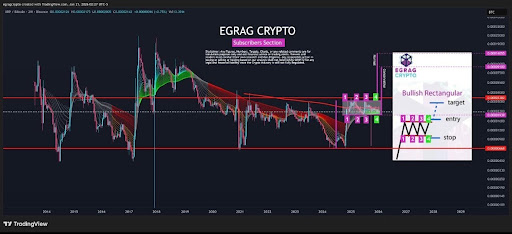
According to a recent technical analysis by market expert Egrag Crypto, XRP has formed a “Super Guppy Compression” against Bitcoin, signaling the potential for a major structural shift. The analyst has revealed what could come next for the XRP/BTC pair following this development, indicating a higher probability of a bullish breakout within the next few months. 

XRP Bitcoin Pair Forms Super Guppy Compression

In his X post, Egrag Crypto provided a detailed breakdown of the XRP/BTC price structure and the recent patterns emerging within its chart. He suggested that the trading pair recently entered a transition phase after a multi-year decline, with price action tightening as the market moved through a period of compression

Egrag Crypto revealed that XRP/BTC has completed a Super Guppy Compression pattern, which shows full ribbon compression across both short- and long-term Moving Averages (MA). According to the analyst, this compression signals an upcoming volatility expansion, indicates exhausted selling pressure, and highlights a clear transition phase in the market. 

Color dynamics within the Guppy system on the chart also suggest a shift in market behavior. Egrag Crypto notes that the short-term Moving Averages, or “ribbons” as he calls them, are turning green, signaling early bullish momentum. At the same time, long-term ribbons remain red but are flattening, indicating that the downward trend on XRP/BTC is easing. These developments also show that the market has exited its bearish phase; however, a clear uptrend has yet to emerge, leaving the trading pair in a base-building stage.

XRP

From a price-structure perspective, Egrag Crypto notes that XRP/BTC is forming a bullish rectangular pattern. The analyst revealed that the trading pair had repeatedly bounced off support while facing rejection at resistance, indicating that supply is being absorbed rather than aggressively sold off. According to him, this behavior aligns with textbook reaccumulation patterns observed after extended downtrends, signaling a potential upward move ahead. 

Egrag Crypto has shared key targets for where he believes XRP/BTC could go next, depending on its current market structure. He noted that the structure matters more than the underlying emotion, suggesting that although the market may seem quiet, it is actively positioning for a decisive move. 

Analyst Sets Bullish And Bearish Targets For XRP/BTC

Continuing his analysis, Egrag Crypto predicted that over the next three to six months, the XRP/BTC price has a 60-70% chance of a bullish breakout. He added that there is also a 30-40% possibility of an extended consolidation, but only if the market structure breaks—a scenario he considers unlikely. 

Looking at the chart, the analyst has identified two key upside targets and one downside scenario. If XRP/BTC crosses the red resistance line at approximately $0.0000338, Egrag Crypto predicts an initial surge to a “conservative” target of $0.000091, followed by a rise to a “normal” target of $0.00014. Conversely, if a structure break occurs, XRP/BTC could plunge from $0.0000193 to $0.00000668.

XRP

Bitcoin Is At Risk From Saylor: Pundit Shares Why Strategy’s BTC Holdings Is A Net Negative

Crypto pundit Crypto Chase has explained how Strategy’s Bitcoin holdings is a net negative for BTC’s adoption, especially among large investors. The pundit also ruled out the possibility of capitulation on Michael Saylor’s part, even if the flagship crypto drops below their entry point. 

Why Saylor’s Strategy Bitcoin Holdings Puts BTC At Risk

In an X post, Crypto Chase opined that Strategy’s BTC holdings do more to deter institutions and high-net-worth individuals than to attract them. The pundit added that there really isn’t any full-scale capitulation below Saylor’s average entry price of $76,000, as he believes that Saylor and Strategy will hold until zero, except if the board forces them to do otherwise.  

This statement followed Strategy’s latest $2.13 billion Bitcoin purchase, which saw the company’s holdings cross the 700,000 BTC milestone. The company now holds 709,715 BTC, which it acquired for $53.92 billion at an average price of $75,979. Meanwhile, Crypto Chase also stated that if the company were to offload these coins, the Bitcoin price would go back to $3,000 or lower. 

The pundit warned that there are not even close to enough bids to handle such selling pressure. As such, he believes that Strategy’s Bitcoin holdings would have to be sold over the counter to the U.S. government or Trump to avoid a total collapse of the flagship crypto. However, Saylor has so far asserted that they have no intention of ever selling their BTC holdings. 

Crypto Chase also mentioned that fear among uneducated market participants could provide a good entry if the narrative is that Saylor and Strategy would be liquidated if BTC drops below their average entry price. The pundit reiterated that it is game over if that ever happened, though. He is also not confident Bitcoin will rise to new highs anytime soon, noting there is significant overhead and Total Cost of Ownership, with entry points above $100,000. 

From Another Crypto Pundit’s Point Of View

It is worth noting that Crypto Chase’s statement about Saylor’s Strategy and Bitcoin’s holdings was in response to crypto pundit Ansem’s point of view. In an X post, Ansem said he believes Bitcoin will find its place alongside gold and silver in portfolios and benefit from large, high-net-worth individuals and institutions adding small positions. He remarked that BTC, as a digital analog, is easier to transport across global borders and easier to transact with. 

Ansem also noted that Saylor and Strategy’s cost average is currently around $75,000 and that he believes that a drop below that level would be a full-scale capitulation into a generational buying opportunity. From a technical standpoint, the pundit does not think Bitcoin will trade below last cycle’s price peak of $69,000 in 2021.

Bitcoin

Why Is The Shiba Inu Price Crashing? The Billion-Dollar Move You Should Know About

The Shiba Inu price crashed to as low as $0.000007683 yesterday, sparking bearish sentiment towards the meme coin. This crash came on the back of a transfer of billions of SHIB tokens, which raised concerns of a potential sell-off by the whale in question. 

Why The Shiba Inu Price Crashed

The Shiba Inu price crashed amid significant selling pressure, with a SHIB whale sending billions of tokens to Robinhood, likely to offload these tokens. Arkham data shows that the whale (0x2d0…9f7bB) first sent 210.365 billion SHIB tokens, worth $1.63 million, to the crypto exchange. These tokens represented about 97% of the whale’s SHIB holdings.

Further data from Arkham shows that the SHIB whale sent an additional 1.52 billion tokens to Robinhood and 7 billion tokens to liquidity provider B2C2 Group, which could be an OTC sale. The Shiba Inu price has notably crashed by over 7% in the last week, and it suffered its worst drop during this period yesterday amid the whale’s transfers. The whale now holds only 5.86 billion SHIB, worth $46,790.

The Shiba Inu price also crashed due to the sell-off in the broader crypto market, led by Bitcoin. BC dropped to as low as $87,000 yesterday amid concerns over trade tensions between the U.S. and Europe stemming from the Greenland-linked Trump tariffs. However, the market recovered towards the end of the day as Trump announced that he had canceled the proposed tariffs, having reached a Greenland deal with NATO.  

Despite the recent Shiba Inu price crash, the meme coin is still up over 15% year-to-date (YTD) and ranks among the best-performing crypto assets this year. However, SHIb is still far off from its current all-time high (ATH) of $0.00008845. 

Exchange Netflows For SHIB Remains Mixed

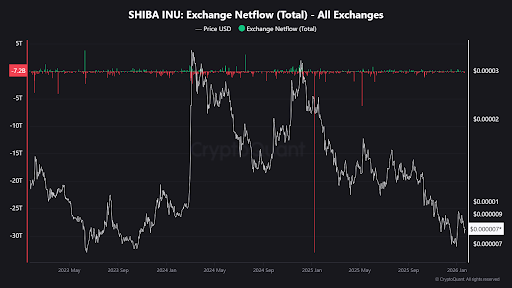
SHIB’s exchange netflows have remained mixed, indicating there is no clear accumulation pattern for the meme coin at the moment. CryptoQuant data shows that today’s net flows are negative, totaling just over 7 billion Shiba Inu tokens, suggesting that more coins are flowing into exchanges than out. 

Shiba Inu

However, the total exchanges’ netflows yesterday were positive, at 1.6 billion tokens, indicating more tokens leaving exchanges, which is bullish for the Shiba Inu price as it hints at accumulation from whales. On January 16, SHIB’s netflows were also positive, totaling around 115 billion tokens. However, the positive netflows on that day were overshadowed by the negative flows of 214 billion SHIB recorded on January 20.   

Related Reading: Here’s Why The Shiba Inu Price Jumped Over 13%

Crypto traders still remain bullish on the Shiba Inu price as CoinGlass data shows the long/short ratio is currently above 1. Derivatives trading volume has also jumped by over 20% while the open interest is up almost 3%. 

At the time of writing, the Shiba Inu price is trading at around $0.000007978, up in the last 24 hours, according to data from CoinMarketCap.

Shiba Inu

Ripple’s RLUSD Is Not A Threat To XRP’s Future, Here’s Why

Rumors about XRP suddenly becoming useless and less relevant appear to be spreading across the crypto market following the introduction of Ripple’s stablecoin, RLUSD. Crypto market analyst XFinanceBull recently took to X to debunk these claims, stating that, rather than being a potential threat, RLUSD was created to complement XRP’s functionality and use cases on the ledger.

Why Ripple’s RLUSD Poses No Danger To XRP 

In his post, XFinanceBull revealed that many in the crypto community now see XRP as less useful because of RLUSD. These concerns carry weight given the growing dissatisfaction over XRP’s price struggles. Furthermore, with a stablecoin in place, the perception is that XRP’s use cases could deteriorate, especially given RLUSD’s greater stability. 

Addressing these growing concerns, XFinanceBull emphasized that XRP and RLUSD serve different purposes within the ecosystem. His commentary aims to correct the misconception that RLUSD was introduced to replace XRP. The analyst referenced statements from Ripple’s former Chief Technology Officer (CTO), David Schwartz, who, in a video, clearly explained the distinct roles of XRP and RLUSD, highlighting how the stablecoin benefits the altcoin rather than threatens it. 

According to XFinanceBull, Schwartz stated that RLUSD attracts large, credible flows to the XRP Ledger (XRPL), and this capital provides structural benefits to XRP. The analyst declared that RLUSD does not replace XRP, but instead amplifies its functionality. He added that as liquidity grows through the stablecoin, more payment routes are created, leading to increased XRP burns. 

XFinanceBull also noted that every stablecoin trade within the Ripple ecosystem indirectly drives demand for XRP as a bridge asset. He concluded that the world will eventually realize that utility is not defined by a whitepaper alone, but by real transaction flows. He added that although the XRP price may be declining, its rails are still being built.  

How RLUSD Benefits XRP

In the video shared by XFinanceBull, Schwartz stated that RLUSD is designed to benefit XRP. He explained that RLUSD strengthens XRP by introducing more credible assets onto the XRP Ledger, thereby expanding the network’s use cases and creating more opportunities for developers. 

The former Ripple CTO also revealed that adding trusted assets, such as RLUSD, increases trading activity on XRPL’s DEX. According to him, higher trading volume generates both direct and indirect benefits for the decentralized network and its native token, XRP. 

A key advantage of the XRPL DEX is its auto-bridging feature, which uses XRP to facilitate trades between different assets. Schwartz said that this mechanism allows XRP to act as an intermediary, helping users find the most efficient trading routes. He added that RLUSD and XRP are designed to complement each other, given their different roles within the ecosystem. While the stablecoin offers price stability, the altcoin functions as a bridge currency within Ripple’s payment products. This means that as RLUSD usage grows, demand for XRP is reinforced.

Ripple

PEPE’s Reversal Move: Pushing Out Bears As Confirmation Closes In

PEPE is finally entering a critical phase as recent price action suggests the market is actively pushing out bears ahead of a potential structural shift. Pseudonymous crypto analyst ‘The Composite Trader’ argues that the move is less about immediate upside and more about completing a controlled reversal process and preventing any further downside. 

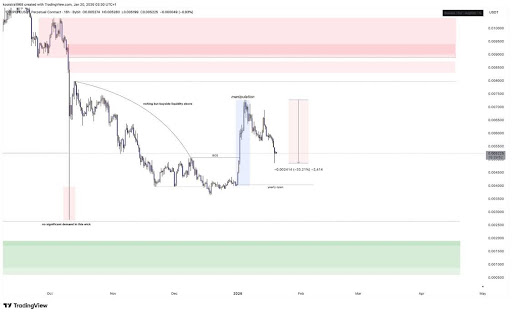
In an X post this Tuesday, The Composite Trader updated a setup he first outlined on January 5, explaining that PEPE’s sharp bullish expansion at the start of the year was never meant to be sustained. He labeled the move as manipulative and stated that a price reversal toward a yearly open was the intended outcome. 

PEPE Stages Reversal Move To Force Out Bears

His accompanying chart supports this narrative by illustrating a brutal downtrend that began in late 2025, with PEPE plummeting nearly 50% before following a descending curved channel. The analyst highlighted a Break of Structure (BOS) at a lower level in the pattern, followed by a short-lived rally into the $0.0065-$0.0075 region. This upward move was explicitly labeled “manipulation” on the chart, pushed higher to hunt for buy-side liquidity, with no real demand to sustain higher prices. 

Related Reading: Why Meme Coins Like PEPE And FARTCOIN Are Ready To Explode

According to the analyst, PEPE’s ongoing reversal process is designed to force out current bearish positions before any confirmed trend change. The chart shows that the meme coin has already corrected by roughly 33.21%, wiping out some of the gains it achieved earlier this year. This move aligns closely with The Composite Trader’s earlier expectation that the yearly open would be challenged, confirming the market’s downward momentum

PEPE


The analyst also noted that similar price patterns are emerging across other altcoin pairs, reflecting the broader impact of whale-driven movements. He has emphasized the importance of understanding the timing behind these reversals, suggesting that not every price shift signals a sustainable uptrend. 

Furthermore, the Composite Trader has said that accumulation schematics and bullish reversals for PEPE will be confirmed when the time is right. Until then, the market remains bearish with strategic price corrections, requiring patience from investors and traders. 

Analyst Predicts More Decline For PEPE Price

Crypto analyst Davie Satoshi has also shared insights on PEPE’s price behavior and its potential next moves. He predicts that PEPE could decline even further if Bitcoin crashes to $85,000 and $75,000. Based on his analysis, PEPE’s price movement is now closely tied to BTC, and the lower Bitcoin goes, the more likely PEPE will follow.

Excluding PEPE, Satoshi forecasts that all meme coins could enter a downtrend if Bitcoin declines. Despite this bearish outlook, he believes PEPE will likely rebound and move back up. The analyst expects the meme coin to reverse sharply and find new support levels. He advises non-PEPE holders to take advantage of the current downtrend by buying the dip.

PEPE

What’s The Beef Between Cardano And XRP? Here’s Why The Communities Are Clashing

A disagreement over US crypto regulation has spilled into public view, drawing the Cardano and XRP communities into an unexpected clash. The reason is the Digital Asset Market Clarity Act, a proposed bill intended to define how digital assets are regulated in the United States. 

The disagreement started after Charles Hoskinson openly criticized Brad Garlinghouse over his stance on the legislation, which led to pushback from prominent XRP community members. This comes just after reports have suggested growing frustration among lawmakers toward Coinbase over disagreements tied to the Clarity Act.

Hoskinson’s Criticism And Garlinghouse’s Position In Full Context

The tension came to the surface during a livestream in January 2026, where Hoskinson criticized Garlinghouse’s apparent support for advancing the Clarity Act despite its shortcomings. In the video, Hoskinson expressed skepticism about the bill’s direction and origins, remarking sarcastically, “And what we got is Elizabeth Warren wrote the bill, that’s leadership we can believe in.”

He went on to challenge the idea that passing an imperfect bill is preferable to continued uncertainty, pointing directly to the position of Ripple CEO Brad Garlinghouse. Hoskinson questioned whether handing regulatory power to the same institutions that previously sued, subpoenaed, or shut down crypto businesses could truly be considered progress.

Hoskinson’s remarks did not go unanswered. Vet, a notable XRP community member and XRP Ledger dUNL validator, reposted the video on X and criticized Hoskinson’s approach. Vet questioned why Hoskinson chose to publicly attack Garlinghouse instead of contributing constructively to the legislative process, writing, “How about focusing on helping shape the Clarity Bill instead of crashing out on Brad for no reason, Charles?”

Why The Clarity Act Matters To Both Communities

The Clarity Act is one of a few bills introduced during the current crypto-positive Trump administration that aims to bring structure to a regulatory environment that has been uncertain for years. The Clarity Act, in particular, was introduced to bring clarity around whether digital assets should be treated as securities or commodities and which agencies should oversee them. 

The bill represents a necessary step toward legal certainty and institutional participation. Supporters of XRP tend to see engagement with lawmakers as a practical route forward after years of legal battles. However, others like Charles Hoskinson are of a different notion. 

The Clarity Act is not without its issues. Sources close to the White House say the administration is considering pulling its support for the Clarity Act if Coinbase does not return to negotiations over stablecoin yield provisions. However, Coinbase CEO Brian Armstrong noted that Coinbase is actively working to find common ground with banks on yield-related issues.

A similar Act, called the Guiding and Establishing National Innovation for US Stablecoins Act, or the “GENIUS Act,” was signed into law in 2025 by President Donald Trump as part of efforts to create better regulatory clarity towards stablecoins in the United States. 

Interestingly, Ripple CEO Brad Garlinghouse was part of the crypto industry leaders that expressed support for the Genius Act after it was signed into law.

XRP

❌