On Thursday, Senator Craig Bowser introduced a new piece of legislation aimed at creating a Strategic Bitcoin and cryptocurrency reserve for Kansas state.
The proposal, filed as Bill 352, would permit the Kansas Public Employees Retirement System (KPERS) to allocate up to 10% of its total funds into Bitcoin exchange-traded funds (ETFs).
Kansas Bitcoin Bill
Under the bill’s framework, KPERS would not be obligated to sell its Bitcoin ETF holdings if their value grows beyond the 10% allocation threshold, unless the board determines that doing so would better serve the interests of beneficiaries.
If enacted, the legislation would also require the KPERS board to conduct an annual review of the investment program, with the results formally submitted to the governor for oversight and evaluation.
Kansas’ move follows a growing trend among US states exploring BTC as a strategic asset as the regulatory environment surrounding crypto has significantly shifted under President Donald Trump’s administration.
US States Move Toward Crypto Reserves
Texas set an early benchmark last November when it became the first state to formally incorporate cryptocurrency into its treasury strategy by purchasing $10 million worth of Bitcoin.
In North Dakota, lawmakers are considering BTC investments as a potential hedge against inflation. Oklahoma has also entered the conversation, with Senator Dusty Deevers introducing the Bitcoin Freedom Act.
Meanwhile, Tennessee introduced a new bill last week—HB1695—designed to establish its own Strategic Bitcoin Reserve. West Virginia has put forward Senate Bill 143, which proposes allocating 10% of certain state funds toward a cryptocurrency reserve.
Missouri has made notable progress as well, advancing House Bill 2080 to create a Strategic Bitcoin Reserve Fund. That measure has already passed its second reading and is now moving forward for further consideration in the state House.
Featured image from DALL-E, chart from TradingView.com
On Tuesday, US Treasury Secretary Scott Bessent confirmed plans for the country’s Strategic Bitcoin Reserve (SBR), coinciding with a sharp decline in BTC and the overall cryptocurrency market.
All Seized Bitcoin To Be Held In Strategic Reserve
In a discussion about the government’s approach to BTC and the recent seizures of the cryptocurrency, Bessent reassured the public that the administration would cease all sales of seized Bitcoin.
Instead of auctioning off these assets, the government plans to add the seized Bitcoin to the Strategic Bitcoin Reserve, which was set up in March last year by President Donald Trump’s administration.
This decision, however, did little to mitigate BTC’s plummet on Tuesday, as the lack of any plans to purchase additional coins from the market contributed to continued downward pressure on prices.
Bessent elaborated that the initiative is part of a broader strategy aimed at fostering digital asset innovation within the United States while maintaining federal oversight of confiscated cryptocurrencies.
“This administration’s policy is to add seized Bitcoin to our digital asset reserve,” Bessent stated, marking a decisive shift in the government’s handling of Bitcoin assets.
Political Climate Leads To $215 Billion Crypto Market Dip
Bitcoin has experienced a decline of nearly $5,800—coinciding with political tensions after President Trump hinted at a 10% tariff on the European Union (EU) in an attempt to compel Denmark to sell Greenland.
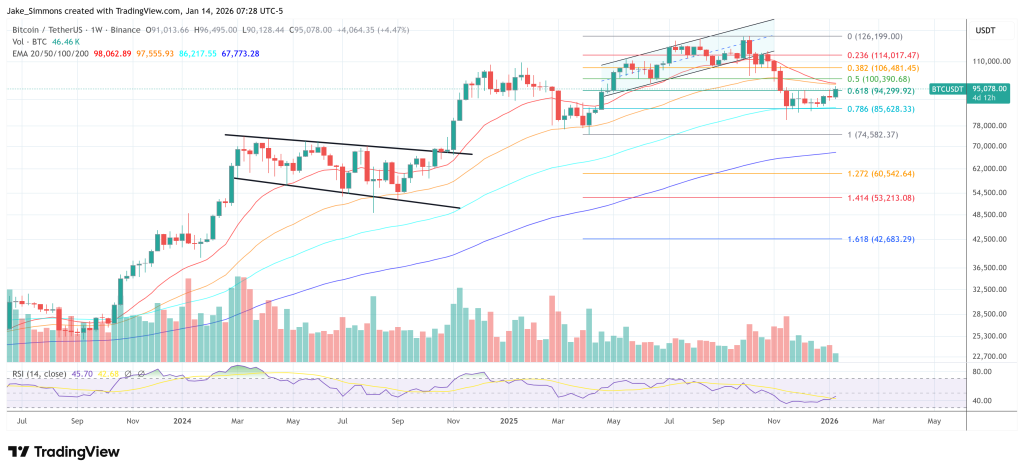
This geopolitical maneuver has not only affected Bitcoin but has also resulted in a staggering loss of approximately $215 billion in total market capitalization across the crypto sector.
Market analyst Ted Pillows warned that BTC must maintain its position above the $89,000 mark. He expressed that failing to hold this level would signal the end of the short-term upward trend, further complicating an already tumultuous condition for the cryptocurrency.
When writing, BTC still holds above the key level outlined by Pillows at $89,497, but has declined by 3.7% in the last 24 hours.
Featured image from OpenArt, chart from TradingView.com
When asked about the U.S. government’s approach to Bitcoin and recent BTC seizures, U.S. Treasury Secretary Scott Bessent re-affirmed that the administration will halt all sales of seized BTC and instead add it to the Strategic Bitcoin Reserve (SBR).
At the World Economic Forum in Davos, Bessent told journalist Christine Lee that the initiative is part of a larger effort to bring digital-asset innovation onto U.S. soil while keeping federal oversight of seized cryptocurrency
This sentiment comes from questions about the government’s handling of BTC seized from developers linked to Tornado Cash in the Southern District of New York as well as the handling of bitcoin from Samourai Wallet developers.
While Bessent declined to comment on ongoing litigation, he emphasized that any seized BTC would be retained by the federal government after legal damages are resolved, rather than being sold at auction as in prior years.
“This administration’s policy is to add seized Bitcoin to our digital asset reserve,” Bessent said, highlighting the first step in implementing the SBR: stopping all sales.
JUST IN: Treasury Sec. Scott Bessent says, “The policy of this government is to add seized #Bitcoin to our digital asset reserve.” pic.twitter.com/e6X2D4peSv
The reserve, established under a March 2025 executive order, treats Bitcoin as a long-term strategic asset, akin to gold or petroleum stockpiles.
Bessent also seemed to frame the broader strategy of this current innovation as a pro-innovation, pro-onshore.
The Treasury wants to make the U.S. the “best regulatory regime for digital assets,” citing bipartisan legislation such as the Genius Act, which codifies stablecoin rules at the federal level.
The U.S. government says they didn’t sell any Samourai Wallet bitcoin
Last week, U.S. officials denied reports that BTC forfeited by Samourai Wallet developers had been sold, confirming the assets will remain part of the Strategic Bitcoin Reserve (SBR) under Executive Order 14233.
Patrick Witt of the President’s Council of Advisors for Digital Assets stated that the Department of Justice confirmed the 57.55 BTC, worth roughly $6.3 million, has not and will not be liquidated.
The clarification came after earlier reports suggested the U.S. Marshals Service may have transferred the BTC to Coinbase Prime, fueling speculation of a sale that would have violated the executive order.
Journalist Frank Corva reported that the U.S. Marshals Service appears to have sent the 57.55 BTC forfeited by Samourai Wallet developers directly to a Coinbase Prime address, which showed a zero balance, suggesting the BTC may have already been sold.
If true, this selling would contradict Executive Order 14233, which requires forfeited bitcoin to be held in the U.S. Strategic Bitcoin Reserve rather than liquidated.
Recent allegations regarding the Bitcoin (BTC) sale by the US Marshal Service (USMS) — operating under the Department of Justice (DOJ) — have been addressed by White House crypto advisor Patrick Witt, who confirmed that the digital assets forfeited by Samourai Wallet and its founders have not been liquidated.
DOJ Confirms Samourai Bitcoin Will Not Be Sold
In a post on social media platform X (formerly Twitter), Witt clarified that the DOJ has verified that the digital assets taken from the Samourai Wallet will not be sold, in accordance with Executive Order 14233. He emphasized that these assets will remain on the government’s balance sheet as part of the Strategic Bitcoin Reserve.
Earlier in the month, speculations suggested that the USMS, following directives from the DOJ, had sold approximately 57.55 Bitcoin forfeited in the Samourai Wallet case through Coinbase Prime on November 3, 2025.
The lack of confirmation until now had led experts to assert that such actions would violate EO 14233, signed by President Donald Trump. This order mandates that Bitcoin obtained through criminal or civil forfeiture be retained and added to the US Strategic Bitcoin Reserve, rather than being sold off.
The Bitcoin in question is valued at almost $6.4 million and was seized from the creators of Samourai Wallet. According to US authorities, the cryptocurrency mixer facilitated over $237 million worth of illicit transactions.
Samourai Wallet’s Co-Founders Face Justice
The DOJ had announced in November the sentencing of Keonne Rodriguez and William Lonergan Hill, the co-founders of Samourai Wallet.
Rodriguez, the company’s CEO, and Hill, its Chief Technology Officer, were implicated in a conspiracy involving the operation of a money transmitting business that “knowingly” transmitted proceeds from criminal activities.
The criminal proceeds laundered through their platform originated from various illegal activities, including drug trafficking, darknet marketplace operations, cyber intrusions, fraud, murder-for-hire schemes, and even a child pornography website. Rodriguez received a five-year prison sentence, while Hill was sentenced to four years.
At the time of writing, Bitcoin is trading at $95,300, marking an almost 6% increase over the past seven days. However, it is still unable to regain the key $100,000 level, which has eluded the cryptocurrency since November last year.
Featured image from DALL-E, chart from TradingView.com
The White House is still treating a US Strategic Bitcoin Reserve as an active priority, even as officials work through what executive director of the White House Crypto Council Patrick Witt described as the legal and bureaucratic questions that sit beneath an idea that, on paper, sounds simple.
US Strategic Bitcoin Reserve On ‘Priority List’
In an interview recorded at the White House for the Jan. 13 episode of Crypto In America, Witt told host Eleanor Terrett that interagency talks on implementing President Donald Trump’s executive order are ongoing and that the effort remains on the administration’s “priority list,” as Congress simultaneously moves toward its next steps on crypto market structure legislation later this week.
Asked how the White House is thinking about the reserve “these days,” Witt pointed to a process being driven not only by crypto policy staff, but by the operations machinery tasked with pushing executive orders through the federal government.
“We’ve had good engagement from the Deputy Chief of Staff for Policy team, which is Steven Miller’s team […] [to] make sure that all of the executive orders that have been signed by the president — that the agencies are moving out on them,” Witt said. “The treasury team, commerce team is involved. […] It seems straightforward, but then you get into some […] obscure legal provisions and why this agency can’t do it, but actually this agency could.”
Witt framed the current phase as less about whether the administration wants the reserve, and more about ensuring it can move in a way that will withstand scrutiny. “We’re continuing to push on that. It is certainly still on the priority list right now,” he said, adding that “Department of Justice, Office of Legal Counsel […] has provided some good guidance on where we can […] move out on this executive order […] and do so in a legally sound way.”
The remarks come against the backdrop of Trump’s March 2025 executive order establishing a Strategic Bitcoin Reserve and a broader “digital asset stockpile,” which directed the government to treat existing federally held bitcoin as a long-term reserve asset while agencies were tasked to research ways for budget-neutral acquisition.
Witt also addressed a separate flashpoint that has circulated in Bitcoin circles in recent days: speculation that the Department of Justice had sold bitcoin linked to the Samourai Wallet case, potentially conflicting with the administration’s reserve posture.
“I think it was somewhat misreported,” Witt said, referencing the settlement language and what he characterized as standard legal drafting. “If you look at the settlement agreement, the legal documents, it sounds like […] the agency is going to take a certain action. […] In talking with DOJ, it was basically written in such a way where they preserve all of their options and their rights in those agreements, but those bitcoins have not been liquidated. Those digital assets have not been sold.”
Witt’s bottom line for viewers was that the headline allegation, that DOJ had “outright violated” the executive order, “is not a concern,” though he stressed that he could not say more beyond that.
Florida lawmakers have revived a push to put bitcoin on the state’s balance sheet, filing new legislation for the 2026 session that would create a state-run cryptocurrency reserve after a similar effort stalled last year.
House Bill 1039, filed Jan. 7 by Republican Rep. John Snyder, would establish a Strategic Cryptocurrency Reserve Fund that sits outside Florida’s main treasury.
The proposal authorizes the state’s chief financial officer to invest public funds in digital assets under a set of guardrails that include audits, reporting requirements, and advisory oversight.
The bill marks a reset rather than a clean break. Florida lawmakers floated broader crypto investment proposals in 2025, but those measures were withdrawn after facing resistance over scope and risk.
The new framework narrows the focus and reflects a growing preference among Republican lawmakers for treating bitcoin as a reserve-style asset rather than a speculative trade.
Under HB 1039, the CFO would have discretion over whether and when to invest. The bill does not mandate a minimum allocation.
Earlier versions of Florida legislation proposed allowing up to 10% of certain state-managed funds to be invested in bitcoin. While the new bill revives that concept, it leaves deployment decisions to the CFO and places the reserve outside pension and retirement accounts.
The legislation includes requirements for independent audits and the creation of an advisory committee to guide investment strategy and risk management. Supporters say those provisions are meant to address concerns about volatility while still giving the state flexibility to act.
The renewed effort is closely tied to parallel legislation in the Senate. Republican Sen. Joe Gruters, a longtime bitcoin supporter and ally of President Donald Trump, has filed companion bills that lay out the trust structure and funding mechanics for the reserve.
Together, the House and Senate measures would govern how Florida acquires, holds, and manages any digital assets.
Bitcoin as a financial hedge for Florida
While the bills do not explicitly name bitcoin, they effectively limit eligibility to it. Only digital assets that maintained an average market capitalization of at least $500 billion over the past 24 months would qualify.
At present, bitcoin is the sole asset that meets that threshold, with a market cap above $1 trillion. Ethereum and other crypto fall well short.
Backers frame the proposal as a hedge rather than a bet. Florida Chief Financial Officer Jimmy Patronis has publicly described bitcoin as “digital gold” and said limited exposure could help diversify state-managed funds over long time horizons. The bill states that the reserve is intended to help protect public assets against inflation and currency debasement.
Florida’s approach mirrors moves in other states that have narrowed their focus to bitcoin after initial attempts to authorize broader crypto exposure.
New Hampshire became the first state to explicitly allow public funds to be invested in crypto, granting its treasurer authority to allocate up to 5% of certain portfolios.
Texas approved a small bitcoin ETF purchase in late 2025 as part of its own reserve strategy.
Wyoming, meanwhile, has passed a slate of laws clarifying the legal status of digital assets without committing public funds.
The proposal also fits within Florida’s broader stance on digital money. In 2023, Gov. Ron DeSantis signed legislation blocking central bank digital currencies from recognition under the state’s commercial code.
The move positioned Florida as skeptical of federally issued digital money while remaining open to decentralized alternatives like bitcoin.
If passed, Florida would become one of the largest U.S. states to formally experiment with crypto as a reserve-class asset. Supporters argue that a tightly governed reserve could allow the state to gain exposure without putting core public funds at risk. Critics, however, point to bitcoin’s history of sharp price swings and question whether public money should be exposed at all.
HB 1039 and its Senate companions must clear committee hearings and floor votes during the 2026 legislative session.
The bills include a conditional effective date of July 1, 2026, meaning implementation would only begin if the full legislative package is approved and signed into law.

 Login
Login
 Treasury Sec. Scott Bessent says, “The policy of this government is to add seized