Reading view

There are new articles available, click to refresh the page.

XRP At ‘Critical Inflection Point’: Analyst Signals Major Expansion If This Level Holds

As XRP attempts to climb to higher levels, an analyst affirmed that the altcoin is “doing what it needs to do” to continue its bullish rally, highlighting multiple key structures in key timeframes.

XRP Enters Inflection Point

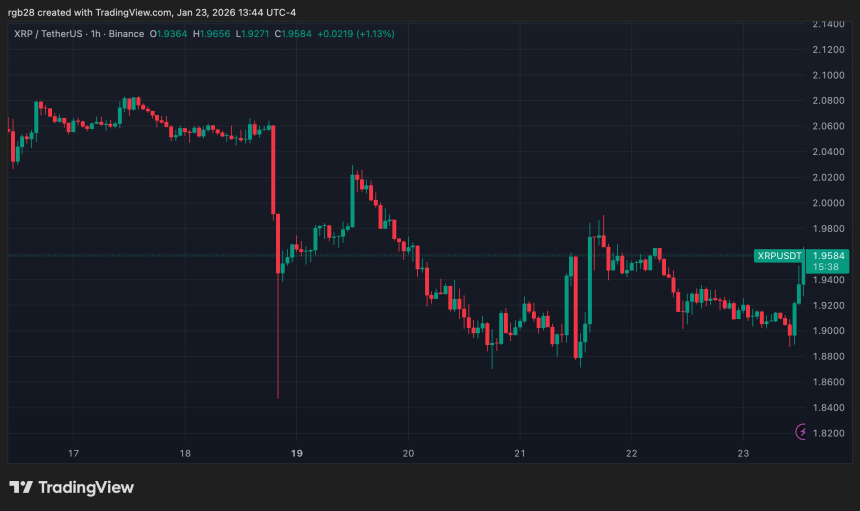
After retesting the $1.90 area on Friday morning, XRP saw a 4.6% intraday bounce toward the mid-zone of its local range. Over the past five days, the cryptocurrency has been hovering in the $1.85-$2.00 price range, failing to hold the upper zone of this range.

Market watcher ChartNerd pointed out a key reversal pattern that could signal a massive price expansion may be around the corner, noting that the altcoin is at a “critical inflection point” as it retests a macro support zone.

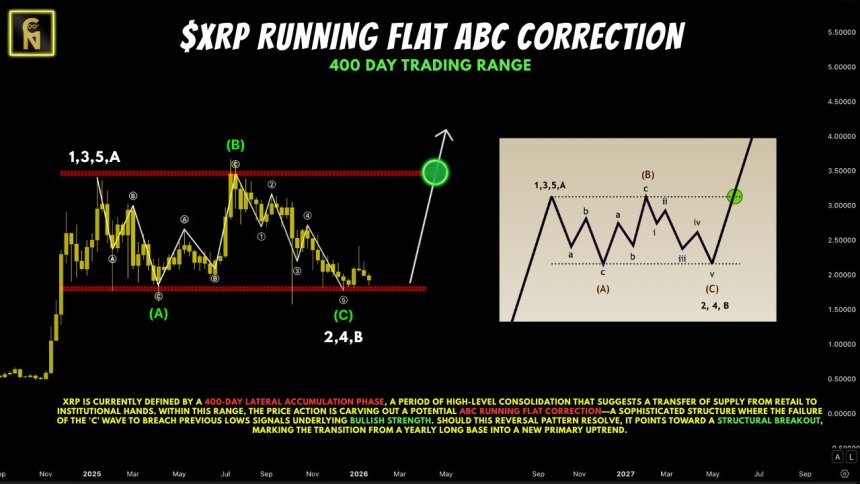
He explained that a running flat ABC correction formation is “a sophisticated structure where the failure of the ‘C’ wave to breach previous lows signals underlying bullish strength.”

XRP has been mirroring the same structure over the past 400 days, which would point “toward a structural breakout, marking the transition from a yearly long base into a new primary uptrend” if it resolves.
xrp

As the chart shows, “the wave counts repeating toward the structure are evident in XRP’s price action,” and as long as the macro support holds, around the $1.80 area, the C wave “could be working in the bulls’ defense.”

We could be just building a base above $1.80, marking the C wave in this running flat correction before the major breakout.

ChartNerd added that there could be a scenario in which XRP deviates below its major support before a V-shape recovery. However, he warned that losing this area would not be healthy, detailing that the only way to invalidate the pattern would be for the price to close below the structure’s support, retest it as resistance, and drop to lower levels.

XRP’s Price Defends Macro Support

The analyst emphasized the importance of the $1.80 level, noting that XRP has been defending this territory for over a year and could lead to a new all-time high (ATH) rally.

“This is a macro accumulation zone, and we evidently also have two major levels of descending resistance for XRP,” he detailed, highlighting that when the first multi-month descending resistance broke, the altcoin rallied to a new all-time high.

It’s pretty simple: we have descending resistance on our heads at the moment, and we once had a point of contact on this resistance at the $2.40 high (…) So, at this moment in time, the simplicity tells us: break the descending resistance, and this is where XRP really starts gearing up for further expansion.

Based on this, ChartNerd asserted that if the altcoin defends the $1.80 macro support, then a similar rally is likely. Similarly, he pointed to a bullish reversal structure building below the key $2.70 resistance on XRP’s chart.

Per the post, the cryptocurrency formed a three-month falling wedge pattern that was broken out of during the early January rally. Now, the price is retesting the pattern’s breakout level as support and could be preparing to climb toward the level it started forming.

“So XRP just needs to defend the guard at $1.80, and this is where we could be looking for that sort of major expansion and looking to press back up to the target of $2.70,” before potentially challenging its pre-Q4 range, he concluded.

XRP, XRPUSDT

A New Crypto Era: SEC-CFTC To Host Joint Regulatory Harmonization Event Next Week

The Securities and Exchange Commission (SEC) and the Commodity Futures Trading Commission (CFTC) have announced a joint event on the future of crypto oversight amid the Trump administration’s push to welcome the sector.

SEC-CFTC Push Joint Crypto Oversight

On Thursday, SEC Chairman Paul Atking and CFTC Chairman Michael Selig announced they will hold an event next week to discuss regulatory harmonization between the two sister agencies.

According to the announcement, the pro-industry chairmen will outline the efforts to work together and cooperate to “deliver on President Trump’s promise to make the United States the crypto capital of the world.”

The event will be hosted on January 27 at the CFTC headquarters and moderated by crypto journalist Eleanor Terret. Additionally, it will be open to the public and livestreamed on both agencies’ websites.

“For too long, market participants have been forced to navigate regulatory boundaries that are unclear in application and misaligned in design, based solely on legacy jurisdictional silos,” said SEC Chair Atkins and CFTC Chair Selig in a joint statement.

“This event will build on our broader harmonization efforts to ensure that innovation takes root on American soil, under American law, and in service of American investors, consumers, and economic leadership,” they added.

Last year, the SEC and CFTC began discussing their options for effectively collaborating on crypto regulations, as a clear framework for digital assets became a top priority for the agencies

As reported by Bitcoinist, the agencies explored reinstating the CFTC-SEC joint advisory committee to develop recommendations on ongoing issues, including efforts in regulatory coordination.

During a September joint roundtable between the two agencies, Atking declared that the era of regulatory fragmentation was ending and the age of harmonized, innovation-friendly crypto oversight was here:

 We are at a crossroads. If we follow the path of our predecessors, America risks ceding leadership in the next chapter of financial history. (…) This ends now (…) our two agencies must work in lockstep to transform dual regulation from a source of confusion into a source of strength. Together, we can offer the best of both worlds: the investor protections that have defined U.S. markets, combined with the innovation-friendly approach that will keep us at the frontier of financial technology throughout the 21st century.

The SEC’s Director of the Division of Trading and Markets, Jamie Selway, highlighted the SEC’s efforts to “further harmonize its rules with our sister regulator, the CFTC. In a January 22 speech, He affirmed that the Division will work shoulder-to-shoulder with the CFTC staff to ensure the US’s continued leadership in financial markets, following Atkins’ September directions.

Congress Regulatory Efforts Stall

The SEC and CFTC’s efforts to regulate the crypto market come as the US Congress struggles to establish a framework to oversee the sector. The Senate Banking Committee’s version of the market structure bill, which focuses on the SEC’s oversight, was delayed after multiple market participants criticized the bill’s draft.

Coinbase CEO Brian Armstrong shared his disappointment with the crypto legislation, withdrawing the company’s support last week. “This version would be materially worse than the current status quo. We’d rather have no bill than a bad bill,” he affirmed.

The Senate Agriculture Committee published its version of the CLARITY Act on Thursday, which mainly addresses the CFTC’s role and regulations, scheduling its markup session for January 27.

Eleanor Terret shared that the industry’s reaction has been mostly positive, “with stakeholders noting the bill’s close similarities to the House Agriculture Committee’s version of the Clarity Act.”

However, recent reports have warned that the Banking Committee’s crypto talks may not resume until later February or early March, as focus shifts to advancing affordable housing plans linked to President Trump’s priorities.

crypto, bitcoin, btc, btcusdt

Dogecoin Foundation-Backed ETF Launches On Nasdaq As Analysts Call For Massive DOGE Rally

21Shares has announced the launch of the first spot DOGE Exchange-Traded Fund (ETF) backed by the Dogecoin Foundation, aiming to offer investors regulated, physically backed access to the largest memecoin by market capitalization.

Dogecoin Goes From Memecoin To Wall Street

On Wednesday, financial services company 21Shares announced the launch of its 21Shares Dogecoin ETF (TDOG) on Nasdaq to provide “a new way to gain physically-backed DOGE exposure in traditional portfolios.”

According to the announcement, the firm’s DOGE ETF is the only investment product of its category to be officially endorsed by the Dogecoin Foundation, the nonprofit organization dedicated to supporting the ecosystem’s development.

Notably, two other spot DOGE ETFs are live: Grayscale’s GDOG and Bitwise’s BWOW. As reported by NewsBTC, the funds debuted in late November, becoming the first DOGE ETFs in the US market.

TDOG’s launch builds on 21Shares’ collaboration with the House of Doge, the corporate arm of the foundation supporting the ecosystem, to create new opportunities across the Dogecoin ecosystem.

The newly launched product will offer investors direct exposure to DOGE through a fully backed, transparent, and exchange-traded vehicle, holding the asset on a 1:1 basis in institutional-grade custody.

Regarding its decision to launch a DOGE ETF, 21Shares affirmed that the memecoin “captures the spirit of internet culture and continues to evolve in our digital economy.” Moreover, the firm argued that it has “helped onboard many new users to crypto, and for many people, this may serve as their first step into crypto.”

Federico Brokate, 21Shares’s Global Head of Business Development, stated that “Dogecoin is a unique asset with a global community and expanding real-world use cases,” adding that “TDOG offers investors regulated, physically backed exposure to DOGE through an ETF structure they already understand and trust.”

DOGE Prepares For New Rally

Analyst Bitcoinsensus suggested that the leading memecoin “could be on for a massive rally to the upside” based on its performance throughout this cycle. The market watcher explained that the cryptocurrency has been experiencing “mini cycles” since 2023, which have led to “bigger and bigger rallies.”

According to the chart, after its late 2022 pump, Dogecoin consolidated within a tight range before a 190% breakout in early 2024. Similarly, the memecoin repeated the same pattern throughout 2024, accumulating for months before a 480% breakout at the end of that year.

Now, DOGE has been consolidating within the $0.125-$0.280 price range for nearly a year, leading the analyst to believe that a breakout towards a higher target near the $0.750 level is possible.

Meanwhile, Trader Tardigrade also suggested that Dogecoin may be preparing for a massive breakout as it appears to be following its performance between late 2022 and 2024.

At the time, the cryptocurrency had apparently bottomed out but ultimately recorded another local low before reversing. Based on this, the analyst affirmed that the memecoin “might see a slightly lower low” in the coming weeks, before the next massive surge occurs.

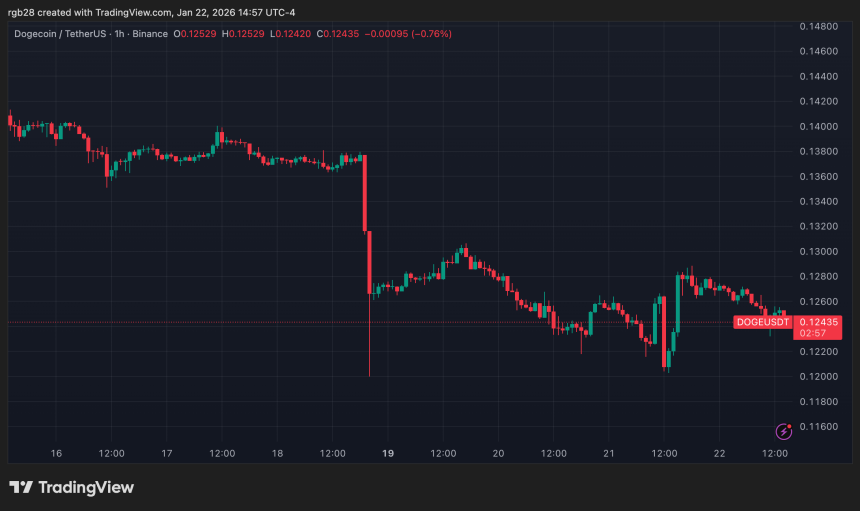
As of this writing, Dogecoin is trading at $0.1249, a 1.75% decline in the daily timeframe.

dogecoin, doge, dogeusdt

Banks’ Concerns Over Stablecoin Interest Payments Are ‘Totally Absurd’, Circle CEO Says

The CEO of stablecoin issuer Circle has weighed in on the importance of stablecoin rewards and why he believes the banking industry’s concerns about interest payments on these assets are “absurd.”

Circle CEO Rejects Banks’ Stablecoin Fears

Speaking at the World Economic Forum (WEF) in Davos, Circle’s CEO, Jeremy Allaire, discussed banks’ growing concerns that paying interest on stablecoins poses a threat to the industry, calling the deposit flight narrative “totally absurd.”

The banking sector has expressed concerns about stablecoin rewards, arguing that interest payments will distort market dynamics and affect credit creation. In the US, banks have heavily criticized the GENIUS Act, claiming that it has loopholes that could pose risks to the financial system.

The executive rejected the sector’s general arguments, citing historical and practical reasons. He asserted that this exact argument has been historically used when new financial products, such as government money market funds, have emerged.

Notably, Bank of America CEO Brian Moynihan recently compared the digital assets to money market mutual funds, which require reserves to be held in short-term instruments, such as US Treasuries, reducing lending capacity in the system.

The executive told investors that the banking sector, small- and medium-sized businesses in particular, could face significant challenges if the US Congress does not prohibit interest-bearing stablecoins, as up to $6 trillion in deposits, or 30% to 35% of all US commercial bank deposits, could flow out of the banking system and into the stablecoin sector.

However, Allaire pointed out that, despite institutions claiming that financial products would “draw all the deposit base,” their growth has not “stopped the ability for lending to happen.”

The importance Of Rewards

Circle’s CEO also argued that stablecoins should not be singled out when rewards for other financial products exist and contribute to the system. “Those rewards (…) exist in every balance that you have with a credit card that you use. They exist around so many other financial products and services that we have,” he detailed.

“These rewards are actually very important,” Allaire continued. “They help with stickiness, they help with customer traction. They are not themselves like these huge monetary policy dampers.”

Most importantly, he pointed out that lending is moving away from the risk-taking of banks, with “a huge amount of lending is moving towards private credit.”

He cited a Wednesday WEF panel, in which a capital markets participant highlighted how the vast majority of GDP growth in the United States was “formed by capital market formation around junk bonds.”

“So private credit issuing junk bonds, capitalizing the build out of the American technology advancements, not bank credit,” the executive added.

Previously, Coinbase Institute shared a similar argument, affirming that “credit is evolving, not shrinking. Lending is shifting to private credit, fintech, and DeFi channels that don’t depend on deposits. Liquidity moves—it doesn’t vanish.”

Allaire concluded that “we want stablecoin money to be cash instrument money, prudentially supervised, very, very safe money. And then I think what we want to do is we want to build models for lending that build on top of stablecoins.”

stablecoin, total

Bitcoin To $80,000? Analyst Warns Of Potential Free Fall As BTC Erases 2026 Gains

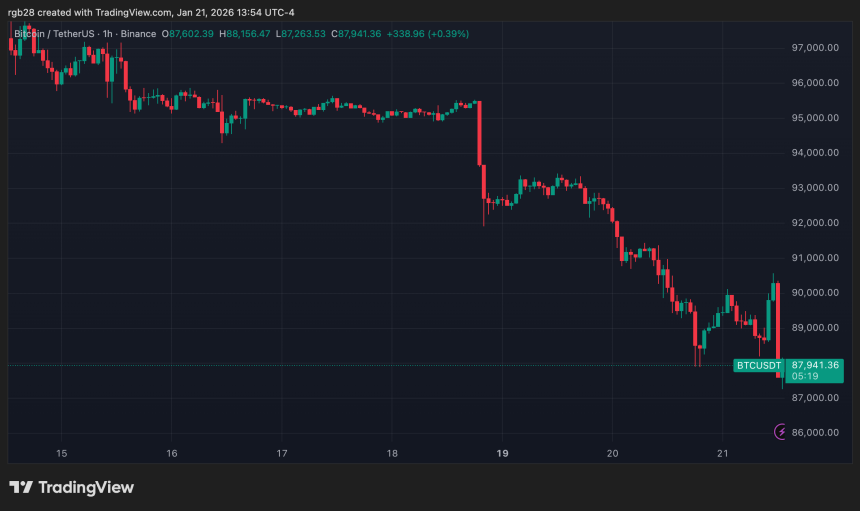
As the market erases its 2026 gains, Bitcoin (BTC) has fallen to its lowest level in weeks and is attempting to reclaim a crucial level. Some market observers have warned that a retest of the November lows is likely if volatility continues.

Bitcoin Breaks Down From Key Support

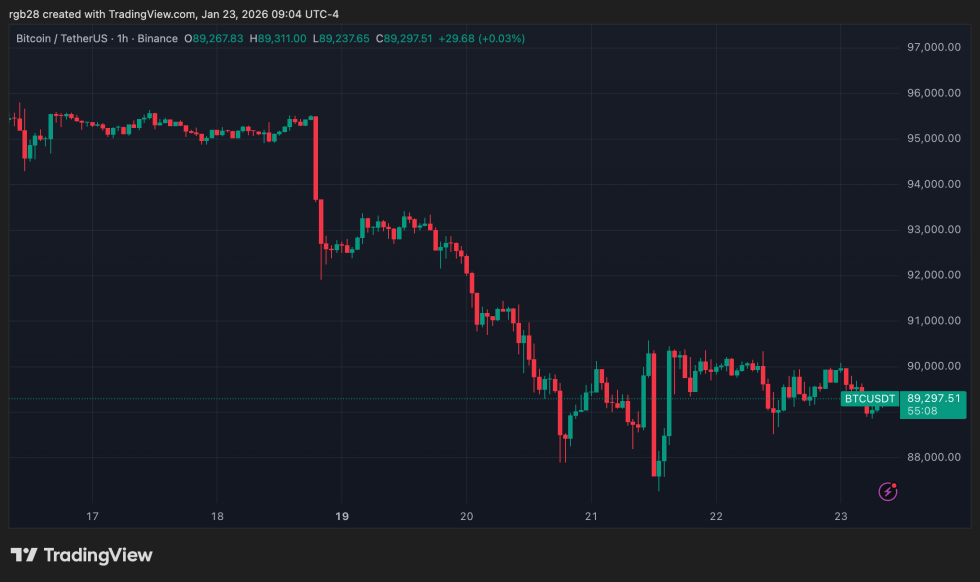
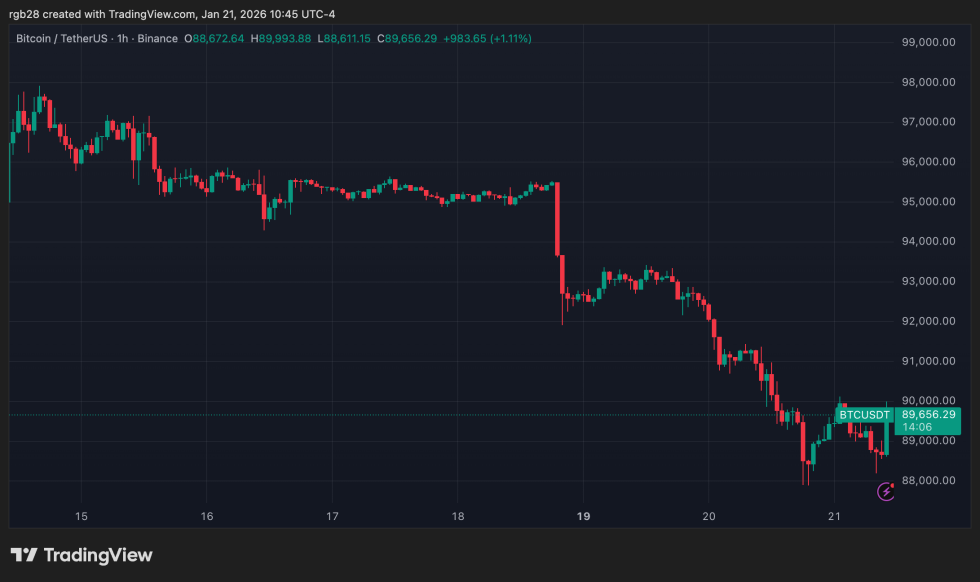
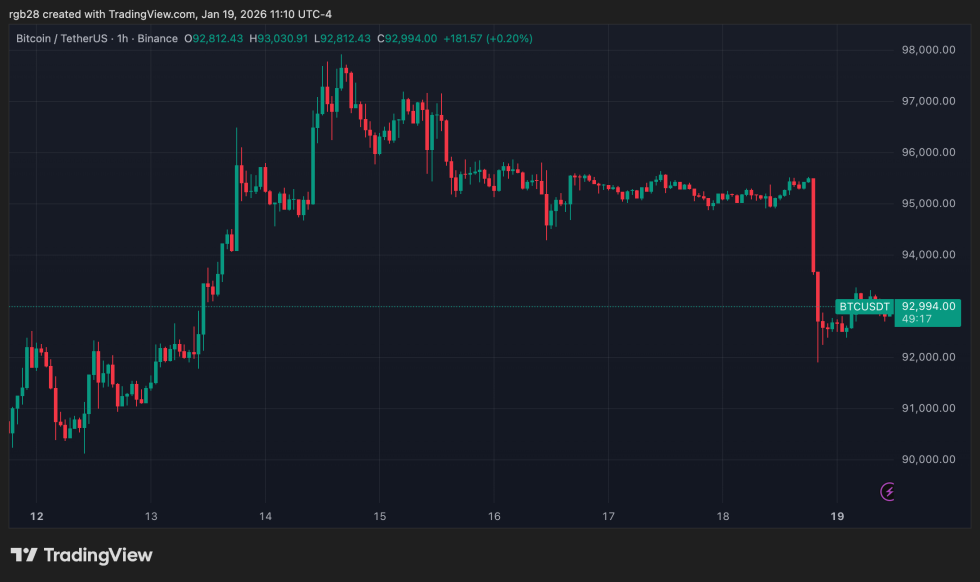
On Wednesday, Bitcoin continued to pullback and hit a three-week low of $87,263. The cryptocurrency had been trading between the $90,000-$96,000 range since its start-of-the-year breakout, reaching a two-month high of $97,924 a week ago.

However, the crypto market has experienced significant volatility over the past few days, fueled by renewed geopolitical tensions. As a result, BTC has retraced 10% in the past week, falling to the mid-zone of its $84,000-$94,000 range.

Amid this performance, trader Wealthmanager noted that the flagship crypto had retraced all its 2026 gains, briefly falling below its yearly opening and POC. He added that this is a critical level to hold in the coming days, as losing this area could send the price back to the $80,000 mark.

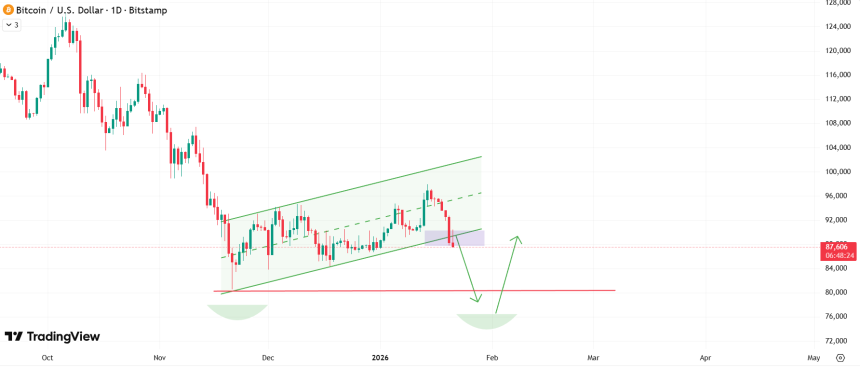
Analyst Crypto Jelle highlighted a two-month bear flag structure on BTC’s daily chart, suggesting a high chance of a breakdown. “Lose the current lows again, and bears will be fully back in the driver’s seat,” he asserted.

Similarly, Market observer Lyvo Crypto pointed out the same formation, detailing that Bitcoin broke down from the pattern’s ascending support after the recent price action and lost its two-month uptrend.

bitcoin

To the trader, this signals that “momentum is fully in the bears’ control” and “if it [bearish momentum] sustains, we could see a free fall” that could likely result in a retest of the $78,000 area.

In the case of a breakdown to the November lows, he advised that “from there, we’ll wait for confirmation of a double bottom and look for a relief rally.”

BTC To Repeat Its 2020 Price Action?

Crypto Bullet drew a parallel between BTC’s current price action and its performance in early 2022. The analyst affirmed that the current price action closely mirrors its 2022 fractal, which could signal that a major correction is ahead.

At the time, Bitcoin retraced over 40% from its late 2021 cycle top, followed by a “dead cat bounce” at the start of 2022 and a second major correction toward new lows.

Now, the flagship crypto displays a similar performance as it has retraced 30% from the October highs and is currently attempting to reclaim the lost ground. However, Crypto Bullet noted that there are two significant differences from its 2022 correction.

First, Bitcoin has yet to retest the 50-week and 200-week Moving Averages (MAs). Second, the timing hints that the final breakdown is not due until later in Q1.

“If we match the 2022 fractal’s top and the October 2025 top, we’ll see there’s still about 1 month of PA to make that final leg up and test the 50-Week MA or the 200-Day MA,” he explained.

He concluded that one more pump above the $100,000 is likely, but advised caution as the key supports are being tested.

As of this writing, Bitcoin is trading at $89,890, a 1.2% increase in the daily timeframe.

bitcoin, btc, btcusdt

Vietnam Begins 5-Year Crypto Licensing Pilot To Regulate Exchanges

Vietnam has launched a pilot program to license cryptocurrency exchanges, aiming to bring the rapidly growing market into a formal legal framework after years of regulatory uncertainty.

Vietnam’s Crypto Licensing Pilot Begins

On Tuesday, Vietnam began its pilot licensing regime to officially regulate crypto trading platforms in the country for the first time, in an effort to gradually move the sector from the shadows into a properly supervised framework under the local financial authorities.

According to local reports, the Ministry of Finance issued Decision No. 96/QD-BTC on January 20, introducing procedures necessary for the implementation of Government Resolution No. 05/2025/NQ-CP.

The three new administrative procedures cover the issuance, modification, and revocation of licenses for entities operating crypto asset trading platforms. The Ministry announced that it began accepting applications from businesses seeking to offer crypto asset trading services.

For context, the country’s cryptocurrency market lacked a clear legal framework, existing in an unsupervised, “gray area.” Last year, the National Assembly passed the “Law on Digital Technology Industry,” which took effect on January 1, 2026, to create a foundation for authorities to develop suitable management policies.

In September, Vietnam’s Deputy Prime Minister Ho Duc Phoc signed Government Resolution No. 05/2025/NQ-CP, allowing a five-year pilot program for the issuance and trading of crypto assets.

As reported by Bitcoinist, under Resolution No. 05, organizations seeking to provide services for crypto trading markets must be registered with the financial authorities and fully comply with a strict set of rules, including a minimum contributed charter capital of VND10 trillion, worth around $380.66 million.

Notably, at least 65% of the charter capital must be held by institutional investors, with more than 35% contributed by at least two institutions such as commercial banks, securities companies, fund management companies, insurance companies, or technology enterprises.

The general director must have at least two years of experience in finance, while the CTO must have at least five years of experience in information technology. Moreover, firms must hire at least 10 technology staff with cybersecurity certificates and at least 10 staff with securities practice certificates working in other departments.

Financial Institutions Dive Into Digital Assets

Following the issuance of Resolution No. 05, major financial players, including securities companies and banking institutions, have announced their intention to participate in the pilot and enter the sector, noted the report.

In June, two SSI’s subsidiaries, SSI Digital Technology JSC and SSI Asset Management Company Limited, signed Memorandums of Understanding with Tether, U2U Network, and Amazon Web Services to develop a digital financial ecosystem in Vietnam based on blockchain and cloud computing platforms.

In addition, VIX Securities contributed capital to establish the VIX Crypto Asset Exchange and partnered with tech giant FPT Corp. to prepare its technology infrastructure.

Meanwhile, the banking sector saw MBBank enter a technical cooperation agreement with Dunamu, the operator of the Korean exchange Upbit, to establish a crypto exchange in Vietnam while jointly developing the legal framework and investor protection mechanisms.

Techcombank also established the Techcom Crypto Asset Exchange with a charter capital of several hundred billion VND. Similarly, VPBank stated it is fully prepared to begin operations as soon as it receives regulatory approval.

Crypto, bitcoin, BTC, BTCUSDT

Trumps Crypto Empire: One-Fifth Of Family’s $6.8B Fortune Tied To Digital Assets

A year into his presidency, US President Donald Trump and his family have reportedly seen a notable shift in their wealth distribution, with a growing concentration of crypto ventures linked to the presidential family.

Trump Family’s Wealth Gets Crypto Boost

On Tuesday, Bloomberg reported that the Trump family’s wealth has remained relatively steady over the past year despite the plunging value of their social media company, Trump Media & Technology Group Corp, and the massive gains of their new crypto ventures.

According to the report, the family’s overall net worth has not grown significantly since President Trump’s inauguration, remaining at around $6.8 billion, as data from the Bloomberg Billionaires Index shows.

Notably, the gains from their new projects were offset by the losses of Trump Media, whose shares have declined by around 66% over the past 12 months, despite efforts to diversify into various endeavors.

Nonetheless, “the way the Trumps’ wealth is distributed now — particularly its concentration in virtual assets and public companies, some of which didn’t exist when he left office in 2021 — represents a sea change in how they’ll earn money for years to come,” the report highlighted.

Per Bloomberg, the family’s most notable change has been the growing concentration of their net worth in cryptocurrencies, with one-fifth of their fortune coming from crypto projects for the first time.

As a result, “cryptocurrency projects became the key driver of the Trump family’s wealth last year,” generating around $1.4 billion from the different digital asset-related ventures managed by the President’s eldest sons, Eric and Donald Trump Jr.

In a statement to the news media outlet, Eric Trump reaffirmed that his family’s crypto push was driven by their experience with banks after the President’s first term. “Having been canceled by banks, out of political malice, led us to many incredible opportunities, as we redefine the future of finance,” he asserted.

Digital Asset Fortune Breakdown

Over the past year, various news outlets have estimated the first family’s crypto fortune, with some reports calculating its value at around $1 billion. In October, Eric Trump shared that the real number was “probably more.”

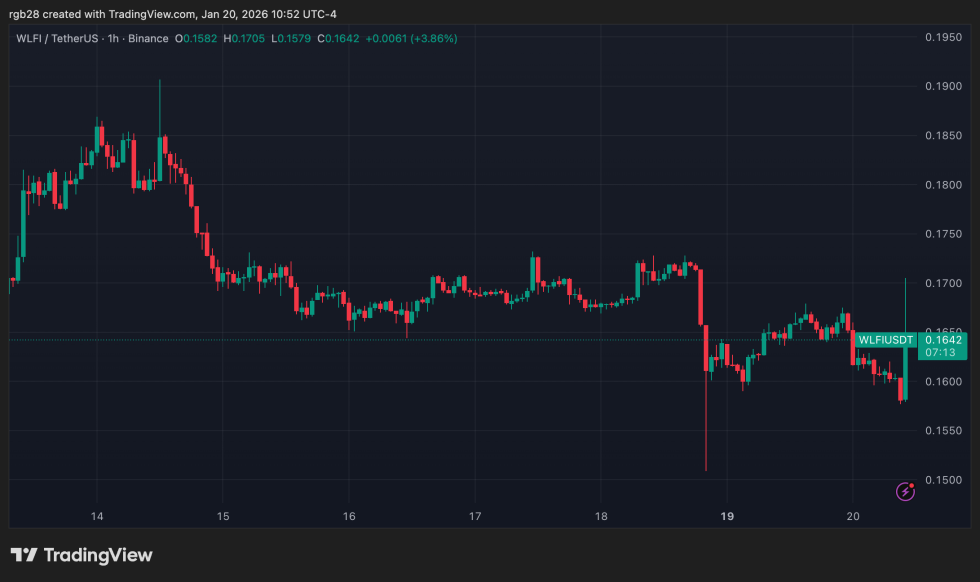
While the Trump family dived into multiple crypto-related projects, Bloomberg analysis highlighted three of their main ventures: World Liberty Financial (WLFI), American Bitcoin Corp., and the official TRUMP and MELANIA memecoins.

World Liberty Financial reportedly sold $550 million worth of tokens, generating $390 million for the presidential family, according to the news media outlet’s calculations. In August, the company announced its partnership with Alt5 Sigma and became an investor in the technology firm, which sought to raise $1.5 billion for its crypto treasury strategy based on WLFI.

According to Bloomberg, “the Trumps netted more than $500 million” from the deal. The company also launched its USD1 stablecoin in March, which has grown to more than $3 billion since its debut. Bloomberg estimated that the business could be worth more than $300 million.

Meanwhile, the official TRUMP and MELANIA memecoins, which launched the weekend before President Trump’s second inauguration, generated gains worth roughly $280 million from the family’s holdings and associated proceeds.

In addition, Eric Trump owns about 7.4% of American Bitcoin, worth roughly $114 million despite the company’s shares declining 82% since their September peak. Donald Jr. reportedly owns a smaller, undisclosed amount.

The report also noted that the Trump family’s fortune could be worth billions more on paper, as they still own founder WLFI tokens, worth $3.8 billion at current prices. Nonetheless, these tokens were not included in the calculations as they remain locked.

crypto, wlfi, wlfiusdt

BitMine’s Ethereum Holdings Near 3.5% Supply Milestone As ETH Falls Below $3,000

As the Ethereum (ETH) price retests a crucial support zone, BitMine revealed it has added another $110 million worth of ETH to its treasury holdings over the past week, approaching an important milestone for the company’s investment strategy.

BitMine’s Ethereum Bet Continues

On Tuesday, BitMine, a Bitcoin and Ethereum Network Company with a focus on accumulating crypto for long-term investment, announced its holdings had reached 4.2 million ETH tokens after acquiring 35,268 ETH, worth roughly $110 million, in the past week.

As a result, the company, which is the largest Ethereum Treasury company in the world and the second-largest global treasury, has crypto and cash holdings totaling $14.5 billion at current prices.

According to the announcement, the company now owns 4,203,036 ETH at $3,211, 193 Bitcoin (BTC), a $22 million stake in Eightco Holdings as part of its “Moonshots” initiative, and unencumbered cash worth $979 million.

After the latest purchase, BitMine now holds 3.48% of ETH’s total supply, and nears its goal to control 5% of the leading altcoin’s 120.7 million supply. Notably, it has achieved nearly 70% if “Alchemy of 5%” target in just six months.

BitMine’s chairman, Thomas “Tom” Lee, stated that “Ethereum’s price ratio to Bitcoin, or ETHBTC, has been steadily climbing since mid-October. In our view, this reflects investors recognizing tokenization and other use cases being developed by Wall Street are being built on Ethereum.”

As of January 19, 2026, BitMine’s total staked ETH stands at 1,838,003, worth $5.9 billion at $3,211 per ETH, an increase of 581,920 ETH in the past week.

ETH Price At Crucial Support Zone

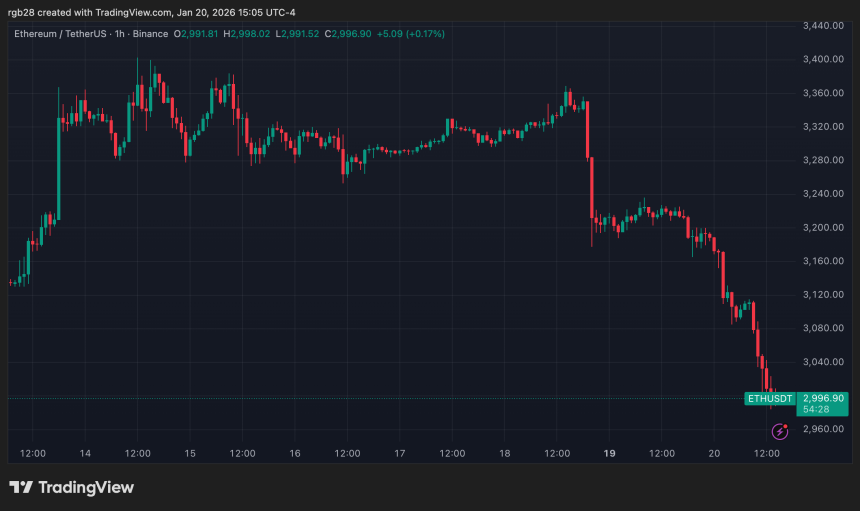
Despite BitMine’s constant bet on the cryptocurrency, Ethereum retraced nearly all its 2026 gains after falling below the $3,000 barrier. On Tuesday, ETH recorded a 6.8% decline in the daily timeframe, dropping from the $3,200 area to a three-week low of $2,980.

The King of altcoins has been trading between the $2,600-$3,350 area since the November pullbacks, reclaiming the upper zone of this range during the start of the year rally. Now, ETH is retesting an important multi-support area that could define the cryptocurrency’s short-term performance.

Analyst World of Charts affirmed that there are two “simple” possibilities for Ethereum. If the price loses the $3,000 area, which serves as the mid-zone of its local range and a key macro support and resistance level, then a retest of the $2,600 lows becomes likely.

On the contrary, if the altcoin holds this zone in the daily timeframe and momentum builds, it could retest the range’s upper boundary resistance again.

Amid the pullback, another pseudonym market observer also pointed out that ETH is currently retesting its 50-day Moving Average (MA), which was reclaimed at the start of the year and currently sits at the $3,089 level.

According to the post, if the 50-day MA holds, a move to the 200-day MA, located around the $3,650 area, could come next. “All eyes [are] on a close above the 50-day MA, which will point to a successful back test,” he added.

As of this writing, ETH is trading at $2,999, a 7% decline in the weekly timeframe.

Ethereum, eth, ethusdt

Solana At Risk Of Breakdown After Key Rejection – Is $100 Next?

A year after reaching its all-time high (ATH), Solana (SOL) is trading 54.3% below its $293 2025 milestone, attempting to hold a crucial zone as support. Some analysts warned that the altcoin could risk a deeper correction if the price fails to recover the recently lost ground.

Solana Breaks Below Key Support

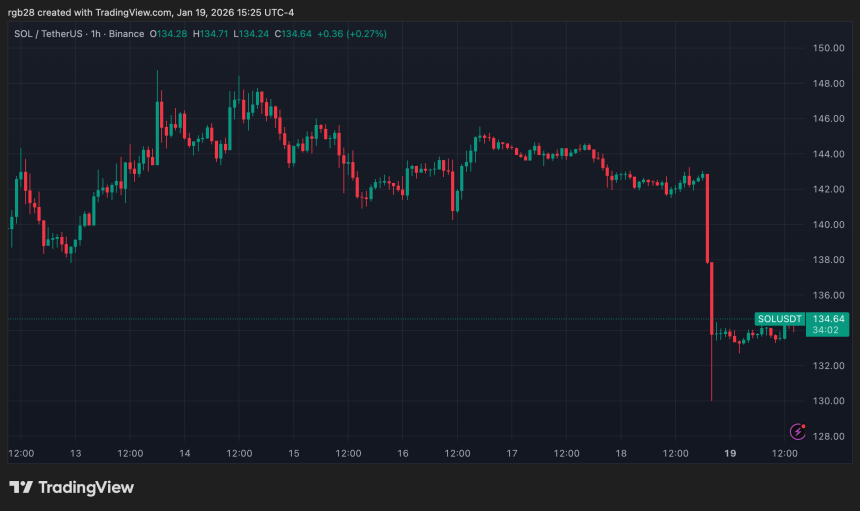
On Sunday, Solana recorded an 8% pullback and hit a two-week low of $130. Since losing the $200 phycological barrier in late October, the cryptocurrency has struggled to hold bullish momentum, hovering between the $115-$145 levels over the past three months.

The start-of-the-year rally saw SOL break out of its multi-month downtrend, reclaim the upper zone of its local range, and briefly breach above the key $145 resistance last week. However, Sunday’s market pullback has sent Solana back below key areas.

Amid this performance, market observer BitGuru affirmed in an X analysis that the cryptocurrency “just swept liquidity into a strong demand zone after a clean structure breakdown.”

He explained that the price is attempting to rebound from its local support area, which could trigger a “sharp relief move toward previous highs” if the price can hold the current levels.

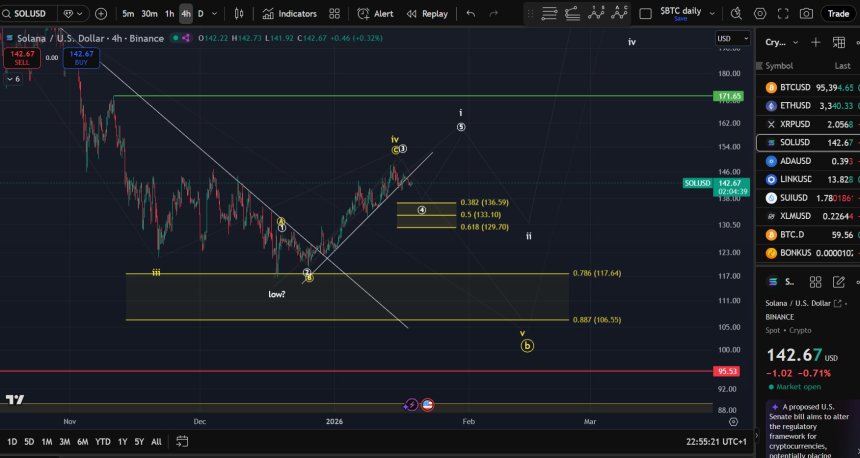
Meanwhile, analyst Man of Bitcoin noted that the altcoin’s price broke below its two-week ascending trendline, which had been supporting its 17% surge from its yearly opening. Moreover, it also dropped below the $136 mark, where the price had consistently bounced after the recent breakout.

Solana

The market observer pointed out that Solana’s short-term support sits between the $129-$136 area, adding that a breach and sustained breakdown from this area would spell trouble for the cryptocurrency.

According to the chart, if selling pressure persists and Solana fails to reclaim the recently lost ground, the price could see a scenario where it retraces deeper and potentially falls up to 25% to challenge the $100 area.

Analysts Warn Of Head And Shoulder Pattern

Other market watchers highlighted a macro pattern on Solana’s chart, suggesting that a breakdown to new lows could be coming. Notably, the altcoin displays a two-year Head and Shoulders formation in the weekly timeframe.

According to the chart, this bearish pattern has been forming since 2024, with the left shoulder developing during the Q1-Q2 2024 rally and the neckline sitting around the $120 area.

Meanwhile, the pattern’s head formed during its late 2024 and early 2025 bullish run, which led to its ATH of $293 a year ago. Lastly, the right shoulder developed after the Q3 2025 rally and Q4 correction.

Based on this performance, trader Slashology affirmed that Solana is “really looking bad here,” warning that investors should “prepare for the worst” as the price trades near the pattern’s neckline.

He forecasted that a breakdown from this key level could lead to a 35%-40% “bloodbath” toward the $75-$80 levels. On the contrary, market observer Crypto Curb suggested a different outcome could be possible.

In an X post, he compared SOL’s recent performance to the S&P 500 (SPX) price action between 2009 and 2011. Per the post, SPX displayed the same pattern as Solana, but ultimately invalidated the pattern after bouncing from the neckline and breaking above the right shoulder’s peak, eventually reaching new highs.

To the analyst, the altcoin could display a similar performance if it rebounds from the current levels and starts to climb higher.

As of this writing, Solana is trading at $134, a 5.6% decline in the daily timeframe.

Solana, sol, solusdt

Hong Kong Professionals Association Urges Regulators To Ease Crypto Reporting Rules

A Hong Kong industry group has urged the city’s regulators to ease aspects of the Organisation for Economic Co-operation and Development’s (OECD) crypto reporting rules ahead of its implementation.

Association Pushes To Soften CARF Requirements

On Monday, the Hong Kong Securities & Futures Professionals Association (HKSFPA) released a response to the implementation of the OECD’s Crypto Asset Reporting Framework (CARF) and the related amendments made to Hong Kong’s Common Reporting Standard (CRS).

In their official response, the association shared its concerns about certain elements of the CARF and CRS amendments, warning that they could create operational and liability risks for market participants.

Notably, the HKSFPA affirmed that it mostly supports the proposals, but urged regulators to ease the record-keeping requirements for dissolved entities. “We generally agree with the six-year retention period to align with existing inland revenue and CRS standards,” they explained, “but we have concerns regarding the obligations placed on individuals post-dissolution.”

The industry group argued that holding directors or principal officers personally liable for record-keeping after dissolution poses significant practical challenges, noting that former officers of dissolved companies may lack the resources, infrastructure, and legal standing to maintain sensitive personal data of former clients.

As a result, they suggested the government “allow for the appointment of a designated third-party custodian (such as a liquidator or a licensed corporate service provider) to fulfill this obligation, rather than placing indefinite personal liability and logistical burden on former individual officers.”

Moreover, the association also cautioned that the proposed uncapped per-account penalties for minor technical errors. They asserted that this could lead to “disproportionately astronomical fines for systemic software errors affecting thousands of accounts where there was no intent to defraud.”

To solve this, they proposed a “reasonable cap” on total penalties for unintentional administrative errors or first-time offenses to ensure that the per-account calculation “is reserved for cases of willful negligence or intentional evasion.”

Additionally, the group suggested a “lite” registration or a simplified annual declaration process for Reporting Crypto-Asset Service Providers (RCASPs) that anticipate filing Nil Returns, to reduce administrative costs while still satisfying the Inland Revenue Department’s oversight requirements.

Hong Kong’s Crypto Hub Efforts

Notably, Hong Kong is among the 76 markets committed to implementing the upcoming crypto reporting framework, which is the OECD’s new global standard for exchanging tax information on crypto assets.

The CARF is designed to prevent tax evasion by bringing crypto users across borders under global tax transparency rules, similar to the OECD’s existing CRS for traditional finance. Hong Kong will be among the 27 jurisdictions that will begin their first cross-border exchanges of crypto reporting data in 2028.

Over the past few years, Hong Kong financial authorities have been actively working to develop a comprehensive framework that supports the expansion of the digital assets industry, part of its strategy to become a leading crypto hub in the world.

As reported by Bitcoinist, the city is exploring rules to allow insurance companies to invest in cryptocurrencies and the infrastructure sector. The Hong Kong Insurance Authority recently proposed a framework that could channel insurance capital into cryptocurrencies and stablecoins.

Moreover, the Hong Kong Monetary Authority (HKMA) is expected to grant the first batch of stablecoin issuer licenses in the first few months of the year. The HKMA enacted the Stablecoins Ordinance in August, which directs any individual or entity seeking to issue a stablecoin in Hong Kong, or any Hong Kong Dollar-pegged token, to obtain a license from the regulator.

Multiple companies have applied for the license, with over 30 applications filed in 2025, including logistics technology firm Reitar Logtech and the overseas arm of Chinese mainland financial technology giant Ant Group.

crypto, bitcoin, btc, btcusdt

South Korea Advances Tokenized Securities Framework Amid Crypto Regulation Push

As South Korea intensifies its push for crypto regulation, lawmakers have advanced a bill to establish a legal framework for issuing and trading security token offerings (STOs) using distributed ledger technology (DLT).

Lawmakers Amend Framework For Tokenized Securities

On Thursday, South Korea’s National Assembly passed key amendments to the Capital Markets Act and the Electronic Securities Act, creating a legal framework for the issuance and distribution of tokenized securities.

According to an official government release, the revised rules define tokenized securities as a broad category that extends to both debt and equity products, and recognize them as legitimate financial instruments.

The amendments to the Electronic Securities Act will allow qualified issuers to launch tokenized securities using distributed ledger technology. Meanwhile, the Capital Markets Act changes will enable the products to be traded as investment contract securities on brokerages and other licensed intermediaries.

Notably, the existing Capital Markets Act prohibited the distribution through securities firms, deeming investment contract securities “unsuitable for distribution due to their non-standard characteristics.”

The changes are “expected to enhance accessibility to investments and improve the provision of investment information for these securities,” the official government release stated.

After legislative approval, the bill will be submitted to the State Council, followed by official presidential promulgation. Therefore, the legislation is expected to be enacted one year after being signed into law, tentatively in January 2027.

Moreover, the Financial Services Commission (FSC) is set to lead the implementation, forming a joint “Token Securities Council” with relevant agencies to ensure seamless preparatory work, including the development of supporting infrastructure and enhanced safeguards.

The consultation body will comprise the FSC, the Financial Supervisory Service, the Korea Securities Depository, the Financial Investment Association, industry participants, and experts.

South Korea’s Crypto Regulatory Push Continues

This major step follows South Korea’s efforts to develop and establish clear, comprehensive rules to regulate the local crypto industry. Last week, the government shared its 2026 Economic Growth Strategy, which included a plan to open its market to Bitcoin (BTC) Exchange-Traded Funds (ETFs) this year.

Crypto-based ETFs have been banned in South Korea since 2017. In 2024, the country’s regulator reaffirmed its stance after the US Securities and Exchange Commission (SEC) approved the investment products. However, it has now cited the success of the US and Hong Kong’s crypto funds as a key factor for their shift.

The FSC will also accelerate the next phase of its digital asset legislation this quarter to establish a clear regulatory framework for stablecoins. As reported by Bitcoinist, South Korea’s Second Phase of the Virtual Asset User Protection Act was delayed until the start of 2026 due to an ongoing disagreement between the FSC and the Bank of Korea (BOK).

The financial authorities have been clashing for months over rules related to the issuance and distribution of stablecoins, disagreeing on the extent of banks’ role in the issuance of won-pegged tokens.

Nonetheless, the main policies of the crypto framework have been decided, set to include investor protection measures, such as no-fault liability for crypto asset operators and isolation of bankruptcy risks for stablecoin issuers.

Moreover, the country is lifting its long-standing ban on institutional crypto trading, which is anticipated to begin later this year. According to local reports, the FSC is considering a rule to limit corporate cryptocurrency investments at 5% of a company’s equity capital.

Under the latest proposal, eligible firms would be able to allocate up to 5% of equity capital per year to digital assets, limited to the top 20 cryptocurrencies by market capitalization. The final draft version could be released as early as January or February.

crypto, TOTAL

XRP To Repeat Its 2017 Playbook? Analyst Forecasts 1,250% Expansion

While XRP retests a crucial support area, some analysts have suggested that the altcoin is preparing for a massive expansion in the coming months, as a potential trend reversal begins to form and its 2017 formula repeats.

XRP Gears Up For Massive Expansion

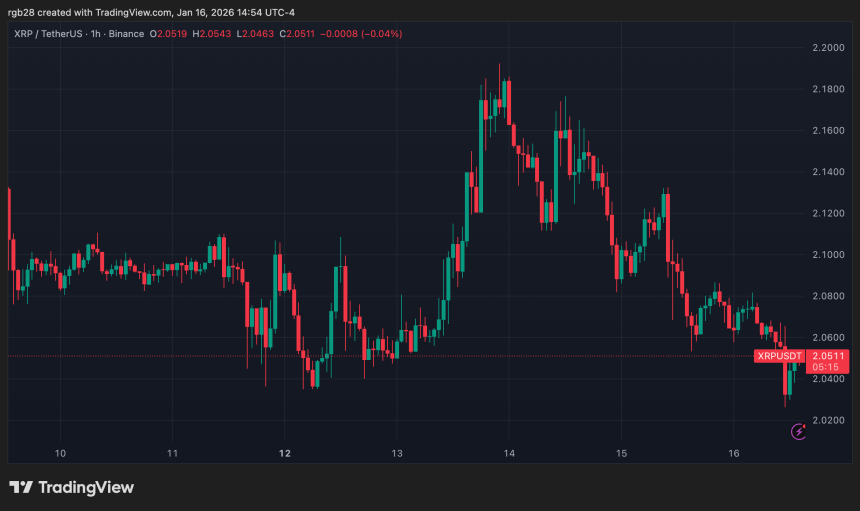
On Friday, XRP reached a 12-day low, falling to the $2.02 area before bouncing. Notably, the cryptocurrency has been trading within the $2.05-$2.35 area for nearly two weeks, moving between the mid and lower zones of this price range for most of this period.

Amid its recent performance, Sjuul from AltCryptoGems noted that the altcoin “is starting to look better, especially after that bullish market structure break with a fresh higher high.” The analyst highlighted that the cryptocurrency has been consistently trending lower since August, exclusively printing lower lows and lower highs.

However, it has broken out of this structure and recorded a higher high for the first time in months after the start-of-the-year rally, setting the stage for a potential reversal. “Now, we have to maintain this bullish structure at any cost and form a higher low on the next dip,” Sjuul warned.

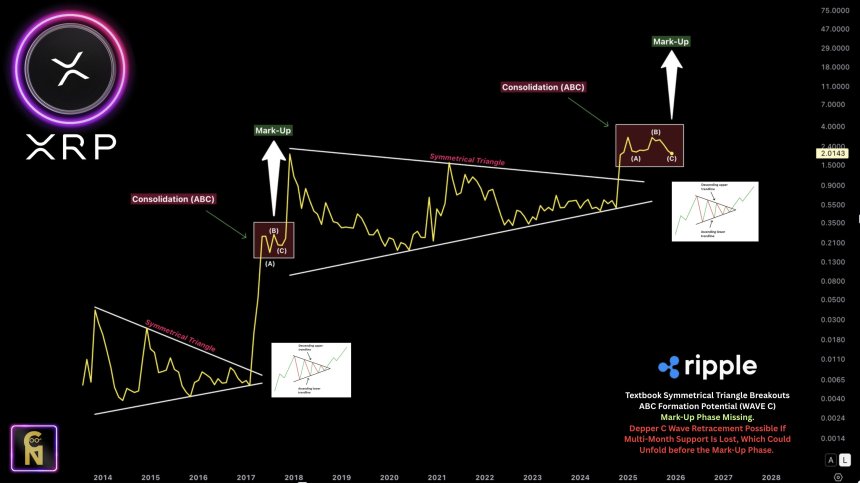
Meanwhile, market observer ChartNerd pointed to a striking similarity between XRP’s 2017 playbook and its current performance. In an X post, the analyst affirmed that the altcoin is repeating its 2016-2017 formula, which led to a massive rally toward its previous all-time high (ATH).

XRP

At the time, XRP saw a textbook multi-year symmetrical triangle formation breakout, followed by a multi-month ABC consolidation before its 1,500% mark-up. This time, the cryptocurrency has repeated a similar symmetrical triangle pattern breakout, and it is currently in Wave C of its ABC consolidation period.

To the analyst, a deeper Wave C retracement is possible if the multi-month $1.80 support is lost. Nonetheless, he added that “cycle formula repetition signals XRP is gearing up for expansion towards $8/$13/$27,” which would be a 300%-1,250% increase from the current levels.

Q1 Close To Define XRP’s Future

Despite his bullish forecast, ChartNerd also shared an important warning for the next two months. According to the analyst, “XRP has just over 2 months to invalidate this 3M bearish Heikin-Ashi candle formation,” or it will risk a massive correction.

In a video analysis, he explained that, in the past, whenever the altcoin saw massive rallies followed by a red bearish candle on the three-month timeframe, it would “normally indicate the start of a downtrend or a macro consolidation period.”

In 2014, XRP saw a bearish candle print in the three-month timeframe after a remarkable pump, which was followed by a correction and consolidation “for quite a couple of years,” he explained.

“The same happened again in 2018. We had this massive rally for XRP, and as soon as we printed a three-month bearish candle in the Heikin-Ashi Candle formation, (…) we entered into the bear market,” ChartNerd continued.

Similarly, the cryptocurrency repeated the same performance in 2021. Now, XRP is starting to form a red candle in this timeframe and has approximately 2 months and 16 days to close the quarter on a positive note.

“We have until March before this candle closes. (…) So, what we don’t want to see is this full-bodied three-month Heikin-Ashi Candle, because if we see it, this is where we are likely to see a deeper correction for the next six to nine and even 12 months,” the analyst concluded.

As of this writing, XRP is trading at $2.05, a 1.7% decline in the weekly timeframe.

xrp, XRPUSDT

Bank Of America CEO Issues $6T Stablecoin Rewards Warning As Regulatory Debate Heats Up

The CEO of Bank of America has warned that trillions of dollars could flee from bank deposits to the stablecoin sector if the upcoming crypto market structure bill allows interest payments on the tokens.

Banking System Could Face $6 Trillion Problem

On Wednesday, Bank of America CEO Brian Moynihan told investors that the banking industry could face significant challenges if the US Congress does not prohibit interest-bearing stablecoins.

During its Q4 earnings call, the executive affirmed that up to $6 trillion in deposits, around 30% to 35% of all US commercial bank deposits, could flow out of the banking system and into the stablecoin sector, citing Treasury Department studies.

The banking sector has heavily criticized the US’s landmark stablecoin legislation, the GENIUS Act, for months, claiming that it has loopholes that could pose risks to the financial system. Notably, the crypto framework prohibits interest payments on the holding or use of payment-purpose stablecoins but only addresses issuers.

Multiple banking associations across the US sent a joint letter to the Senate Banking Committee urging Congress to amend the law to include digital asset exchanges, brokers, dealers, and related entities.

According to the call’s transcript, Moynihan compared the digital assets to money market mutual funds, which require reserves to be held in short-term instruments, such as US Treasuries, thereby reducing lending capacity in the system.

That is the bigger concern that we’ve all expressed to Congress as they think about this, if you move it outside the system, you’ll reduce the lending capacity of banks. (…) And if you take out deposits, (…) they’re either not going to be able to loan or they’re going to have to get wholesale funding and that wholesale funding will come at a cost that will increase the cost of borrowing.

The CEO asserted that Bank of America would not be affected by this issue, as the institution would be able to “meet customer demand, whatever may surface.” However, he noted that it would particularly hurt small- and medium-sized businesses, as they’re “largely lent to end consumers by the banking industry.”

Stablecoin Rewards Debate Intensifies

Moynihan’s remarks come amid the Senate’s struggles with the long-awaited market structure bill. The recently shared draft, which was scheduled for a markup today, has raised concerns among crypto industry leaders, who have outlined multiple problems with the bill.

Coinbase’s CEO, Brian Armstrong, took to X to share his disappointment with the legislation, affirming that “this version would be materially worse than the current status quo. We’d rather have no bill than a bad bill.”

He affirmed that, after reviewing the bill’s draft, Coinbase could not support it in its current state, arguing that there were “too many issues.” Among the problems, he noted the de facto ban on tokenized equities, crucial DeFi prohibitions, the “erosion” of the Commodity Futures Trading Commission (CFTC)’s authority, and the policies regarding the payment of interests on stablecoins.

As reported by Bitcoinist, this version of the market structure bill introduced key restrictions for stablecoin issuers. Under the proposed changes, issuers would be able to offer rewards for specific actions, such as account openings and cashback.

However, they are prohibited from offering interest payments to passive token holders. To Armstrong, this “would kill rewards on stablecoins,” and allow banks to “ban their competition.”

Amid the intensified backlash, Senate Banking Committee Chairman Tim Scott announced on Wednesday that the bill’s markup had been postponed to “deliver clear rules of the road that protect consumers, strengthen our national security, and ensure the future of finance is built in the United States.”

Total, stablecoin

CME Group To Launch Cardano, Chainlink, Stellar Futures Amid Crypto Lineup Expansion – Details

Leading derivatives exchange CME plans to add futures contracts tied to Cardano (ADA), Chainlink (LINK), and Stellar (XLM) to continue growing its roster of regulated crypto derivatives.

CME Adds New Altcoins To Crypto Derivatives Lineup

On Thursday, Chicago-based derivatives exchange CME Group announced a new expansion of its lineup of regulated crypto derivatives with the upcoming inclusion of Cardano, Chainlink, and Stellar futures.

According to the announcement, the new crypto additions are expected to launch on February 9, 2026, although they are still pending regulatory review. In addition, they will offer both micro-sized and larger-sized contracts for the three cryptocurrencies.

For the standard Cardano futures, the contract will cover 100,000 ADA, while the micro-sized ADA futures will consist of 10,000 tokens. In addition, the Chainlink and Stellar’s large-sized futures will be set at 5,000 LINK and 250,000 XLM, respectively, while the small-sized contracts will cover 250 LINK and 12,500 XLM.

The upcoming Cardano, Chainlink, and Stellar futures contracts build on the derivatives exchange’s existing crypto suite, which includes four of the largest cryptocurrencies by market capitalization.

In 2017, CME first launched Bitcoin (BTC) futures, followed by the introduction of Ethereum (ETH) futures in 2021. In the first half of 2025, the Chicago-based exchange added Solana (SOL) and XRP futures to its lineup, introducing options for both cryptocurrencies later in the year.

Giovanni Vicioso, CME Group Global Head of Cryptocurrency Products, highlighted the industry’s expansion and development over the past few years, affirming that “given crypto’s record growth over the last year, clients are looking for trusted, regulated products to manage price risk as well as additional tools to gain exposure to this dynamic market.”

“With these new micro- and larger-size Cardano, Chainlink and Stellar futures contracts, market participants will now have greater choice with enhanced flexibility and more capital-efficiencies,” he added.

Cardano, Chainlink, Stellar Price Reaction

Despite the positive development, the trajectory of ADA, LINK, and XLM remained mostly unchanged, with the three altcoins continuing their intraday correction. Chainlink and Stellar both saw 4% declines from their Thursday highs, falling to the $13.60 and $0.225 levels.

LINK has momentarily lost the $13.80 level as support and is attempting to hold the current area to prevent further bleeding. Similarly, XLM was also rejected from the Wednesday highs and bounced from the $0.230 before continuing its descent toward its two-day low.

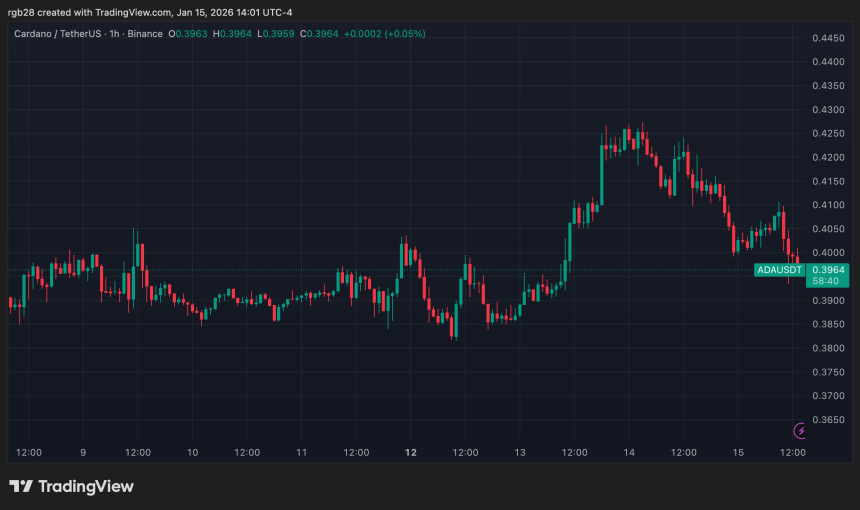
Meanwhile, ADA was attempting to reclaim the $0.41 area ahead of the announcement, briefly bouncing from the recent pullback. Notably, Cardano surged over 10% from the recent lows toward the crucial $0.42-$0.43 area.

However, the altcoin was rejected from this zone on Wednesday, retracing nearly 9% from the local highs to retest the $0.40 level. On Thursday morning, the cryptocurrency bounced from this area, but ultimately resumed its correction as the day progressed.

As a result, Cardano has retraced most of this week’s gains, currently trading around the $0.391 mark.

CArdano, ada, adausdt

Analyst Says It’s Time For Ethereum’s ‘Big Test’ – Is ETH Season Loading?

After its recent price breakout, Ethereum (ETH) is facing its next big test and attempting to turn a crucial area into support. Some analysts have suggested that the altcoin is ready to continue its bullish momentum, arguing that the biggest rotation in years is coming.

Ethereum Challenges Key Resistance Area

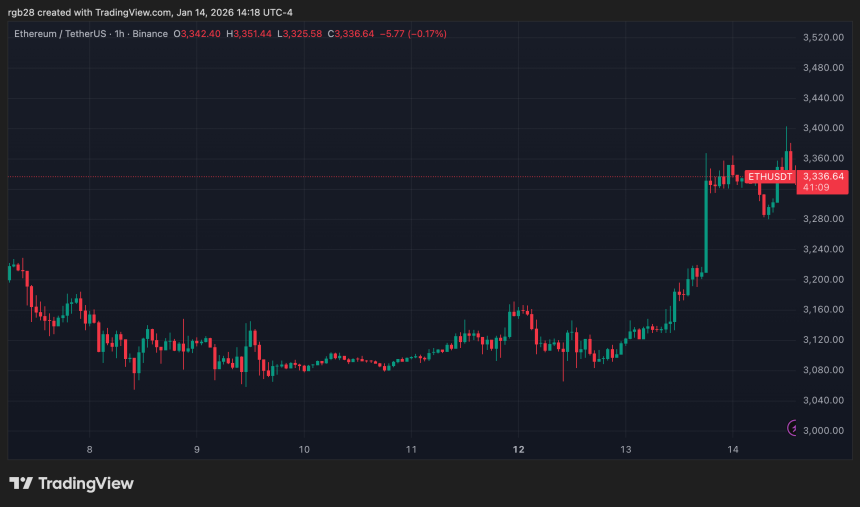
On Wednesday, Ethereum broke past a crucial area and retested the $3,400 level for the first time in over a month. The king of altcoins has seen a 6% increase in the daily timeframe, jumping from the $3,100 level to the current levels.

Notably, ETH has been hovering between the $3,000-$3,300 area since the start of the year rally, but failed to break the local range’s upper boundary during last week’s attempt. Now, the cryptocurrency has daily closed above this barrier and is testing this area as support.

Amid this performance, analyst Michaël van de Poppe affirmed that “it’s ETH season” as the leading altcoin has held above the 21-day Moving Average (MA) since January 1. He explained that this level, officially lost during the early Q4 2025 corrections, is crucial for the price to hold onto to strengthen the momentum.

To the market observer, Ethereum is “ready to make new highs and continue the uptrend,” and based on this structure, his main scenario is that the cryptocurrency will likely retest the $3,800 area soon.

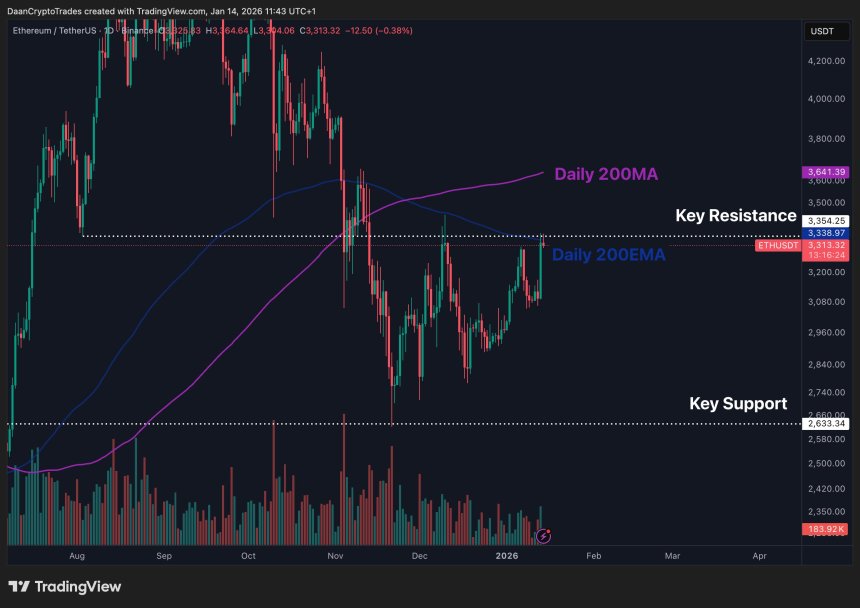
Meanwhile, Daan Crypto Trades pointed out that ETH is currently facing a “big test.” The trader noted that the altcoin has been moving within its $2,600-$3,300 price range over the past two months, adding that a breakout from this range is necessary to define the direction of its next move.

Ethereum

Per the chart, Ethereum must reclaim the $3,350 level, where the 200-day exponential moving average (EMA) is located. This indicator has served as a key rejection area since November, and breaking above it “should lead to a move higher to catch the Daily 200MA next,” currently located around the $3,600 area.

ETH To Follow Its 2018 Playbook?

Crypto Jelle also shared an optimistic outlook for the cryptocurrency, asserting that Ethereum “looks better than it has looked in years” against both Bitcoin (BTC) and the US Dollar.

He argued that both charts are poised to move higher since ETH’s downtrend against BTC is over, and its USD chart looks ready to push towards the $4,000 barrier again. He added that the ETH/BTC anticipated rally means “ETHUSD could see price move a lot higher over the coming months.”

Similarly, Alex Wacy recently explained that the “biggest ETH rotation in 8 years [is] forming right now.” The analyst highlighted that the king of altcoins is repeating the same playbook that led to its 2018 breakout against BTC, but with “bigger players” and “more capital entering.”

According to the chart, ETH saw a multi-year accumulation against Bitcoin between 2015 and 2017, leading to its massive expansion in 2018. After an initial breakout, the cryptocurrency re-accumulated for an extended period inside a falling wedge pattern, which resulted in a 50x pump from this structure.

This time, Ethereum’s trading pair against BTC moved within a multi-year falling wedge pattern again, which was broken out of in Q4 2025. If history repeats itself, the altcoin could see a new massive surge against the flagship crypto over the coming months.

As of this writing, Ethereum is trading at $3,375, a 5% increase in the weekly timeframe.

Ethereum, eth, ethusdt

Pakistan Partners With WLFI-Linked Company For USD1 Stablecoin Payments

Pakistan has partnered with a company affiliated with Trump-linked World Liberty Financial (WLFI) to explore innovation in digital finance and the use of stablecoins for cross-border transactions.

Pakistan To Explore USD1 For Cross-Border Payments

On Wednesday, Pakistan announced it had signed a memorandum of understanding (MoU) with a crypto firm linked to the Trump Family’s main crypto business, World Liberty Financial.

According to a report by Reuters, the Pakistan Virtual Asset Regulatory Authority (PVARA) entered an agreement with SC Financial Technologies, a firm described as an affiliated entity of WLFI, to explore the use of its USD1 stablecoin for cross-border payments.

The memorandum is set to enable “dialogue and technical understanding around emerging digital payment architectures,” and was announced during WLFI founder and CEO Zach Witkoff’s visit to Pakistan.

Notably, Witkoff is also the CEO of SC Financial Technologies, which co-owns the USD1 stablecoin brand alongside World Liberty Financial, according to documentation on the stablecoin’s reserves reviewed by the news media outlet.

Under the agreement, the WLFI-linked company will collaborate with Pakistan’s central bank to integrate its USD 1 stablecoin into a regulated digital payments structure. A source involved in the deal detailed that this would allow the token to operate alongside Pakistan’s own digital currency infrastructure.

It’s worth noting that PVARA officials have previously affirmed that the country will launch a national stablecoin as part of its strategy to modernize payments and support tokenized debt. Additionally, the central bank is developing a pilot for a central bank digital currency (CBDC).

“Our focus is to stay ahead of the curve by engaging with credible global players, understanding new financial models, and ensuring that innovation, where explored, is aligned with regulation, stability, and national interest,” said Pakistan’s Finance Minister Muhammad Aurangzeb.

WLFI Faces New Conflict Of Interest Concerns

The news comes as WLFI faces some scrutiny in the US. On Tuesday, US Senator Elizabeth Warren sent a letter to Comptroller of the Currency (OCC), Jonathan Gould, pressing the agency to halt its review of the bank charter application submitted by the Trump-linked company.

On January 7, World Liberty Financial applied with the OCC to operate as a national trust bank purpose-built for stablecoin services in the US. The move is intended to facilitate the issuance of WLFI’s USD1 stablecoin. Moreover, it would allow the crypto company to provide custodial banking services and gain access to national payment networks under the OCC’s supervision.

The democratic senator cited fears she expressed in July, when she told newly appointed Jonathan Gould that “the OCC may soon be in the position where it has to review a stablecoin issuer application submitted by a company directly tied to President Trump and his family and to draft regulations that clearly influence the President’s finances.”

Unlike most of his predecessors, President Trump has not put his crypto ventures in a trust managed by an independent party, an October investigation stated, pointing out that instead, most of his businesses are owned by a revocable trust, of which he is the sole beneficiary, and managed by his son Donald Trump Jr.

According to the Tuesday letter, Warren’s concerns have gone from being “hypothetical,” as Gould reportedly called them, to being a reality. The senator argued that if the application is approved, the OCC would promulgate rules that “influence the profitability of the President’s company” and would also be responsible for “directly supervising and enforcing the law against the President’s company—and its competitors.”

Therefore, Warren requested that the OCC delay World Liberty Financial’s review until US President Donald Trump divests and eliminates all financial conflicts of interest involving himself or his family members and the company.

WLFI, WLFIUSDT

Bitwise CIO Defends Bitcoin In 401(k)s Amid Sen. Warren’s New Warning

While a senator presses the Securities and Exchange Commission (SEC) against Bitcoin (BTC) and other cryptocurrencies in 401(k) plans, Bitwise’s CEO has defended the Trump administration’s push to allow digital assets’ inclusion in retirement funds.

Hougan Slams Bitcoin Restrictions In 401(k)s

On Monday, Bitwise CIO Matt Hougan discussed whether 2026 will be the year investors can own Bitcoin and other cryptocurrencies in 401(k) plans, as the inclusion of digital assets is becoming more common in individual retirement accounts (IRAs).

In an interview, the executive argued that providers are “slow to move,” but noted that the Trump administration’s pro-crypto shift, which removed “what was effectively a ban on Bitcoin from 401(k)s,” has opened the doors.

Hougan pointed out that large firms like Vanguard had strong restrictions but have recently relaxed their stance on Bitcoin investments. He argued that these bans are “ridiculous,” calling BTC “just another asset” that is no more volatile than stocks, such as those of Nvidia.

Does it go up and down? Absolutely. Is there risk in it? Absolutely. But it’s actually less volatile over the last year than Nvidia stock. And you don’t see any rules about banning 401k providers from offering Nvidia stock. That’s not that would seem ridiculous.

Recent K33 Research data showed that Bitcoin recorded the least volatile year in the asset’s history in 2025. Notably, BTC registered its lowest volatility level last year, with just 2.24%.

“So, I don’t know if the 401(k) providers will get all the way to the point of actually putting it in this year. These are very slow moving institutions, but we’re moving in that direction and eventually it’ll be normalized like other assets, which is how it should be treated,” he concluded.
Senator Warren Issues New Warning

Bitwise CEO’s remarks came as Democratic Senator Elizabeth Warren reached out directly to SEC chairman Paul Atkins to question how the Commission intends to protect investors from potential financial risks now that crypto investments are allowed in retirement plans.

As reported by Bitcoinist, the Department of Labor (DOL) rescinded in May a 2022 guidance that discouraged fiduciaries from including cryptocurrency investments in 401(k) retirement plans.

Months later, US President Donald Trump signed an Executive Order (EO) that aimed to allow more private equity, real estate, cryptocurrency, and other alternative assets in 401(k) retirement accounts.

The EO, signed on August 7, 2025, directed the DOL and the SEC to reduce regulatory barriers that prohibited investments in alternative assets in their defined contribution retirement plans.

In a new letter, the anti-crypto senator shared her concerns, cautioning that allowing Bitcoin and other crypto assets into these accounts could enable significant risks. She listed the “volatility associated with cryptocurrencies, the lack of market transparency, and potential conflicts of interest” as reasons to be cautious about introducing these assets into retirement plans.

She also emphasized that 401(k) plans are a vital source of retirement security for most Americans. Therefore, they should not be treated as a “playground for financial risk” that could put investors in vulnerable positions.

Despite Warren’s warnings, multiple US lawmakers have supported the Trump Administration’s efforts. In September, nine House members asked Atkins to provide “swift assistance” in implementing the president’s executive order and work with the DOL to protect workers.

Later, House of Representatives member Troy Downing proposed a bill to codify Trump’s directive, giving “the force and effect of law” and making it easier for investors to access Bitcoin and other alternative assets in their 401(k) retirement plans.

bitcoin, btc, btcusdt

Bitcoin Nears ‘Historic’ Technical Test As Price Eyes $93,500 Barrier – What’s Next?

As Bitcoin (BTC) breaks out of key resistance levels, an analyst suggests that the cryptocurrency is positioning itself for a move to higher levels and a retest of a crucial technical area in the coming weeks.

Bitcoin Approaching Make-Or-Break Test

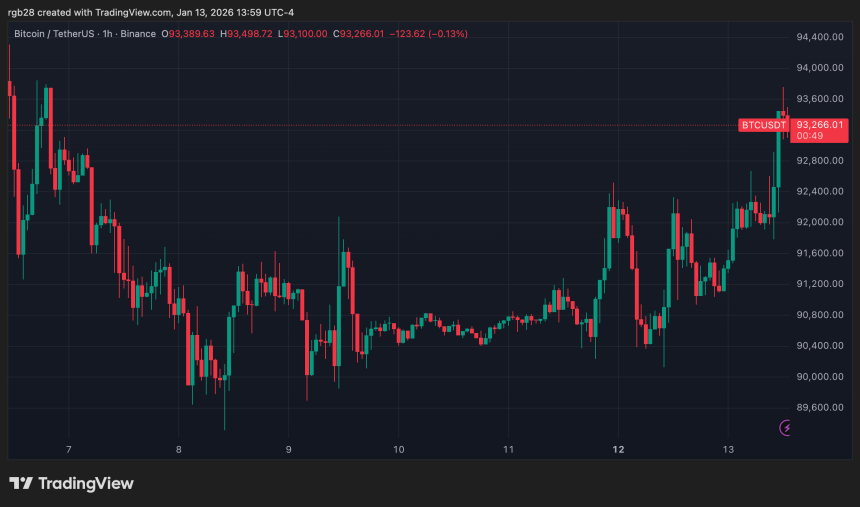
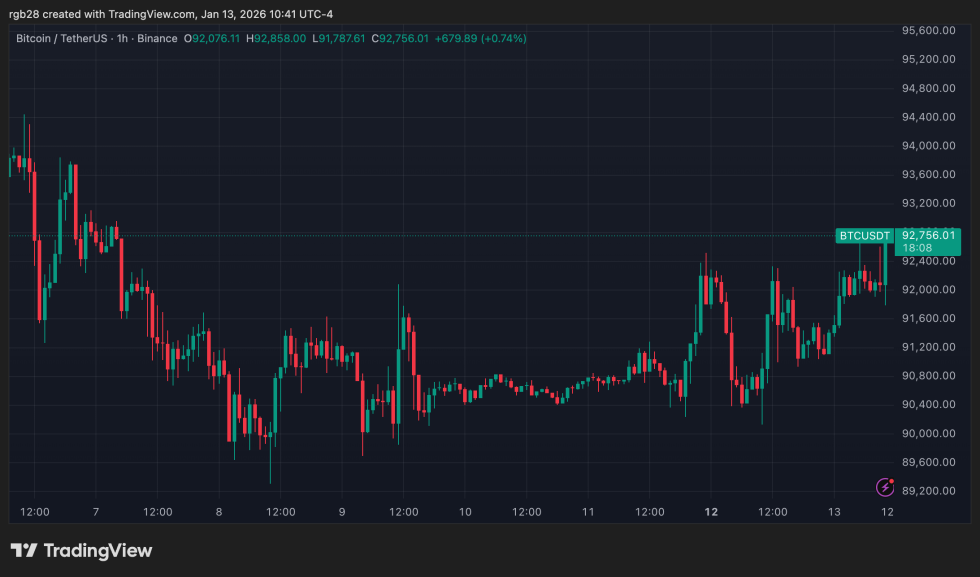
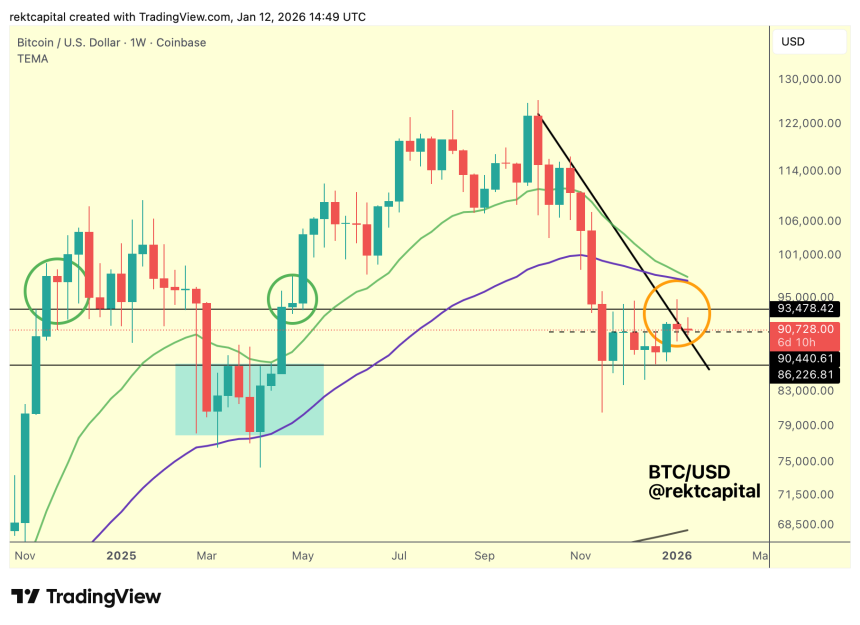
On Tuesday, Bitcoin surged 2.5% to retest the $93,500 resistance level for the first time in a week. The cryptocurrency has been hovering between the $84,000 to $93,500 price range for three months and has failed to turn this level into support multiple times.

Analyst Rekt Capital recently noted that the flagship crypto is near a “historic” test as it has begun to form “another technically decisive region” just above current price levels.

The market watcher explained that BTC is approaching its dynamic Bull Market Exponential Moving Average (EMA) cluster, where the 50-week EMA and 21-week EMA are getting closer.

Bitcoin

This key cluster, currently located between the $96,000 and $97,500 levels, has historically been tested before a “meaningful crossover,” with the Bitcoin price overextending beyond the cluster.

However, this has usually been followed by an unsuccessful confirmation of this region as support. “When that happens, the crossover itself often follows the bearish price event, rather than causing it, with the EMA cluster flipping into resistance from the underside and leading to downside continuation,” the analyst detailed.

Notably, past cycles reveal that the 50-week and 21-week EMAs can move very close together, Rekt Capital wrote, emphasizing that they can even overlap for prolonged periods before a decisive crossover.

Currently, Bitcoin has yet to retest and overextend beyond the two EMAs, but its historical performance suggests that it will likely occur. Moreover, BTC’s price is “positioning itself in a way that could allow for a springboard higher, potentially enabling a test of this cluster in the weeks ahead. The key question is timing.”

BTC Price Breaks Out Of Key Resistances

In his analysis, the market observer discussed BTC’s recent performance, which has seen a structural change despite the sideways price action. Last week, the cryptocurrency’s price closed above its multi-week downtrend, which has been serving as a major resistance point since late November.

This marks “a small but notable technical milestone” as Bitcoin now holds above the November and December highs in the weekly timeframe, treating the previous resistance as support.

In addition, the mid-zone of its local range, around the $90,500 level, is now “almost perfectly confluent with the former Downtrend, meaning the Downtrend that last week rejected price is beginning to act as layered support instead.”

Therefore, if Bitcoin continues to hold the mid-range region, the price should be able to challenge higher levels and find a path toward $100,000. Rekt Capital added that, unlike previous retests, the most recent rejection from the crucial $93,500 resistance was significantly shallower and shorter, suggesting that it was getting weaker.

Now, the flagship crypto has successfully retested the downtrend breakout area as support and momentarily reclaimed the $93,500 resistance, surging above the $94,000 area once again.

Ultimately, BTC will need to hold this area and close the week above $93,500 to “kickstart a breakout from the Weekly Range as per previous green circles,” the analyst concluded.

As of this writing, BTC trades at $94,334, a 2.6% increase in the weekly timeframe.

bitcoin, btc, btcusdt

Monero (XMR) Hits New $610 All-Time High – Veteran Trader Shares Silver-Like Setup

Monero (XMR) is leading the crypto market bounce by breaking out of a macro resistance level and breaching above the $600 barrier for the first time. A legendary trader has suggested that the cryptocurrency is mirroring silver’s historical breakout and could see a massive price discovery rally.

Monero Soars To New Highs

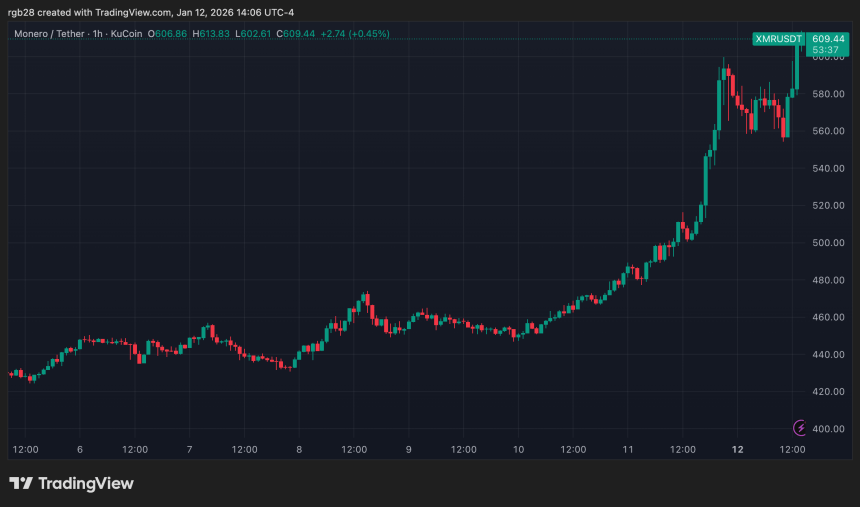
On Monday, Monero outperformed the rest of the market, surging nearly 21% toward its new all-time high of $611.01. The privacy-focused cryptocurrency has been leading the start-of-year market rally, experiencing a 43% increase over the past seven days.

XMR’s rally has been fueled by renewed interest in privacy tokens and redirected liquidity toward the project, which has driven its market capitalization to $10 billion for the first time.

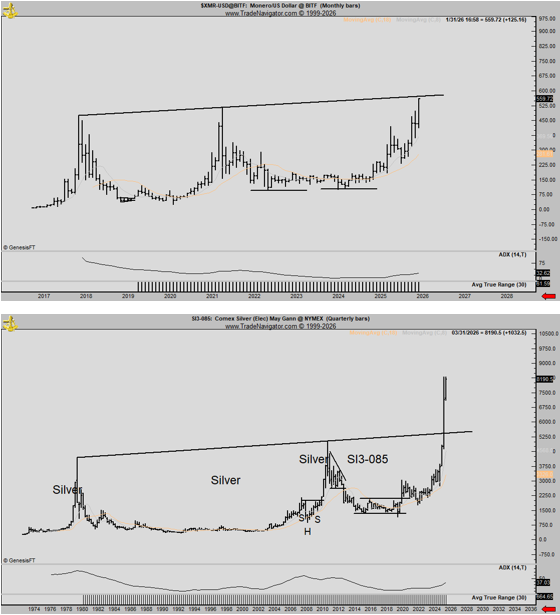
Amid this performance, veteran trader Peter Brandt drew a parallel between Monero and Silver’s long-term charts, suggesting that the cryptocurrency could be near a massive breakout.

In an X post, Brandt compared Monero’s current rally to silver’s historical breakout, which led to a massive run toward new highs. Silver saw a multi-decade price setup in which its price accumulated below and retested a macro ascending resistance trendline.

According to the chart, its price formed its long-term resistance during its 2011 peak, when it reached a slightly higher ATH of $49.83 before correcting. During its Q4 2025 rally, silver finally broke above this key level, nearly doubling its price toward its latest ATH of $86.23.

Monero

Similarly, Monero has been forming its multi-year ascending trendline in the monthly timeframe since its 2017 high. In 2021, the cryptocurrency retested this area, also hitting a slightly higher ATH before retracing.

Now, XMR has broken out of its ascending resistance and could see a similar path to silver’s recent breakout into price discovery, the post suggested.
XMR to See 50% Breakout Or Breakdown Next?

Market observer TraderSZ recently shared an optimistic outlook for Monero once it broke through its crucial resistance area and turned this level into support. To the trader, the cryptocurrency could reach three main price targets if momentum continues.

Per the post, the initial breakout level could reach the $685 area, a more than 30% rally from the resistance level. Moreover, it could surge between 50% and 80% toward the $790 and $900 levels, like silver’s recent price discovery progression in the monthly chart.

Analyst 0xMarioNawfal also highlighted XMR’s performance as “price continues to trend aggressively higher, breaking through previous resistance levels with strong momentum and minimal pullback.”

To him, the structure remains bullish, with buyers stepping in and “no clear signs of distribution yet.” As a result, he forecasted potential volatility but added that as long as the price holds above recent breakout levels, the trend will remain intact.

Nonetheless, Ali Martinez posted a more concerning forecast for the cryptocurrency, suggesting that a significant correction may be around the corner. According to the chart, Monero has been forming a multi-year rising wedge pattern since 2017, with the price bouncing between the upper and lower boundaries.

Based on this, XMR could likely fail to turn the macro resistance into support and begin a long-term 50% decline toward the $300 area, where the pattern’s lower boundary is currently located.

As of this writing, Monero is trading at $597, a 47.5% increase in the monthly timeframe.
Monero, XMR, XMRUSDT

❌