Reading view

There are new articles available, click to refresh the page.

Coinbase CEO Shares 6 Takeaways From WEF Davos 2026 – Details

While Binance co-founder and former CEO Changpeng “CZ” Zhao made the headlines following his interview at the just-concluded World Economic Forum, where he called a Bitcoin supercycle in 2026, his crypto counterpart and Coinbase CEO, Brian Armstrong, has come forward with feedback from the global event held in Davos, Switzerland.

Coinbase CEO Praises Trump-Led White House As Most Crypto-Forward Government 

In a January 24 post on the social media platform X, Armstrong shared a few key “themes and takeaways” from the latest edition of WEF. After admitting that the conference offered a productive time of meeting people one-on-one, the Coinbase CEO revealed that the major focus was on pushing crypto adoption globally.

Starting his list of takeaways, Armstrong highlighted that everyone was talking about tokenization, which is beginning to expand to every asset class in the world. The crypto leader said to expect some major progress in the tokenization sector in 2026, especially as the Fortune 500 business leaders continuously lean in.

Secondly, the Coinbase CEO shared that crypto legislation and the CLARITY Act were another area of focus, as the government of the day looks to make the United States the crypto capital of the world. According to Armstrong, most of the bank CEOs he met at the WEF in the past week are actually pro-crypto.

Armstrong wrote on X:

One CEO of a top 10 global bank told me crypto is their number one priority, and they view it as existential.

Furthermore, the Coinbase CEO lauded the Trump administration as the most crypto-forward government in the world at the moment. Armstrong acknowledged their progress with the crypto market structure, stating that these clear rules are crucial for global competitiveness and will put money back in people’s pockets.

In what seemed like a cheeky tone, Armstrong mentioned that ESG (Environmental, Social, and Governance) and DEI (Diversity, Equity, and Inclusion) topics didn’t come up throughout the forum. According to the crypto founder, the week felt productive, as it centered around real, global progress — all thanks to BlackRock CEO and new WEF co-chair Larry Fink.

The Coinbase leader touted crypto and AI (artificial intelligence) as the most talked-about technologies in today’s world. Highlighting their compatibility, Armstrong stated that AI agents will eventually default to using stablecoins for payments, as they cannot be KYC’d like human beings.

Finally, Armstrong revealed that the Coinbase, Circle, and Bermuda partnership to build a fully on-chain economy was announced at WEF Davos 2026. “Excited to make progress on this and create a compelling case study for other nations to follow,” the crypto CEO concluded.

Total Crypto Market Cap At $3.09 Trillion

As of this writing, the global cryptocurrency market has a total capitalization of $3.086 trillion, with Bitcoin retaining its spot as the world’s largest cryptocurrency.

Coinbase

Analyst Says You’re Not Bullish Enough On Ethereum – What Does He Mean?

A growing number of analysts believe Ethereum’s current price action is being misunderstood. Although frustration is growing due to Ethereum’s inability to hold above $3,000, some technical analysts are quick to point out that the structure forming beneath the surface tells a very different story. According to one analyst, the real risk right now is not being bullish on Ethereum and trying to short in anticipation of a downside breakout.

Higher Lows And A Structure That Keeps Tightening

The analyst’s technical view on Ethereum is focused less on short-term momentum and more on the structure developing on the chart, which he argues is even clearer than what is currently visible on Bitcoin’s chart.

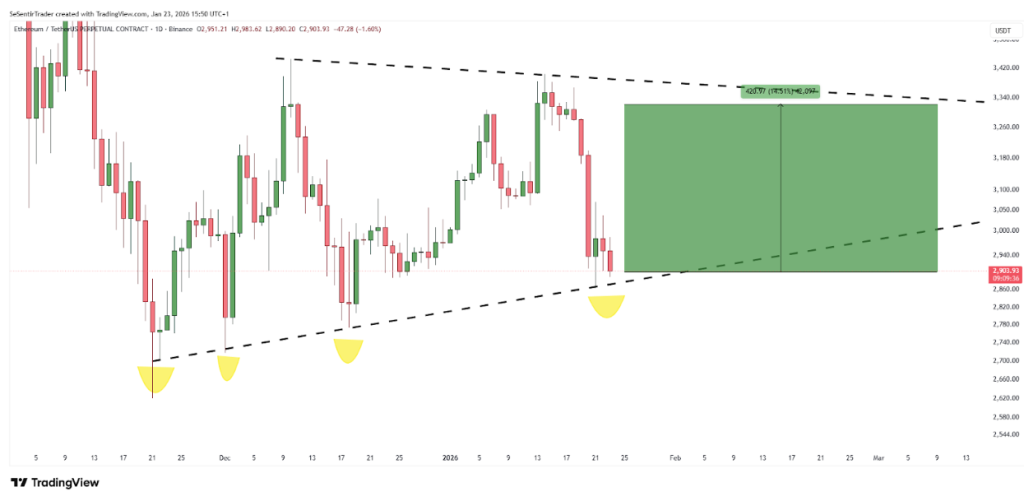
Notably, Ethereum’s price action is carving out a series of higher lows on the daily candlestick timeframe chart to form a tightening triangular pattern since December 2025. This kind of behavior shows that each pullback is being absorbed at progressively higher levels, which is how strong trends reset before continuation.

Ethereum needs to avoid a breakdown below key support zones in order for this trend continuation setup to still be valid. According to the analyst, a dip under $2,860 would begin to weaken the pattern, while a close below $2,780 would invalidate the higher-low structure. 

At the time of writing, Ethereum is trading around $2,950, which is dangerously close to the lower boundary of this setup. Therefore, some traders will be tempted to short Ethereum at this level, but the analyst called it the dumbest thing to do here.

As long as those levels ($2,860 and $2,780) hold, the analyst sees no technical justification for betting against ETH, especially near the lower boundary of the channel where buyers have repeatedly stepped in. 

If support holds, the next move would be a gradual return to the upper trendline of the channel, which is just below $3,340. A move into that region would bring price back into direct contact with overhead resistance and set the stage for a breakout if buying pressure continues to increase.

Ethereum Price Chart. Source: @Tryrexcrypto on X

The Bigger Picture Behind Ethereum’s Price Action

Ethereum is entering 2026 without clear bullish momentum, a reality that has dampened sentiment across the spot and derivatives markets. Spot ETF inflows into Ethereum and Bitcoin have slowed down, and issuers have been highlighted with consistent days of outflows.

Nonetheless, major asset managers are still holding huge amounts of Ethereum and are working on diversifying their activities on Ethereum. BlackRock, for example, filed with the SEC in December to launch a staked Ethereum exchange-traded fund, a move that will bring in more institutional investors into the Ethereum ecosystem.

Speaking of staking, BitMine Technologies recently amped up its ETH staking to over $5.71 billion worth of Ethereum. On-chain data from Arkham Intelligence shows that the firm has staked an additional 171,264, worth $503.2 million, pushing its total stake to over 1.94 million ETH.

Featured image from Unsplash, chart from TradingView

Stablecoins Gain Ground In Africa As Remittances Outpace Aid, Ex-UN Official Says

Africa is seeing a quiet shift in how people send and hold value. Mobile phones are central. According to Vera Songwe, a former UN under-secretary-general, millions who lack bank accounts can use stablecoins to protect savings and move money faster. That access matters in places where inflation has been high and bank fees are steep.

Use By Businesses And Everyday People

Reports have disclosed that stablecoins now make up around 43% of all crypto transaction volume in sub-Saharan Africa. Nigeria alone processed nearly $22 billion in dollar-linked stablecoin activity over a recent 12-month span.

That money is used for remittances, payroll and business settlements. Firms and market traders are among the biggest users, but many everyday people are joining in too.

In countries such as Egypt, Nigeria, Ethiopia and South Africa, demand is driven by volatile local currencies and rules that limit access to dollars. Mobile money networks help push adoption along.

Stablecoins Speed Up Cross-Border Payments

Traditional remittances can be costly. At a World Economic Forum panel in Davos, Switzerland on Thursday, Songwe noted that sending $100 through traditional money transfer services in Africa often costs around $6, making cross-border payments both slow and costly.

Stablecoins cut those costs and shorten wait times from days to minutes for many transfers. Small payments and wages can be settled quickly, and that speed changes how businesses plan cash flow.

Local Rules Are Changing Fast

Governments are reacting in different ways. Ghana passed a Virtual Asset Service Providers law to bring trading into a formal framework. On January 13, Nigeria required crypto platforms to link transactions to tax ID numbers, a move meant to bring activity into official records.

South Africa’s central bank has warned that stablecoins and other tokens could pose risks to financial stability as use grows. Policy is being written while users and tech firms keep pushing ahead.

Risks And The Road Ahead

High inflation remains a core reason people are turning to stablecoins. Reports say inflation has exceeded 20% in 12 to 15 countries since the pandemic, and that reality pushes people to look for alternatives to local notes.

Everyday Use, Measured Change

What started as a tech niche has grown into a practical tool for many across the continent. For small and medium businesses, the benefit is clear: faster settlements and lower costs.

For people without bank accounts, a smartphone can now open a route to store value in currencies less tied to local inflation. Adoption will likely keep rising, but how quickly it becomes part of mainstream finance will depend on stronger rules, better safeguards, and the continued spread of simple mobile services that people trust.

Featured image from Unsplash, chart from TradingView

💾

With more stablecoin transfers in 2024 than Visa and Mastercard combined, the asset-pegged token is shifting from niche crypto instrument to a foundational e...

End Of This Reaccumulation Phase Could Trigger Most Aggressive XRP Rally Ever

XRP has spent most of the past few months trading with lower highs since July 2025, frustrating traders and compressing price action into an increasingly tight range. 

However, a technical breakdown shared by crypto analyst ChartNerd argued that what looks like stagnation may actually be the final preparation phase before a historic move. The price structure suggests something far bigger that sends XRP on its most aggressive rally in eight years, but the implications only become clear when the full setup is examined.

A 400-Day Rectangular Reaccumulation Still Holding Structure

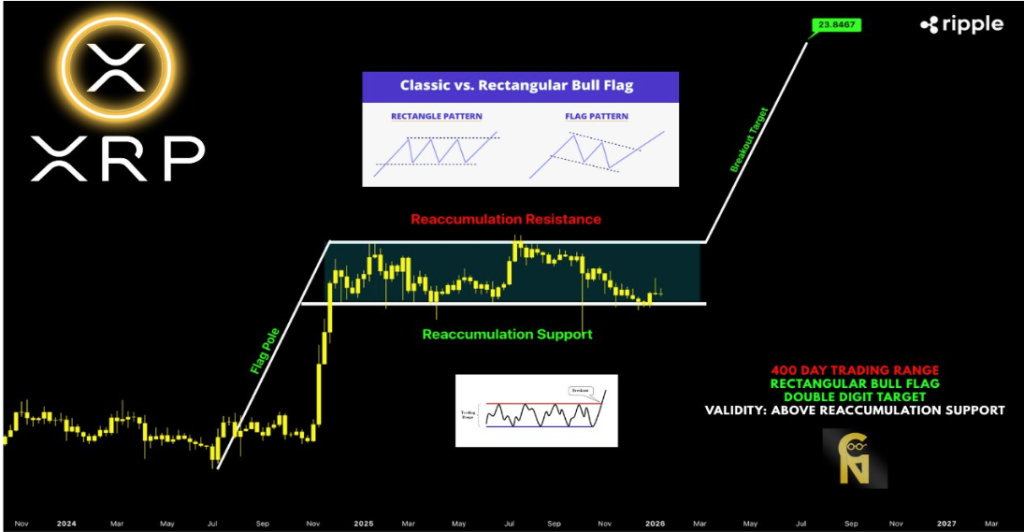
According to technical analysis done by ChartNerd, XRP’s price action has been locked inside a rectangular reaccumulation zone for about 400 days, and this has led to the formation of what looks like a rectangular bull flag on a macro timeframe. The technical chart shows a strong impulsive move from July 2024 to December 2024 acting as the flagpole, right when XRP peaked at the $3.4 price zone back then.

This impulsive flagpole has been followed by a long period of sideways trading where XRP’s price has repeatedly respected a clearly defined support around $1.8 and resistance boundaries around $3.6. This type of structure is associated with reaccumulation within the support and resistance zones, especially when it is playing out after a sharp expansion move and holding for this length of time.

Each dip into reaccumulation support has been absorbed, preventing any sustained breakdown and keeping the broader pattern intact. ChartNerd noted that the rectangular flag will be valid as long as this support level is defended, and this will activate the expansion journey.

XRP Price Chart. Source: @ChartNerdTA on X

Macro Breakout Projection Puts XRP Price Target At $23

According to ChartNerd, bearish participants are increasingly pressured by the fact that this fractal is still holding despite repeated attempts to invalidate it. The longer XRP’s price action is trapped inside the rectangle without breaking down, the more likely it becomes that the eventual resolution favors the dominant trend that preceded the consolidation. In this case, that trend was bullish, which strengthens the case for an upside breakout once resistance is cleared.

If the rectangular bull flag resolves to the upside as projected, the chart outlines a breakout trajectory that would carry XRP into double-digit territory, with a long-term target region near $23. This price target projection is derived from the height of the flagpole extended from the top of the reaccumulation range.

ChartNerd labelled this possible move as one of the most aggressive rallies XRP could see in seven to eight years. At the time of writing, XRP is trading around $1.92, meaning a move toward the $23 region would represent a gain of over 1,000% from current levels, which is a type of percentage expansion XRP has played out well in the past.

Featured image from Unsplash, chart from TradingView

GameStop Transfers Full Bitcoin Stack, Analysts Flag Possible Exit

GameStop moved its entire Bitcoin stash into Coinbase Prime this month, according to blockchain trackers that monitor large transfers.

The wallet associated with the company sent a large deposit to the institutional arm of Coinbase, a platform used by big traders and companies.

Analysts watching on-chain flows immediately flagged the move as a likely setup for a sale, though no confirmed sell orders have been announced.

Big Move To Coinbase Prime

According to on-chain reports, GameStop holds 4,710 BTC that it bought last year, and that full balance was shifted into Coinbase Prime.

The company first bought the coins in May 2025 at prices that averaged near $107,900 per BTC, a buy that cost roughly $504 million at the time.

Moving a corporate treasury from cold storage to an active institutional account is often read as a step toward execution — to sell, hedge, or rebalance — but it is not the same as a sale itself.

GameStop throws in the towel?

Their on-chain wallets just moved all BTC holdings to Coinbase Prime, likely to sell.

Between May 14–23, 2025, they bought 4,710 BTC at an avg. price of $107.9K, investing ~$504M.

Now selling for around $90.8K, potentially realising approximately… pic.twitter.com/Bp7MwRVQ43

— CryptoQuant.com (@cryptoquant_com) January 23, 2026

What Analysts Are Saying

Reports say the math is simple and stark: selling now, with Bitcoin trading closer to the $90,000 area, would lock in a sizable loss versus the initial purchase price.

Several analytics firms put that figure near $76 million if the whole lot were sold at recent market levels. Some market watchers suggest the company could be doing tax-loss harvesting or trimming volatile assets on its books.

Others view it as a pragmatic adjustment to reduce treasury exposure to crypto swings. Still, defenders of the move point out that GameStop’s Bitcoin stake was never a core retail play; it was a treasury experiment meant to diversify.

How Much Has Already Moved

Not all outlets agree on timing or size of day-by-day transfers. Reports note that some transfers earlier this month added up to about half of the original position — roughly 2,396 BTC moved in smaller tranches before the full deposit was flagged.

On-chain sleuths track each shift, and those staggered movements can mean many things: a staged sale, an internal reorganization, or simply routing through a trusted custodian before any trades.

Market And Shareholder Reaction

Share action around GameStop has not mirrored the crypto chatter. While Bitcoin watchers focused on the wallet move, investors were also reacting to company news on other fronts, including fresh share purchases by CEO Ryan Cohen.

Featured image from PeterPhoto, chart from TradingView

Bitcoin Pattern From 2022 That Led To Crash To $20,000 Reappears

Bitcoin (BTC) is mirroring the same setup from its 2022 bull cycle, which led to a massive price crash to $20,000. According to market expert Crypto Bullet, this recurring structure could signal another major correction for BTC ahead. However, this time the leading cryptocurrency could give up almost a quarter of its current value. 

2022 Bitcoin Chart Pattern Signals Over 20% Crash

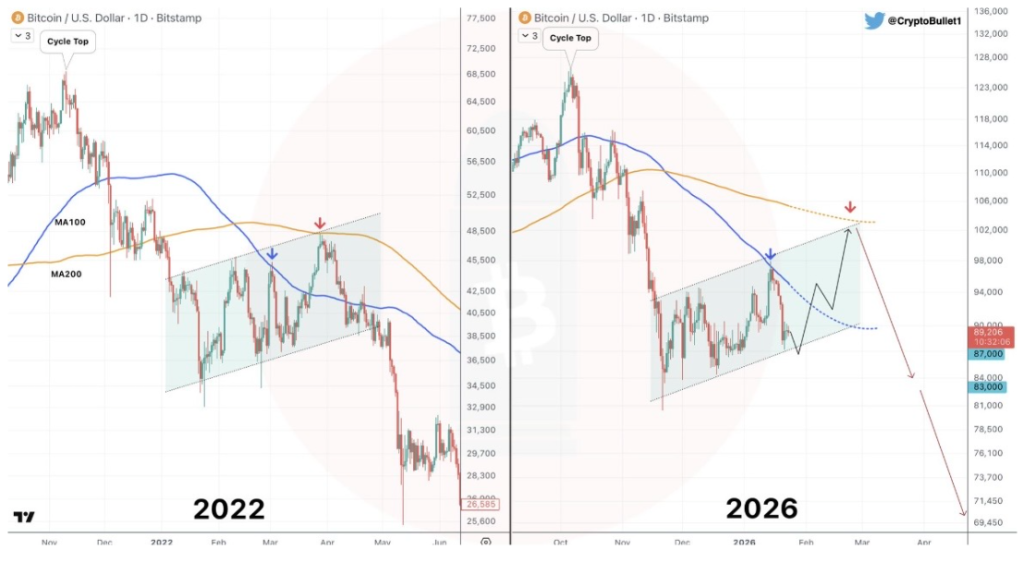
In his technical analysis released on X, Crypto Bullet revealed that Bitcoin is currently repeating a 2022 structure that could lead to a more than 20% decline in its value. To support his bearish outlook, the analyst presented a parallel chart comparing Bitcoin’s price action from 2023-2022 and 2025-2026, highlighting similar technical patterns, price behavior, and Moving Averages (MA). 

During the 2022 cycle, Bitcoin experienced a similar pattern, beginning with a test of the 100-day Moving Average (MA100), highlighted as the blue trendline on the chart. After facing rejection at that level, the price pulled back to a nearby support zone inside a rising channel. From there, BTC staged a sharp rally, surging to fresh highs around $48,500, where it aligned with the 200-day Moving Average (MA200), marked in orange. 

However, the recovery proved short-lived. Bitcoin soon reversed course and failed to reclaim the MA200 as support. Once the cryptocurrency’s price structure was lost, downside momentum accelerated, pushing the price into a much deeper correction toward the $20,000 level. 

According to Crypto Bullet, Bitcoin is repeating this exact pattern in 2026. It has already retested the MA100, gotten rejected, and moved lower into a support zone within a similar ascending channel. The chart also showed that in both cycles, BTC reached a “market cycle top,” first around December 2023 and then again in November 2025, before breaking down and entering a consolidation phase

Given how closely Bitcoin is mirroring its 2022 setup, Crypto Bullet has forecast another dramatic price crash, predicting a more than 23.5% drop from its current price near $89,500 to $68,450. Before this decline happens, the analyst expects BTC to experience a short-term recovery, potentially climbing back above the $100,000 psychological level to reach $102,000. 

Bitcoin Could Still Rally To $92,000

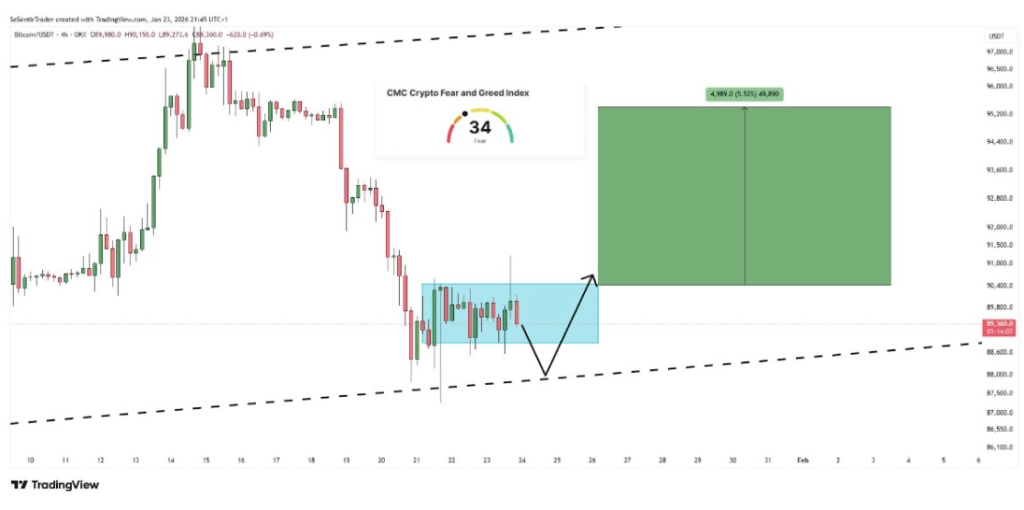
Crypto analyst Tyrex has stated that Bitcoin has been consolidating for the past 48 hours, with price holding above $89,000 for most of that period. Despite the muted price action, he believes that BTC could soon rally to $92,000. The analyst also noted that the broader market is in a state of fear, with many traders anticipating further declines in Bitcoin.

However, the analyst cautions that this expected drop may be a trap. He points out that an ascending channel is forming on Bitcoin’s chart, prompting him to adopt a more bullish outlook despite the prevailing bearish sentiment and sideways price movement.  

Featured image from Unsplash, chart from TradingView

Grayscale Files Spot BNB ETF Application With US SEC — Report

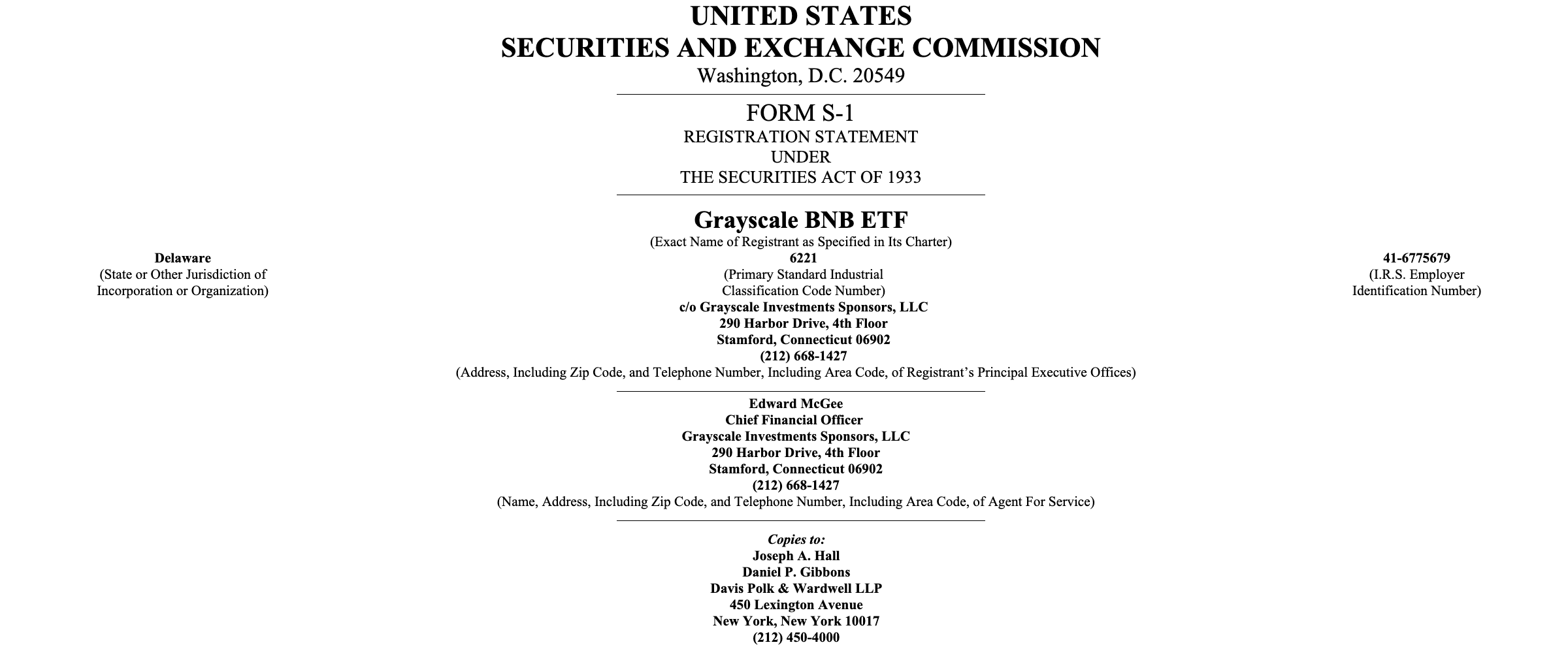
In an interesting development, Grayscale has applied to the United States Securities and Exchange Committee to launch a spot exchange-traded fund (ETF) linked to BNB, the Binance Ecosystem’s native token. This move marks a power play by the asset management firm to further establish itself in the cryptocurrency space.

Grayscale Looks To Add To List Of Crypto-Linked ETFs

On Friday, January 23, Grayscale filed an S-1 registration statement with the SEC to launch a spot BNB exchange-traded fund in the US. According to the SEC filing, the proposed Grayscale ETF would hold the Binance ecosystem’s native token directly and issue shares designed to track the token’s market value.

This Grayscale investment product, if approved, would offer US investors exposure to the BNB token without having to own or hold the asset themselves. The asset manager’s registration statement also revealed that the exchange-traded fund would trade on the Nasdaq exchange under the ticker symbol GBNB, subject to regulatory approval. 

BNB

It is worth mentioning that Grayscale is not the first asset manager to file for a spot BNB ETF, as VanEck applied as far back as April 2025. However, this latest filing reflects the firm’s resolve to expand its list of crypto-linked investment products, especially after the successful launch of the Bitcoin and Ethereum ETFs.

It was always only a matter of time before BNB, the fourth-largest cryptocurrency by market capitalization, received extra attention from institutions focused on exchange-traded products. As such, this move by Grayscale has caught the attention of the cryptocurrency market, including former Binance CEO Changpeng ‘CZ’ Zhao.

In a Friday post on the social media platform X, CZ said that Grayscale’s submission of its S-1 filing to the SEC represents a small step toward making the United States the capital of crypto. “A small step in helping to make America the Capital of Crypto, by giving access to the 3rd largest crypto,” the Binance co-founder wrote on Friday.

Meanwhile, Bloomberg ETF expert James Seyffart concurred that a spot ETF approval could mean that the BNB token will be classified as a commodity rather than a security. This is because the approval of an exchange-traded fund is often an indication that the SEC views the underlying asset as a commodity rather than as a security.

BNB Price At A Glance

After making a play for $900 on Friday afternoon, the price of BNB now stands at around $890. According to data from CoinGecko, the fourth-largest cryptocurrency is down by nearly 5% in the past seven days.

BNB

Monero, Zcash, And Dash Prohibited In India Amid Money-Laundering Crackdown

India’s Financial Intelligence Unit (FIU‑IND) has launched a fresh anti‑money‑laundering crackdown aimed at privacy‑focused cryptocurrencies. The move targets Monero (XMR), Zcash (ZEC), and Dash (DASH), which together represent the largest and most widely used privacy coins globally.

India Tightens Crypto Oversight

Details of the action were shared on Friday by market analyst MartyParty on social media platform X (previously Twitter), who notes that FIU‑IND has issued a directive to crypto exchanges registered in India, instructing them to immediately suspend deposits, withdrawals, and trading activity for Monero, Zcash, and Dash. 

At the heart of the regulator’s concerns is the technology underpinning these assets. Privacy coins rely on advanced cryptographic techniques designed to obscure transaction details, wallet balances, and user identities. 

Monero uses ring signatures to hide the sender and receiver, Zcash allows shielded transactions that conceal transaction data, and Dash offers optional privacy features. 

While these tools are valued by users seeking confidentiality, regulators argue they make it difficult for exchanges to meet know‑your‑customer (KYC) and transaction‑monitoring obligations. The regulator views these features as posing elevated risks related to money laundering, terrorist financing, and sanctions evasion. 

The latest directive applies to all cryptocurrency exchanges registed in the country, which currently includes crypto platforms operating in compliance with Indian regulations. They have been instructed to stop supporting the assets, including delisting, blocking all deposits and withdrawals, and disabling any associated trading pairs.

Monero, Zcash, And Dash Show Mixed Market Reaction

The latest action builds on a broader regulatory push by Indian authorities. In October 2025, FIU‑IND ordered internet service providers to block access to 25 offshore crypto exchanges that failed to register. 

By contrast, only a handful of exchanges currently remain fully registered and compliant in the country. Binance, Mudrex, Coinbase, CoinSwitch (CoinSwitch Kuber), and ZebPay continue to operate legally in India.

Despite the regulatory pressure, market prices for the targeted privacy coins showed short‑term resilience. Over the past 24 hours, all three assets posted gains after recovering from sharp losses earlier in the week. 

Monero was trading at $524 at the time of writing, up 3.5% on the day. Zcash also rebounded modestly, rising 2.2% to trade at $372. Dash recorded the strongest daily performance, jumping 11.6% during the same period.

However, the broader trend remains negative. According to CoinGecko data, Monero, Zcash, and Dash are still down sharply on a weekly basis, with losses of approximately 21%, 8%, and 20% respectively over the past seven days. 

Monero

Featured image from DALL-E, chart from TradingView.com

Expert Forecasts $5 XRP Price As Exchange Balances Plummet By 57%

XRP has given back all of its early‑year gains, sliding toward the $1.90. Despite the pullback, several on‑chain and market indicators are pointing to a possible breakout from current levels, driven largely by a sharp decline in XRP held on exchanges. 

XRP Exchange Balances Slide To 1.5B

Market analyst Sam Daodu notes that over the past months, a substantial portion of XRP has steadily moved off centralized trading platforms and into long‑term storage and institutional custody. 

On‑chain figures indicate that XRP exchange balances dropped from roughly 4 billion tokens in early 2025 to about 1.5 billion by late December. This 57% decline represents the steepest annual reduction in XRP exchange supply on record.

Data from CryptoQuant reinforces this trend, showing shrinking XRP reserves on major trading platforms such as Binance, where balances continued to fall into early 2026. At the same time, wallet accumulation has increased, particularly among institutional custody accounts. 

Daodu argues that with fewer tokens available on exchanges, buying pressure that previously moved XRP only marginally can now drive gains of 10% to 15% within days. 

When combined with approximately $1.37 billion in XRP exchange-traded fund (ETF) inflows recorded since November 2025, Daodu believes the conditions favor a potential breakout toward the $4 to $5 range, rather than another rally that stalls below $3.

Bullish, Base, And Bearish Scenarios

Looking ahead, Daodu outlines three broad price paths for XRP, each tied to how exchange balances and ETF inflows evolve. In a bullish scenario, the altcoin could move into the $4 to $5 range if monthly ETF inflows average $300-$500 million and exchange balances fall below 1.5 billion tokens. 

A more neutral outcome would see XRP trading between $2.50 and $3.50. This scenario assumes ETF inflows slow to roughly $50 million to $70 million per week and exchange balances continue to decline at a steadier pace. 

The bearish case hinges on the possibility that the supply contraction thesis proves overstated. If rapid transfers refill exchange order books, escrow releases increase selling pressure, or ETF demand slows due to tighter macroeconomic conditions, XRP could lose support. 

In that scenario, prices may fall below $2.00 and revisit the $1.60 level during periods of risk aversion. Prolonged uncertainty could see XRP trading between $1.50 and $2.00 for much of 2026, according to the analyst. 

XRP

At the time of writing, the altcoin was trading at $1.94. This represented losses of 4% and 8% over seven and fourteen-day periods, respectively. This positions the fifth-largest cryptocurrency in terms of market cap 46% below the current all-time high of $3.64 reached back in July of last year.

Featured image from DALL-E, chart from TradingView.com 

Crypto Company Ledger Plans US IPO With Valuation Expected To Top $4 Billion

Ledger, the French maker of hardware wallets for crypto assets, is reportedly moving ahead with plans for a potential initial public offering (IPO) in New York, signaling continued momentum in public market interest for digital asset companies. 

The listing would place Ledger among a growing group of crypto firms seeking access to US capital markets, following the recent public debut of BitGo earlier this week.

Ledger Taps Wall Street Giants For US IPO

The move comes amid a broader initial public offering wave that gained strong traction throughout 2025, when several major crypto-native companies either went public or began laying the groundwork to do so. 

Firms such as Circle (CRLC), Bullish (BLSH), eToro (ETOR), Figure (FIGR), and Gemini (GEMI) have already gone public in the US, while Grayscale and Kraken remain part of the renewed IPO push, with filings submitted and preparations still underway.

According to a report by the Financial Times, Ledger has engaged investment banks including Goldman Sachs and Barclays to advise on its initial public offering in the United States. 

People familiar with the matter say the offering could value the company at more than $4 billion. While the IPO could take place as soon as this year, sources cautioned that the plans remain subject to change.

Ledger’s reported IPO ambitions come as BitGo opened trading on Thursday with its shares jumping 24.6%, giving the company a valuation of approximately $2.59 billion. 

BitGo and several of its existing shareholders sold 11.8 million shares priced above the initially marketed range of $15 to $17, raising $212.8 million in the process.

BitGo Sets Tone For 2026 Crypto IPOs

Market experts have pointed to BitGo’s performance as an important signal for the broader crypto IPO landscape. Lukas Muehlbauer, an IPOX research associate, described BitGo’s listing as the first major test of investor demand for crypto-related offerings in 2026. 

He noted that while Gemini went public near the peak of the crypto market last year, BitGo entered the market during a period of recent selloffs, making its reception particularly telling. 

Muehlbauer added that BitGo’s positioning as a profitable and regulated “digital asset infrastructure company,” rather than a business tied directly to token price movements, helped insulate it from “Bitcoin’s (BTC) day-to-day volatility.”

Beyond Ledger, expectations are building that the pipeline of crypto IPOs will continue to grow. In addition to Kraken and Grayscale, industry experts believe the coming year could bring an even larger number of crypto-related IPOs in the US. 

“2025 marked the professionalization of crypto, and the public markets noticed,” said Mike Bellin, a partner at PwC who leads the firm’s US IPO practice. 

Some offerings, however, have faced delays. Elliot Han, chief investment officer at C1 Fund, said that the fourth quarter could have seen an even higher number of IPOs. 

He pointed to the federal government’s prolonged shutdown as a key factor that pushed several listings into the first quarter of 2026. Han also noted that heightened stock market volatility toward the end of the third quarter added further complications.

Ledger

Featured image from DALL-E, chart from TradingView.com 

A New Crypto Era: SEC-CFTC To Host Joint Regulatory Harmonization Event Next Week

The Securities and Exchange Commission (SEC) and the Commodity Futures Trading Commission (CFTC) have announced a joint event on the future of crypto oversight amid the Trump administration’s push to welcome the sector.

SEC-CFTC Push Joint Crypto Oversight

On Thursday, SEC Chairman Paul Atking and CFTC Chairman Michael Selig announced they will hold an event next week to discuss regulatory harmonization between the two sister agencies.

According to the announcement, the pro-industry chairmen will outline the efforts to work together and cooperate to “deliver on President Trump’s promise to make the United States the crypto capital of the world.”

The event will be hosted on January 27 at the CFTC headquarters and moderated by crypto journalist Eleanor Terret. Additionally, it will be open to the public and livestreamed on both agencies’ websites.

“For too long, market participants have been forced to navigate regulatory boundaries that are unclear in application and misaligned in design, based solely on legacy jurisdictional silos,” said SEC Chair Atkins and CFTC Chair Selig in a joint statement.

“This event will build on our broader harmonization efforts to ensure that innovation takes root on American soil, under American law, and in service of American investors, consumers, and economic leadership,” they added.

Last year, the SEC and CFTC began discussing their options for effectively collaborating on crypto regulations, as a clear framework for digital assets became a top priority for the agencies

As reported by Bitcoinist, the agencies explored reinstating the CFTC-SEC joint advisory committee to develop recommendations on ongoing issues, including efforts in regulatory coordination.

During a September joint roundtable between the two agencies, Atking declared that the era of regulatory fragmentation was ending and the age of harmonized, innovation-friendly crypto oversight was here:

 We are at a crossroads. If we follow the path of our predecessors, America risks ceding leadership in the next chapter of financial history. (…) This ends now (…) our two agencies must work in lockstep to transform dual regulation from a source of confusion into a source of strength. Together, we can offer the best of both worlds: the investor protections that have defined U.S. markets, combined with the innovation-friendly approach that will keep us at the frontier of financial technology throughout the 21st century.

The SEC’s Director of the Division of Trading and Markets, Jamie Selway, highlighted the SEC’s efforts to “further harmonize its rules with our sister regulator, the CFTC. In a January 22 speech, He affirmed that the Division will work shoulder-to-shoulder with the CFTC staff to ensure the US’s continued leadership in financial markets, following Atkins’ September directions.

Congress Regulatory Efforts Stall

The SEC and CFTC’s efforts to regulate the crypto market come as the US Congress struggles to establish a framework to oversee the sector. The Senate Banking Committee’s version of the market structure bill, which focuses on the SEC’s oversight, was delayed after multiple market participants criticized the bill’s draft.

Coinbase CEO Brian Armstrong shared his disappointment with the crypto legislation, withdrawing the company’s support last week. “This version would be materially worse than the current status quo. We’d rather have no bill than a bad bill,” he affirmed.

The Senate Agriculture Committee published its version of the CLARITY Act on Thursday, which mainly addresses the CFTC’s role and regulations, scheduling its markup session for January 27.

Eleanor Terret shared that the industry’s reaction has been mostly positive, “with stakeholders noting the bill’s close similarities to the House Agriculture Committee’s version of the Clarity Act.”

However, recent reports have warned that the Banking Committee’s crypto talks may not resume until later February or early March, as focus shifts to advancing affordable housing plans linked to President Trump’s priorities.

crypto, bitcoin, btc, btcusdt

OpenSea Insider Trading Case Ends Without A Retrial – Details

Nathaniel Chastain, a former product manager at OpenSea, will not face a retrial after federal prosecutors chose to drop their re-review of his insider trading case.

Reports say the US Attorney’s Office reached a deferred prosecution agreement with Chastain that will lead to dismissal of the charges once the agreement runs its course.

What Prosecutors Decided

Prosecutors told a Manhattan federal court they would not retry Chastain following an appeals court ruling that tossed his earlier conviction.

Under the deferred prosecution deal, the government will dismiss the case about a month after notifying the court, and Chastain has agreed to forfeit roughly 15.98 ETH tied to the trades. He has already served three months in prison from his original sentence.

How The Appeals Court Changed The Case

According to the US Court of Appeals for the Second Circuit, the jury in the first trial had been given the wrong instructions about what the wire fraud law covers.

The judges said confidential information only counts as property under the statute when it has commercial value to the employer, and jurors might otherwise convict someone for behavior that is unethical but not criminal. That legal point is at the heart of the reversal.

Reports note that prosecutors had called the matter the first-ever insider trading case tied to NFTs. Now, lower courts and enforcement teams will have to think carefully before using traditional fraud laws to police activity in NFT markets.

The ruling highlights a gap between old statutes and new kinds of online goods, which may push lawmakers to give clearer rules for how to treat confidential business signals related to crypto platforms.

OpenSea: The Case’s Earlier Chapters

Chastain was first charged in mid-2022 after prosecutors said he bought certain NFTs before they were featured on OpenSea’s homepage, then sold them after prices rose.

He was convicted at trial in 2023 of wire fraud and money laundering and received a sentence that included three months behind bars. The US Attorney’s Office originally described the scheme as a novel use of insider knowledge in digital markets.

With the deferred prosecution agreement in place for OpenSea, prosecutors can close this chapter without a new trial.

Chastain’s forfeiture of crypto assets and his already served time mean the government has secured some remedy, while the appellate decision leaves open big questions about when private business information can be treated as property for federal fraud charges.

Legal teams, judges, and regulators are likely to keep a close eye on how similar cases are handled in the future.

Featured image from Getty Images, chart from TradingView

Binance Leads Push To Offer Tokenized US Stocks Outside Traditional Markets

Major cryptocurrency exchanges are reportedly positioning to bring tokenized stock trading onto the blockchain, signaling a renewed push to merge traditional financial markets with digital assets. 

According to a report published Friday by The Information, platforms such as Binance are exploring ways to offer crypto tokens that track publicly listed US companies, effectively creating new channels for equity exposure through tokenized instruments.

Binance And OKX Explore Tokenized Stocks

The report says Binance is considering reintroducing stock tokens to its platform, several years after pulling similar products in 2021 amid regulatory uncertainty. 

The plan, cited by a person familiar with the matter, reflects a broader shift within the industry as exchanges revisit tokenized equities under evolving market and compliance frameworks. 

OKX is also said to be evaluating the possibility of offering tokenized stocks, according to Haider Rafique, the company’s global managing partner and chief marketing officer.

Binance has framed the move as part of its long-term strategy to connect traditional finance with the crypto ecosystem. In a statement to CoinDesk, a Binance spokesperson said the exchange is focused on expanding user choice while maintaining strict regulatory standards. 

The company noted that it began supporting tokenized real-world assets (RWAs) last year and recently launched what it described as the first regulated traditional finance perpetual contracts settled in stablecoins. 

Exploring tokenized equities, the spokesperson said, is a natural progression as Binance continues to build infrastructure, collaborate with established financial institutions, and develop new products for users and the wider industry.

Binance and OKX are not alone in this effort. Several major crypto firms, including Robinhood (HOOD), Gemini (GEMI), and Kraken, have already rolled out tokenized stock offerings in Europe. Meanwhile, Robinhood and blockchain startup Dinari are seeking regulatory approval to introduce similar products in the United States.

Tokenized Shares Gain Increased Interest

Robinhood took a significant step in June of last year when it launched trading in tokens linked to publicly listed companies and announced plans to expand into tokenized shares of private firms. 

As part of the rollout, the company distributed tokens pegged to OpenAI. According to Robinhood’s terms and conditions, those tokens function as derivative contracts backed by the firm’s ownership of fund units in a special-purpose vehicle that holds OpenAI convertible notes. 

Coinbase (COIN), on the other hand, is reportedly in discussions with the US Securities and Exchange Commission (SEC) about launching tokenized securities that would grant investors the same legal rights and benefits as conventional shares

Several issuers involved in the space say they are closely adhering to established rules around securities law, anti-money laundering requirements, bankruptcy protections, and investor safeguards.

Industry leaders argue that, when structured properly, tokenization can strengthen rather than weaken investor protections. Ian De Bode, chief strategy officer at Ondo Finance, said that a careful approach to tokenized securities can enhance safeguards while unlocking efficiencies that traditional markets struggle to achieve.

Binance

Featured image from OpenArt, chart from TradingView.com 

Big Banks Go Stablecoins: Capital One Buys Brex For $5.15 Billion

Reports say Capital One will buy stablecoin fintech Brex for $5.15 billion in a deal that mixes cash and stock. According to the bank’s release, roughly half of the price will be paid in cash and the other half in Capital One stock.

Regulators must still sign off. The two companies expect the transaction to finish by mid-2026, though that timing could shift if approvals take longer.

Brex Brings Cards, Software — And Stablecoin Plans

Brex began as a corporate card and expense tool for startups and has added services for larger firms.

Reports note the company moved quickly into payment tech last year when it announced plans to offer native stablecoin payments, letting customers send and accept dollar-pegged tokens with automatic conversion back into USD balances.

That bit of tech is a major part of why the deal matters to a bank that wants faster settlement options.

A Mix Of Old And New

This is not just about software. It is also a play for customers. Brex runs business accounts, serves big names in tech, and has built a set of tools that many businesses use daily.

Some of those clients moved business deposits to Brex after the 2023 banking turmoil, and those relationships are part of the package Capital One is buying.

The price tag looks smaller than Brex’s peak private valuation years ago, which shows how venture valuations have reset across the sector.

Why This Matters For Payments

Banks have been testing token-based rails and faster settlement for a while. By folding Brex into its operations, Capital One gains a ready platform that already experiments with stablecoin rails.

Real-time settlement for businesses can lower friction and could cut the waiting time for funds to clear. At the same time, regulators in the US and abroad are paying closer attention to token projects, so the new setup will run under tighter scrutiny.

Source: Coingecko The Growing Stablecoin Market

Stablecoins have drawn growing attention across traditional finance after Congress approved major rules for the tokens last year.

Based on data from Coingecko, the total value of stablecoins has climbed over 18% to an all-time high of $315 billion since the GENIUS Act was passed in July 2025. USDT takes the lion share of the overall stablecoin market.

Leadership And Market Reaction

Reports note that Pedro Franceschi, Brex’s CEO, will continue to lead the unit after the sale, now inside Capital One.

Investors reacted calmly overall; Capital One’s shares dipped early but were supported by robust quarterly results announced at the same time. That earnings strength helped soften any sharp market moves.

Featured image from YouHodler, chart from TradingView

Expert Analyzes XRP, Ethereum, And Solana: Predictions For The Next Altcoin Season

As the crypto market faces uncertainty and continues in a consolidation phase, market expert Sam Daodu has issued a report examining the potential for XRP, Ethereum (ETH), and Solana (SOL) to emerge as frontrunners if a new altcoin season arises in 2026. 

XRP, ETH, And SOL Price Forecasts

Daodu began his analysis by pointing out that Bitcoin’s (BTC) dominance is currently hovering around 59%, alongside an Altcoin Season Index reading of 55. These indicators suggest that 2026 could herald a substantial rotation towards altcoins, mirroring significant shifts experienced during cycles in 2016-2017 and 2020-2021.

The expert outlines several bullish scenarios for each. For XRP, he envisions a potential surge past the $6-$8 range if exchange-traded fund (ETF) inflows maintain a monthly average exceeding $400 million and RippleNet continues to expand its influence in global banking. 

ETH, on the other hand, could see itself climbing toward $12,000-$18,000 if Layer 2 (L2) adoption unlocks broader usage and ETF inflows rebound. 

Daodu highlights that active addresses are at cycle highs, indicating organic demand that may translate to higher prices once institutional sentiment shifts positively.

For SOL, the outlook is similarly optimistic. Solana might rocket to the range of $500-$800 if its transaction finality of 150 milliseconds and low fees attract a new wave of applications. Additionally, the rise in ETF filings could lead to significant capital inflows.

Potential Risks Ahead 

In more stable scenarios, Daodu suggests that XRP might consolidate between $2.50-$3.50 if institutional adoption progresses steadily without dramatic catalysts. 

He also speculates that Ethereum could trade within the range of $5,000-$9,000, benefiting from consistent demand driven by staking yields and decentralized finance (DeFi) growth.

Meanwhile, Solana might trend between $200-$350, assuming that developer growth and retail adoption continue at their current pace without major breakthroughs. 

However, Daodu cautions that XRP could fall below $1.50 if demand for ETFs wanes or if regulatory uncertainties arise. Similarly, ETH could fall below $2,500 if scalability issues arise or if regulatory challenges become more pronounced. SOL could drop below $100 if outages persist or if it faces increased competition from other Layer 1 platforms.

What AI Models Anticipate

AI predictions provide additional insight into the expected performance of these altcoins. For XRP, forecasts vary significantly, with ChatGPT estimating a range of $0.80-$3.00, while Grok presents a more bullish outlook with a target of $1.50-$6.00. 

Ethereum’s AI predictions show a range of $3,000-$9,000 from ChatGPT, while Gemini anticipates a high of $7,000-$18,000 through increased tokenization. 

Lastly, Solana’s predictions range from $120-$350 from ChatGPT to a more optimistic $300-$800 from Gemini, depending on the growth of consumer applications.

XRP

XRP was trading at $1.93 at the time of writing, down 2% in the previous 24 hours. ETH traded at roughly $2,952, while SOL traded at $128, both experiencing comparable declines during the same time period. 

Featured image from DALL-E, chart from TradingView.com  

Russia’s A7A5 Stablecoin Moved $100 Billion Before Global Crackdown: Elliptic

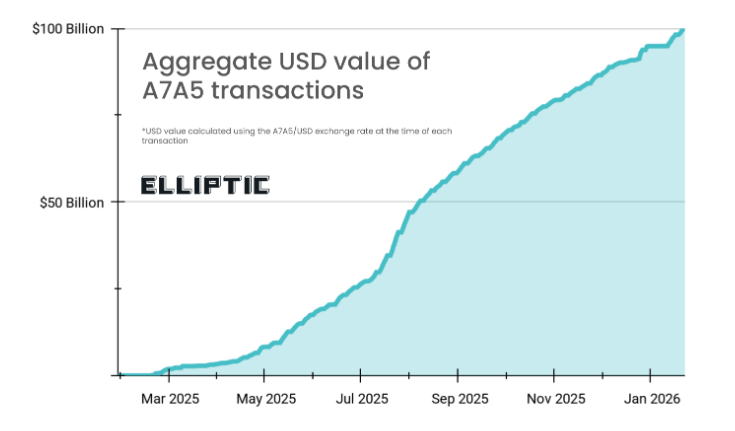
A little token that few people had heard of a year ago has become a big mover of money. Reports say the A7A5 stablecoin, launched as a rouble-linked coin, has processed the equivalent of $100 billion in transfers since it began moving at scale.

Elliptic Finds Rapid Growth And Large Volumes

According to analysis by Elliptic, A7A5 grew quickly after its launch and was used heavily for settlement between firms that could not rely on regular banks. The firm traced huge daily flows, with transaction totals rising into the billions and aggregate transfers passing major milestones.

Origins And Backing

A7A5 was set up in a way that tied it to rouble deposits and to a handful of private entities connected to Russia’s financial network.

Reports say the project was linked to a payments group and to banking partners that have been under western scrutiny. Some of the people and firms behind the token were later sanctioned by authorities in the US and the UK.

How The Money Moved

Transactions were concentrated on a small number of exchanges and on on-chain routes that made cross-border transfers possible without the usual banking rails.

In practice, the coin served as a bridge into other stablecoins and crypto markets. That routing let trade keep moving even when formal channels were closed to certain actors.

A7A5 Stablecoin Role In Sanctions Evasion Claims

Reports note that regulators and analysts view those flows as a tool that could help avoid sanctions. Regulators in several countries have taken action against linked platforms and individuals after patterns of transfers were uncovered.

Some of the design choices around the token made monitoring harder for a time, and in a few cases tokens were reissued in new wallets to muddy traces.

Market Reaction And The Wider Impact

Markets noticed. The token’s market cap surged, and exchanges that handled it saw sharply higher volumes.

Ordinary traders were not the main users; activity was often timed with business hours and weekdays, which suggested corporate or institutional flows rather than retail swaps. This type of pattern changed how people outside the region looked at crypto as a payments tool.

Authorities responded by blacklisting some addresses and platforms and by stepping up enforcement against those named in the network.

The moves show that a token can move a lot of value, but it can also draw regulatory heat and prompt countermeasures that affect every participant in the chain.

Featured image from Pixabay, chart from TradingView

Banks’ Concerns Over Stablecoin Interest Payments Are ‘Totally Absurd’, Circle CEO Says

The CEO of stablecoin issuer Circle has weighed in on the importance of stablecoin rewards and why he believes the banking industry’s concerns about interest payments on these assets are “absurd.”

Circle CEO Rejects Banks’ Stablecoin Fears

Speaking at the World Economic Forum (WEF) in Davos, Circle’s CEO, Jeremy Allaire, discussed banks’ growing concerns that paying interest on stablecoins poses a threat to the industry, calling the deposit flight narrative “totally absurd.”

The banking sector has expressed concerns about stablecoin rewards, arguing that interest payments will distort market dynamics and affect credit creation. In the US, banks have heavily criticized the GENIUS Act, claiming that it has loopholes that could pose risks to the financial system.

The executive rejected the sector’s general arguments, citing historical and practical reasons. He asserted that this exact argument has been historically used when new financial products, such as government money market funds, have emerged.

Notably, Bank of America CEO Brian Moynihan recently compared the digital assets to money market mutual funds, which require reserves to be held in short-term instruments, such as US Treasuries, reducing lending capacity in the system.

The executive told investors that the banking sector, small- and medium-sized businesses in particular, could face significant challenges if the US Congress does not prohibit interest-bearing stablecoins, as up to $6 trillion in deposits, or 30% to 35% of all US commercial bank deposits, could flow out of the banking system and into the stablecoin sector.

However, Allaire pointed out that, despite institutions claiming that financial products would “draw all the deposit base,” their growth has not “stopped the ability for lending to happen.”

The importance Of Rewards

Circle’s CEO also argued that stablecoins should not be singled out when rewards for other financial products exist and contribute to the system. “Those rewards (…) exist in every balance that you have with a credit card that you use. They exist around so many other financial products and services that we have,” he detailed.

“These rewards are actually very important,” Allaire continued. “They help with stickiness, they help with customer traction. They are not themselves like these huge monetary policy dampers.”

Most importantly, he pointed out that lending is moving away from the risk-taking of banks, with “a huge amount of lending is moving towards private credit.”

He cited a Wednesday WEF panel, in which a capital markets participant highlighted how the vast majority of GDP growth in the United States was “formed by capital market formation around junk bonds.”

“So private credit issuing junk bonds, capitalizing the build out of the American technology advancements, not bank credit,” the executive added.

Previously, Coinbase Institute shared a similar argument, affirming that “credit is evolving, not shrinking. Lending is shifting to private credit, fintech, and DeFi channels that don’t depend on deposits. Liquidity moves—it doesn’t vanish.”

Allaire concluded that “we want stablecoin money to be cash instrument money, prudentially supervised, very, very safe money. And then I think what we want to do is we want to build models for lending that build on top of stablecoins.”

stablecoin, total

Crypto ETFs Are Coming To Thailand: SEC To Launch New Rules This Year

Thailand’s Securities and Exchange Commission (SEC) is preparing to launch new rules related to crypto, including exchange-traded funds (ETFs).

Thailand To Regulate Crypto ETFs And Futures This Year

As reported by Bangkok Post, the Thailand SEC is preparing regulatory changes related to crypto to support the growth of investment in the sector. Jomkwan Kongsakul, deputy secretary-general of the SEC, said the regulator is planning to issue guidelines supporting the launch of digital asset ETFs, while also working to enable crypto futures trading on the Thailand Futures Exchange (TFEX).

ETFs are investment vehicles that allow investors to gain exposure to an underlying asset without having to directly own it. In the context of digital assets, ETFs enable traders to invest into coins like Bitcoin without interacting with any on-chain element like wallets or exchanges.

In the United States, spot ETFs gained approval by the nation’s SEC in January 2024 for Bitcoin and July 2024 for Ethereum. Since then, these funds have attracted notable attention, capturing demand from traditional investors who were reluctant to deal with blockchain infrastructure.

Kongsakul noted:

A key advantage of crypto ETFs is ease of access; they eliminate concerns over hacking and wallet security, which has been a major barrier for many investors.

Within Asia, Hong Kong approved spot ETFs for both Bitcoin and Ethereum in April 2024, while South Korea is planning to roll out similar investment vehicles this year.

According to Kongsakul, Thailand’s SEC board has already approved crypto ETFs in principle, with detailed investment and operational rules currently being finalized. Although an exact timeline is unknown, the SEC is expected to introduce the regulations “early this year.”

Alongside ETFs, the SEC is also moving to formally recognize crypto within Thailand’s derivatives framework, allowing digital asset futures products to trade on the TFEX. Kongsakul said crypto futures would provide traders with hedging tools and more sophisticated risk management options.

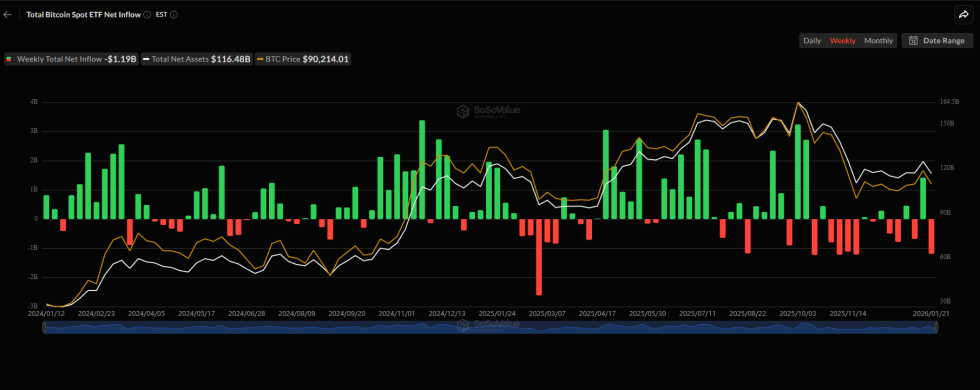
In related news, the US spot Bitcoin ETFs have faced weak demand recently, with the netflow for the current week sitting at a notable negative value, according to data from SoSoValue.

Bitcoin Spot ETF Netflows

As displayed in the above graph, the US Bitcoin spot ETFs have witnessed net outflows of $1.19 billion this week so far. These negative netflows have come as the asset’s price has gone through a bearish shift, retracing the recovery it had made earlier this year.

Last week, the funds actually saw net inflows of $1.42 billion, breaking the trend of weak inflows or outright outflows that had persisted since mid-October. But this week’s netflow suggests the bullish market mood couldn’t last.

BTC Price

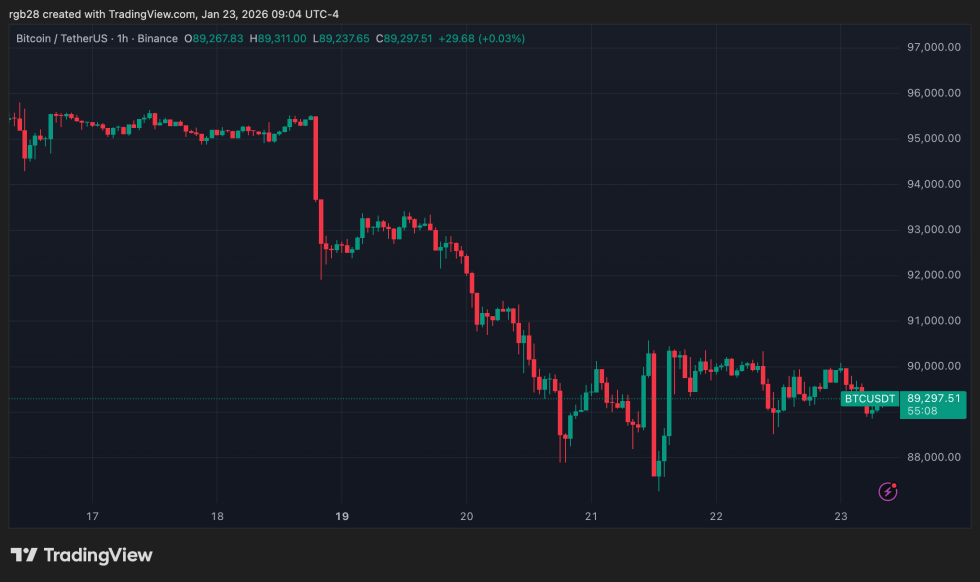
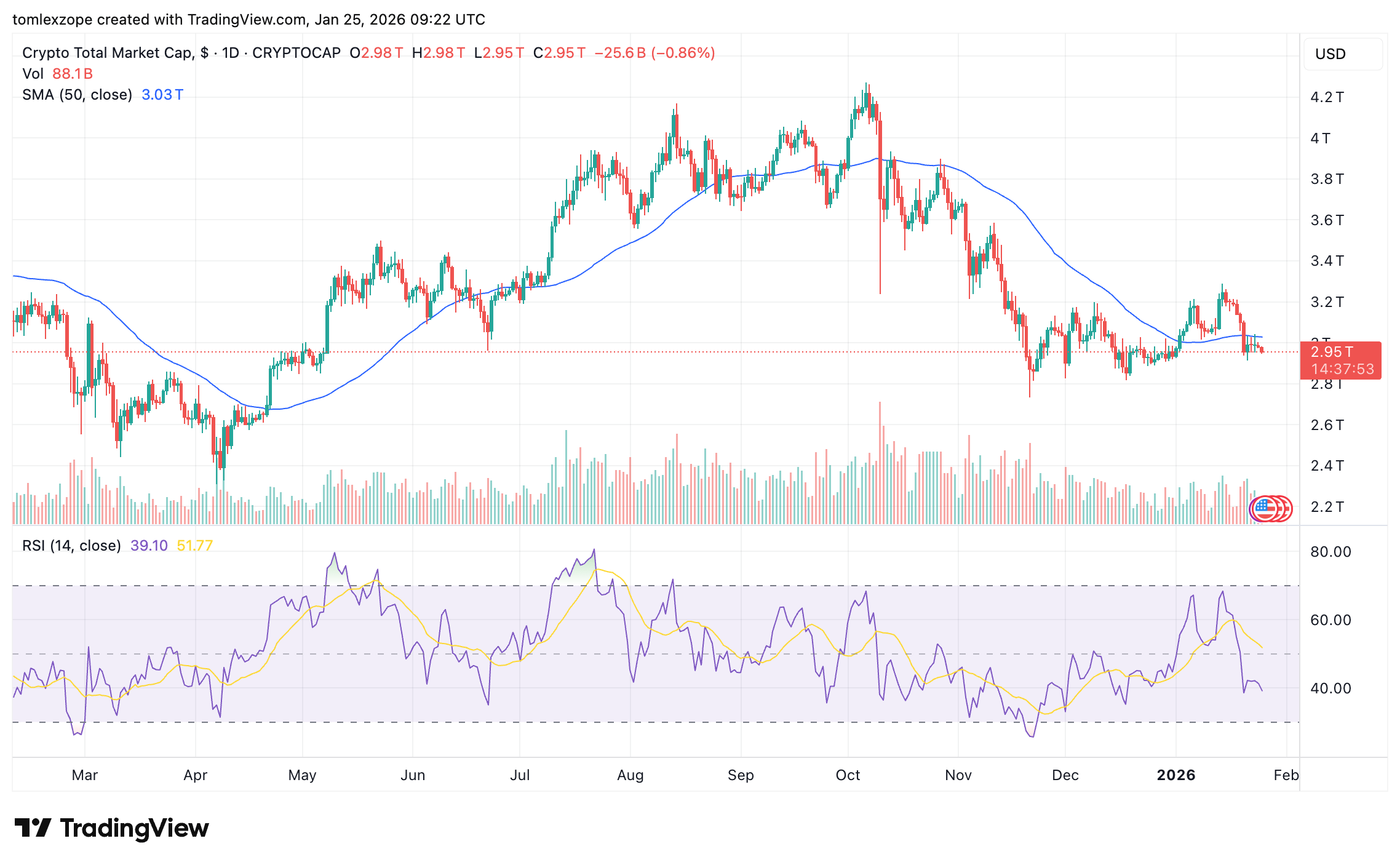
At the time of writing, Bitcoin is trading around $89,100, down more than 8% over the last week.

Bitcoin Price Chart

Bitwise Says Crypto Has Likely Bottomed, Echoing Q1 2023 Setup

Bitwise Asset Management is arguing that crypto’s current drawdown has the fingerprints of a cyclical low: weak prices alongside strengthening on-chain and business fundamentals, a pattern the firm says last appeared in Q1 2023 before a multi-year rally.

In its Q4 2025 “Crypto Market Review,” Bitwise Chief Investment Officer Matt Hougan frames the quarter as an unusually important inflection point precisely because the signals are not all moving in the same direction. “But sometimes—every once in a while—the charts are mixed,” Hougan wrote. “The last one I remember was Q1 2023. At the time, we were starting to rebound post-FTX, and the data was topsy-turvy; some up, some down, some sideways. In the two years that followed, crypto prices soared.”

Bitwise’s core claim rests on a divergence between market performance and usage metrics in Q4. The firm notes that Ethereum fell 29% over the quarter, even as Ethereum and Layer 2 transactions “soared to new all-time highs (up 24.5%).” Crypto equities also sold off, down 20% in Q4 by Bitwise’s measure while the underlying companies’ revenues were “on pace to grow 3x faster than any other sector of the stock market,” according to the report.

The price tape was undeniably heavy. The Bitwise 10 Large Cap Crypto Index fell 26.29% in Q4 and finished 2025 down 10.64% year-to-date; Bitcoin was down 23.48% in Q4 (down 6.26% in 2025), while Ethereum fell 28.59% in Q4 (down 11.03% in 2025).

Yet the report also shows the market retaining scale: total crypto market capitalization stood at roughly $2.78 trillion as of Dec. 31, with bitcoin representing 63.6% and ether about 12.9%.

Where Bitwise sees “green shoots” is in rails and revenue. The executive summary argues that “both stablecoin AUM and stablecoin transaction activity soared to new all-time highs,” presenting that as evidence a durable adoption wave is underway.

Four Crypto Catalysts Bitwise Is Watching In 2026

Bitwise argues the market’s next leg will be shaped less by narrative rotation and more by identifiable catalysts, starting with US market-structure legislation. “All eyes are on the CLARITY Act,” the report says, describing it as a Senate-moving bill that could provide a “strong regulatory foundation” but also carries the risk of a weaker outcome or no bill at all.

The second catalyst is what the firm calls a “stablecoin supercycle,” positioning stablecoins as payment infrastructure that is increasingly decoupled from directional crypto beta. Bitwise writes that 2025 annual stablecoin transaction volume topped $32 trillion, up 73% year-over-year, “more than doubling Visa’s volume through the first nine months of the year,” and says that data “confirm[s] their arrival in the mainstream.”

The third is macro, specifically the coming change at the Federal Reserve. Bitwise notes Chair Jerome Powell’s “looming departure in May,” giving President Trump an opportunity to appoint new leadership. Between named candidates Kevin Warsh and Kevin Hassett, Bitwise says Hassett is viewed as the more dovish on rates and fiscal policy, adding that a dovish appointment would increase the likelihood of rate cuts and “should drive crypto assets higher.”

The fourth is plumbing: distribution at major US wealth platforms. Bitwise points to “initial wirehouse ETF flows” following Q4 approvals, writing that financial advisors at three of the four major wirehouses gained access to crypto ETFs in Q4 after previously being barred from recommending exposure. Those advisors “control ~$16 trillion in assets,” and Bitwise expects early flows to start slowly in Q1 before accelerating.

Hougan stops short of calling any single variable decisive, but ties the bottom thesis to whether the underlying data keeps improving. He wrote he was drafting the memo on Jan. 16 after crypto had already begun posting strong early-year returns and added: “If the fundamental data in this report stays steady, I think that trend could continue.”

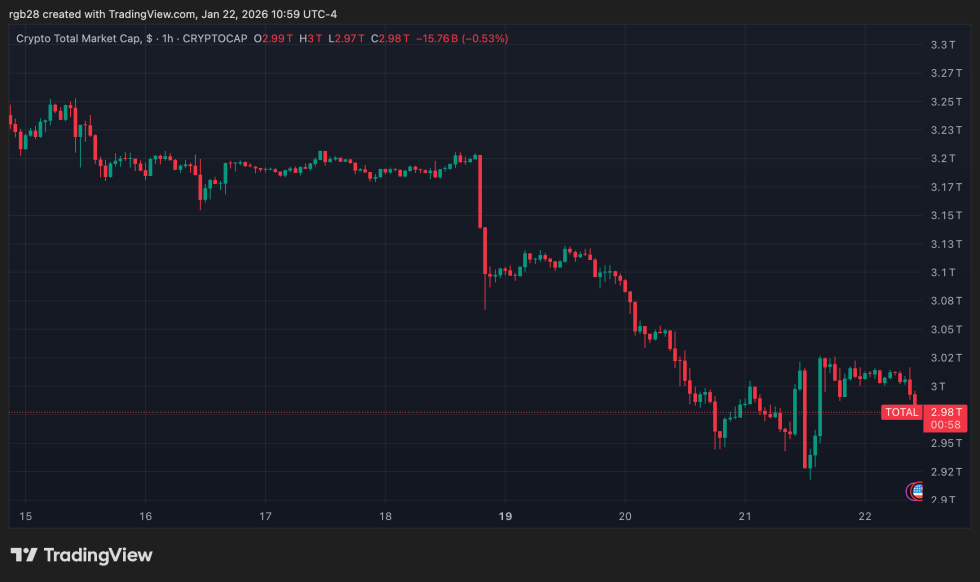
At press time, the total crypto market cap stood at $3.00 trillion.

Total crypto market cap chart

Coinbase Announces New Board Of Experts To Combat Rising Quantum Computing Risks

The crypto industry is preparing for a potential security challenge with the anticipated arrival of quantum computing. In response to this potential threat, Coinbase (COIN) has announced the formation of an advisory board composed of external experts. 

Coinbase Chief Security Officer’s Warning 

According to a report from Fortune, the newly established board includes academics from Stanford, Harvard, and the University of California, specializing in fields like computer science, cryptography, and fintech. 

Officially titled the Coinbase Independent Advisory Board on Quantum Computing and Blockchain, the group also features experts from the Ethereum Foundation, the decentralized finance (DeFi) platform EigenLayer, and Coinbase itself.

Jeff Lunglhofer, Coinbase’s Chief Information Security Officer, elaborated on the potential impact of quantum computing on current encryption methods. 

He explained that the encryption protecting wallets and private keys of Bitcoin (BTC) holders relies on complex mathematical problems that would take conventional computers thousands of years to solve. 

However, with the computational power that quantum computers promise—potentially a million times greater—these problems could be solved much more swiftly, Lunglhofer asserted.

Although the security implications of quantum computing are genuine, Lunglhofer reassured that they are not expected to become an immediate concern for at least a decade. The purpose of the new advisory board is to examine the upcoming challenges posed by quantum computing in a measured manner. 

This involves fostering initiatives within the blockchain industry that are reportedly already underway to enhance the resilience of Bitcoin and other networks against quantum attacks.

Blockchain Networks Expected To Implement Larger Keys

At present, Bitcoin secures its wallets through private keys, which consist of long strings of random characters. These keys are accessible to their owners but can only be estimated through extensive trial-and-error computations. 

The advent of quantum computing, however, would make it feasible to deduce private keys using trial-and-error methods in a fraction of the time. 

In response to this looming threat, Fortune disclosed that blockchain experts speculate that networks will implement larger keys and add “noise” to obscure their locations, making them more difficult to detect. Implementing these defensive upgrades across blockchain networks is said to take several years. 

In the meantime, the newly formed Coinbase Advisory Board is gearing up to publish research papers and issue position statements aimed at helping the cryptocurrency industry brace for the impacts of quantum computing. 

Their first paper, which will address quantum’s influence on the consensus and transaction layers of blockchain, is expected to be released within the next couple of months.

Coinbase

At the time of writing, Coinbase’s stock, which trades under the ticker symbol COIN on the Nasdaq, is trading at $225.10. This represents a slight drop of 1.2% over the last 24 hours. 

Featured image from OpenArt, chart from TradingView.com 

❌