Reading view

There are new articles available, click to refresh the page.

Ethereum Launches $2M Quantum Defense Team as Threat Timeline Accelerates

The Ethereum Foundation has officially elevated quantum resistance to a top strategic priority with the formation of a dedicated Post Quantum team backed by $2 million in funding.

The new initiative comes as blockchain networks face mounting pressure to defend against quantum computing threats that industry experts increasingly warn could materialize within years rather than decades.

Ethereum researcher Justin Drake announced the team formation on Friday, revealing that Thomas Coratger will lead the effort alongside Emile, a core contributor to leanVM.

After years of quiet R&D, EF management has officially declared PQ security a top strategic priority,” Drake said, adding that the foundation has been developing its quantum strategy since a 2019 presentation at StarkWare Sessions.

Today marks an inflection in the Ethereum Foundation's long-term quantum strategy.

We've formed a new Post Quantum (PQ) team, led by the brilliant Thomas Coratger (@tcoratger). Joining him is Emile, one of the world-class talents behind leanVM. leanVM is the cryptographic…

— Justin Drake (@drakefjustin) January 23, 2026

Foundation Commits Resources Across Multiple Fronts

The Ethereum Foundation is launching comprehensive defensive measures spanning research, development, and infrastructure testing.

Antonio Sanso will kick off bi-weekly All Core Devs Post Quantum breakout calls next month, focusing on user-facing security, including dedicated precompiles, account abstraction, and transaction signature aggregation with leanVM.

The foundation announced two $1 million prize competitions to strengthen cryptographic foundations.

The newly launched Poseidon Prize targets the hardening of the Poseidon hash function, while the existing Proximity Prize continues to drive hash-based cryptography research.

We are betting big on hash-based cryptography to enjoy the strongest and leanest cryptographic foundations,” Drake stated.

Multi-client post-quantum consensus development networks are already operational, with pioneer teams including Zeam, Ream Labs, PierTwo, Gean client, and Ethlambda working alongside established consensus clients Lighthouse, Grandine, and Prysm.

Weekly post-quantum interop calls, coordinated by Will Corcoran, are managing collaborative technical development across these diverse implementation teams.

The foundation will host a three-day expert workshop in October, bringing together top specialists from around the world, building on last year’s post-quantum workshop in Cambridge.

An additional dedicated post-quantum day is scheduled for March 29 in Cannes, ahead of EthCC, to create multiple forums for advancing research and coordination across the global Ethereum development community.

Industry Voices Split on Timeline Urgency

The quantum threat has divided blockchain leaders on both timeline predictions and strategic priorities.

Independent Ethereum educator sassal.eth called quantum computing “a very real threat for blockchains” that is “coming sooner than most people think,” praising the foundation’s defensive preparations.

Pantera Capital General Partner Franklin Bi predicted that traditional financial institutions will struggle with the transition to post-quantum cryptography.

People are over-estimating how quickly Wall Street will adapt to post-quantum cryptography,” Bi said, adding that blockchain networks possess unique capabilities for system-wide upgrades at a global scale.

The post-quantum race begins.

My prediction:

People are over-estimating how quickly Wall Street will adapt to post-quantum cryptography. Like any systemic software upgrade, it'll be slow & chaotic with single points of failure for years. Traditional systems are only as strong… https://t.co/6mEdFKcXrm

— Franklin Bi (@FranklinBi) January 23, 2026

He argued that successful quantum resistance could transform select blockchains into “post-quantum safe havens for data and assets,” particularly as traditional systems face prolonged periods of vulnerability due to single points of failure.

Bitcoin community assessments remain sharply contested. Vitalik Buterin previously shared Metaculus data showing a median 2040 timeline for quantum computers breaking modern cryptography, with roughly a 20% probability before the end of 2030.

Metaculus's median date for when quantum computers will break modern cryptography is 2040:https://t.co/Li8ni8A9Ox

Seemingly about a 20% chance it will be before end of 2030.

— vitalik.eth (@VitalikButerin) August 27, 2025

Blockstream CEO Adam Back has dismissed near-term concerns, claiming practical threats remain decades away and accusing critics of creating unnecessary market alarm.

Project ZKM contributor Stephen Duan acknowledged transition challenges while calling quantum resistance “inevitable,” noting that his team will soon upgrade multiset hashing to a lattice-based construction.

ZKsync inventor Alex Gluk also said the network’s Airbender prover is already “100% PQ-proof,” highlighting Ethereum’s unmatched ability to adapt to emerging threats while maintaining its position as the global financial settlement layer.

Foundation Plans Comprehensive Roadmap Release

The Ethereum Foundation will publish detailed strategic guidance on pq.ethereum.org covering full transition planning to achieve zero loss of funds and zero downtime over the coming years.

Drake highlighted recent artificial intelligence breakthroughs in formal proof generation, noting that specialized mathematics AI recently completed one of the hardest lemmas in hash-based SNARK foundations in a single eight-hour run costing $200.

The foundation is developing educational materials, including a six-part video series with ZKPodcast and enterprise-focused resources through EF Enterprise Acceleration.

Quantum Threatens $600B of Bitcoin 🎧🤖@nic_carter joins me for an in-person @PodcastDelphi to cover his 6 months of research on Quantum's effect on $BTC

Nic's first and only podcast on Quantum

Listen directly here, or on any of the links below pic.twitter.com/CSnv7xekqn

— Tommy (@Shaughnessy119) January 9, 2026

Ethereum now has representation on the post-quantum advisory board, Coinbase announced this week, bringing together leading cryptography researchers to assess long-term blockchain security risks as quantum computing capabilities advance across government and private-sector development programs.

The post Ethereum Launches $2M Quantum Defense Team as Threat Timeline Accelerates appeared first on Cryptonews.

Institutional-Scale Ethereum Lockup: Bitmine Crosses 1.94M ETH Staked Mark

Ethereum has slipped below the critical $3,000 level, adding fresh pressure to a market that is already showing clear signs of hesitation. After weeks of choppy price action, ETH is now entering a more fragile phase where failed recoveries are starting to shift sentiment. With sellers gaining control and bullish momentum fading, several analysts are warning that this breakdown could open the door for a deeper correction if demand does not return quickly.

The timing is important. Ethereum is moving through a pivotal zone where short-term price direction could shape the broader narrative for 2026. If ETH continues to trade below $3,000 and lower support levels fail to hold, the market may transition into a prolonged risk-off regime. On the other hand, a fast recovery back above this psychological threshold could signal that the breakdown was only a liquidity sweep, setting up a rebound toward higher resistance.

Despite a weakening price structure, on-chain activity suggests large players remain active. Market data shows that Bitmine staked another 171,264 ETH, worth roughly $503.2 million, just a few hours ago. The move adds to the firm’s growing exposure and reinforces the idea that institutional-scale actors are still positioning aggressively, even as Ethereum faces one of its most decisive moments of the year.

Bitmine Ethereum Transfers | Source: Arkham

Bitmine’s ETH Staking Signals Long-Term Conviction Despite Short-Term Weakness

According to data from Arkham, Bitmine has now staked a total of 1,943,200 ETH, worth roughly $5.71 billion, marking one of the most aggressive Ethereum accumulation and yield-positioning moves currently visible on-chain.

Staking at this scale removes a significant amount of ETH from liquid circulation, effectively shifting supply away from exchanges and into long-term validator positions. In practical terms, it suggests Bitmine is not positioning for a short-term flip, but rather treating Ethereum as a strategic asset that can generate native yield while potentially appreciating over time.

This activity stands out because it is happening while Ethereum is under pressure after losing the $3,000 level. At the moment, the market is stuck in a fragile, risk-sensitive phase, where traders are reacting quickly to breakdowns and failed recoveries. Momentum has weakened, liquidity remains thin, and analysts are increasingly warning that a deeper correction could unfold if key supports continue to fail.

However, Bitmine’s staking expansion provides a counter-signal: large players appear willing to keep committing capital even as sentiment deteriorates. That divergence highlights the current split in the market—short-term participants are defensive, while longer-term allocators are still building exposure. If price stabilizes, this kind of staking-driven supply reduction can become a structural tailwind.

Ethereum Downtrend Pressure Builds

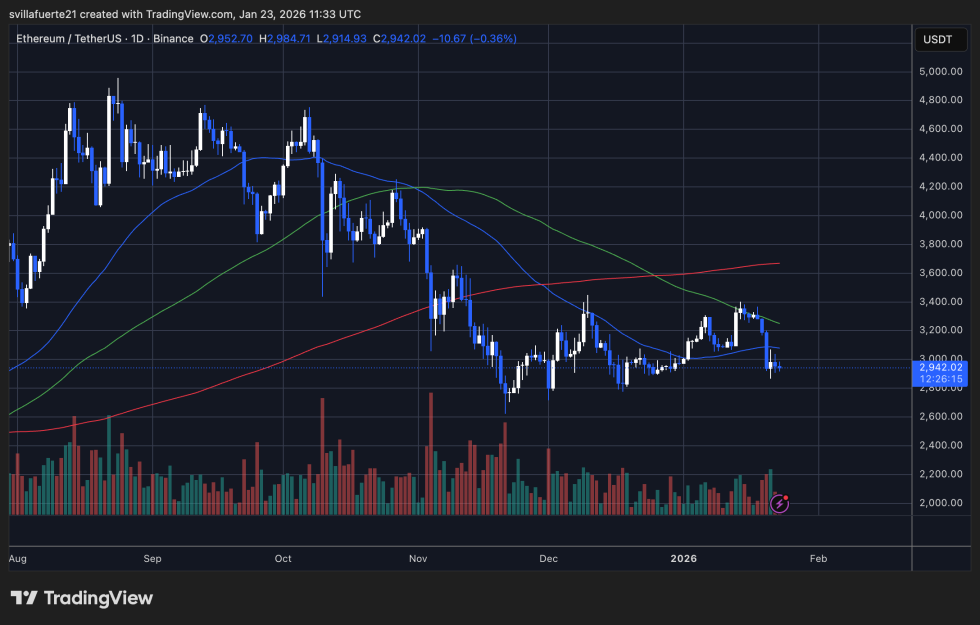
Ethereum is trading near $2,940 after losing the key $3,000 psychological level, putting the market back into a fragile position. The chart shows ETH has been trending lower since the October peak, with a clear sequence of lower highs and heavy sell-side volatility that accelerated into November. Although ETH managed to stabilize into a broad consolidation range between roughly $2,850 and $3,250, the most recent breakdown suggests buyers are struggling to defend support when momentum fades.

ETH testing key support | Source: ETHUSDT chart on TradingView

From a trend perspective, Ethereum remains capped beneath its major moving averages. Price is trading below the green long-term average and the blue mid-term average, both of which are sloping downward and acting as dynamic resistance.

The recent rebound attempt toward the $3,300–$3,400 zone failed right under the green line, reinforcing that sellers are still controlling rallies. Meanwhile, the red long-term average sits higher near the mid-$3,000s, highlighting that ETH remains far from reclaiming a macro bullish structure.

Volume has increased on the sharp red candles compared to the slower grind higher, which often signals distribution rather than healthy accumulation. If ETH cannot reclaim $3,000 quickly, downside risk opens toward the $2,850 range floor. A clean recovery back above $3,150–$3,250 would be needed to reduce bearish pressure and reset the near-term trend.

Featured image from ChatGPT, chart from TradingView.com 

Ethereum Emerges As Likely Candidate In BlackRock Tokenization Vision – Here’s Why

Recent remarks from BlackRock CEO Larry Fink have pointed toward the need for a single, unified blockchain for tokenized markets, and have intensified the focus on platforms capable of handling institutional-scale liquidity, compliance, and settlement. With its long track record in smart contracts, extensive developer ecosystem, and growing role in regulated financial products, Ethereum is now emerging as the most likely candidate to serve as the settlement layer for tokenized capital markets.

Why Asset Managers Prefer Familiar Infrastructure

In an X post, the Ethereum Daily shared a video in which BlackRock CEO Larry Fink made it clear that tokenization is necessary. Speaking at the World Economic Forum, Fink said the financial system must move rapidly toward digitization, adding that a single, common blockchain could reduce corruption and improve transparency across the global markets.

While Fink did not name a specific network, the most plausible candidate could be ETH, based on BlackRock’s own initiatives and public statements that emphasized the role of ETH in asset tokenization. The firm has consistently highlighted ETH as a core platform for its on-chain strategy. Meanwhile, BlackRock launched its BUIDL tokenized money market fund directly on ETH, a product that has already grown to over $2 billion in total value locked. “There’s no second best,” Ethereum Daily noted.

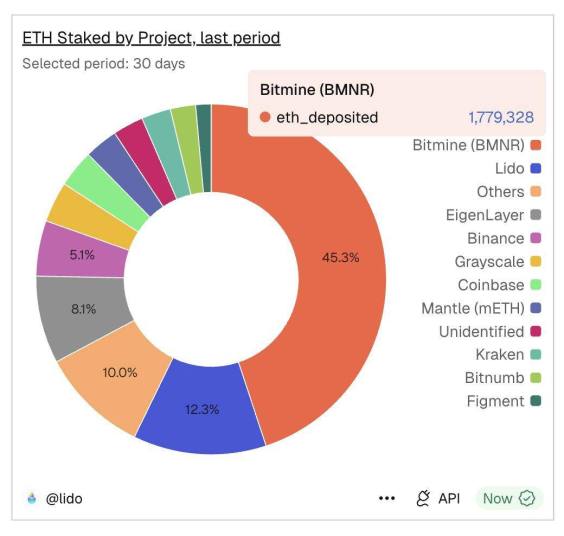
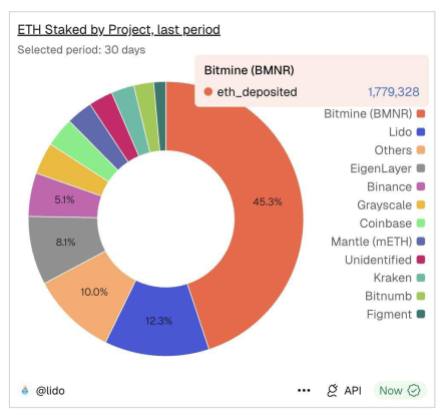
In the staking space, Bitmine has turned Ethereum staking into a multi-billion-dollar business. An analyst known as Milk Road has revealed that the company now has 1.83 million ETH staked, worth roughly $6 million at current prices, and plans to scale that figure toward 4.2 million ETH over time. Over the past months, Bitmine Immersion Technologies Inc. (BMNR) has accounted for nearly 50% of all new ETH entering the staking queue.

Ethereum

Staking at this scale is important because it removes ETH from the liquid supply and locks it into long-term infrastructure rather than keeping it for short-term trading. When one player is willing to commit billions of dollars worth of ETH to staking, it reflects confidence in ETH’s future economic prospects. A lower liquid supply, combined with sustained network demand, will create structural pressure over time.

How Support Built Through Multiple Market Cycles

Analyst Milk Road has also highlighted that Ethereum is holding near a critical support zone around $3,000, hovering just above the lower boundary of its long-term rising structure, an area that has acted as a stress test for ETH throughout the cycle. Historically, when ETH drifts into this area, the market will need to decide whether the weakness is temporary or structural.

The $2,750 level remains the key line because it has repeatedly stopped downside pressure after macro-driven or narrative-driven pullbacks, making it a reliable floor for the broader trend. As long as ETH holds above that level, the broader multi-year uptrend will remain intact.

Ethereum

Ethereum Funding Rates Pushing Towards Negative: What’s Going On?

Ethereum is currently trading under pressure after failing to push above the $3,000 level again over the past 24 hours, a move that is reflecting trader sentiment across the derivatives markets. ETH is currently trading at $2,925, down 2.7% on the day, after moving within a 24-hour range capped at $3,012.99 and finding lows around $2,909.60, according to price data from CoinGecko. 

As price action weakens, a notable change has been developing, with on-chain data showing funding rates drifting toward negative territory and derivative positioning beginning to tilt more defensively.

Funding Rates Slide As Shorts Gain Ground

Ethereum’s failure to hold above $3,000 is an important psychological break for traders, especially after several failed attempts to hold above that level in January. Price action over the past week shows sellers maintaining control after ETH rejected around $3,360 on January 18, followed by a steady push lower toward the high-$2,900s. 

Although the pullback has so far been orderly above $2,900, this decline has come alongside fading momentum across the derivatives market.

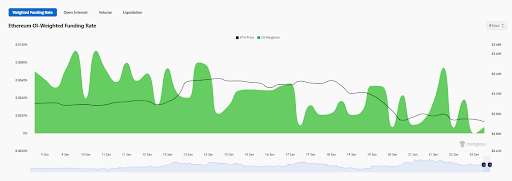
One of the clearest signals for this can be seen in Ethereum’s OI-weighted funding rate, which has been steadily compressing and is now edging toward negative levels. At the time of writing, Ethereum’s OI-weighted is at 0.0008%, close to breaking into negative territory and far below readings around 0.009%, which it registered earlier in the month.

Ethereum

Funding rates turning negative typically indicate that short positions are paying longs, meaning stronger demand for downside exposure. Funding spikes that previously accompanied the price rebound in early January have faded, and the overall trend suggests bearish positioning is slowly gaining the upper hand.

Open Interest, Liquidations, And What’s Next

Although Ethereum’s price action fell below $3,000, derivatives traders have stayed in the market, keeping total open interest at high levels. Data from CoinGlass shows aggregate Ethereum open interest increasing by 0.68% in the past 24 hours, which shows that many traders are not exiting Ethereum entirely. At the time of writing, the total open interest is sitting at about 13.36 million ETH, equivalent to roughly $39.19 billion.

Looking across major exchanges, Binance has the largest share of ETH open interest, accounting for about $8.95 billion, but it is down by 0.8% in the past 24 hours. CME follows with approximately $5.73 billion in open interest, up by 3.72% in the past 24 hours. Gate comes next at around $4.01 billion, while MEXC comes in close at $3.51 billion worth of ETH open interest.

Over the past 24 hours, Ethereum liquidations totaled $64.34 million, with long positions ($52.52 million) accounting for the majority of losses.

A hold above $2,900 could allow Ethereum’s funding rates to normalize and open the door for another rebound attempt to $3,000. However, a continued fall in funding rates into negative territory could see bearish control pushing Ethereum below $2,900.

Ethereum

Here’s How Ethereum Staking Transforms Into A Multi-Billion-Dollar Bet For Bitmine Immersion

Over the years, Ethereum staking has become one of the most vital and successful aspects of the broader ETH ecosystem, with big companies steadily jumping into the field. The majority of these companies, especially Bitmine Immersion, are revolutionizing ETH staking, turning it into a massive financial sector and edge.

Bitmine Monetized Ethereum Staking At Scale

After the entry of institutional investors, Ethereum staking has been transformed into a significant business opportunity from a technical requirement. At the forefront of this evolution is Bitmine Immersion Technologies Inc. (BMNR), a leading digital asset platform dedicated to improving the ETH ecosystem.

With its remarkable involvement in ETH staking, Bitmine Immersion is proving just how large this opportunity can be. The digital asset platform has successfully transformed Ethereum staking into a multi-billion-dollar enterprise by growing its validator operations and staking infrastructure.

As outlined by Milk Road on the social media platform X, the company intends to increase its present investment of 1.83 million ETH, valued at approximately $6 billion at current rates, to 4.2 million ETH. Bitmine’s plan and robust participation in ETH staking are a clear sign of the growing institutional appetite for on-chain yield.

Ethereum

This expansion demonstrates how staking is now about creating profitable, long-lasting businesses around ETH’s proof-of-stake economy rather than just protecting the network. Over the past month, Bitmine has been responsible for almost half of all new ETH entering the staking queue. 

Milk Road stated that staking at this scale removes Ethereum from the liquid supply and locks it away in long-term infrastructure rather than short-term trading. When a single player expresses a willingness to commit billions of dollars’ worth of ETH to staking, it points to an increased confidence in ETH’s future economics.

According to the expert, structural pressure is created by a reduced liquid supply and ongoing network demand over time. Given the sustained growth in institutional staking, Milk Road is confident that ETH’s price will move higher in the foreseeable future.

ETH Powering Crypto Native Financial Rails

With crypto native financial rails expanding, Ethereum is increasingly being positioned as the core infrastructure for major financial firms. JP Morgan asset management firm has confirmed this narrative with its latest fund launched on the ETH network.

Milk Road has reported that JP Morgan has introduced a tokenized money market fund on ETH, which is now live and already holds over $100 million in US treasuries. The rails are native to cryptocurrency, and the product appears to be traditional finance.

In reality, there is no separation, and there is only a financial product operating on the trains that make the most sense. Interestingly, this is how institutions move into new systems. “Incrementally, and only after the rules are clear enough to deploy real capital. Once they are live, they don’t leave,” Milk Road stated.

Ethereum

Ethereum Founder Vitalik Buterin Ditches Big Tech: His 2026 “Self-Sovereign” Stack Reveals Surprising Changes

Ethereum cofounder Vitalik Buterin has outlined a personal shift away from Big Tech platforms, framing 2026 as a pivotal year for what he calls “computing self-sovereignty.”

This is a concept that extends beyond blockchain and into how individuals use everyday software, communication tools, and artificial intelligence.

2026 is the year we take back lost ground in computing self-sovereignty.

But this applies far beyond the blockchain world.

In 2025, I made two major changes to the software I use:

* Switched almost fully to https://t.co/caFP0K5fYF (open source encrypted decentralized docs)
*…

— vitalik.eth (@VitalikButerin) January 22, 2026

In a post shared on X, Buterin described a series of changes he has made across his devices to reduce reliance on centralized, data-intensive services.

Vitalik Buterin Replaces Google, Telegram With Privacy-Focused Alternatives

He claimed that the process started in 2025 when he transferred nearly completely to the open-source and encrypted and decentralized document platform Fileverse, which is purported to be a privacy-focused alternative to Google Docs.

At roughly the same period, he reported having changed to Signal as his main messaging application, abandoning Telegram.

Signal supports end-to-end encryption on all conversations by default and only retains a little metadata, whereas Telegram encrypts messages only in optional so-called secret chats.

He further stated that it otherwise stores messages and metadata on its servers, a design that has attracted increased attention due to an increase in law enforcement requests in some jurisdictions.

🔒 Telegram CEO Pavel @Durov has issued a statement reaffirming the platform’s commitment to user privacy.#privacy #telegramhttps://t.co/ZPIeUno9K1

— Cryptonews.com (@cryptonews) April 21, 2025

The changes made in 2026 included more extensive ones, which were due to those initial adjustments.

Buterin claimed to have substituted Google Maps with OpenStreetMap, with Organic Maps on mobile phones, citing the advantage of local and offline use that restricted the volume of location data sent to third parties.

He also left Gmail for Proton Mail, citing encrypted messaging as a more powerful tool to use for confidential communication.

Simultaneously, he claimed to have started giving priority to decentralized social media and still tests the idea of running large language models locally, as opposed to using cloud-based AI services.

Buterin Sees Local AI as the Future of User Privacy

The rationale of these decisions is not purity in ideology but practicality, as Buterin wrote.

According to him, it is not necessary to send big amounts of personal information to centralized services, as there are tools that can be used to minimize this exposure.

He admitted that local AI systems still have usability and integration issues, especially for translation, transcription, and document search, but noted that there has been a lot of improvement in the last year.

He explained a more ambitious long-term vision where local models are integrated with cryptographic schemes like zero-knowledge proofs, trusted execution environments, and local data filtering to restrict the information that ever leaves a user’s device.

Rising AI Demand Puts Self-Sovereign Computing Back on the Map

The remarks made by Butterin come amidst the wider revival of interest in self-sovereign computing, which is a model that highlights the importance of individualized controls of data, identity, and computing resources.

The idea integrates identity systems based on decentralization, personal servers, and privacy-by-design software with the aim of minimizing reliance on platforms that are controlled by corporations.

Privacy activists, including Naomi Brockwell, have long held the position that the most consistent approach to ensuring autonomy is to run software and AI models in place.

The most private way to use AI is to host it locally, but you're limited by your own hardware. There are AI platforms that allow you to access more powerful models & also respect your privacy. Planning to update this video soon to include newcomers like https://t.co/ueOskOEx0g. pic.twitter.com/WlB6PUxlpA

— Naomi Brockwell priv/acc (@naomibrockwell) January 19, 2026

The time also stands out due to the re-evaluation of the strategic value of computing infrastructure by governments and corporations.

Analysts believe that 2026 will be the year of a change in the treatment of AI data centers, energy-backed compute and GPU capacity.

👀 Governments are expected to start treating AI data centers and energy-backed computing power as strategic infrastructure in 2026, similar to how oil reserves are managed.#AI #Energy #TokenizedDollars #Cryptohttps://t.co/DUYrsqn7iI

— Cryptonews.com (@cryptonews) January 13, 2026

With the demand of large-scale AI continuing to outpace its supply, compute and energy are becoming viewed as a source of geopolitical power.

In that environment, the appeal of local and decentralized computing models has grown, particularly as concerns mount over surveillance, data residency, and platform dependence.

The post Ethereum Founder Vitalik Buterin Ditches Big Tech: His 2026 “Self-Sovereign” Stack Reveals Surprising Changes appeared first on Cryptonews.

Ethereum Whales’s $15 Million Move, Is This Another Insider Trader?

An inactive Ethereum whale has just re-entered the trading scene, withdrawing over $15 million worth of ETH in just a single day. Considering Ethereum’s slow price growth over the past few months and the whale’s sudden appearance despite being dormant for months, there could be a possibility of insider trading.

Dormant Ethereum Whale Moves $15 Million ETH

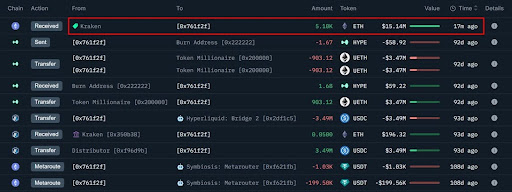
A sudden $15.14 million Ethereum transaction has caught the crypto market’s attention, with the move either driven by insider knowledge or simple strategic positioning. According to data from blockchain analytics platform, Onchain Lens, the transfer shifted approximately 5,099 ETH from a dormant wallet address on Kraken into active circulation on Thursday, January 22. 

Based on on-chain records, the whale, identified by the address ‘0x761F2F,’ has remained inactive in the market for more than three months. The last few times the whale was actively moving in the market were when it executed a series of stablecoin and HYPE transactions. The anonymous whale had initiated multiple million-dollar trades in UETH, USDT, and USDC. Meanwhile, the HYPE transactions were primarily token burns. 

Ethereum 1

After withdrawing 5,099 ETH from Kraken, Arkham Intelligence reported that the whale had transferred the ETH to Lido Finance, converting it into 5,100 STETH. While there is currently no evidence of insider trading, the timing of the transaction raises questions, especially given Ethereum’s muted price action over the past few months and the mounting selling pressure from large scale holders

Typically, insider trading in crypto occurs when individuals with non-public information make large transactions ahead of major market events that could influence market price. Currently, there has been no spike in Ethereum’s price, nor any major news that could suddenly affect its movements. In fact, ETH continues to trade lower, down by roughly 1.7% over the past 24 hours. Its daily trading volume is also down by 34.89%, signaling reduced confidence among traders and investors. 

Whales Go Long On Ethereum

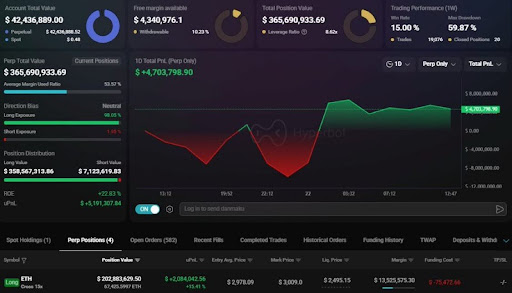
While dormant large-scale players are suddenly re-entering the market, some active whales remain bullish on Ethereum’s long-term prospects despite its ongoing downtrend. According to well-known market analyst Max Crypto, an anonymous whale has just opened a $202 million long position in ETH with 15x leverage. 

The scale of the trade is extraordinary considering Ethereum’s recent volatility. It shows strong confidence in the cryptocurrency’s future price action and its potential to overcome its ongoing downtrend. Notably, the position has a liquidation price of $2,495, meaning that if ETH falls to that level, the trade could be forcibly closed by the crypto exchange, resulting in substantial losses for the whale. 

Ethereum 2

Market participants are closely watching the whales’ positioning, with some calling it a brave but chaotic bet. Others have even speculated that the position may have been taken based on insider information, fueling discussions about potential market moves and a possible bullish turnaround for ETH.

Ethereum price chart from Tradingview.com

Expert Analyzes XRP, Ethereum, And Solana: Predictions For The Next Altcoin Season

As the crypto market faces uncertainty and continues in a consolidation phase, market expert Sam Daodu has issued a report examining the potential for XRP, Ethereum (ETH), and Solana (SOL) to emerge as frontrunners if a new altcoin season arises in 2026. 

XRP, ETH, And SOL Price Forecasts

Daodu began his analysis by pointing out that Bitcoin’s (BTC) dominance is currently hovering around 59%, alongside an Altcoin Season Index reading of 55. These indicators suggest that 2026 could herald a substantial rotation towards altcoins, mirroring significant shifts experienced during cycles in 2016-2017 and 2020-2021.

The expert outlines several bullish scenarios for each. For XRP, he envisions a potential surge past the $6-$8 range if exchange-traded fund (ETF) inflows maintain a monthly average exceeding $400 million and RippleNet continues to expand its influence in global banking. 

ETH, on the other hand, could see itself climbing toward $12,000-$18,000 if Layer 2 (L2) adoption unlocks broader usage and ETF inflows rebound. 

Daodu highlights that active addresses are at cycle highs, indicating organic demand that may translate to higher prices once institutional sentiment shifts positively.

For SOL, the outlook is similarly optimistic. Solana might rocket to the range of $500-$800 if its transaction finality of 150 milliseconds and low fees attract a new wave of applications. Additionally, the rise in ETF filings could lead to significant capital inflows.

Potential Risks Ahead 

In more stable scenarios, Daodu suggests that XRP might consolidate between $2.50-$3.50 if institutional adoption progresses steadily without dramatic catalysts. 

He also speculates that Ethereum could trade within the range of $5,000-$9,000, benefiting from consistent demand driven by staking yields and decentralized finance (DeFi) growth.

Meanwhile, Solana might trend between $200-$350, assuming that developer growth and retail adoption continue at their current pace without major breakthroughs. 

However, Daodu cautions that XRP could fall below $1.50 if demand for ETFs wanes or if regulatory uncertainties arise. Similarly, ETH could fall below $2,500 if scalability issues arise or if regulatory challenges become more pronounced. SOL could drop below $100 if outages persist or if it faces increased competition from other Layer 1 platforms.

What AI Models Anticipate

AI predictions provide additional insight into the expected performance of these altcoins. For XRP, forecasts vary significantly, with ChatGPT estimating a range of $0.80-$3.00, while Grok presents a more bullish outlook with a target of $1.50-$6.00. 

Ethereum’s AI predictions show a range of $3,000-$9,000 from ChatGPT, while Gemini anticipates a high of $7,000-$18,000 through increased tokenization. 

Lastly, Solana’s predictions range from $120-$350 from ChatGPT to a more optimistic $300-$800 from Gemini, depending on the growth of consumer applications.

XRP

XRP was trading at $1.93 at the time of writing, down 2% in the previous 24 hours. ETH traded at roughly $2,952, while SOL traded at $128, both experiencing comparable declines during the same time period. 

Featured image from DALL-E, chart from TradingView.com  

Ethereum Approaches A “Never Broken” Support Line: Accumulators Step In

Ethereum is once again under pressure as it struggles to regain solid ground around the $3,000 level, reflecting a broader wave of uncertainty across the crypto market. With sentiment turning increasingly fragile, many altcoins remain stuck in corrective mode, and bulls are now forced to defend key support zones to prevent deeper downside. In this environment, Ethereum’s ability to push higher is becoming a critical signal for whether the market can stabilize or if the current bearish trend will extend.

Despite the weakness, on-chain data suggests that ETH may be nearing an important turning point. According to CryptoQuant, Ethereum is approaching a major support line that has historically acted as a strong floor during periods of heavy volatility.

The report highlights that the realized price of Ethereum accumulation addresses continues to climb and is now approaching the current market price, indicating that long-term accumulation remains active even as short-term traders hesitate.

This dynamic matters because accumulation-based cost levels often represent zones where large investors defend their positions aggressively. If ETH holds above this rising support range, the market may be setting the foundation for a broader recovery.

Ethereum Whale Cost Basis Signals a Potential Bottom Zone

CryptoQuant’s report suggests Ethereum may be approaching one of its most important structural support zones, anchored by the realized price of accumulation addresses. This metric tracks the average on-chain cost basis of entities that consistently accumulate ETH, and it often behaves as a “defense line” for whales who build long-term positions.

According to the analysis, this realized price level has historically acted as a reliable floor, with Ethereum never breaking below this range during prior drawdowns, even when broader market conditions turned sharply risk-off.

That historical behavior matters because it implies that accumulation whales tend to protect their cost basis aggressively, either by adding exposure near support or by reducing sell pressure when the price approaches their entry zone. In practice, this can limit downside momentum and create a stabilization area where volatility compresses before the next trend decision.

Ethereum Realized Price For Accumulation Addresses | Source: CryptoQuant

Based on the current trajectory, the report argues that even if ETH sees another leg down, the most probable “bottom zone” sits near $2,720. From current levels, that would represent an additional pullback of roughly 7%, keeping the move within a controlled correction rather than a full breakdown. If buyers defend this area, Ethereum could begin rebuilding a base for a renewed push back above $3,000.

ETH Price Slips Back Toward $3,000 As Bulls Struggle To Reclaim Control

Ethereum (ETH) continues to trade under heavy pressure as price struggles to stabilize around the $3,000 zone. The chart shows ETH printing another sharp rejection after failing to hold the recent rebound, reinforcing that the market remains in a corrective phase rather than a clean recovery. Even though buyers are attempting to defend current levels, momentum still looks weak, with each bounce being met by renewed selling.

ETH consolidates in a pivotal demand level | Source: ETHUSDT chart on TradingView

From a technical perspective, ETH is trading below its key moving averages, which highlights how resistance continues to stack above the price. The broader structure suggests a downtrend that is transitioning into consolidation, but without a confirmed breakout, the risk remains tilted to the downside.

The recent push toward the mid-$3,200 region failed to flip that zone into support, and the pullback toward $2,980 signals that bulls are still struggling to build sustainable demand.

Volume remains relatively muted compared to the larger selloffs seen earlier in the cycle, which supports the idea that this is a grinding distribution phase rather than full panic capitulation. For a bullish shift, ETH needs to reclaim $3,200–$3,300 and hold above it. Until then, the $2,900–$3,000 area remains the key line of defense.

Featured image from ChatGPT, chart from TradingView.com 

Vitalik Buterin Proposes Fix to Ethereum Staking — No More Single-Node Risk

Vitalik Buterin, the co-founder of Ethereum, has suggested the fundamental alteration to the staking system in the network to eliminate the dependency on one validator node.

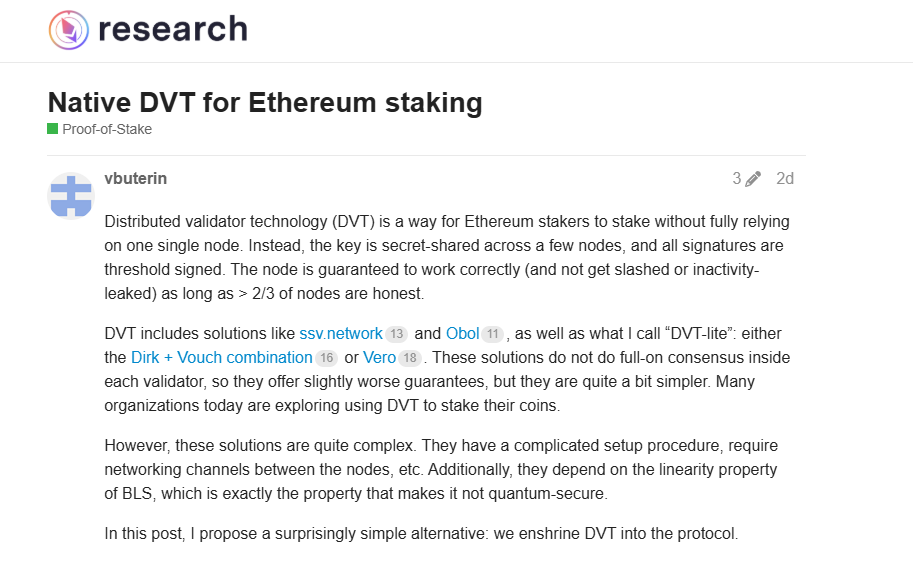
In a detailed post published Wednesday on the Ethereum Research forum, Buterin introduced the idea of “native distributed validator technology,” or native DVT.

Source: ethresear.ch

The idea would allow stakers to split validator responsibilities across multiple nodes directly at the protocol level rather than relying on complex external setups.

Ethereum’s Staking Boom Brings New Security Questions

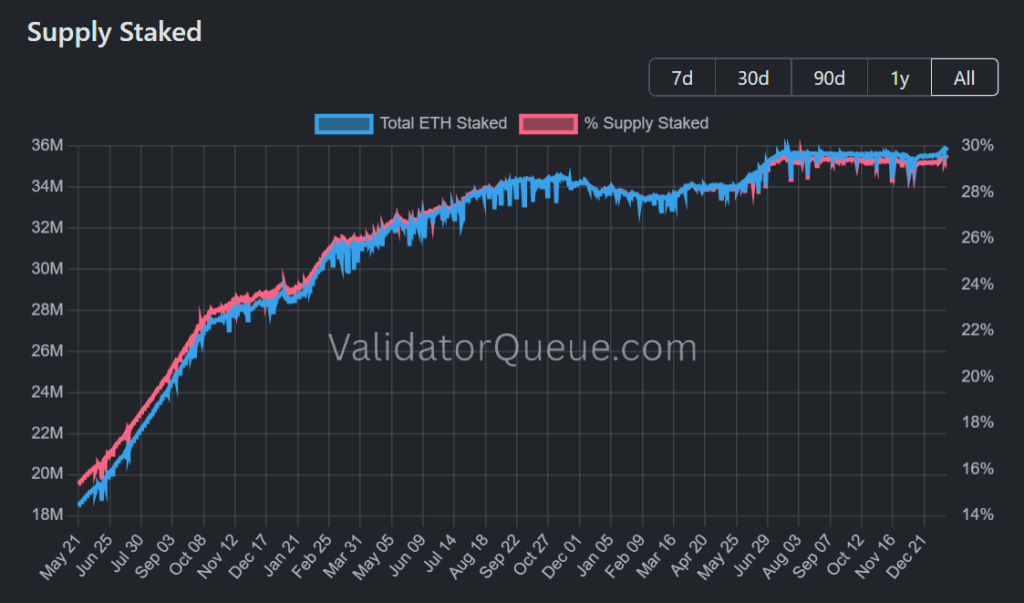
The proposal comes as Ethereum staking reaches record scale with more than 36 million ETH now staked across nearly one million validators, with the total value of staked assets exceeding $118 billion.

Source: ValidatorQueue.

While this growth has reinforced Ethereum’s security, it has also amplified long-standing concerns around centralization, operational risk, and the technical barriers faced by solo stakers.

For much of Ethereum’s proof-of-stake history, running a validator meant placing 32 ETH behind a single machine and a single private key.

Any failure, from a power outage to a software bug or security breach, could result in inactivity penalties or slashing.

These risks pushed many users toward large staking providers and liquid staking platforms, concentrating control of consensus among a relatively small group of operators and cloud providers.

Buterin’s proposal directly targets that single-node risk, as under the proposed native DVT, a validator with a larger balance would be allowed to register multiple keys, up to a maximum of 16, and define a threshold for signing duties.

Validator actions, such as block proposals or attestations, would only be considered valid if a minimum number of those keys signed off together.

As long as more than two-thirds of the nodes behave honestly, the validator would continue operating normally without penalties.

Buterin’s Native DVT Idea Targets Easier, Safer ETH Staking

Unlike existing DVT solutions such as Obol or ssv.network, which rely on external tooling, networking layers, and the linear properties of BLS signatures, Buterin’s design would be embedded directly into Ethereum’s consensus rules.

He argued this would dramatically simplify staking operations, reduce setup complexity, and remove dependencies that may not be compatible with future cryptographic upgrades.

🚀 @VitalikButerin unveils "The Splurge," a bold plan to prepare Ethereum for a quantum future!#Ethereum #QuantumComputinghttps://t.co/vvRijeahpS

— Cryptonews.com (@cryptonews) October 29, 2024

From a user perspective, Buterin described the experience as running multiple standard validator nodes with minimal configuration changes.

Most of the added complexity would be limited to block production, where one node would act as a temporary leader and others would co-sign its output.

The proposal is explicitly aimed at medium- to large-sized ETH holders, including institutions and individual “whales,” who currently face a choice between running fragile single-node setups or outsourcing control to staking providers.

By making multi-node staking simpler, Buterin said native DVT could increase client diversity, improve measurable decentralization metrics, and encourage more self-custodial staking.

Ethereum Developers Debate Practical Challenges of the DVT model

The discussion quickly drew technical feedback from the community.

Ethereum developer Alonmuroch raised questions around coordination during block production, the possibility of multiple proposers racing to collect signatures, and the need for protocol-level key rotation to handle compromised keys without forcing validators to exit and re-stake.

Buterin largely agreed, noting that instant key changes should be feasible and that reducing operational headaches is central to the proposal’s motivation.

The proposal also fits into a broader shift in Buterin’s recent public messaging.

Earlier this month, he declared 2026 the year Ethereum would reclaim lost ground on self-sovereignty and trustlessness, calling for fewer compromises in favor of convenience.

Days later, he warned that Ethereum risks becoming an “unwieldy mess” if developers continue layering complexity onto the protocol without deliberate simplification.

The post Vitalik Buterin Proposes Fix to Ethereum Staking — No More Single-Node Risk appeared first on Cryptonews.

Is It Ethereum? BlackRock CEO Wants ‘One Blockchain’ For Tokenization

BlackRock CEO Larry Fink used the World Economic Forum stage to argue that tokenization needs to move from pilot programs to market plumbing and suggested that a shared blockchain standard could cut costs and even “reduce corruption,” a framing that immediately reignited the “which chain?” debate across crypto and specifically inside the Ethereum community.

Fink didn’t name a network. But the combination of BlackRock’s onchain product footprint and its own research positioning makes Ethereum the most natural candidate for the “one common blockchain” he alluded to, even if he kept it implicit.

Fink’s remarks, delivered in the language of infrastructure rather than crypto evangelism, leaned heavily on the operational case for digitized assets and interoperable settlement rails.

“I think the movement towards tokenization, decimalization is necessary. It’s ironic that we see two emerging countries leading the world in the tokenization and digitization of their currency, that’s Brazil and India. I think we need to move very rapidly to doing that.”

He then pushed the argument beyond payments and into capital markets: “We would be reducing fees, we would do more democratization by reducing more fees if we had all investments on a tokenized platform that can move from a tokenized money market fund to equities and bonds and back and forth.”

The most provocative line was his call for standardization and the trade-off he implied comes with it. “[If] we have one common blockchain, we could reduce corruption. So I would argue that, yes, we have more dependencies on maybe one blockchain, which we could all talk about, but that being said, the activities are probably processed and more secure than ever before.”

BlackRock CEO Larry Fink told the World Economic Forum he thinks the movement toward tokenization and digitization is necessary. We need to move very rapidly to doing that. With one common blockchain, we can reduce corruption.

The “one common blockchain” Larry Fink referenced… https://t.co/sMMcg4oyN1 pic.twitter.com/VhRvuwCx00

— Ethereum Daily (@ETH_Daily) January 22, 2026

Why Ethereum Is Coming Up

In the abstract, “one common blockchain” could be read as a generic appeal for shared rails. In practice, BlackRock’s public-market crypto lineup and its tokenization work have concentrated around Bitcoin and Ethereum.

On the ETF side, BlackRock’s flagship US spot products track bitcoin and ether — iShares Bitcoin Trust (IBIT) and iShares Ethereum Trust (ETHA) — with ETHA launching in 2024 and now sitting in the center of the firm’s public-facing Ethereum exposure.

On the tokenization side, BlackRock’s first tokenized fund, the BlackRock USD Institutional Digital Liquidity Fund (BUIDL), debuted on Ethereum via Securitize in March 2024, making Ethereum the original issuance network for what has become one of the market’s most closely watched institutional RWAs.

While BUIDL has expanded across multiple networks over time, the key point for Fink’s “common blockchain” framing is that Ethereum has been BlackRock’s default starting point for public-chain issuance, a meaningful signal in a market where “standards” tend to follow whoever already has the deepest liquidity, the broadest integration surface, and the most conservative counterparties.

The stronger tell came this week from BlackRock research rather than Davos soundbites. In its 2026 thematic outlook, BlackRock explicitly floats the idea of Ethereum as the infrastructure layer that collects the “toll” as tokenization scales. One slide asks: “Could Ethereum represent the ‘toll road’ to tokenization?” and adds that stablecoin adoption may be an early proxy for tokenization “in action,” with “blockchains like Ethereum” positioned to benefit.

In the same section, BlackRock cites RWA data “as of 1/5/2026” and notes that “of tokenized assets 65%+ are on Ethereum,” underscoring the network’s lead in today’s tokenized-asset stack.

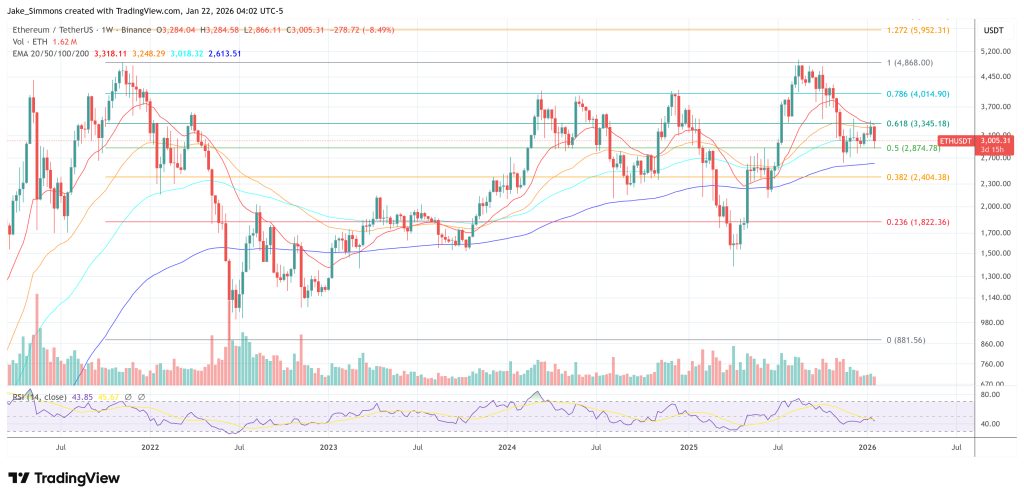
At press time, ETH traded at $3,005.

Ethereum price chart

Uniswap brings token launch auctions and price discovery to Base

  • CCA runs fully on-chain auctions that clear bids block by block for gradual price discovery.
  • After auctions end, liquidity is automatically added to a Uniswap v4 pool at the final cleared price.
  • The model aims to reduce sniping, front-running, and bundled transactions during token launches.

Uniswap has rolled out its Continuous Clearing Auctions (CCA) feature on Base, giving developers a new way to launch tokens fully on-chain with built-in price discovery and automatic liquidity setup.

The decentralised exchange confirmed the rollout on Jan. 22, with the CCA framework now available to builders using Uniswap v4 on the Base network.

The update expands Uniswap’s structured token launch tools to one of the busiest Ethereum layer-2 ecosystems, offering teams a single workflow for auctions, pricing, and liquidity.

With CCA now live for Base developers, projects can run token sales that settle gradually over time rather than relying on one-time listings or fixed-price launches that can trigger sharp price swings.

What CCA does on Base

CCA allows teams to run fully on-chain token auctions where tokens are sold gradually instead of all at once.

The mechanism clears bids block by block, which helps prices form naturally before open trading begins.

Once the auction ends, liquidity is added automatically to a Uniswap v4 pool at the final cleared price.

This reduces the need for teams to manually create a pool after launch and aims to avoid common listing issues linked to sudden volatility at the start of trading.

Developers can also adjust auction settings to fit their launch requirements while keeping the entire process on-chain and transparent.

How auctions reduce launch risks

The model is designed to create a fairer starting point for new tokens by spreading distribution over time.

Rather than concentrating activity into a single launch moment, CCA introduces a phased selling process that can lower the impact of sniping, front-running, and bundled transactions.

By clearing bids over multiple blocks, the auction format supports more gradual price discovery.

This can help reduce sharp dislocations that often happen when tokens go live with limited liquidity or when early trading activity is dominated by automated strategies.

For teams, this approach bundles the early steps of a token launch into one on-chain flow, covering auction mechanics, pricing formation, and liquidity provisioning without requiring separate manual actions.

Open access for all Base developers

Uniswap’s deployment on Base is open to all developers building on the network. The feature does not require approvals or special access, meaning any team can integrate CCA into its token launch process.

This open availability may appeal to projects looking for alternatives to private sales or unstable fair-launch formats.

It also supports teams that want a more standardised on-chain approach to distributing tokens while setting up liquidity in a predictable way once the auction completes.

With CCA, teams can rely on the auction’s final cleared price to determine the pool setup, rather than selecting an initial listing price independently.

Uniswap’s wider v4 expansion

The Base rollout follows Uniswap’s broader expansion of v4 tools across multiple chains in recent months.

CCA was rolled out in late 2025 and has already been used by projects such as Aztec Network for early price discovery and liquidity setup.

Uniswap has also been integrating with partners such as Revolut for fiat access and Ledger for safe swaps via its trading API.

Separately, the protocol has gone live on networks including Monad and X Layer.

By bringing CCA to Base, Uniswap is extending structured launch infrastructure into a major Ethereum layer-2 environment, while continuing to expand its product suite and chain support across decentralised finance.

The post Uniswap brings token launch auctions and price discovery to Base appeared first on CoinJournal.

Layer-1 Protocol Saga Temporarily Shuts SagaEVM Chain After $7M Exploit

Layer-1 network Saga paused its SagaEVM chain after an exploit that moved nearly $7m in tokens to Ethereum, as the team works through an ongoing investigation.

Saga said it stopped the chain at block height 6593800 after identifying a security incident on Jan. 21, and it has kept the network paused “out of an abundance of caution” while it validates the full impact and patches the weakness and reinforces the system.

“We recognize that a pause is disruptive. We made this decision because the safety of our community comes first,” the team said Wednesday in its blog. “Once remediation is complete, we will publish a more comprehensive technical post-mortem.”

SagaEVM remains paused while we finalize the results of our investigation into the Jan 21 exploit.

We’re working with partners on remediation and will publish a post-mortem once findings are fully validated. $7M of USDC was bridged out and converted to ETH.

Extracted funds were…

— Saga ⛋ (@Sagaxyz__) January 22, 2026

Saga Identifies Wallet Linked To $7M Exploit

In its investigation update, Saga said nearly $7M in USDC, yUSD, ETH, and tBTC were transferred to the Ethereum Mainnet, and it identified the wallet it was extracted to.

The team said it is coordinating with exchanges and bridge operators to blacklist the attacker’s address and support recovery efforts, while it continues forensic analysis using archive data and execution traces.

Saga described the attack as a coordinated sequence involving contract deployments and cross-chain activity that ended in rapid liquidity withdrawals.

Chainalysis Estimates $3.4B In Crypto Theft In 2025

Reports on the incident also said the attacker bridged assets to Ethereum and converted proceeds into ETH via swaps.

Saga said the incident affected the SagaEVM chainlet along with Colt and Mustang, but it did not affect the Saga SSC mainnet, the protocol’s consensus, validator security, or other Saga chainlets. It also said it found no evidence of validator compromise, signer key leakage, or consensus failure.

The breach lands as crypto security remains under pressure. Chainalysis estimated the industry saw over $3.4B in theft in 2025, and pointed to large, concentrated hacks as a key driver of losses.

The post Layer-1 Protocol Saga Temporarily Shuts SagaEVM Chain After $7M Exploit appeared first on Cryptonews.

Ethereum Supply Tightens On Binance As Reserves Hit Lowest Level Since 2016

Ethereum has slipped below the $3,000 level again as selling pressure returns across the broader crypto market, keeping bulls on the defensive after a brief recovery attempt. The move back under this psychological zone suggests that traders remain cautious, with downside volatility re-emerging as risk appetite fades and liquidity thins near key support levels.

However, while price action looks heavy in the short term, on-chain data is flashing a different signal beneath the surface. According to Arab Chain, Ethereum reserves held across centralized exchanges have dropped to around 16.2 million ETH, marking their lowest level since 2016. That milestone matters because it highlights a steady, long-duration trend of withdrawals rather than a sudden one-off event.

In practical terms, fewer coins sitting on exchanges typically means less immediate supply available for spot selling, especially during periods of market stress. This behavior can reflect a shift away from short-term trading and toward longer-term holding, self-custody, or deployment in DeFi.

Ethereum remains vulnerable as price struggles below $3,000. Still, the persistent reserve decline suggests that supply conditions may be tightening in the background, setting the stage for a sharper reaction if demand returns.

Binance Reserves Keep Falling

The CryptoQuant analysis also points to a similar reserve drawdown on Binance, reinforcing the broader exchange supply contraction narrative. Since the beginning of 2026, Binance’s Ethereum reserves have dropped from roughly 4.168 million ETH to around 4.0 million ETH, signaling steady withdrawals even as the price remains under pressure. This matters because Binance is often the main liquidity hub for ETH spot and derivatives, so shifts in its reserve balance can reflect real changes in market positioning.

Ethereum Exchange Reserve Binance | Source: CryptoQuant

What stands out is that this decline is happening without a meaningful rebound in inflows. In other words, ETH is not rotating back onto exchanges aggressively, suggesting sellers are not rushing to increase liquid supply at current levels. That dynamic typically aligns with a market where investors prefer holding behavior over active distribution. Either moving ETH to cold storage or deploying it across DeFi.

While reserves falling does not guarantee an immediate rally, it can change the supply-demand equation over time. With fewer coins sitting on exchanges, the market becomes more reactive if demand returns suddenly, as there is less readily available ETH to absorb buy pressure.

If Ethereum manages to reclaim key resistance levels, this supply tightening could amplify upside follow-through.

Ethereum Loses $3,000 as Bears Regain Control

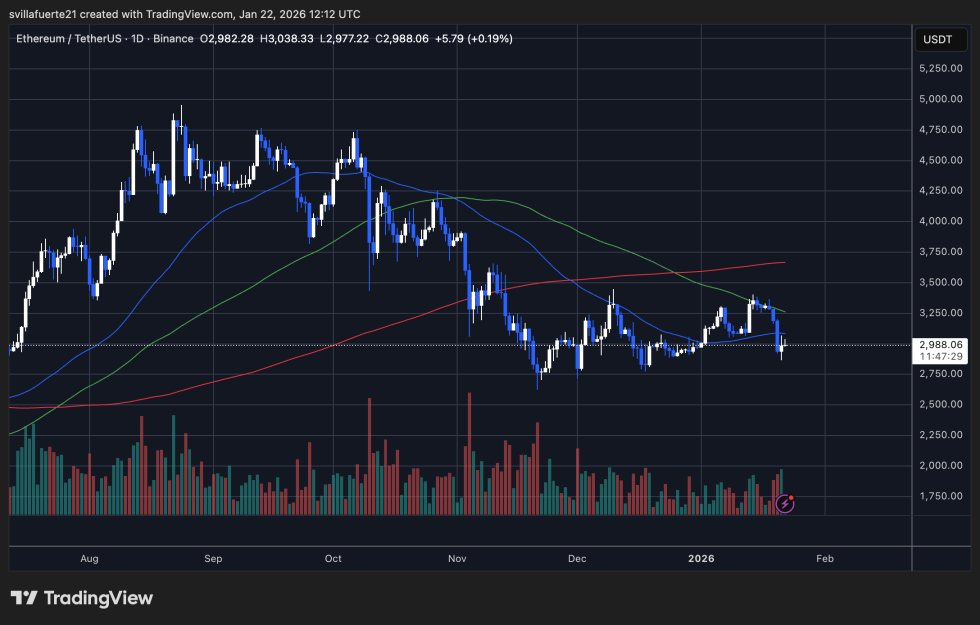
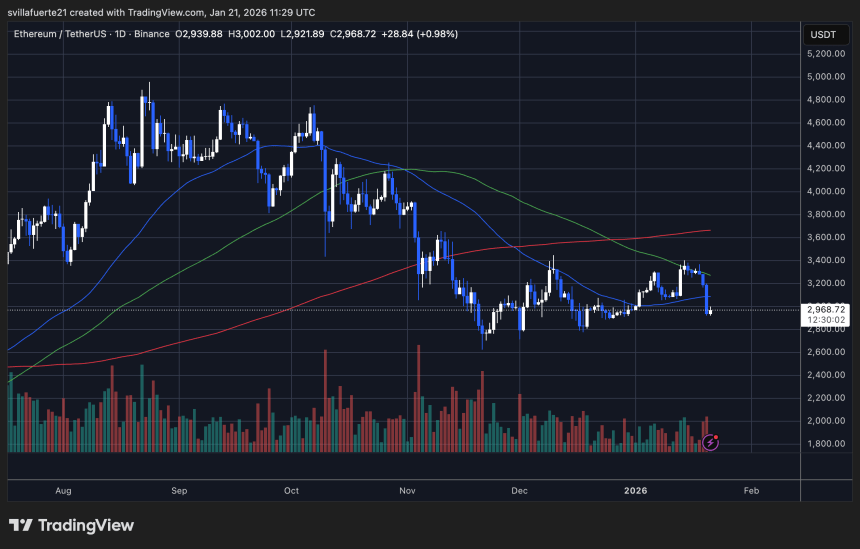
Ethereum is showing renewed weakness after failing to hold above the key $3,000 level, with price now hovering near $2,970 on the daily chart. After briefly stabilizing earlier this month, ETH attempted a rebound toward the $3,300–$3,400 supply zone. But momentum faded quickly as sellers stepped back in and pushed the market lower.

ETH testing critical support | Source: ETHUSDT chart on TradingView

From a technical perspective, Ethereum remains trapped below its major moving averages, reinforcing the bearish structure. The recent rejection near the descending trend of the 200-day average signals that upside attempts are still being capped by overhead resistance. Keeping bulls on the defensive. At the same time, the breakdown below $3,000 shifts market sentiment back into risk-off mode. Especially as crypto traders remain sensitive to broader macro uncertainty.

The current price action also reflects a fragile recovery attempt rather than a confirmed reversal. ETH’s latest drop places focus on the $2,850–$2,900 region as the next support area. An area where buyers previously stepped in during earlier selloffs. If this zone fails to hold, the market could revisit deeper levels from the previous correction phase.

For bulls to regain control, Ethereum must reclaim $3,000 quickly and build stronger demand above that threshold.

Ethereum Loses Structure After $3,220 Rejection — Is This Distribution Or Just The First Crack?

Ethereum has taken a sharp turn after facing a firm rejection at the $3,220 level, with price breaking structure and slipping into a weaker posture. The speed of the drop and lack of strong buying interest raise an important question for traders: Is this merely an early warning sign within a broader uptrend, or the start of a deeper distribution phase that could pressure ETH further in the near term?

Rejection At $3,220 Signals Distribution, Not A Shakeout

Crypto analyst PEPE is Friend highlighted that Ethereum’s sharp rejection at the $3,220 level was deliberate rather than random. The drop was clean, with key structure breaking down, selling pressure accelerating, and price quickly flushing toward the $3,106 area, aligning with a classic distribution behavior rather than a simple shakeout.

Assessing the current price reaction, there are still no signs of a true reversal. The bounce has been notably weak, trading volume remains thin, and buyers have yet to show a strong commitment. Instead of signaling renewed bullish momentum, the move higher appears to be a technical pullback within a broader weakening structure.

Ethereum

The key technical zone remains well-defined. ETH is trading below the former support band between $3,170 and $3,200. As long as the price stays below this range, any upside move is likely to be viewed as a selling opportunity rather than the start of a sustained recovery. 

When this price action is viewed alongside Ethereum spot ETF data, the picture becomes clearer. While ETF flows remain positive daily, they lack strong momentum or a standout confirmation day. Capital appears to be absorbed rather than aggressively deployed, suggesting institutional demand is not yet strong enough to drive a decisive breakout. Until that changes, sellers are expected to remain in control below the $3,170–$3,200 resistance zone.

Ethereum Slips Below $3,062 As Bears Regain Short-Term Control

In an X post, Kamile Uray noted that Ethereum has closed below the $3,062 level, shifting attention toward the next major downside zone at $2,623. This level is now critical, as holding above it could allow ETH to stabilize and attempt another recovery move.

On the upside, a clean break above the pink-box resistance near $3,445 would activate bullish formations such as a cup-and-handle or an ascending triangle, opening the door for a move toward the $3,894 area.

Further strength would be confirmed if ETH manages to close above the $3,661 high, which would mark the first higher high on the daily chart relative to the previous downtrend, improving the bullish outlook. Still, $3,894 remains a key level, as it aligns with the 0.618 Fibonacci retracement of the last decline.

On the downside, a clear break below the $2,623 low would expose ETH to deeper losses, with the $2,274–$2,104 zone emerging as the next major support area. This region hosts a potential bullish “Libra” reversal setup, and Ethereum could once again attempt a bounce toward its previous all-time high if reversal confirmation appears there.

Ethereum

BitMine Gobbles Up $110M Ethereum in Massive Dip Buy — Is the “Alchemy of 5%” Imminent?

BitMine Immersion Technologies has once again pushed itself to the center of the crypto market after revealing a fresh wave of Ethereum accumulation that reflects how far the company has come in just six months.

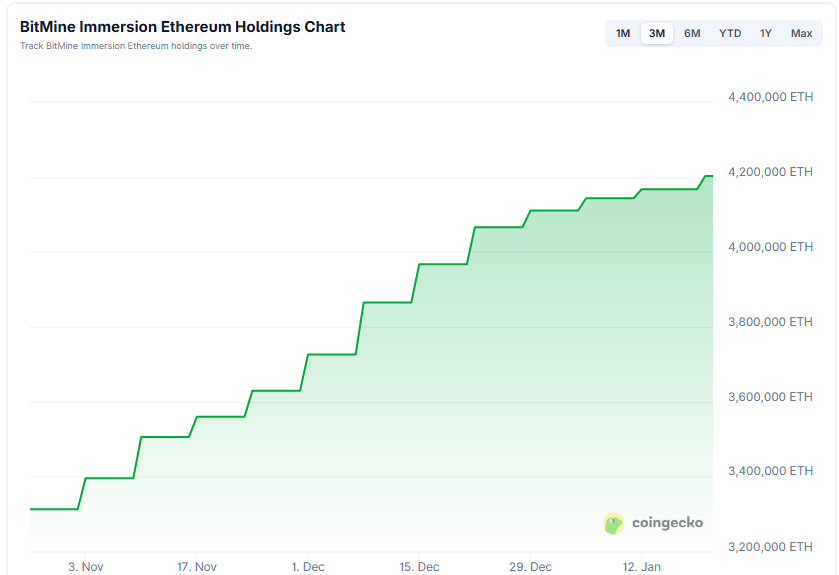
The New York–listed firm disclosed on January 20 that it now holds 4,203,036 ETH, valued at roughly $13.5 billion at recent prices, following weeks of steady purchases made during market weakness.


BitMine provided its latest holdings update for January 20th, 2026:

$14.5 billion in total crypto + "moonshots":
– 4,203,036 ETH at $3,211 (@coinbase)
– 193 Bitcoin (BTC)
– $22 million stake in Eightco Holdings (NASDAQ: $ORBS) (“moonshots”) and
– total cash of $979…

— Bitmine (NYSE-BMNR) $ETH (@BitMNR) January 20, 2026

Ethereum has declined by 10.8% over the past seven days and is down 4.5% in the last 24 hours, currently trading at $2,966.44.

The update immediately reignited debate around BitMine’s stated goal of acquiring 5% of Ethereum’s total circulating supply, a target the company calls the “alchemy of 5%.”

Weekly ETH Buys Push BitMine Toward 5% Supply Mark

The numbers show how close BitMine already is; with Ethereum’s circulating supply estimated at about 120.7 million ETH, a 5% stake would amount to roughly 6.03 million ETH.

BitMine’s current holdings represent about 3.48% of supply, leaving the company needing approximately 1.8 million additional ETH to reach its stated threshold.

Source: CoinGecko

At prevailing prices near $3,000 per token, that remaining gap translates into several billion dollars of capital, even before accounting for market impact.

Company disclosures show that BitMine has been buying ETH nearly every week since late October, including more than 35,000 ETH in the week ending January 20.

These purchases have taken place alongside broader volatility in crypto markets, reinforcing the firm’s message that it is using price weakness to build a long-term position rather than trading short-term moves.

Chairman Tom Lee has repeatedly framed the strategy as accretive to net asset value, emphasizing that the company does not intend to issue shares below its internal estimate of mNAV.

That approach appears to have won shareholder backing, so that even at BitMine’s January 15 stockholder meeting in Las Vegas, investors approved all four proposals put forward by management.

📈 Tom Lee @fundstrat wants BitMine to raise its authorized share limit to 50 billion to enable future stock splits as its valuation tracks Ethereum.#Ethereum #BitMinehttps://t.co/C76OxSDEOP

— Cryptonews.com (@cryptonews) January 3, 2026

About 81% of votes cast supported the change, representing more than half of all outstanding shares.

Lee described the result as a clear show that shareholders understand and support the ETH accumulation strategy, even as concerns around dilution continue to surface in market discussions.

BitMine Ramps Up Ethereum Staking as Treasury Swells

Beyond simply holding Ether, BitMine is also moving aggressively to stake its position. As of January 19, the company had staked 1,838,003 ETH, worth close to $5.9 billion, up sharply from just over 650,000 ETH earlier this month.

The staking effort currently relies on third-party providers, but BitMine is preparing to launch its own infrastructure, the Made in America Validator Network, or MAVAN, in early 2026.

🚀 BitMine @BitMNR plans an early-2026 launch of its MAVAN validator network, aiming to turn a $12B Ether treasury into staking yield at scale.#BitMine #Staking https://t.co/YOlkeNouQu

— Cryptonews.com (@cryptonews) December 30, 2025

Using the current composite Ethereum staking rate of about 2.81%, the company estimates that a fully deployed staking operation could generate roughly $374 million in annual fees, or more than $1 million per day, assuming performance and network conditions remain stable.

The scale of BitMine’s balance sheet now places it in rare territory among public companies.

Its crypto, cash, and “moonshot” holdings total about $14.5 billion, including nearly $1 billion in cash, a smaller Bitcoin position of 193 BTC, and equity stakes such as a recently announced $200 million investment into Beast Industries.

🚀 @BitMNR has further cemented its position as the largest corporate holder of Ether after adding more than 24,000 ETH to its balance sheet.#Bitmine #Etherhttps://t.co/vphtiEXCXb

— Cryptonews.com (@cryptonews) January 13, 2026

While that investment is not directly tied to the Ethereum strategy, it reflects BitMine’s broader effort to diversify alongside its core crypto treasury.

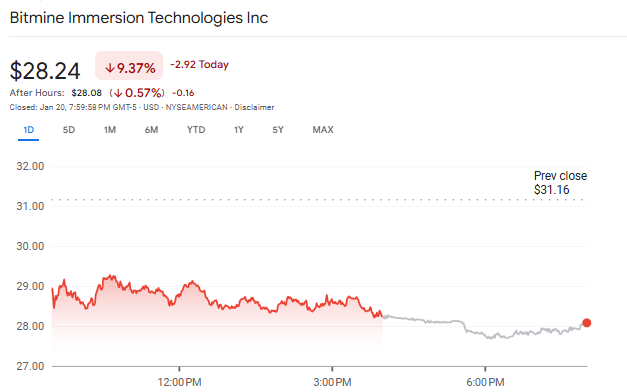
Source: Google Finance

Following the news, Bitmine stock is trading slightly above $28, far below its mid-2025 peak, yet it remains one of the most actively traded stocks in the United States, with average daily dollar volume around $1.5 billion.

The post BitMine Gobbles Up $110M Ethereum in Massive Dip Buy — Is the “Alchemy of 5%” Imminent? appeared first on Cryptonews.

Vitalik Buterin Calls for Return to Decentralized Social, Warns Against ‘Corposlop’ Crypto Platforms

Ethereum’s co-founder Vitalik Buterin has renewed his push for decentralized social media arguing that competition — rather than engagement-maximising algorithms or speculative tokens — is essential to building healthier mass communication systems.

In 2026, I plan to be fully back to decentralized social.

If we want a better society, we need better mass communication tools. We need mass communication tools that surface the best information and arguments and help people find points of agreement. We need mass communication… https://t.co/ye249HsojJ

— vitalik.eth (@VitalikButerin) January 21, 2026

In a post on X, Buterin said he plans to be “fully back to decentralized social” in 2026, framing the shift as a response to deep structural problems in today’s dominant platforms.

“If we want a better society, we need better mass communication tools,” he wrote, calling for systems that surface high-quality information, help people find points of agreement, and serve users’ long-term interests instead of optimising for short-term engagement.

According to Buterin decentralization provides a starting point by allowing real competition. Shared data layers allow multiple clients to be built on top of the same social graph, reducing the power of any single interface or algorithm.

“Decentralization is the way to enable that,” he said, arguing that choice at the client level is critical to improving online discourse. Buterin notes that his return to decentralized social is already underway.

Since the start of the year, he said every post he has written or read has been accessed through Firefly, a multi-client interface that supports X, Lens, Farcaster and Bluesky.

The experience, he suggested, highlights how decentralized tools can coexist with — and gradually pull attention away from — centralized platforms.

Tokens Are Not Social Innovation

Buterin was sharply critical of how many crypto-native social projects have evolved. Too often, he argued, teams mistake the addition of a speculative token for meaningful innovation.

While combining money and social interaction is not inherently flawed — he cited Substack as an example of a system that successfully supports high-quality content — problems arise when platforms create price bubbles around creators instead of rewarding the content itself.

Over the past decade, Buterin said, repeated attempts to financialise social influence have failed in predictable ways: rewarding pre-existing social capital rather than quality and ultimately collapsing as tokens trend toward zero.

He dismissed claims that creating new markets and assets is automatically beneficial, describing such thinking as “galaxy-brained” rhetoric that masks a lack of genuine interest in improving information flow. “That is not Hayekian info-utopia,” he wrote. “That is corposlop.”

A Renewed Focus on the ‘Social’

For decentralized social to succeed, Buterin argued, it must be led by teams that care deeply about the social problem itself.

He praises the Aave team’s stewardship of Lens to date and said he is optimistic about the project’s next phase, pointing to the incoming team’s long-standing interest in encrypted social communication.

Buterin said he plans to post more actively on Lens this year and encouraged users to spend more time across Lens, Farcaster and the broader decentralized social ecosystem.

The goal is to move beyond “a single global info warzone” and reopen a frontier where new and healthier forms of online interaction can emerge.

The post Vitalik Buterin Calls for Return to Decentralized Social, Warns Against ‘Corposlop’ Crypto Platforms appeared first on Cryptonews.
Binance Order Flow Suggests Ethereum Is In Correction Mode: Demand Still Missing

Ethereum is trying to stabilize above the $3,100 level after failing to break the $3,400 resistance, as the broader crypto market struggles to recover momentum. While bulls managed to defend key support in recent sessions, price action remains fragile and highly reactive, with sellers still showing up on rallies. ETH is stuck in a tight range, and traders are watching closely to see whether this pullback turns into a deeper correction or simply a reset before the next move higher.

A report from Arab Chain highlights that Binance data is signaling a sensitive phase for Ethereum at the start of 2026. According to the analysis, ETH is trading near the $3,200 zone, but market flow conditions remain tilted to the downside.

The Accumulated Order Flow (CVD) indicator sits at approximately -3,676, suggesting that net selling pressure is still dominating short-term activity. In simple terms, more aggressive sell orders are hitting the market than buy orders, even as price attempts to hold recent levels.

This divergence between price stabilization and negative flow reflects a market that is not collapsing, but also not attracting strong demand yet. As Ethereum defends support, the next test will be whether buyers can reclaim $3,300 and challenge the $3,400 ceiling again, or if weakness drags price back toward deeper support zones.

Ethereum Holds Despite Negative Binance Order Flow

Arab Chain notes that even though Ethereum’s CVD remains negative, the relationship between price and liquidity flows is not fully broken. According to the report, the 30-day correlation between ETH price and CVD sits near 0.62, which is a relatively constructive reading. This pattern suggests that price action partially aligns with volume behavior, even though liquidity currently tilts toward selling rather than fresh buying.

In other words, Ethereum is not trading in a vacuum—flows still matter—and the market is reacting in a way that reflects real positioning.

Binance ETH CVD Momentum & Price Correlation | Source: CryptoQuant

From a broader perspective, ETH’s gradual decline to its current levels signals a correction phase following its previous upside surge. Historically, this is the type of environment where short-term investors take profits and reduce exposure, while larger players begin to rebalance portfolios and slowly rebuild positions. Instead of an immediate trend reversal, the market often transitions into sideways price action as both sides test liquidity.

The key issue is that CVD remains negative, meaning demand has not yet become strong enough to flip the short-term flow structure. However, Ethereum’s ability to hold above the $3,000 level points to underlying support that is limiting downside acceleration.

This mismatch—weak momentum in volume flows but stable price behavior—often precedes quieter consolidation periods that can later set the foundation for stronger upside once liquidity conditions improve.

EETH Bulls Fight to Reclaim $3,100

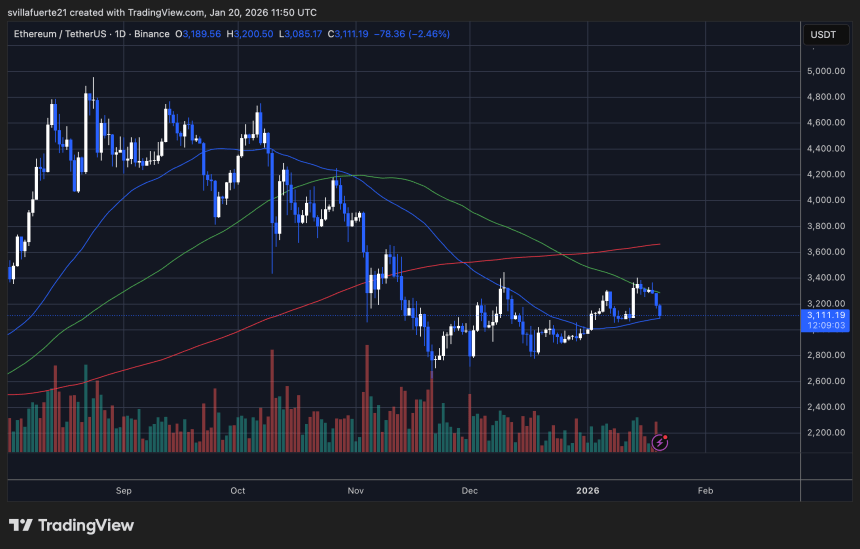
Ethereum is trying to stabilize above the $3,100 level after a sharp rejection from the $3,400 supply zone, with price now trading near $3,111. The chart shows ETH still recovering from the broader downtrend that started after the November breakdown, but the structure remains fragile as sellers continue defending every attempt to push higher.

ETH testing key MA | Source: ETHUSDT chart on TradingView

From a technical perspective, the $3,300–$3,400 region stands out as the key resistance cluster. Price has repeatedly failed in this area, and the latest rejection confirms it remains a major distribution level. At the same time, Ethereum is holding above its short-term moving average near $3,050–$3,100. Suggesting buyers are still active, defending the current range.

However, ETH remains capped below the mid-term moving averages, which are trending lower and acting as dynamic resistance. This keeps the market in a “recovery inside a downtrend” setup unless bulls can flip those levels back into support. Volume has also remained relatively muted during the rebound, signaling that the move still lacks aggressive follow-through.

Ethereum appears stuck in consolidation. With $3,000 as the critical floor and $3,400 as the breakout trigger needed to shift market sentiment.

Featured image from ChatGPT, chart from TradingView.com 

Ethereum’s Supply Dynamics Shift As ETH Staking Sees Historical Growth – Here’s The Number

In the current market structure, the Ethereum price continues to move in a separate direction from its network’s performance and fundamentals. While ETH’s price struggles to initiate a major rally, the network is performing at a remarkable pace, breaking past prior all-time highs in most aspects of the blockchain, such as staking.

More Ethereum Getting Locked Away

Even in the ongoing crypto volatile landscape, the supply dynamics of Ethereum, the second-largest cryptocurrency asset, are undergoing a quiet but meaningful shift. Currently, ETH staking is experiencing exponential growth, leading to a tightening supply as more ETH gets locked away.

Milk Road, a market expert, stated that ETH is becoming intentionally harder to access in the midst of the strong growth in its staking ecosystem. The chart shared by Milk Road shows that ETH staking has now hit a new all-time high, with millions of the altcoin presently scheduled to be locked away.

Ethereum

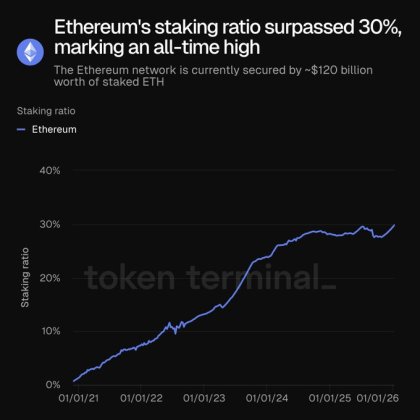
While more tokens are being locked into validator contracts, an increasing percentage of Ethereum’s total supply is essentially taken out of daily circulation. The supply of ETH taken by staking has never been this high, snatching over 30% of the entire supply in circulation. 

This points to growing confidence in staking as a yield strategy in the long term and a deeper commitment to the security offered by the network. Meanwhile, the Ethereum network is now secured by approximately $120 billion worth of staked ETH.

In addition to being removed from active circulation, Milk Road highlighted that this supply is also taken off crypto exchanges. When staking rises, and supply shrinks, Mlik Road stated that this trend is a positive signal for price appreciation in the long term, reinforcing the expert’s conviction in ETH to move higher. 

A Sharp Rise In ETH’s Network Activity To New Highs

On-chain activity has experienced a similar growth, rising to historical levels. Crypto Tice reported that Ethereum network activity is at an all-time high, highlighting the blockchain’s rising function as the layer of settlement for cryptocurrency and financial operations.

The network growth is observed among new wallet addresses, of which more than 393,000 new wallets were created in a single day, reaching the highest level ever recorded for the 7-day average of daily wallet creation. Such an increase in activity is noteworthy not only for its magnitude but also for its tenacity, occurring despite the continued volatility of the market.

It is worth noting that these types of growth are subtle as they do not show up at the tops, and momentum is gradually picking up again. However, when it does show up, it is accompanied by a quiet spike in adoption beneath the surface; a clear instance of how increasing demands follow an expansion in usage.

At the time of writing, the ETH price was trading at $3,119, demonstrating a nearly 3% decline in the last 24 hours. Its trading volume is also showing bearish performance, dropping by more than 16% over the past day.

Ethereum

Staking Provider Chorus One Partners with Ledger for Self-Custodial ETH, SOL Staking

Institutional staking provider Chorus One has integrated with Ledger Enterprise to bring self-custodial, governance-ready staking for four cryptocurrencies.

According to the press release shared with Cryptonews.com, this move aims to enable institutions to earn staking rewards directly from Ledger’s custody ecosystem.

All staking operations happen within the institution’s existing governance framework. Therefore, institutions can participate in Proof-of-Stake (PoS) networks without “transferring asset custody or compromising internal governance controls.”

The collaboration enables staking for Ethereum (ETH), Solana (SOL), Polkadot (DOT), and Tezos (XTZ).

Chorus One x Ledger Enterprise 🤝

Institutions can now stake ETH, SOL, DOT & XTZ directly through their self-custody platform, using Chorus One validator infrastructure.

🔐 Hardware-backed key management
📊 Audit-ready reporting
⚙ Seamless staking & reward management pic.twitter.com/xwNMoTQ80W

— Chorus One (@ChorusOne) January 20, 2026

Per the announcement, Ledger’s hardware and governance controls protect the private keys. At the same time, Chorus One backs the institutional-grade validator performance. It says it provides institutional validator infrastructure and research-driven staking operations.

Other key points of the collaboration include multi-authorisation and configurable governance workflows, as well as reporting and auditability for compliance and treasury management.

“Institutions need staking solutions that match their security, compliance, and operational requirements,” says Damien Scanlon, Chief Product Officer at Chorus One. The integration allows the two companies “to deliver a streamlined staking experience that keeps governance firmly in the hands of the client,” he added.

Staking In The News

Sébastien Badault, Executive Vice President at Ledger Enterprise, noted that “companies are adopting digital assets at a rapid pace worldwide.” At the same time, “uncompromising security and governance remain fundamental prerequisites.”

Therefore, integrating Chorus One’s staking infrastructure into the Ledger Enterprise platform makes “it simpler for institutions to earn staking yields,” Badault says.

Speaking of which, many staking-related news stories hit the front pages in the first few days of this year.

Among these, Robinhood’s head Vlad Tenev claimed that staking remains one of the most sought-after features among Robinhood users.

Tenev urged the US to be the leader in shaping crypto policy. The staking feature is still not available to customers in four US states “due to the current gridlock,” he said. “Stock Tokens are available to our customers in the EU, but not in our home market,” Tenev wrote.

Staking is one of the most requested features on @RobinhoodApp, but it’s still unavailable to customers in four U.S. states due to the current gridlock. Stock Tokens are available to our customers in the EU, but not in our home market.

It's time for the US to lead on crypto…

— Vlad Tenev (@vladtenev) January 15, 2026

Moreover, SharpLink Gaming started seeing results of its decision to fully commit to ETH and place its entire crypto treasury into staking. The company reported more than $33 million in passive income generated from ETH staking over the past seven months.

Also, Bitmine recently added nearly 100,000 ETH, valued at about $344.4 million, lifting its holdings to 908,192 ETH, worth $2.95 billion. The additional staking came hours after the leading ETH accumulator reported staking 19,200 ETH, worth $60.85 million.

Bitmine (@BitMNR) has further staked 109,504 $ETH, worth $344.44M

In total, they have staked 908,192 $ETH, valued at $2.95Bhttps://t.co/1vbYSuGDkR https://t.co/XRS6pEPUkJ pic.twitter.com/5wLn0GrtTh

— Onchain Lens (@OnchainLens) January 8, 2026

Meanwhile, Chorus One operates infrastructure for over forty PoS networks, including Cosmos, Solana, Avalanche, and Near.

As for Ledger, it announced its Ledger Nano Gen5 last year. It is now weighing a US listing and is preparing to raise capital.

“Money is in New York today for crypto, it’s nowhere else in the world, certainly not in Europe,” said chief executive Pascal Gauthier.

Early in January, hackers exploited vulnerabilities in Ledger’s Global‑e payment processor, gaining access to customer names and contact information. Wallets and private keys were unaffected, the company said.

The post Staking Provider Chorus One Partners with Ledger for Self-Custodial ETH, SOL Staking appeared first on Cryptonews.

❌