Reading view

There are new articles available, click to refresh the page.

XRP Charts Flash Familiar Signal As Analyst Calls For $11, Then $70

A growing number of chart watchers are pointing to a long stretch of sideways trading for XRP and saying this setup has come before big rallies. According to a widely followed analyst known as CryptoBull, the current price action echoes earlier runs in the token’s history.

The signal is simple: long quiet periods sometimes lead to sharp moves when buying pressure returns. That does not mean a jump is guaranteed. Markets can stay quiet for a long time, and timing is uncertain.

Pattern Mirrors Prior Cycles

Based on reports, XRP’s weekly structure shows a stretch of range trading after strong breakouts from earlier years. The comparison reaches back several cycles. In past examples, long ranges eventually gave way to impulsive runs that pushed the price far above prior highs.

The next impulse will take #XRP to $11 and the last wave to $70. The price pattern is copying the previous bullrun, only difference is time, which makes sense, as we need longer accumulation for higher prices. pic.twitter.com/WJxzYDVRKT

— CryptoBull (@CryptoBull2020) January 23, 2026
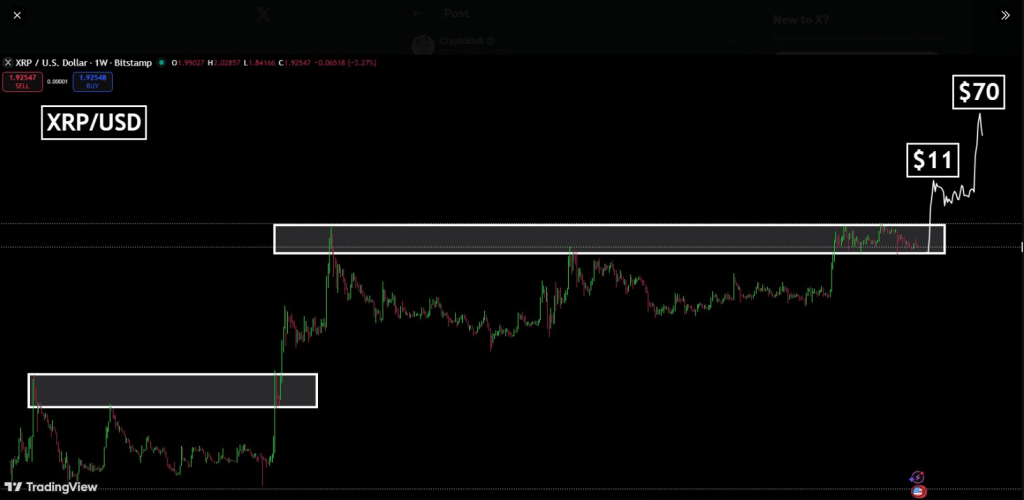
CryptoBull argues the present consolidation has lasted longer than previous ones, which, he says, could compress price action and build fuel for a larger expansion when momentum flips. The idea rests on history repeating itself in broad strokes, not in exact moves.

Longer Accumulation Could Support Bigger Targets

Some analysts see a sixfold move as plausible if the same pattern plays out. That kind of rise would put XRP near $11, a figure being discussed by multiple commentators. There is also talk of a further, final wave lifting the token much higher in a later stage — talk that reaches $70 in extreme scenarios.

A bottom test—where price revisits support to confirm strength before a new push—has appeared in a few past cycles and is being watched closely now.

The presence of such tests can either validate a base or warn that the range has more work to do. Timelines are vague, and a long accumulation period can stretch for years before any decisive breakout.

RLUSD Rumors Fuel Speculative Calls

Reports that BlackRock may use Ripple’s RLUSD stablecoin have added fuel to the fire. News like that has pushed sentiment upward and sparked fresh technical calls, with some forecasts ranging from $6 to $14 in near- to mid-term scenarios.

Other voices go far beyond, naming targets that would imply market caps so large they would be hard to reconcile with today’s market size.

These more extreme numbers should be treated with caution, because they assume near-perfect conditions and massive capital flows that may never arrive. Still, adoption whispers can tilt sentiment and speed up moves when buyers pile in.

Featured image from Unsplash, chart from TradingView

Ethereum Emerges As Likely Candidate In BlackRock Tokenization Vision – Here’s Why

Recent remarks from BlackRock CEO Larry Fink have pointed toward the need for a single, unified blockchain for tokenized markets, and have intensified the focus on platforms capable of handling institutional-scale liquidity, compliance, and settlement. With its long track record in smart contracts, extensive developer ecosystem, and growing role in regulated financial products, Ethereum is now emerging as the most likely candidate to serve as the settlement layer for tokenized capital markets.

Why Asset Managers Prefer Familiar Infrastructure

In an X post, the Ethereum Daily shared a video in which BlackRock CEO Larry Fink made it clear that tokenization is necessary. Speaking at the World Economic Forum, Fink said the financial system must move rapidly toward digitization, adding that a single, common blockchain could reduce corruption and improve transparency across the global markets.

While Fink did not name a specific network, the most plausible candidate could be ETH, based on BlackRock’s own initiatives and public statements that emphasized the role of ETH in asset tokenization. The firm has consistently highlighted ETH as a core platform for its on-chain strategy. Meanwhile, BlackRock launched its BUIDL tokenized money market fund directly on ETH, a product that has already grown to over $2 billion in total value locked. “There’s no second best,” Ethereum Daily noted.

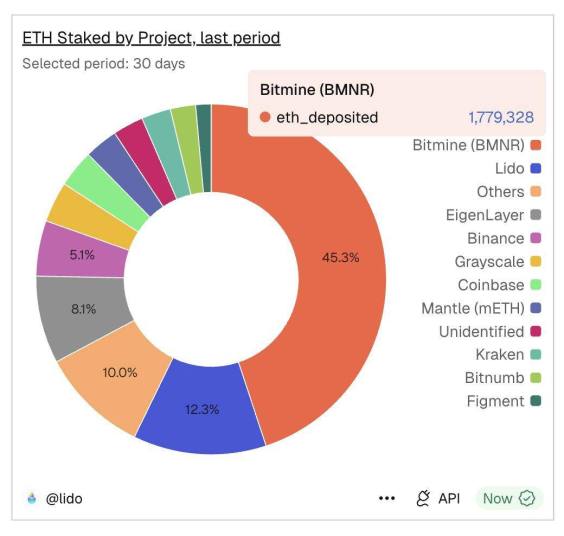
In the staking space, Bitmine has turned Ethereum staking into a multi-billion-dollar business. An analyst known as Milk Road has revealed that the company now has 1.83 million ETH staked, worth roughly $6 million at current prices, and plans to scale that figure toward 4.2 million ETH over time. Over the past months, Bitmine Immersion Technologies Inc. (BMNR) has accounted for nearly 50% of all new ETH entering the staking queue.

Ethereum

Staking at this scale is important because it removes ETH from the liquid supply and locks it into long-term infrastructure rather than keeping it for short-term trading. When one player is willing to commit billions of dollars worth of ETH to staking, it reflects confidence in ETH’s future economic prospects. A lower liquid supply, combined with sustained network demand, will create structural pressure over time.

How Support Built Through Multiple Market Cycles

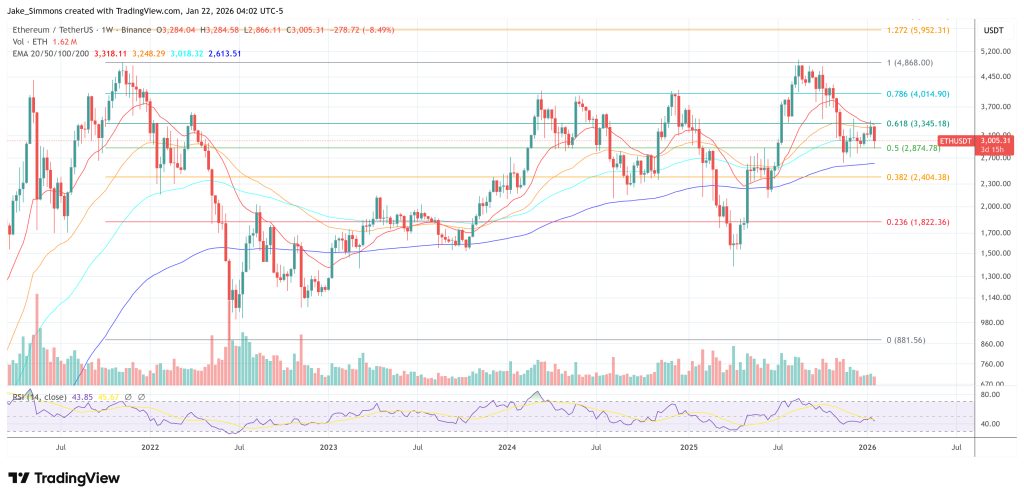
Analyst Milk Road has also highlighted that Ethereum is holding near a critical support zone around $3,000, hovering just above the lower boundary of its long-term rising structure, an area that has acted as a stress test for ETH throughout the cycle. Historically, when ETH drifts into this area, the market will need to decide whether the weakness is temporary or structural.

The $2,750 level remains the key line because it has repeatedly stopped downside pressure after macro-driven or narrative-driven pullbacks, making it a reliable floor for the broader trend. As long as ETH holds above that level, the broader multi-year uptrend will remain intact.

Ethereum

Is It Ethereum? BlackRock CEO Wants ‘One Blockchain’ For Tokenization

BlackRock CEO Larry Fink used the World Economic Forum stage to argue that tokenization needs to move from pilot programs to market plumbing and suggested that a shared blockchain standard could cut costs and even “reduce corruption,” a framing that immediately reignited the “which chain?” debate across crypto and specifically inside the Ethereum community.

Fink didn’t name a network. But the combination of BlackRock’s onchain product footprint and its own research positioning makes Ethereum the most natural candidate for the “one common blockchain” he alluded to, even if he kept it implicit.

Fink’s remarks, delivered in the language of infrastructure rather than crypto evangelism, leaned heavily on the operational case for digitized assets and interoperable settlement rails.

“I think the movement towards tokenization, decimalization is necessary. It’s ironic that we see two emerging countries leading the world in the tokenization and digitization of their currency, that’s Brazil and India. I think we need to move very rapidly to doing that.”

He then pushed the argument beyond payments and into capital markets: “We would be reducing fees, we would do more democratization by reducing more fees if we had all investments on a tokenized platform that can move from a tokenized money market fund to equities and bonds and back and forth.”

The most provocative line was his call for standardization and the trade-off he implied comes with it. “[If] we have one common blockchain, we could reduce corruption. So I would argue that, yes, we have more dependencies on maybe one blockchain, which we could all talk about, but that being said, the activities are probably processed and more secure than ever before.”

BlackRock CEO Larry Fink told the World Economic Forum he thinks the movement toward tokenization and digitization is necessary. We need to move very rapidly to doing that. With one common blockchain, we can reduce corruption.

The “one common blockchain” Larry Fink referenced… https://t.co/sMMcg4oyN1 pic.twitter.com/VhRvuwCx00

— Ethereum Daily (@ETH_Daily) January 22, 2026

Why Ethereum Is Coming Up

In the abstract, “one common blockchain” could be read as a generic appeal for shared rails. In practice, BlackRock’s public-market crypto lineup and its tokenization work have concentrated around Bitcoin and Ethereum.

On the ETF side, BlackRock’s flagship US spot products track bitcoin and ether — iShares Bitcoin Trust (IBIT) and iShares Ethereum Trust (ETHA) — with ETHA launching in 2024 and now sitting in the center of the firm’s public-facing Ethereum exposure.

On the tokenization side, BlackRock’s first tokenized fund, the BlackRock USD Institutional Digital Liquidity Fund (BUIDL), debuted on Ethereum via Securitize in March 2024, making Ethereum the original issuance network for what has become one of the market’s most closely watched institutional RWAs.

While BUIDL has expanded across multiple networks over time, the key point for Fink’s “common blockchain” framing is that Ethereum has been BlackRock’s default starting point for public-chain issuance, a meaningful signal in a market where “standards” tend to follow whoever already has the deepest liquidity, the broadest integration surface, and the most conservative counterparties.

The stronger tell came this week from BlackRock research rather than Davos soundbites. In its 2026 thematic outlook, BlackRock explicitly floats the idea of Ethereum as the infrastructure layer that collects the “toll” as tokenization scales. One slide asks: “Could Ethereum represent the ‘toll road’ to tokenization?” and adds that stablecoin adoption may be an early proxy for tokenization “in action,” with “blockchains like Ethereum” positioned to benefit.

In the same section, BlackRock cites RWA data “as of 1/5/2026” and notes that “of tokenized assets 65%+ are on Ethereum,” underscoring the network’s lead in today’s tokenized-asset stack.

At press time, ETH traded at $3,005.

Ethereum price chart

Delaware Life Launches First Fixed Index Annuity That Offers Bitcoin Exposure

Bitcoin Magazine

Delaware Life Launches First Fixed Index Annuity That Offers Bitcoin Exposure

Delaware Life Insurance Company has become the first U.S. insurance carrier to offer a fixed index annuity (FIA) linked to a cryptocurrency-focused index, the BlackRock U.S. Equity Bitcoin Balanced Risk 12% Index. 

The move allows retirement investors to gain indirect exposure to Bitcoin while retaining principal protection, a hallmark of traditional annuity products.

The newly launched index blends 74% exposure to the iShares Core S&P 500 ETF with 25% exposure to the iShares Bitcoin Trust ETF (IBIT) and a 1% cash allocation. It is designed with a 12% target volatility, using dynamic cash adjustments to moderate BTC’s price swings.

“This launch builds around the tremendous success and client demand we have seen for IBIT, enabling insurance clients to now add Bitcoin exposure as part of a broader indexed annuity strategy,” said Robert Mitchnick, Global Head of Digital Assets at BlackRock.

“The BlackRock U.S. Equity Bitcoin Balanced Risk 12% Index offers a measured approach, allowing policyholders to participate in digital assets while maintaining the downside protection they expect from annuity products.”

Delaware Life’s CEO of Marketing, Colin Lake, touched on the company’s focus on innovation. 

“We’re proud to partner with BlackRock as the first insurance carrier to offer cryptocurrency exposure through a fixed index annuity,” Lake said. “As the retirement-planning landscape evolves, we’re continuously and thoughtfully innovating to meet the needs of financial professionals and their clients. Our fixed index annuities deliver what today’s investors want and need: opportunity for growth with protection.”

Bitcoin’s high returns balanced with equity growth

The index’s mixed allocation is designed to balance traditional equity growth with BTC’s high return potential, all while managing volatility.

As of December 31, 2024, the index delivered a six-month return of 1.88%, though BTC’s recent three-month decline contributed to a 3.16% drop over that period.

The BlackRock U.S. Equity Bitcoin Balanced Risk 12% Index is available on three Delaware Life FIA products: Momentum Growth™, Momentum Growth Plus™, and DualTrack Income™, giving clients multiple avenues to integrate BTC exposure into retirement portfolios.

The inclusion of IBIT, the largest and most liquid Bitcoin exchange-traded product, provides professional management without requiring direct cryptocurrency ownership.

This is the first time a life insurance company has allowed policy holders to select a product which includes Bitcoin.

The price of BTC today is $87,774, down 2% in the last 24 hours, with a 24-hour trading volume of $64 billion.

This post Delaware Life Launches First Fixed Index Annuity That Offers Bitcoin Exposure first appeared on Bitcoin Magazine and is written by Micah Zimmerman.

Delaware Life Teams Up With BlackRock To Bring Bitcoin Exposure To Annuities

Delaware Life is taking a new step toward mainstreaming Bitcoin exposure in retirement-style products, adding a BlackRock-built index that blends US equities and Bitcoin to its fixed indexed annuity lineup.

The insurer, which sits within Group 1001, said Tuesday it has added the BlackRock US Equity Bitcoin Balanced Risk 12% Index to its fixed indexed annuity portfolio, calling it the first time an insurance carrier has offered an index that includes cryptocurrency.

Fixed indexed annuities, or FIAs, typically protect the policyholder’s principal while crediting interest that is linked to a market index, often with caps or other limits on upside.

The new index is designed to deliver exposure to the iShares Core S&P 500 ETF alongside the iShares Bitcoin Trust ETF, and it targets 12% volatility by adding a cash component that can dial risk up or down.

Delaware Life Insurance Company, a Group 1001 insurance subsidiary, announced the addition of the BlackRock U.S. Equity Bitcoin Balanced Risk 12% Index to its fixed indexed annuity (FIA) product lineup, making it the first U.S. insurer to introduce bitcoin exposure within this…

— Wu Blockchain (@WuBlockchain) January 20, 2026

Delaware Life Blends Crypto Access With Capital Preservation

Delaware Life framed the move as a way to let investors add Bitcoin exposure without handling coins directly, while keeping the principal protection structure that defines the FIA wrapper.

“We’re proud to partner with BlackRock as the first insurance carrier to offer cryptocurrency exposure through a fixed index annuity,” said Colin Lake, president & CEO of Delaware Life Marketing.

“As the retirement-planning landscape evolves, we’re continuously and thoughtfully innovating to meet the needs of financial professionals and their clients. Our fixed index annuities deliver what today’s investors want and need: opportunity for growth with protection.”

Demand For Bitcoin Exposure Pushes Deeper Into Retirement Products

Meanwhile, BlackRock’s Robert Mitchnick tied the launch to demand for Bitcoin exposure through familiar rails, saying the index aims for a measured approach that keeps the downside protection annuity buyers expect.

At the same time, the index option will be available on three Delaware Life products, Momentum Growth, Momentum Growth Plus, and DualTrack Income, as traditional finance keeps experimenting with ways to package crypto exposure inside regulated products.

The launch also leans on the momentum behind BlackRock’s spot Bitcoin vehicle, with iShares’ site listing tens of billions of dollars in net assets for IBIT.

The post Delaware Life Teams Up With BlackRock To Bring Bitcoin Exposure To Annuities appeared first on Cryptonews.

Did BlackRock Make A Billion-Dollar XRP Bet? Here’s The Real Tea

Rumors of a large-scale XRP purchase by the world’s largest asset manager, BlackRock, have captured the attention of the crypto world this week. Screenshots circulating on X suggest that the global investment company had invested over a billion dollars in the altcoin, sparking both bullish excitement and skepticism across the crypto community.

BlackRock’s Rumored $1.85 Billion XRP Bet

The frenzy began when several popular crypto influencers, including The Crypto Bull, shared a post and portfolio screenshot claiming that BlackRock had added $1.85 billion worth of XRP to its already substantial crypto holdings. Given BlackRock’s significant influence in the crypto space, the idea that the asset manager had invested in XRP seemed like a major signal for institutional adoption of the cryptocurrency. 

The rumors triggered a wave of speculation about the token, with some market participants viewing the alleged purchase as extremely bullish. A closer examination of BlackRock’s actual portfolio, however, shows that the reports were unfounded and lacked any evidence to support them. 

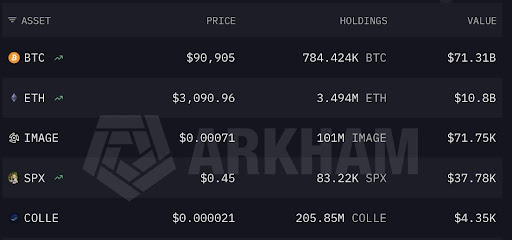
Data from Arkham Intelligence, a blockchain analytics company, revealed that, contrary to expectations, BlackRock holds just 5.267 XRP, valued at just $10.32—a far cry from the acclaimed $1.85 billion in holdings. The data also showed that the asset manager held the majority of its holdings in Bitcoin and Ethereum. BlackRock’s total crypto portfolio is estimated at $82.1 billion, including 784,424 BTC valued at $71.31 billion, 3.494 million ETH worth approximately $10.8 billion, and other assets. 

XRP

Investigations also revealed that the original screenshots, which showed BlackRock owning 911.76 million XRP, had been edited to exaggerate the asset manager’s holdings. This misrepresentation created a temporary buzz, but did not reflect any real investment in the altcoin by the firm. 

Despite the false alarm, the incident highlights how quickly misinformation can spread in the crypto space, especially when shared by crypto influencers with thousands of followers. The Crypto Bull’s post drew a variety of reactions from the community.  Some questioned why XRP’s price had not moved if the reports were accurate, while others remained skeptical, and a few outrightly dismissed the claims. 

Rise Of Misinformation In The Crypto Space

False rumors have become a recurrent theme in the crypto world, and the latest incident with XRP and BlackRock is just one example. This is alson’t the first time false claims have been made about the token. Earlier this month, rumours of a potential Ripple partnership with Amazon spread across the community, sparking speculation about how such a collaboration could positively impact XRP’s price. 

Similarly, overly optimistic price forecasts can also contribute to misinformation. Some analysts have predicted that XRP could surge to $50,000, fueling unrealistic expectations for investors. In a market predominantly driven by speculation and volatility, it’s important for investors to verify sources and avoid making decisions based on unproven claims.

XRP

Spot Bitcoin ETF sees sharp inflow revival amid shifting US rate signals

  • Fidelity’s FBTC dominated inflows, with BlackRock’s IBIT also posting strong demand.
  • Cumulative net inflows into US spot Bitcoin ETFs have exceeded $57 billion.
  • Shifting US rate expectations are shaping institutional ETF positioning.

Spot Bitcoin exchange-traded funds listed in the US recorded a sharp revival in inflows on Wednesday, signalling renewed institutional engagement after weeks of uneven activity.

The move marked the strongest single-day intake in more than a month and coincided with shifting expectations around US monetary policy.

While Bitcoin’s price action remains constrained by heavy supply levels, ETF flows suggest investors are reassessing exposure through regulated products as macro conditions evolve.

Inflows rebound across major funds

US spot Bitcoin ETFs recorded $457 million in net inflows on Wednesday, their highest daily total since mid-November.

Fidelity’s Wise Origin Bitcoin Fund led the session, attracting roughly $391 million and accounting for the bulk of the inflows.

BlackRock’s iShares Bitcoin Trust followed with around $111 million, according to data from Farside Investors.

The latest intake pushed cumulative net inflows for US spot Bitcoin ETFs above $57 billion.

Total net assets climbed past $112 billion, equivalent to about 6.5% of Bitcoin’s total market capitalisation.

The figures underline the growing role ETFs play in shaping institutional access to Bitcoin exposure.

Shift after weeks of uneven flows

The inflow revival comes after a choppy period through November and early December, when ETF activity swung between modest inflows and sharp outflows.

That instability reflected cautious positioning amid uncertain price direction and tightening liquidity conditions.

The last time spot Bitcoin ETFs recorded inflows above $450 million was on November 11, when funds drew roughly $524 million in a single day.

The renewed activity suggests investors may be positioning earlier in anticipation of changing macro conditions, rather than responding to short-term price momentum.

ETF flows have increasingly become a barometer for how institutions interpret broader financial signals.

US rate signals influence positioning

Macro expectations shifted further on Wednesday after US President Donald Trump said he plans to appoint a new Federal Reserve chair who strongly supports cutting interest rates.

Speaking during a national address marking the first year of his second term, Trump said he would announce a successor to current Fed Chair Jerome Powell early next year.

He added that all known finalists favour lower rates than current levels.

Lower interest rates are generally viewed as supportive for risk assets such as crypto, as they ease financial conditions and improve liquidity.

Against this backdrop, spot Bitcoin ETFs appear to be attracting capital as a relatively direct way to express macro-driven positioning.

Price pressure and fragile demand persist

Despite stronger ETF inflows, Bitcoin’s market structure remains under pressure.

The asset has returned to price levels last seen nearly a year ago, leaving a dense supply zone between $93,000 and $120,000 that continues to cap recovery attempts.

This has pushed the amount of Bitcoin held at a loss to around 6.7 million BTC, the highest level of the current cycle, according to Glassnode.

Glassnode data also points to fragile demand across both spot and derivatives markets.

Spot buying has been selective and short-lived, corporate treasury flows episodic, and futures positioning continues to de-risk rather than rebuild conviction.

Until sellers are absorbed above $95,000 or fresh liquidity enters the market, Bitcoin is likely to remain range-bound, with structural support forming near $81,000.

The post Spot Bitcoin ETF sees sharp inflow revival amid shifting US rate signals appeared first on CoinJournal.

❌