Reading view

There are new articles available, click to refresh the page.

XRP Validators Vote YES On Permissionless Domains – What This Means

The XRP Ledger has moved one step closer to a major structural upgrade after validators voted in favor of Permissioned Domains. The amendment has now entered its two-week activation window, which is the standard process on the network before new features go live.  The change may sound technical on the surface, but it carries implications for how XRP-based infrastructure could be used by institutions operating under regulatory frameworks.

Validators Vote Yes On Permissioned Domains

According to commentary shared on X by Vincent Van Code, the amendment introducing Permissioned Domains has received enough validator support to pass. Vincent Van Code is a widely followed software engineer in the community. Amendments on the XRP ledger require sustained validator consensus before activation, meaning this approval reflects alignment across a large portion of the network’s validator set. 

Particularly, amendments on the XRP Ledger require over 80% consensus from trusted validators to hold for two consecutive weeks before activating. This process ensures network-wide agreement, preventing forced changes by any single entity. If support drops below the 80% threshold, the amendment is temporarily rejected, and the two-week period restarts.

As it stands, the consensus on permissioned domains is at 85.29%, and the expected time of approval is on February 4, 2026. Once the two-week waiting period concludes, the permissioned domains feature will become active at the protocol level. 

This means developers and institutions will no longer be building applications through off-chain workarounds or private chains. Developers will now be able to start building applications that rely on controlled access rules directly on the public XRP ledger.

How Permissioned Domains Change What Can Be Built On XRPL

According to the XRP Ledger website, permissioned domains are controlled environments within the broader ecosystem of the XRP Ledger blockchain. Anyone can define a permissioned domain in the ledger. That person becomes the owner of that domain and can update its settings or delete it. 

Permissioned Domains introduce a way to create gated environments on the XRP Ledger, where participation is limited to accounts holding specific verifiable credentials. Instead of every address being treated equally by default, certain activities can now be restricted to verified participants only, without altering the open nature of the base ledger. According to Vincent Van Code, this unlocks institutional use cases by restricting access to accounts with specific verifiable credentials. 

This capability opens the door to permissioned decentralized exchanges where regulated trading of tokenized securities, stablecoins, real-world assets, and even FX instruments can occur among compliant counterparties. The same framework also supports controlled lending protocols, restricted liquidity pools, and treasury operations that only approved entities can access.

The vote on permissioned domains plays into a growing trend of institutional entry into the XRP Ledger. While talking at the World Economic Forum in Davos 2026, Ripple’s CEO discussed increasing integration of the XRP Ledger technology with global financial infrastructure, including stronger engagement with banking partners and tokenization efforts. 
XRP price chart from Tradingview.com

Ethereum Whales’s $15 Million Move, Is This Another Insider Trader?

An inactive Ethereum whale has just re-entered the trading scene, withdrawing over $15 million worth of ETH in just a single day. Considering Ethereum’s slow price growth over the past few months and the whale’s sudden appearance despite being dormant for months, there could be a possibility of insider trading.

Dormant Ethereum Whale Moves $15 Million ETH

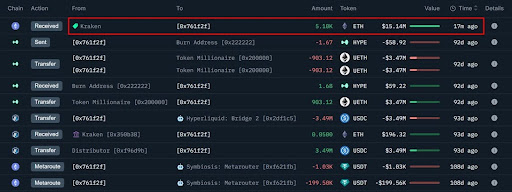
A sudden $15.14 million Ethereum transaction has caught the crypto market’s attention, with the move either driven by insider knowledge or simple strategic positioning. According to data from blockchain analytics platform, Onchain Lens, the transfer shifted approximately 5,099 ETH from a dormant wallet address on Kraken into active circulation on Thursday, January 22. 

Based on on-chain records, the whale, identified by the address ‘0x761F2F,’ has remained inactive in the market for more than three months. The last few times the whale was actively moving in the market were when it executed a series of stablecoin and HYPE transactions. The anonymous whale had initiated multiple million-dollar trades in UETH, USDT, and USDC. Meanwhile, the HYPE transactions were primarily token burns. 

Ethereum 1

After withdrawing 5,099 ETH from Kraken, Arkham Intelligence reported that the whale had transferred the ETH to Lido Finance, converting it into 5,100 STETH. While there is currently no evidence of insider trading, the timing of the transaction raises questions, especially given Ethereum’s muted price action over the past few months and the mounting selling pressure from large scale holders

Typically, insider trading in crypto occurs when individuals with non-public information make large transactions ahead of major market events that could influence market price. Currently, there has been no spike in Ethereum’s price, nor any major news that could suddenly affect its movements. In fact, ETH continues to trade lower, down by roughly 1.7% over the past 24 hours. Its daily trading volume is also down by 34.89%, signaling reduced confidence among traders and investors. 

Whales Go Long On Ethereum

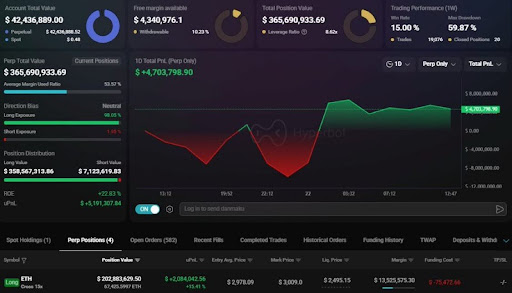
While dormant large-scale players are suddenly re-entering the market, some active whales remain bullish on Ethereum’s long-term prospects despite its ongoing downtrend. According to well-known market analyst Max Crypto, an anonymous whale has just opened a $202 million long position in ETH with 15x leverage. 

The scale of the trade is extraordinary considering Ethereum’s recent volatility. It shows strong confidence in the cryptocurrency’s future price action and its potential to overcome its ongoing downtrend. Notably, the position has a liquidation price of $2,495, meaning that if ETH falls to that level, the trade could be forcibly closed by the crypto exchange, resulting in substantial losses for the whale. 

Ethereum 2

Market participants are closely watching the whales’ positioning, with some calling it a brave but chaotic bet. Others have even speculated that the position may have been taken based on insider information, fueling discussions about potential market moves and a possible bullish turnaround for ETH.

Ethereum price chart from Tradingview.com

Ripple’s Next Steps: Where XRP Stops Being Trade And Starts Being Infrastrucutre

Ripple is laying out a transition in which XRP is no longer positioned primarily as a traded asset, but as infrastructure supporting tokenized finance and institutional settlement. At the World Economic Forum 2026, Ripple CEO Brad Garlinghouse described how this shift is already taking shape through live tokenization activity, regulated integration with banks, and on-chain settlement at scale. 

XRP Tokenization Shifts From Theory To Balance-Sheet Reality

Garlinghouse used tokenization as the primary context for explaining this transition. He described tokenization as a process that has already moved beyond experimentation and into operational use across financial institutions. To support that claim, he pointed to activity on the XRP Ledger, where tokenized asset volume expanded significantly over the course of a single year, rising from roughly $19 trillion to $33 trillion.

That level of growth signals institutional commitment rather than exploratory testing. Tokenized assets at this scale imply the involvement of banks, custodians, and regulated entities moving real value. According to Garlinghouse, institutions are now focused on how to integrate tokenized assets into existing balance sheets, liquidity structures, and settlement processes.

This shift changes what infrastructure is required. Tokenization at institutional scale demands networks that can process high volumes consistently, provide deterministic settlement, and operate continuously. The XRP Ledger is being positioned within this framework as a system capable of supporting that throughput. The emphasis is not on innovation for its own sake, but on reliability and execution under real financial constraints.

As tokenized assets become embedded in core financial operations, the supporting rails stop being optional. They become foundational. That is the context in which XRP is being discussed, not as a standalone asset, but as part of the machinery enabling tokenized finance to function.

Connecting Regulated Assets And On-Chain Liquidity

Garlinghouse also addressed the structural challenge that emerges as tokenization intersects with decentralized finance. Institutions want access to programmability and liquidity, but they cannot compromise compliance, custody, or trust. He described this tension as the central problem Ripple is working to solve.

Rather than positioning itself against traditional finance, Ripple is working directly with global banks to build regulated pathways between tokenized assets and on-chain liquidity. The objective is to allow institutions to interact with decentralized systems without stepping outside regulatory frameworks. Within this design, XRP serves as a settlement and connectivity layer, enabling movement between systems.

This approach reframes XRP’s utility. Its value lies in facilitating finality, liquidity access, and interoperability across regulated and on-chain environments. As tokenized assets, decentralized rails, and institutional settlement converge, networks capable of delivering finality at scale become increasingly important. Garlinghouse emphasized that the XRP Ledger already provides this capability, giving it a structural advantage. As a result, XRP is no longer positioned primarily as a tradeable asset; it is being aligned as infrastructure that enables the issuance, movement, and settlement of value within an increasingly tokenized financial system.

XRP price chart from Tradingview.com

What Happens If XRP Starts Competing With Major Banks?

The idea of a cryptocurrency like XRP competing directly with global banks once sounded unrealistic, but that line is starting to blur. Ripple, the payments technology company behind XRP, has spent recent months pushing deeper into payments, liquidity, custody, and treasury infrastructure with acquisitions. 

This has seen the role of XRP changing from a settlement token into something that increasingly mirrors core banking functions. The question is no longer whether Ripple can coexist with global banks, but what changes if it begins competing head-on with them.

A Strategic Challenge For Banks

Recent acquisitions and commentary across the global financial landscape have seen conversations about XRP’s role as a cross-border settlement token change into what might happen if Ripple starts competing with banks. Ripple has completed several high-profile acquisitions in recent months that extend its reach into treasury services, trading infrastructure, stablecoin rails, and custody, and each of these deals speaks to a broader strategy. 

One of the most consequential moves was Ripple’s purchase of Hidden Road in April 2025. Hidden Road is a global prime broker that clears trillions annually and serves more than 300 institutional clients. With Hidden Road, which now operates as Ripple Prime, Ripple is now in charge of a multi-asset clearing, prime brokerage, and financing business. 

Another significant acquisition was that of GTreasury, a treasury management platform bought for about $1 billion in October 2025. Ripple also agreed to acquire Rail, a stablecoin payments platform, for around $200 million in August 2025. Integrating Rail’s stablecoin-focused technology strengthens Ripple’s broader payments ecosystem and helps better position its stablecoin, Ripple USD (RLUSD).

That acquisition sits alongside other strategic deals completed in recent months, such as the purchases of Palisade and, most recently, Sydney-based fintech firm Solvexia on January 6, 2026 by GTreasury.

Can Ripple Start Competing With Major Banks?

Ripple has always been clear about its stance of competing with SWIFT as the leading global messaging network for financial institutions across the globe. Ripple’s CEO, Brad Garlinghouse, noted that the company plans to capture up to 14% of SWIFT’s current cross-border volume within the next five years. 

Ripple’s partnerships with over 300 banks and financial institutions around the world already show how its blockchain rails are being used to speed cross-border settlement and manage liquidity efficiently. Many partners use RippleNet’s messaging for faster transfers, and those that use XRP often do so to tap into liquidity corridors that eliminate the need for massive prefunded accounts on both ends of a transaction.

Vincent Van Code, a popular crypto commentator on X, noted that Ripple is now encroaching on banks’ multi-trillion-dollar treasury, remittance, and custody revenue streams, areas that have historically been protected by legacy infrastructure. Ripple was held back for years by external constraints, but those barriers are now giving way and all the strategic pieces are beginning to fall into place.

Most banks are working on outdated systems and will soon be forced to rebuild their infrastructure from the ground up, a process that could cost between $3 billion and $4 billion per institution just to remain competitive.

XRP price chart from Tradingview.com

Coinbase Exec Points Out The Big Difference Between Bitcoin And Central Banks

Bitcoin’s role in the global financial system remains widely misunderstood, even at the highest levels of policy and finance. That disconnect surfaced during a major international forum, prompting a pointed clarification from a Coinbase executive. The moment centered on a fundamental question with growing relevance: what truly separates Bitcoin from central banks?

Bitcoin’s Structural Design Sets It Apart – Coinbase Executive

During the World Economic Forum in Davos, where global policymakers and financial leaders were debating the future of money and tokenization, Brian Armstrong, CEO of Coinbase, responded to remarks made by François Villeroy de Galhau, Governor of the Banque de France, who argued that central banks deserve greater trust than Bitcoin because they operate under democratic mandates and institutional oversight.

Armstrong’s response focused on how Bitcoin is designed. Bitcoin operates as a decentralized protocol with no issuing authority, no governing committee, and no single entity capable of altering its monetary rules. Its supply is fixed, its issuance is algorithmic, and its operation depends on a distributed network of participants rather than institutional oversight. This design makes Bitcoin structurally independent in a way no central bank can replicate.

By contrast, central banks sit at the top of national monetary systems. They control currency issuance, influence interest rates, and adjust monetary policy in response to political and economic pressures. Even when described as “independent,” they remain tightly connected to governments and fiscal policy. Armstrong highlighted that this link introduces discretion, policy shifts, and long-term currency debasement through money creation—a vulnerability Bitcoin was explicitly built to avoid.

This distinction becomes especially relevant during periods of aggressive deficit spending. Because Bitcoin’s supply cannot be expanded, it functions as a constraint rather than a tool. In Armstrong’s view, this makes Bitcoin a direct counterweight to systems where new money can be introduced at will, gradually reducing purchasing power over time. That structural constraint is the foundation of Bitcoin’s appeal as a hedge during periods of uncertainty.

Trust, Accountability, And Individual Choice

The exchange also exposed a deeper disagreement about how trust is formed. Villeroy de Galhau emphasized trust in central banks as institutions backed by legal authority and democratic systems. Armstrong countered by reframing trust as something derived from transparency and verifiability rather than institutional reputation. 

Armstrong further positioned Bitcoin as an accountability mechanism. Because its supply cannot be adjusted to accommodate government spending, it imposes discipline by design. In this sense, Bitcoin functions less as a policy tool and more as a constraint—similar to how gold historically limited monetary excess. This characteristic has driven its growing perception as a store of value during times of economic uncertainty.

Importantly, Armstrong did not frame the relationship between Bitcoin and fiat currencies as a zero-sum battle. Instead, he described it as a healthy competition that leaves the ultimate decision with individuals. Users can choose between systems: one based on institutional control and policy flexibility, and another based on fixed rules and decentralization.

Bitcoin price chart from Tradingview.com

Here’s Why The XRP Price Is Still Weak, And Could Crash Further

With the market still weak and uncertainty lingering, concerns of another XRP price crash are growing. This comes as selling pressure increases and market dynamics show no clear indications of an upcoming bullish reversal. Notably, XRP’s ongoing downtrend also coincides with a decline in both retail and institutional activity, underscoring weakened confidence across the broader market. 

XRP Price Stays Weak Amid Retail And Institutional Decline 

After jumping above $2 earlier this year, the XRP price stayed stuck around that level for weeks, repeatedly attempting to break to the upside but failing. Following last week’s unexpected price increase, the cryptocurrency crashed down toward $1.95, where it has since stabilized and continued to consolidate for several days. This unexpected downturn suggests that XRP remains just as weak as it was last year despite the brief rally. 

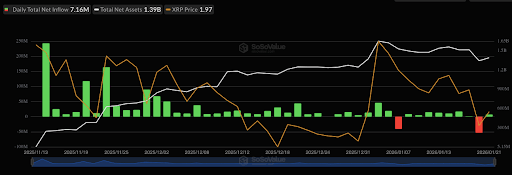
This weakness and price volatility appear to be driven by a slowdown in institutional participation. As selling pressure continues to mount, Spot XRP ETFs have recently recorded their second outflow since launching in November 2025. This latest outflow marks the largest ever recorded by XRP ETFs. 

According to SoSoValue, the first XRP ETF outflow occurred earlier this year, on January 7, when $40,80 million exited the investment products. The most recent data shows that XRP ETFs recorded another outflow of approximately $53.32 million on Tuesday, January 20. 

Grayscale was the only issuer to post outflows that day, with more than $55.39 million leaving its GXRP ETF, while products issued by Canary, Bitwise, and 21 Shares saw zero flows. Meanwhile, Franklin Templeton’s XRPZ recorded inflows of $2.07 million, which only slightly offset the losses, bringing the net daily outflow to $53.32 million. 

XRP Price 1

If more outflows occur, the continued drop in institutional activity, combined with XRP’s weakened price, could push the cryptocurrency lower. At present, XRP is trying to recover from recent losses, with its price rising approximately 1.62% over the past 24 hours, according to CoinMarketCap. 

XRP Open Interest Crash Adds To Weakness

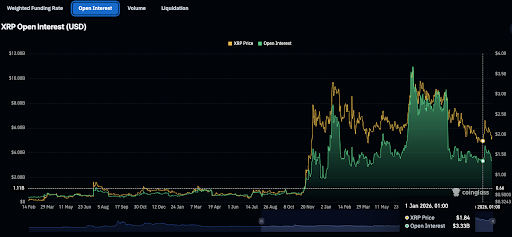
In addition to the decline in ETF inflows, XRP’s Open Interest (OI) has reportedly crashed to new lows, signaling a sharp reduction in trading activity and retail market participation. Data from Coinglass shows that XRP’s derivatives market saw its futures Open Interest fall to $3.35 billion this Wednesday. This marks the lowest level recorded since January 1, 2026, when OI declined to $3.33 billion. 

XRP Price 2

A drop in Open Interest often indicates that traders may be losing interest in XRP’s upside potential. This waning optimism and confidence may be further fueled by growing geopolitical and regulatory uncertainty. Investors appear to be adopting a more risk-off approach, reflected in the crypto Fear and Greed Index, which has entered extreme fear territory. 

XRP price chart from Tradingview.com

BlackRock Powers Bitcoin Investment For US Insurance Company, Here’s How

BlackRock is enhancing Bitcoin investment by creating new avenues for institutional capital to access the asset within the US financial system. Instead of relying on traditional crypto markets, the firm channels Bitcoin-linked returns through the insurance sector. Through its partnership with Delaware Life Insurance Company, this approach integrates BTC exposure into a fixed index annuity framework, allowing insurers and policyholders to benefit from Bitcoin-linked returns without direct ownership of the asset.

How BlackRock Is Powering Bitcoin Exposure In Insurance

BlackRock is enabling Bitcoin exposure for a US insurance company by translating the volatile asset into a structure that fits the strict risk requirements of insurance products. In a statement on Tuesday, Delaware Life confirmed it has added the BlackRock US Equity Balanced Risk 12% Index to its fixed index annuity portfolio, formalizing the integration. This index connects digital assets with traditional insurance frameworks in a controlled way, making Bitcoin participation feasible within a risk-managed product.

Instead of holding BTC directly, the index combines US equity exposure through the iShares Core S&P 500 ETF with Bitcoin exposure delivered via the iShares Bitcoin Trust ETF (IBIT). IBIT, BlackRock’s spot Bitcoin ETF launched in January 2024, has grown to nearly $76 billion in assets under management, establishing it as the primary institutional gateway for BTC exposure in the US.

Risk management is central to the index’s design. A 12% volatility target dynamically adjusts allocations to limit downside risk rather than pursue aggressive upside. This feature is essential for fixed index annuities, which are structured around principal protection.

As a result, policyholders are insulated from direct losses on their initial investment while still participating in index-linked returns influenced by both equity and BTC performance. BlackRock’s role extends beyond access, supplying the ETF infrastructure and volatility-controlled framework that allows Bitcoin exposure to function within an insurance balance sheet.

Why This Matters For Insurance And BTC Adoption

For Delaware Life, a subsidiary of Group 1001 Insurance Holdings, the partnership marks the first instance of a US insurer embedding Bitcoin exposure within a fixed index annuity. With Group 1001 overseeing approximately $76.4 billion in assets, the move reflects a strategic product expansion by a major insurance platform rather than an experimental initiative. Company leadership has positioned the offering as a response to growing demand from financial professionals seeking modern portfolio tools that remain compatible with retirement product risk constraints.

From BlackRock’s standpoint, the structure expands Bitcoin’s presence in long-term savings and insurance markets without altering the conservative expectations of those products. By framing BTC as a return component within a tightly governed risk framework, BlackRock enables institutional adoption that aligns with regulatory standards, insurer capital requirements, and retirement planning logic. In effect, Bitcoin exposure is being packaged in a form insurers already understand and can distribute, quietly extending its reach into one of the most risk-controlled areas of finance.

Bitcoin price chart from Tradingview.com

XRP Just Hit An Infamous Liquidity Pocket, Here’s What Happened Last Time It Hit

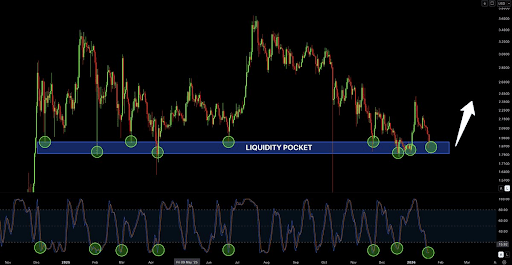
XRP has once again traded directly into a price zone that a few traders have come to recognize as a liquidity pocket. This area has acted as a magnet for price since December 2024, causing repeated tests and reactions that stand out clearly on the price chart. In a recent technical breakdown shared on X, crypto analyst ChartNerd highlighted how XRP has repeatedly made contact with this liquidity pocket over the past year and the cryptocurrency might be approaching a relief bounce.

Liquidity Pocket: Support Or Springboard?

Technical analysis of XRP’s price action shows that the cryptocurrency is now trading within a liquidity zone that has acted as a support range since December 2024. This liquidity zone, which spans the range from $1.90 to $1.75, has acted as a price magnet for many months. Even after reaching its all-time high of $3.65 in July 2025, XRP entered into a multi-month correction that eventually found support at this liquidity zone.

According to the analysis, nearly every prior visit to this zone was followed by some form of relief, especially when momentum indicators aligned. The last time XRP returned to this level, it slowed down its decline and eventually bounced back above $2.4 in early January.

However, the most recent push downwards played out as a 20% decline after a rejection at the $2.40 zone in early January, which has essentially pushed the XRP price action back to trading within this liquidity range and has started to show tentative stabilization. 

To bring further confirmation to the setup, the analyst included the daily Stochastic RSI below the price chart. This momentum indicator, which measures relative strength and conditions of overbought or oversold pressure, is currently sitting in deeply oversold territory according to the chart. These oversold conditions in the Stoch RSI aligned with rebounds off this same liquidity pocket.

XRP Liquidity pocket

XRP Price Chart. Source: @ChartNerdTA On X

What Happens Next?

If history repeats itself, the repeated tests of this liquidity pocket and accompanying oversold signals might be clearing the road for a bounce. If XRP was underneath this pocket and rejecting at this level, that would be bearish. Holding it as support for a long duration points to a strong support strength in this area.

That said, there is another possibility that the reverse could happen. Should XRP break decisively below this zone with strong selling pressure, the technical setup would shift from supportive to bearish and leave the price action trending downwards.

Trading activity hints that recent buyers may be in a tough spot, because the mix of holders now resembles the early 2022 structure when price pressure was high. That means many participants may be below their breakeven cost basis, and this can build selling pressure over time if prices fail to move higher.

XRP price chart from Tradingview.com

Pundit Clarifies XRP Roadmap To $10: How Price Will Play Out In 2026

Although the XRP price has remained in a downtrend and largely range-bound since falling below its 2025 peak, a crypto analyst believes it could still surge to $10 in 2026. The analyst has shared a detailed roadmap supporting this bullish outlook, outlining how XRP’s price could play out this year and the key factors that could influence its movements.  

A Roadmap To XRP $10 Price Surge

In a YouTube video released on January 20, crypto market analyst Zach Rector laid out his honest expectations for XRP’s outlook in 2026, offering insights into how it could get to $10 and the catalysts that could fuel this rally. According to the analyst, the XRP market is currently dominated by Fear, Uncertainty, and Doubt (FUD), along with signs of capitulation, which have pushed the price down and negatively impacted the sentiment and confidence of newer investors. 

Rector revealed that long-term XRP holders are also becoming increasingly frustrated with the prolonged downtrend, with many wishing they had taken profits during last year’s rally, particularly when XRP rose to a peak around $3.6. He added that there has also been discontent and negative sentiment regarding XRP’s slow adoption, delay in industry regulation, and more. 

However, from both a technical and investment standpoint, the analyst said he remains excited and optimistic about XRP’s price prospects in 2026. He explained that the market is already entering a renewed liquidity cycle, a shift that typically leads to an expansion in the broader business cycle. According to him, this stage has always correlated with powerful bull runs during an altcoin season. 

Rector mentioned that although many investors and analysts expected an altcoin season in 2025, it never came. He believes that market conditions could still align for an altcoin season this year, with XRP positioned for significant gains during that period. He further acknowledged that he does not expect XRP to skyrocket to $50 or $100 in 2026, calling those price targets highly ambitious. 

For his more realistic projection, Rector said he believes XRP could rise to between $5 and $10 in 2026. He noted that a significant sell wall exists around this range, as many investors are likely to take profits amid potential price volatility. Despite this, the analyst said that XRP still brings a strong ROI opportunity for investors. He pointed to factors that could drive the market, including US interest rate cuts, the implementation of the CLARITY Act, and billions of dollars expected from the Fed’s QE programs. 

XRP Could Double ROI Faster Than Gold And Silver

In his video, Rector compared XRP’s long-term profitability potential to that of gold and silver. He noted that both precious metals performed exceptionally during this cycle, reaching new all-time highs. Silver, in particular, exceeded expectations, breaking past $95 in the last 24 hours after experiencing a years-long downtrend. 

Rector believes that the chances of silver doubling to $200 or gold reaching $9,000-$10,000 per ounce this year are low. However, he says XRP has much stronger upside potential, forecasting a surge to $4 and beyond. If this happens, long-term investors who bought at or below $2 could effectively double their ROI.  

XRP price chart from Tradingview.com

Is Dogecoin About To Repeat NVIDIA’s Run? Here’s What The Chart Says

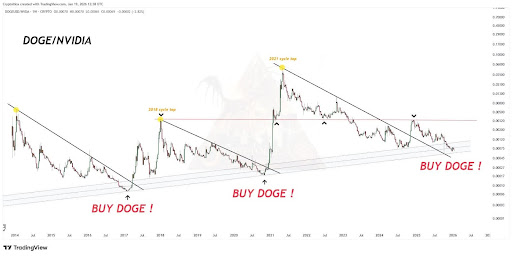
Comparing Dogecoin to NVIDIA may seem illogical at first. One is a speculative digital asset rooted in internet culture, while the other is a leading equity in the AI and tech sector. However, a chart shared by cycle analyst @Cryptollica reframes the comparison by stripping away narrative and focusing on capital flows. Rather than asking which story is more compelling, it examines how money has historically rotated between established market leaders and high‑risk assets as cycles mature.

What The Dogecoin—NVIDIA Chart Is Showing Investors

The chart posted by Cryptollica tracks the DOGE-to-NVIDIA ratio across multiple market cycles, emphasizing relative performance rather than absolute price. This perspective matters because it highlights where capital has generated the highest marginal returns over time. Historically, the ratio has moved within a clearly defined downward channel, with major turning points occurring when the price reaches the lower boundary of that structure.

During both the 2017 and 2021 cycles, the ratio compressed into this same support area. In each case, NVIDIA had already realized significant upside, while Dogecoin remained heavily discounted in relative terms. What followed was not a breakdown in NVIDIA’s price, but a period where Dogecoin significantly outperformed as speculative capital rotated back into higher-risk opportunities.

The current structure mirrors those earlier conditions. The ratio is again testing long-term support, signaling a familiar imbalance: extended gains already priced into NVIDIA, and suppressed relative value in Dogecoin. In previous cycles, this setup preceded sharp shifts in relative performance as liquidity began favoring assets with greater upside sensitivity.

What A Rotation Environment Means For Dogecoin

The pattern highlighted by the chart centers on rotation rather than decline. When leading trades lose momentum, capital typically stays within the market and seeks higher beta exposure. Historically, Dogecoin has benefited during these transitions, serving as a vehicle for speculative flows once dominant growth assets reached saturation.

Dogecoin price

This does not imply weakness in NVIDIA’s underlying fundamentals. Its valuation remains tied to sustained AI-driven growth expectations. Dogecoin, however, operates under a different dynamic, driven largely by sentiment and liquidity conditions. When markets move from concentration into dispersion, assets like DOGE have previously delivered outsized percentage gains.

The chart suggests that a similar environment may be forming again. At comparable points in past cycles, Dogecoin outperformed after NVIDIA-like leaders had already completed their primary expansion phase. If the ratio holds its historical support, the data points to a renewed window where DOGE could outperform on a relative basis.

Rather than predicting hype-driven rallies, the chart highlights a recurring structural relationship between capital leaders and speculative assets. Whether the pattern repeats will depend on liquidity and risk appetite, but the setup reflects a consistent historical behavior that has appeared more than once across market cycles.

Dogecoin price chart from Tradingview.com

XRP’s Blessing In Disguise: How Investors Could Benefit Soon

Crypto market expert, ChartNerd, has said that XRP’s recent flash crash could be a “blessing in disguise.” According to the analyst, the drawdown has placed the cryptocurrency at the exact sell-side liquidity the analyst mentioned in previous reports, increasing the potential for a bullish takeover even as market dynamics remain uncertain and weak. 

Why The XRP Crash Could Be A Blessing In Disguise

In an X post on January 9, ChartNerd suggested that the recent sell-off that saw the XRP price crash by more than 4.6% this week could end up working in the market’s favor. He said the decline may be a “huge” blessing in disguise, as it has sent the price directly into a long-anticipated sell-side liquidity zone. 

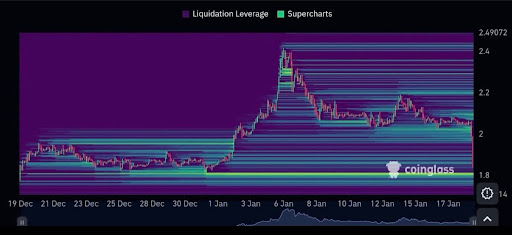
The analyst shared a chart highlighting the sell-side liquidity pocket around the $1.8 level on the monthly heatmap. Rather than signaling weakness, ChartNerd indicated XRP’s latest move aligned with areas where bulls have consistently shown interest. He noted that this liquidity zone had acted as a key support area for the altcoin for approximately 13 months, with bulls repeatedly stepping in to prevent deeper downside

XRP

Notably, XRP experienced a major flash crash this week, sending its price tumbling from above $2 to below $1.95. Following its earlier January high near $2.49, the cryptocurrency also declined sharply, now settling into this highlighted liquidity band. On the heatmap, the area around $1.80 appears to be the most intense and concentrated, reflecting strong historical engagement and repeated price reactions. 

ChartNerd has characterized XRP’s retest of sell-side liquidity as a “clarity response” rather than a structural breakdown. Typically, a decline of this magnitude can trigger fear and uncertainty in the market about a cryptocurrency’s next move. However, ChartNerd has said that he is now closely monitoring how the market responds to this new reaction. His analysis offers hope that the recent crash may ultimately benefit investors by establishing a clearer directional bias, rather than simply being a destructive sell-off that undermines its broader structure.  

While the analyst’s report adds significant context to XRP’s latest move, community members have responded with their own forecasts. Some believe that the recent crash into sell-side liquidity could trigger another breakdown to $1.20, which would represent a more than 38% drop from current levels around $1.96. Others, however, remain relatively bullish, opting to wait and see how the market reacts. 

Price Stabilizes After Crash

This week, XRP gave up gains that had fueled a major recovery earlier this year. While hovering around $2, XRP repeatedly tested upper resistance levels but failed to break out to the upside. Although the recent decline pushed it back underneath $2, its price has since stabilized and is now consolidating above $1.95. 

Interestingly, the pullback has been accompanied by a significant increase in trading volume. Recent reports reveal that XRP’s trading activity spiked across several markets despite its struggling price. 

XRP price chart from Tradingview.com

Shiba Inu Whales Are On The Move Again, 361 Billion SHIB Stuns Community

Shiba Inu’s on-chain data shows an interesting dynamic among SHIB holders and their relationship with crypto exchanges. Recent metrics from CryptoQuant show sustained withdrawals from exchanges alongside a noticeable increase in burn activity in the past few days, all of which are signs of tighter supply conditions. 

This dwindling exchange supply reflects hundreds of billions of SHIB tokens removed from exchanges in recent days in a trend that dates back up to a year.

Massive Decline In SHIB Held On Exchanges

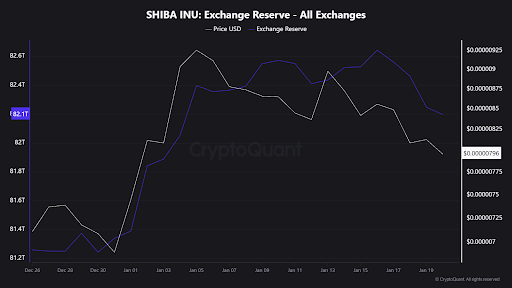
According to data from on-chain analytics platform CryptoQuant, SHIB exchange reserves have declined noticeably as whale wallets withdraw large amounts of tokens from trading platforms. On January 16, the total Shiba Inu exchange reserves stood at approximately 82.6 trillion SHIB. As of January 20, that figure has fallen to about 82.23 trillion SHIB.

This change means that roughly 370 billion SHIB has been removed from exchanges in just a few days. Such movements are typically attributed to whale activity, as transfers of this size are rarely caused by retail traders. When whales move SHIB off exchanges, the tokens are often sent to cold storage or long-term holding wallets, reducing the amount of supply immediately available for selling.

Shiba Inu 1

SHIB Exchange Reserve. Source: CryptoQuant

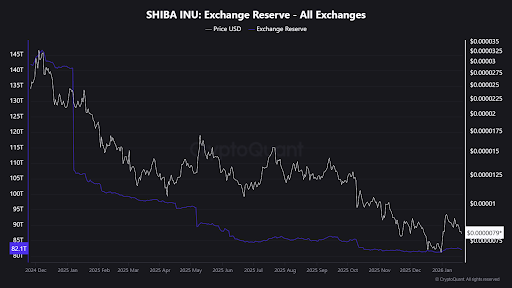
This short-term outflow also fits into a much larger trend of outflows from crypto exchanges since January 2025. CryptoQuant data shows that SHIB exchange reserves were close to 140 trillion tokens in early January 2025. Since then, however, SHIB whales have steadily reduced exchange balances, and this has pushed the reserves down to current levels around 82.2 trillion SHIB. The consistency of this decline suggests deliberate accumulation or long-term positioning by large holders.

Shiba Inu 2

SHIB Exchange Reserve. Source: CryptoQuant

Whale Activity Correlates With Increased SHIB Burn Rates

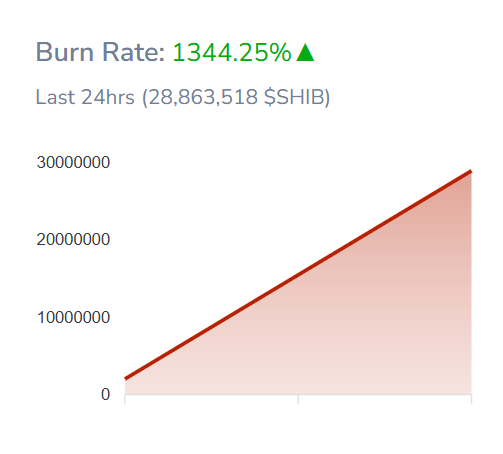
Burn activity across the Shiba Inu network has intensified alongside whales withdrawing SHIB from exchanges. According to recent on-chain data, the SHIB burn rate has witnessed a jump of more than 1,200% in the past 24-hour period, with almost 29 million SHIB permanently removed from circulation. 

Although burns are not exclusively initiated by whales, large holders often play a role by sending large tokens to burn addresses or interacting with ecosystem mechanisms like Shibarium that lead to burns. Data from the burn tracker website Shibburn shows that the bulk of these burns were made with one single transfer of 28 million SHIB tokens sent to burn address CA.

Shiba Inu 3

SHIB Burn Rate. Source: Shibburn.com

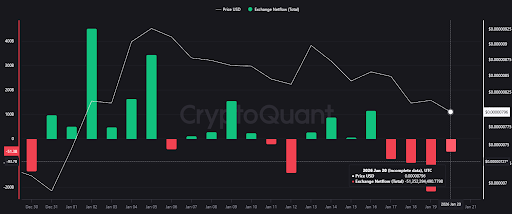
According to CryptoQuant data, over 51.2 billion SHIB tokens have been withdrawn from crypto exchanges in the past 24 hours alone. So far, Shiba Inu’s price action has not made a decisive move in response to these changes. At the time of writing, Shiba Inu is trading at $0.00000794, up by 1% in the past 24 hours but down by 7.6% in a seven-day timeframe.

Shiba Inu 4

SHIB Exchange Netflow. Source: CryptoQuant

Shiba Inu price chart from Tradingview.com

XRP’s 45% Crash On Binance: What’s Going On With The Crypto Giant?

XRP’s presence on Binance has undergone a dramatic contraction over the past year, with exchange-held reserves dropping by roughly 45%. This sharp decline has shifted attention away from short-term price fluctuations and toward a deeper structural change in how XRP supply is being managed on the world’s largest crypto exchange. The scale and persistence of this crash raise a central question: why is XRP disappearing from Binance, and what does this mean for the market going forward?

Binance’s XRP Reserves Collapse Signals A Structural Supply Shift

Over a twelve-month period, the value of XRP held on Binance fell from about $10.16 billion in mid-January 2025 to roughly $5.55 billion by mid-January 2026, according to on-chain data. This was not a sudden drain triggered by a single event. Instead, reserves declined through a steady sequence of withdrawals, with short-lived recoveries repeatedly followed by fresh outflows.

This pattern points to a deliberate and sustained move away from keeping XRP on the exchange. As Binance acts as a primary liquidity venue for XRP, such a steep contraction materially reduces the amount of supply readily available for trading. By early 2026, reserve levels had dropped close to yearly lows, confirming that the crash was not corrective but structural in nature.

The result is a tighter exchange-side supply environment. With fewer tokens sitting on Binance, the market loses a layer of immediate liquidity that typically absorbs selling activity. This reshaping of supply dynamics changes how price reacts to shifts in demand.

How XRP’s Price Behavior Connects To The Binance Crash

XRP’s price action during the reserve drawdown provides important context. Periods marked by accelerated outflows from Binance have historically aligned with price stabilization or subsequent upside moves. This relationship became especially clear in mid-2025, when a steep fall in exchange-held XRP coincided with a strong rally.

The underlying mechanism is straightforward. When exchange reserves shrink, selling pressure tends to ease because fewer tokens are positioned for rapid distribution. At the same time, XRP’s relatively stable price during the latest phase of reserve contraction suggests that holders are not exiting en masse but repositioning for longer-term exposure.

The continued crash in Binance’s XRP reserves implies that investors are favoring self-custody or long-term storage strategies. This behavior is commonly associated with accumulation phases rather than imminent sell-offs. As a result, any meaningful pickup in demand could have an outsized impact on XRP’s price due to the reduced supply available on the exchange.

While broader market conditions will still dictate direction, the 45% crash in Binance’s XRP reserves highlights a decisive shift in market structure. It suggests XRP is moving into a tighter supply phase, one that has historically created conditions favorable for stronger price responses when demand re-emerges.

XRP price chart from Tradingview.com

What To Expect For The Bitcoin Price This Week After Psychological Breakdown

A crypto analyst has delivered a detailed psychological breakdown outlining what investors, traders, and market watchers should expect from the Bitcoin price this week. The report focuses on market behavior that has remained largely unchanged and could most likely continue its bearish streak to new lows. 

Bitcoin Price Expectation For The Week

Crypto market expert Doctor Profit has released a compelling report examining the Bitcoin price movement this week. In this analysis posted on X, he explained that Bitcoin has seen almost no meaningful price movement since November 2025. Price action remains stuck in a sideways consolidation, which the analyst views as a bearish sign that could eventually lead to another crash below the $80,000 zone. 

Doctor Profit revealed that he had anticipated Bitcoin’s current consolidation months earlier. He warned that sideways movement would dominate the market before BTC faces a sharper pullback. That warning still stands, signaling a cautious, bearish outlook for the leading cryptocurrency.   

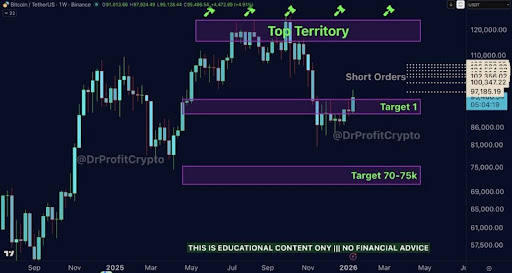
Because he expects Bitcoin to move lower, the analyst confirmed that he is still holding his short position from $115,000 and $125,000. He noted that additional shorts would only be considered if BTC revisits the $97,000-$107,000 range, and nowhere earlier. Doctor Profit also revealed that his first short, around $97,000, has already been filled, with another positioned near $98,000.

The analyst shared a detailed price chart showing all his short positions and Bitcoin’s “top territory” near $120,000. Several additional orders have also been placed between $97,000 and $110,000 to manage risk during the cryptocurrency’s prolonged consolidation phase. 

Bitcoin price

Beyond technical structures, the report highlighted January 21, 2026, as a key date for the crypto market, as it marks the expected release of the CLARITY Act bill. Doctor Profit stressed that once the bill is published, it would give institutions and traders a clear view of the regulatory framework, showing who regulates crypto, how exchanges would be treated, and whether the new rules would favor or restrict the industry. 

Even without an immediate vote by the US Senate Banking Committee, Doctor Profit noted that the bill’s release alone could move markets. He explained that clarity eliminates uncertainty in the market, which is a powerful catalyst for price action. Notably, the vote on the bill has been scheduled for January 27, with its outcome set to shape the future of crypto regulations and also influence price movements. 

Analyst Remains Extremely Bearish On Bitcoin

Doctor Profit has said in his report that he remains extremely bearish on the market, expecting another leg down that would officially confirm his bear market thesis. He stated that there have been no relevant updates to invalidate his outlook or support a new bullish narrative. His chart forecasts a potential drop toward the $70,000- $75,000 range. With Bitcoin currently trading above $92,500, that would mean a decline of over 20%. 

Bitcoin price chart from Tradingview.com

3-Wave Correction Sets XRP Price On Bearish Course – Another Major Crash Is Coming

XRP’s price action in recent days has taken a softer turn, with the token now trading below $2 after failing to hold recent recovery attempts. That move has changed the near-term momentum back in favor of sellers, especially as price action is printing closes beneath short-term dynamic support on the higher timeframes. 

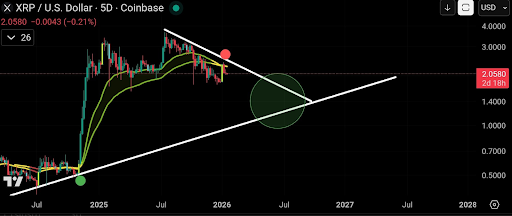
A technical analysis shared by CoinsKid on X looks at a broader corrective structure developing on the 5-day chart, one that could place XRP on a more pronounced bearish path if important price levels are not reclaimed.

3-Wave Correction: Structure And Significance

Technical analysis of XRP’s price action since mid-2025 shows an interesting corrective sequence that can be described in terms of waves. According to CoinsKid, what appeared to start as a corrective advance into the cluster of moving averages on the 5-day chart has failed to sustain itself once meeting resistance at the marked sell signal, which is shown in the chart image below.

According to CoinsKid’s interpretation of the 5-day candlestick chart, XRP price action appears to be tracing out a three-wave corrective move. The significance of this interpretation lies in its implication that the most recent bounce to $2.4 was not a true shift back to bullish control but a retracement within a larger downward corrective pattern that still has more moves to play out. 

An important point in the analysis is the loss of a custom indicator called the CoinsKid ribbon on the 5-day timeframe. This band of moving averages had previously acted as a guide for trend strength for most of 2025, with sustained trading above it pointing to bullish control. However, XRP has repeatedly closed below this ribbon since the flash crash in October 2025, and sellers have maintained control of the broader structure since then.

XRP Price

XRP Price Chart. Source: @Coins_Kid on X

Multi-Year Trendline As Downside Magnet

The bearish scenario outlined on the chart places XRP’s next major area of interest around the rising multi-year support trendline, which currently converges in the $1.30 to $1.40 range. This ascending white trendline, which is visible on the 5-day chart and extends back to 2020, coincides with zones where XRP found strong demand after pullbacks. The highlighted green zone on the chart centers on this $1.30 to $1.40 range.

At the time of writing, XRP is trading at $1.96, down by 4.7% in the past 24 hours. CoinsKid’s projection is that if the current corrective move continues to play out, the XRP price could rotate lower from the descending resistance line and travel toward this support area over the coming months. This would be the final move in an ABC wave correction that began after XRP peaked at a new all-time high of $3.65 in July 2025.

According to the analysis, only a sustained move back above the 5-day ribbon would invalidate this bearish path and reduce the likelihood of price revisiting that lower support region.

XRP price chart from Tradingview.com

Bitcoin Flashes Near-Identical Fractal Before The 2021 Bull Run Started

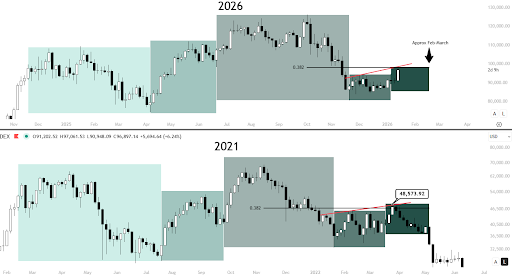
Bitcoin may be replaying a market structure that historically preceded one of its most powerful rallies. A high-timeframe trader has identified a fractal that closely mirrored Bitcoin’s behavior ahead of the 2021 bull run. He argues that the current cycle is unfolding in line with a well-established structural script observed across multiple market cycles spanning more than a decade.

Bitcoin’s Fractal: Rooted In High-Timeframe Structure

The fractal highlighted by the trader is based on a direct structural comparison between Bitcoin’s current cycle and the 2021 setup, illustrated in a chart he attached to his analysis. The chart aligns both periods to show how price advanced into a broad distribution range, rolled over into a sharp corrective phase, and then attempted to recover while capped by descending resistance. In both cases, Bitcoin retraced to the 0.382 Fibonacci level before stabilizing, marking a shared technical inflection point rather than a coincidental price overlap.

Bitcoin price

This structural symmetry extends beyond price levels into timing. According to the trader, the current cycle has tracked the rhythm of prior four-year cycles with notable consistency, allowing historical all-time highs and lows to be mapped objectively. Using that same framework, the data previously supported a high-probability short near the peak candle around $123,000, reinforcing his view that recurring market structure continues to guide directional risk.

By comparing the two cycles directly, the trader argues that Bitcoin’s behavior is being evaluated through a recurring structural pattern that has remained intact for more than 12 years, rather than through subjective bias.

$100,000 As A Structural And Psychological Ceiling

Within the identified fractal, psychological resistance is a key determinant of Bitcoin’s upside potential. Looking back at 2021, Bitcoin failed to decisively reclaim the $50,000 level and instead front-ran it before reversing, establishing a behavioral precedent for how traders respond to significant round-number thresholds. Applying this pattern to the current cycle, $100,000 now functions as the analogous psychological ceiling. As a result, some participants may act preemptively, which could generate selling pressure from underwater holders and distribution by larger players.

This potential resistance is reinforced by diagonal trendlines that mirror the caps observed in 2021, creating a structural limit on upside momentum. Within this context, short-term extensions into the $98,000–$99,000 range remain plausible and are fully compatible with the fractal, as price can approach the psychological ceiling. Moreover, positioning data from the past six to eight months indicates that the median short-term buyer cost basis has clustered between $95,000 and $100,000, highlighting zones where profit-taking and defensive selling are likely to intensify.

These elements suggest a scenario where price may test resistance, experience temporary stalls, and respect structural limits without invalidating the broader high-timeframe thesis. However, the trader notes that the framework is probabilistic: only a sustained move above $104,000–$105,000 would break the fractal pattern and necessitate a full reassessment of the high-timeframe trend.

Bitcoin price chart from Tradingview.com

XRP Social Interest Explodes To Rival The Likes Of Bitcoin – Details

XRP is in the center of crypto conversations, with social interest on X rising to levels that now rival Bitcoin. Recent data tracking the most searched cashtags on the platform shows XRP consistently appearing among the dominant assets drawing user attention.  Interestingly, this surge in visibility is not happening in isolation but in tandem with a series of regulatory, institutional, and ecosystem developments within the XRP ecosystem.

XRP Surges Into The Top Cashtags On X

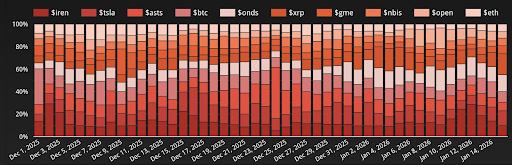
Data tracking the most-searched cashtags on the social media platform X shows XRP climbing alongside other cryptocurrencies like Bitcoin and Ethereum. However, a closer look at the data shows that XRP has received many more cashtags compared to other cryptocurrencies.

This trend was revealed by Nikita Bier, head of product at X, who shared a visualization chart of recent search behavior on X. The chart data shows that XRP has consistently appeared among the most queried assets on X since December 2025. Throughout the period depicted, top cashtag traffic has been fluctuating with daily rhythm as X users scan the platform and post on X with cashtags.

The share of searches attributable to $xrp slices into a larger portion of the total during days in early January 2026, which indicates extended interest. On some dates, XRP’s presence in the search mix rivals that of $btc and $eth, which are typically the dominant anchors of crypto attention on social media.

The chart also shows how other tags wax and wane alongside XRP’s performance. Some days show greater fragmentation, where interest is spread across stocks such as $iren (IREN), $tesla (Tesla), $gme (GameStop), and $asts (AST SpaceMobile Inc.). Nonetheless, the trajectory for XRP in the first half of January shows a growing base of people actively getting involved in the cryptocurrency.

XRP Social sentiment

Top Cashtags Searched On X

Why XRP Is Commanding So Much Attention

Social interest on X is a mix of speculation and ecosystem developments, which XRP is currently sitting at the center of. Behind this spike in attention are tangible developments surrounding Ripple and the XRP ecosystem. 

One recent example is how Ripple secured regulatory approval from the UK’s Financial Conduct Authority, obtaining both an Electronic Money Institution license and cryptoasset registration. Ripple’s regulatory buildout is expanding across Europe, with additional approvals in Luxembourg as part of its push to operate on both sides of the continent.

Interestingly, there are also indications of deeper engagement with Ripple’s ecosystem on the institutional side. Rumors and mentions on X indicate that BlackRock, the world’s largest asset manager, has started to use Ripple’s USD-backed stablecoin (RLUSD) as collateral. However, this move is yet to be confirmed by BlackRock.

These updates, combined with many others, help explain why social interest and cashtag searches for XRP have recently been on the rise on X and other social media platforms.

XRP price chart from Tradingview.com

PEPE Price Could Soar 3,000% If The Bottom Is In; Analyst Explains

As meme coins posted sharp rebounds earlier this year, PEPE also rallied, delivering notable gains. Although the meme coin has since slipped back into negative territory, a crypto analyst believes another bullish reversal may be approaching soon. According to the analyst, a key technical pattern has recently emerged on the chart, suggesting that PEPE has formed a bottom and could be on its way to a massive 3,000% price rally. 

PEPE Price Prepares For Massive 3,000% Rally

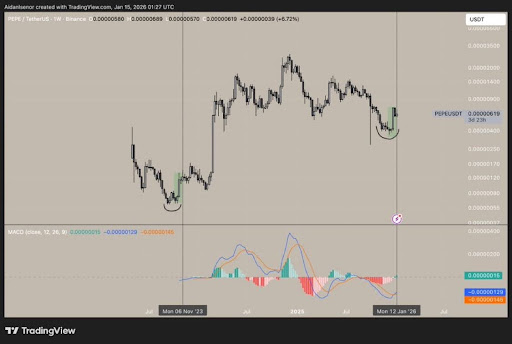
In a post shared on X this Thursday, market analyst CryptoLinx outlined a bullish outlook for PEPE, pointing to a key shift on the weekly chart that he believes could trigger a 3,000% rally in the meme coin’s price. He stated that PEPE has just printed a bullish Moving Average Convergence Divergence (MACD) cross on the weekly timeframe. 

The analyst’s chart shows the weekly MACD lines crossing upward with momentum shifting from red to green. This move comes after an extended downtrend and coincides with price stabilizing and starting to curl higher, a pattern often associated with a rounded bottom. 

PEPE price

In his post, CryptoLinx emphasized that most traders and investors do not fully understand just how powerful the weekly MACD can be when it crosses at a true market bottom. Such moments often mark the market’s transition from an accumulation phase to a sustained uptrend. 

In previous cycles, similar setups have led to substantial price appreciation in PEPE. Moves of 200% to 300% were recorded in the PEPE price as momentum shifted in favor of buyers. CryptoLinx has suggested that if PEPE has indeed found its true bottom, its potential price rally could be significantly more explosive than past cycles. 

Based on the analyst’s predictions, the bullish MACD cross would not fuel a simple price recovery for PEPE, but an explosive surge that could completely flip its ongoing downtrend and mark a new ATH. The analysis points to a potential upside of 1,500% to 3,000% for PEPE this year. Such a rally could see the meme coin jump from its current levels around $0.00000585 to $0.0000928 and $0.000179, respectively. 

An Update On PEPE Price Action

In 2025, the Pepe price spent several months in a sustained downtrend, closing the year in the red and extending its losses into the first few days of 2026. However, as meme coins saw a sudden market revival at the beginning of the year, PEPE jumped by more than 30%, briefly rallying before shedding some of its gains. 

According to CoinMarketCap’s data, the PEPE price remains down over 68% Year-to-Date (YTD). Despite this broader decline, the meme coin has shown signs of recovery, climbing more than 44% over the past month. At the time of writing, PEPE is down nearly 3% in the last 24 hours and about 4.5% in the past week. 

PEPE price chart from Tradingview.com

Pundit Warns XRP Is On The Verge Of Being Sold Out, What’s Going On?

Is XRP running out? A recent debate between market analyst Jake Claver and other industry commentators has thrust the digital asset back into the spotlight, predicting a looming supply crunch. As structural limits meet rising demand, experts warn of a “sell-out” scenario that could fundamentally redefine the token’s market dynamics.

The Escrow Trap And The Reality Of An XRP Supply Shock

The core of the “sell-out” claim lies in the technical architecture of the XRP Ledger’s escrow system. In a post on January 14, 2026, Claver explained that Ripple’s monthly supply releases are hard-coded into the protocol, meaning the company is unable to inject extra tokens into the market during a liquidity crisis. While this mechanism was designed to provide predictability and limit manipulation, it creates a double-edged outcome. In a high-demand environment, supply becomes effectively inelastic.

This structure is more relevant when viewed against current supply figures. XRP has a hard maximum of 100 billion tokens. About 60.7 billion XRP are already in circulation, leaving roughly 39.3 billion outside active market supply. At a price near $2.10, circulating supply translate to a market capitalization above $127 billion, while the fully diluted valuation sits close to $210 billion.

These figures show that nearly 40% of XRP’s total supply is effectively off the table and cannot be accessed to meet sudden demand. If a large institution attempted to buy $10 billion worth of XRP, Ripple could not unlock escrow early to provide liquidity because the ledger prohibits releases beyond the 1-billion-token monthly cap. Any abrupt surge in buying pressure therefore, cannot be met with new supply. This rigidity materially increases the risk of a severe supply shock, with price acting as the sole pressure valve under this structural bottleneck.

Institutional Accumulation Pushes Toward A Liquidity Cliff

The conversation escalated when a user known as RemiRelief responded to Claver, sounding an alarm that XRP is “on the verge of being sold out completely.” RemiRelief argued that there is very little liquid supply left on exchanges and predicted a “mind-boggling” scenario if investors began moving their holdings into private storage. The post specifically pointed to the potential entry of BlackRock as a catalyst that would drain the remaining “low-hanging fruit” from the market.

The current performance of XRP ETFs supports this “constant buying” narrative. Since early 2026, XRP ETFs have seen massive, consistent net inflows—reaching over $1.37 billion in a single week. Every dollar flowing into an ETF represents XRP being sucked out of the public market and locked into institutional vaults. 

RemiRelief’s claim stems from this collision: institutional giants are buying up tokens at a record pace, while the “escrow trap” Claver described prevents any new supply from entering the market to balance it out. Beyond signalling a looming sellout, this debate emphasizes that the window for acquiring XRP at “low” prices is closing fast.  

XRP price chart from Tradingview.com

Dogecoin Founder Crashes Bullish Bitcoin Hopes, Casts Doubts On All-Time High Predictions

Dogecoin is part of those receiving inflows with the current inflows into the Bitcoin and crypto industry. However, Billy Markus, best known as the co-creator of Dogecoin, shared a blunt take on the current state of digital assets. 

Taking to the social platform X, Markus acknowledged the general strength of the market but made it clear he isn’t interested until he sees cryptocurrencies breaking past their previous peak price levels. His message came at a moment when markets have shown gains and following Bitcoin’s return above $96,000.

Doubts On All-Time High Predictions

The entire crypto market cap is currently sitting at $3.344 trillion at the time of writing. When compared to the $3.047 trillion recorded on January 1, this represents an increase of about 9.7%, meaning close to $300 billion has flowed back into digital assets over the past few weeks. That rise has helped restore some confidence across the market after a period of choppy and indecisive price action in late 2025.

Things are going well for Bitcoin, Ethereum, and other large market-cap cryptos, and bullish momentum is starting to creep in steadily. However, Billy Markus, the co-creator of Dogecoin, specifically mentioned the need for big benchmark breaks to actually happen before believing the optimism that’s creeping in.

In a short message addressed to his millions of followers, Markus remarked that while “crypto is doing good and all,” he would rather be woken up when all-time highs are actually being broken. The comment struck a chord across the community and quickly drew a range of reactions, with some noting new all-time highs feel like a myth at this point, and others noting that new price highs are certainly coming.

Although Markus and his co-creators created Dogecoin as a joke, he holds a selective view of the different assets in the crypto industry. Over the years, he has expressed respect for a small group of networks he views as meaningful or resilient, including Bitcoin, Ethereum, Dogecoin, and Solana.

Where Crypto Stands Now

Billy Markus’ comment shows a larger divide between perspectives in the crypto community based on the current price action of major cryptocurrencies. On one hand, prices have recovered meaningfully from recent pullbacks, but on the other, the major benchmarks many traders are watching have yet to be reclaimed.

Bitcoin is currently trading in the mid-$90,000 range $96,240 after retreating from its October peak above $126,000. This price uptick is yet to reclaim $100,000, and it might not be until this happens that a full bullish momentum rolls in.

Dogecoin’s performance corresponds to the broader market’s mixed signals. The meme token is now back to making daily closes above $0.14 as selling pressure eases and traders are on high alert. However, technical analysis of Dogecoin’s price action shows that the real test is at $0.157, and traders should not celebrate early until this level falls.

Dogecoin price chart from Tradingview.com

❌