Reading view

There are new articles available, click to refresh the page.

XRP Price Prediction: $1.88 Triple-Bottom Support as ETF Money Pulls Back – What’s Next?

XRP is trading near $1.89–$1.91 as January draws to a close, holding a well-defined triple-bottom support around $1.88 after slipping below the $2.00 mark earlier this week. The pullback has coincided with ETF outflows and a sharp drop in trading volume, but price action suggests stabilization rather than renewed selling pressure.

With volatility compressing and buyers repeatedly defending the same demand zone, XRP is approaching a technical decision point that could define its next directional move.

ETF Outflows Ease Short-Term Momentum Without Breaking the Thesis

Short-term pressure has been driven largely by institutional flows. According to data reported by CryptoQuant, U.S. spot XRP ETFs recorded their first weekly net outflows, totaling approximately $40.6 million toward the end of January. Trading volume has also declined sharply, with some estimates showing a 50%+ drop in 24-hour activity, signaling trader hesitation rather than aggressive selling.

That said, the flow data points to rotation and profit-taking, not abandonment. XRP remains one of the few large-cap tokens with clear regulatory positioning in the US, and earlier ETF inflows north of $1 billion underscore that institutional interest hasn’t disappeared. The current reset appears more about leverage clearing than confidence breaking.

Core Adoption Trends Remain Unchanged Despite Price Weakness

Fundamentally, Ripple’s long-term thesis remains unchanged. XRP continues to underpin on-demand liquidity (ODL) across Ripple’s global payments network, offering faster and cheaper settlement compared to legacy systems.

More than 300 financial institutions remain connected to RippleNet, and ongoing regulatory clarity following 2025 rulings continues to distinguish XRP from many peers.

While no major partnership headlines have emerged this week, the absence of negative ecosystem news reinforces the view that the current weakness is market-driven, not fundamental.

XRP Price Prediction: Volatility Shrinks at $1.90 – Breakout or Breakdown Ahead?

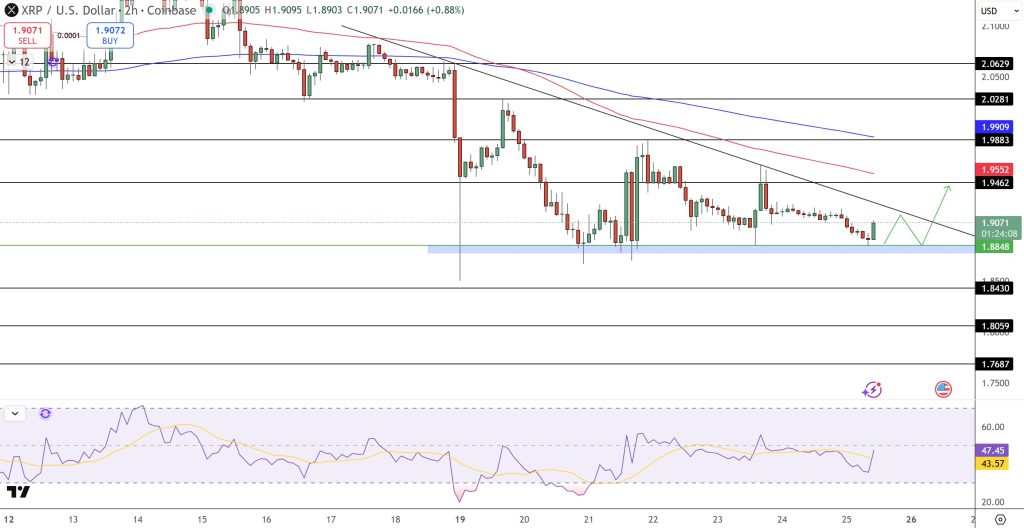
From a technical perspective, XRP price prediction remains cautiously neutral near term. On the 2-hour chart, price is stabilizing inside a descending channel, capped by a falling trendline near $1.95. XRP is trading below the 50-EMA and 100-EMA, while the 200-EMA near $1.99 continues to act as firm resistance.
XRP Price Chart – Source: Tradingview

Support is clearly defined between $1.88 and $1.85, where repeated long lower wicks suggest responsive buying. RSI has recovered into the mid-40s after oversold readings, indicating easing downside pressure. Volatility has contracted, forming a descending wedge, a structure that often resolves higher if support holds.

A successful break above $1.95 would expose $2.03–$2.06, signaling structural repair. Conversely, a decisive loss of $1.85 would open downside toward $1.80 and $1.77.

XRP Trade setup: Accumulate near $1.88–$1.85, target $2.03–$2.06, invalidation below $1.80.

Bitcoin Hyper: The Next Evolution of BTC on Solana?

Bitcoin Hyper ($HYPER) is bringing a new phase to the BTC ecosystem. While BTC remains the gold standard for security, Bitcoin Hyper adds what it always lacked: Solana-level speed. The result: lightning-fast, low-cost smart contracts, decentralized apps, and even meme coin creation, all secured by Bitcoin.

Audited by Consult, the project emphasizes trust and scalability as adoption builds. And momentum is already strong. The presale has surpassed $30.9 million, with tokens priced at just $0.013635 before the next increase.

As Bitcoin activity climbs and demand for efficient BTC-based apps rises, Bitcoin Hyper stands out as the bridge uniting two of crypto’s biggest ecosystems. If Bitcoin built the foundation, Bitcoin Hyper could make it fast, flexible, and fun again.

Click Here to Participate in the Presale

The post XRP Price Prediction: $1.88 Triple-Bottom Support as ETF Money Pulls Back – What’s Next? appeared first on Cryptonews.
Ethereum Price Prediction: $3,000 Rejected, But On-Chain Data Tells Another Story

Ethereum is trading in the $2,930–$2,950 range as of January 25, 2026, consolidating after a broader pullback from January highs above $3,400. The move lower reflects near-term macro caution and heavy ETF-related selling rather than a breakdown in network fundamentals.

With Bitcoin hovering near $89,000 and risk sentiment mixed, ETH has shifted into a range-bound phase where price is lagging underlying activity.

ETF Pressure Weighs on Price, Not Structure

Short-term pressure has largely come from spot ETH ETF outflows, which exceeded $600 million between January 20–23, led in part by a single-day $250 million exit from BlackRock’s ETHA. This selling has cooled momentum and kept ETH capped below the $3,000 handle.

However, the flow data points more toward rotation and profit-taking than institutional abandonment. On-chain tracking shows whales accumulating roughly $1 billion worth of ETH during the recent correction, while funding rates and open interest have reset from crowded long conditions. That combination suggests leverage is being flushed, not confidence.

On-Chain Activity Tells a Different Story

Beneath the price, Ethereum’s network activity remains strong. Daily active addresses have climbed toward 1.3 million, while transaction counts are holding between 1.9 million and 2.2 million per day.

Validator behavior reinforces this trend: exit queues are near zero, entry queues are rebuilding, and staking participation continues to rise, tightening circulating supply.

Low fees and improved efficiency post-upgrades are also driving sustained DeFi and app usage, reinforcing a “price weak, fundamentals firm” dynamic that has historically preceded larger trend moves.

Ethereum Rises Despite U.S.-Iran Tensions

On the geopolitical front, the tensions are rising between the U.S. and Iran as Iran’s Revolutionary Guard warns it is “more ready than ever” amid U.S. warships moving toward the Middle East. The warning comes after Iran’s recent crackdown on protests, which left thousands dead, and Trump has set strict red lines for military action, including preventing mass executions and violence against civilians.

Despite these geopolitical tensions, Ethereum (ETH) continues to rise. This shows that investors remain confident in Ethereum’s growth, likely supported by strong developments like the Ethereum Foundation prioritizing post-quantum security.

Today marks an inflection in the Ethereum Foundation's long-term quantum strategy.

We've formed a new Post Quantum (PQ) team, led by the brilliant Thomas Coratger (@tcoratger). Joining him is Emile, one of the world-class talents behind leanVM. leanVM is the cryptographic…

— Justin Drake (@drakefjustin) January 23, 2026

Ethereum Price Prediction: Compression Builds Near $2,950 as ETH Eyes Its Next Leg

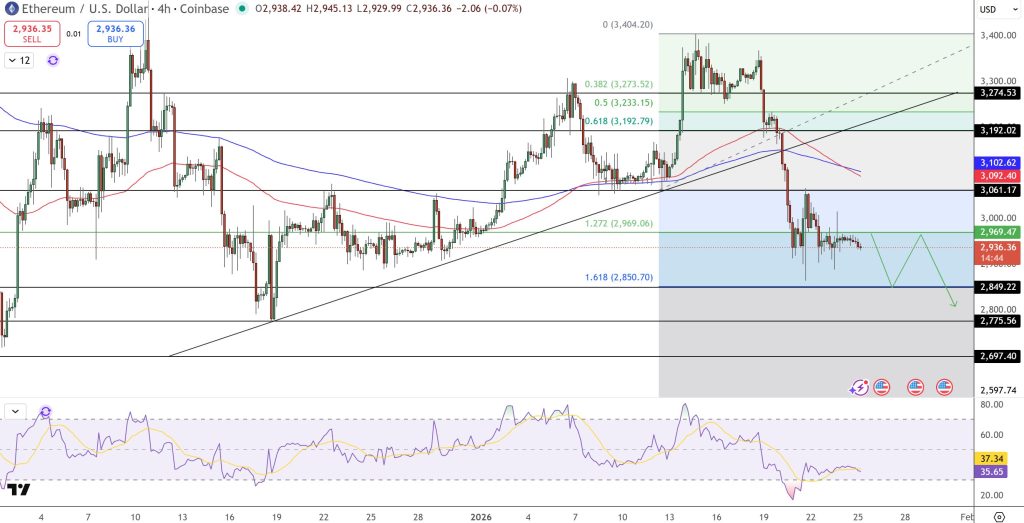
Technically, Ethereum price prediction is bearish as ETH is holding above $2,850–$2,900, a key support zone aligned with prior demand and Fibonacci confluence. RSI remains subdued near 35–40, signaling caution but not capitulation.

A reset toward support followed by a reclaim of $3,060 would reopen upside toward $3,190–$3,400, while a clean break below $2,800 would risk a deeper retracement toward $2,700.

Ethereum Price Chart – Source: Tradingview

Looking ahead, Ethereum’s 2026 roadmap adds weight to the longer-term case. The upcoming Glamsterdam upgrade and later Hegota phase focus on scalability, efficiency, and sustainability, building on blob infrastructure progress and accelerating Layer-2 adoption.

With over 8.7 million new contracts deployed entering the year, analysts increasingly view 2026 as a potential breakout period if macro conditions stabilize.

Ethereum (ETH/USD) Trade setup: Accumulate near $2,850–$2,900, target $3,190–$3,400, invalidation below $2,700.

Bitcoin Hyper: The Next Evolution of BTC on Solana?

Bitcoin Hyper ($HYPER) is bringing a new phase to the BTC ecosystem. While BTC remains the gold standard for security, Bitcoin Hyper adds what it always lacked: Solana-level speed. The result: lightning-fast, low-cost smart contracts, decentralized apps, and even meme coin creation, all secured by Bitcoin.

Audited by Consult, the project emphasizes trust and scalability as adoption builds. And momentum is already strong. The presale has surpassed $30.9 million, with tokens priced at just $0.013635 before the next increase.

As Bitcoin activity climbs and demand for efficient BTC-based apps rises, Bitcoin Hyper stands out as the bridge uniting two of crypto’s biggest ecosystems. If Bitcoin built the foundation, Bitcoin Hyper could make it fast, flexible, and fun again.

Click Here to Participate in the Presale

The post Ethereum Price Prediction: $3,000 Rejected, But On-Chain Data Tells Another Story appeared first on Cryptonews.

Bitcoin Price Prediction: BTC at $88K as BIP-110 Adoption and GameStop Fuel a Make-or-Break Zone

Bitcoin is trading near $88,700 as markets weigh a pullback from $97K against rising regulatory clarity in the US, internal network debates, and shifting technical momentum. Senate crypto reforms, growing BIP-110 adoption, and rumors around GameStop’s BTC transfer have added noise, but price action suggests consolidation, not collapse. The $88K zone now stands as the key pivot for Bitcoin’s next directional move.

Bitcoin Governance Debate Resurfaces as BIP-110 Node Adoption Expands

Bitcoin’s long-running governance debate has resurfaced as adoption of Bitcoin Improvement Proposal 110 (BIP-110) edges higher. Roughly 2.38% of Bitcoin nodes are now running BIP-110, a temporary soft fork designed to limit non-monetary data, or “spam,” embedded in transactions.

The proposal restores restrictions on OP_RETURN data and output sizes that were loosened in recent Bitcoin Core updates.

Facilitating Spam is incompatible with Bitcoin’s sound money mission via decentralization.

Facilitating Spam makes it more expensive/cumbersome to use Bitcoin in a self sovereign manner than it otherwise would without Spam.

Activate BIP-110 yesterday.

Filters up.🛡 https://t.co/6czRByhKLb

— ₿itcoin ₿ombadil (@BitcoinBombadil) January 24, 2026

The issue has divided the community. Critics argue that allowing excessive arbitrary data risks turning Bitcoin into a data-storage network, raising node costs and pushing out smaller, home-run operators, which could increase centralization. Supporters counter that usage should not be artificially limited and that existing spam filters are ineffective.

While the debate may create short-term noise, it has little direct price impact. Over time, efforts like BIP-110 reinforce Bitcoin’s decentralization, strengthening its credibility as resilient, trust-minimized money.

GameStop Moves 4,700 BTC to Coinbase Prime, Raising Sale Speculation

GameStop has moved its entire Bitcoin holding, roughly 4,710 BTC worth over $420 million, to Coinbase Prime, sparking speculation that a sale may be imminent. According to CryptoQuant, the company acquired its Bitcoin at an average price near $107,900, meaning a full exit at current levels around $90,800 would imply an unrealized loss of roughly $76 million.

GameStop throws in the towel?

Their on-chain wallets just moved all BTC holdings to Coinbase Prime, likely to sell.

Between May 14–23, 2025, they bought 4,710 BTC at an avg. price of $107.9K, investing ~$504M.

Now selling for around $90.8K, potentially realising approximately… pic.twitter.com/Bp7MwRVQ43

— CryptoQuant.com (@cryptoquant_com) January 23, 2026

Large transfers to institutional trading platforms often precede selling, but the move alone does not confirm liquidation. GameStop has not issued any public statement, leaving markets to interpret the intent.

The broader impact on Bitcoin appears limited. More than 190 publicly listed companies now hold Bitcoin on their balance sheets, underscoring continued institutional participation.

Even if GameStop were to exit, it would represent an isolated corporate decision rather than a shift in overall institutional confidence. Short-term volatility is possible, but longer-term demand remains intact.

Bitcoin Price Prediction: BTC Tests $88K Support as Breakout Pressure Builds

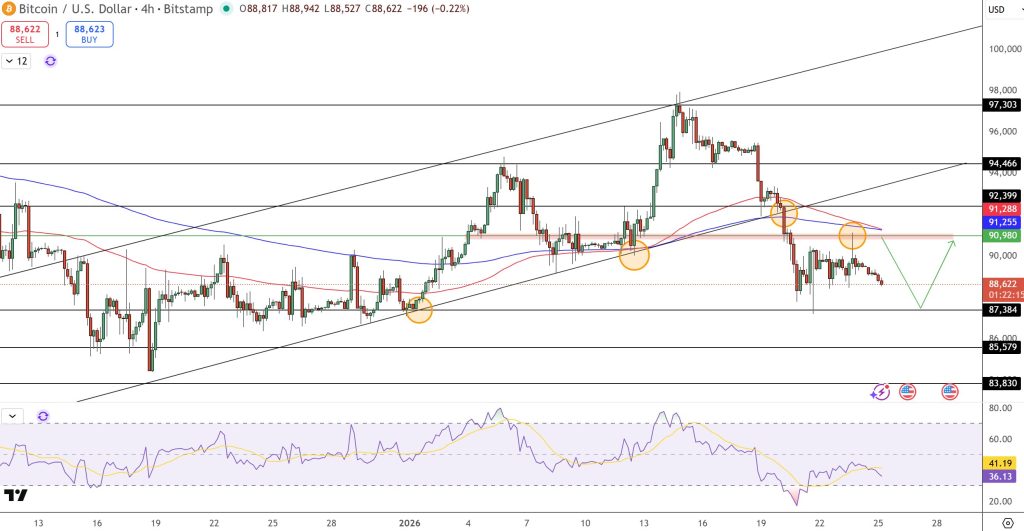
Bitcoin price prediction remains bearish as BTC is trading near $88,600, entering a corrective phase after failing to hold the $97,300 swing high earlier this month. On the 4-hour chart, price has slipped back into a rising channel that guided the move from the $83,800 low.

The rejection at channel resistance marked a momentum shift, reinforced by long upper wicks and a bearish engulfing candle that broke short-term support.

Bitcoin Price Chart – Source: Tradingview

BTC is now testing a key confluence zone between $88,000 and $87,300, which aligns with prior demand and the lower boundary of the ascending channel. Recent candles show smaller bodies with lower wicks, suggesting selling pressure is easing rather than accelerating. However, price remains below the 50-EMA and 100-EMA, while the 200-EMA near $91,200 continues to cap rebounds, keeping near-term bias cautious.

RSI has rebounded from oversold levels near 30 and is stabilizing around 40–42, signaling balance but not strength. The structure resembles a descending flag within a broader uptrend. If $87,300 holds, a reclaim of $90,000 could open $92,400–$94,500. A clean break below risks $85,600.

Bitcoin (BTC/USD) Trade Setup: Buy $87,500–$88,000, target $94,000, stop below $85,500.

Bitcoin Hyper: The Next Evolution of BTC on Solana?

Bitcoin Hyper ($HYPER) is bringing a new phase to the BTC ecosystem. While BTC remains the gold standard for security, Bitcoin Hyper adds what it always lacked: Solana-level speed. The result: lightning-fast, low-cost smart contracts, decentralized apps, and even meme coin creation, all secured by Bitcoin.

Audited by Consult, the project emphasizes trust and scalability as adoption builds. And momentum is already strong. The presale has surpassed $30.9 million, with tokens priced at just $0.013635 before the next increase.

As Bitcoin activity climbs and demand for efficient BTC-based apps rises, Bitcoin Hyper stands out as the bridge uniting two of crypto’s biggest ecosystems. If Bitcoin built the foundation, Bitcoin Hyper could make it fast, flexible, and fun again.

Click Here to Participate in the Presale

The post Bitcoin Price Prediction: BTC at $88K as BIP-110 Adoption and GameStop Fuel a Make-or-Break Zone appeared first on Cryptonews.

Analyst Says You’re Not Bullish Enough On Ethereum – What Does He Mean?

A growing number of analysts believe Ethereum’s current price action is being misunderstood. Although frustration is growing due to Ethereum’s inability to hold above $3,000, some technical analysts are quick to point out that the structure forming beneath the surface tells a very different story. According to one analyst, the real risk right now is not being bullish on Ethereum and trying to short in anticipation of a downside breakout.

Higher Lows And A Structure That Keeps Tightening

The analyst’s technical view on Ethereum is focused less on short-term momentum and more on the structure developing on the chart, which he argues is even clearer than what is currently visible on Bitcoin’s chart.

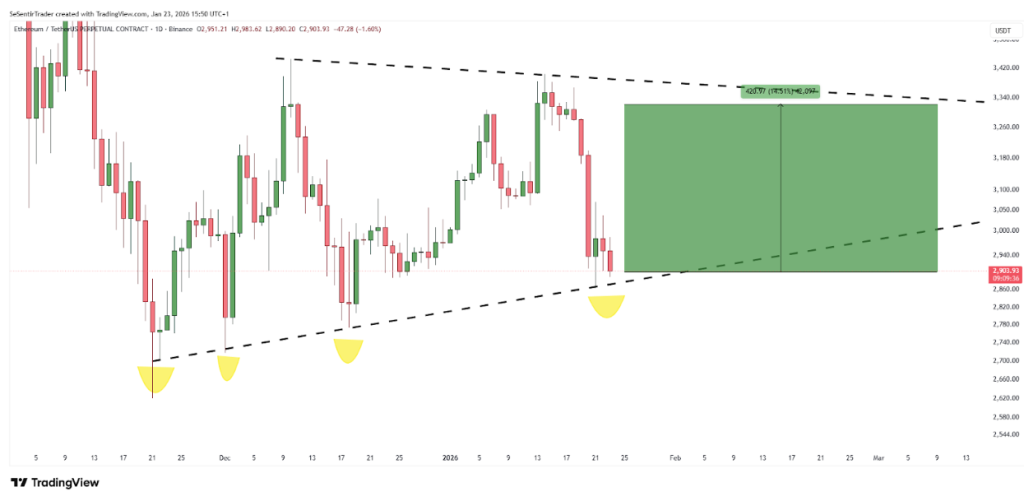
Notably, Ethereum’s price action is carving out a series of higher lows on the daily candlestick timeframe chart to form a tightening triangular pattern since December 2025. This kind of behavior shows that each pullback is being absorbed at progressively higher levels, which is how strong trends reset before continuation.

Ethereum needs to avoid a breakdown below key support zones in order for this trend continuation setup to still be valid. According to the analyst, a dip under $2,860 would begin to weaken the pattern, while a close below $2,780 would invalidate the higher-low structure. 

At the time of writing, Ethereum is trading around $2,950, which is dangerously close to the lower boundary of this setup. Therefore, some traders will be tempted to short Ethereum at this level, but the analyst called it the dumbest thing to do here.

As long as those levels ($2,860 and $2,780) hold, the analyst sees no technical justification for betting against ETH, especially near the lower boundary of the channel where buyers have repeatedly stepped in. 

If support holds, the next move would be a gradual return to the upper trendline of the channel, which is just below $3,340. A move into that region would bring price back into direct contact with overhead resistance and set the stage for a breakout if buying pressure continues to increase.

Ethereum Price Chart. Source: @Tryrexcrypto on X

The Bigger Picture Behind Ethereum’s Price Action

Ethereum is entering 2026 without clear bullish momentum, a reality that has dampened sentiment across the spot and derivatives markets. Spot ETF inflows into Ethereum and Bitcoin have slowed down, and issuers have been highlighted with consistent days of outflows.

Nonetheless, major asset managers are still holding huge amounts of Ethereum and are working on diversifying their activities on Ethereum. BlackRock, for example, filed with the SEC in December to launch a staked Ethereum exchange-traded fund, a move that will bring in more institutional investors into the Ethereum ecosystem.

Speaking of staking, BitMine Technologies recently amped up its ETH staking to over $5.71 billion worth of Ethereum. On-chain data from Arkham Intelligence shows that the firm has staked an additional 171,264, worth $503.2 million, pushing its total stake to over 1.94 million ETH.

Featured image from Unsplash, chart from TradingView

End Of This Reaccumulation Phase Could Trigger Most Aggressive XRP Rally Ever

XRP has spent most of the past few months trading with lower highs since July 2025, frustrating traders and compressing price action into an increasingly tight range. 

However, a technical breakdown shared by crypto analyst ChartNerd argued that what looks like stagnation may actually be the final preparation phase before a historic move. The price structure suggests something far bigger that sends XRP on its most aggressive rally in eight years, but the implications only become clear when the full setup is examined.

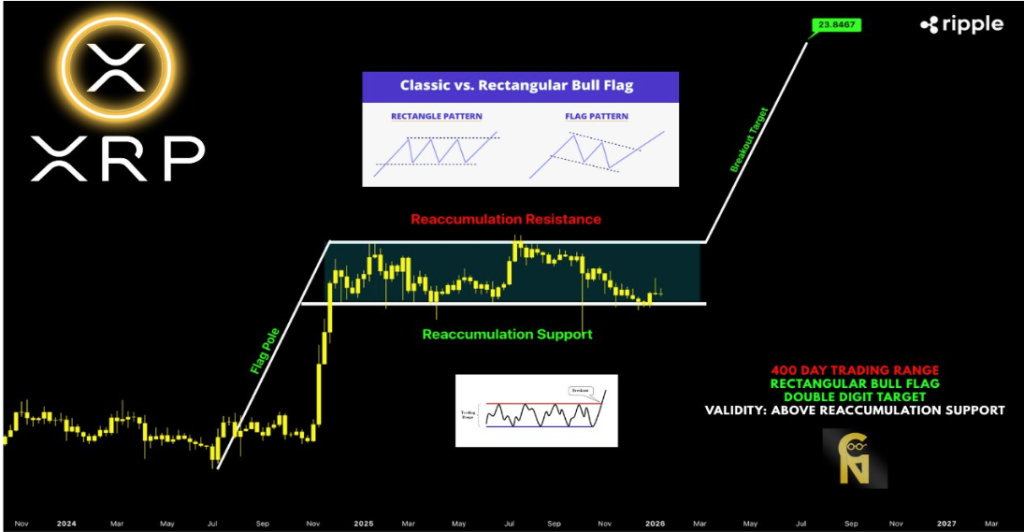
A 400-Day Rectangular Reaccumulation Still Holding Structure

According to technical analysis done by ChartNerd, XRP’s price action has been locked inside a rectangular reaccumulation zone for about 400 days, and this has led to the formation of what looks like a rectangular bull flag on a macro timeframe. The technical chart shows a strong impulsive move from July 2024 to December 2024 acting as the flagpole, right when XRP peaked at the $3.4 price zone back then.

This impulsive flagpole has been followed by a long period of sideways trading where XRP’s price has repeatedly respected a clearly defined support around $1.8 and resistance boundaries around $3.6. This type of structure is associated with reaccumulation within the support and resistance zones, especially when it is playing out after a sharp expansion move and holding for this length of time.

Each dip into reaccumulation support has been absorbed, preventing any sustained breakdown and keeping the broader pattern intact. ChartNerd noted that the rectangular flag will be valid as long as this support level is defended, and this will activate the expansion journey.

XRP Price Chart. Source: @ChartNerdTA on X

Macro Breakout Projection Puts XRP Price Target At $23

According to ChartNerd, bearish participants are increasingly pressured by the fact that this fractal is still holding despite repeated attempts to invalidate it. The longer XRP’s price action is trapped inside the rectangle without breaking down, the more likely it becomes that the eventual resolution favors the dominant trend that preceded the consolidation. In this case, that trend was bullish, which strengthens the case for an upside breakout once resistance is cleared.

If the rectangular bull flag resolves to the upside as projected, the chart outlines a breakout trajectory that would carry XRP into double-digit territory, with a long-term target region near $23. This price target projection is derived from the height of the flagpole extended from the top of the reaccumulation range.

ChartNerd labelled this possible move as one of the most aggressive rallies XRP could see in seven to eight years. At the time of writing, XRP is trading around $1.92, meaning a move toward the $23 region would represent a gain of over 1,000% from current levels, which is a type of percentage expansion XRP has played out well in the past.

Featured image from Unsplash, chart from TradingView

Solana Price Prediction: Why $126 Could Be the Calm Before SOL’s Next Surge

Solana is trading near $126, slipping modestly over the past 24 hours but holding a price zone that traders are watching closely. While short-term price action reflects broader market caution, Solana’s underlying activity tells a very different story. Network usage, institutional interest, and upcoming protocol upgrades are all accelerating, creating a widening gap between price and fundamentals as the market heads deeper into 2026.

This divergence is shaping Solana’s near-term outlook and its longer-term investment narrative.

Solana Finds Balance Near $126 After January Pullback

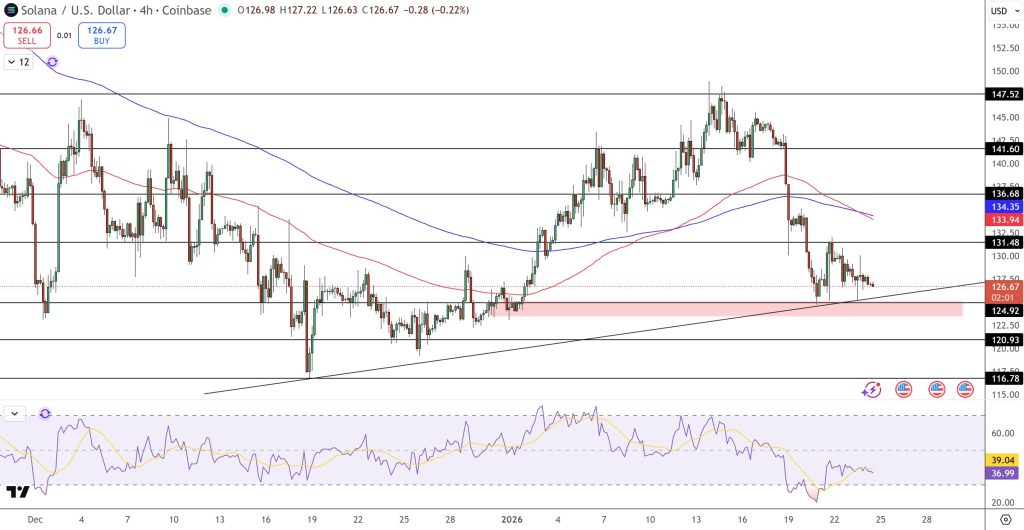
Solana ended the session near $126.72, with daily trading volume around $2.74 bn and a market capitalization just under $72 bn, ranking the token #7 globally. The recent pullback follows a rejection near $147.50, with price now consolidating inside a defined support band between $124 and $127.

On the technical side, SOL remains below its 50-EMA near $134 and 200-EMA around $136, confirming that short-term momentum has cooled. However, candlestick behavior has shifted.

Recent sessions show smaller bodies and reduced downside follow-through, suggesting selling pressure is fading rather than accelerating. As long as $125 holds, the move looks corrective, not structural.

On-Chain Activity Remains Firm Despite Price Weakness

While price has softened, Solana’s network activity continues to expand at record speed.

Key on-chain metrics stand out:

  • DEX volume reached $107 bn, surpassing Ethereum, Base, and BSC combined in recent periods
  • Stablecoin transfer volume climbed to $312 bn, highlighting real payment and settlement use
  • Active addresses surged to 27.1 million, up more than 50% week over week
  • Staking participation hit all-time highs, signaling long-term confidence rather than speculative churn

These figures point to real demand rather than short-term trading flows, reinforcing Solana’s role as a high-throughput settlement layer.

Real-World Asset Tokenization Gains Momentum on Solana

Institutional adoption is quietly reshaping Solana’s positioning. Enterprise blockchain firm R3 is building Solana-native infrastructure focused on private credit and trade finance, while Coinbase completed full Solana chain integration, expanding liquidity access across major regions.

At the same time, Solana has crossed $1 bn in tokenized real-world assets, supported by flows tied to BlackRock’s BUIDL initiative and rising USDC velocity. This shift is reframing Solana from a speculative trading chain into an institutional-grade platform for tokenized finance.

Solana (SOL/USD) Technical Outlook: $125 Support Tested as $136 Comes Into Focus

From a price perspective, Solana price prediction seems bearish as SOL is testing a rising trendline that originates from December lows. RSI remains subdued near 38–40, reflecting caution but not exhaustion. A clean break below $124 would expose $120.90, while a reclaim above $131.50 would signal renewed upside toward $136 and $141.60.

Solana Price Chart – Source: Tradingview

Looking further ahead, the upcoming Alpenglow upgrade, targeting faster finality and expanded block capacity, reinforces Solana’s long-term thesis. If fundamentals continue to outpace price, the current range may prove to be a positioning phase rather than a peak.

Solana Trade idea: Buy near $124–$125, target $136, stop below $120.90.

Bitcoin Hyper: The Next Evolution of BTC on Solana?

Bitcoin Hyper ($HYPER) is bringing a new phase to the BTC ecosystem. While BTC remains the gold standard for security, Bitcoin Hyper adds what it always lacked: Solana-level speed. The result: lightning-fast, low-cost smart contracts, decentralized apps, and even meme coin creation, all secured by Bitcoin.

Audited by Consult, the project emphasizes trust and scalability as adoption builds. And momentum is already strong. The presale has surpassed $30.9 million, with tokens priced at just $0.013625 before the next increase.

As Bitcoin activity climbs and demand for efficient BTC-based apps rises, Bitcoin Hyper stands out as the bridge uniting two of crypto’s biggest ecosystems. If Bitcoin built the foundation, Bitcoin Hyper could make it fast, flexible, and fun again.

Click Here to Participate in the Presale

The post Solana Price Prediction: Why $126 Could Be the Calm Before SOL’s Next Surge appeared first on Cryptonews.

Bitcoin Pattern From 2022 That Led To Crash To $20,000 Reappears

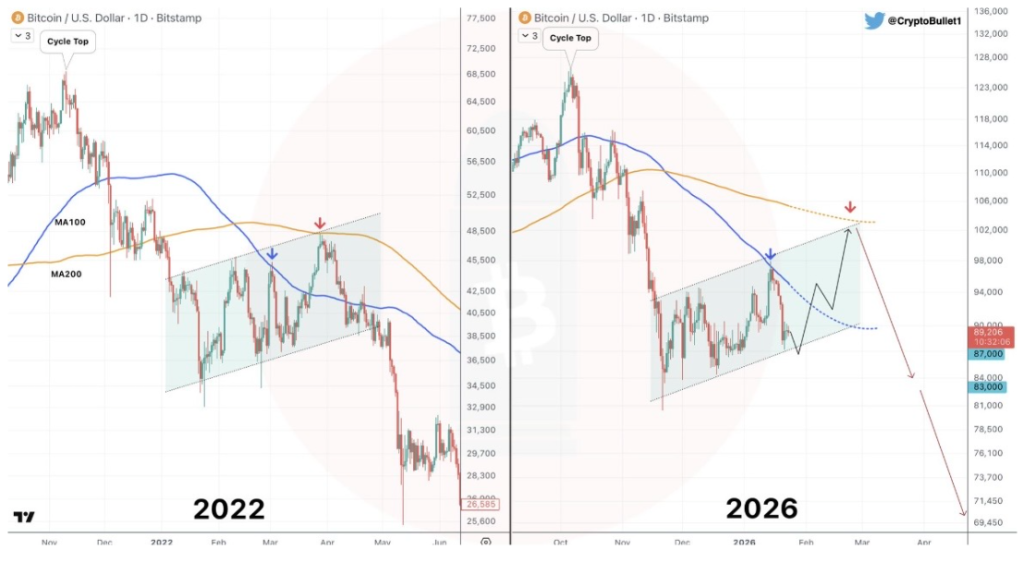
Bitcoin (BTC) is mirroring the same setup from its 2022 bull cycle, which led to a massive price crash to $20,000. According to market expert Crypto Bullet, this recurring structure could signal another major correction for BTC ahead. However, this time the leading cryptocurrency could give up almost a quarter of its current value. 

2022 Bitcoin Chart Pattern Signals Over 20% Crash

In his technical analysis released on X, Crypto Bullet revealed that Bitcoin is currently repeating a 2022 structure that could lead to a more than 20% decline in its value. To support his bearish outlook, the analyst presented a parallel chart comparing Bitcoin’s price action from 2023-2022 and 2025-2026, highlighting similar technical patterns, price behavior, and Moving Averages (MA). 

During the 2022 cycle, Bitcoin experienced a similar pattern, beginning with a test of the 100-day Moving Average (MA100), highlighted as the blue trendline on the chart. After facing rejection at that level, the price pulled back to a nearby support zone inside a rising channel. From there, BTC staged a sharp rally, surging to fresh highs around $48,500, where it aligned with the 200-day Moving Average (MA200), marked in orange. 

However, the recovery proved short-lived. Bitcoin soon reversed course and failed to reclaim the MA200 as support. Once the cryptocurrency’s price structure was lost, downside momentum accelerated, pushing the price into a much deeper correction toward the $20,000 level. 

According to Crypto Bullet, Bitcoin is repeating this exact pattern in 2026. It has already retested the MA100, gotten rejected, and moved lower into a support zone within a similar ascending channel. The chart also showed that in both cycles, BTC reached a “market cycle top,” first around December 2023 and then again in November 2025, before breaking down and entering a consolidation phase

Given how closely Bitcoin is mirroring its 2022 setup, Crypto Bullet has forecast another dramatic price crash, predicting a more than 23.5% drop from its current price near $89,500 to $68,450. Before this decline happens, the analyst expects BTC to experience a short-term recovery, potentially climbing back above the $100,000 psychological level to reach $102,000. 

Bitcoin Could Still Rally To $92,000

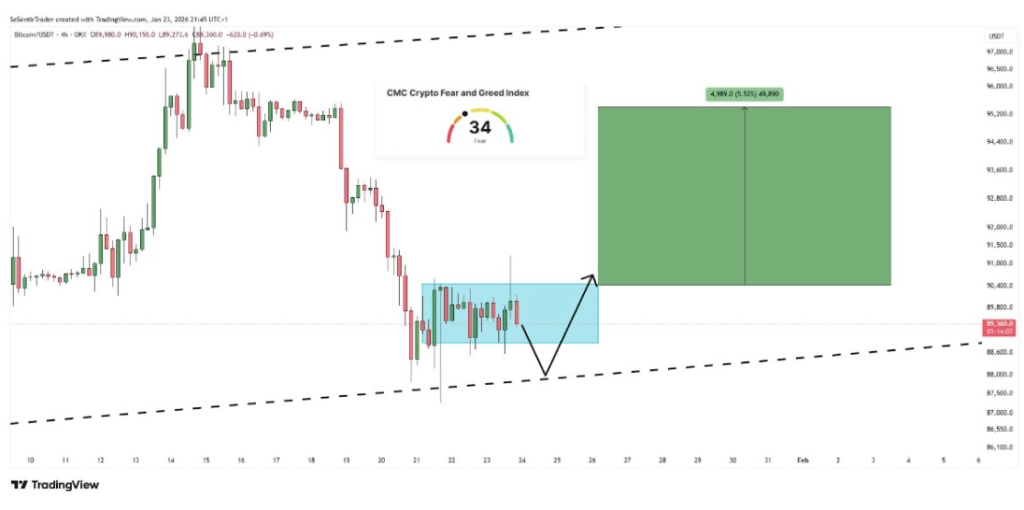
Crypto analyst Tyrex has stated that Bitcoin has been consolidating for the past 48 hours, with price holding above $89,000 for most of that period. Despite the muted price action, he believes that BTC could soon rally to $92,000. The analyst also noted that the broader market is in a state of fear, with many traders anticipating further declines in Bitcoin.

However, the analyst cautions that this expected drop may be a trap. He points out that an ascending channel is forming on Bitcoin’s chart, prompting him to adopt a more bullish outlook despite the prevailing bearish sentiment and sideways price movement.  

Featured image from Unsplash, chart from TradingView

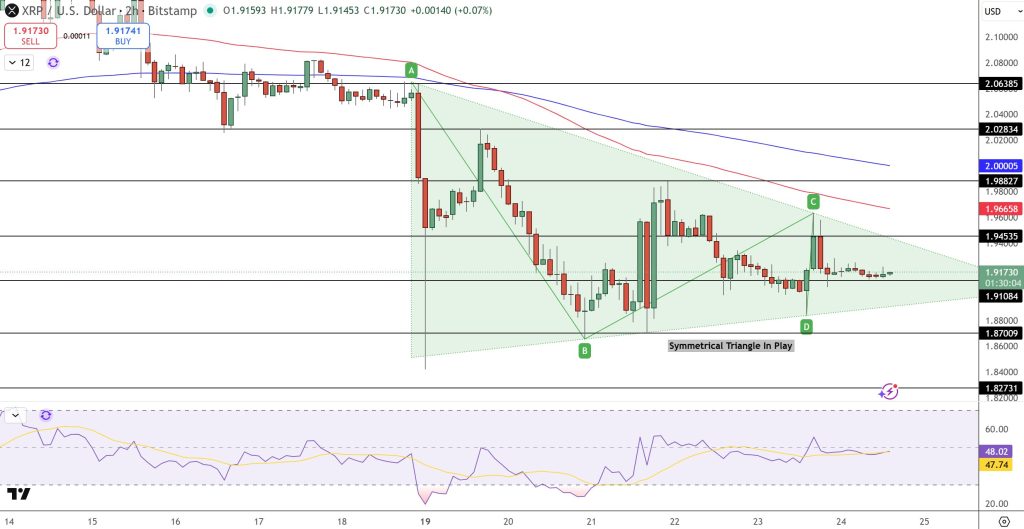
XRP Price Prediction: Symmetrical Triangle at $1.90 – Breakout or Breakdown Next?

XRP is trading near $1.92, with 24-hour volume around $1.92 bn and a market cap of $116.6 bn, keeping it ranked #5 among cryptocurrencies. After January’s pullback, price has stabilized, pointing to a shift from active selling toward positioning. Recent sessions show XRP consolidating in a tight range, with buyers consistently stepping in around $1.88–$1.90.

That support has limited further downside while volatility narrows, putting focus on whether this consolidation resolves higher or gives way to renewed pressure.

RLUSD Gains Traction on Binance as XRP Liquidity and Institutional Use Expand

Ripple’s USD-backed stablecoin RLUSD is quickly emerging as a key catalyst. On January 22, 2026, Binance listed RLUSD for spot trading, including an XRP/RLUSD pair, alongside a temporary zero-fee promotion. Initially launched on Ethereum, RLUSD’s upcoming integration with the XRP Ledger is expected to enhance settlement efficiency and on-chain activity.

The stablecoin’s regulatory positioning stands out:

  • Approved by NYDFS and cleared by the OCC
  • Designed for institutional and compliance-first use
  • Positioned as a bridge between traditional finance and crypto rails

Analysts see this as a structural positive for XRP, as increased RLUSD usage ties liquidity flows more closely to the XRP ecosystem.

Leadership and Institutional Momentum: Why XRP’s Long-Term Case Is Strengthening

Ripple CEO Brad Garlinghouse remains optimistic about 2026, pointing to regulatory progress and institutional demand as drivers for the next growth phase. He has highlighted momentum around US crypto legislation and framed regulatory clarity as a long-term unlock for enterprise adoption.

Spirited dialogue during today’s WEF session (to say the least), but one important point of agreement across the panelists was that innovation and regulation aren’t on opposite sides.

I firmly believe this is THE moment to use crypto and blockchain technology to enable economic… https://t.co/4d3jNeNC4h

— Brad Garlinghouse (@bgarlinghouse) January 21, 2026

Beyond stablecoins, Ripple continues expanding its banking footprint. Recent partnerships, including DXC Technology’s integration with Ripple infrastructure, aim to support custody, payments, and tokenization for institutions managing trillions in assets. These developments reinforce XRP’s role beyond speculation, anchoring it in real financial use cases.

XRP Technical Outlook: $1.90 Support Tested as XRP Nears a Breakout Decision

Technically, XRP price prediction is neutral as XRP is compressing inside a symmetrical triangle, formed by lower highs from $2.40 and higher lows near $1.87. The 50-EMA around $1.97 caps short-term rallies, while the 200-EMA near $2.02 reinforces resistance. RSI near 48–50 signals balance rather than exhaustion.

XRP Price Chart – Source: Tradingview

A confirmed break above $1.96 could open a move toward $2.05–$2.15, while a loss of $1.88 would expose $1.83. Until then, XRP remains in decision mode.

XRP Trade setup: Buy on a confirmed break above $1.96, target $2.10–$2.15, stop below $1.88.

Bitcoin Hyper: The Next Evolution of BTC on Solana?

Bitcoin Hyper ($HYPER) is bringing a new phase to the BTC ecosystem. While BTC remains the gold standard for security, Bitcoin Hyper adds what it always lacked: Solana-level speed. The result: lightning-fast, low-cost smart contracts, decentralized apps, and even meme coin creation, all secured by Bitcoin.

Audited by Consult, the project emphasizes trust and scalability as adoption builds. And momentum is already strong. The presale has surpassed $30.9 million, with tokens priced at just $0.013625 before the next increase.

As Bitcoin activity climbs and demand for efficient BTC-based apps rises, Bitcoin Hyper stands out as the bridge uniting two of crypto’s biggest ecosystems. If Bitcoin built the foundation, Bitcoin Hyper could make it fast, flexible, and fun again.

Click Here to Participate in the Presale

The post XRP Price Prediction: Symmetrical Triangle at $1.90 – Breakout or Breakdown Next? appeared first on Cryptonews.

Bitcoin Price Prediction: BTC Stuck at $89,500 – Are Korea’s Breach and UBS the Catalyst?

Bitcoin is trading near $89,500, locked in a tight range that reflects consolidation rather than weakness. While price action remains compressed, a series of institutional and regulatory developments this week is reshaping how the market views Bitcoin’s longer-term role.

South Korea’s $48M Bitcoin Custody Breach Raises Alarms

South Korean authorities are investigating the disappearance of roughly 70 bn won ($48 mn) worth of seized Bitcoin from official custody. The issue surfaced during a routine audit by the Gwangju District Prosecutors’ Office, according to local reports.

Preliminary findings suggest the loss resulted from a phishing attack, after a staff member reportedly accessed a fake website, leading to leaked credentials. While details remain limited due to the ongoing investigation, the case has reignited debate around how governments store and protect confiscated digital assets.

South Korean prosecutors investigate disappearance of seized Bitcoin following phishing attack

Multiple Bitcoins went missing in mid-2025 after private key credentials were exposed in a phishing attack, resulting in irreversible transfers

— crypto.news (@cryptodotnews) January 23, 2026

Importantly, the incident does not reflect a failure of the Bitcoin network itself. Instead, it underscores weaknesses in human processes and custody frameworks. Long term, this type of breach may push governments toward stricter crypto custody standards, ironically strengthening institutional confidence rather than weakening it.

You can't make this up.

"an agency worker accessed a scam website"

Nearly $50M in seized Bitcoin was stolen in a phishing attack.

What could have gone to a national strategic bitcoin reserve has now fallen into the hands of bad actors.

As state agencies and employees work… pic.twitter.com/sga9sqJExD

— Boring Security (@BoringSecurity) January 23, 2026

UBS Explores Crypto for Private Banking Clients

In a separate but related signal, UBS is reportedly evaluating plans to offer cryptocurrency investing to select private banking clients, beginning with Bitcoin and Ether for wealthy Swiss customers. According to Bloomberg, the bank is assessing third-party partners to support the rollout.

UBS plans to make cryptocurrency investing available for some private banking clients in what could become a significant move into digital assets for the wealth manager https://t.co/pWi6Inm9AP

— Bloomberg (@business) January 23, 2026

If successful, UBS could later expand the service into the US and Asia-Pacific, aligning with similar initiatives from Morgan Stanley and JPMorgan. The move reflects growing demand among high-net-worth investors for crypto exposure through trusted, regulated institutions, rather than exchanges alone.

Bitwise’s Bitcoin-Gold ETF Signals Macro Thinking

Adding to the institutional theme, Bitwise Asset Management has launched the Bitwise Proficio Currency Debasement ETF (BPRO) on the NYSE. Unlike spot Bitcoin ETFs, BPRO is actively managed and blends Bitcoin, gold, precious metals, and mining equities, with at least 25% allocated to gold at all times.

The fund carries a 0.96% expense ratio and targets long-term investors focused on capital preservation. By pairing Bitcoin with gold, Bitwise frames BTC as a macro hedge against currency debasement, not a speculative trade.

Bitcoin Price Forecast: $89,500 Range Tightens as Breakout Pressure Builds

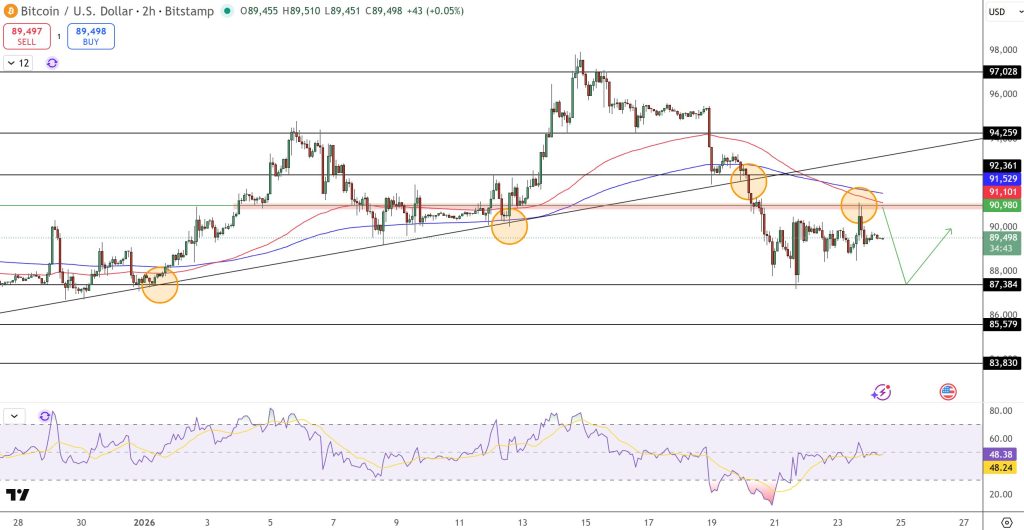
Bitcoin is trading near $89,500, holding inside a narrowing range after a sharp rejection from the $97,000 peak earlier this month. On the 2-hour chart, price action points to compression rather than breakdown. BTC continues to defend the $87,300–$88,000 support band, an area repeatedly tested and protected by buyers.

Long lower candlestick wicks around this zone suggest sellers are struggling to gain follow-through, signaling thinning supply at lower levels.

Bitcoin Price Chart – Source: Tradingview

From a structural view, Bitcoin remains anchored to a rising trendline that has guided price higher since the $83,800 low. While price briefly slipped below the 50-EMA and 100-EMA, it has stabilized near the 200-EMA, which is flattening instead of rolling over.

This behavior typically reflects a transition phase, not a confirmed trend reversal. The broader setup resembles a descending flag within an ascending channel, a formation that often resolves in the direction of the prevailing trend.

Momentum supports this outlook. RSI has rebounded from oversold levels near 30 and is now hovering around 48–50, signaling balance rather than renewed selling pressure. Recent candles show smaller bodies and reduced volatility, often seen before range expansion. If BTC dips, $87,400 remains key support. A push above $90,980 would open the path toward $92,400 and $94,250.

Trade setup: Buy near $88,000–$87,500, target $94,000, stop below $85,500.

Bitcoin Hyper: The Next Evolution of BTC on Solana?

Bitcoin Hyper ($HYPER) is bringing a new phase to the BTC ecosystem. While BTC remains the gold standard for security, Bitcoin Hyper adds what it always lacked: Solana-level speed. The result: lightning-fast, low-cost smart contracts, decentralized apps, and even meme coin creation, all secured by Bitcoin.

Audited by Consult, the project emphasizes trust and scalability as adoption builds. And momentum is already strong. The presale has surpassed $30.9 million, with tokens priced at just $0.013625 before the next increase.

As Bitcoin activity climbs and demand for efficient BTC-based apps rises, Bitcoin Hyper stands out as the bridge uniting two of crypto’s biggest ecosystems. If Bitcoin built the foundation, Bitcoin Hyper could make it fast, flexible, and fun again.

Click Here to Participate in the Presale

The post Bitcoin Price Prediction: BTC Stuck at $89,500 – Are Korea’s Breach and UBS the Catalyst? appeared first on Cryptonews.

How to Set Up a Crypto Exchange in 2026

By: lois

Cryptocurrency exchanges continue to be one of the most profitable segments of the digital asset economy. The combination of market maturity, institutional adoption, and regulatory clarity has made exchange platforms viable fintech products for startups, brokerage firms, and enterprise operators.

This guide explains the full process of launching a crypto exchange in 2026— from infrastructure and compliance to liquidity and go-to-market strategy.

1. Define Your Exchange Model

The first step is choosing your platform type. Common models include:

  • Centralized Exchanges (CEX) — spot, margin, futures, leverage
  • P2P Exchanges — peer-matching with escrow
  • OTC Desks — large block trade execution
  • Derivatives Exchanges — perpetuals, options, futures
  • Hybrid Exchanges — on-chain settlement + centralized order matching

Each model influences regulatory scope, liquidity structure, and risk requirements.

2. Choose the Right Development Strategy

There are three primary development routes:

A. Custom Development From Scratch

  • Fully customizable
  • 10–18 months build cycle
  • Highest CAPEX (typically $300K — $1M+)

B. White-Label Exchange Solutions

  • Modular ready-made infrastructure
  • Fraction of the development time
  • Ideal for fast deployment and MVP strategies

C. Pre-Built Exchange Scripts

  • Fastest deployment model
  • Ideal for startups and regional exchanges
  • Lower cost barrier

A good breakdown of how modern exchanges like Binance are engineered is detailed in How to Build a Crypto Exchange Like Binance

3. Core Platform Components

A functional crypto exchange requires several mission-critical layers:

Trading Engine

  • Order matching
  • Order book management
  • Market/limit/stop orders
  • TradingView charting (highly preferred)

Wallet + Custody Layer

  • Multi-asset support (BTC, ETH, USDT, etc.)
  • Hot/cold wallet separation
  • Fiat on/off ramp integration
  • Optional multi-signature custody

Security Protection

Modern security stack includes:

  • DDoS mitigation
  • MFA/2FA authentication
  • Anti-phishing controls
  • Withdrawal whitelisting
  • Custodial signing layers

Compliance & Monitoring

Regulations in 2026 mandate:

  • KYC/KYB onboarding
  • AML/CTF monitoring
  • Travel Rule compliance
  • Risk scoring & sanctions screening

4. Licensing & Jurisdiction Strategy

Crypto licensing remains geography-dependent. Popular operational jurisdictions include:

  • Singapore
  • Lithuania
  • Estonia
  • UAE
  • Malta
  • Hong Kong

Regulators now separate permissions for:
✔ Spot trading
✔ Custody
✔ Derivatives
✔ Brokerage
✔ OTC operations

Early legal consultation is recommended to ensure alignment with regulatory frameworks.

5. Infrastructure & Deployment Architecture

A production-grade exchange architecture typically includes:

  • Web + Mobile Frontend
  • High-performance Matching Engine
  • Wallet & Custodial Layer
  • Compliance Admin Console
  • Liquidity Routing Layer
  • Database + Cloud Stack
  • Monitoring & Security Layer
  • APIs for institutions & partners

AWS, Google Cloud, and bare-metal environments are standard depending on latency requirements.

6. Liquidity Acquisition Strategy

Liquidity is essential for trader confidence. Primary approaches include:

✔ Market maker partnerships
✔ Aggregated liquidity providers
✔ Shared order book feeds
✔ OTC liquidity pools
✔ Institutional routing APIs

Liquidity directly affects spreads, slippage, and execution quality.

7. Audit, Testing & Certification

Before production deployment, mandatory testing phases include:

  • Functional testing
  • Load & stress simulations
  • Wallet audit + reconciliation checks
  • Latency and throughput benchmarking
  • Regulatory compliance simulations
  • Security & penetration testing

Smart contracts (if included) require independent code audits.

8. Launch Strategy & Market Expansion

After technical launch comes adoption. Common go-to-market channels include:

  • Referral & affiliate programs
  • KOL + influencer activation
  • Educational campaigns
  • Token listings & market incentives
  • Regional institutional onboarding
  • Community management & multilingual support

Sustainable exchanges focus on both liquidity growth and user trust.

9. Cost Structure (2026 Estimates)

Cost varies by build strategy, licensing region, and technical scope.

Category

Estimated Range

White-label/software deployment

$25K — $120K

Full custom build

$300K — $1M+

Compliance & licensing

$30K — $500K+

Liquidity services

$10K — $80K/month

Infrastructure

$5K — $30K/month

Marketing

Variable

A deeper analysis is available in Cost to Build a Crypto Exchange Platform

Final Perspective

Building a crypto exchange in 2026 requires mastery across:

✔ Fintech architecture
✔ Regulatory compliance
✔ Security engineering
✔ Liquidity provisioning
✔ Market strategy

For organizations seeking reduced time-to-market, modern Cryptocurrency Exchange Script solutions provide pre-built trading engines, compliance modules, wallet systems, and operator dashboards.


How to Set Up a Crypto Exchange in 2026 was originally published in Coinmonks on Medium, where people are continuing the conversation by highlighting and responding to this story.

FBI Arrests Former Olympic Snowboarder and Top Cocaine Trafficker in Crypto-Linked Case

By: Amin Ayan

US authorities have arrested former Canadian Olympic snowboarder Ryan Wedding, ending a years-long international manhunt for a figure investigators describe as a major cocaine trafficker who relied on cryptocurrency to move and conceal illicit profits.

Key Takeaways:

  • Former Olympian Ryan Wedding was arrested in Mexico and extradited to the US after years on the FBI’s Most Wanted list.
  • Authorities allege he ran a cartel-linked cocaine network and used crypto to launder proceeds.
  • US officials say the operation generated over $1 billion annually and spanned multiple countries.

Wedding, 44, was taken into custody in Mexico late Thursday and transferred to the United States on Friday, according to US officials.

The former athlete, who competed for Team Canada at the 2002 Winter Olympics in Salt Lake City, had been listed among the FBI’s Ten Most Wanted fugitives, with a reward of up to $15 million offered for information leading to his capture.

Former Olympic Snowboarder Faces US Charges in Global Drug Case

US Attorney General Pam Bondi said Wedding, whom she described as a “onetime Olympian snowboarder-turned alleged violent cocaine kingpin,” will face federal charges in the US related to drug trafficking, murder, and operating a criminal enterprise spanning multiple countries.

FBI Director Kash Patel confirmed the arrest in a post on X, crediting cooperation with Mexican authorities for locating Wedding after more than a decade on the run.

UPDATE: After landing in LA today to transfer Top Ten Most Wanted Fugitive Ryan Wedding, our FBI/DOJ teams are now landing in Charlotte, NC to transfer another – Alejandro Castillo – the Top Ten Most Wanted Fugitive arrested one week ago today in Mexico.

Castillo’s quick return… pic.twitter.com/wsrS3eWa2k

— FBI Director Kash Patel (@FBIDirectorKash) January 23, 2026

Investigators allege that Wedding played a senior role in cocaine distribution networks tied to Mexico’s Sinaloa Cartel, overseeing shipments from Colombia into the United States and Canada.

According to US officials, the operation generated more than $1 billion annually in illegal proceeds at its peak.

The US Treasury Department’s Office of Foreign Assets Control sanctioned Wedding in November, accusing his organization of using cryptocurrency to move and launder drug profits.

In its notice, the Treasury said digital assets were used to obscure the flow of funds and conceal large sums derived from narcotics trafficking.

Mexico’s Security Secretary Omar García Harfuch said Wedding voluntarily surrendered at the U.S. Embassy before being handed over to the FBI.

Patel later told reporters that Wedding had been hiding in Mexico for over 10 years and was believed to be under cartel protection.

Wedding arrived Friday at Ontario International Airport in Southern California, where federal officials held a press conference following his transfer.

Authorities said they seized firearms, luxury vehicles, artwork, and other assets connected to the alleged criminal enterprise, and indicated further arrests may follow as the investigation continues.

Ryan Wedding’s Earlier Cocaine Case Predates Latest US Charges

This is not Wedding’s first encounter with US law enforcement. In 2008, he was arrested in California in a cocaine trafficking sting involving a Vancouver-based operation.

He was convicted in 2009 and sentenced to four years in prison, before being released around 2011.

The arrest comes as crypto-related crime remains a growing concern. According to Chainalysis, illicit cryptocurrency addresses received a record $154 billion in 2025, a sharp increase from the year before.

In another case, US prosecutors have charged a 23-year-old Brooklyn resident, Ronald Spektor, with stealing roughly $16 million in cryptocurrency from around 100 Coinbase users through an alleged phishing and social engineering scheme.

The post FBI Arrests Former Olympic Snowboarder and Top Cocaine Trafficker in Crypto-Linked Case appeared first on Cryptonews.

Crypto Company Ledger Plans US IPO With Valuation Expected To Top $4 Billion

Ledger, the French maker of hardware wallets for crypto assets, is reportedly moving ahead with plans for a potential initial public offering (IPO) in New York, signaling continued momentum in public market interest for digital asset companies. 

The listing would place Ledger among a growing group of crypto firms seeking access to US capital markets, following the recent public debut of BitGo earlier this week.

Ledger Taps Wall Street Giants For US IPO

The move comes amid a broader initial public offering wave that gained strong traction throughout 2025, when several major crypto-native companies either went public or began laying the groundwork to do so. 

Firms such as Circle (CRLC), Bullish (BLSH), eToro (ETOR), Figure (FIGR), and Gemini (GEMI) have already gone public in the US, while Grayscale and Kraken remain part of the renewed IPO push, with filings submitted and preparations still underway.

According to a report by the Financial Times, Ledger has engaged investment banks including Goldman Sachs and Barclays to advise on its initial public offering in the United States. 

People familiar with the matter say the offering could value the company at more than $4 billion. While the IPO could take place as soon as this year, sources cautioned that the plans remain subject to change.

Ledger’s reported IPO ambitions come as BitGo opened trading on Thursday with its shares jumping 24.6%, giving the company a valuation of approximately $2.59 billion. 

BitGo and several of its existing shareholders sold 11.8 million shares priced above the initially marketed range of $15 to $17, raising $212.8 million in the process.

BitGo Sets Tone For 2026 Crypto IPOs

Market experts have pointed to BitGo’s performance as an important signal for the broader crypto IPO landscape. Lukas Muehlbauer, an IPOX research associate, described BitGo’s listing as the first major test of investor demand for crypto-related offerings in 2026. 

He noted that while Gemini went public near the peak of the crypto market last year, BitGo entered the market during a period of recent selloffs, making its reception particularly telling. 

Muehlbauer added that BitGo’s positioning as a profitable and regulated “digital asset infrastructure company,” rather than a business tied directly to token price movements, helped insulate it from “Bitcoin’s (BTC) day-to-day volatility.”

Beyond Ledger, expectations are building that the pipeline of crypto IPOs will continue to grow. In addition to Kraken and Grayscale, industry experts believe the coming year could bring an even larger number of crypto-related IPOs in the US. 

“2025 marked the professionalization of crypto, and the public markets noticed,” said Mike Bellin, a partner at PwC who leads the firm’s US IPO practice. 

Some offerings, however, have faced delays. Elliot Han, chief investment officer at C1 Fund, said that the fourth quarter could have seen an even higher number of IPOs. 

He pointed to the federal government’s prolonged shutdown as a key factor that pushed several listings into the first quarter of 2026. Han also noted that heightened stock market volatility toward the end of the third quarter added further complications.

Ledger

Featured image from DALL-E, chart from TradingView.com 

Bitcoin Price Prediction: Wall Street Combines Bitcoin and Gold in One ETF – Trillions Incoming?

Bitcoin is trading in a tight $87,000–$90,000 range, but recent developments suggest this consolidation may be more than a pause. On January 22, 2026, reported that Bitwise Asset Management launched the Bitwise Proficio Currency Debasement ETF (BPRO), an actively managed fund that combines Bitcoin, gold, silver, precious metals, and mining equities under one structure.

The message from Wall Street is clear. BTC is no longer being framed as a speculative trade alone, but as part of a broader hard-asset allocation strategy designed to hedge currency debasement. Bitwise manages over $15 bn in client assets, while Proficio Capital Partners oversees roughly $5 bn, placing this product firmly in institutional territory. The ETF allocates at least 25% to gold, with flexible exposure to Bitcoin and other scarcity-based assets, signaling long-term conviction rather than short-term positioning.

This matters for price. When institutional vehicles treat Bitcoin alongside gold, flows tend to be slower, larger, and more persistent.

Bitcoin (BTC/USD) Technical Analysis: Why the $87K–$90K Zone Matters for BTC

From a technical perspective, Bitcoin price prediction seems bearish as BTC’s current range reflects compression, not breakdown. Price has repeatedly held above the $87,400–$88,000 support zone, an area defined by prior demand and reinforced by long lower candlestick wicks. These candles show sellers losing follow-through rather than accelerating downside momentum.

Bitcoin Price Chart – Source: Tradingview

On the 4-hour chart, BTC remains inside a broader ascending channel, with price consolidating into a descending flag. The 50-EMA and 100-EMA are flattening, while the 200-EMA continues to rise near the mid-$86,000s, preserving the higher-timeframe trend. RSI is stabilizing near the high-30s to low-40s, recovering from oversold conditions without flashing bearish continuation signals.

In practical terms, this structure often precedes range expansion, not further liquidation.

Institutional Framing Supports a Breakout Case

What strengthens the technical setup is the macro narrative behind it. According to Bitwise, gold ETFs currently account for just 0.17% of private financial holdings, despite gold’s long-standing role as a store of value. Bitcoin’s inclusion alongside gold highlights how institutions are positioning for currency debasement, not short-term volatility.

Key takeaways from the BPRO launch:

  • Actively managed exposure to BTC and precious metals
  • Minimum 25% allocation to gold
  • Designed as a hedge against declining fiat purchasing power
  • Listed on NYSE under ticker BPRO
  • Expense ratio of 0.96%

As these structures gain adoption, Bitcoin’s role shifts from tactical trade to portfolio component, which historically supports higher price floors.

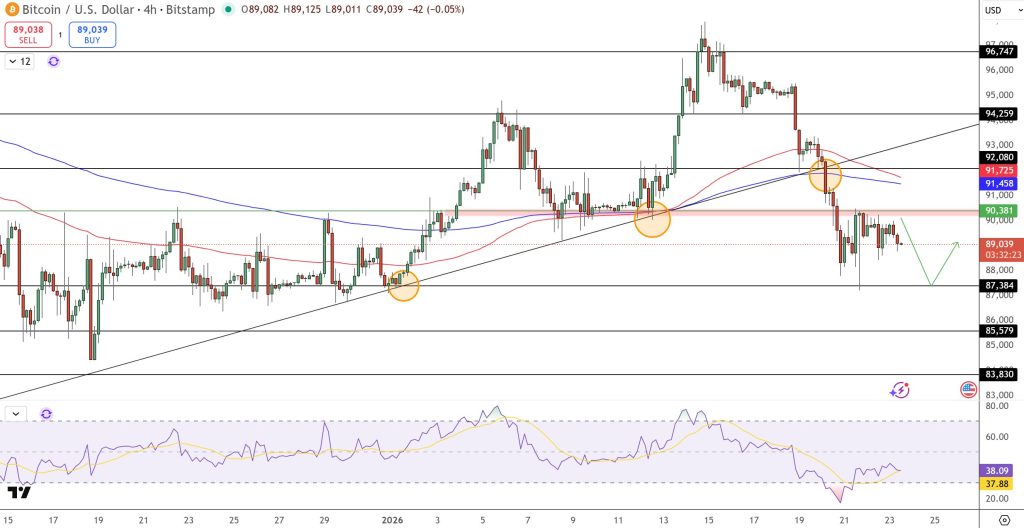
Bitcoin Price Prediction: Why BTC’s $87K–$90K Range Could Set Up the Next Breakout

On the technical front, Bitcoin is trading near $89,000, and despite recent weakness, the broader picture still points to consolidation rather than trend failure. Price has pulled back to a rising trendline that has supported the move higher since $83,800, showing buyers remain active on dips.

#bitcoin lost its rising trendline but hasn’t broken structure yet.
BTC holds $87.4K support after rejecting $91.7K EMAs.
This looks like consolidation, not panic.
Next move likely decides above $90.4K or below $87.4K. 📉📈 pic.twitter.com/eh1eFPoZ5E

— Arslan Ali (@forex_arslan) January 23, 2026

If Bitcoin holds above $87,400, price could grind back toward $90,400, followed by a test of $92,000–$94,250. A break below $87,400 would delay this outlook and expose $85,600, but for now, pullbacks continue to look corrective rather than structural.

BTC Trade idea: Buy near $88,000–$87,500, target $94,000, stop below $85,500.

Bitcoin Hyper: The Next Evolution of BTC on Solana?

Bitcoin Hyper ($HYPER) is bringing a new phase to the BTC ecosystem. While BTC remains the gold standard for security, Bitcoin Hyper adds what it always lacked: Solana-level speed. The result: lightning-fast, low-cost smart contracts, decentralized apps, and even meme coin creation, all secured by Bitcoin.

Audited by Consult, the project emphasizes trust and scalability as adoption builds. And momentum is already strong. The presale has surpassed $30.9 million, with tokens priced at just $0.013625 before the next increase.

As Bitcoin activity climbs and demand for efficient BTC-based apps rises, Bitcoin Hyper stands out as the bridge uniting two of crypto’s biggest ecosystems. If Bitcoin built the foundation, Bitcoin Hyper could make it fast, flexible, and fun again.

Click Here to Participate in the Presale

The post Bitcoin Price Prediction: Wall Street Combines Bitcoin and Gold in One ETF – Trillions Incoming? appeared first on Cryptonews.
❌