As the crypto market suffered a widespread decline, Aave (AAVE) prices dipped by nearly 10%, reaching a local bottom around $153. Presently, the altcoin is trading within a range of $155-$160, but an emerging chart pattern indicates an impending price breakout.
AAVE Falling Wedge Nears Explosion Point, $145 As Key Price Floor
In an X post on January 23, popular market expert Ali Martinez shares an insightful analysis of the AAVEUSD 4-hour chart, showing the altcoin is approaching a critical market juncture. Notably, a key support zone of $144 sits at the base of a broader descending structure that has defined AAVE’s price action since last year. Martinez’s analysis shows that AAVE is trading within a falling wedge formation, characterized by a series of lower highs capped by a descending trendline and relatively stable support near the $145 region. This price formation often represents a period of consolidation following sustained downside pressure, as sellers gradually lose momentum while buyers defend a key floor.
For context, since topping out above the $350 level earlier in the cycle, AAVE has experienced a steady corrective move, with price stepping down through multiple horizontal levels near $240, $200, and $162. The loss of these zones shifted short-term momentum firmly in favor of sellers, making the current support range even more important. At present, AAVE is trading in the mid $150s, leaving limited room before a direct retest of the $144.93 support. However, this level has already acted as a demand zone multiple times during the current downtrend, reinforcing its significance.
According to Martinez’s analysis, a clean break below $145 could force an accelerated downside move, with the next major support area set around $125. In that scenario, price acceptance below the wedge structure would likely confirm a continuation of the broader bearish trend. Conversely, holding the $145 support may provide the conditions for a technical rebound.
A successful defense of this level, combined with a break above the descending trendline, could allow AAVE to reclaim higher resistance zones around $162 and potentially $200 over time. While such a move would not immediately invalidate the larger corrective structure, it would suggest improving market balance and decreased selling pressure.
AAVE Price Overview
At press time, Aave trades at $156.99, reflecting a decline of 0.76% in the past 24 hours. Meanwhile, the daily trading volume is up by 6.07% and valued at $362.59 million. With price compressing toward the apex of the falling wedge, traders should expect increased volatility in the coming AAVE trading sessions. For now, the price moves at $144.93 as a pivotal inflection point for determining the next directional move.
Featured image from Rootsttrap, chart from TradingView
Aave has handed stewardship of the Lens Protocol to Mask Network, marking a strategic shift that narrows Aave’s focus back to decentralized finance.
This will place the next phase of decentralized social development in the hands of a team more tightly focused on consumer-facing execution.
The transition was confirmed this week by statements from Aave and Lens founder Stani Kulechov, as well as from Mask Network.
Aave Keeps Advisory Role while giving Lens App Development to Mask Network
Kulechov said Aave’s role in Lens will now be limited to technical advisory support, describing the move as a refocus rather than a retreat.
He explained that Aave initially expanded beyond onchain financial primitives to build social primitives that users could own, resulting in the creation of Lens.
Over the years, we have built some of the most important onchain financial primitives. We later expanded that ambition to social primitives that users truly own.
We built the Lens Protocol and its underlying onchain rails, including state-of-the-art decentralized data storage… https://t.co/g0zLIUlaBh
The original aim, he said, was to create neutral social infrastructure that developers could rely on to build consumer-grade applications capable of reaching mainstream users.
With that foundation now in place, stewardship is shifting to Mask Network, which will lead development at the application and product layer while Aave returns to its core expertise in DeFi.
Both Aave and Lens emphasized that the move is not an acquisition, sale, or exit. There was no indication of a transfer of protocol ownership, intellectual property, treasuries, or governance control.
Lens’ core components, including its onchain social graph, profiles, follows, and smart contracts, will remain open-source and permissionless.
Aave said it will continue to provide input on protocol-level decisions but will no longer lead product development or operate social applications directly.
Mask Network, a Web3 company known for integrating blockchain features into social and messaging platforms, will now assume responsibility for consumer-facing execution.
This includes product roadmap decisions, user experience design, and day-to-day operational leadership for social applications built on Lens, such as Orb.
In a statement announcing the transition, Lens said the ecosystem’s next phase requires less protocol experimentation and more focus on unified social experiences that can operate at scale and meet user expectations.
Lens was launched by Aave in 2022 as a Web3-native social protocol designed to give users ownership over their social identities and content through onchain profiles and NFTs.
From the outset, it was positioned as infrastructure rather than a standalone social network.
Lens Enters Its Next Chapter as Decentralized Social Gains Momentum
Since launch, Lens has grown into one of the most widely used decentralized social protocols. Early builder adoption was rapid, with more than 50 projects built on Lens shortly after launch.
By early 2023, the protocol had surpassed 100,000 minted profiles and supported more than 120 applications.
Lens later migrated to Polygon mainnet, rolled out V2 and V3 upgrades, and introduced Lens Chain, a purpose-built network powered by ZKsync and Avail, aimed at improving scalability, speed, and monetization.
Lens uses GHO as gas, enabling near-instant, low-cost transactions, and includes decentralized storage through Grove and features like Family Accounts.
The handover to Mask Network comes as decentralized social regains attention across the crypto industry.
Ethereum co-founder Vitalik Buterin said he plans to spend more time on decentralized social platforms in 2026, arguing that better mass communication tools are needed and that decentralization enables competition by allowing multiple clients to build on shared data layers.
In 2026, I plan to be fully back to decentralized social.
If we want a better society, we need better mass communication tools. We need mass communication tools that surface the best information and arguments and help people find points of agreement. We need mass communication… https://t.co/ye249HsojJ
Mask Network founder Suji Yan described the transition as aligned with the cypherpunk values at the heart of crypto, saying decentralized social should be part of everyday life rather than limited to financial products.
Lens stands for decentralization and the cypherpunk spirit at the heart of blockchain/crypto.
Crypto shouldn’t be just financial products — it should be part of everyday life, in every post, every interaction. Own your post – and make SocialFi great again.
Imagine borrowing millions of dollars — without collateral, without paperwork, and without risk — then repaying it all in a single transaction.
That’s not a thought experiment. That’s Aave flash loans, and they’re quietly redefining how capital efficiency works in decentralized finance (DeFi).
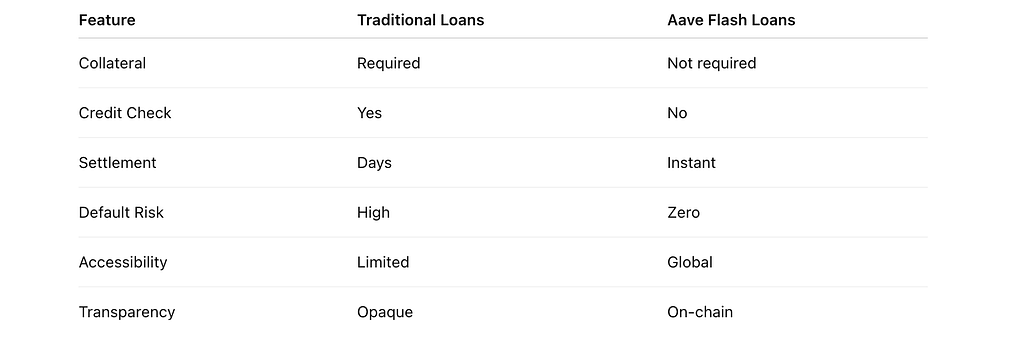
Flash loans have turned traditional finance logic upside down. They allow anyone — from solo developers to institutional traders — to access enormous liquidity instantly, as long as the loan is repaid within the same blockchain transaction. If it isn’t, the entire transaction is automatically reversed.
No defaults. No counterparty risk. No credit checks.
In a financial system built on trustless execution and smart contracts, Aave’s flash loans represent one of the most powerful innovations ever introduced to crypto lending, arbitrage, and on-chain capital markets.
This article explains why Aave’s flash loans are a true game-changer, how they work, who uses them, the risks involved, and why they matter for the future of finance, wealth creation, and debt-free capital access.
What Are Flash Loans?
A flash loan is a type of uncollateralized crypto loan that must be:
Borrowed
Used
Repaid
— all within a single blockchain transaction.
If the loan is not repaid instantly, the transaction fails and the blockchain state reverts as if it never happened.
This is possible because of atomic transactions — a core feature of smart contract platforms like Ethereum.
Key Characteristics of Flash Loans
No collateral required
Executed instantly
Repaid in the same transaction
Enforced by smart contracts
Zero credit risk for lenders
Aave pioneered flash loans in DeFi, making them widely accessible to developers, traders, and protocols.
Are you servicing a high-interest debt or have low savings?
Private credit is becoming the new income solution. Get $300 on first deposit with Insidefinacent. See how it works here.
Why Aave Flash Loans Are Revolutionary
In traditional finance:
Borrowing requires collateral or creditworthiness
Large loans require approval
Risk is socialized across lenders
Defaults are possible
In DeFi flash loans:
Capital is accessed temporarily
Risk is eliminated through code
Settlement is instant
Efficiency is maximized
This changes who can access capital, how markets self-correct, and how financial strategies are executed on-chain.
Aave: The Flash Loan Pioneer
Aave is one of the largest decentralized lending protocols in crypto, managing billions in total value locked (TVL) and serving as core infrastructure for DeFi.
Aave introduced flash loans in early 2020, and they quickly became:
A core DeFi primitive
A building block for advanced trading strategies
A tool used by protocols, bots, and institutions
Today, Aave flash loans are embedded into the plumbing of decentralized finance.
How Aave Flash Loans Work (Step-by-Step)
Let’s break it down in plain English.
Step 1: Borrow
A user or smart contract requests a flash loan from Aave’s liquidity pool.
Step 2: Execute Strategy
The borrowed funds are used immediately for:
Arbitrage
Debt refinancing
Collateral swaps
Liquidations
Yield optimization
Step 3: Repay
Before the transaction ends, the loan is repaid plus a small fee.
Step 4: Atomic Validation
If repayment fails, the entire transaction is canceled.
From the blockchain’s perspective:
Either everything succeeds
Or nothing ever happened
This is why flash loans are fundamentally risk-free for lenders.
Why Flash Loans Matter for Capital Efficiency
Capital efficiency is one of the most important concepts in modern finance.
Flash loans:
Remove idle capital
Unlock dormant liquidity
Allow massive trades without upfront capital
Enable strategies that were previously impossible
This is especially powerful in high-frequency, low-margin environments like arbitrage and liquidations.
Top Use Cases for Aave Flash Loans
1. Arbitrage Trading
Flash loans allow traders to exploit price differences across:
DEXs (Uniswap, Curve, Sushi)
Lending protocols
Synthetic asset platforms
A trader can:
Borrow millions via flash loan
Buy asset cheaply on one exchange
Sell it higher on another
Repay the loan
Keep the profit
All without risking personal capital.
2. Debt Refinancing & Collateral Swaps
Flash loans enable DeFi debt restructuring.
Example:
A user has a high-interest loan on one protocol
Uses a flash loan to repay it
Moves collateral
Opens a new loan at a lower rate
Repays flash loan
This allows:
Lower interest rates
Reduced liquidation risk
Smarter debt management
3. Liquidations (Professional DeFi Strategy)
Liquidations are essential for protocol stability.
Flash loans allow liquidators to:
Repay undercollateralized loans
Receive collateral at a discount
Sell collateral
Repay flash loan
Capture liquidation bonuses
This ensures:
System solvency
Faster market corrections
Efficient risk removal
4. Yield Optimization & DeFi Automation
Advanced DeFi strategies often involve:
Moving liquidity between protocols
Rebalancing yield positions
Compounding rewards
Flash loans make this possible without locking capital, enabling automated strategies and smart vaults.
5. Protocol-to-Protocol Composability
Flash loans are used by:
Other DeFi protocols
DAOs
Automated market makers
Yield aggregators
They act as temporary liquidity bridges, allowing protocols to interact seamlessly.
Flash loans are powerful — but they don’t exist in isolation. Many of the strategies discussed here depend on liquidation mechanics, market volatility, and automated risk controls.
Understanding liquidations is essential if you want to avoid becoming the exit liquidity.

 Login
Login


 (@suji_yan)