Reading view

There are new articles available, click to refresh the page.

Spot vs Perpetual Trading on Hyperliquid: What Every Trader Must Understand
By: MintonFin
Spot vs Perpetual Trading on Hyperliquid

One wrong choice between spot and perpetual trading can silently drain your capital — especially on a high-performance platform like Hyperliquid.

Hyperliquid has rapidly emerged as one of the most talked-about decentralized trading platforms in crypto. With lightning-fast execution, deep liquidity, and a fully on-chain order book, it attracts everyone from casual traders to highly leveraged professionals.

But here’s the uncomfortable truth most guides don’t tell you:

  • Spot and perpetual trading on Hyperliquid are not interchangeable.
  • They reward completely different mindsets, risk tolerances, and time horizons.
  • Choosing the wrong one can turn a profitable strategy into a liquidation event.

In this guide, you’ll learn exactly how spot trading and perpetual trading work on Hyperliquid, how they differ, and most importantly, which one aligns with your goals, capital structure, and psychology as a trader.

Whether you’re a long-term crypto holder, an active DeFi participant, or an advanced derivatives trader, this article will help you make smarter, safer, and more profitable decisions on Hyperliquid.

What Is Hyperliquid?

Hyperliquid is a decentralized exchange (DEX) optimized for high-performance spot and perpetual futures trading, built with a custom Layer-1 blockchain designed specifically for trading.

Unlike many DeFi platforms that rely on AMMs (automated market makers), Hyperliquid uses a fully on-chain central limit order book (CLOB) — similar to Binance or OKX, but decentralized.

Key Features of Hyperliquid

  • Fully on-chain order book
  • Ultra-low latency execution
  • Deep liquidity for major trading pairs
  • Spot trading and perpetual futures in one interface
  • No KYC required
  • Non-custodial (you control your funds)

This hybrid design makes Hyperliquid uniquely powerful — but also more complex than typical DeFi platforms.

Understanding spot vs perpetual trading is critical before using it seriously.

Are you servicing a high-interest debt or want better savings?

Private credit is becoming the new income solution. Get $300 on first deposit with Insidefinacent.

Spot Trading Explained (Hyperliquid Spot Markets)

What Is Spot Trading?

Spot trading means buying or selling an asset for immediate settlement at the current market price.

When you buy ETH on the spot market:

  • You own the ETH
  • It appears directly in your wallet
  • There is no leverage
  • No liquidation risk

How Spot Trading Works on Hyperliquid

On Hyperliquid’s spot market:

  • You trade crypto pairs (e.g., ETH/USDC)
  • Trades settle instantly on-chain
  • Assets are fully owned by you
  • Profits and losses are unrealized until you sell

Spot Trading Example

If you:

  • Buy ETH at $2,500
  • Hold it for three months
  • Sell at $3,000

Your profit is simply:

($3,000 — $2,500) × ETH amount

No funding rates. No margin calls. No forced liquidation.

Advantages of Spot Trading on Hyperliquid

Spot trading is often underestimated — especially in a derivatives-driven market.

1. Zero Liquidation Risk

Your position cannot be forcibly closed due to volatility.

This makes spot trading ideal for:

  • Long-term investors
  • Conservative traders
  • Portfolio builders

2. Full Asset Ownership

You actually own the underlying crypto, which means:

  • You can withdraw anytime
  • You can move assets to cold storage
  • You can use them in DeFi elsewhere

3. Simple Risk Management

Your maximum loss is limited to your initial investment.

No leverage = no surprise margin calls.

4. Ideal for Market Cycles

Spot trading excels during:

  • Bull markets
  • Accumulation phases
  • Long-term trend formation

Disadvantages of Spot Trading

Despite its safety, spot trading has limitations.

1. Capital Inefficiency

Without leverage:

  • Returns are slower
  • Large capital is needed for meaningful gains

2. No Short Selling (in pure spot)

You cannot profit from falling prices unless:

  • You sell an asset you already own
  • Or rotate into stablecoins

3. Opportunity Cost

Capital tied in spot positions can’t be redeployed quickly for short-term trades.

Perpetual Trading Explained (Hyperliquid Perps)

What Are Perpetual Futures?

Perpetual contracts (perps) are derivative instruments that track the price of an asset without expiration.

You do NOT own the underlying asset.

Instead, you:

  • Open long or short positions
  • Use margin
  • Trade price movement only

How Perpetual Trading Works on Hyperliquid

Hyperliquid’s perpetual markets allow:

  • High leverage
  • Long and short positions
  • Cross-margin and isolated margin
  • Continuous funding payments

Key Components

  • Margin: Collateral posted to open a position
  • Leverage: Borrowed exposure (e.g., 10x, 20x)
  • Funding Rate: Periodic payments between longs and shorts
  • Liquidation Price: Price at which your position is forcibly closed

Perpetual Trading Example

You:

  • Deposit $1,000
  • Open a 10x long on ETH
  • Control $10,000 worth of ETH exposure

If ETH rises 5%:

  • Your profit ≈ 50%

If ETH drops ~10%:

  • Your position is liquidated
  • Your capital is gone

Advantages of Perpetual Trading on Hyperliquid

1. Leverage Amplifies Returns

Perps allow:

  • Faster capital growth
  • Efficient use of capital
  • Aggressive strategies

2. Ability to Short the Market

You can profit from:

  • Bear markets
  • Downtrends
  • Market corrections

This is critical for professional traders.

3. High Liquidity and Tight Spreads

Hyperliquid’s order book provides:

  • Minimal slippage
  • Institutional-grade execution

4. Advanced Trading Strategies

Perpetuals support:

  • Hedging spot positions
  • Delta-neutral strategies
  • Arbitrage opportunities

Risks of Perpetual Trading

Perpetual trading is not forgiving.

1. Liquidation Risk

Small price movements can wipe out positions.

Most retail traders lose money due to:

  • Over-leverage
  • Poor stop placement
  • Emotional trading

2. Funding Rate Costs

Holding perps long-term can:

  • Erode profits
  • Turn winning trades negative

3. Psychological Pressure

Perps amplify:

  • Stress
  • Overtrading
  • Revenge trading

This is why many traders underperform despite good analysis.

Spot vs Perpetual Trading on Hyperliquid (Comparison Table)
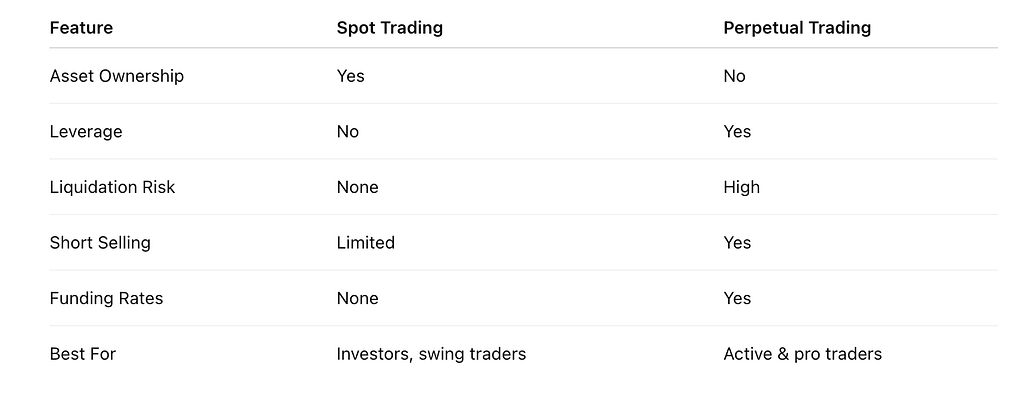
Spot vs Perpetual Trading on Hyperliquid

Which Should You Choose on Hyperliquid?

Choose Spot Trading If:

  • You’re building long-term positions
  • You want low stress
  • You prioritize capital preservation
  • You’re new to Hyperliquid

Choose Perpetual Trading If:

  • You understand leverage deeply
  • You actively manage risk
  • You trade intraday or swing short-term
  • You have strict stop-loss discipline

Advanced Strategy: Combining Spot + Perpetuals

Professional traders often use both.

Example Hedging Strategy

  • Hold ETH spot long-term
  • Short ETH perps during market weakness
  • Reduce volatility without selling spot

This approach:

  • Protects capital
  • Preserves upside
  • Requires discipline

This is how professionals trade. Combining spot and perpetuals isn’t advanced — it’s essential.

If this strategy changed how you think about trading, clap to help it reach more serious traders.

Common Mistakes Traders Make on Hyperliquid

  1. Over-leveraging perps
  2. Using perps for long-term holding
  3. Ignoring funding rates
  4. Trading emotionally after losses
  5. Treating perps like spot

Avoiding these mistakes alone can dramatically improve performance.

Is Hyperliquid Safe for Spot and Perpetual Trading?

Hyperliquid’s non-custodial design reduces:

  • Exchange counterparty risk
  • Custody failures

However:

  • Smart contract risk exists
  • Trader behavior is the biggest risk factor

The platform isn’t dangerous — poor risk management is.

Final Thoughts: Spot vs Perpetual Trading on Hyperliquid

Hyperliquid is one of the most powerful decentralized trading platforms available today. But power cuts both ways.

  • Spot trading rewards patience and conviction
  • Perpetual trading rewards precision and discipline

Understanding the difference is not optional — it’s essential.

The traders who thrive on Hyperliquid aren’t the most aggressive. They’re the ones who choose the right tool for the right market condition.

Trade Smarter on Hyperliquid

The difference between surviving and thriving isn’t luck — it’s structure.

  • Save this guide
  • Clap if it added value
  • Follow for more no-nonsense crypto trading breakdowns

Your capital deserves better decisions.


Spot vs Perpetual Trading on Hyperliquid: What Every Trader Must Understand was originally published in Coinmonks on Medium, where people are continuing the conversation by highlighting and responding to this story.


Thailand Finalizes Rules for Bitcoin ETFs and Crypto Futures in Early-2026 Push

Bitcoin Magazine

Thailand Finalizes Rules for Bitcoin ETFs and Crypto Futures in Early-2026 Push

Thailand is moving decisively to cement its position as one of Asia’s most crypto-friendly financial centers, with regulators finalizing new rules for bitcoin and crypto exchange-traded funds (ETFs), futures trading, and tokenized investment products in early 2026.

The country’s Securities and Exchange Commission (SEC) confirmed this week that it is preparing comprehensive regulatory guidelines that would allow crypto ETFs to be formally established, crypto futures to trade on the Thailand Futures Exchange (TFEX), and digital assets to be recognized as an official asset class under existing derivatives law.

SEC Deputy Secretary-General Jomkwan Kongsakul said the new framework is designed to expand access to digital assets while addressing security and custody risks that have historically deterred institutional investors.

“A key advantage of crypto ETFs is ease of access,” Kongsakul said, according to local reports. “They eliminate concerns over hacking and wallet security, which has been a major barrier for many investors.”

Bitcoin and crypto ETFs are moving closer to market

Thailand’s SEC board has already approved crypto ETFs in principle, with regulators now finalizing operational rules covering custody, liquidity, and cooperation between asset managers and licensed digital asset exchanges.

Thailand approved its first spot Bitcoin ETF in June 2024, initially restricting participation to institutional investors. By October 2025, the regulator signaled plans to expand offerings beyond bitcoin to include other cryptocurrencies, such as ether, potentially in the form of diversified crypto “basket” products.

Under the proposed framework, investors would be allowed to allocate up to 4–5% of diversified portfolios to digital assets—an approach aimed at balancing innovation with risk management.

Once approved, domestically listed crypto ETFs could trade on the Stock Exchange of Thailand, offering local exposure without requiring investors to directly hold or manage cryptocurrencies.

Alongside ETFs, the SEC is advancing plans to launch crypto futures trading on TFEX under the Futures Trading Act. Regulators also intend to formally recognize digital assets as an underlying asset class under the Derivatives Act, providing a clearer legal foundation for crypto-linked derivatives.

To support liquidity and price stability, the SEC plans to introduce market-making mechanisms in 2026. Potential market makers could include financial institutions, licensed digital asset exchanges, corporations, and entities holding cryptocurrencies on their balance sheets.

The futures market is expected to provide investors with hedging tools and more advanced risk management options, while expanding institutional participation in Thailand’s digital asset markets.

Thailand’s recent crypto incentives

Thailand’s regulatory push extends beyond ETFs and derivatives. The SEC is also developing rules for tokenized real-world assets (RWAs), including tokenized bonds and other securities that could be issued and traded on blockchain infrastructure.

These efforts align with broader global trends in asset tokenization and could eventually include baht-backed stablecoins. In 2025, Thailand approved U.S. dollar stablecoins for local trading, marking another step toward regulated digital finance.

On the tax front, Thailand eliminated capital gains tax on crypto trading from January 1, 2025, through December 31, 2029. 

This post Thailand Finalizes Rules for Bitcoin ETFs and Crypto Futures in Early-2026 Push first appeared on Bitcoin Magazine and is written by Micah Zimmerman.

Spot vs Futures on Binance: Where Should Smart Money Actually Trade?

By: MintonFin
Spot vs Futures on Binance - Where Should Smart Money Actually Trade?

Smart money doesn’t chase hype — it chooses structure, liquidity, and asymmetric risk. On Binance, that choice usually comes down to one critical decision: Spot trading or Futures trading?

Retail traders often frame this debate as simple — low risk vs high reward. Professionals know it’s far more nuanced. The real question isn’t which market is more profitable, but which market aligns with capital preservation, risk-adjusted returns, and scalable strategy execution.

In this in‑depth guide, we break down Spot vs Futures on Binance from the perspective of institutional traders, hedge funds, high‑net‑worth investors, and disciplined professionals — not gamblers.

By the end, you’ll know exactly where smart money actually trades, why, and how to position yourself accordingly.

Smart money uses both Spot and Futures on Binance — but for different objectives.

  • Spot trading is preferred for long‑term accumulation, capital preservation, and directional conviction.
  • Futures trading is used for hedging, short‑term alpha, volatility capture, and capital efficiency — not reckless leverage.

The edge comes from knowing when to use each market, not choosing only one.

Smart traders don’t rely on hype — they rely on frameworks. If you want more deep‑dive guides on Binance, crypto risk management, and professional‑grade trading strategies, follow this Medium profile now so you don’t miss the next article.

Understanding Binance Spot Trading

What Is Spot Trading on Binance?

Spot trading on Binance involves buying or selling cryptocurrencies at the current market price, with immediate ownership of the underlying asset. When you buy BTC on the spot market, you actually own BTC — no contracts, no expiry, no liquidation risk.

This is the most straightforward and transparent form of crypto trading, which is why it remains the foundation of most professional portfolios.

Key Features of Binance Spot Markets

  • Real ownership of assets
  • No leverage required
  • No liquidation risk
  • Simple fee structure
  • Ideal for long‑term holding

Who Uses Spot Trading?

Spot markets attract:

  • Long‑term investors
  • Funds building core crypto exposure
  • Family offices allocating to digital assets
  • Traders with strong directional conviction
  • Risk‑averse capital seeking asymmetric upside

For smart money, spot trading is about positioning, not excitement.

Advantages of Spot Trading (Why Smart Money Loves It)

1. No Liquidation Risk

One of the biggest advantages of spot trading is zero liquidation risk. Prices can move violently against you, but your position remains intact unless you choose to exit.

This is critical for professionals who prioritize survivability over short‑term performance.

2. Ideal for Long‑Term Conviction Trades

Smart money often identifies structural trends early — Layer 2 adoption, Bitcoin halvings, ETF inflows, DeFi primitives, or real‑world asset tokenization.

Spot markets allow them to:

  • Accumulate gradually
  • Ride multi‑year trends
  • Ignore short‑term volatility

3. Simpler Risk Management

Risk is limited to the capital invested. There are no margin calls, funding rates, or forced liquidations to manage.

This simplicity is a feature, not a weakness.

4. Psychological Advantage

Spot traders experience far less emotional pressure than leveraged traders.

This leads to:

  • Better decision‑making
  • Less over‑trading
  • More consistent execution

Smart money values emotional control as much as strategy.

Limitations of Spot Trading

Despite its strengths, spot trading isn’t perfect.

Capital Inefficiency

To generate meaningful returns, spot traders must deploy significant capital. A 20% move requires 100% capital exposure.

For institutions seeking capital efficiency, this can be a constraint.

Limited Short Opportunities

Spot markets make shorting difficult or impossible without borrowing assets, which adds complexity and counterparty risk.

This is where futures enter the conversation.

Pro Insight: Most traders lose money not because of bad markets — but because they choose the wrong tool.

Are you servicing a high-interest debt or want better savings?

Private credit is becoming the new income solution. Get $300 on first deposit with Insidefinacent. Here’s how it works.

Understanding Binance Futures Trading

What Are Binance Futures?

Binance Futures allows traders to speculate on the price of cryptocurrencies using derivative contracts rather than owning the underlying asset.

Key characteristics include:

  • Ability to go long or short
  • Use of leverage
  • Funding rates
  • Liquidation thresholds

Types of Binance Futures

  • USDT‑Margined Futures (most popular)
  • COIN‑Margined Futures

Smart money overwhelmingly prefers USDT‑margined perpetual futures due to liquidity and simplicity.

Why Smart Money Uses Futures (The Real Reasons)

Contrary to popular belief, professionals do not use futures primarily to gamble with high leverage.

1. Hedging Spot Exposure

One of the most common professional strategies is spot‑futures hedging.

Example:

  • Long BTC in spot
  • Short BTC perpetual futures during high volatility

This allows smart money to:

  • Protect downside risk
  • Lock in profits
  • Reduce portfolio volatility

2. Capital Efficiency

Futures require far less capital than spot positions. This allows funds to:

  • Deploy capital across multiple strategies
  • Maintain liquidity
  • Optimize returns on equity

3. Short‑Term Alpha Generation

Futures markets are ideal for:

  • Range trading
  • Breakout strategies
  • Mean reversion
  • Event‑driven trades

These strategies are difficult to execute efficiently on spot markets.

4. Market Neutral Strategies

Smart money often aims for delta‑neutral returns — profits regardless of market direction.

This is only possible with futures.

Risks of Futures Trading (Why Retail Traders Lose)

Liquidation Risk

Leverage magnifies both gains and losses. Poor risk management leads to forced liquidation — the #1 reason retail traders fail.

Funding Rate Costs

Holding futures positions during crowded trades can result in significant funding payments, silently eroding profits.

Emotional Overload

Leverage amplifies stress, leading to:

  • Over‑trading
  • Revenge trading
  • Strategy abandonment

Smart money survives by avoiding these traps.

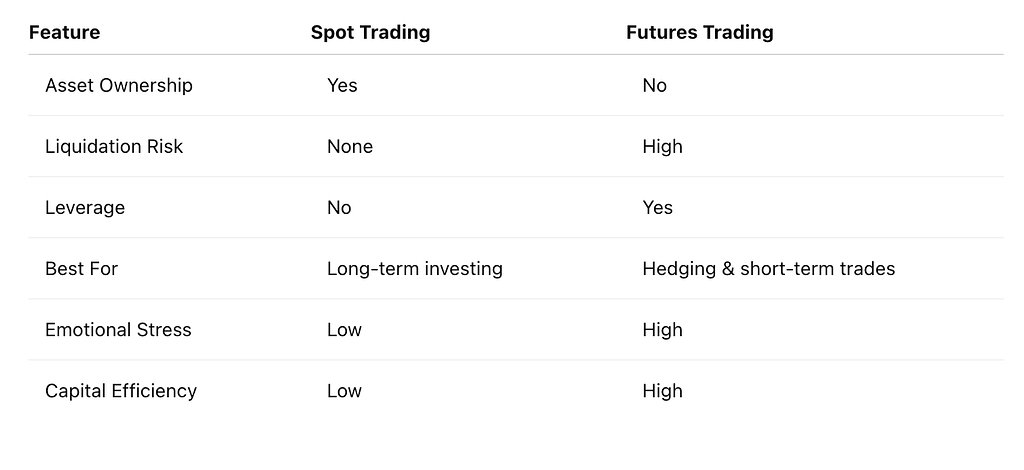
Spot vs Futures: Side‑by‑Side Comparison

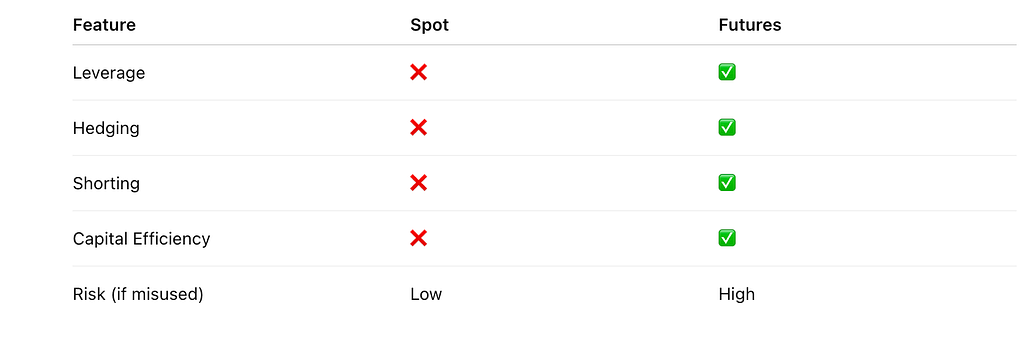
Spot vs Futures: Side‑by‑Side Comparison

Want the full smart‑money playbook? This article is part of a series focused on how professionals actually trade crypto — not what influencers sell.

Save this article so you can revisit these frameworks before your next trade.

Where Does Smart Money Actually Trade?

The honest answer: both — but strategically.

Smart Money Playbook

  • Spot for core holdings and conviction trades
  • Futures for risk management, tactical positioning, and volatility capture

They do not:

  • Go all‑in on high leverage
  • Trade emotionally
  • Chase every move

They focus on risk‑adjusted returns, not screenshots.

Common Retail Mistakes to Avoid

  1. Using high leverage without a plan
  2. Trading futures without understanding funding rates
  3. Ignoring spot accumulation
  4. Over‑trading low‑quality setups
  5. Confusing luck with skill

Avoiding these mistakes immediately puts you ahead of 90% of traders.

How to Choose Between Spot and Futures

Ask yourself:

  • Is my goal long‑term wealth or short‑term income?
  • Can I emotionally handle leverage?
  • Do I understand liquidation mechanics?
  • Am I trading with a strategy or chasing price?

If unsure, start with spot.

Advanced Strategy: Combining Spot and Futures

Professionals often run hybrid strategies, such as:

  • Spot accumulation + futures hedging
  • Spot long‑term + futures scalping
  • Spot portfolio + futures arbitrage

This layered approach reduces risk while maximizing opportunity.

Final Verdict: Spot vs Futures on Binance

Spot trading builds wealth. Futures trading manages and enhances it.

Smart money doesn’t choose sides — it chooses structure, discipline, and survivability.

If your goal is long‑term success rather than short‑term excitement, the path is clear:

  • Build conviction in spot markets
  • Use futures selectively
  • Manage risk relentlessly

That’s where smart money actually trades.

If this guide helped sharpen your understanding of Spot vs Futures on Binance, do clap and save. Your future self will thank you before your next trade.

This isn’t content for gamblers.

It’s for traders who want to stay in the game long enough to win.


Spot vs Futures on Binance: Where Should Smart Money Actually Trade? was originally published in Coinmonks on Medium, where people are continuing the conversation by highlighting and responding to this story.

Bitcoin Hits $0 on Paradex After Starknet Glitch — Mass Liquidations Force Rollback

Bitcoin briefly appeared to trade at zero on Paradex early Sunday after a technical failure during scheduled maintenance triggered mass liquidations across the decentralized perpetual futures exchange, forcing the team to announce a rare chain rollback to reverse the damage.

The incident unfolded shortly after Paradex carried out database maintenance at around 4:30 a.m. London time.

Within minutes, traders began reporting that prices on several perpetual markets, including Bitcoin, Ethereum, and Solana, had collapsed to near-zero levels.

🩸🚨Okay, when I posted the screenshot, I thought it was a UI bug.

Then I saw on the computer that the price came back after going to $0.

Now there are thousands of liquidations.

This doesn't look good for @paradex ☠ https://t.co/m4YbnfHkgN pic.twitter.com/QbKd3U432s

— Sniper ₿ (@sniiperrB) January 19, 2026

Screenshots and videos shared on social media showed a flood of liquidation alerts hitting the platform almost simultaneously, suggesting that the exchange’s pricing mechanism or oracle feed had malfunctioned during the update.

Timestamped alerts indicate the most intense activity occurred around 05:02 UTC on January 19, 2026.

Inside Paradex’s Chain Rollback After Mass Liquidations

During that brief window, long positions across multiple markets were liquidated at prices displayed as $0.00.

Bitcoin perpetual contracts saw numerous long liquidations at zero, while some short positions were closed at normal market prices near $92,600, pointing to an issue that disproportionately affected one side of the order book.

The sudden repricing automatically forced leveraged positions to close to prevent negative balances, amplifying the damage in a matter of seconds.

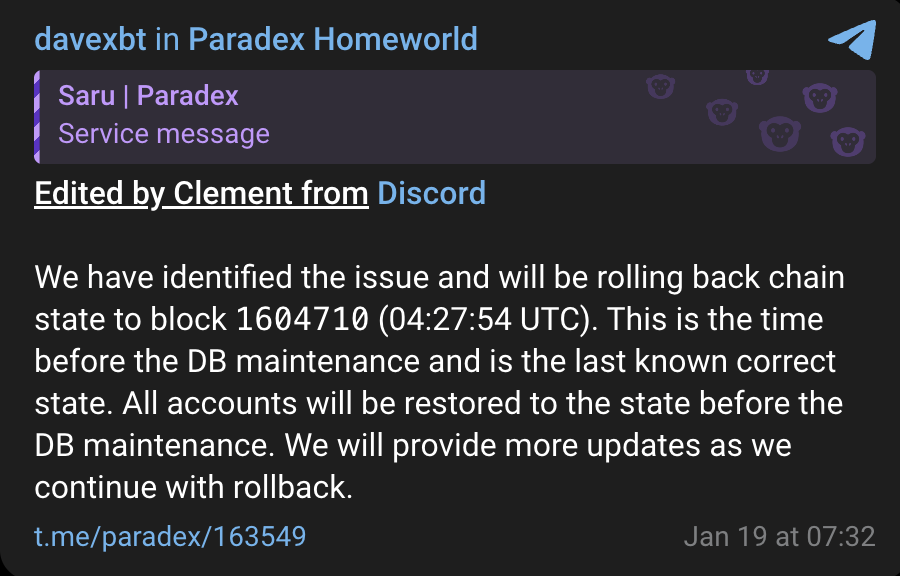
Roughly three hours after the event, Paradex director of engineering Clement Ho addressed users on Telegram, confirming that the team had identified the issue and would roll back the chain state to block 1,604,710, timestamped at 04:27:54 UTC.

Source: Clement

Ho noted that this block represented the last known correct state before the maintenance began. Paradex later echoed the message on its website, stating that recovery efforts were underway and that all user funds remained safe.

A rollback in this context means reverting the blockchain and associated system state to a point before the faulty transactions occurred, effectively canceling all trades, deposits, and liquidations that took place after that block.

While improperly liquidated users may see their positions restored, any profits earned after the rollback point would also be erased.

Such actions are widely considered a last resort in decentralized systems because they undermine the principle of immutability that blockchains are designed to uphold.

Paradex Restores Services After Outage, Warns Users of Impersonation Scams

Paradex operates on Starknet as a decentralized perpetual futures exchange and has grown into a sizable venue for on-chain derivatives trading.

Data from DefiLlama shows the platform processed nearly $1.6 billion in trading volume the day before the incident and holds around $225 million in user deposits.

Source: DefiLlama

CoinGecko reported approximately $652 million in open interest over the past 24 hours, and over a 30-day period, Paradex ranks among the top ten decentralized perps exchanges, with more than $37 billion in reported trading volume.

Following the liquidations, Paradex reported a platform-wide service outage affecting its trading interface, APIs, blockchain components, bridge, and block explorer.

As part of its recovery process, the exchange said it would force-cancel all open orders except take-profit and stop-loss orders.

Later updates confirmed that the platform and vault withdrawals had been re-enabled, though deposits and withdrawals for Gigavault would remain paused for up to 24 hours.

We’ve received reports of fake support accounts posing as our team.

Please remember:
+ Official updates only come from this account
+ We will never ask for your private keys
+ If another account messages you first, it is a scam

— Paradex (@paradex) January 19, 2026

The team also issued warnings about fake support accounts impersonating Paradex staff during the outage, urging users to rely only on official channels.

The incident has renewed scrutiny around technical risk in on-chain derivatives markets, which have faced a series of disruptions in recent months.

Aster, a top perps exchange by volume, has suffered repeated losses after being targeted by sophisticated trading strategies, including a high-profile incident in September when following an abnormal price spike in its XPL perpetual contract.

The post Bitcoin Hits $0 on Paradex After Starknet Glitch — Mass Liquidations Force Rollback appeared first on Cryptonews.

Ethereum Futures Volume Hits Highest Level On Binance Since Mid-December — Details

Over the week, Ethereum struggled to sustain any significant move to the upside. Although the second-largest cryptocurrency reclaimed the $3,300 price level, it could not break above $3,400 to continue its path towards higher price levels. As it stands, it appears that the Ether token is taking on a short-term bearish structure. However, an on-chain evaluation has recently been put out, which suggests that market participants might be gearing up for a significant move in the near-term.

Ethereum Futures Activity Reaches Monthly High Following Market Inactivity

In a recent QuickTake post on the CryptoQuant platform, analytics group Arab Chain reveals that there has recently been a spike in futures trading activity on the Binance derivatives market. This revelation is based on the Binance: ETH Futures Daily Volume metric, which monitors the total value of Ethereum futures contracts being traded on Binance each day, hence reflecting market activity, trader participation, and potential leverage exposure.

The latest reading of the metric has highlighted a major shift, with trading volume climbing as high as $21.7 billion. According to Arab Chain, this reading marks the highest level since mid-December, reflecting that strong momentum has returned to the futures market.


Ethereum

Notably, the spike in futures trading volume was preceded by a period of relative decline in the second half of December. This event coincides with a period of price stability, alongside a tapering risk appetite among traders. Interestingly, institutional investors also contributed prevalent aversion to risk.  Arab Chain explains that the decline is a typical sign that market participants want to “wait and see,” instead of speculatively opening large positions.

However, the present scenario — where futures volume surged — paints an opposing story. As the futures trading volume reflects levels above its mid-December high, it becomes apparent that interest among Ethereum traders is being rekindled. This is because increasing futures volume “is typically associated with higher leverage usage, hedging activity, and speculative positioning” — a line up which indicates that the market is preparing for significant movement.

The reason for this spike could also be attributed to traders who are reacting to key technical levels or shifting expectations around near-term price action of a potential trend reversal. In the grand scheme, however, the Ethereum price reacts to this activity, depending on the alignment of spot demand with derivatives activity. Till such a definite sign comes up, the market stands at a point of uncertainty.

ETH Price Overview

As of this writing, Ethereum stands at a price of $3,292, reflecting no real growth since the past day.

Ethereum

Binance Futures Explained: How Pros Trade Safely Without Getting Liquidated

By: MintonFin
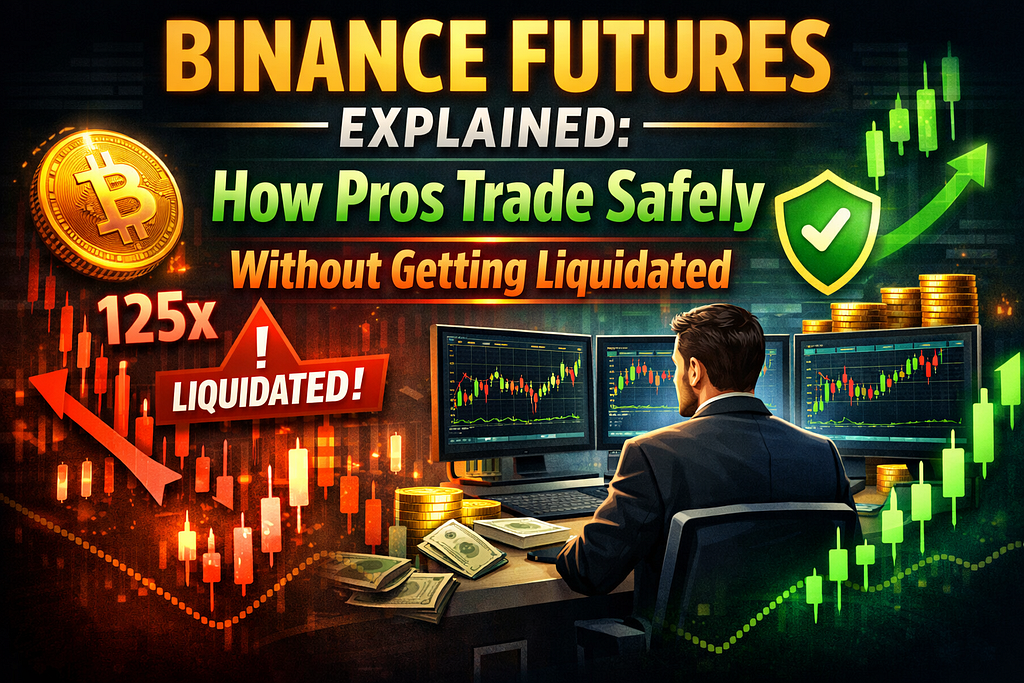
Binance Futures Explained: How Pros Trade Safely Without Getting Liquidated

Most traders don’t lose money on Binance Futures because they’re wrong about the market — they lose because they don’t understand risk.

Every liquidation you see on crypto Twitter, every $10M “rekt” screenshot, every blown account story follows the same pattern: too much leverage, poor position sizing, and zero risk management. Meanwhile, professional traders quietly compound capital on Binance Futures by doing the exact opposite.

This guide breaks down how professionals actually use Binance Futures, how they avoid liquidation, and how you can apply the same institutional risk frameworks — even with a small account.

Whether you’re trading for income, portfolio hedging, or capital growth, this article will show you how Binance Futures fits into a smart wealth strategy, not a gambling habit.

What Is Binance Futures?

Binance Futures is a derivatives trading platform that allows traders to speculate on the price of cryptocurrencies without owning the underlying asset.

Instead of buying Bitcoin outright, you trade contracts that track price movements.

Key Binance Futures Features

  • Perpetual Contracts (no expiration date)
  • Leverage up to 125x (rarely used by professionals)
  • USDT-M and COIN-M contracts
  • Cross and Isolated Margin
  • Advanced order types
  • Deep liquidity and tight spreads

Professionals use Binance Futures not to gamble, but to:

  • Hedge spot portfolios
  • Generate income in sideways markets
  • Reduce downside risk
  • Trade volatility efficiently

How Do Professionals Avoid Liquidation on Binance Futures?

Professionals avoid liquidation on Binance Futures by:

  1. Using low leverage (1x–3x)
  2. Trading with isolated margin
  3. Limiting risk to 1–2% per trade
  4. Always placing a stop-loss
  5. Maintaining sufficient margin buffers

These principles dramatically reduce liquidation risk even during high market volatility.

Liquidation isn’t bad luck — it’s mathematical certainty when leverage and risk aren’t controlled.

Professionals build strategies where liquidation is nearly impossible, even during extreme volatility.

Leverage: Why Professionals Use Less, Not More

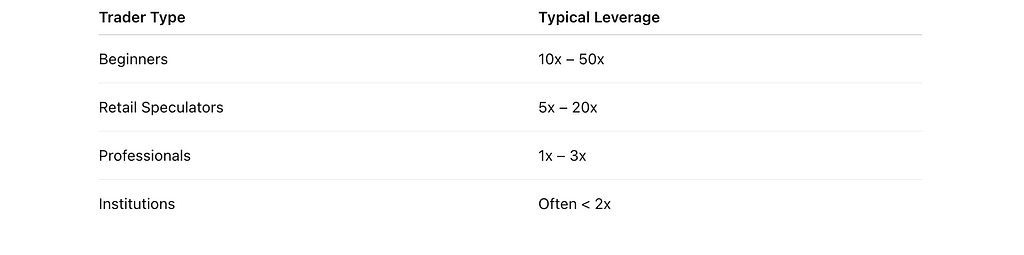
Retail traders are attracted to Binance Futures because of high leverage. Professionals view leverage as a risk tool, not a profit shortcut.

How Professionals Think About Leverage

How Professionals Think About Leverage

Low leverage increases survivability, allowing traders to stay in the market during volatility.

A 2x leveraged position can survive a 50% drawdown. A 10x position cannot survive a 10% move.

What Is the Safest Leverage to Use on Binance Futures?

The safest leverage on Binance Futures is between 1x and 3x.

Most professional traders and institutions rarely exceed 3x leverage because:

  • It allows positions to survive normal market swings
  • Liquidation thresholds remain far from price
  • Risk remains controllable during volatility

Cross Margin vs Isolated Margin: Which Is Better?

Isolated margin is safer than cross margin for most traders.

Cross Margin vs Isolated Margin

Isolated Margin (Professional Default)

  • Risk limited to one position
  • Liquidation does not affect entire account
  • Easier to calculate risk
  • Ideal for directional trades

Cross Margin (Advanced & Dangerous)

  • Entire account backs open positions
  • One bad trade can wipe everything
  • Used mainly for hedging strategies

Professionals default to isolated margin to prevent one trade from wiping out the entire account.

Position Sizing: The #1 Professional Skill

Professionals don’t ask:

“How much can I make?”

They ask:

“How much can I afford to lose?”

How Do Professionals Calculate Position Size?

Professionals calculate position size using this formula:

Position Size = (Account Size × Risk %) ÷ Stop-Loss Distance

Example:

  • Account size: $10,000
  • Risk per trade: 1% ($100)
  • Stop loss: 5%

Position size = $2,000

Professional Risk Rule

  • Risk 0.5%–2% of total capital per trade
  • Never risk more than 5% across all positions

This single rule alone eliminates most liquidations.

What Is a Stop-Loss in Binance Futures?

A stop-loss in Binance Futures is an order that automatically closes a position when price reaches a predefined level to limit losses.

A stop loss is not optional — it’s the foundation of futures trading.

Professional Stop-Loss Principles

  • Always placed before entry
  • Based on structure, not emotion
  • Never moved further away
  • Only adjusted to reduce risk

Common stop-loss tools:

  • Support/resistance
  • VWAP
  • Previous highs/lows
  • ATR-based stops

Professionals never rely on liquidation price as a stop.

How Do Funding Rates Work on Binance Futures?

Funding rates are periodic payments exchanged between long and short traders to keep futures prices aligned with spot prices.

  • Positive funding → longs pay shorts
  • Negative funding → shorts pay longs

Professionals monitor funding rates to:

  • Avoid crowded trades
  • Earn funding yield
  • Identify market sentiment extremes
  • Hedge spot holdings with futures

In some markets, professionals earn passive income simply by holding positions that collect funding.

Can Binance Futures Be Used for Hedging?

Yes, Binance Futures is commonly used for portfolio hedging.

Hedge Strategy Example

  • Hold $50,000 BTC spot
  • Short $25,000 BTC perpetuals
  • Reduce downside risk during uncertainty
  • Maintain long-term exposure

This allows investors to:

  • Avoid panic selling
  • Protect capital
  • Manage taxes more efficiently
  • Reduce emotional decisions

Institutions hedge constantly. Retail traders rarely do.

Liquidation Price: Why Pros Ignore It

Retail traders obsess over liquidation price. Professionals don’t.

Why?

  • They never let price get close
  • Stops trigger first
  • Risk is predefined
  • Margin buffers are large

If you’re watching liquidation price, your leverage is already too high.

Volatility Management: Trading When Others Panic

Professionals wait for:

  • Liquidity sweeps
  • Forced liquidations
  • Extreme fear or greed
  • Overcrowded positions

They enter after retail traders are wiped out — not before.

Binance Futures provides real-time data that professionals use to:

  • Identify leverage clusters
  • Spot liquidation zones
  • Trade against emotional traders

Advanced Order Types Professionals Use

Binance Futures offers tools most retail traders ignore.

Professional Order Stack

  • Limit orders (not market)
  • Post-only orders
  • Stop-limit entries
  • Reduce-only exits
  • Partial take-profits

This improves:

  • Entry precision
  • Fee efficiency
  • Risk control
  • Emotional discipline

Psychology: The Hidden Edge in Futures Trading

Professional traders don’t trade constantly.

They:

  • Wait for high-probability setups
  • Avoid revenge trading
  • Accept losses as operating costs
  • Focus on consistency, not excitement

“Your goal isn’t to win every trade — it’s to survive long enough to let probabilities work.”

Binance Futures vs Spot Trading

Binance Futures vs Spot Trading

Professionals use both, but for different purposes.

Common Myths About Binance Futures

“Futures trading is gambling”

Truth: Poor risk management is gambling.

“High leverage means higher profits”

Truth: High leverage increases liquidation risk.

“Only whales win”

Truth: Small accounts with discipline outperform reckless whales.

How Professionals Build Long-Term Futures Income

Professional futures traders think in months and years, not days.

Long-Term Framework

  • Capital preservation first
  • Small, repeatable edges
  • Risk-adjusted returns
  • Continuous learning
  • Emotional neutrality

This is how futures become a wealth-building tool, not a debt trap.

Risk Management Checklist (Professional Standard)

Before every trade:

  • Is leverage under 3x?
  • Is risk under 2%?
  • Is stop loss placed?
  • Is position isolated?
  • Is funding considered?
  • Is emotion controlled?

If any answer is “no,” professionals don’t trade.

Conclusion: Binance Futures Is a Tool — Not a Trap

Binance Futures isn’t dangerous. Ignoring risk is.

Professionals don’t get liquidated because they:

  • Respect leverage
  • Control position size
  • Use stops religiously
  • Think probabilistically
  • Treat trading as a business

If you approach Binance Futures with discipline, education, and patience, it can become a powerful component of your investment strategy, helping you manage risk, generate income, and protect long-term wealth.

Want More Professional Crypto Risk Guides?

Follow our Medium profile for:

  • Futures risk frameworks
  • DeFi income strategies
  • Portfolio protection tactics
  • Scam prevention and capital preservation insights

Smart money survives first — profits come second.


Binance Futures Explained: How Pros Trade Safely Without Getting Liquidated was originally published in Coinmonks on Medium, where people are continuing the conversation by highlighting and responding to this story.
CME Group To Launch Cardano, Chainlink, Stellar Futures Amid Crypto Lineup Expansion – Details

Leading derivatives exchange CME plans to add futures contracts tied to Cardano (ADA), Chainlink (LINK), and Stellar (XLM) to continue growing its roster of regulated crypto derivatives.

CME Adds New Altcoins To Crypto Derivatives Lineup

On Thursday, Chicago-based derivatives exchange CME Group announced a new expansion of its lineup of regulated crypto derivatives with the upcoming inclusion of Cardano, Chainlink, and Stellar futures.

According to the announcement, the new crypto additions are expected to launch on February 9, 2026, although they are still pending regulatory review. In addition, they will offer both micro-sized and larger-sized contracts for the three cryptocurrencies.

For the standard Cardano futures, the contract will cover 100,000 ADA, while the micro-sized ADA futures will consist of 10,000 tokens. In addition, the Chainlink and Stellar’s large-sized futures will be set at 5,000 LINK and 250,000 XLM, respectively, while the small-sized contracts will cover 250 LINK and 12,500 XLM.

The upcoming Cardano, Chainlink, and Stellar futures contracts build on the derivatives exchange’s existing crypto suite, which includes four of the largest cryptocurrencies by market capitalization.

In 2017, CME first launched Bitcoin (BTC) futures, followed by the introduction of Ethereum (ETH) futures in 2021. In the first half of 2025, the Chicago-based exchange added Solana (SOL) and XRP futures to its lineup, introducing options for both cryptocurrencies later in the year.

Giovanni Vicioso, CME Group Global Head of Cryptocurrency Products, highlighted the industry’s expansion and development over the past few years, affirming that “given crypto’s record growth over the last year, clients are looking for trusted, regulated products to manage price risk as well as additional tools to gain exposure to this dynamic market.”

“With these new micro- and larger-size Cardano, Chainlink and Stellar futures contracts, market participants will now have greater choice with enhanced flexibility and more capital-efficiencies,” he added.

Cardano, Chainlink, Stellar Price Reaction

Despite the positive development, the trajectory of ADA, LINK, and XLM remained mostly unchanged, with the three altcoins continuing their intraday correction. Chainlink and Stellar both saw 4% declines from their Thursday highs, falling to the $13.60 and $0.225 levels.

LINK has momentarily lost the $13.80 level as support and is attempting to hold the current area to prevent further bleeding. Similarly, XLM was also rejected from the Wednesday highs and bounced from the $0.230 before continuing its descent toward its two-day low.

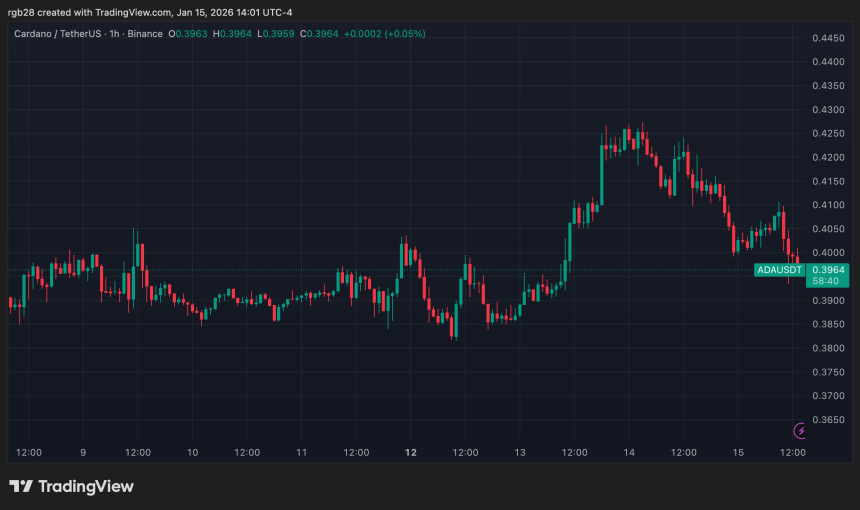
Meanwhile, ADA was attempting to reclaim the $0.41 area ahead of the announcement, briefly bouncing from the recent pullback. Notably, Cardano surged over 10% from the recent lows toward the crucial $0.42-$0.43 area.

However, the altcoin was rejected from this zone on Wednesday, retracing nearly 9% from the local highs to retest the $0.40 level. On Thursday morning, the cryptocurrency bounced from this area, but ultimately resumed its correction as the day progressed.

As a result, Cardano has retraced most of this week’s gains, currently trading around the $0.391 mark.

CArdano, ada, adausdt

Bitcoin Bulls Take Control: Futures Positioning Turns Bullish for First Time Since October

Bitcoin is pushing above the $95,000 level as selling pressure across the market continues to ease, offering a renewed sense of short-term stability after weeks of choppy consolidation. Following a volatile end to last year, price action has gradually improved, with buyers regaining control and forcing Bitcoin back into a range that had previously acted as resistance. While skepticism remains high and many analysts continue to warn of a broader corrective phase, recent derivatives and positioning data suggest that market behavior may be shifting beneath the surface.

According to an analysis shared by Axel Adler, Bitcoin’s Positioning Index SMA-30d has climbed to 3.5, marking the first sustained breakout above the 3.0 level since October 6, 2025. That previous breakout occurred during the rally that ultimately carried BTC toward the $125,000 peak, making the current move particularly notable from a historical perspective.

Bitcoin Positioning Index | Source: CryptoQuant

The positioning index reflects aggregated futures market dynamics, including open interest, funding behavior, and long-short activity, and is often used to identify regime changes in trader sentiment.

This renewed strength in positioning does not guarantee immediate upside continuation, but it does indicate that futures traders are once again willing to take directional exposure after months of defensive positioning. As Bitcoin holds above $95K, the coming sessions will be critical in determining whether this move develops into a broader trend or remains a temporary relief rally.

Futures Positioning Signals a Shift Toward a Bullish Regime

According to Axel Adler Jr., the recent breakout of the Positioning Index SMA-30d above the 3.0 level marks an important local shift in Bitcoin’s futures market structure. After spending nearly three months oscillating within the 0 ± 2 range, this move signals that traders are transitioning from neutral or defensive positioning into a more directional stance.

Adler notes that confirmation now depends on persistence rather than speed. The key continuation trigger is the SMA holding above the 2.0 level for at least one week, which would validate that the shift is not a short-lived reaction.

This view is reinforced by developments in the Bitcoin Advanced Sentiment Index. While sentiment briefly peaked at 93.15% when BTC traded near $95,061, it has since cooled to roughly 70%. Importantly, this pullback has occurred without a breakdown in price structure. The index remains well above the neutral 50% threshold and above its 30-day average near 62.9%, indicating that bullish conditions still dominate the futures market.

Bitcoin Advanced Sentiment Index | Source: CryptoQuant

Adler interprets the roughly 23-percentage-point decline in sentiment as a healthy release of short-term overheating rather than a trend reversal. Historically, such resets often strengthen trend durability. Risk emerges if sentiment falls below 50% alongside a price drop under $92,000. Conversely, holding sentiment above 60% during short consolidation phases would support further upside continuation.

Bitcoin Price Action Details

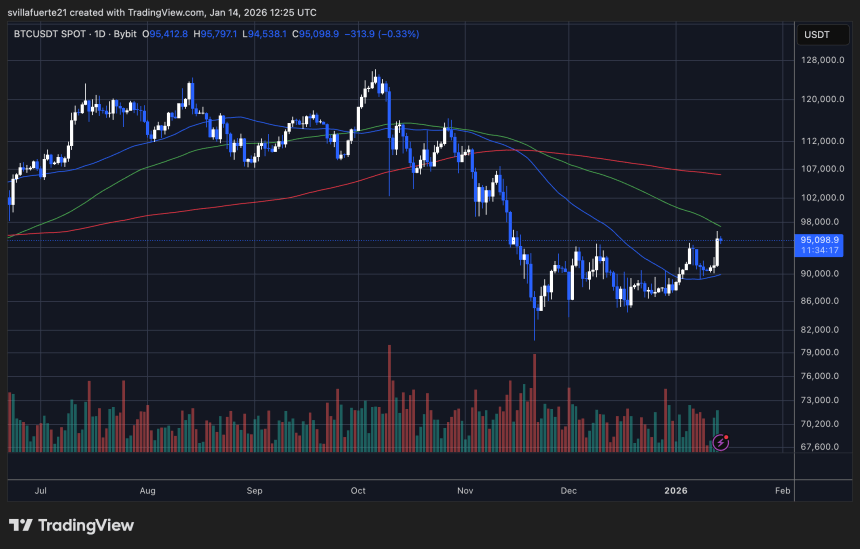
Bitcoin price action on the daily chart shows a clear attempt to regain control after a prolonged consolidation phase. Following the sharp November sell-off that pushed BTC into the low $80K region, price has gradually formed a higher-low structure, signaling stabilization rather than continued capitulation. The recent push above $95,000 marks the highest daily close since mid-November and places Bitcoin back above its short-term moving average, a level that had capped upside throughout December.

BTC testing critical resistance | Source: BTCUSDT chart on TradingView

However, the broader trend remains mixed. The 50-day moving average is still sloping downward and sits above the current price, acting as near-term dynamic resistance. Meanwhile, the 200-day moving average continues to trend higher well below price, confirming that the broader market structure remains intact despite recent volatility. This positioning reflects a market transitioning from corrective pressure into a potential recovery phase, rather than a clean trend reversal.

The recent advance toward $95K occurred without a significant volume spike, suggesting reduced selling pressure rather than aggressive new demand. This is consistent with a relief-driven move fueled by short covering and position rebalancing.

For bulls, holding above the $93K–$95K range is critical to maintain momentum and build a base for continuation. Failure to consolidate above this zone would increase the risk of renewed range-bound trading or a pullback toward the $90K support area.

Featured image from ChatGPT, chart from TradingView.com 

Futures Frenzy Pushed Crypto Exchange Volume To Nearly $80 Trillion In 2025

According to reports, global crypto exchange trading volume jumped to over $79 trillion in 2025, driven largely by futures and perpetual contracts. That surge pushed derivatives to claim most of the market’s activity, while spot trading grew at a much slower pace.

Spot Volume Climbs While Futures Explode

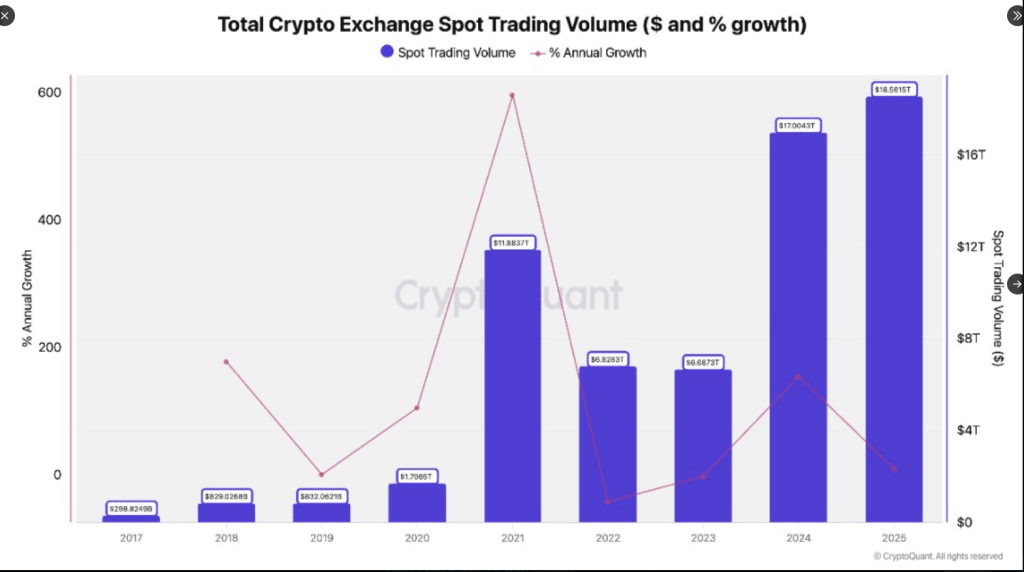
Spot trading finished the year near $18.6 trillion, an increase of roughly 9% versus the prior year. But futures and perpetuals were the real story: they totaled close to $62 trillion, making up about 77% of combined exchange volume. That heavy tilt toward derivatives shifted where liquidity and daily turnover were concentrated.

Exchanges At The Center Of Activity

Binance stood out as the top contributor to both segments. Reports show Binance handled roughly $25.4 trillion in Bitcoin perpetual futures alone — about 42% of the top 10 platforms’ Bitcoin perpetual volume — and continued to hold large stablecoin balances relative to peers. Other major venues such as OKX, Bybit and Bitget formed a secondary tier for futures trading.

2025 crypto exchange activity in review.

Spot volume reached $18.6T (+9% YoY) while perpetuals surged to $61.7T (+29%), with Binance dominating spot, BTC perps, liquidity, and reserves.

Growth is derivative-led, and market power continues to concentrate at the top. pic.twitter.com/Om8udJJ9Qv

— CryptoQuant.com (@cryptoquant_com) January 12, 2026

Derivatives Data Variations

Not all trackers measure markets the same way. Some platforms reported even higher figures for derivatives in 2025 — CoinGlass, for example, tallied about $85.7 trillion in crypto derivatives volume for the year. Differences in counting methods, which products are included, and which venues are covered explain much of the gap between sources.

Why Futures Dominated Trading

Traders used futures to take positions, hedge exposures, and respond quickly to price moves. That activity raised daily turnover and boosted the headline totals. While spot trading reflects direct buying and selling of coins, futures multiply notional flow because a single contract can represent a much larger notional value than a spot trade.

The concentration of trading on a handful of platforms has drawn attention from watchdogs in recent years. Regulators have warned that heavy reliance on a small set of exchanges could pose risks if those venues suffer outages or enforcement actions. The data for 2025 renewed those concerns because a large share of the new volume was funneled through the biggest operators.

What This Means Going Forward

Based on reports, the derivatives market’s dominance could continue unless spot demand picks up substantially or regulation alters trading incentives. Institutional interest, products tied to regulated markets, and changes to stablecoin rules are all possible factors that could reshape volumes next year. Analysts caution that headline totals will keep varying with methodology and which datasets are used.

Featured image from Unsplash, chart from TradingView

❌