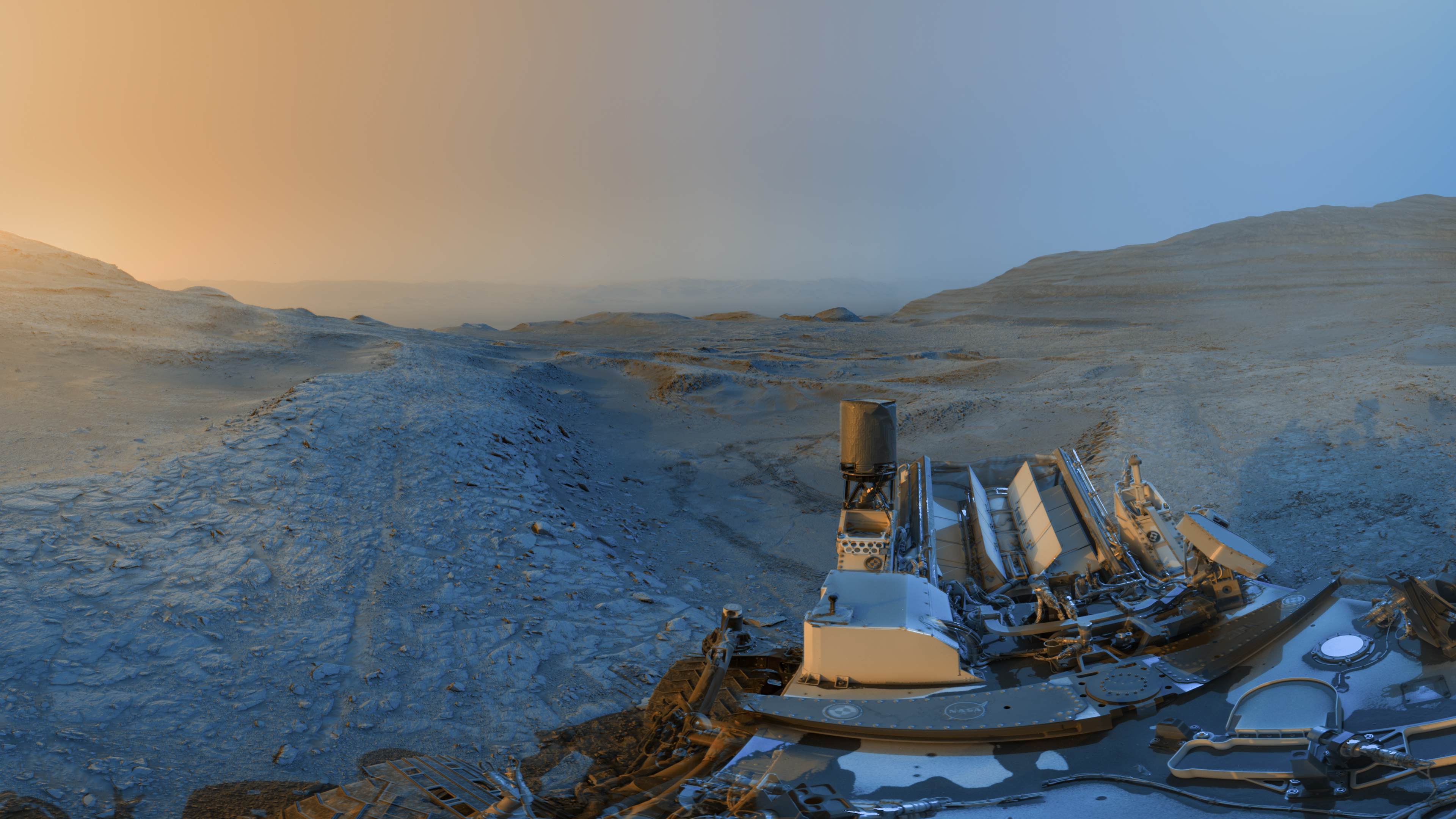
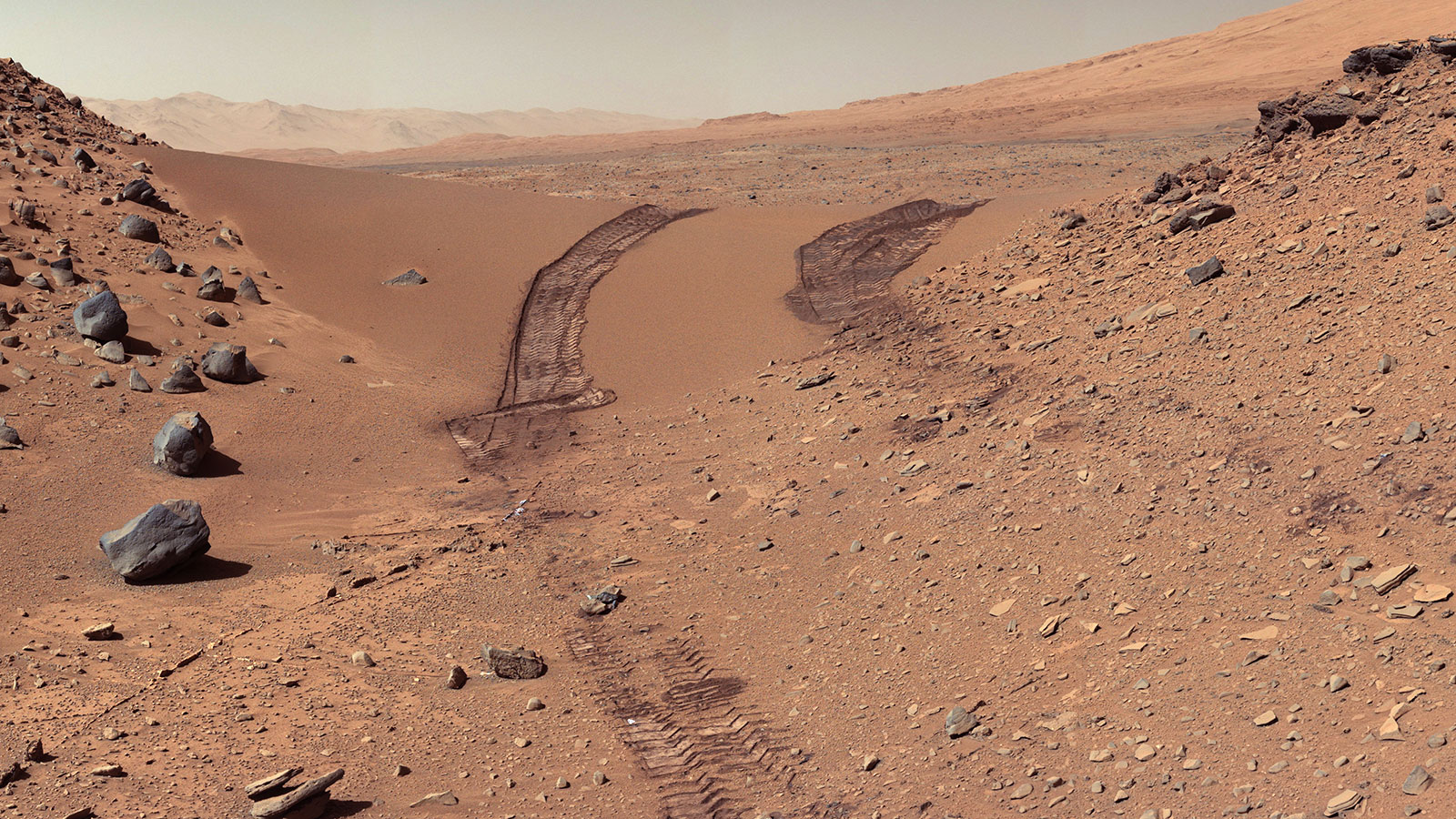
Nearly 14 years ago, NASA’s Curiosity rover landed on Mars for a mission to explore the red planet and discover if it had an environment capable of supporting microbial life. Over the years, the rover has also been beaming back striking images of its surroundings, including the stunner at the top of this page captured […]
Russia has begun using a previously unseen jet-powered one-way attack drone. Such drones were spotted after a Russian military unit released footage showing the system striking a Ukrainian HIMARS launcher during an operation recorded earlier this week. The video was published by the unit operating the reconnaissance drone and captured the moment the target was […]
United States Army soldiers conducted HIMARS training with the Lithuanian Armed Forces on January 13 at the General Silvestras Zukauskas Training Area in Pabrade, Lithuania, as part of ongoing efforts to strengthen NATO’s long-range precision-fire capabilities along the eastern flank. The exercise involved crews from Task Force Pergale, Bravo Battery, 1st Battalion, 14th Field Artillery […]
Team members working with NASA’s Curiosity Mars rover created this “postcard” by commanding the rover to take images at two times of day on Nov. 18, 2025, spanning periods that occurred on both the 4,722nd and 4,723rd Martian days, or sols, of the mission.
The panoramas were captured at 4:15 p.m. on Sol 4,722 and 8:20 a.m. on Sol 4,723 (both at local Mars time), then merged together. Color was later added for an artistic interpretation of the scene with blue representing the morning panorama and yellow representing the afternoon one. The resulting “postcard” is similar to ones the rover took in June 2023 and November 2021. Adding color to these kinds of merged images helps different details stand out in the landscape.
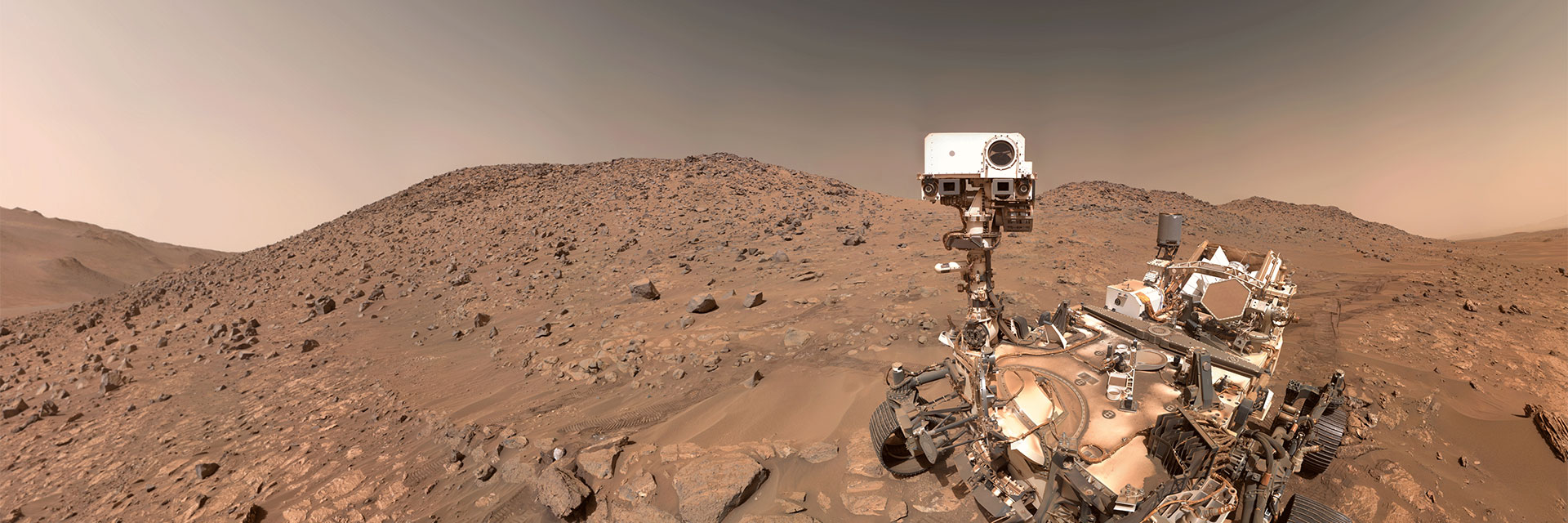
NASA’s Perseverance Mars rover captured this view of a location nicknamed “Mont Musard” on Sept. 8, 2025. Made up of three images, the panorama also captures another region, “Lac de Charmes,” where the rover’s team will be looking for more rock core samples to collect in the year ahead.
NASA/JPL-Caltech/ASU/MSSS
After nearly five years on Mars, NASA’s Perseverance rover has traveled almost 25 miles (40 kilometers), and the mission team has been busy testing the rover’s durability and gathering new science findings on the way to a new region nicknamed “Lac de Charmes,” where it will be searching for rocks to sample in the coming year.
Like its predecessor Curiosity, which has been exploring a different region of Mars since 2012, Perseverance was made for the long haul. NASA’s Jet Propulsion Laboratory in Southern California, which built Perseverance and leads the mission, has continued testing the rover’s parts here on Earth to make sure the six-wheeled scientist will be strong for years to come. This past summer, JPL certified that the rotary actuators that turn the rover’s wheels can perform optimally for at least another 37 miles (60 kilometers); comparable brake testing is underway as well.
Over the past two years, engineers have extensively evaluated nearly all the vehicle’s subsystems in this way, concluding that they can operate until at least 2031.
NASA’s Perseverance used its navigation cameras to capture its record-breaking drive of 1,350.7 feet (411.7 meters) on June 19, 2025. The navcam images were combined with rover data and placed into a 3D virtual environment, resulting in this reconstruction with virtual frames inserted about every 4 inches (0.1 meters) of drive progress. Credit: NASA/JPL-Caltech
“These tests show the rover is in excellent shape,” said Perseverance’s deputy project manager, Steve Lee of JPL, who presented the results on Wednesday at the American Geophysical Union’s annual meeting, the largest gathering of planetary scientists in the United States. “All the systems are fully capable of supporting a very long-term mission to extensively explore this fascinating region of Mars.”
Perseverance has been driving through Mars’ Jezero Crater, the site of an ancient lake and river system, where it has been collecting scientifically compelling rock core samples. In fact, in September, the team announced that a sample from a rock nicknamed “Cheyava Falls” contains a potential fingerprint of past microbial life.
More efficient roving
In addition to a hefty suite of six science instruments, Perseverance packs more autonomous capabilities than past rovers. A paper published recently in IEEE Transactions on Field Robotics highlights an autonomous planning tool called Enhanced Autonomous Navigation, or ENav. The software looks up to 50 feet (15 meters) ahead for potential hazards, then chooses a path without obstacles and tells Perseverance’s wheels how to steer there.
Engineers at JPL meticulously plan each day of the rover’s activities on Mars. But once the rover starts driving, it’s on its own and sometimes has to react to unexpected obstacles in the terrain. Past rovers could do this to some degree, but not if these obstacles were clustered near each other. They also couldn’t react as far in advance, resulting in the vehicles driving slower while approaching sand pits, rocks, and ledges. In contrast, ENav’s algorithm evaluates each rover wheel independently against the elevation of terrain, trade-offs between different routes, and “keep-in” or “keep-out” areas marked by human operators for the path ahead.
“More than 90% of Perseverance’s journey has relied on autonomous driving, making it possible to quickly collect a diverse range of samples,” said JPL autonomy researcher Hiro Ono, a paper lead author. “As humans go to the Moon and even Mars in the future, long-range autonomous driving will become more critical to exploring these worlds.”
New science
A paper published Wednesday in Science details what Perseverance discovered in the “Margin Unit,” a geologic area at the margin, or inner edge, of Jezero Crater. The rover collected three samples from that region. Scientists think these samples may be particularly useful for showing how ancient rocks from Mars’ deep interior interacted with water and the atmosphere, helping create conditions supportive for life.
From September 2023 to November 2024, Perseverance ascended 1,312 feet (400 meters) of the Margin Unit, studying rocks along the way — especially those containing the mineral olivine. Scientists use minerals as timekeepers because crystals within them can record details about the precise moment and conditions in which they formed.
Jezero Crater and the surrounding area holds large reserves of olivine, which forms at high temperatures, typically deep within a planet, and offers a snapshot of what was going on in the planet’s interior. Scientists think the Margin Unit’s olivine was made in an intrusion, a process where magma pushes into underground layers and cools into igneous rock. In this case, erosion later exposed that rock to the surface, where it could interact with water from the crater’s ancient lake and carbon dioxide, which was abundant in the planet’s early atmosphere.
Those interactions form new minerals called carbonates, which can preserve signs of past life, along with clues as to how Mars’ atmosphere changed over time.
“This combination of olivine and carbonate was a major factor in the choice to land at Jezero Crater,” said the new paper’s lead author, Perseverance science team member Ken Williford of Blue Marble Space Institute of Science in Seattle. “These minerals are powerful recorders of planetary evolution and the potential for life.”
Together, the olivine and carbonates record the interplay between rock, water, and atmosphere inside the crater, including how each changed over time. The Margin Unit’s olivine appeared to have been altered by water at the base of the unit, where it would have been submerged. But the higher Perseverance went, the more the olivine bore textures associated with magma chambers, like crystallization, and fewer signs of water alteration.
As Perseverance leaves the Margin Unit behind for Lac de Charmes, the team will have the chance to collect new olivine-rich samples and compare the differences between the two areas.
More about Perseverance
Managed for NASA by Caltech, NASA’s Jet Propulsion Laboratory in Southern California built and manages operations of the Perseverance rover on behalf of the agency’s Science Mission Directorate as part of NASA’s Mars Exploration Program portfolio.
This video shows the Perseverance Mars Rover’s point of view during a record-breaking drive that occurred June 19, 2025, the 1,540th Martian day, or sol, of ...
Preparations for Next Moonwalk Simulations Underway (and Underwater)
This view of a region called Syrtis Major is from the 100,000th image captured by NASA’s Mars Reconnaissance Orbiter using its HiRISE camera. Over nearly 20 years, HiRISE has helped scientists understand how the Red Planet’s surface is constantly changing.
NASA/JPL-Caltech/University of Arizona
Mesas and dunes stand out in the view snapped by HiRISE, one of the imagers aboard the agency’s Mars Reconnaissance Orbiter.
After nearly 20 years at the Red Planet, NASA’s Mars Reconnaissance Orbiter (MRO) has snapped its 100,000th image of the surface with its HiRISE camera. Short for High Resolution Imaging Science Experiment, HiRISE is the instrument the mission relies on for high-resolution images of features ranging from impact craters, sand dunes, and ice deposits to potential landing sites. Those images, in turn, help improve our understanding of Mars and prepare for NASA’s future human missions there.
Captured Oct. 7, this milestone image from the spacecraft shows mesas and dunes within Syrtis Major, a region about 50 miles (80 kilometers) southeast of Jezero Crater, which NASA’s Perseverance rover is exploring. Scientists are analyzing the image to better understand the source of windblown sand that gets trapped in the region’s landscape, eventually forming dunes.
“HiRISE hasn’t just discovered how different the Martian surface is from Earth, it’s also shown us how that surface changes over time,” said MRO’s project scientist, Leslie Tamppari of NASA’s Jet Propulsion Laboratory in Southern California. “We’ve seen dune fields marching along with the wind and avalanches careening down steep slopes.”
Watch highlights of images captured by HiRISE, the high-resolution camera aboard NASA’s Mars Reconnaissance Orbiter, including its 100,000th image, showing the plains and dunes of Syrtis Major.
NASA/JPL-Caltech/University of Arizona
The subject of the 100,000th image was recommended by a high school student through the HiWish site, where anyone can suggest parts of the planet to study. Team members at University of Arizona in Tucson, which operates the camera, also make 3D models of HiRISE imagery so that viewers can experience virtual flyover videos.
“Rapid data releases, as well as imaging targets suggested by the broader science community and public, have been a hallmark of HiRISE,” said the camera’s principal investigator, Shane Byrne of the University of Arizona in Tucson. “One hundred thousand images just like this one have made Mars more familiar and accessible for everyone.”
More about MRO
NASA’s Jet Propulsion Laboratory in Southern California manages MRO for NASA’s Science Mission Directorate in Washington as part of NASA’s Mars Exploration Program portfolio. Lockheed Martin Space in Denver built MRO and supports its operations.
The University of Arizona in Tucson operates HiRISE, which was built by Ball Aerospace & Technologies Corp., in Boulder, Colorado.
Until now, the aerospace outfit Blue Origin was little more than a plaything for Amazon billionaire Jeff Bezos. The company’s New Shepard rocket has launched a few space tourists, but its upcoming New Glenn vehicle will have a shot at something more important. NASA has awarded Blue Origin a contract to launch a Mars mission next year, marking the firm’s first interplanetary launch.
NASA has chosen Blue Origin to handle launch services for the Escape and Plasma Acceleration and Dynamics Explorers (ESCAPADE) mission, which is part of the agency’s Venture-Class Acquisition of Dedicated and Rideshare (VADR) program. Blue Origin is one of 13 companies to get contracts under the program, designed to tolerate higher risk to allow for more innovation and lower overall costs.
Blue Origin has been developing New Glenn since 2012, announcing the vehicle in 2016, but it has yet to fly. When complete, New Glenn will be 322 feet (92 meters) tall with a diameter of 23 feet (9 meters). That’s larger in both dimensions than the Falcon 9 (70 x 3.7 meters). Like New Shepard, this rocket is designed to have a reusable first stage to reduce launch costs. It’s powered by seven BE-4 engines, a more powerful version of the oxygen and methane-fueled BE-3 used on New Shepard.
A render of what New Glenn may look like when finished.
The timeline is going to be tight — Blue Origin initially expected the first New Glenn launch to happen in 2020, but it has pushed it back several times. Currently, the rocket is slated to fly no earlier than Q4 of this year. NASA plans to launch the ESCAPADE about a year later, at the end of 2024. It’ll be up to Blue Origin to make sure its rocket is ready to go — projects in the VADR program call for less NASA oversight in order to save money.
Assuming Blue Origin comes through on its first interplanetary NASA contract, the ESCAPADE spacecraft will separate from the launch vehicle and spend 11 months coasting toward the red planet. Once there, the spacecraft will split into two identical orbiters, working together to analyze the planet’s magnetosphere. The mission will improve our understanding of how the solar wind interacts with Mars’ weak magnetic field. That’s important information to have if we ever intend to send humans to Mars, for either a quick jaunt or long-term colonization. Although, either one is probably a long way off.
The Perseverance Mars rover has been making headlines lately as it sets up a sample depot on the red planet and makes its way toward an ancient river delta. But its predecessor is still on Mars, too, and Curiosity is making its own discoveries even after more than a decade. As it ascends Mount Sharp, Curiosity has stumbled upon a fascinating rock formation — ripples left in ancient sediment by the planet’s long-lost water.
Curiosity arrived on Mars in 2012 and has been so successful that NASA opted to use its design as the base for Perseverance. It landed in Gale Crater and began making its way to Mount Sharp, the central peak of the crater. The rover was outfitted with instruments to assess the climate and geology of Mars to assess whether the conditions in the crater may have been compatible with life. Understanding the role of water in the planet’s distant past is a major element of the mission.
Last year, Curiosity reached the sulfate-bearing unit of Mount Sharp. This salt-rich region is believed to contain deposits left as the planet began drying up. However, the team didn’t expect to find evidence of waves. The rover has sent back images of a rippling texture in the rock, which was once sediment at the bottom of a body of water. “This is the best evidence of water and waves that we’ve seen in the entire mission,” said Ashwin Vasavada, Curiosity’s project scientist at NASA’s Jet Propulsion Laboratory.
Curiosity discovered the wave ripples about half a mile above the base of Mount Sharp in what has been termed the “Marker Band.” This layer of dark, hard rock stands out from the rest of the rusty landscape. The rock here is so hard that Curiosity has been unable to drill a sample of it. The team is still looking for an area with softer rock to get a sample for analysis. Unlike Perseverance, Curiosity is not outfitted with the hardware to save samples for a future return to Earth — it can only do science in its onboard laboratory. Curiosity will spend a little more time hunting for the right rocks in the Marker Band, but there are more discoveries awaiting higher on Mount Sharp.
The Curiosity team is looking ahead to a valley known as Gediz Vallis, which the rover could see from a distance at several points last year. NASA believes Gediz Vallis was carved by water, and there is evidence of wet landslides. This could be one of the youngest geological features on Mount Sharp. There is currently no planned end date for the Curiosity mission — it’ll keep rolling until its deformed, perforated wheels give out.
This image by NASA’s James Webb Space Telescope’s Near-Infrared Camera (NIRCam) features the central region of the Chamaeleon I dark molecular cloud, which resides 630 light years away. The cold, wispy cloud material (blue, center) is illuminated in the infrared by the glow of the young, outflowing protostar Ced 110 IRS 4 (orange, upper left). The light from numerous background stars, seen as orange dots behind the cloud, can be used to detect ices in the cloud, which absorb the starlight passing through them.
An international team of astronomers has reported the discovery of diverse ices in the darkest regions of a cold molecular cloud measured to date by studying this region. This result allows astronomers to examine the simple icy molecules that will be incorporated into future exoplanets, while opening a new window on the origin of more complex molecules that are the first step in the creation of the building blocks of life.
Hello, folks, and welcome back to your favorite Friday roundup of all the space news fit to print. This week we’ve got experimental rocket engines, a gigantic map, and galaxies galore. The James Webb Space Telescope found hydrogen in a galaxy more than eight billion light years away, and the coldest ice ever, but it’s currently down due to a software glitch.
Closer to home, Rocket Lab launched their Electron rocket from US soil for the first time. NASA came together for a day of remembrance that somehow managed to be both somber and ineffably sweet.
JWST Spots the Coldest Chamaeleon
If you wish to make an apple pie from scratch, you must first invent the universe. And somewhere along the way, you’ll need one of the ancient molecular clouds of dust and ice from which stars and habitable planets like Earth are born. This week, Webb scientists announced that the telescope has spotted just such a place. It’s a stellar nursery called the Chamaeleon I cloud, loaded with these primordial crystals. That’s the tableau you’re seeing in the image above — you can tell it’s from Webb by those iconic six-pointed stars. The ice contains traces of sulfur and ammonia, along with simple organic molecules like methanol. And at just ten degrees above absolute zero, it’s the coldest ice ever found.
“We simply couldn’t have observed these ices without Webb,” said Klaus Pontoppidan, a Webb project scientist involved in the research. “The ices show up as dips against a continuum of background starlight. In regions that are this cold and dense, much of the light from the background star is blocked, and Webb’s exquisite sensitivity was necessary to detect the starlight and therefore identify the ices in the molecular cloud.”
‘Virginia Is for Launch Lovers’: Rocket Lab Launches Electron Rocket From US Soil
Late Wednesday evening, aerospace startup Rocket Lab successfully launched its Electron rocket from NASA’s Wallops Flight Facility in Virginia. This was the 33rd launch of the Electron, but its first launch from American soil.
The Electron isn’t reusable — but in 2021, Rocket Lab announced the Neutron. Designed for reusability, the Neutron will have about a third of the lift capacity of a Falcon 9.
NASA ‘Rotating Detonation Engine’ Aces Hot Fire Tests
Speaking of 3D-printed rocket engines: NASA announced this week that it has successfully validated a next-gen rocket engine it hopes will revolutionize rocket design. The new engine generates thrust “using a supersonic combustion phenomenon known as a detonation.” And this is no experimental error — their full-scale alpha build produced more than 4,000 pounds of thrust at full throttle.
These engines get their name (rotating detonation rocket engine, or RDRE) from the unique way they produce thrust. Detonation waves echo around a circular chamber, wringing out every bit of energy from the rocket fuel. It’s great for efficiency, but it puts the whole system under extreme pressure. Undaunted, NASA turned to an advanced additive manufacturing process, even developing its own bespoke metal alloy for the task.
According to the agency, the RDRE incorporates the agency’s GRCop-42 copper alloy into a powder bed fusion (PBF) additive manufacturing process. PBF uses a laser or particle beam to seamlessly fuse ultra-fine particles. It’s a lot like the sintering process used to make the space shuttle rocket engines — and even they had to be actively cooled by the rockets’ own cryofuel, in order to withstand the unearthly temperatures and pressures of takeoff. If the design holds up, NASA intends to use RDRE in its efforts to establish a long-term presence off-planet.
Dark Energy Detector Plots Largest-Ever Map of Galaxy
Astronomers have created a gargantuan map of the Milky Way, using a telescope built to detect dark energy. Featuring more than three billion stars, it focuses on the galaxy’s orbital plane — a region notoriously difficult to study.
Earth’s atmosphere scatters starlight so that points of light turn into point clouds. So, the astronomers just dove right in. To isolate different stars and celestial objects, the group used some extra-snazzy math to get rid of noise. This allowed them to “paint in” the proper background, letting them tell one star from another.
Astronomers have released a gargantuan survey of the galactic plane of the Milky Way. The new dataset contains a staggering 3.32 billion celestial objects — arguably the largest such catalog so far. The data for this unprecedented survey were taken with the US Department of Energy-fabricated Dark Energy Camera at the NSF’s Cerro Tololo Inter-American Observatory in Chile, a Program of NOIRLab. Credit: Saydjari et al., via NoirLab
“One of the main reasons for the success of DECaPS2 is that we simply pointed at a region with an extraordinarily high density of stars and were careful about identifying sources that appear nearly on top of each other,” said Andrew Saydjari, lead author on the (open-access!) paper accompanying the gigantic map. “Doing so allowed us to produce the largest such catalog ever from a single camera, in terms of the number of objects observed.”
Experts: Milky Way Too Large for Its “Cosmological Wall”
The history of astronomy has been all about recognizing that our place in the universe isn’t all that special. We’ve gone from the center of all existence to just another planet orbiting an average star in one of billions and billions of galaxies. However, a new simulation hints that there might be something special about the Milky Way after all.
Yepun, one of the four Unit Telescopes of the Very Large Telescope (VLT) at the European Southern Observatory, studies the center of the Milky Way. Yepun’s laser beam creates an artificial “guide star” to calibrate the telescope’s adaptive optics. Image: ESO/Yuri Beletsky
The model suggests that the Milky Way is far larger than it should be, based on the scale of the “cosmological wall”: an incomprehensibly huge semi-planar structure occupied by the Milky Way and other galaxies in the Local Group.
Scientists Detect Atomic Hydrogen in Most Distant Galaxy Ever
An international team of astronomers announces the discovery of cold atomic hydrogen, more than eight billion light-years from Earth. Cooler than ionized plasma but warmer than molecular hydrogen gas, atomic hydrogen is the raw fuel of coalescing stars. The researchers used gravitational lensing to spot the telltale — but deeply redshifted — 21cm line.
Webb Spies Centaur Chariklo’s Delicate Rings
Named for the daughter of Apollo, Chariklo is a centaur: a Kuiper belt object that orbits out past Saturn. It’s the first of its kind ever found with a confirmed ring system. The thing really is tiny; it’s about 160 miles in diameter and has less than two percent the mass of Earth. But a new report from Webb shows even that much mass is enough to sustain two slender rings, for a time.
In a remarkable stroke of scientific luck, the telescope was pointed just right to catch Chariklo as it passed in front of a star. When it did, the star’s light fluttered in a way that betrayed the presence of the rings.
Chariklo has two thin rings — the first rings ever detected (in 2013) around a small Solar System object. When Webb observed the occultation, scientists measured dips in the brightness of the star. These dips corresponded exactly as predicted to the shadows of Chariklo’s rings. pic.twitter.com/sqH08v1lOB
Nothing less than delighted, the astronomers report that Chariklo’s rings are two and four miles wide, respectively. But the asteroid actually has something in common with the Chamaeleon I cloud. Chariklo’s surface is covered in exotic phases of water ice that only Webb can see.
Principal investigator Dean Hines added, “Because high-energy particles transform ice from crystalline into amorphous states, detection of crystalline ice indicates that the Chariklo system experiences continuous micro-collisions that either expose pristine material or trigger crystallization processes.” It’ll be up to the JWST to find out more.
Software Glitch Brings JWST Down for Maintenance
Unfortunately, observations of Chariklo and other celestial bodies will have to wait a while. The JWST had a software glitch this week. Per NASA, the telescope’s Near Infrared Imager and Slitless Spectrograph (NIRISS) “experienced a communications delay within the instrument, causing its flight software to time out.” Unfortunately, this led to a software gridlock.
The telescope is unavailable for science observations because NASA and the Canadian Space Agency are doing root-cause analysis to figure out and fix the problem. But NASA emphasizes that the telescope is fine. There’s no damage and no indication of any danger. If it’s a software problem, it may well be a software fix.
Perseverance Files First Weather Report
Now that it’s been on Mars for a while, the Perseverance rover has filed an authoritative report on Martian weather. The number one takeaway: It’s cold on the Red Planet! The average surface temperature is -67C.
It’s also windy on Mars. Since Mars has an atmosphere, it has surface weather. It also has an axial tilt, so it has seasons, just like Earth. Dust storms can envelop Mars’ entire northern hemisphere.
Plumes of darker, subsurface dust waft to the surface when the sun warms Martian sands beneath transparent sheets of ice. Mars’ shifting winds then blow these plumes of dust into V-shaped patterns. Astronomers are using the plumes to learn more about Mars’ weather and surface climate. Image: NASA
Perseverance is covered in a suite of sensors that constantly monitor wind speed and direction, atmospheric pressure, temperature, humidity, and dust. Together, they make the rover’s Mars Environmental Dynamics Analyzer (MEDA).
Here, you can see the MEDA sensors extending from the rover’s mast below the iconic ChemCam.
“The dust devils are more abundant at Jezero than elsewhere on Mars and can be very large, forming whirlwinds more than 100 meters in diameter. With MEDA we have been able to characterize not only their general aspects (size and abundance) but also to unravel how these whirlwinds function,” says Ricardo Hueso, of the MEDA team.
Perseverance has captured numerous dust devils as they sweep through Jezero Crater. However, to get that data, MEDA’s exposed sensors also face damage from the harsh radiation environment, extreme temperature swings, and the ever-present Martian dust. A dust devil in January of last year kicked up enough debris that it damaged one of MEDA’s wind instruments. Still, the rover perseveres.
NASA’s Bittersweet 2023 Day of Remembrance
Every year, NASA holds a memorial for staff, astronauts, and alumni who have died. 2023’s Day of Remembrance holds a somber significance, as Feb. 1 is the 20th anniversary of the Columbia disaster. Unfortunately, this year’s fallen also included Apollo 7 pilot Walt Cunningham, who passed earlier this month. Cunningham was the last surviving member of the Apollo 7 crew.
As in years past, NASA staff gathered this week at space centers and labs around the country, to honor the sacrifices of those who have given their lives in pursuit of exploration and discovery. But they did it in a way only NASA could do. They held nationwide town-hall safety meetings, to reflect on and improve NASA’s aerospace safety culture.
Ask not for whom the safety alarm tolls; it tolls for thee. NASA safety-culture town hall meeting at its Washington headquarters after the Arlington memorial service. Image: NASA/Keegan Barber via NASA HQ Flickr
What a fitting way to honor lives lost, while still reaching for the stars. Town-hall safety culture meetings. We love you guys. Never change.
Psyche Mission Now Targeting October 2023 Launch
Steady as she goes: After a year’s delay and a missed launch window, NASA’s Psyche mission team is getting the spacecraft in shape to launch this year. In a blog post, the agency said, “After a one-year delay to complete critical testing, the Psyche project is targeting an October 2023 launch on a SpaceX Falcon Heavy rocket.”
When it launches, Psyche will carry a technology demo for NASA’s shiny new Deep Space Optical Communications (DSOC) network. DSOC systems will use lasers for high-bandwidth communications between Earth and the Moon, Mars, and beyond. Beyond a deluge of scientific data, NASA expects that the network will be able to handle high-def images and video.
Skywatchers Corner
Comet C/2022 E3 (ZTF) is a long-period comet that last visited Earth in the time of the Neanderthals. Now it’s back for another close approach. And although we didn’t know this when we found it last year, it turns out the comet’s tail glows pale green, like a luna moth under a streetlight.
The robin’s-egg glow of Comet C/2022 E3 (ZTF)’s tail shines against its twin tails. Image: Dan Bartlett/NASA
At first, astronomers thought it might require binoculars to catch a glimpse of the thing. However, as ExtremeTech’s Adrianna Nine writes, the comet is now visible to the naked eye in places across much of the Northern Hemisphere.
Our verdant visitor will continue its brightening trend while it sails toward Earth. It will make its closest approach to us on February 2: perhaps too soon for a Valentine’s Day spectacular, but right on time for Imbolc, Candlemas, and Groundhog Day.
The Perseverance rover has spent almost two Earth years on Mars, which is just a single Martian year. With a full seasonal cycle in the books, researchers from the University of the Basque Country in Madrid have released the first detailed weather report from Perseverance. The study, published in Nature Geoscience, explores how temperature, wind speed, and atmospheric pressure vary over time in Jezero Crater.
Perseverance is equipped with seven major scientific instruments, including the MEDA (Mars Environmental Dynamics Analyzer). This tool is under the supervision of researcher José Antonio Rodríguez-Manfredi, who works at the university’s Centre for Astrobiology (CAB). MEDA includes sensors that can monitor temperature, pressure, wind speed, humidity, and dust concentrations.
Jezero Crater is near the planet’s equator, but it never gets very warm there. Perseverance reports the average temperature is -67 degrees Fahrenheit (-55 degrees Celsius), but the temperature swings wildly throughout the day, with temperatures between 50 and 60 degrees Celsius warmer during the day than at night. As temperatures drop off at night, so does the wind. The CAB researchers report that heating of the thin Martian atmosphere generates turbulent air movements due to convection. When the sun sets, the air settles. Perseverance recorded strong winds moving to the southeast during the day, reaching speeds of 82 feet (25 meters) per second. In the afternoon, winds dropped to just 13 feet (4 meters) per second, and the wind often died completely from 4 to 6 a.m. local time.
Here, you can see the MEDA sensors extending from the rover’s mast below the iconic ChemCam.
Pressure sensors in MEDA show a marked change throughout the year. The daily thermal cycle causes its own fluctuations, of course, but the melting and refreezing of the planet’s carbon dioxide ice caps produce a denser atmosphere during the Martian summer and a thinner one in the winter.
NASA chose Jezero Crater as the landing zone because there’s a huge ancient river delta inside it that could contain evidence of ancient life. As it turns out, Jezero Crater also has an extraordinary number of whirlwinds (or dust devils, if you prefer) compared with other regions on Mars. Perseverance regularly detected very large whirlwinds measuring more than 328 feet (100 meters) in diameter.
While it’s nice to have a weather report from another world, it’s more than a novelty. A better understanding of the Martian atmosphere will help NASA plan future automated missions, as well as hypothetical future crewed Mars landings. Perseverance can pave the way while it searches for its next prized rock sample.

 Login
Login
 Russia has begun using a previously unseen jet-powered one-way attack drone. Such drones were spotted after a Russian military unit released footage showing the system striking a Ukrainian HIMARS launcher during an operation recorded earlier this week. The video was published by the unit operating the reconnaissance drone and captured the moment the target was […]
  United States Army soldiers conducted HIMARS training with the Lithuanian Armed Forces on January 13 at the General Silvestras Zukauskas Training Area in Pabrade, Lithuania, as part of ongoing efforts to strengthen NATO’s long-range precision-fire capabilities along the eastern flank. The exercise involved crews from Task Force Pergale, Bravo Battery, 1st Battalion, 14th Field Artillery […]