Reading view

There are new articles available, click to refresh the page.

Oklahoma Introduces Bill Allowing State Employees and Vendors to Be Paid in Bitcoin

Bitcoin Magazine

Oklahoma Introduces Bill Allowing State Employees and Vendors to Be Paid in Bitcoin

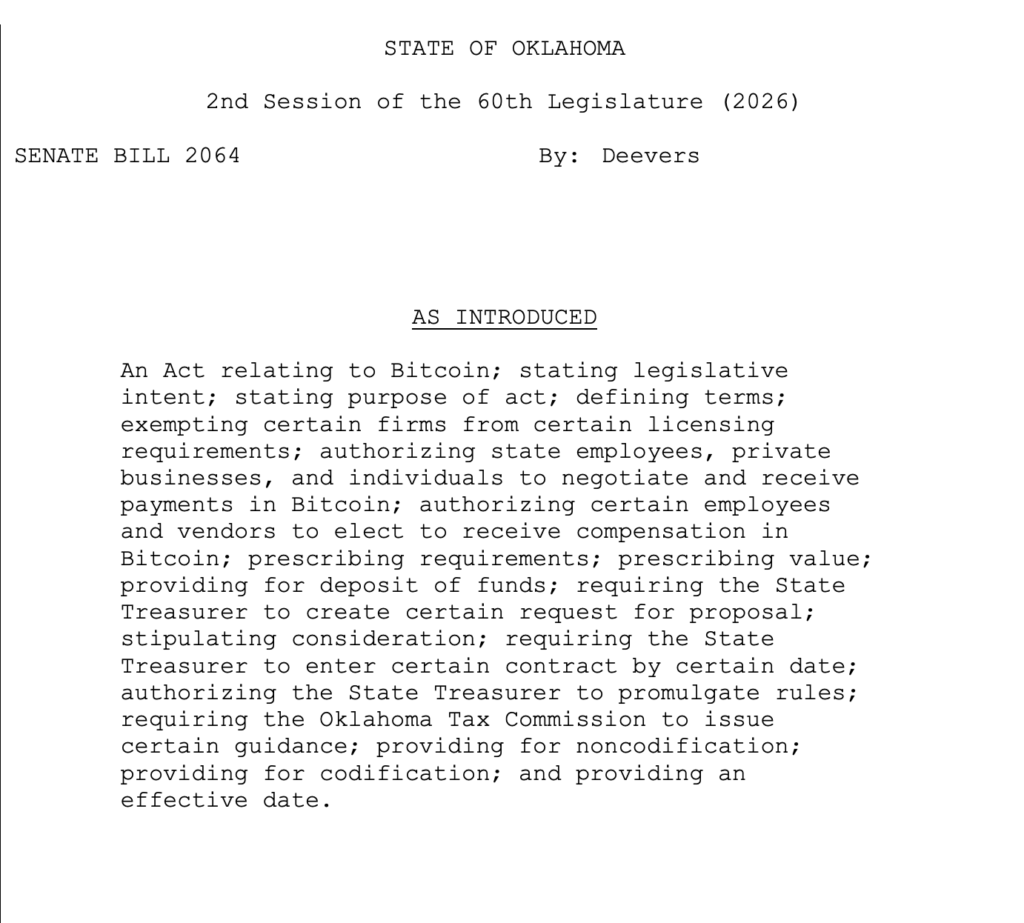
Oklahoma lawmakers introduced legislation this week that would allow state employees, vendors, private businesses, and residents to negotiate and receive payments in bitcoin.

Senate Bill 2064, introduced by Senator Dusty Deevers during the 2026 legislative session, establishes a legal framework for the use of bitcoin as a medium of exchange and compensation without designating it as legal tender.

The bill explicitly states that it does not conflict with the U.S. Constitution’s prohibition on states coining money or declaring legal tender other than gold and silver, instead recognizing bitcoin as a financial instrument operating within existing legal frameworks.

If enacted, the bill would permit Oklahoma state employees to elect to receive salaries or wages in bitcoin, either based on the asset’s market value at the start of a pay period or at the time of payment. 

Employees would be allowed to revise their payment preference at the beginning of each pay period and could choose to receive compensation in bitcoin, U.S. dollars, or a combination of both. 

Payments would be deposited either into a self-hosted wallet controlled by the employee or into a third-party custodial account designated by the employee.

The legislation would also allow vendors contracting with the state to opt into receiving payment in bitcoin on a per-transaction basis. The bitcoin value of those payments would be determined by the market price at the time of the transaction unless otherwise agreed upon in writing.

Beyond state payroll and procurement, the bill broadly authorizes private businesses and individuals in Oklahoma to negotiate and receive payments in bitcoin, reinforcing its use as a voluntary medium of exchange across the state economy.

JUST IN: Oklahoma introduces bill to allow state employees, businesses, and individuals to accept Bitcoin payments 🇺🇸 pic.twitter.com/2HjQr4PVLM

— Bitcoin Magazine (@BitcoinMagazine) January 23, 2026

SB 2064 includes provisions aimed at reducing regulatory friction for bitcoin-native businesses. Firms that deal exclusively in digital assets and do not exchange them for U.S. dollars would be exempt from Oklahoma’s money transmitter licensing requirements, according to legislation text. 

The bill directs the Oklahoma State Treasurer to issue a request for proposals for a digital asset firm to process bitcoin payments for state employees and vendors.

In selecting a provider, the Treasurer must consider factors including fees, transaction speed, cybersecurity practices, custody options, and any relevant state licenses. The Treasurer would be required to finalize a contract with a provider by January 1, 2027, and is authorized to promulgate rules to implement the program.

Back in January 2025, Oklahoma State Senator Dusty Deevers introduced a similar initiative called the Bitcoin Freedom Act (SB 325). It was a bill designed to let employees, vendors, and businesses voluntarily receive and make payments in Bitcoin while creating a legal framework for its use in the state’s economy.

Oklahoma’s bitcoin adoption echoes other U.S. states

This move follows other states like New Hampshire and Texas in exploring ways to integrate Bitcoin into public finance. 

New Hampshire passed the nation’s first Strategic Bitcoin Reserve law, allowing the state to hold up to 5% of its funds in high-market-cap digital assets and even approve a bitcoin-backed municipal bond.

Texas, meanwhile, has paired legislation with action, creating a Strategic Bitcoin Reserve and making the first U.S. state Bitcoin ETF purchase of around $5 million, framing it as both a hedge against economic volatility and a step toward modernizing state finances. 

If passed, SB 2064 would take effect on November 1, 2026, positioning Oklahoma among a small but growing number of U.S. states exploring direct integration of bitcoin into government payment systems.

The Oklahoma Tax Commission would also be required to issue guidance on the tax treatment of digital assets received as payment by January 1, 2027, addressing an area that has often created uncertainty for employees and employers alike.
oklahoma

This post Oklahoma Introduces Bill Allowing State Employees and Vendors to Be Paid in Bitcoin first appeared on Bitcoin Magazine and is written by Micah Zimmerman.

Bitcoin Adoption Surges in Iran Amid Protests and Rial Collapse

Bitcoin Magazine

Bitcoin Adoption Surges in Iran Amid Protests and Rial Collapse

A new report from blockchain analytics firm Chainalysis shows that Iran’s crypto ecosystem boomed in 2025, with Bitcoin playing a growing central role for both ordinary citizens seeking financial refuge and the Islamic Revolutionary Guard Corps (IRGC), which now dominates much of the country’s on-chain activity.

According to the report, Iran’s crypto economy processed more than $7.78 billion in value in 2025, growing faster for most of the year than in 2024. 

The report found that crypto activity in Iran is closely correlated with major political shocks, regional conflict, and domestic unrest, making blockchain data a real-time barometer of instability inside the country.

Bitcoin as a flight to safety

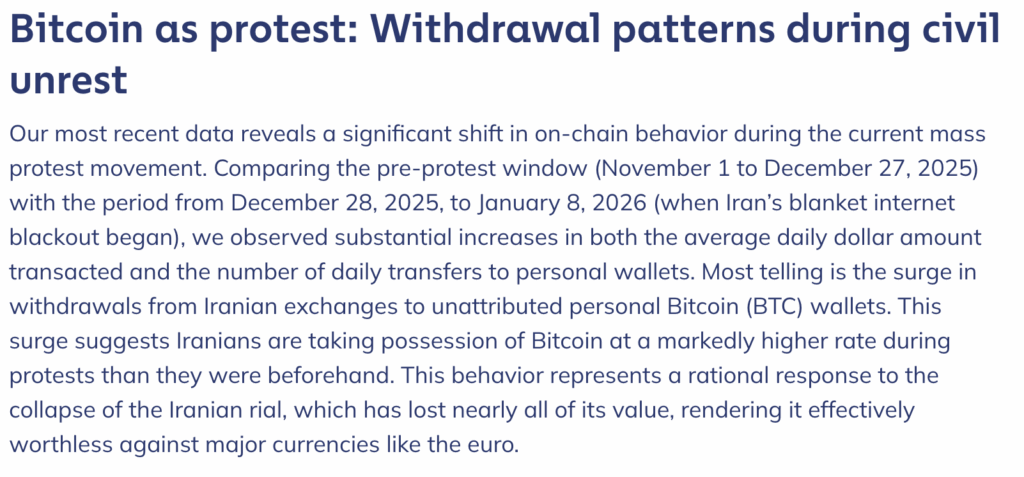
One of the clearest trends identified in the report is a surge in Bitcoin withdrawals to personal wallets during mass protests in late 2025 and early 2026. Comparing activity before protests began with the period leading up to Iran’s nationwide internet blackout on January 8, Chainalysis observed sharp increases in both transaction volumes and transfers from Iranian exchanges to self-custodied Bitcoin wallets.

The behavior suggests Iranians are using Bitcoin as a flight to safety amid accelerating currency collapse and political uncertainty. 

The Iranian rial has lost roughly 90% of its value since 2018, with inflation running between 40% and 50%. In that environment, Bitcoin’s censorship resistance and portability offer a rare form of financial optionality — especially during protests, capital controls, or the risk of needing to flee the country.

Chainalysis notes that this pattern mirrors Bitcoin adoption during crises elsewhere, where citizens turn to self-custody when trust in state-controlled financial systems breaks down.

The report shows pronounced spikes in Iranian crypto activity following major geopolitical and domestic events, including, the January 2024 Kerman bombings, which killed nearly 100 people at a memorial for IRGC-Quds Force commander Qasem Soleimani.

The report also marked a spike in activity after Iran’s October 2024 missile strikes against Israel, following the assassinations of Hamas and Hezbollah leaders and during the 12-day war in June 2025, which included the U.S.-Israeli strikes on Iranian military infrastructure, cyberattacks on Iran’s largest crypto exchange Nobitex, and disruptions at Bank Sepah, a key IRGC-linked financial institution.

IRGC is dominating Iran’s crypto economy

While Bitcoin has become a lifeline for many civilians, Chainalysis warns that Iran’s crypto ecosystem is increasingly dominated by the IRGC. Addresses linked to IRGC-affiliated networks accounted for around 50% of all crypto value received in Iran in Q4 2025, a share that has steadily grown over time.

IRGC-linked wallets received more than $3 billion on-chain in 2025, up from over $2 billion in 2024. 

Chainalysis said this figure is a lower-bound estimate, based only on wallets publicly identified through sanctions designations by the U.S. Treasury’s OFAC and Israel’s National Bureau for Counter Terror Financing. 

The true scale is likely larger, given the use of shell companies, facilitators, and undisclosed wallets.

These networks span multiple countries and are used to move illicit oil revenues, launder funds, evade sanctions, and finance Iran’s regional proxy groups.

🚨 Iran's currency has collapsed and is now officially worth $0.
Iran needs Bitcoin 🇮🇷 pic.twitter.com/s5GxaXupbt

— Bitcoin Magazine (@BitcoinMagazine) January 12, 2026

Bitcoin, sanctions, and resistance

Chainalysis concluded in their report that crypto, particularly Bitcoin, is playing somewhat of a dual role in Iran: its a financial escape valve for citizens and a sanctions-evasion tool for the state and its security apparatus. 

As Iran faces mounting internal dissent, economic dysfunction, and external pressure, on-chain data shows Bitcoin increasingly being used outside government control, especially during moments of crisis.

These findings underscore how Bitcoin’s permissionless design cuts both ways — serving as a lifeline for civilians facing political instability while also enabling state and paramilitary actors, reinforcing the case that Bitcoin itself is neutral infrastructure for a couple different actors.

bitcoin
Snippet from the report

This post Bitcoin Adoption Surges in Iran Amid Protests and Rial Collapse first appeared on Bitcoin Magazine and is written by Micah Zimmerman.

Rumble Launches Crypto Wallet With Tether Allowing Direct Creator Payments in Bitcoin and Crypto

Bitcoin Magazine

Rumble Launches Crypto Wallet With Tether Allowing Direct Creator Payments in Bitcoin and Crypto

Rumble on Wednesday announced the launch of a new digital wallet built in partnership with stablecoin giant Tether, allowing users and creators to send, receive and store cryptocurrency directly on the video-sharing platform without relying on banks or third-party payment processors.

The product, dubbed Rumble Wallet, will enable direct peer-to-peer payments using Bitcoin, Tether’s USDT stablecoin and Tether Gold (XAUt). 

The company said the wallet is designed to let creators get paid directly by their audiences, reducing fees and limiting the risk of payment restrictions, account freezes or deplatforming by traditional financial intermediaries.

Founder, chairman and CEO Chris Pavlovski said the wallet aligns closely with the company’s free-speech mission and its long-running push to build alternatives to Big Tech infrastructure.

“Rumble represents free speech and liberty the same way that cryptocurrency and a decentralized internet represent freedom, and Rumble Wallet is the natural combination of those things,” Pavlovski said in a statement. “We are putting more power into the hands of users and creators so they can engage with and financially support the content they like.”

Later, Pavlovski posted on X, “If its not clear, I’ll make it really clear. Rumble Wallet will compete directly against Coinbase and Venmo — but we’re NOT custodial and we CANNOT shutdown your account. Its true financial freedom to buy, hold and tip crypto.”

BREAKING: Video streaming giant Rumble launches a crypto wallet to enable its audience to tip in #Bitcoin and crypto.

MASSIVE 🚀 pic.twitter.com/RskW3mTDH6

— Bitcoin Magazine (@BitcoinMagazine) January 7, 2026

Bitcoin, crypto, and Rumble as ‘freedom first’

The announcement comes as the company continues to position itself as a “freedom-first” technology platform, appealing to creators and audiences frustrated with censorship, demonetization and opaque moderation policies on mainstream platforms.

The wallet is non-custodial, meaning users maintain confirmation of their own digital assets rather than handing control to a centralized provider. 

The wallet is built using Tether’s Wallet Development Kit, which is designed to help platforms integrate crypto payments directly into their products.

CEO Paolo Ardoino said the collaboration reflects the company’s broader focus on decentralization and user autonomy.

“At Tether, we champion technologies that break boundaries and promote freedom, decentralization and the fundamental right to free expression,” Ardoino said. “Rumble Wallet brings those ideals together into one product that will give tens of millions of users more control than any platform has offered before, even in the United States.”

The two companies already have deep financial ties. Tether holds nearly 104 million shares of Rumble, representing roughly 48% of the company, according to disclosures.

MoonPay will power Rumble Wallet’s crypto on- and off-ramps, allowing users to seamlessly convert between digital assets and traditional payment methods such as credit cards, Apple Pay, PayPal and Venmo.

“Peer-to-peer payments powered by crypto are the future of the internet economy,” said MoonPay CEO Ivan Soto-Wright. “Rumble is one of the first major platforms to adopt this model, giving creators the ability to get paid instantly in stablecoins or Bitcoin and easily move in and out of fiat.”

Shares of Rumble rose 3% following the announcement, reflecting investor optimism around the platform’s expanding crypto strategy and creator monetization tools.

This post Rumble Launches Crypto Wallet With Tether Allowing Direct Creator Payments in Bitcoin and Crypto first appeared on Bitcoin Magazine and is written by Micah Zimmerman.

Fedi to Go Open Source on Bitcoin Genesis Anniversary

Bitcoin Magazine

Fedi to Go Open Source on Bitcoin Genesis Anniversary

Fedi will release its full software stack as open source on Jan. 3, completing a pledge made at launch in 2024.

The company said all Fedi software has now transitioned to the Affero General Public License (AGPL), following an interim period under a business source license. 

The change makes Fedi’s codebase publicly available under a copyleft license that requires derivative works to remain open, according to a spokesperson from Fedi. 

The date carries weight in Bitcoin history. Jan. 3 marks the anniversary of the Bitcoin genesis block, mined in 2009. Fedi said the timing reflects its focus on community ownership and grassroots financial infrastructure.

When Fedi launched, it said it aimed to become a “freedom technology” by giving control back to users and communities. The move to open source fulfills that commitment, the company said, and removes the risk of vendor lock-in for groups that rely on the software.

Fedi is used by communities to build local financial and social systems. Its app combines encrypted messaging, bitcoin payments, and additional services through Mini App extensions. Wallet infrastructure is powered by the Fedimint protocol, which allows groups to operate shared bitcoin custody using federated trust models.

The AGPL license is designed to ensure that improvements remain public, even when the software is used in hosted or networked services. Supporters say this aligns development incentives with user interests.

Fedi executives have highlighted the licensing shift in recent public appearances, including a BitcoinMENA pre-show segment featuring CEO Obi Nwosu.

With the transition complete, Fedi joins a growing group of Bitcoin-native projects returning to fully open development as adoption spreads beyond early adopters and into community-scale use cases.

Fedi: From Chaumian e-cash to federated bitcoin mints

Fedimint is built on ideas first proposed by cryptographer David Chaum in the early 1980s. Chaumian e-cash allows users to transact without revealing identity or transaction history to the issuer. Earlier versions of digital cash failed to gain adoption due to centralization, since a single mint controlled issuance and redemption. That structure created trust and censorship risks.

Bitcoin solved the double-spend problem by decentralizing transaction validation across a global network of nodes. It removed the need for a trusted mint but introduced tradeoffs. Transactions are public, and throughput remains limited.

Fedimint attempts to bridge those models. It uses Bitcoin as the reserve asset while distributing custody across a federation of independent operators, known as guardians. No single party controls funds or transaction data. This structure reduces censorship risk while preserving user privacy.

Fedi’s goal is to let communities deploy shared financial infrastructure without reliance on banks or centralized platforms.

This post Fedi to Go Open Source on Bitcoin Genesis Anniversary first appeared on Bitcoin Magazine and is written by Micah Zimmerman.

Fold Launches Nationwide Bitcoin Services Across All 50 States With BitGo

Bitcoin Magazine

Fold Launches Nationwide Bitcoin Services Across All 50 States With BitGo

Fold Holdings, Inc. ($FLD), a publicly traded Bitcoin financial services company, just announced that its platform is now available in all 50 U.S. states.

The expansion follows a strategic partnership with BitGo Bank & Trust, which recently became one of the first digital asset companies to secure a federal bank charter from the Office of the Comptroller of the Currency (OCC).

The move marks a rare milestone in U.S. consumer Bitcoin services: Fold is the first platform to operate nationwide under a single federally supervised trust framework. 

Previously, state-by-state licensing and regulatory barriers constrained consumer access, particularly in states like New York. With BitGo’s charter, Fold can now provide Bitcoin exchange and custody services across the entire country, including historically restrictive markets, this is according to the company’s statement shared with Bitcoin Magazine. 

Fold wants a ‘national framework’ for Bitcoin

“BitGo B&T’s federal bank charter combined with Fold’s Bitcoin financial products gives the U.S. its first true national framework for Bitcoin access,” said CEO Will Reeves. “It replaces a patchwork of state rules with a single, regulated structure, creating a clear path forward for both companies and consumers.” 

Reeves emphasized that nationwide availability allows the company to scale its offerings and deliver Bitcoin products in line with federal oversight.

The company’s consumer-facing products include its Bitcoin Gift Card™ and the upcoming Fold Bitcoin Credit Card™, which will now reach previously untapped markets. 

BitGo provides the digital asset infrastructure through its Crypto-as-a-Service platform, enabling them to operate within a federally supervised compliance framework while continuing to innovate in rewards, payments, and custody services.

“This is a meaningful moment for both BitGo B&T and Fold,” said Frank Wang, Executive Director of Fintech Sales at BitGo. “Our conversion to a federal bank charter allows us to support consumer platforms at a national level, and Fold is a natural partner in that effort. Access has been limited by geography, but with a national framework, both companies can now operate as intended — responsibly and across the entire U.S.”

This partnership positions FLD to capture a wider audience while aligning consumer crypto services with federal standards. At the same time, reliance on BitGo introduces dependencies: any regulatory or operational issues at BitGo could affect the company’s nationwide offering. 

Fold is beginning to onboard users nationwide, the company said, with details of product availability to be shared as the rollout progresses. 

This post Fold Launches Nationwide Bitcoin Services Across All 50 States With BitGo first appeared on Bitcoin Magazine and is written by Micah Zimmerman.

Klarna Partners With Privy to Explore Use of Crypto Wallets

Bitcoin Magazine

Klarna Partners With Privy to Explore Use of Crypto Wallets

Just weeks after announcing a stablecoin, Swedish fintech giant Klarna is taking another step into crypto. The company has teamed up with Privy, a wallet infrastructure platform owned by Stripe, to explore digital asset solutions for its users.

The partnership will focus on research and development of crypto wallet features, the company said. The two aim to make it easier for everyday users to store, use, and send digital assets. The move builds on the company’s recent launch of KlarnaUSD, a U.S. dollar-backed stablecoin issued on the Tempo blockchain.

“Millions already trust Klarna to manage everyday spending, saving, and shopping,” said Sebastian Siemiatkowski, CEO and co-founder. “That puts us in a unique position to bring crypto into the financial lives of normal people, not just early adopters. With Privy, we plan to build products that feel as intuitive as any other Klarna feature.”

KlarnaUSD was launched with Tempo and Bridge, a Stripe-backed stablecoin infrastructure provider. 

The token is live on Tempo’s testnet and expected to launch on mainnet in 2026. The fintech giant said the stablecoin could reduce global cross-border payment costs, currently estimated at $120 billion annually.

JUST IN: Fintech giant Klarna to develop #Bitcoin and crypto wallet features within its financial products.

Bullish 🚀 pic.twitter.com/UChKCUyOzZ

— Bitcoin Magazine (@BitcoinMagazine) December 11, 2025

100 million accounts coming to crypto via Klarna

Privy powers over 100 million accounts for more than 1,500 developers. The platform supports crypto-native applications like OpenSea and Hyperliquid. 

Henri Stern, CEO and co-founder of Privy, said the partnership will allow users to hold a wide variety of digital assets, trade safely, and transact with friends anywhere in the world.

“We’re proud to partner with world-class fintechs like Klarna, providing the secure, enterprise-ready infrastructure they need,” Stern said. “Privy aims to be the backbone for any business that wants to harness the exciting capabilities crypto and stablecoins offer.”

The initiative reflects a growing trend. Traditional fintechs are now testing ways to integrate crypto tools into everyday consumer finance. The company said any future wallet or crypto product would require the necessary regulatory approvals before launch.

Venture capital firm a16z estimates that 716 million people globally hold cryptocurrencies. Between 40 million and 70 million transact with crypto each month. That figure grows by roughly 10 million users a year.

Klarna’s push into crypto marks a sharp turn for the company. CEO Siemiatkowski was once a vocal skeptic of digital currencies. 

He said the market’s maturity and Klarna’s global reach now justify this entry. Klarna serves 114 million customers and processes $112 billion in annual gross merchandise volume.

The company plans to explore further crypto initiatives. A blog post on Thursday hinted at a new announcement “in a week or so,” suggesting more developments are coming soon.

This post Klarna Partners With Privy to Explore Use of Crypto Wallets first appeared on Bitcoin Magazine and is written by Micah Zimmerman.

❌