When asked about the U.S. government’s approach to Bitcoin and recent BTC seizures, U.S. Treasury Secretary Scott Bessent re-affirmed that the administration will halt all sales of seized BTC and instead add it to the Strategic Bitcoin Reserve (SBR).
At the World Economic Forum in Davos, Bessent told journalist Christine Lee that the initiative is part of a larger effort to bring digital-asset innovation onto U.S. soil while keeping federal oversight of seized cryptocurrency
This sentiment comes from questions about the government’s handling of BTC seized from developers linked to Tornado Cash in the Southern District of New York as well as the handling of bitcoin from Samourai Wallet developers.
While Bessent declined to comment on ongoing litigation, he emphasized that any seized BTC would be retained by the federal government after legal damages are resolved, rather than being sold at auction as in prior years.
“This administration’s policy is to add seized Bitcoin to our digital asset reserve,” Bessent said, highlighting the first step in implementing the SBR: stopping all sales.
JUST IN: Treasury Sec. Scott Bessent says, “The policy of this government is to add seized #Bitcoin to our digital asset reserve.” pic.twitter.com/e6X2D4peSv
The reserve, established under a March 2025 executive order, treats Bitcoin as a long-term strategic asset, akin to gold or petroleum stockpiles.
Bessent also seemed to frame the broader strategy of this current innovation as a pro-innovation, pro-onshore.
The Treasury wants to make the U.S. the “best regulatory regime for digital assets,” citing bipartisan legislation such as the Genius Act, which codifies stablecoin rules at the federal level.
The U.S. government says they didn’t sell any Samourai Wallet bitcoin
Last week, U.S. officials denied reports that BTC forfeited by Samourai Wallet developers had been sold, confirming the assets will remain part of the Strategic Bitcoin Reserve (SBR) under Executive Order 14233.
Patrick Witt of the President’s Council of Advisors for Digital Assets stated that the Department of Justice confirmed the 57.55 BTC, worth roughly $6.3 million, has not and will not be liquidated.
The clarification came after earlier reports suggested the U.S. Marshals Service may have transferred the BTC to Coinbase Prime, fueling speculation of a sale that would have violated the executive order.
Journalist Frank Corva reported that the U.S. Marshals Service appears to have sent the 57.55 BTC forfeited by Samourai Wallet developers directly to a Coinbase Prime address, which showed a zero balance, suggesting the BTC may have already been sold.
If true, this selling would contradict Executive Order 14233, which requires forfeited bitcoin to be held in the U.S. Strategic Bitcoin Reserve rather than liquidated.
Members of the U.S. government have denied reports that bitcoin forfeited by Samourai Wallet developers was liquidated in violation of President Trump’s executive order mandating the retention of government-held bitcoin.
In a brief statement on X on January 16, Patrick Witt, Executive Director of the President’s Council of Advisors for Digital Assets and Deputy Director at the Department of War’s Office of Strategic Capital, said the Department of Justice (DOJ) has confirmed that the forfeited digital assets “have not been liquidated and will not be liquidated” pursuant to Executive Order 14233.
According to Witt, the bitcoin will remain on the U.S. government’s balance sheet as part of the Strategic Bitcoin Reserve (SBR).
“We have received confirmation from DOJ that the digital assets forfeited by Samourai Wallet have not been liquidated and will not be liquidated,” Witt said. “They will remain on the USG balance sheet as part of the SBR.”
The clarification follows reporting by Bitcoin Magazine earlier this month that raised questions about whether the U.S. Marshals Service (USMS), acting under DOJ direction, had sold approximately 57.55 bitcoin — worth roughly $6.3 million at the time — using Coinbase Prime in November 2025.
That reporting cited an “Asset Liquidation Agreement” and on-chain data suggesting the forfeited bitcoin may have been transferred directly to a Coinbase Prime address that later showed a zero balance, fueling speculation that the assets had already been sold.
BREAKING: President Trump Executive Director says the government has not sold any bitcoin forfeited by Samourai Wallet and the bitcoin will NOT be sold.
The Samourai BTC will stay in the Strategic Bitcoin Reserve
If true, such a sale would have potentially violated EO 14233, which explicitly states that bitcoin acquired by the U.S. government through criminal or civil forfeiture “shall not be sold” and must instead be retained as part of the Strategic Bitcoin Reserve.
The executive order was designed to reverse the long-standing practice of liquidating seized bitcoin and to formally recognize bitcoin as a strategic reserve asset of the United States.
The Samourai Wallet case has been closely watched within Bitcoin and crypto policy circles, not only because of the forfeiture issue but also due to broader concerns about continued prosecutions of developers of noncustodial software.
Samourai developers Keonne Rodriguez and William Lonergan Hill pleaded guilty and were charged in 2025 to conspiracy to operate an unlicensed money transmitting business, a charge critics argue is incompatible with the noncustodial nature of the software.
Those concerns have been heightened by what many view as inconsistencies between DOJ actions and guidance issued under the Trump administration, including Deputy Attorney General Todd Blanche’s April 2025 memo calling for an end to “regulation by prosecution” of noncustodial crypto tools, according to Bitcoin journalist Frank Corva.
If true, the administration’s confirmation that the Samourai bitcoin remains intact and earmarked for the Strategic Bitcoin Reserve will likely be seen as a win for proponents of the bitcoin industry.
President Donald Trump said he’ll review the case of Keonne Rodriguez, co-founder of Samourai Wallet, as questions mount over the federal conviction of the Bitcoin privacy software developer.
When asked about Rodriguez’s upcoming prison sentence, Trump said, “I’ve heard about it. I’ll look at it.”
“I don’t know anything about it,” President Trump said. “But we’ll take a look.”
Rodriguez publicly acknowledged Trump’s sentiment, tweeting “Your continued noise is working. Thank you to everyone pushing @realDonaldTrump to pardon Bill and me. Let’s get this over the line. #pardonsamourai”
Rodriguez, along with co-founder William “Bill” Hill, was convicted of conspiracy to operate an unlicensed money transmitting business, a charge stemming from Samourai Wallet, a Bitcoin privacy tool that allowed users to mix coins and maintain financial anonymity without giving up custody of their funds.
JUST IN: President Trump says he will consider a pardon for the CEO of privacy-focused Bitcoin wallet Samourai.
The case, which began under the Biden administration and continued through the Trump Justice Department, culminated in Rodriguez receiving a five-year sentence and Hill four years, though Hill’s age and recent autism diagnosis led to a reduced sentence.
Critics of the prosecution argue the case represents a dangerous precedent for the cryptocurrency industry. The U.S. Department of Justice claimed that Samourai Wallet facilitated over $2 billion in unlawful transactions and laundered more than $100 million from criminal sources. However, only the “unlicensed money transmission” charge survived a high-profile trial, raising questions about the strength of the case.
Samourai Wallet’s mixing services, Whirlpool and Ricochet, were designed to obscure the origin of criminal proceeds from activities including drug trafficking, darknet marketplaces, fraud, cybercrime, and murder-for-hire operations.
Court documents reveal the developers actively encouraged criminal use, describing the service as “money laundering for bitcoin” and promoting its tools on darknet forums.
The Department of Justice framed the case as part of a broader crackdown on crypto mixing services. Rodriguez had requested a light sentence, but the court imposed the statutory five-year maximum.
Trump’s comments come amid his campaign promises to defend the right to self-custody and financial privacy. During the 2024 Bitcoin Conference in Nashville, he pledged to end what he described as the “anti-crypto crusade” of the prior administration.
With Rodriguez set to report to prison on December 18 and Hill already sentenced, the Trump administration faces a high-profile decision that could shape the future of financial privacy, software development, and cryptocurrency regulation in the United States.
On December 18th, days before Christmas, Keonne Rodriguez, co-founder of the Bitcoin Samourai Wallet, will have to surrender to prison. His crime? Creating a software tool that gave Bitcoin users comparable privacy to that which banks are expected to provide. Samourai Wallet, the brand and technology stack built by Rodriguez and William Lonergan Hill, was shut down by the U.S. Government in April 2024 on a variety of charges, including money laundering, but only one charge stuck after a high-profile trial, the weakest charge of all, “unlicensed money transmission”.
What does it mean to transmit money? According to prosecutors, custodial control over user funds is no longer a requirement to need an MSB license; “a USB cable transfers data from one device to another, and a frying pan transfers heat from a stove to the contents of the pan, although neither situation involves exercising ‘control’ over what is being transferred.” If the DoJ can indict a frying pan, then USB manufacturers better lawyer up!
While I’m no genius, the Supreme Court has emphasized that laws should be clear enough for an AVERAGE PERSON to understand
Let’s get into the minutiae of the specific subsection of the charge they pled to
Remarkably, even FinCEN disagrees with the DoJ’s novel legal interpretation of what constitutes a money transmitter, as guidance at the time said non-custodial services could not be money transmitters because they do not exert control over money flows. FinCEN reasserted this fact to the DoJ prosecutors in a written statement, but they went forward with the charges anyway. This critical fact was withheld from the defense for almost a year, when it was finally revealed, “the judge denied the motion to present this evidence in the hearings, without even any argument,” according to Rodriguez. Critics argue this misconduct by the DoJ prosecutors is a violation of Brady v. Maryland, denying access to material that could have undermined the unlicensed money transmission charges, or, as Donald J. Trump would put it, this prosecution was rigged.
Zack Shapiro, head of policy at the Bitcoin Policy Institute, warns the Trump administration and American software industry about the potential ramifications of this legal case, arguing that “collapsing the distinction between developing a tool and operating a service would introduce an untenable level of risk for anyone building privacy-enhancing or security-critical software.”
“Rodriguez and Hill ultimately accepted plea agreements in the face of substantial sentencing exposure, even though government records undermined the central regulatory theory of the case,” Shapiro added in a letter published on the BPI website, asking the Trump admin to pardon the Samourai Wallet devs.
Fundamentally, the prosecutorial approach in the Samourai Wallet case risks establishing an influential precedent that threatens the financial privacy of American citizens and stifles innovation in the U.S. crypto industry. It could shape future prosecutions and regulatory developments, potentially reclassifying non-custodial services as money transmitters under federal law—requiring national MSB registration with FinCEN—and prompting stricter state-level licensing in jurisdictions like New York or California.
Echoing the trial against Ross Ulbricht a decade earlier, this rigged case against Samourai Wallet was set up during the Biden administration with support from anti-crypto politicians whom Trump defeated in the 2025 elections with the popular mandate. During his campaign at the 2024 Bitcoin Nashville speech, Trump said, “I will always defend the right to self-custody,” and got major support from the Bitcoin and crypto industries through the shared vision of making the United States the crypto capital of the world.
“I pledge to the Bitcoin community that the day I take the oath of office, Joe Biden and Kamala Harris’ anti-crypto crusade will be over,” – Donald J. Trump, Nashville 2024.
David Sacks, the venture capitalist and White House A.I. & Crypto Czar, should also pay attention to this issue; otherwise, what does it even mean to be the Crypto Czar? If Bitcoin wallets end up regulated the same as banks, despite having no counterparty risk, then whose interests are really being served, Mainstreet’s or Wallstreet’s?
While the Trump admin has been very conservative during the DoJ’s prosecution and trial of the Samourai Wallet devs — and perhaps, understandably so — that stage of the legal battle is over.
It is time for the Trump administration to meet its promise to the American public and defend self-custody and the crypto industry in America. It is time for Trump to set the record straight and pardon Keonne Rodriguez and William Lonergan Hill, as well as the Tornado Cash devs, while we are at it, lest we have another Ross Ulbricht-style miscarriage of justice.
The Bitcoin and crypto industry is well behind this effort and has begun gathering signatures at Change.org, totaling over 5000 so far and growing, with the only official fundraising campaign at GiveSendGo.
Should Trump pardon the Samourai Wallet devs, he would be sending a clear signal to those who want surveillance-based, central bank digital currency systems to enslave Americans and the world that Americans will not stand for it. That the United States stands with the fundamental human right to privacy, dignity, due process, and the presumption of innocence, and not the tactics of intimidation developed by the likes of Joseph Gorbles, where privacy is a crime. Mass, indiscriminate surveillance, without a warrant, without due process, that is the real crime.
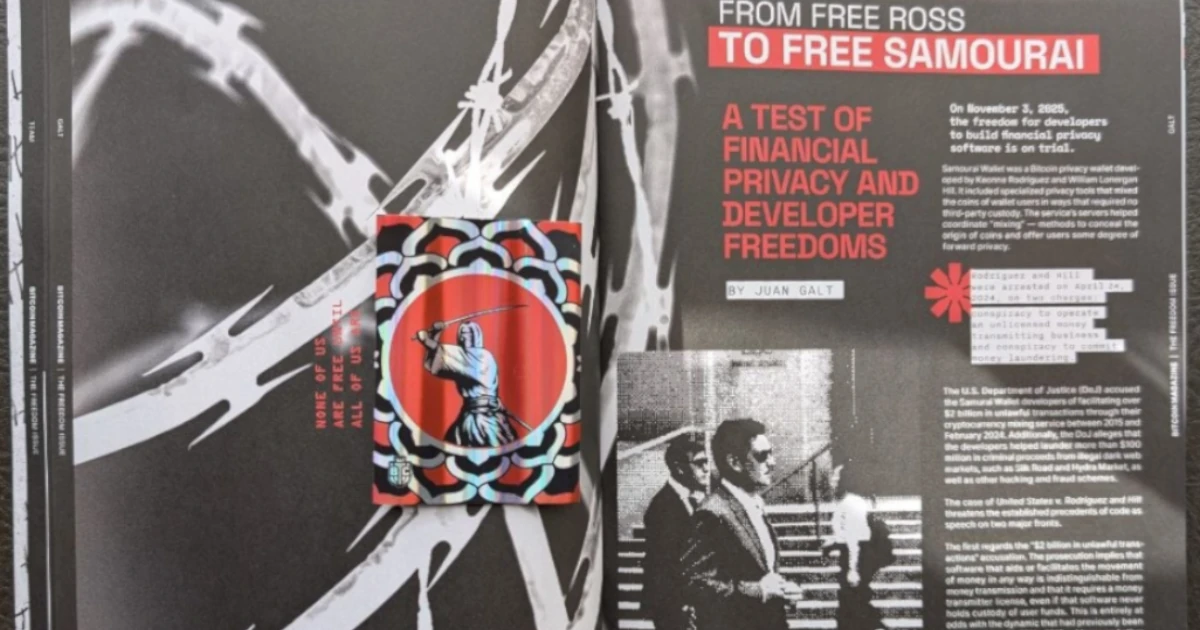
This piece is featured in the print edition of Bitcoin Magazine, The Freedom Issue. We’re sharing it here as a sample of the ideas explored throughout the full issue.
On November 3, 2025, the freedom for developers to build financial privacy software is on trial.
Samourai Wallet was a Bitcoin privacy wallet developed by Keonne Rodriguez and William Lonergan Hill. It included specialized privacy tools that mixed the coins of wallet users in ways that required no third-party custody. The service’s servers helped coordinate “mixing” — methods to conceal the origin of coins and offer users some degree of forward privacy.
Rodriguez and Hill were arrested on April 24, 2024, on two charges: conspiracy to operate an unlicensed money transmitting business and conspiracy to commit money laundering.
The U.S. Department of Justice (DoJ) accused the Samurai Wallet developers of facilitating over $2 billion in unlawful transactions through their cryptocurrency mixing service between 2015 and February 2024. Additionally, the DoJ alleges that the developers helped launder more than $100 million in criminal proceeds from illegal dark web markets, such as Silk Road and Hydra Market, as well as other hacking and fraud schemes.
The case of United States v. Rodriguez and Hill threatens the established precedents of code as speech on two major fronts.
The first regards the “$2 billion in unlawful transactions” accusation. The prosecution implies that software that aids or facilitates the movement of money in any way is indistinguishable from money transmission and that it requires a money transmitter license, even if that software never holds custody of user funds. This is entirely at odds with the dynamic that had previously been established by FinCEN’s 2019 guidance and other legacy financial regulations.
The second implication is that software that defends the privacy of communications or transfer of value is not protected speech under the United States’ First Amendment.
Code is Speech
The United States has a long and unique tradition of defending freedom of speech.
Over the years, many court cases have reinforced these values, creating precedents that let developers create great software and share it online. That kind of software has made the United States the technological epicenter of the world, from AI to cryptographic finance; the freedom to build software today is critical to the economic success of the nation.
Texas v. Johnson (1989), for example, established that burning the U.S. flag in protest was indeed protected speech even though the “speech” in this case was “functional”, i.e., expressed in the destruction of the flag.
In the 1990s, with the rise of the internet, landmark cases like Bernstein v. United States (1996-1999) established that discussions about cryptography — specifically the sharing of source code involving cryptographic algorithms — was not a “munition” governed and regulated by the Arms Export Control Act and the International Traffic in Arms Regulations. On the contrary, the publication of source code explaining how cryptography worked was expressive speech and thus fully protected under the First Amendment.
The Bernstein case marked a critical victory for the Cypherpunks of the ’90s, whose contributions to open source software laid the foundations for Bitcoin: Many of the technologies that Satoshi Nakamoto used in its construction were indeed invented in the internet forums of the time. It was there that the Cypherpunks discussed the application of cryptography to the defense of freedom of speech, digital privacy, and civil rights.
In the Universal City Studios v. Corley (2001) case, however, something shifted slightly. Jon Lech Johansen, a Norwegian teenager, wrote software that jail-broke copyrighted movies from software locks placed there by Universal Studios, making movies playable in Linux systems. Eric Corley, a U.S. journalist, published the software online, which led to a massive lawsuit spearheaded by Universal Studios.
This landmark case turned on the question of whether something is speech or conduct in the realm of software. It established that when speech in the form of software gained “function”, such as the breaking of a DVD encryption lock, it suddenly became a tool and could become subject to regulation.
While Corley’s free speech protections were eventually reaffirmed in the Second Circuit Court of Appeals, the distinction between source code publications as a form of expression and functional software as a tool that can be regulated was established.
Despite the rulings — Corley even removed the copy of the DeCSS piracy software from his website — the damage was done. Internet civil disobedience spread the software far and wide, and the piracy wars of the 2000s raged on for years. They demonstrated not just the limits of free speech protections but also the limits of trying to enforce digital censorship.
Information simply wants to be free.
The Samourai case could face a similar challenge, and it is unclear whether “code is speech” can be a sufficient defense for Rodriguez and Hill.
Chink in the Armor
A controversial project that created as many loyal superusers as it did haters and critics is now on the front lines of the Biden-era lawfare, and the principle that code is speech appears to be at stake once again.
As a result, it has forced critics — myself included — to rise to the defense of a wallet that, while quite successful in its adoption, made many design choices that were questionable and for which they may be judged harshly in the coming months.
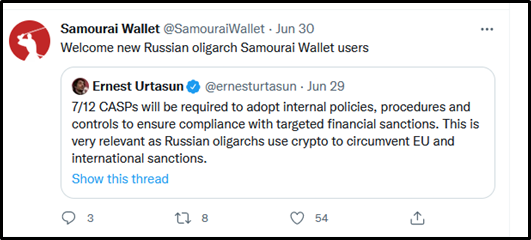
One potential weak point in their defense is their alleged enabling of sanctioned parties to “launder money” through their coin-mixing service. The U.S. Attorney’s Office for the Southern District of New York (SDNY) went as far as to embed a screenshot of the Samourai wallet account welcoming sanctioned oligarchs:
Coin mixers are akin to the virtual private networks (VPNs) used by law-abiding citizens and criminals alike. For privacy to exist, one must be able to hide in a crowd, their choices and personal information shielded from prying eyes, and to be revealed or judged after due process.
With that, the Samourai Wallet founders did not make themselves a difficult target. If the allegations by the prosecution are true, and they knowingly helped dress up wolves in sheep’s clothing, then they likely will have to pay a price for violating sanctions doctrines. A deeply chilling legal precedent could then be set, shaping the future of digital finance and directly harming the proliferation of such technology in the United States.
However, there may be hope in the change to a more crypto-friendly administration under the leadership of President Trump.
“I Will Defend Your Right to Self Custody” – Trump
During his keynote speech at the Bitcoin Conference in Nashville in 2024, Trump made a promise, one that he still has the opportunity to keep.
He promised to “defend the right to self custody”.
Without financial privacy, self custody is dramatically weakened, as seen by the growing wave of physical attacks on Bitcoiners in recent years. The liberty previously enjoyed by software developers to build self-custodial Bitcoin tools like Samourai Wallet, is on trial.
The chilling effect
The U.S. government has, for the most part, learned not to attack an already hardened legal precedent like freedom of expression. However, by going after the developers and maintainers of Samourai Wallet directly, the DoJ had a net negative effect on financial privacy in the U.S., and it spread a chilling effect among Bitcoin software developers.
Immediately following the arrest of Rodriguez and Hill, Phoenix Wallet, arguably the best self-custodial Lightning wallet in the industry, exited the U.S. app stores — a decision made to protect their business from a U.S. government that appeared hostile to Bitcoin self-custody software. (As of April 2025, Phoenix is once more available in the U.S.) Wasabi Wallet, another financial privacy software company, stopped offering its noncustodial mixing services to the public. And wallets like Blink from El Salvador geofenced American users from their app entirely.
If Trump is going to really defend the right to self custody, and stop the eventual deployment of a central bank digital currency (CBDC) in the United States (another election promise), he will have to address the need for financial privacy in the digital era and reverse the injustices set in course by the Biden administration.
In one way or another, these cases will leave a mark on his presidential legacy.
Foundations of a CBDC
The Biden administration continued to sue, scrutinize, and debank the crypto industry — a policy that started under Obama with Operation Choke Point and ultimately resulted in Silicon Valley CEOs losing access to their bank accounts altogether.
A sharp example of permissioned financial rails being abused was also witnessed in Canada in 2022 when the bank accounts of truckers and donors were frozen during the Freedom Convoy COVID protests in Ottawa, following the invocation of the Emergencies Act by then-Prime Minister Justin Trudeau.
Furthermore, top U.S. officials from the Treasury have stated that central bank digital currencies (CBDCs) would need to have strong identity tracking, even while “balancing consumer privacy”, striking at a trade-off that’s sacrificing user privacy altogether:
“The Report notes that ‘a CBDC system could increase the amount of data generated on users and transactions,’ which would pose ‘privacy and cyber security risks, but … offer opportunities for proper … supervision and law enforcement efforts.’”
Among the ideals of justice and fairness laid out by the Constitution is one where the privacy of the individual is granted by default, where there is a presumption of innocence, and the prosecution must prove the accused’s guilt beyond a reasonable doubt.
The Fourth Amendment rights of innocent Americans who were using Samourai Wallet in particular are under attack by the kind of lawfare seen in the Samourai case:
“The right of the people to be secure in their persons, houses, papers, and effects, against unreasonable searches and seizures, shall not be violated, and no Warrants shall issue, but upon probable cause, supported by Oath or affirmation, and particularly describing the place to be searched, and the persons or things to be seized.”
Our homes are no longer just made of brick and stone, and our words no longer contained within those four walls. They are often digitized and transmitted, and so is the value they hold and move. Like cash in a sealed envelope, the use of financial privacy software naturally fits the protections of the Fourth Amendment, especially when no custody of funds is ever taken by the infrastructure facilitating its transit.
Yet the few tools that protect this default access to privacy have been systematically attacked and undermined in the digital age, akin to the government suing envelope manufacturers as money launderers for obfuscating the contents of a person’s exchanges.
It’s actually much worse. While developers of privacy software like Samourai Wallet are harassed, legacy financial institutions, in their attempt to be compliant with KYC and AML regulations — the same class of regulations used to prosecute Samourai Wallet today — are forced to gather excessive private information from their customers in order to report anything “suspicious” to the authorities.
These KYC data vaults are regularly hacked. Indeed, it’s impossible to keep them secure as they grow in size and become targets for cybercriminals, which exposes everyday people to organized crime in the form of identity theft and fraud. By 2012 in the U.S, identity fraud cost more than all other forms of theft combined, reaching over $21 billion, and this figure rose to $52 billion by the 2020s.
This surveillance infrastructure is doing profound and irreversible harm to U.S. citizens and the legacy financial system as a whole.
It is nevertheless sold as the necessary evil that stops money laundering by cartels and ends terrorist financing via sanctions through mechanisms like the OFAC list. And yet it is these same banks who are regularly busted laundering hundreds of millions of dollars for cartels, like TD Bank last year, which had to pay a record fine to U.S. regulators of $3 billion. It was accused of failing to surveil $18 trillion in transactions, of which close to $700 million was allegedly moved by drug cartels. Despite all the regulations and compliance, it turns out it was the banks that were doing the bulk of the money laundering.
When it comes to sanctions, meanwhile, Russia has received the worst lot of U.S. sanctions in recent memory, perhaps in history,including freezing its foreign treasury reserves. Despite that, Russia has run over major territories in Ukraine during the invasion and managed to survive long enough to be in a very strong negotiating position on the other side of the conflict — effectively marking the end of the sanctions foreign policy regime. It is no coincidence that the Trump administration is so focused on tariffs, overseeing the flow of goods across borders instead of the flow of money.
Also, let us not forget that when it comes to terrorist financing, it was the CIA that funded and trained the Afghan Mujaheddin in the ’80s, training guerrilla operatives like Osama bin Laden, who later on helped create Al Qaeda and carried out 9/11.
None of these crimes were done by Bitcoin or Bitcoiners. But the consequences of these laws weigh heavily on civilian populations. And the exponential growth of identity theft, the demoralizing ironies of the war on cash, the micromanagement overhead of the public’s finances, and the chilling effect on privacy-oriented software developers are the direct consequence of the KYC panopticon being constructed all around us.
All these policies can be summed up as flash points in the war on cash, a broad policy strategy of the pre-Trump era, that I believe was meant to set a foundation for the deployment of CBDCs, a state monstrosity that Trump specifically promised to protect us from.
Lesson Learned
The biggest concern I had with the Samourai Wallet’s mobile app was its backend design. Ambitious and commendable as it was to try and bring cutting-edge, self-custodial coin mixing to the masses, in order to achieve it, Samourai Wallet made some questionable compromises — compromises which competitors and critics doubted were worth the upside and which can be judged in the trial as well. The most obvious problem was the way the mobile client was said to handle the xpubs of their users.
Xpubs are very important cryptographic information in Bitcoin and crypto wallets. Similar to IP addresses in the world of VPNs, xpubs represent a key piece of identifying information for Bitcoin users. Anyone who has your xpub can deterministically recreate all public addresses you ever had or ever will have in that wallet, allowing them to know exactly what public Bitcoin addresses are within your control and which funds have moved through them.
In the marketing and debates about VPNs — which are in some sense the early web’s equivalent to Bitcoin mixers — IP addresses, and whether a service can or cannot keep IP logs, is critical to their credibility among a savvy user base. Services often boast about their processes and procedures around not keeping their users’ IP addresses, which, if shut down — as Samourai Wallet has been — could end up in the hands of prosecutors, compromising the browsing history of their users.
In the case of Samourai Wallet and xpubs, a similar rule of thumb should apply. Internet users throughout the decades have discovered that paranoia about the quality of the tools and implementations pays off in the end. This lesson has been learned the hard way as VPN services and privacy-oriented email providers have been hacked or seized by government prosecutors. If there’s user data accumulated, the service can become a juicy target.
We don’t yet know what data Samourai Wallet had in the 17 terabytes confiscated by the U.S. government. Most of it is likely on-chain analysis done by their research arm OXT. But if user data was kept, then the privacy of many of those users might be at risk as well.
The Trump Legacy?
It is fascinating that the future of software developers and their freedom to build private self-custody software will be judged and shaped in an age where Michael Saylor argues that the coin is not a currency and Trump, the self-branded crypto president, promises to protect your self-custody rights.
As Rodriguez and Hill stand trial, those wrapping themselves in the orange flag and those who can influence public policy about financial privacy will also be on trial in the court of public opinion; history will be their judge.
For us plebs who cannot influence public policy directly and can only judge the tools we use on their merit, there is a moral to this story. Compromising on privacy for convenience — to avoid the learning curve otherwise required — does not come without risk.
And on a long enough time frame, only the paranoid crypto-anarchists survive.
This piece is featured in the print edition of Bitcoin Magazine, The Freedom Issue. We’re sharing it here as a sample of the ideas explored throughout the full issue.
The Samourai Wallet matter raises a fundamental question about how the United States treats non-custodial software and the developers who create it. Keonne Rodriguez and William Lonergan Hill did not operate a financial service or handle customer assets. They wrote and maintained software that allowed users to construct collaborative Bitcoin transactions in a privacy-preserving way. Throughout the tool’s entire lifecycle, users controlled their own keys, initiated their own transactions, and never relied on Samourai or its developers to transmit or safeguard value. The distinction between a custodial service and a non-custodial tool is not a technicality; it is the core boundary that the Bank Secrecy Act, FinCEN guidance, and decades of regulatory practice use to distinguish software authors from regulated financial intermediaries.
This point was reinforced by FinCEN itself. In an internal analysis, the agency concluded that Samourai’s architecture did not constitute money transmission because no third party took possession or control of user funds. That conclusion was never disclosed to the defense while the prosecution advanced a theory that required the opposite: that building software which users employ for privacy is functionally equivalent to operating a financial institution. When that analysis finally surfaced, it confirmed what has long been understood across the industry and within the regulatory community—that non-custodial tools fall outside the BSA’s money-transmitter framework because there is no transfer of value by a third party. The case ultimately treated the developers as if they were responsible for the independent actions of users, even though they had no role in executing, intermediating, or approving any transaction. Some individuals did misuse the tool, as happens with any privacy or security technology, but the law has never equated misuse with liability for the creators. We do not treat the authors of encryption libraries, VPN protocols, or email clients as participants in unlawful activity simply because bad actors rely on those tools. Collapsing the distinction between developing a tool and operating a service would introduce an untenable level of risk for anyone building privacy-enhancing or security-critical software.
There is also an important speech component. Courts have consistently recognized that code is expressive, and publishing open-source software is an act of communication. When publication is treated as evidence of “operation,” the legal boundary between authorship and conduct becomes blurred in a way that threatens a wide range of legitimate technologies. Any precedent suggesting that developers are responsible for unforeseeable downstream use would have immediate consequences for cryptography, cybersecurity research, and open-source work more broadly.
Rodriguez and Hill ultimately accepted plea agreements in the face of substantial sentencing exposure, even though government records undermined the central regulatory theory of the case. Their convictions now rest on a framework that is at odds with established guidance and with the direction in which federal policy has since moved. A pardon would bring the legal outcome back into alignment with the underlying facts: this was software development, not money transmission, and the individuals involved should not bear criminal liability for writing code that users executed independently.
This case has already had a measurable chilling effect on developers working on privacy and security tools in the United States. Leaving the convictions in place would discourage responsible innovation and push critical work to jurisdictions that do not share our commitment to open research and transparent development. A pardon would correct a clear misapplication of federal law, protect the integrity of long-standing distinctions in financial regulation, and reaffirm that publishing non-custodial software is not—and should not become—a criminal act.
Disclaimer – This is a guest contribution by Zack Shapiro, originally published by the Bitcoin Policy Institute (BPI). The views and opinions expressed are solely those of the author and do not necessarily reflect the views of BTC Inc or Bitcoin Magazine.

 Login
Login
Treasury Sec. Scott Bessent says, “The policy of this government is to add seized #Bitcoin to our digital asset reserve.”