Login
LoginTether’s Strategic Investment in Ledn: Building the Credit Layer of the Bitcoin Economy

The integration of USD liquidity with Ledn's Bitcoin-collateralized infrastructure establishes a transparent, verifiable foundation for…

The integration of USD liquidity with Ledn's Bitcoin-collateralized infrastructure establishes a transparent, verifiable foundation for…
Vimeo just got hit by a brutal round of layoffs, according to a report by Business Insider. Staffers are posting on various social media sites that the layoffs have impacted most of the company, including the entire video team. Vimeo is a video-hosting platform, so that sounds bad.
“Yesterday, following Vimeo’s recent acquisition by a private equity firm, I learned that I, along with a large portion of the company, was impacted by layoffs,” wrote the company’s former vice president of Global Brand & Creative, Dave Brown. He is referring to a firm called Bending Spoons that bought Vimeo for $1.38 billion in the latter half of 2025.
We don't know why parent company Bending Spoons conducted such a massive round of layoffs, but the equity firm is known for purchasing tech companies and aggressively cutting costs via layoffs. It did the same thing to Evernote back in 2023 and WeTransfer in 2024. Engadget has reached out to Vimeo to inquire about the exact number of employees that were laid off and will update this post when we hear back.
"I can confirm that a layoff was announced at Vimeo on January 20, 2026. To respect the privacy of those departing, we cannot provide additional details at this time,” a Bending Spoons spokesperson told Gizmodo in an emailed statement. "Going forward, Bending Spoons remains committed to growing Vimeo to meet the needs of its diverse user base."
Reviving this account to say: Almost everyone at Vimeo was laid off yesterday, including the entire video team. If you're looking for talented engineers, there are a few on the market.
— Derek Buitenhuis (@daemon404) January 21, 2026
Sucks to see something I built killed by private equity in a technology company skin suit.
It's good to know the company "remains committed to growing Vimeo" after firing just about everyone that works there. One former employee said on X that it "sucks to see something I built killed by private equity in a technology company skin suit."
Vimeo has been around a long time. The platform was founded a full year before YouTube and has positioned itself as being a premium alternative for hosting creative and business-adjacent videos. We have no idea what it'll look like with a minimal staff and no video team.
This article originally appeared on Engadget at https://www.engadget.com/big-tech/vimeo-lays-off-most-of-its-staff-just-months-after-being-bought-by-private-equity-firm-184556023.html?src=rss©
© Vimeo
After years of uncertainty over TikTok's future in the United States, a deal for the app's US business has been finalized. The new US entity is called TikTok USDS Joint Venture. ByteDance has retained a 19.9 percent percent stake in the new business, with the rest controlled by a group of non-Chinese investors, including Oracle, Silver Lake and MGX, an Emirati-state owned investment firm, all of which have a 15 percent stake. Dell CEO Michael Dell and other investors have smaller stakes in the new company.
The terms of the deal were first leaked last month, after TikTok CEO Shou Chew reportedly told employees in a memo that TikTok and ByteDance had agreed to a group of investors. This ends a lengthy saga and months of slow progress as the agreement was being worked out, ensuring that the app will remain available in the US after years of being on the verge of a ban in the country.
President Donald Trump, who had tried to ban the app during his first term in office, praised the deal in a post on Truth Social. "It will now be owned by a group of Great American Patriots and Investors, the Biggest in the World, and will be an important Voice," he wrote."I only hope that long into the future I will be remembered by those who use and love TikTok."
According to TikTok’s announcement, the joint venture will protect American users’ data with Oracle's secure US cloud environment. It will also retrain TikTok’s algorithm on US users’ data and will be in charge of content moderation in the US. The entity promises interoperability, as well, promising that users will still get international content and, if they’re a creator, viewers. “The safeguards provided by the Joint Venture will also cover CapCut, and Lemon8 and a portfolio of other apps and websites in the US,” TikTok said.
The new entity will be overseen by a seven-member board of directors, most of whom are Americans. It includes, Shou Chew, the Chief Executive Officer of TikTok, Silver Lake co-CEO Egon Durban, Oracle Executive Vice President Kenneth Glueck and MGX Chief Strategy and Safety Officer David Scott. Adam Presser, who had previously been head of operations and trust and safety at TikTok, is the CEO of TikTok USDS Joint Venture.
Exactly what the new joint venture means for US users of TikTok is unclear. Shortly after the deal was announced, TikTok introduced new terms of service for US users. As the BBC notes, the new terms include provisions relating to use of the app by kids under 13 (they are limited to the "Under 13 Experience") and that the "TikTok USDS Joint Venture does not endorse any content" in the app. The company hasn’t announced specific changes to the app’s algorithm or other core features.
Update, January 23, 2026, 10:58AM PT: This post was updated to add a statement from President Trump, and with additional information about TikTok’s new terms of service.
This article originally appeared on Engadget at https://www.engadget.com/big-tech/tiktok-finalizes-deal-for-its-us-entity-010543484.html?src=rss©
Paramount Skydance CEO David Ellison is apparently still hopeful that investors will approve his $108.4 billion hostile takeover of Warner Bros. Discovery. Paramount Skydance announced Thursday that it's extending its all-cash offer to acquire the storied studio, and giving investors until February 20, 2026 to accept. The company's previous offer expired on January 21, but with a lawsuit in the works and a revised Netflix deal to compete with, Paramount Skydance wants to stay in the conversation.
Netflix and Warner Bros. Discovery originally announced their $82.7 billion acquisition agreement in December 2025. Netflix's deal is for a significant portion, but notably not all, of Warner Bros. Discovery as it exists today. If approved, the streaming service would acquire Warner Bros. film studios, New Line Cinema, HBO, HBO Max, the company's theme parks, game studios and select linear channels like TNT, but not the collection of reality TV and news programming that Warner Bros. Discovery calls “Global Networks.”
Paramount Skydance made its competing offer of $108.4 billion for all of Warner Bros. Discovery a few days later in December, with the recommendation that shareholders reject the Netflix deal. To add pressure, Paramount Skydance also sued Warner Bros. Discovery in January alleging that the company had not provided adequate information about why it favored Netflix over Paramount. Beyond offering more money, Paramount contends its deal is more likely to be approved by regulators because owning Warner Bros. doesn't "entrench Netflix's market dominance." Warner Bros. Discovery claims that funding for Paramount's deal "remains inadequate" and that the company is uncertain Paramount Skydance will actually be able to complete the deal.
David Ellison was previously able to merge Skydance with Paramount using the financial backing of his billionaire father Larry Ellison, and the Ellison family's friendly relationship with the Trump administration. Promising to make sure that CBS News represents "a diversity of viewpoints” via a newly appointed ombudsman, and that the merged Paramount Skydance won't create any diversity, equity and inclusion programs was enough to get the FCC to approve the merger. Ellison might have thought acquiring Warner Bros. Discovery would be equally easy, but at least so far that hasn't worked out as planned.
This article originally appeared on Engadget at https://www.engadget.com/entertainment/david-ellison-extends-deadline-for-warner-bros-discovery-takeover-offer-204752313.html?src=rss©
Harriet Rees from Starling Bank and Dr Rohit Dhawan from Lloyds Banking Group will spearhead AI adoption.
The post UK Appoints AI Champions to Boost Financial Services appeared first on TechRepublic.
Harriet Rees from Starling Bank and Dr Rohit Dhawan from Lloyds Banking Group will spearhead AI adoption.
The post UK Appoints AI Champions to Boost Financial Services appeared first on TechRepublic.
UK MPs warn regulators’ hands-off stance on AI in finance risks consumer harm, fraud, and systemic shocks as adoption outpaces oversight.
The post Lawmakers Raise Concerns Over Unchecked AI Use in UK Finance appeared first on TechRepublic.
UK MPs warn regulators’ hands-off stance on AI in finance risks consumer harm, fraud, and systemic shocks as adoption outpaces oversight.
The post Lawmakers Raise Concerns Over Unchecked AI Use in UK Finance appeared first on TechRepublic.

I have read a lot of articles on crypto as a whole in the last couple of months and when I say that, I mean the following: I’ve read…
ONDO has lost over 65% of its value since October as heavy selling pressure continues to dominate the altcoin market. While Bitcoin has shown relative stability at key levels, many mid-cap tokens like ONDO have struggled to find consistent demand. This drawdown has pushed sentiment toward the bearish side, especially as traders remain cautious around liquidity events and token unlocks.
Still, some analysts argue that the current dip is not purely a sign of weakness. A CryptoQuant report explains that the headlines may scream “price drop,” but the on-chain data is pointing toward “opportunity” instead. The focus is now on ONDO’s massive 1.94 billion token unlock scheduled for January 18, 2026. Historically, unlocks can trigger panic selling, as investors anticipate higher circulating supply and additional distribution pressure.
However, this time may be different. The report suggests that larger market participants are actively positioning through the decline, using the fear as a liquidity window. Rather than treating the unlock as a reason to exit, the data hints that “smart money” is stepping in to absorb supply while retail confidence remains fragile. That sets the stage for a critical test.
The CryptoQuant report outlines why larger investors appear to be ignoring the noise around ONDO’s decline. The first signal is the “whale shield.” Despite the sharp correction since the December 2024 peak, Spot Average Order Size continues to be dominated by “Big Whale Orders,” shown through consistent green dots on the chart. This implies institutions are using weakness to absorb liquidity, with the $0.35–$0.40 zone acting as a primary accumulation range.

Second, ONDO has officially entered a Taker Buy Dominant phase. The 90-day Cumulative Volume Delta (CVD) remains positive and continues rising, showing that market buy pressure has outweighed market sells for months. This is important because takers represent aggressive participants who buy at the ask without waiting for better entries.
The report frames this alignment as “taker alpha.” When large whale orders and aggressive taker buying strengthen while the price falls, it often reflects absorption. If this continues through the unlock, ONDO could be building a coiled-spring setup for a 2026 RWA breakout.
ONDO remains under heavy pressure after a prolonged decline that has erased most of its 2025 upside. The 3-day chart shows a clear breakdown from the former consolidation range near $0.90–$1.00, where price repeatedly failed to reclaim momentum during the second half of the year. Once sellers forced a decisive move lower, the market quickly transitioned into a steep downtrend marked by weak bounces and consistent lower highs.
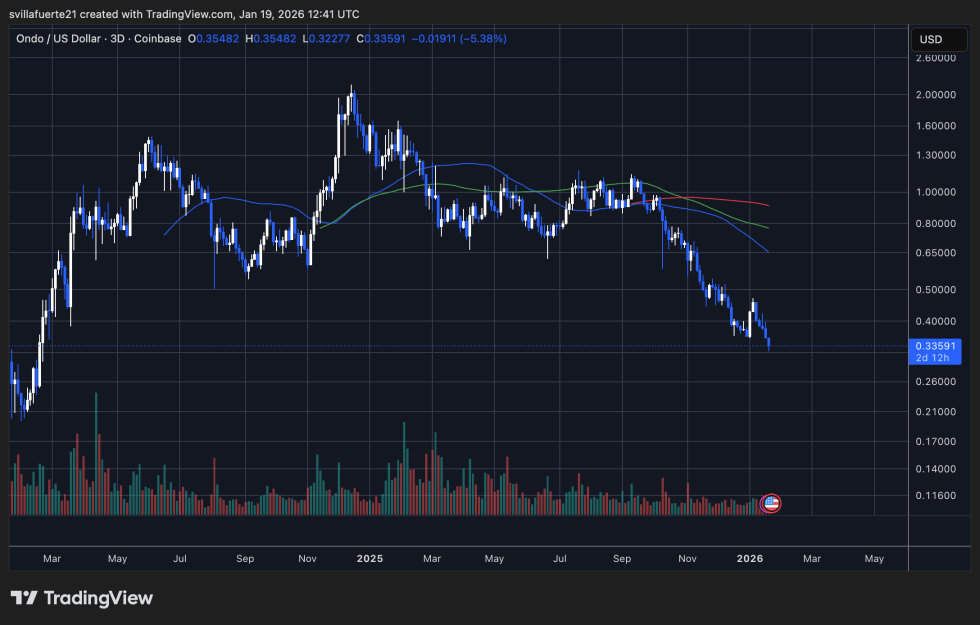
At the time of writing, ONDO is trading near $0.33 after slipping below the $0.40 handle, a psychological level that previously acted as temporary support. This drop places the token deep below its key moving averages, with the shorter trend lines rolling over and acting as overhead resistance. The failed recovery attempts throughout late 2025 confirm that sellers have stayed in control, while buyers have struggled to generate enough volume to shift the trend.
However, price is now approaching a potential demand zone around $0.30–$0.35, where volatility historically increases and dip buyers may try to step in. If this area fails, the chart suggests downside could accelerate. Still, a strong defense could open the door for a stabilization phase before any meaningful rebound.
Featured image from ChatGPT, chart from TradingView.com
Mixed bag this week in crypto markets: BTC edged down slightly overall (from ~$91k to ~$95.6k ), while altcoins like SUI (+20–31% ) and XRP surged. Your portfolio (BTC, ETH, SUI, AERO, XRP) stayed positive on average, buoyed by SUI/XRP strength amid BTC stability around 95–97k. 📈

Portfolio benefited from altcoin rotation away from BTC dominance.
Coin Weekly Change/Volatility Key Swings Note BTC -0.58% to +5% 91k → 97k USD Stable, mild dip ETH -2% to +3% 3.200–3.500 USD Consolidation SUI +20–31% 1.5 → 1.8–2 USD Top winner 🚀 AERO Neutral No big moves Following alt trend XRP +21% → 2.1 USD BTC rotation play
Moderate bullish momentum emerging.

Gold in bearish correction toward $4,235 support post-ATH, eyeing rally above $5,165. RSI trendline backs upside amid geopolitics fueling long-term bull.

DeFi portfolio grinding higher with minimal new capital.
Metric Value Total Value ~$8,550–8,650 USD Concentration BTC-derivs + BTC/USDC CLM Weighted APY ~18–20% annual Yield Sources Uniswap v3 BTC CLM, PancakeSwap vaults, Aerodrome vLP, Morpho/Beefy
Yields stable from fees/compounding.
Category Last Week Now Change Total Value ~$8,700 $8,927 +$227 (+2.6%) Est. Daily Yield ~$3.7–4.0 ~$3.8 Stable Accrued Yield (Lifetime) ~$1,691 $1,738 +$47 net
Notes: Growth from yields + mild BTC/ETH price lifts. Lower volatility, better range-resilience. Risk down, IL pressure eased. Subjective score: 8.2/10 (up from 7.5).
Portfolio up ~2.6% in a week, holding steady daily cashflow (~$3.8). APY isn’t sky-high, but structure is mature, less volatile, and sustainable — less action, more results.
🧠 Final Take:
Thoughts on SUI ETF buzz or XRP’s win? Comment below! 👇
🛑🛑🛑🛑🛑🛑🛑🛑🛑🛑🛑🛑🛑🛑🛑🛑🛑🛑🛑🛑🛑🛑🛑🛑
Disclaimer:
This post is just my personal opinion and ideas. I am not promoting or recommending any cryptocurrency or investment. Please do your own research and be careful when investing. Any decisions you make are at your own risk.
🛑🛑🛑🛑🛑🛑🛑🛑🛑🛑🛑🛑🛑🛑🛑🛑🛑🛑🛑🛑🛑🛑🛑🛑
💼 Jan 2026 Portfolio Update: Stable 18–20% APY Amid BTC Consolidation was originally published in Coinmonks on Medium, where people are continuing the conversation by highlighting and responding to this story.
The digital bank's free HMRC-recognised tax tool is unveiled ahead of Making Tax Digital changes.
The post Monzo Unleashes Tax Tool for UK Small Businesses appeared first on TechRepublic.
The rapid spread of proposals signals a broader shift in how state leaders are thinking about public finance, economic development strategy, and more.
The post States Move to Add Bitcoin to US Public Reserves appeared first on TechRepublic.
The digital bank's free HMRC-recognised tax tool is unveiled ahead of Making Tax Digital changes.
The post Monzo Unleashes Tax Tool for UK Small Businesses appeared first on TechRepublic.
The rapid spread of proposals signals a broader shift in how state leaders are thinking about public finance, economic development strategy, and more.
The post States Move to Add Bitcoin to US Public Reserves appeared first on TechRepublic.
We now have some idea of what's at stake in the longstanding feud between Elon Musk and OpenAI. As first reported by Bloomberg, the latest filing, as part of a lawsuit that accuses the AI giant of abandoning its non-profit status, claims that Musk is owed anywhere between $79 billion and $134 billion in damages from the "wrongful gains" of OpenAI and Microsoft.
Musk claimed in the filing that he's entitled to a portion of OpenAI's recent valuation at $500 billion, after contributing $38 million in "seed funding" during the AI company's startup years. Along with providing "roughly 60 percent of the nonprofit's seed funding," Musk offered recruiting of key employees, introductions with business contacts and startup advice, according to the filing. The monetary estimate comes from C. Paul Wazzan, a financial economist who's serving as Musk's expert in the case. According to Wazzan's calculations, OpenAI earned between $65.5 billion and $109.43 billion in wrongful gains, while Microsoft saw between $13.3 billion and $25.06 billion.
The lawsuit between Elon Musk and OpenAI dates back to March 2024, when the xAI CEO first filed a legal action claiming that OpenAI violated its non-profit status. Musk later added Microsoft as another defendant and even tried to get an injunction when OpenAI announced efforts to reorganize its corporate structure. Besides this suit, Musk has named OpenAI in another legal battle, accusing the company, along with Apple, of monopolistic practices that prevent xAI from getting a fair shot in the App Store.
This article originally appeared on Engadget at https://www.engadget.com/big-tech/elon-musk-is-looking-for-a-134-billion-payout-from-openai-and-microsoft-171824945.html?src=rss©
© REUTERS / Reuters
Canary Capital’s CEO, Steven McClurg, has predicted that XRP will be the leading token in real-world assets (RWAs), which is projected to be a trillion-dollar sector. This came as he highlighted recent developments that put the altcoin on course to dominate the industry.
During an interview, the investment manager opined that XRP will be the leading token for real-world assets, based on Ripple’s moves over the last two years. He noted that the crypto firm has done a great job of integrating the XRP Ledger (XRPL) into many transactions and into Wall Street, which has led to institutional adoption.
The Canary Capital CEO further noted that the XRP Ledger is moving assets such as stablecoins, including Ripple’s RLUSD stablecoin, and other tokenized real-world assets. Notably, Ondo Finance has also tokenized its U.S. treasury fund (OUSG) on the XRPL, while Ripple has partnered with Securitize to add RLUSD access for BlackRock’s BUIDL fund.
Furthermore, Ripple partnered with Archax and UK-based asset manager abrdn to introduce the first tokenized money market fund on the XRP Ledger. There are also plans for the network to get a tokenized gold upgrade, even as demand for precious metals rises. It is also worth noting that Ripple has previously predicted that the XRP Ledger could dominate the real-world assets industry, putting XRP at the heart of the industry, as McClurg has also predicted.
Interestingly, McClurg’s prediction comes as the XRP ETFs draw institutional investors into the altcoin’s ecosystem. These ETFs have been a success since their launch, recording only one net outflow since November. Coincidentally, McClurg’s Canary Capital is currently the largest XRP ETF issuer, with $374 million in total net assets, according to SoSoValue data.
Ripple and XRP Ledger developers continue to work on introducing new features on the network to attract traditional finance (TradFi) institutions. XRPL validator Vet recently revealed that compliance features for TradFi are coming to the network. This includes on-chain compliance tools such as KYC, AML, and other credentials, which will be used by lending protocols, as well as the XRPL DEX and the Permissioned DEX.
Meanwhile, Ripple developers also described Permissioned Domains, which are part of the amendments, as a game-changer for the XRP Ledger because they will bring institutional-grade controls to a public network, without sacrificing the trade-offs of a private chain. The developers further noted that this will set the stage for financial institutions to engage in permissioned flows on a fast, scalable, and resilient blockchain network such as the XRPL.
At the time of writing, the XRP price is trading at around $2.06, down in the last 24 hours, according to data from CoinMarketCap.
Ethereum finds itself in an unusual position where the fundamentals are strengthening, but capital flows remain hesitant. On-chain activity and the real-world tokenization of assets point to a network that is becoming increasingly useful and more deeply embedded in financial infrastructure. The price action movement shows that ETH is stuck in a range where it is struggling to attract sustained momentum.
Ethereum is stuck in the middle, with the price hovering around $3,300, which is slightly up from earlier this month, but it remains compressed within the same triangle that has been forming since November. An investor known as Pepeisfriend mentioned on X that this kind of price action usually means pressure is building and a move is coming. However, the direction hasn’t been specified.
As a result of this move, big money doesn’t seem very excited. ETH whales have been slowly reducing their exposure since mid-December, with no panic selling, just lightening positions. This kind of behavior signals a lower willingness from large investors to carry risk at these levels. The ETF flows have shown that there have been a few days of positive inflows, but the overall net flows are still negative, showing institutions haven’t truly rotated back into ETH the way they did during the previous hype phase.
Meanwhile, Decentralized Finance (DeFi) activity looks weaker, and total value locked (TVL) has dropped noticeably, suggesting that on-chain capital is either leaving or just sitting on the sidelines. When DeFi isn’t active, ETH struggles to generate sustained upside momentum.
Investor Pepeisfriend concluded that ETH isn’t bearish, but also not inspiring confidence for a breakout. This is a clear “wait for confirmation” phase that must be held, but probably still too early to go all-in or expect an immediate breakout.
While the market is obsessed with layer-1 competition, Ethereum is transitioning from a speculative asset into a yield-bearing, productive asset. Analyst Senior pointed out that on January 15, 2026, Sharplink Gaming deployed $170 million worth of ETH into a combined staking and restaking strategy on Linea. This move shows that institutional treasuries have moved beyond simple accumulation to active yield generation.

At the same time, Visa is piloting stablecoin payouts directly on-chain, and EIP-7702 infrastructure is finally going live to eliminate biometric authentication seed phrases via Face ID. The user experience gap that once held ETH back has officially closed. This is the moment ETH is positioning itself as the most secure and liquid on-chain neobank financial platform in the world, and why the $3,500 breakout attempt will feel obvious.


What if your crypto could work for you — 24/7 — without relying on banks, brokers, or savings accounts that barely beat inflation?
In a world where traditional interest rates struggle to keep up with rising living costs, decentralized finance (DeFi) has emerged as a powerful alternative for investors seeking passive income, portfolio diversification, and long-term wealth building.
One of the most beginner-friendly yet powerful gateways into this ecosystem is Crypto.com’s DeFi Wallet.
Unlike centralized platforms that control your funds, Crypto.com DeFi Wallet gives you full ownership of your assets, while still offering access to staking, yield farming, liquidity pools, and on-chain rewards — all from a single mobile interface.
In this step-by-step guide, you’ll learn exactly how to use Crypto.com’s DeFi Wallet to generate passive income, even if you’re new to DeFi. We’ll cover setup, security, earning strategies, risk management, and how to maximize yields responsibly.
Whether your goal is earning yield on idle crypto, reducing reliance on traditional debt-based systems, or building decentralized income streams, this guide is designed to help you do it safely and strategically.
Crypto.com’s DeFi Wallet is a non-custodial cryptocurrency wallet that allows users to earn passive income through staking, DeFi lending, liquidity pools, and yield protocols while maintaining full control of their private keys.
Unlike centralized platforms, the wallet connects directly to decentralized finance applications (dApps), enabling on-chain rewards without intermediaries.
Building passive income with crypto is a skill — not a gamble.
Follow this publication to learn how professionals use DeFi, staking, and yield strategies to grow income, protect capital, and reduce reliance on traditional banks — without falling for hype or scams.
Yes, Crypto.com’s DeFi Wallet allows users to earn passive income by staking CRO, earning yield on stablecoins, providing liquidity to DeFi pools, and lending crypto assets through decentralized protocols — all while retaining self-custody.
Returns vary based on market conditions and protocol risk.
Traditional savings accounts often offer negative real returns after inflation. DeFi flips this model by allowing users to earn yield directly from blockchain activity.
Crypto.com’s DeFi Wallet acts as a bridge between beginners and advanced DeFi strategies, making it ideal for investors who want passive income without unnecessary complexity.
Important Security Note:
Your recovery phrase is your money. Lose it, and your funds are gone forever.
To earn passive income, you need assets inside your wallet.
Popular assets for passive income:
Each asset offers different yield opportunities, risk levels, and lock-up terms.
Crypto.com’s DeFi Wallet supports multiple income-generating strategies, each with different risk-reward profiles.
The most popular passive income methods include:
Each strategy offers different risk levels, yield potential, and liquidity conditions.
By staking CRO, you help secure the Cronos network and earn staking rewards in return.
Typical APYs fluctuate based on network conditions, but CRO staking remains one of the most stable DeFi income options.
If you prefer income without price swings, stablecoins are your friend.
This approach is especially attractive for investors focused on debt reduction, cash-flow stability, or income replacement strategies.
Stablecoin yield strategies are generally less volatile than crypto staking because they are pegged to fiat currencies like the U.S. dollar. However, they still carry smart contract and protocol risk.
Stablecoins are often used for income stability and capital preservation.
Save this guide before you move on.
This step-by-step walkthrough is designed to be reused as you set up your DeFi wallet, choose staking options, and compare yield strategies. Saving now prevents costly mistakes later.
Liquidity pools allow you to earn:
Example:
Providing CRO/USDC liquidity on Cronos dApps.
This strategy is best for experienced investors who understand DeFi mechanics and risk management.
Impermanent loss occurs when the price of tokens in a liquidity pool changes compared to holding them individually, potentially reducing overall returns despite earning trading fees.
It is a key risk factor when providing liquidity in DeFi protocols.
Some DeFi platforms allow you to lend your crypto to borrowers and earn interest.
Ideal Assets:
This method closely resembles traditional interest-based finance, but without banks acting as middlemen.
Crypto.com’s DeFi Wallet includes a Web3 browser, giving access to vetted DeFi protocols.
How to Use It:
Always:
Crypto.com’s DeFi Wallet is considered secure because it is non-custodial, open-source, and requires users to manage their own private keys.
Security ultimately depends on user practices, such as protecting recovery phrases and avoiding unverified DeFi apps.
Passive income doesn’t mean risk-free income.
Think of DeFi as a portfolio tool, not a lottery ticket.
Compound interest remains one of the most powerful wealth-building forces — especially in DeFi.
Avoiding these mistakes alone can dramatically improve long-term returns.
Are you servicing a high-interest debt or have low savings?
Private credit is becoming the new income solution. Get $300 on first deposit with Insidefinacent. See how it works.
Security depends largely on user behavior.
Safety Strengths:
Your biggest risk isn’t the wallet — it’s poor operational security.
This wallet is ideal for:
If you’re serious about earning passive income with crypto, Crypto.com’s DeFi Wallet offers a balanced entry point into decentralized finance.
It combines:
In a financial system increasingly defined by inflation, debt, and centralized control, learning how to generate decentralized income is no longer optional — it’s strategic.
Step-by-Step: How to Use Crypto.com’s DeFi Wallet for Passive Income was originally published in Coinmonks on Medium, where people are continuing the conversation by highlighting and responding to this story.