Terry Gerton I want to start with Secretary Hegseth’s Arsenal of Freedom tour. He’s taking his pitch on the road and recently spoke at the Lockheed Martin Air Force plant in Fort Worth, Texas. I know you’ve been following this, the developments in defense procurement for quite a while. What are you hearing at this point?
Stephanie Kostro So Terry, this “Arsenal of Freedom” is a month-long tour, and it really is Secretary Hegseth going around to various places. He started out in Newport News, here in Virginia, talking with shipbuilders about what it means to be part of the team, right? Being part of the arsenal of freedom and in making things faster, more efficiently, etc. He then went out to California and spoke with folks, and then most recently, just last week in Texas, visiting Lockheed Martin as you mentioned, but also SpaceX. And so talking to folks about, what does it mean to be part of the arsenal of freedom? This is building on his November 7th Arsenal of Freedom speech that he gave here at Fort McNair in the D.C. area. And it is really about reviving this team mentality of, “we are in this together.” Against that backdrop, of course, we have recent activity in acquisition transformation, but also an executive order that came out earlier this month about limiting executive compensation for defense contractors, limiting dividends and also share repurchases or stock buybacks. And so this is a very interesting time to be in the defense industry.
Terry Gerton Stephanie, with all of the changes in the FAR and the DFAR and now the Defense Appropriation Act that’s in law, do you think that DoD has the policy tools it needs and wants to accomplish its transformation?
Stephanie Kostro There are two elements of the answer here. One is, with the fiscal year 2026 National Defense Authorization Act, which was just signed into law last month, they received a lot of new authorities, a lot of a sense from Congress about the ways in which this should be tackled. There is language there about technical data rights and intellectual property. There were things in there about how to define a nontraditional defense company, etc. But I don’t think that was sufficient; we still have work to do. And so does the department have all of the authorities and resources it needs to move forward? I think we’re going to see a lot of legislative proposals come out of the department for this next round of the NDAA, the fiscal year ’27 NDAA. And I think we’ll see things about acquisition workforce. We’re going to see things about working outside of the Federal Acquisition Regulation way of doing contracts. That is code for things like Other Transaction Authority or commercial solutions openings, etc. I don’t think they have everything they need. Part of the Arsenal of Freedom tour and the rollout of this acquisition transformation is to look at how the department can buy things more effectively and more efficiently. That’s time, not having cost overruns, etc. And so all of this is sort of coming together, in a way, to ultimately really transform the way the department buys. And I’m very excited to be part of this.
Terry Gerton Having the rules and authorities is only one piece. What’s your sense of whether the acquisition culture and workforce are aligned to actually accomplish the goals?
Stephanie Kostro Culture is the hardest element of any kind of transformation, right? I do think they’re trying to empower contracting officers and other key members of the acquisition workforce, program managers, contracting officer representatives, etc. This is a longer-term issue, and I think they are trying to tackle it through training programs, etc., letting folks know tools are at their disposal and giving them the authority to go ahead and use those tools. Now, folks don’t get into acquisition within the civil service because they’re risk-loving. A lot of times they get into it because they want to do things very smartly, very efficiently and oftentimes they look back on precedent to see how things were done before. Layer over that, Terry, the fact that we lost a lot of contracting personnel through deferred resignation programs, voluntary early retirement programs and reductions in force. So we are trying to rebuild the workforce in numbers as well as in training. I don’t think they’re there yet; I do think there’s a path to get them there. I’m eager for industry to work with the Department of War and others about how to train effectively and to let industry folks sit in the same training as the government folks, so everyone’s hearing the same thing.
Terry Gerton Stephanie, before we leave this topic, you touched on the executive order about defense contractors and compensation and buybacks. There’s a lot of unknowns still in how that will play out, but what are you hearing from your members?
Stephanie Kostro Our members were very eager to hear how the Professional Services Council would summarize that EO. So we did put out — based on the fact sheet from the White House, based from some interactions we’ve had with administration officials — our interpretation of it. That said, we’ve also asked our member companies, and we have 400 member companies and the majority of them do business with the Department of War and the intelligence community, “hey, what questions for clarification would you like us to ask?” And that list is growing. It is very long. It’s things like, is this really just for publicly traded companies? What about privately owned, or S corps and LLCs? The reason I mentioned that, Terry, is S corps and LLCs will often pay out a dividend to an executive at the company so that executive can pay taxes. They pay out of dividend, so it’s not only a dividend payment, it’s executive compensation, but it’s really just to go ahead and pay federal taxes. What do people do in that regard? How do they explain this? If they have a parent company that is overseas in Europe or elsewhere, how do they explain this executive order to those folks? And that executive compensation, there’s a limit if the company is underperforming, and all of this is predicated on the company’s underperforming — either cost overruns or schedule overruns. How do they explain this to folks? And is it really just about government contracts, or what if you’re a commercial and a government company and your executive compensation is based usually on both elements, commercial and government? So how do you go ahead and limit compensation there? This is a fascinating area to be engaged with the government on. We are all learning this together.
Terry Gerton As Secretary Hegseth tries to walk this tightrope between encouraging defense contractors to be on the team and work with us, and at the same time kind of tightening the screws on enforcement and compensation, the president has said he wants to spend $1.5 trillion on defense next year. That’s a lot of money. How is that going to get spent, do you think?
Stephanie Kostro Oh, it is an eye-catching number, right? $1.5 trillion when we are roughly $1 trillion now are just under, and it is a huge increase. Now, we’ve had large increases in the defense budget in other times in U.S. history. In the early 1950s with the Korean War, the Reagan buildup that some of us remember from the ’80s. Some of us who are listening may not remember it. They may not have been born yet, and that’s okay too. You know, there is some precedent for huge increases in the defense spend. The question here becomes, if the department and the military services are going for commercial-first mentality to prioritize speed of award and innovation, etc., they certainly can spend that money throughout the defense ecosystem. The question that we have is really, what is the organizing construct for this? What would we be spending the money on? Would it be shipbuilding, combat aircraft, the logistics piece, which always tends to be an issue? We also know operations and maintenance accounts are sometimes used and reprogrammed away if they’re not spent by a certain time, because it’s one-year money at the department, it gets reprogramed away. It’s going to be an interesting mathematical problem to tackle. In addition, I would mention, we had the reconciliation bill, the One Big, Beautiful Bill Act that passed and was signed into law last July. That infused a bunch of cash into both the Department of Defense and the Department of Homeland Security. I understand some of that money hasn’t been apportioned and provided to the departments yet, but we are now at this point in January of 2026 talking about, what would a reconciliation bill look like for 2026? Congress can pass one per fiscal year. The one that was passed last July was the one for fiscal ’25. What happens this year? There are a lot of different mechanisms to get that money through Congress and over to the government to apportion to the department.
Terry Gerton Well, speaking of 2026 appropriations, it looks like Homeland Security and Defense will be two of the last bills out, hopefully before the end of this month. What are you hearing from folks on the Hill?
Stephanie Kostro I’m hearing that they’re trying really, really hard to avert a shutdown. And I think we’re going to get there. I’m not a betting person, Terry, you know, I’ve talked about that in the past. And I’m not in this case, either. The chance for a shutdown is never zero. That said, the experience that we all had back in October and November last year would indicate that there really is no appetite for a shutdown this year. The National Defense Appropriations Act and the DHS [bill] I think are probably the last because they want to get everything done before they tackle those. Those are the two departments that received the lion’s share of the money from the reconciliation bill, One Big Beautiful Bill Act last year, and they are looking to get more money in a reconciliation bill this year. So I’m not surprised to hear that those are last, but I actually don’t think that indicates that they’re very far apart on the numbers.
Terry Gerton And on those two departments, PSC is sponsoring a trip in January to the border to do some on-site research. Tell us about that plan.
Stephanie Kostro I am so excited about this. PSC has not typically done this. I do know other entities have done this, I used to be at a think tank where we would do things like this. We are bringing almost 30 different companies out to California next week, Jan. 28 and 29, to do a behind-the-scenes access with the Customs and Border Protection folks who are out there. And the ports of LA and Long Beach, the ports at entry, the land ones over at San Ysidro and Otay Mesa, really talking with folks on the ground there about what their requirements are. This is really focused on technology. How do we use technology and the art of the possible to protect our borders? Now, I would hasten to add, Terry, border security is not a partisan issue in many, many ways. The Biden administration, the Obama administration, the previous Trump administration all focused on border issues in different ways. Our companies really want to mention to folks on the ground, here is technology that you may not have experience with that is up-and-coming. How can we leverage it to better secure our borders? Talking about cargo screening, etc. I think this is a really good opportunity for companies to sit down with folks who are in the field and hear about what they need.
FILE - Containers with Yang Ming Marine Transport Corporation, a Taiwanese container shipping company, are stacked up at the Port of Los Angeles with the the Long Beach International Gateway Bridge seen in the background on Wednesday, April 9, 2025 in Los Angeles. (AP Photo/Damian Dovarganes, File)
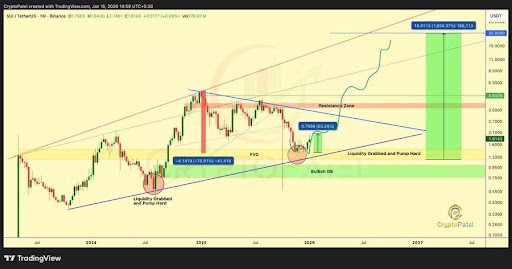
SUI is showing early signs of a meaningful shift in momentum after reclaiming a key smart money accumulation zone on the weekly chart. Following a deep corrective phase, the price structure is beginning to stabilize, suggesting that patient buyers may be positioning for the next major move. With higher-timeframe support holding and a bullish structure gradually rebuilding, the setup hints that a larger expansion could be brewing.
Defending Weekly Accumulation After Deep 2024 Correction
Crypto analyst Crypto Patel, in a post shared on X, highlighted that SUI continues to hold a high-timeframe accumulation zone on the weekly chart following a deep correction from its 2024 highs. According to the analysis, the broader market structure now points toward a re-accumulation phase with smart money participation.
From a technical standpoint, several constructive signals stand out. The liquidity sweep at the lows has already been completed, while a strong weekly bullish order block between $1.50 and $1.30 has been fully filled. Also, the fair value gap overlaps with a demand zone. Since reacting from this region, SUI has already delivered a bounce of roughly 45%, indicating growing bullish responsiveness.
The structure remains technically healthy, with price action respecting a rising channel and the high-timeframe bias gradually shifting back toward the upside. These developments suggest that the corrective phase may be maturing, allowing for a more sustained recovery if current conditions persist.
Looking ahead, Crypto Patel outlined ambitious upside targets at $5, $10, and $20, contingent on the broader bullish structure remaining intact. As long as SUI/USDT holds above the $1.20 level, the macro bullish thesis remains valid.
The analyst also noted that the optimal entry zone, previously shared around $1.50–$1.30, had already played out, delivering close to 50% gains on a short-term swing. Overall, this remains a patience-driven weekly setup with attractive risk-to-reward for both spot and swing traders, but invalidation could occur on a weekly close below $1.20.
SUI Respects Structure After Completing HTF Correction
Sui Community outlined that the recent price action is far from random and continues to respect a clear structural framework. Following a complete high-timeframe correction, SUI has transitioned into a re-accumulation phase, with price stabilizing inside a well-defined weekly demand zone.
This zone is where smart money participation has become evident, signaling renewed confidence after the corrective move. The community also made reference to the same $1.30 and $1.50 entry zone as Crypto Patel, which has since been filled and validated, delivering gains of roughly 50%.
At this stage, the outlook shifts into a patience-based weekly play with an asymmetric risk-to-reward profile. As long as the broader structure holds, the long-term upside targets remain firmly in focus at $5, $10, and $20.
RSAC just made a power move. With Jen Easterly stepping in as CEO, the cybersecurity industry’s front porch gets real leadership, real credibility, and real intent—writes Alan.
The secretive National Reconnaissance Office has announced a new top official. William Adkins was appointed principal deputy director of the NRO on Monday. Adkins previously served as professional staff on the House Appropriations Committee. He’s also a veteran of the Central Intelligence Agency and had been detailed to the NRO to manage technology development projects in the late 1990’s.
Congress breathes new life into the Technology Modernization Fund. House and Senate appropriators agreed to give funding to the Technology Modernization Fund for the first time in four years. Lawmakers on the Financial Services and General Government appropriations subcommittee allocated $5 million for 2026 in the bipartisan deal struck over the weekend. Congress had zeroed out any new funding for the TMF since 2023. Two other centralized IT funds also received support from Capitol Hill. The Federal Citizen Services Fund is slated to receive $70 million and the IT Oversight and Reform Fund is getting $8 million.
The Pentagon has rolled out a new artificial intelligence strategy that seeks to transform the department into an “AI-First warfighting force.” Defense Secretary Pete Hegseth said the department will invest heavily in AI compute infrastructure, from data centers to systems at the tactical edge. The strategy directs the chief digital and artificial intelligence office to enforce the Pentagon’s “Data Decrees” to make all DoD data interoperable, visible and trustworthy. Military departments and defense agencies will be required to establish and maintain federated data catalogs that expose data assets and system interfaces across all classification levels. Hegseth also directed the department to use special hiring authorities and talent programs to bring in AI talent.
A new bill will require the Pentagon to assess whether its current efforts to recruit, train and retain cyber talent are working. The Department of Defense Comprehensive Cyber Workforce Strategy Act of 2025 tasks the Pentagon with developing a new cyber workforce strategy. The lawmakers want the Pentagon to assess remaining gaps in implementing the DoD’s 2023–2027 Cyber Workforce Strategy, and identify which elements of the current strategy should be continued or dropped. Congress is also requesting detailed workforce data, including the size of the cyber workforce, vacancy rates, specific work roles and other data related to personnel system metrics. The Pentagon faces a shortage of approximately 25,000 cyber professionals.
The state and local cloud security program known as GovRamp has new leadership. Tony Sauerhoff, the chief artificial intelligence and innovation officer for Texas, is the new president of the GovRAMP Board of Directors. He replaces JR Sloan, the Arizona CIO, who served in that role since 2021. Sauerhoff also served as Texas' chief information security officer and previously worked for the Marine Corps and Air Force. In addition to Sauerhoff’s appointment, GovRAMP announced its 2026 board and committee leadership.
Lawmakers look to put more money behind plans to offload unused federal office space. House and Senate appropriators want to give the General Services Administration more than $1 billion to carry out new construction and repair the federal buildings it already owns. Lawmakers said they’re concerned about a multi-billion-dollar maintenance backlog for these buildings. GSA will likely need much more funding to keep its buildings from falling into disrepair. The new GSA administrator said the agency is looking at a $24 billion maintenance backlog, and said that is likely an undercount.
The latest spending package for fiscal 2026 directs the General Services Administration to improve public-facing service delivery. Lawmakers want GSA to make federal websites more accessible to people with disabilities. The spending package also calls on GSA to help agencies improve their public-facing benefits and services through AI tools. But the spending deal doesn’t put any new funding behind this goal.
The Department of Homeland Security is flush with funding for new drone technologies. Now DHS is establishing an office to lead those purchases. DHS’ new Program Executive Office for Unmanned Aircraft Systems and Counter-Unmanned Aircraft Systems will oversee strategic investments expected to total in the billions of dollars in the coming years. This week, the office plans to finalize a $115 million counter-drone award to help secure America250 and FIFA World Cup events. And late last year, DHS began accepting proposals from the counter-drone industry for a $1.5 billion contract vehicle.
The Defense Counterintelligence and Security Agency has new leadership in place. Justin Overbaugh has been serving as acting director of DCSA since November. Overbaugh was confirmed by the Senate in September to serve as Deputy Undersecretary of Defense for Intelligence and Security. His appointment to also lead DCSA comes after full-time director David Cattler stepped down in September. Overbaugh is a retired Army colonel with 25 years of intelligence and special operations experience.
(DCSA leadership - Defense Counterintelligence and Security Agency )
The Coast Guard said it’s awarded some long-awaited contracts to start building a new fleet of icebreakers. Both contracts will go toward the construction of medium icebreakers. The work will start in Finland, where the Coast Guard has awarded a contract to Rauma Marine Constructions to start building one, and possibly two, of the new class of cutters. From there, the Trump administration said it wants to “on-shore” the icebreaker building expertise, partly through a second contract with Bollinger Shipyards in Lockport, Louisiana. That contract will support the construction of up to four more ships. The first ship is expected to be finished in Finland in 2028, and the first American-built hull will follow a year later. It’s part of a broader Coast Guard plan to rebuild its icebreaking capability. As of now, the service only has two icebreakers in service and the ships are at or beyond their planned service life.
The Energy Department faces big human capital challenges heading into 2026 after it lost 20% of its workforce this year. That’s according to the DOE inspector general’s latest report on Energy’s top management challenges. The IG reports that more than 3,500 of DOE’s 15,705 employees departed the agency in 2025 through deferred resignations, early retirements and other actions. The report also highlights challenges with DOE’s cybersecurity program and its efforts to leverage artificial intelligence.
Federal employees looking to join the Senior Executive Service may soon see changes in training requirements for the higher-level positions. The Office of Personnel Management is proposing to alter the timeframe and content of SES candidate development programs. But that’s far from the only change in senior executive development this year. The Trump administration has also launched several leadership training programs through OPM, as well as a required training for supervisors on recent reforms to performance management.
Probationary federal employees are on track to see more restrictions when appealing their terminations, according to a new proposal from the Trump administration. In addition to the limitations on appeals, the new proposal would also put the Office of Personnel Management in charge of adjudicating employees’ cases. That’s instead of the Merit Systems Protection Board. Generally, OPM said the upcoming changes should help streamline the appeals process and hold probationary employees accountable.
A Florida congresswoman accused of stealing federal COVID relief funds is maintaining her innocence. Rep. Sheila Cherfilus-McCormick (D-Fla.) was scheduled to be arraigned on fraud charges yesterday, but her attorneys asked that the hearing be postponed while she assembles a legal team. Outside the courthouse, she told reporters the charges are politically motivated. Federal prosecutors claim the congresswoman stole funds that were overpaid to her family’s health care company and that at least some of those funds went toward her campaign for Congress.
Terry Gerton You’ve done an interesting report recently. You revealed that senior officials at the FBI were granted waivers for polygraph exams. Let’s start at the beginning. Really, is this normal? And if it’s not, what is normal?
William Turton It’s not normal. You know, the people we spoke to who’ve worked at the highest levels of the FBI have told us that to grant waivers for people like the deputy director, Dan Bongino, the congressional liaison, Marshall Yates and the executive assistant to the director Kash Patel — a woman named Nicole Rucker — granting them polygraph waivers is unprecedented. We spoke to one person who said that they can only recall one waiver being granted, to an outside expert, and that was the only one they knew of in about a seven-year period.
Terry Gerton Are senior leaders at the FBI normally required to pass a polygraph exam?
William Turton All FBI employees are required to pass a polygraph exam. And that’s been the case since 1994. So just to become an FBI employee, you must pass a polygraph. And then as you gain more clearances or access to more sensitive information, some employees have to pass multiple polygraphs.
Terry Gerton And what does a waiver, then, of the polygraph signify?
William Turton We would love to know more about why they were granted waivers. When you take a polygraph at the bureau, based on the people that we spoke to, you get asked all sorts of questions ranging from illegal drug use to foreign contacts. Anything in the spectrum there can potentially cause issues with your employment. We didn’t report any details as to why these people were granted waivers, but we’d love to know more.
Terry Gerton So who has the authority then to grant the waiver?
William Turton We reported that Kath Patel, the director of the FBI, granted the waivers to all three of the employees that I mentioned earlier.
Terry Gerton Is there any requirement to give a justification for that, or was there any transparency around why those waivers were provided?
William Turton The Bureau didn’t disclose that the waivers were granted. The only reason we know that is because we spoke to sources with knowledge and we ended up reporting it. But there was no sort of disclosure or justification from the Bureau as to why the waivers were granted. When we went to the Bureau for comment, one of the things that they told us was that, well, these employees are Schedule C political appointees, so therefore they don’t have to take a polygraph. We spoke to four experts who specialize in security clearances and polygraphs who told us that’s not true. Being a Schedule C or political appointee doesn’t preclude you from having to take a polygraph. And for the record, I went and checked the Plum Book; only one of the three employees that I previously mentioned, Nicole Rucker, is listed as a political appointee.
Terry Gerton One of the reasons that you might expect an FBI official to take a polygraph is to make sure there isn’t any compromising information in their background. But one of the other reasons is to secure that top secret clearance. What kind of information might these folks be exposed to and what is the impact of not having a clear polygraph test and clearance?
William Turton As we reported in this story, the deputy director of the FBI receives some of the most closely guarded secrets that the American government has to offer. People have told us that the deputy director would routinely receive the president’s daily brief, which is a summary from all across the intelligence community of some of the most pressing threats to the country. They also get access to SCI, or special compartmented information, where people are read in and read out of various programs, where a very small amount of people have knowledge of that program. There’s also secure spaces within FBI headquarters. For example, on the seventh floor where the director of the FBI works, the entire director’s suite is what’s known as a SCIF, or secure compartmented information facility, meaning it’s designed to protect against electronic eavesdropping, you can’t bring personal devices inside and you need clearance that is granted, in part, by passing your polygraph to access those spaces.
Terry Gerton I’m speaking with William Turton. He’s an investigative reporter with ProPublica. So what does all of this mean in terms of national security and public trust, if these folks don’t have the proper clearances or haven’t been properly vetted and have access to these important secret information?
William Turton I think one of the most immediate impacts that this has could be on the morale of other FBI employees. It’s important to note that Mr. Patel, the director of the FBI, has used the polygraph on his own workforce in order to see if negative comments have been made about him personally or if there have been leaks to the media. And so I think it presents a sort of immediate double standard that hasn’t really been explained by the Bureau, where top officials close to Patel don’t have to take a polygraph; at the same time Patel will use the polygraph to try and ferret out leaks or negative comments about his leadership.
Terry Gerton What’s happening in terms of oversight here? Has the Department of Justice said anything or the congressional oversight committees?
William Turton Sen. Durbin, who is the ranking member of the Senate Judiciary Committee, which is the main congressional oversight body of the FBI, raised this issue before Kash Patel when he testified before Congress. This actually happened before our story published, but Durbin mentioned senior members of Patel’s staff, and didn’t at that time explicitly name the deputy director. So this is on Congress’s radar, and when Kash Patel was asked about this, he didn’t engage in the question directly and deflected.
Terry Gerton So this feels a little bit like a tree falling in the forest. If no one is there to hear it, does it make a sound? Is this really a big deal? And if it is, what is going to happen in terms of broader implications, policy changes or even maybe a shakeup?
William Turton The former senior FBI officials and other government officials we spoke to thought it was a big deal. They thought it was a reflection of the fact that the FBI is being run by people who wouldn’t be able to, in their view, pass the minimum requirements to become an agent, much less the deputy director. So I think there’s a question of security, absolutely, people are concerned about. There’s a question about keeping information confidential and secure. And then there’s open questions about the motivations of the people running the Bureau. Officials that we spoke to wondered whether this was an example of prioritizing personal loyalty to the Trump administration and the director, rather than the kind of policies and procedures that are typically in place for FBI employees.
Terry Gerton Have you heard anything from Sen. Durbin or his staff or the committees about moving forward with additional hearings or additional oversight or possibly even future reforms of this process?
William Turton We haven’t, really. I think the story got lost in the news a little bit. There’s been a lot of news about the Bureau of late. I’m keeping my ears open; I think there’s a lot more to this story. And I have a feeling that it’s just scratching the surface.
Terry Gerton If it is eventually to generate some kind of reform, what do you think would be most likely? Would it be tightening clearance rules or codifying the polygraph requirements, as an example?
William Turton I’m not sure what avenues for reform there are, because as I understand it, the director and the president basically have unilateral authority to grant waivers for polygraphs or to grant, in some cases, clearances. So I think I don’t think anyone is eager to change that level of authority that rests with the president or the director of the FBI.
Terry Gerton Do you see any parallels between how the FBI has approached the polygraph and maybe what’s happening in the Department of Defense?
William Turton I think the most obvious parallel to me in writing the story — I’m a little bit biased because I did some reporting on this earlier this year — but what was happening at DHS, where employees were regularly being polygraphed for questions about media leaks or if employees had criticized leadership. It was kind of the exact same thing that we’ve been hearing at the FBI happening to rank-and-file staff.
OPINION — Not long ago, I was talking to an old friend and China analyst about the need for Intelligence Community (IC) analysts to spend significantly more time looking at themselves and their own agencies, processes, procedures, habits, biases, etc.—in other words, to be more introspective. I thought this an uncontroversial assertion as it has beenwell established in management literature that healthy organizations have robust introspective proclivities. But his response proved me wrong: “Do you have any idea what my read pile looks like? I have no time for navel-gazing.”
The above comment beautifully captures not only the IC’s aversion to introspection but also what is probably the main reason for that aversion—our “mission focus.” In fact, for most of us “mission, mission, mission” becomes a mantra from the day we take our oaths. But that admirable mission focus also comes with a very real downside: we tend to see introspection as a distraction from the mission rather than as a prerequisite to mission success. Add to that another compelling reason for our aversion—our historical and cultural wariness about looking at “blue” (U.S.-related) issues—and the roots of our introspective deficiencies quickly become evident.
That said,our aversion to introspection might well be disputed by some observers. After all, most of us take multiple personality assessments (e.g.,Myers Briggs,DISC, etc.) during the course of our service. Additionally, we do have many of the trappings of an introspective community: organizations (e.g.,National Intelligence University,Center for the Study of Intelligence, etc.), personnel (e.g., methodologists, tradecraft specialists, historians, etc.), and publications (e.g., NIU’s Research Notes, Shorts and Monographs; CIA’s Studies in Intelligence, etc.) that are specifically dedicated to thinking about the practice of intelligence. Why, then, do I posit that we are not sufficiently introspective?
Well, relative to the IC’s size, the aforementioned trappings are, by any measure, tiny. Moreover, although a sub-community of extraordinarily introspective officers exists, the majority of them are at their most introspective when—and because—they are not working on the line. As part of my research, I talk to many intelligence officers, especially line analysts. And in doing so I never fail to be amazed at how few seem to view routine introspective activities as vital to high performance. Sure, they see value in the occasional class, tradecraft-focused article, or ticking off the boxes on anIntelligence Community Directive 203 (Analytic Standards) checklist. But as a systematic, thorough, and routine activity? Not so much.
The Cipher Brief brings expert-level context to national and global security stories. It’s never been more important to understand what’s happening in the world. Upgrade your access to exclusive content by becoming a subscriber.
Given this, the IC needs to fundamentally reassess its whole conception of introspection. No longer can it be sufficient to expect introspective initiatives to be carried out mostly by non-line or support entities, although their foundational introspective efforts will remain vital supports to mission. Rather, on top of that foundational work, the IC must start building introspective activity into the regular routines of officers actively and directly working on the mission. Just as practicingdoctors andlawyers are required (at least on paper) to engage in self-assessment—”reflective practice”—even as they confront ever-increasing numbers of patients and caseloads, intelligence practitioners too must consciously invest time and thought in regularly reflecting on how we conduct our work and ways in which we could better achieve our mission.
There is no set form this reflective practice must take. It could be conducted in a group, individual and/or hybrid format. The only aspects that are non-negotiable are that it be regular, resourced (particularly with regard to time), and required.
Ultimately, and as mentioned at the outset, healthy organizations have strong introspective tendencies. It is crucial then, that the IC reconceives and incentivizes introspection as a fundamental prerequisite to mission success and not the distraction or “navel gazing” it too often is deemed to be.
The Cipher Brief is committed to publishing a range of perspectives on national security issues submitted by deeply experienced national security professionals.
Opinions expressed are those of the author and do not represent the views or opinions of The Cipher Brief.
Have a perspective to share based on your experience in the national security field? Send it to Editor@thecipherbrief.com for publication consideration.
Read more expert-driven national security insights, perspective and analysis in The Cipher Brief
🌿 The Vault Levels Up: We’re Going Full CBD, Baby! 🌿
As if The Vault wasn’t already the high point of your week (pun absolutely intended), we’ve just taken things to a whole new level of chill. That’s right — The Vault Cannabis Seeds Store has cracked open a brand-new treasure trove: our very own CBD shop! 💚
We know you’ve loved our CBD Gummies (and who wouldn’t, they’re the sweetest way to stay mellow), but now we’ve gone full-spectrum — literally. We’ve added the complete range of Aztec CBD Pods and Aztec CBD Pod Refills, giving you 15 delicious flavours to puff, sip, and savour your way to serenity.
So whether you’re into Mango Kush Mondays, Blueberry Bliss Thursdays, or that classic OG Kush comfort, there’s a pod for every mood. It’s like Pokémon for adults — gotta try ‘em all.
This is only the beginning folks as we will be launching many more products over the coming weeks so make sure and sign up for our newsletter to stay informed about new product launches!
🌀 The Aztec Experience: Chill, Refilled, Repeated
These Aztec CBD Pods are as smooth as your best one-liner after a few gummies. Designed for the sleek Aztec CBD Pod Device, they deliver the perfect hit of calm — minus the high, but with all the vibes.
Each pod is crafted with love, care, and a pinch of magic (okay, mostly premium CBD, but we like to think there’s magic in there too). And when you’re done, simply pop in a refill and keep your zen flowing. It’s the circle of life — Vault edition.
💸 Celebration Time: Discount Alert!
You know us — we couldn’t launch something this exciting without throwing a little party. So, to celebrate our CBD store launch, we’re giving you 10% off EVERYTHING.
That’s right — everything. Seeds? ✅
CBD goodies? ✅
Head shop items that make your mates say “Where’d you get that?” ✅
Just use the code CBD10 at checkout and bask in the sweet glow of savings.
🌈 Why You’ll Love It
15 flavours of Aztec CBD Pods and refills (because choice is everything)
Top-quality CBD from a trusted name
Discounts on literally everything (we can’t stress that enough)
And, of course, the same cheeky Vault charm you know and love 💚
Drop a comment below and let us know what you think of our first 3 CBD products and which ones you would like us to stock next?
So what are you waiting for? Whether you’re mellowing out, topping up, or just looking to refill your chill, head over to The Vault’s CBD Store
Newsletter Sign Up
Make sure you never miss another Vault Giveaway or Promo – sign up for our newsletter!
Legal Disclaimer: The competition winners will have their prizes sent to them via recorded delivery. Please, double-check you’re giving us your full address correctly. If you win the competition but don’t receive your prize, we cannot resend competition prizes, so you’ll have to raise this with your local delivery service (In the UK, for example, this would be Royal Mail).
Remember: It is illegal to germinate cannabis seeds in many countries including the UK. It is our duty to inform you of this fact and to urge you to obey all of your local laws to the letter. The Vault only ever sells or sends out seeds for souvenir, collection or novelty purposes.
EXPERT OPINION — It is time to reimagine the US intelligence community (IC). The 1947 National Security Act established the CIA which arguably had the biggest impact on the modern age of U.S. intelligence. Subsequent changes to the National Security Act and the Intelligence Community (IC) were mere tweaks in comparison:
In 2003, the Department of Defense established the Under Secretary for Intelligence (amended in 2020 to the Under Secretary for Intelligence and Security); the office acts as a chapeau for Defense Intelligence. Its role in oversight of the Military Intelligence Program arguably could give it influence over the defense intelligence agencies and services, if the office leaned into its leadership role.
In 2004, Congress amended the 1947 National Security Act and created the Director of National Intelligence (DNI), taking the role of manager for community intelligence from the Director of the CIA. This move did not reengineer how the IC is organized.
For nearly eighty years, we have been tinkering and adding to the IC but we have not fundamentally redrawn or refocused it. Now is the time to do that. Three critical junctures make it imperative that we rethink how the IC is organized and functions. Important technological advancements need to be the heart beat of how the IC does its work. Global conditions are emphasizing the need for gray zone work/cognitive warfare which currently is a side hustle of the IC and needs to become a focus. Finally, the IC has become too unwieldy and dispersed to have the impact it should.
Congress is proposing changes to the DNI, legislating procurement, and legislating definitions of covert warfare versus irregular warfare, but that remains piecemeal and not far reaching enough. As a whole, the IC has been directed to downsize. This is sorely needed as the overlap and bloated bureaucracies help to develop the go it alone mindset. A leaner IC will force integration.
Now is the time to go back to the drawing board and reimagine what our intelligence community should look like:
Technology forward.
More emphasis on publicly available information.
More integrated and driven by USG foreign policy strategies that have clear goals.
Closer ties between the Department of Defense and the rest of the intelligence community.
Focus on irregular warfare, cognitive warfare, and gray zone activities.
A Technology-Driven IC
The heart of the new IC should be embodied in two new organizations that are retooled from existing structures: one that is an Open Source Center that curates all Open-source data; and one that is a technology hub that oversees and develops technology for the entire IC—a one stop shop.
The Open Source Center would be the heart of analysis for the new IC. It would be loosely modeled after the old Foreign Broadcasting Information Service (FBIS) that procured important open source articles and books and provided translations for the entire government during the Cold War era. Individuals working in this new agency would range from those without clearance to those with high clearance levels but the data would be all unclassified—until merged into a comprehensive story board. The data and tools would be accessible to the entire IC. The center would include the latest AI technology to help highlight anomalies. It would include data analysts from government, tech companies, and companies that are already working commercial data open source analysis.
The Open Source Center currently housed at the CIA and DIA’s Open Source organization would be the nucleus of the personnel for this work. Analysts and technology specialists would work together to gather the latest trends to feed the rest of the government. The center would work with partners and allies to bring in their data and share patterns. Eventually, the patterns and anomalies procured in this center would be merged with U.S. exquisite intelligence, but more routinely, this publicly available or procured unclassified data would be used to provide warning at the strategic, operational, and tactical levels across government agencies, to partners, and when appropriate, to the American people. This data would feed the U.S. IC and military watch centers across the world as a first notice of concerning anomalies.
In order to speed up technology procurement and ensure that leading-edge technology is being used by the IC, we need an IC technology center or hub. Much like the parts and pieces of IARPA, DARPA, and IN-Q-TEL that compete, this unit should bring in all the technology experiments and investments so that the successes can be shared across the IC more quickly. This would allow government and industry to focus on the IC’s technology priorities, make pricing of new technologies more competitive, and cut down on boutique answers to requirements that cannot be scaled IC wide. It would also speed up technology acquisition by bringing in some of the authorities for quick procurement that the above agencies have. This Center would support both Defense and civilian intelligence organizations and be manned by personnel from across the entire IC.
Sign up for the Cyber Initiatives Group Sunday newsletter, delivering expert-level insights on the cyber and tech stories of the day – directly to your inbox. Sign up for the CIG newsletter today.
DNI for All
Turn the DNI into the organization that it was made to be—the leader focused on oversight, guidance, and integration of the entire IC. This does not need to happen with a lot of bureaucracy. The right leaders and experts can do this work.
The DNI has never been given the powers that it needs to fulfill its mandate. To do this, the DNI must have say over the entire National Intelligence Program budgeting. Currently, the DNI’s oversight is watered down by having little budget decision making authority. If they do not like the direction that the DNI is providing, the other intelligence agency Directors go directly to Congress who will earmark specific funds and the DNI, who answers directly to the President, is thwarted. This needs to change.
Defense intelligence makes up the largest part of the intelligence community with each service having its own intelligence unit, each COCOM having its own, and the collection support agencies technically being under the Secretary of Defense. To oversee this enterprise, the Office of the Secretary of Defense created the Undersecretary for Intelligence and Security (OUSDI&S) in 2003. This office continues to struggle to find its footing in the IC. As stated previously, it has some power that the DNI does not in that it has sway over the Military Intelligence Program (MIP) budget. However, the CSA Directors have their own avenues of communication to the Secretary of Defense, the DNI, and Congress. To fix this issue, the I&S Under Secretary simultaneously should act as the DNI Deputy. The Director for Military Affairs at the DNI should be the Department’s and I&S’ in-house consultant on a day-to-day basis and act as conduit between DNI and OUSDI&S. This arrangement would streamline the multiple meetings that CSA Directors are invited to attend separately with I&S and DNI—they could be held at the same time. It would also make it clear that OUSD I&S brings the rest of the defense intelligence agencies to the table and sets joint IC priorities.
A key issue in the IC is that there is no comprehensive strategy for countering our adversaries. While the NSC sometimes tries to play the role of the strategy developer, most NSC Directors do not thoroughly understand the capabilities of each of the intelligence agencies and IC agencies are not compelled to follow the direction of such strategies, especially when the NSC provides competing priorities. Either the IC is left out or there are multiple IC entities who compete with each other to try to develop the strategy. It makes most sense to have the DNI embrace its integration role and represent the entire IC to the NSC to develop the IC portion of strategic competition strategies. The DNI, with its National Intelligence Managers, would lead IC strategic competition teams so that these teams could be prioritized by resources and personnel.
By retasking and focusing the DNI workforce, the above work can be accomplished without growing the workforce and with more streamlined personnel numbers. The IC also needs to entice the best and brightest to work at the DNI. The IC needs those individuals who truly are experts both in their functional area and as intelligence professionals. Agency directors must recognize the importance of interagency work and reward that work. Over time, the real IC experts and leaders no longer go to DNI on rotation because they have seen their home agencies shut them out upon return.
All Source Agencies Should Double Down on Core Competencies
CIA and DIA have spread into each other’s lanes so that there is now a duplication of analysis and, in some cases, collection. CIA should focus on nonmilitary issues such as political stability and economics, and DIA should focus its workforce on military and military technology issues. Of course, there will be a gray area but that should be worked out between the Directors of the two agencies. Some would say that we should have only one all-source analytical organization. The issue with that is that the needs of the Department of Defense for niche military analysis would overwhelm the economic, medical, and political stability issues that CIA focuses on. Both need to be done and both have their customers.
During my time as a young analyst at CIA, my focus was on political stability and when I had to brief or write on a specific military issue that required anything more than basic knowledge, I would call my DIA counterpart to provide his/her expertise. That individual would be able to discuss all aspects of a weapon system, military personalities, and readiness, etc. When DIA analysts were asked to discuss stability issues, they would bring me with them and together we could paint a holistic story.
Single Source Agencies
The National Geospatial Agency and the National Security Agency are both U.S. treasures. We need to keep them focused on their core competencies by feeding them commercially available data—do not make them go out and develop analytics, buy data sets, etc. We also need to keep them focused on their genre. They should not be doing all source analytics.
The Cipher Brief brings expert-level context to national and global security stories. It’s never been more important to understand what’s happening in the world. Upgrade your access to exclusive content by becoming a subscriber.
Emphasizing Irregular and Cognitive Warfare
Irregular warfare must be a focus of U.S. national security policy going forward. This concept needs to include cognitive warfare as a regular tool for national security leaders. Instead of the steel-eyed focus on dominating an opponent’s military, with the covert and clandestine arts as a small subset of our national security, we must focus on positively influencing governments and populations as much as we focus on overcoming an adversary’s weapon system. We must excel at denial and deception and information operations that give our adversaries pause during peacetime and make them think hard about any offensive engagement with the U.S.
We also must use all the gray zone tactics to be prepared in case the worst happens and we are in a kinetic fight. This gets accomplished through the use of irregular warfare and well thought out strategic campaigns. This requires a "whole-of-government" approach. No single government entity can win an irregular war on its own. With a DNI that is truly leading the IC and partnering with the Department of Defense, the DNI’s, National Intelligence Managers would work with COCOMs to help develop these irregular warfare or competition strategies and bring in intelligence units from all the agencies to include state, treasury, energy, military services, etc.
To further support a whole of government effort in this area, we need to develop an OSS-like agency that has oversight of CIA HUMINT and covert capabilities with DoD HUMINT and clandestine capabilities. This small but mighty organization would focus on deconfliction and training. It would respond to gaps and requirements using the best athletes from the appropriate agency or department. The current office of Community HUMINT could be the nucleus for this new entity but it must move from CIA to DNI so that DNI can play its leadership/integrator role.
Defense Intelligence
DIA began as an all-source agency to support the warfighter. It has developed into a large bureaucracy. DIA headquarters needs to be refocused and slimmed down to a staff that provides support to the Pentagon (OSD and Joint Staff) and to the COCOMs. Headquarters should only provide those supporting functions such as training, resources, personnel, infrastructure, and data. They should also deconflict and integrate the work of the individuals in the field and at the COCOMs. COCOMs, OSD, and Joint Staff should be plussed up with analysts and collectors currently at DIA headquarters. They would work on the issues that the operators and military decisionmakers need to be worked on.
Conclusion
This new IC would have a clear leader and be refocused on technology, publicly available information, and developing strategies for gray zone competition. The other proposed changes clean up ongoing issues that add to some dysfunction and distraction in the IC. This focus on technology and publicly available information leaves the most sensitive activities that any global power must perform to a smaller, more focused group of individuals who would be experts in the field of covert and clandestine activities. The plan also stops some of the redundancies across the three important areas of analysis, technology, and sensitive activities. It clarifies leadership roles and allows enough overlap to encourage some internal IC competition while providing for better oversight.
Who’s Reading this? More than 500K of the most influential national security experts in the world. Need full access to what the Experts are reading?
Read more expert-driven national security insights, perspective and analysis in The Cipher Brief because National Security is Everyone’s Business.
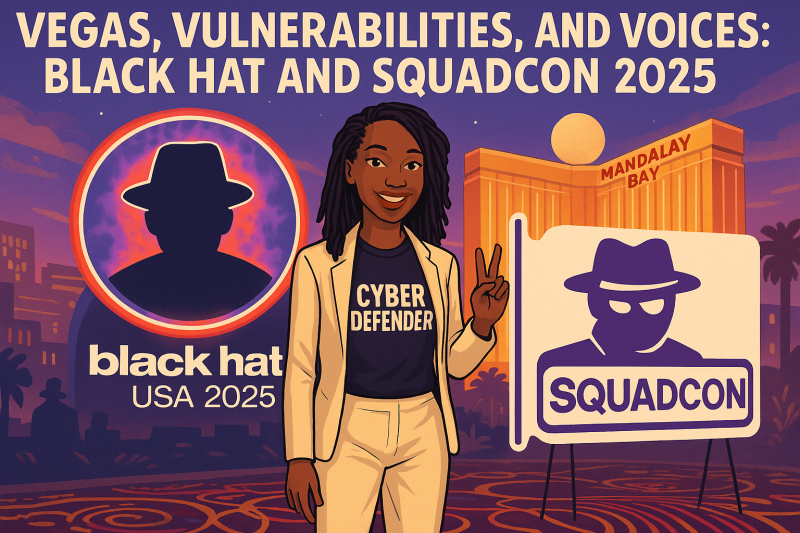
The week of August 4th, I had the opportunity to attend two exciting conferences in the cybersecurity world: Black Hat USA 2025 and Squadcon which were held in Las Vegas....
For seniors, aging often comes with its fair share of challenges – chronic pain, sleepless nights, and the need for safer treatment options. While the US cannabis market is thriving with innovative products and accessibility, the UK offers a different, patient-focused approach that’s reshaping care for older adults.
With over 12.5 million people aged 65 and older, seniors in the UK are turning to cannabis for pain and carefully tailored UK cannabis strains to find relief from conditions like arthritis and sleep disorders.
By focusing on safety and regulation, the UK provides an example of how medical cannabis can meet the needs of aging populations – a lesson the US may find valuable as the industry continues to grow.
Why do seniors struggle with traditional treatments?
Chronic pain is a reality for many older adults, often caused by conditions like arthritis, back injuries, and fibromyalgia. Conventional treatments (opioids, NSAIDs, or sleep aids) come with significant drawbacks. Side effects like dependency, gastrointestinal issues, and diminished effectiveness over time make these options less than ideal, especially for vulnerable aging bodies.
Are older patients more open to cannabis now?
The short answer? Yes. As education and destigmatization efforts continue, more seniors are exploring cannabis as a natural alternative. In the UK, 1.4 million people already use cannabis recreationally for medical purposes, with chronic pain as one of the leading drivers.
This trend reflects a growing openness to plant-based solutions that can address both pain and sleep issues safely.
How is medical cannabis transforming senior care in the UK?
For older adults who have exhausted traditional treatments, medical cannabis has been nothing short of life-changing. Arthritis patients report regaining mobility, while those with chronic pain find relief without the side effects of opioids.
What does a patient-first approach look like?
Unlike the US, where cannabis is widely accessible but unevenly regulated, the UK ensures every prescription is tailored to individual needs. Products undergo rigorous testing, guaranteeing both safety and efficacy. A study from the UK Medical Cannabis Registry revealed that 45.4% of chronic pain patients also experience sleep impairments—issues that medical cannabis uniquely addresses by tackling pain and improving rest simultaneously.
Clinics like Releaf are at the forefront of this shift. Known for their high standards and patient-first ethos, they represent what’s possible when regulation meets innovation. While the UK’s system is smaller and slower to grow compared to the US, it prioritizes trust and long-term care over commercial gains.
How does the US approach chronic pain differently?
The US cannabis market is an undeniable world-leading powerhouse, offering products and services that reflect the creativity of the industry. From THC-infused beverages to same-day delivery, dispensaries on almost every corner in certain cities, and some of the very best bud known to man, patients have a level of accessibility that the UK can’t match.
But this abundance comes with its challenges. Over-commercialization has led to quality inconsistencies, and with regulations varying by state, patients are often left wondering if their cannabis is as safe as it should be.
What can the US learn from the UK?
By adopting some of the UK’s emphasis on safety and regulation, the US could create a more balanced system. Incorporating medical oversight into cannabis care wouldn’t stifle innovation—it would enhance trust and ensure the industry meets the needs of its most vulnerable patients, including seniors.
What does the future hold for seniors and cannabis in the UK?
As wellness trends evolve, the demand for medical cannabis among seniors is set to rise. Chronic pain and sleep disorders will likely remain top priorities, but education and outreach could open the door for even more conditions to be treated.
Could cannabis become a standard part of senior care?
With clinics like Releaf leading the way in the UK, it’s easy to see how cannabis could integrate into senior care as a routine treatment. As research grows and collaboration between countries like the UK and US increases, cannabis could become a cornerstone of holistic health for aging populations.
Final thoughts
For older adults seeking relief from pain and sleep problems, medical cannabis offers hope where traditional medicine often fails. The UK’s careful, patient-first approach highlights what’s possible when safety and care take precedence a perspective that could benefit the growing US cannabis market as well.
To learn more about how cannabis is transforming lives, revisit the links up top in this article on cannabis for pain and UK cannabis strains to learn a little more on how these approaches are shaping a brighter future for senior wellness.
Remember: It’s illegal to germinate cannabis seeds in many countries including the UK. It is our duty to inform you of this important fact and to urge you to obey all of your local laws.
Humboldt Green Events, producers of Cannifest, are excited to announce the return of Humboldt County’s signature cannabis culture festival this Labor Day Weekend, August 30–31, 2025, at Halverson Waterfront Park. This year’s edition will mark Cannifest’s 10th anniversary, promising an unforgettable weekend of world-class music, community connection, and celebration of the plant that has shaped […]
You may or may not remember my article Mount Synology NAS in Linux. Being the lucky owner of a Synology DS720+, I sometimes do some interesting things on it besides the standard stuff. And since this site is also my online notebook, I have collected all the things I have configured on my NAS in this article.
Powered by Cannifest, The Headstash Bowl is a premier cannabis community competition open to all those over the age of 21. With categories for homegrowers and rosin makers, both non-commercial and commercial, The Headstash Bowl is an opportunity for cannabis producers to win cash, prizes, bragging rights, and the coveted Headstash Bowl trophy. Each Headstash […]
There is lot of low tier hacker forums and communities. It’s hard to find a place where you can find all the good quality information about hacking. It is such a large field and the knowledge in it is so extensive and specific that there is no forum where you can find everything. There is also no place on the web where you can find guides from
 Login
Login