Reading view

There are new articles available, click to refresh the page.

A New Crypto Era: SEC-CFTC To Host Joint Regulatory Harmonization Event Next Week

The Securities and Exchange Commission (SEC) and the Commodity Futures Trading Commission (CFTC) have announced a joint event on the future of crypto oversight amid the Trump administration’s push to welcome the sector.

SEC-CFTC Push Joint Crypto Oversight

On Thursday, SEC Chairman Paul Atking and CFTC Chairman Michael Selig announced they will hold an event next week to discuss regulatory harmonization between the two sister agencies.

According to the announcement, the pro-industry chairmen will outline the efforts to work together and cooperate to “deliver on President Trump’s promise to make the United States the crypto capital of the world.”

The event will be hosted on January 27 at the CFTC headquarters and moderated by crypto journalist Eleanor Terret. Additionally, it will be open to the public and livestreamed on both agencies’ websites.

“For too long, market participants have been forced to navigate regulatory boundaries that are unclear in application and misaligned in design, based solely on legacy jurisdictional silos,” said SEC Chair Atkins and CFTC Chair Selig in a joint statement.

“This event will build on our broader harmonization efforts to ensure that innovation takes root on American soil, under American law, and in service of American investors, consumers, and economic leadership,” they added.

Last year, the SEC and CFTC began discussing their options for effectively collaborating on crypto regulations, as a clear framework for digital assets became a top priority for the agencies

As reported by Bitcoinist, the agencies explored reinstating the CFTC-SEC joint advisory committee to develop recommendations on ongoing issues, including efforts in regulatory coordination.

During a September joint roundtable between the two agencies, Atking declared that the era of regulatory fragmentation was ending and the age of harmonized, innovation-friendly crypto oversight was here:

 We are at a crossroads. If we follow the path of our predecessors, America risks ceding leadership in the next chapter of financial history. (…) This ends now (…) our two agencies must work in lockstep to transform dual regulation from a source of confusion into a source of strength. Together, we can offer the best of both worlds: the investor protections that have defined U.S. markets, combined with the innovation-friendly approach that will keep us at the frontier of financial technology throughout the 21st century.

The SEC’s Director of the Division of Trading and Markets, Jamie Selway, highlighted the SEC’s efforts to “further harmonize its rules with our sister regulator, the CFTC. In a January 22 speech, He affirmed that the Division will work shoulder-to-shoulder with the CFTC staff to ensure the US’s continued leadership in financial markets, following Atkins’ September directions.

Congress Regulatory Efforts Stall

The SEC and CFTC’s efforts to regulate the crypto market come as the US Congress struggles to establish a framework to oversee the sector. The Senate Banking Committee’s version of the market structure bill, which focuses on the SEC’s oversight, was delayed after multiple market participants criticized the bill’s draft.

Coinbase CEO Brian Armstrong shared his disappointment with the crypto legislation, withdrawing the company’s support last week. “This version would be materially worse than the current status quo. We’d rather have no bill than a bad bill,” he affirmed.

The Senate Agriculture Committee published its version of the CLARITY Act on Thursday, which mainly addresses the CFTC’s role and regulations, scheduling its markup session for January 27.

Eleanor Terret shared that the industry’s reaction has been mostly positive, “with stakeholders noting the bill’s close similarities to the House Agriculture Committee’s version of the Clarity Act.”

However, recent reports have warned that the Banking Committee’s crypto talks may not resume until later February or early March, as focus shifts to advancing affordable housing plans linked to President Trump’s priorities.
crypto, bitcoin, btc, btcusdt

Crypto Bill Delayed Several Months as Senate Pivots to Trump’s Housing Initiatives

Bitcoin Magazine

Crypto Bill Delayed Several Months as Senate Pivots to Trump’s Housing Initiatives

The sweeping U.S. Senate effort to establish a comprehensive legal framework for cryptocurrency trading and oversight is likely to be pushed back for weeks or even months, after key legislative momentum stalled this week in the wake of major industry backlash.

The Senate Banking Committee indefinitely postponed work on its long-anticipated market structure bill — widely seen as the centerpiece of U.S. crypto regulation — after Coinbase, one of the industry’s largest exchanges, publicly withdrew its support for the measure.

The withdrawal came at a crucial moment before a scheduled markup hearing, where lawmakers would have debated amendments and potentially advanced the bill toward a floor vote. With Coinbase no longer backing the legislation “as written,” the committee has shifted its immediate focus to other priorities, including housing affordability initiatives tied to President Donald Trump’s agenda.

Industry insiders say the delay could stretch into late February or March, according to Bloomberg reporting. Lawmakers wrestled with unresolved policy disputes and are trying to rebuild bipartisan consensus in a sharply divided Senate.

Several factors are contributing to the slowdown. Coinbase’s withdrawal of support, following CEO Brian Armstrong’s decision, shows there are some deep divisions between crypto firms and portions of the bill’s drafters, mainly around stablecoin rewards.

Industry leaders argue that provisions in the current text could weaken the Commodity Futures Trading Commission’s authority, restrict decentralized finance (DeFi), and curtail stablecoin rewards — measures widely viewed as essential to continued crypto innovation. 

Political dynamics are slowing the crypto bill’s progress

At the same time, the traditional banking sector has pushed lawmakers to impose tighter restrictions on yield-bearing crypto products, warning that such features could draw deposits away from banks and destabilize lending markets; that lobbying effort appears to have shaped the bill’s language and intensified industry opposition. 

Also, shifting legislative priorities ahead of the midterm elections have further slowed momentum, as senators face pressure to focus on voter-facing issues such as housing affordability.

While some lawmakers insist the delay is temporary and that robust crypto rules remain achievable, the interruption highlights the fragile nature of legislative consensus on digital assets. 

Senate Agriculture Committee members have released a separate market structure draft, but industry observers caution it may lack the bipartisan backing necessary to prevail.

Patrick Witt, executive director of the White House council on digital assets, has publicly urged continued negotiation, describing regulatory clarity as “a question of when, not if.” However, he warned that without industry cooperation, future iterations could be less favorable to crypto firms.

This post Crypto Bill Delayed Several Months as Senate Pivots to Trump’s Housing Initiatives first appeared on Bitcoin Magazine and is written by Micah Zimmerman.

Coinbase CEO Claims Big Banks Are Aiming To ‘Kill Competition’ With Latest Crypto Market Bill Draft

Cryptocurrency exchange Coinbase (COIN) recently retracted its support for the latest iteration of the crypto market structure bill, known as the CLARITY Act, just 24 hours before a crucial markup was scheduled. 

This signals significant concerns about the bill’s alignment with the interests of cryptocurrency firms compared to traditional banking institutions, not only for the exchange but also for broader market participants.

Coinbase CEO’s Concerns Over Fair Competition

On Friday, Coinbase CEO Brian Armstrong elaborated on the rationale behind the exchange’s withdrawal in an appearance on FOX Business, expressing his frustration with the notion that banks could use regulatory means to stifle competition in their favor. 

“It just felt deeply unfair to me that one industry [banks] would come in and get to do regulatory capture to ban their competition,” Armstrong stated. He also underscored the importance of a level playing field, asserting that competition should thrive without undue interference from powerful financial entities.

Coinbase CEO emphasized that his concerns resonate with “much of the industry,” highlighting his obligation to advocate for customers who he believes are being shortchanged by the provisions of the proposed market legislation. 

“I declined to opine on the exact—whether the hearing, the markup should happen or not… But I did feel like I had to speak up on behalf of our customers and all Americans here,” he articulated.

Debate Heats Over CLARITY Act

Central to the ongoing debate surrounding the CLARITY Act is a critical disagreement between banks and crypto firms regarding the fate of stablecoin holders and whether they should be entitled to receive reward payments. 

Armstrong has previously raised alarms that the bill might prohibit tokenized equities, impose restrictions on decentralized finance (DeFi), and expand governmental access to financial data, thereby compromising individual privacy. 

Furthermore, he warned that the legislation could shift regulatory authority away from the Commodity Futures Trading Commission (CFTC) and towards the Securities and Exchange Commission (SEC), sidelining competition within the crypto space.

Armstrong Critiques Banking Lobbying Tactics

Armstrong noted the irony in the current situation, pointing out that while banks are indeed leveraging the advantages of cryptocurrency, their lobbying efforts seem aimed at restricting competing firms. 

“Many of these banks are actually very smart,” he acknowledged, referencing the commercial side of banking that is increasingly engaging with crypto. “They’re actually doing deals with Coinbase. We’re powering a lot of crypto and stablecoin infrastructure for them on the commercial side.”

Despite his criticisms of the banking sector’s lobbying tactics, Armstrong expressed optimism that legislators could ultimately resolve the outstanding issues within the crypto market structure bill:

And then their lobbying arm comes to D.C. and thinks of it as very zero-sum and is trying to kill the competition. So, I suspect, like many things, if we get the principles in the room, we can actually get this figured out and make a good deal.

Coinbase

Featured image from DALL-E, chart from TradingView.com 

Institutions Are Positioning Ahead Of US Crypto Market Structure Shift – Details

The cryptocurrency market is showing signs of short-term relief as Bitcoin and major altcoins attempt to stabilize after weeks of sustained selling pressure. Prices have rebounded modestly across the board, easing some of the recent bearish momentum. However, sentiment remains fragile. Many analysts argue that this move fits the profile of a relief rally rather than the start of a durable trend reversal, pointing to still-weak market structure and unresolved macro and regulatory risks.

Against this backdrop, a draft market structure bill released by the US Senate is drawing significant attention.  The proposed framework represents a potential structural shift in how crypto assets are treated within the US financial system.

The bill aims to clearly differentiate which crypto assets fall under the definition of commodities and which qualify as securities, while assigning regulatory oversight accordingly. Until now, the US regulatory approach has largely relied on enforcement actions, creating uncertainty for investors, developers, and institutions alike. By outlining classification criteria in advance, the proposal seeks to reduce ambiguity and provide a cleaner operating environment.

As markets digest this information, the focus is shifting from headline-driven volatility toward longer-term structural implications. Whether this regulatory clarity translates into sustained confidence remains an open question.

Regulatory Clarity Signals a Shift

A report from XWIN Research Japan highlights a critical nuance in the latest US market structure proposal: fully decentralized networks and DeFi protocols are not treated as traditional financial intermediaries. Developers, validators, and node operators are not automatically classified as regulated entities, signaling a formal recognition of decentralization as a core structural attribute rather than a loophole to be closed.

This distinction is meaningful, as it reduces legal uncertainty for open-source contributors and preserves the permissionless nature of decentralized infrastructure.

In contrast, centralized entities face a more clearly defined regulatory perimeter. Exchanges, brokers, and custodians are expected to comply with stricter rules on registration, asset segregation, and disclosure. Rather than targeting innovation, these requirements appear designed to professionalize market infrastructure and align centralized crypto businesses with existing financial standards.

Within this framework, Bitcoin, Ethereum, stablecoins, and spot ETFs are implicitly assumed to remain integrated into the US financial system, reinforcing their status as legitimate financial instruments.

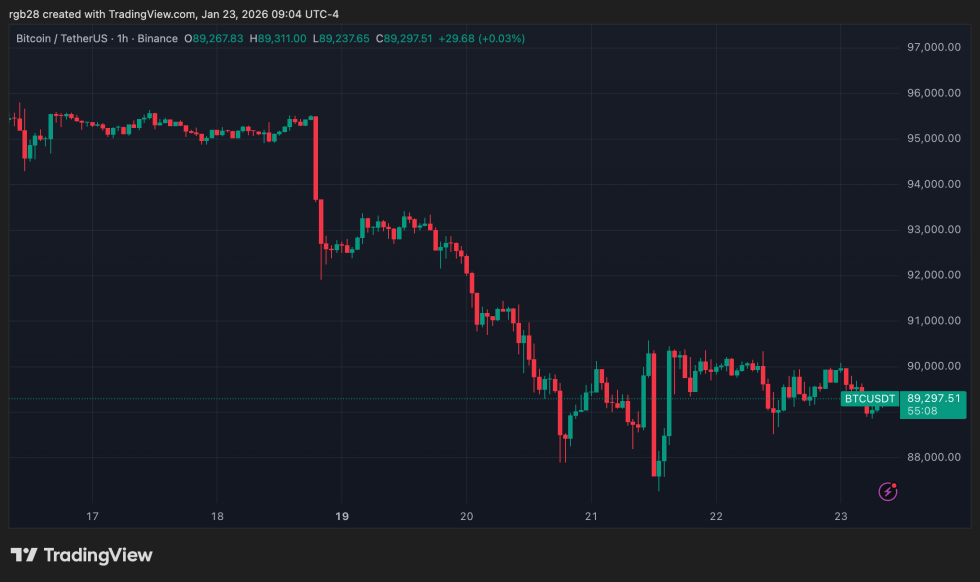
On-chain data already reflects this transition. Metrics from CryptoQuant show that near the $90,000 Bitcoin level, retail activity remains muted while mid- and large-sized spot orders dominate. This pattern suggests neither speculative excess nor panic-driven exits, but measured positioning by larger investors.

Bitcoin Spot Average Order Size

Taken together, these signals imply a market gradually shifting from reactive, headline-driven behavior toward a more structure-driven phase. Regulatory clarity may not spark immediate price moves, but it is already influencing how capital positions itself across the crypto landscape.

Total Crypto Market Cap Enters Consolidation Phase

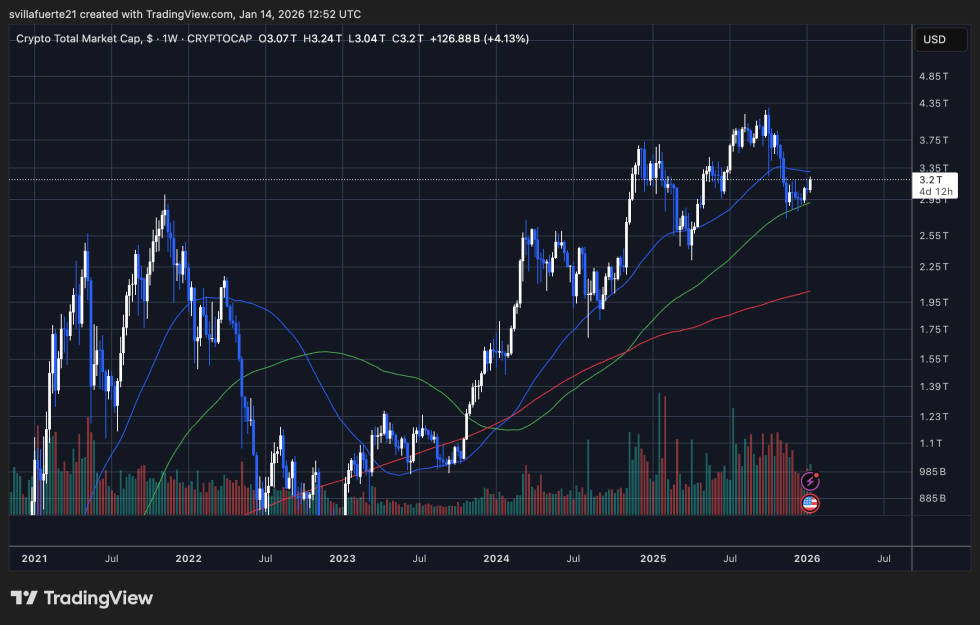
The total cryptocurrency market capitalization chart shows a market in consolidation after an aggressive multi-quarter expansion. Following the strong advance from late 2023 into mid-2025, total market cap peaked near the $3.8–$4.0 trillion zone before entering a corrective phase. Since then, price action has transitioned into a broad range, with higher volatility compressing into a more orderly structure.

Crypto Market Cap tests key demand level | Source: TOTAL chart on TradingView

Currently, the total market cap is hovering around the $3.2 trillion level, which aligns with a key former resistance zone that has now acted as support multiple times. The weekly structure suggests a cooling phase rather than a breakdown. Price remains above the rising 200-week moving average, which continues to slope upward and reinforces the idea that the primary market trend is still constructive.

Shorter-term moving averages have flattened, reflecting indecision and reduced momentum after the earlier impulsive move. Volume has declined from peak levels, indicating that aggressive distribution pressure has eased, but strong expansion demand has not yet returned. This combination is typical of mid-cycle consolidation rather than terminal weakness.

From a structural perspective, the market is digesting prior gains while maintaining a higher-low framework relative to previous cycles. A sustained hold above the $3.0 trillion region keeps the broader bullish structure intact. However, failure to defend this zone would expose the market to deeper retracements toward long-term trend support.

Featured image from ChatGPT, chart from TradingView.com 

Coinbase Mulls Exiting Support For Crypto Market Structure Bill Ahead Of January 15 Deadline

As the January 15 markup of the crypto market structure bill—known as the CLARITY Act—draws closer, reports indicate that Coinbase (COIN) is reconsidering its support for the legislation. 

A Monday report from Bloomberg suggests this shift in position is contingent on whether the anticipated bill includes provisions beyond enhanced disclosure requirements tied to stablecoin rewards.

High Stakes For Coinbase

The CLARITY Act is expected to be marked up in at least one Senate committee this Thursday, and Coinbase’s potential withdrawal could have significant implications for the bill. 

A source familiar with Coinbase’s stance told Bloomberg that the exchange would re-evaluate its support if the legislation veers too far from its interests, particularly regarding stablecoin incentives.

Some insiders suggest the bill might restrict the ability to provide rewards to regulated financial institutions, a move that aligns with the banking sector’s concerns about losing deposits to crypto platforms.

Coinbase currently holds applications for a national trust charter that could permit it to offer those kinds of rewards under regulatory rules. However, many crypto-native firms are pushing back against potential restrictions, arguing that such measures could disrupt competition in the market.

The stakes for Coinbase are high, as rewards programs play a crucial role in its business model. The exchange allows users to earn 3.5% rewards on Circle’s USDC holdings. 

Should the market-structure bill include bans on these incentives, fewer users might choose to hold stablecoins on the platform. This could jeopardize an anticipated revenue stream projected at $1.3 billion in 2025, according to Bloomberg.

Banking Vs. Crypto

The GENIUS Act, passed into law in July of last year, prohibits stablecoin issuers from offering interest on token holdings, and does not prevent third-party partners like Coinbase from providing rewards tied to customer balances. 

The banking industry, however, argues that allowing exchanges to pay such rewards could negatively impact bank deposits and, consequently, community lending. 

As reported by Bitcoinist over the past month, the American Bankers Association (ABA) has voiced concerns that this situation could displace “billions” from local lending, allegedly harming small businesses and households.

In contrast, Faryar Shirzad, Coinbase’s chief policy officer, has argued that maintaining rewards tied to stablecoins is crucial for preserving the dollar’s dominance, especially in light of China’s announcement to start offering interest on its digital yuan.

Banking Lobby Fights Back

A potential compromise being discussed would permit only licensed banking entities or financial institutions to provide rewards on stablecoin balances. 

Recently, five crypto firms, including Ripple, Circle, and Paxos, received conditional approvals from the US Office of the Comptroller of the Currency (OCC) to become national trust banks, a move met with opposition from the banking lobby. 

If restrictions are indeed imposed, the report suggests that this could lead to creative workarounds as crypto firms seek alternative ways to reward customers. 

Coinbase

Featured image from DALL-E, chart from TradingView.com

New Hope For Crypto: Senators Introduce Blockchain Regulatory Certainty Act

In a major new development for the crypto industry, Senators Ron Wyden and Cynthia Lummis announced on Monday evening the introduction of a bipartisan, standalone version of the Blockchain Regulatory Certainty Act (BRCA). 

This legislation aims to provide much-needed clarity for software developers and infrastructure providers in the blockchain space, particularly concerning their classification under federal law.

New Crypto Bill To Protect Blockchain Developers 

According to the detailed press release regarding the matter, the BRCA specifies that developers and providers who do not have control over user funds will not be classified as money transmitters. Senator Lummis highlighted the ongoing challenges faced by blockchain developers, stating: 

Blockchain developers who have simply written code and maintain open-source infrastructure have lived under threat of being classified as money transmitters for far too long. This designation makes no sense when they never touch, control, or have access to user funds, and unnecessarily limits innovation. 

Lummis emphasized that the bill provides developers with the clarity needed to advance digital finance without the fear of legal repercussions for activities that do not pose a money laundering risk. Lummis added, “It’s time to stop treating software developers like banks simply because they write code.”

Senator Wyden echoed these concerns, arguing that imposing the same regulatory requirements on developers as those applied to exchanges or brokers is fundamentally flawed. 

Main Highlights Of The BRCA

The Blockchain Regulatory Certainty Act aims to set clear federal standards defining when blockchain developers and service providers can be exempt from money transmitter regulations. 

Under current legislation toward crypto, the Senators assert blockchain developers face regulatory ambiguities that have not only stifled innovation but also driven many projects offshore, as they navigate conflicting regulations across different states.

The bill specifically establishes that a “non-controlling developer or provider” refers to any entity that develops or maintains distributed ledger technology but does not possess the unilateral authority to initiate or execute transactions involving users’ digital assets without third-party consent.

In addition, the crypto bill clarifies protected activities, including the development or publication of software for distributed ledgers, maintenance services for blockchain networks, offering customer self-custody solutions, and providing necessary infrastructure to support distributed ledger services. 

Importantly, while the bill allows states to enforce their laws consistent with federal regulations, it also prevents them from imposing money transmitter requirements on developers engaged solely in the specified protected activities.

Crypto

Featured image from DALL-E, chart from TradingView.com 

❌