Reading view

There are new articles available, click to refresh the page.

Monero, Zcash, And Dash Prohibited In India Amid Money-Laundering Crackdown

India’s Financial Intelligence Unit (FIU‑IND) has launched a fresh anti‑money‑laundering crackdown aimed at privacy‑focused cryptocurrencies. The move targets Monero (XMR), Zcash (ZEC), and Dash (DASH), which together represent the largest and most widely used privacy coins globally.

India Tightens Crypto Oversight

Details of the action were shared on Friday by market analyst MartyParty on social media platform X (previously Twitter), who notes that FIU‑IND has issued a directive to crypto exchanges registered in India, instructing them to immediately suspend deposits, withdrawals, and trading activity for Monero, Zcash, and Dash. 

At the heart of the regulator’s concerns is the technology underpinning these assets. Privacy coins rely on advanced cryptographic techniques designed to obscure transaction details, wallet balances, and user identities. 

Monero uses ring signatures to hide the sender and receiver, Zcash allows shielded transactions that conceal transaction data, and Dash offers optional privacy features. 

While these tools are valued by users seeking confidentiality, regulators argue they make it difficult for exchanges to meet know‑your‑customer (KYC) and transaction‑monitoring obligations. The regulator views these features as posing elevated risks related to money laundering, terrorist financing, and sanctions evasion. 

The latest directive applies to all cryptocurrency exchanges registed in the country, which currently includes crypto platforms operating in compliance with Indian regulations. They have been instructed to stop supporting the assets, including delisting, blocking all deposits and withdrawals, and disabling any associated trading pairs.

Monero, Zcash, And Dash Show Mixed Market Reaction

The latest action builds on a broader regulatory push by Indian authorities. In October 2025, FIU‑IND ordered internet service providers to block access to 25 offshore crypto exchanges that failed to register. 

By contrast, only a handful of exchanges currently remain fully registered and compliant in the country. Binance, Mudrex, Coinbase, CoinSwitch (CoinSwitch Kuber), and ZebPay continue to operate legally in India.

Despite the regulatory pressure, market prices for the targeted privacy coins showed short‑term resilience. Over the past 24 hours, all three assets posted gains after recovering from sharp losses earlier in the week. 

Monero was trading at $524 at the time of writing, up 3.5% on the day. Zcash also rebounded modestly, rising 2.2% to trade at $372. Dash recorded the strongest daily performance, jumping 11.6% during the same period.

However, the broader trend remains negative. According to CoinGecko data, Monero, Zcash, and Dash are still down sharply on a weekly basis, with losses of approximately 21%, 8%, and 20% respectively over the past seven days. 

Monero

Featured image from DALL-E, chart from TradingView.com

Winklevoss Twins Donate $1.2M to Zcash’s Shielded Labs Amid ECC Exodus

Tyler and Cameron Winklevoss donated 3,221 ZEC (approximately $1.2 million) to Shielded Labs on Tuesday, the Swiss-based nonprofit confirmed, marking their second contribution to the independent Zcash development organization.

https://t.co/iRx986OwCr

— Shielded Labs (@ShieldedLabs) January 20, 2026

Zcash (ZEC) is currently trading around $368.85 and is up about 3.01% over the past 24 hours.

The funds will support three protocol-level initiatives: the Network Sustainability Mechanism (economic health upgrades), Crosslink (a hybrid PoW/PoS layer), and Dynamic Fees. Shielded Labs operates entirely outside Zcash’s Dev Fund structure, relying solely on donations from ZEC holders.

“A healthy Zcash ecosystem depends on multiple independent organisations contributing at the protocol level. Shielded Labs plays an important role in that effort, and we’re glad to support their work,” Cameron Winklevoss said.

Cameron Winklevoss also added that the twins have backed Zcash for years, calling privacy “the point at which government and corporate overreach end and your freedom and self-sovereignty begin.”

Timing and Context

The donation lands two weeks after the entire Electric Coin Company development team (roughly 25 members, including CEO Josh Swihart and Chief Scientist Chelsea Komlo) resigned on January 7, citing what Swihart described as “constructive discharge” following a governance dispute with Bootstrap, ECC’s nonprofit overseer.

Over the past few weeks, it's become clear that the majority of Bootstrap board members (a 501(c)(3) nonprofit created to support Zcash by governing the Electric Coin Company), specifically Zaki Manian, Christina Garman, Alan Fairless, and Michelle Lai (ZCAM), have moved into…

— Josh Swihart 🛡 (@jswihart) January 7, 2026

The departing developers immediately formed a new startup, cashZ, and announced plans for a wallet built on the existing Zashi codebase. ZEC dropped 20% following the announcement, briefly touching $385.

Shielded Labs, led by Zcash founder Zooko Wilcox as Head of Product, now represents a parallel development path. The organization received its first Winklevoss donation in 2023 to seed the Crosslink team.

Winklevoss-Backed Accumulation

The brothers’ support extends beyond donations. Winklevoss Capital led a $58.88 million private placement in October 2025 for Cypherpunk Technologies (NASDAQ: CYPH), a company that shifted to a Zcash treasury strategy.

Cypherpunk purchased 56,418 ZEC last month and now holds nearly 2% of the circulating supply. Zooko Wilcox joined Cypherpunk as Strategic Advisor in December 2025.

Regulatory Tailwind

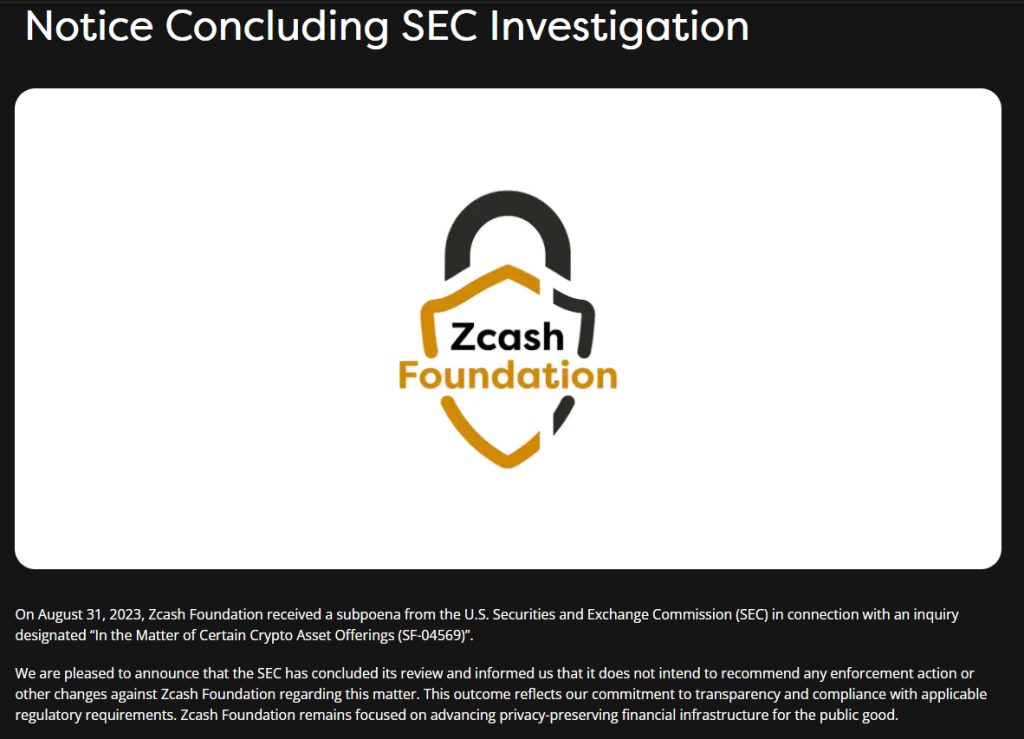
The SEC closed its two-year investigation into the Zcash Foundation on January 14, 2026, without enforcement action. The probe, initiated via subpoena in August 2023, examined whether ZEC constituted a securities offering. The closure aligns with broader SEC pullback on crypto enforcement under Chair Paul Atkins.

ZEC surged 14% on the SEC news but has since retraced as governance uncertainty persists.

What This Means for Desks

The Winklevoss donation shows institutional confidence in Shielded Labs as the de facto development anchor for Zcash. With ECC’s team now operating independently under cashZ and regulatory clarity secured, ZEC’s path forward hinges on execution of the Crosslink hybrid PoS upgrade.

Liquidity providers watching the privacy coin sector should note the twins’ coordinated accumulation via Cypherpunk and direct protocol funding. The governance fracture introduces development risk, but also decentralizes the previously ECC-centric structure.

The post Winklevoss Twins Donate $1.2M to Zcash’s Shielded Labs Amid ECC Exodus appeared first on Cryptonews.

Winklevoss Brothers Donate $1.2M ZEC to Shielded Labs to Support Zcash Network

Billionaire Brothers Tyler and Cameron Winklevoss, co-founders of Gemini exchange, have donated 3,221 Zcash tokens (ZEC) to Shielded Labs, supporting the network’s initiatives. The contribution is valued at approximately $1.2 million at current market prices.

Shielded Labs, led by Zcash founder Zooko, announced Tuesday that the donation will directly support Shielded Labs’ core initiatives. This includes strengthening long-term security, sustainability, and scalability of the Zcash network.

Privacy is Crucial for Crypto: Winklevoss Twins

Cameron Winklevoss emphasized that privacy is the next frontier in crypto. It’s the point at which government and corporate overreach end and your freedom and self-sovereignty begin, he wrote on X.

“Shielded Labs is committed to building Zcash — unstoppable private money. That’s why Tyler and I are supporting their mission.”

Privacy is the next frontier in crypto. It's the point at which government and corporate overreach end and your freedom and self-sovereignty begin. @ShieldedLabs is committed to building Zcash — unstoppable private money. That's why @tyler and I are supporting their mission. https://t.co/Y63ynX0TGY

— Cameron Winklevoss (@cameron) January 20, 2026

Further, Tyler noted that the donation at the protocol level would help foster a healthy Zcash ecosystem. “Shielded Labs plays an important role in that effort, and we’re glad to support their work.”

Winklevoss twins initially donated to Shielded Labs in 2023 to support the formation of the dedicated Crosslink team.

“Their contribution meaningfully accelerates our ability to execute on critical protocol-level work and to collaborate openly with other contributors to advance Zcash’s mission,” Swiss-based Shielded Labs noted.

Besides, Winklevoss-backed Cypherpunk bought 56,418 ZEC last month, holding nearly 2% of the token’s circulating supply.

Zcash Token ZEC Trades in Red, What Next?

Zcash, in its turn, has been registering among the most robust performances in the crypto market since September 2025. increased nearly 800% in the last 12 months.

However, the token is showing bearish outlook since the start of this year. ZEC has been trading within a narrowing triangle pattern on the daily chart. The price has formed a series of lower highs and higher lows, showing a loss of momentum in both directions.

At the time of reporting, ZEC trades near $357.79, down 1.5% in 24 hours, extending a 14% weekly decline. Analysts warn that a close below $360 could target $300 next – a 16% downside risk from current prices.

That said, Zcash Foundation recently cleared a years-long investigation by the US Securities and Exchange Commission without any enforcement action. The move brought regulatory clarity to the industry’s most closely watched privacy projects.

The post Winklevoss Brothers Donate $1.2M ZEC to Shielded Labs to Support Zcash Network appeared first on Cryptonews.

Zcash Surges Post-SEC Probe: Is a Fresh Yearly High on the Horizon?

Zcash (ZEC) is back on investors’ radar after U.S. regulators ended a long-running investigation into the Zcash Foundation without enforcement. The decision removes a key source of uncertainty that had followed the privacy-focused cryptocurrency since 2023.

Related Reading: XRP Price Is Approaching A Key Decision Zone, But Structure Is Still Firmly Bullish

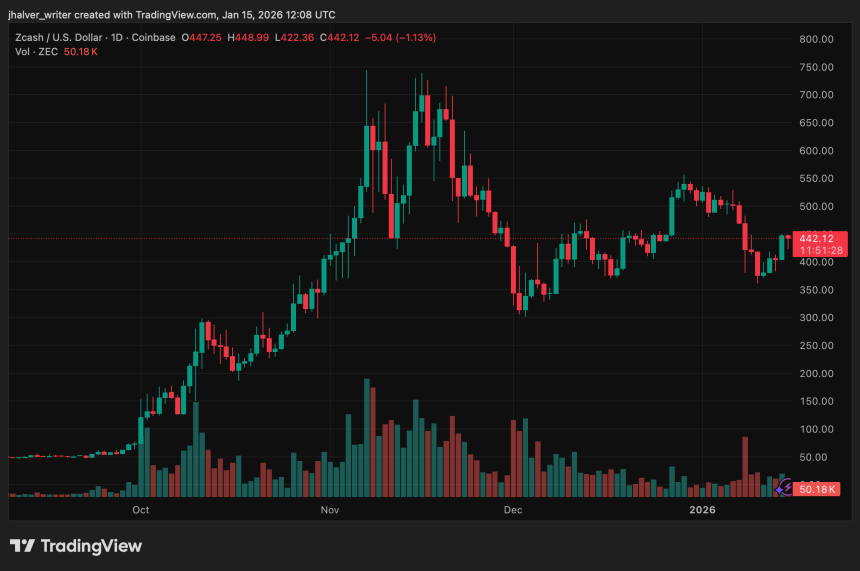
Markets reacted quickly, with ZEC posting double-digit gains in some sessions and stabilizing above the $400 level. While regulatory clarity has helped improve sentiment, questions around governance and long-term development remain.

Zcash ZEC ZECUSD ZECUSD_2026-01-15_13-08-32

SEC Closes Two-Year Zcash Investigation

The U.S. Securities and Exchange Commission confirmed it has concluded its review of the Zcash Foundation, which began with a subpoena issued on August 31, 2023.

The inquiry focused on potential securities law concerns tied to Zcash’s funding model, governance structure, and token distribution. According to the foundation, the SEC does not intend to recommend enforcement action, fines, or operational changes.

This outcome marks a notable shift for privacy-focused cryptocurrencies, which have often faced heightened regulatory scrutiny due to concerns about illicit use. The decision suggests that Zcash’s privacy features alone were not deemed sufficient grounds for action under existing securities laws.

The closure also aligns with a broader trend of the SEC withdrawing from several high-profile crypto investigations in recent months under new leadership. For Zcash, the end of the probe removes a regulatory overhang that had weighed on investor confidence for nearly two years.

Market Reaction and Price Projections

Following the announcement, ZEC surged between 5% and 14% across major exchanges, briefly testing the $440–$450 resistance zone. Currently, the token is trading around $427–$442, holding above the $400 psychological support level.

Technically, ZEC remains in a consolidation phase after falling from its January high near $535. Resistance is clustered around $450–$470, while support sits near $400, with a deeper floor around $350 if sentiment weakens.

Some analysts point to a symmetrical triangle pattern on longer timeframes, often viewed as a continuation structure after strong rallies. A confirmed breakout above the upper trendline could open the door toward higher levels, including a potential retest of the $1,000 mark later in 2026.

Governance Uncertainty Clouds the Outlook

Despite the regulatory win, internal challenges persist. Earlier this month, the full development team at Electric Coin Company (ECC), which has led core Zcash development, resigned following a dispute with its nonprofit board.

Former ECC leaders cited deteriorating working conditions and have since announced plans to launch a new privacy-focused wallet, cashZ, based on Zcash technology.

Related Reading: Arthur Hayes Bets On MSTR, Metaplanet And Zcash As Bitcoin Liquidity Turns

The Zcash Foundation has stated that network operations and protocol stability remain unaffected by the personnel changes. Still, the departures have raised concerns about governance stability, development continuity, and long-term coordination within the ecosystem.

Cover image from ChatGPT, ZECUSD chart from Tradingview

Arthur Hayes Bets On MSTR, Metaplanet And Zcash As Bitcoin Liquidity Turns

Arthur Hayes is positioning for a 2026 liquidity rebound, arguing that Bitcoin’s weak 2025 wasn’t a referendum on “crypto narratives” so much as a straightforward dollar-credit story. In his latest essay, “Frowny Cloud,” the Maelstrom CIO says he is adding risk via Strategy (MSTR), Japan’s Metaplanet, and Zcash (ZEC) as he expects US dollar liquidity to inflect higher after a year in which Bitcoin lagged both gold and US tech stocks.

Hayes frames 2025 as an awkward year for the standard cross-asset shorthand that treats Bitcoin as either digital gold or a high-beta proxy for US tech. In his telling, Bitcoin behaved “as expected” under tightening conditions, while gold and the Nasdaq 100 rose for different reasons despite falling dollar liquidity.

He argues gold’s bid is being driven by sovereign balance sheets rather than retail mania, rooted in distrust of US Treasury exposure after prior asset-freeze precedents. “If the US president steals your money, it’s an instant zero. Does it then matter what price you buy gold at?” he writes, casting central banks as price-insensitive buyers.

On equities, Hayes leans into an industrial-policy interpretation of the AI trade. His claim is that the US and China have effectively treated “winning AI” as strategic, dulling the usual market discipline and helping explain why the Nasdaq decoupled from his dollar-liquidity index in 2025. That divergence matters because it sets up his core takeaway for 2026: Bitcoin needs expanding dollar liquidity to regain momentum.

“Bitcoin and the Nasdaq rise when dollar liquidity expands. The only problem is the recent divergence,” Hayes writes, before returning to the “vicissitudes of dollar liquidity” as the primary driver he wants to track.

The Three-Pillar Liquidity Pitch

Hayes’ 2026 outlook hinges on a sharp rebound in dollar credit creation. He cites three channels: a growing Fed balance sheet via Reserve Management Purchases (RMP), commercial-bank lending into “strategic industries,” and lower mortgage rates catalyzed by policy-driven demand for mortgage-backed securities.

In his account, quantitative tightening faded as a dominant headwind in late 2025, with QT ending in December and RMP beginning as a new, steady buyer. He claims RMP “at a minimum” expands the balance sheet by $40 billion per month, and expects that pace to rise as government funding needs increase.

The second leg is bank credit creation, which he says accelerated in 4Q25, with large lenders willing to extend loans where government equity stakes or offtake agreements reduce default risk. The third is housing: Hayes points to Trump-backed directives for Fannie Mae and Freddie Mac to deploy $200 billion toward MBS purchases, arguing that lower mortgage rates could unlock a familiar wealth effect and, by extension, more credit.

He ties the pieces together with a simple conclusion: if liquidity turns, Bitcoin should follow. “Bitcoin … and dollar liquidity bottomed around the same time,” he writes, arguing that the next major leg depends less on sentiment than on renewed credit expansion.

MSTR, Metaplanet, And ZCash

Hayes describes himself as a “degen speculator” and says Maelstrom is already “nearly fully invested,” but he still wants “MOAR risk” to capture upside convexity if Bitcoin reclaims higher levels. Rather than using perpetuals or options, he says he’s long Strategy and Metaplanet for levered exposure via corporate balance sheets.

His timing argument is valuation-relative: he compares each company’s “DAT” to Bitcoin priced in the relevant currency (yen for Metaplanet, dollars for Strategy) and says those ratios sit near the low end of the past two years, after being “down substantially” from mid-2025 peaks. He adds a key condition: “If Bitcoin can retake $110,000, investors will get the itch to go long Bitcoin through these vehicles. Given the leverage embedded in the capital structure of these businesses, they will outperform Bitcoin on the upside.”

He also flags continued accumulation of Zcash. Hayes argues the departure of developers at Electric Coin Company (ECC) is not bearish: “We continue to add to our Zcash position. The departure of the devs at ECC is not bearish. I firmly believe they will ship better, more impactful products within their own for-profit entity. I’m thankful for the opportunity to buy discounted ZEC from weak hands.”

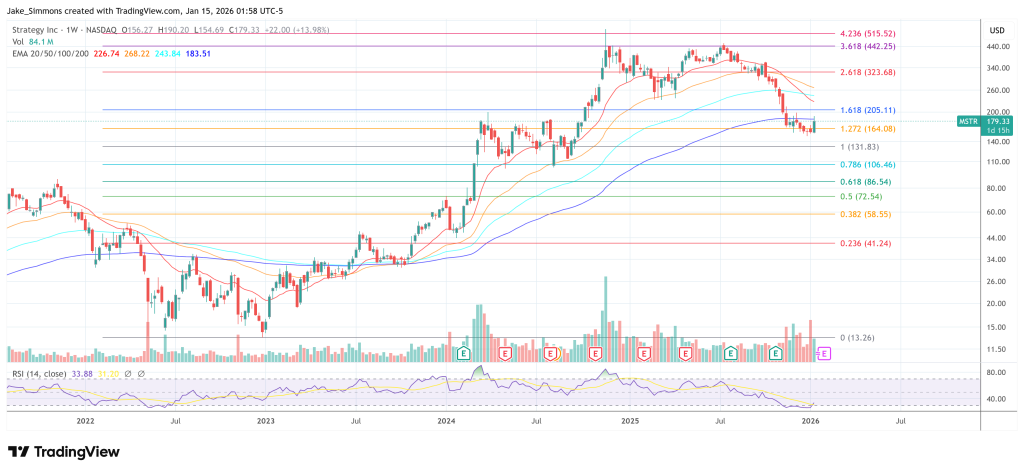
At press time, MSTR traded at $179.33.

MSTR price chart

Zcash Foundation Investigation Closed: SEC Decision Sparks 12% Jump In ZEC Price

On Wednesday, the Zcash Foundation announced a significant development regarding its ongoing operations: the US Securities and Exchange Commission (SEC) has concluded its investigation into the public charity. 

This news has sparked a notable recovery in the price of the Zcash native token (ZEC), signalling renewed investor confidence, with trading volume surging by 39% over the past 24 hours.

Zcash Foundation Cleared By SEC

The Zcash foundation received a subpoena from the regulatory agency back in August 31, 2023, as part of a broader inquiry titled “In the Matter of Certain Crypto Asset Offerings (SF-04569).” 

After a thorough review, the Zcash Foundation was informed that the SEC does not plan to recommend any enforcement actions or changes pertaining to the organization. 

This comes amid significant regulatory changes towards digital assets under the Trump administration, including the appointment of the pro-crypto Paul Atkins as chair of the SEC. Similar enforcement actions against firms such as Uniswap (UNI), Coinbase (COIN) and Robinhood (HOOD) were dropped last year.  

ZEC Price Surges Near $440

In their statement, the foundation expressed satisfaction with the outcome, emphasizing their commitment to transparency and adherence to regulatory standards. They reiterated their focus on advancing financial infrastructure that preserves user privacy for the greater good.

Following this announcement, ZEC experienced a robust increase of 12%, pushing its price to approximately $437.75 at the time of writing. This surge comes after the cryptocurrency had recently dipped to a near one-month low of $363 last Saturday, illustrating a significant turnaround. 

However, even with this recent boost, the Zcash token still has a long way to climb. The cryptocurrency remains 86% below its all-time high of over $3,191, according to CoinGecko data.

Zcash

Featured image from DALL-E, chart from TradingView.com 

Monero (XMR) Hits New $610 All-Time High – Veteran Trader Shares Silver-Like Setup

Monero (XMR) is leading the crypto market bounce by breaking out of a macro resistance level and breaching above the $600 barrier for the first time. A legendary trader has suggested that the cryptocurrency is mirroring silver’s historical breakout and could see a massive price discovery rally.

Monero Soars To New Highs

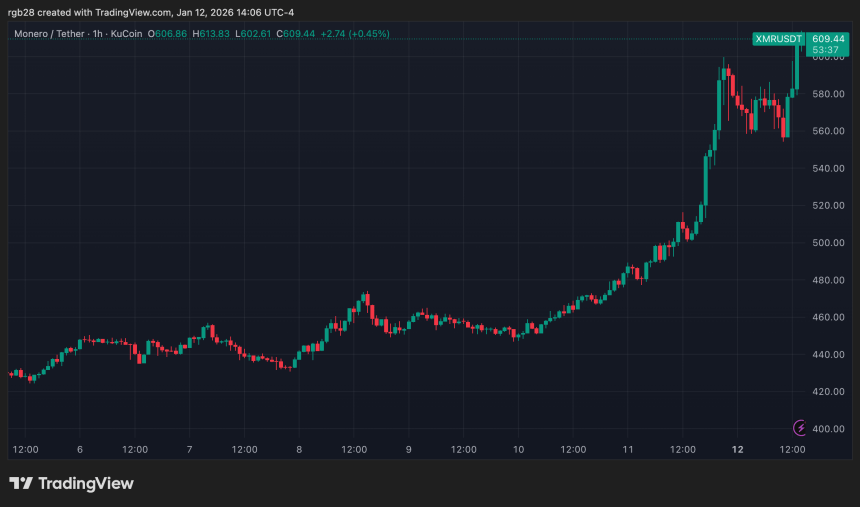
On Monday, Monero outperformed the rest of the market, surging nearly 21% toward its new all-time high of $611.01. The privacy-focused cryptocurrency has been leading the start-of-year market rally, experiencing a 43% increase over the past seven days.

XMR’s rally has been fueled by renewed interest in privacy tokens and redirected liquidity toward the project, which has driven its market capitalization to $10 billion for the first time.

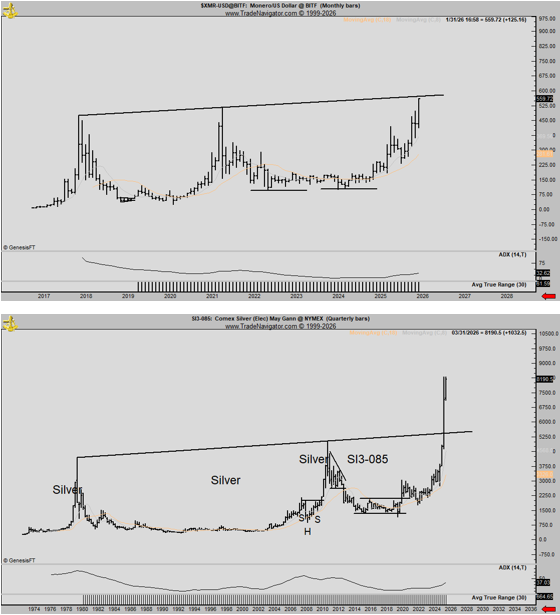
Amid this performance, veteran trader Peter Brandt drew a parallel between Monero and Silver’s long-term charts, suggesting that the cryptocurrency could be near a massive breakout.

In an X post, Brandt compared Monero’s current rally to silver’s historical breakout, which led to a massive run toward new highs. Silver saw a multi-decade price setup in which its price accumulated below and retested a macro ascending resistance trendline.

According to the chart, its price formed its long-term resistance during its 2011 peak, when it reached a slightly higher ATH of $49.83 before correcting. During its Q4 2025 rally, silver finally broke above this key level, nearly doubling its price toward its latest ATH of $86.23.

Monero

Similarly, Monero has been forming its multi-year ascending trendline in the monthly timeframe since its 2017 high. In 2021, the cryptocurrency retested this area, also hitting a slightly higher ATH before retracing.

Now, XMR has broken out of its ascending resistance and could see a similar path to silver’s recent breakout into price discovery, the post suggested.

XMR to See 50% Breakout Or Breakdown Next?

Market observer TraderSZ recently shared an optimistic outlook for Monero once it broke through its crucial resistance area and turned this level into support. To the trader, the cryptocurrency could reach three main price targets if momentum continues.

Per the post, the initial breakout level could reach the $685 area, a more than 30% rally from the resistance level. Moreover, it could surge between 50% and 80% toward the $790 and $900 levels, like silver’s recent price discovery progression in the monthly chart.

Analyst 0xMarioNawfal also highlighted XMR’s performance as “price continues to trend aggressively higher, breaking through previous resistance levels with strong momentum and minimal pullback.”

To him, the structure remains bullish, with buyers stepping in and “no clear signs of distribution yet.” As a result, he forecasted potential volatility but added that as long as the price holds above recent breakout levels, the trend will remain intact.

Nonetheless, Ali Martinez posted a more concerning forecast for the cryptocurrency, suggesting that a significant correction may be around the corner. According to the chart, Monero has been forming a multi-year rising wedge pattern since 2017, with the price bouncing between the upper and lower boundaries.

Based on this, XMR could likely fail to turn the macro resistance into support and begin a long-term 50% decline toward the $300 area, where the pattern’s lower boundary is currently located.

As of this writing, Monero is trading at $597, a 47.5% increase in the monthly timeframe.

Monero, XMR, XMRUSDT

❌