Login
LoginWhat I’d Teach a New 1-Minute Trader About Indicators

If a new trader came to me today and said, “I want to trade the 1-minute chart — what indicators should I use?” I wouldn’t open a chart. I…

If a new trader came to me today and said, “I want to trade the 1-minute chart — what indicators should I use?” I wouldn’t open a chart. I…
One wrong choice between spot and perpetual trading can silently drain your capital — especially on a high-performance platform like Hyperliquid.
Hyperliquid has rapidly emerged as one of the most talked-about decentralized trading platforms in crypto. With lightning-fast execution, deep liquidity, and a fully on-chain order book, it attracts everyone from casual traders to highly leveraged professionals.
But here’s the uncomfortable truth most guides don’t tell you:
In this guide, you’ll learn exactly how spot trading and perpetual trading work on Hyperliquid, how they differ, and most importantly, which one aligns with your goals, capital structure, and psychology as a trader.
Whether you’re a long-term crypto holder, an active DeFi participant, or an advanced derivatives trader, this article will help you make smarter, safer, and more profitable decisions on Hyperliquid.
Hyperliquid is a decentralized exchange (DEX) optimized for high-performance spot and perpetual futures trading, built with a custom Layer-1 blockchain designed specifically for trading.
Unlike many DeFi platforms that rely on AMMs (automated market makers), Hyperliquid uses a fully on-chain central limit order book (CLOB) — similar to Binance or OKX, but decentralized.
This hybrid design makes Hyperliquid uniquely powerful — but also more complex than typical DeFi platforms.
Understanding spot vs perpetual trading is critical before using it seriously.
Are you servicing a high-interest debt or want better savings?
Private credit is becoming the new income solution. Get $300 on first deposit with Insidefinacent.
Spot trading means buying or selling an asset for immediate settlement at the current market price.
When you buy ETH on the spot market:
On Hyperliquid’s spot market:
If you:
Your profit is simply:
($3,000 — $2,500) × ETH amount
No funding rates. No margin calls. No forced liquidation.
Spot trading is often underestimated — especially in a derivatives-driven market.
Your position cannot be forcibly closed due to volatility.
This makes spot trading ideal for:
You actually own the underlying crypto, which means:
Your maximum loss is limited to your initial investment.
No leverage = no surprise margin calls.
Spot trading excels during:
Despite its safety, spot trading has limitations.
Without leverage:
You cannot profit from falling prices unless:
Capital tied in spot positions can’t be redeployed quickly for short-term trades.
Perpetual contracts (perps) are derivative instruments that track the price of an asset without expiration.
You do NOT own the underlying asset.
Instead, you:
Hyperliquid’s perpetual markets allow:
You:
If ETH rises 5%:
If ETH drops ~10%:
Perps allow:
You can profit from:
This is critical for professional traders.
Hyperliquid’s order book provides:
Perpetuals support:
Perpetual trading is not forgiving.
Small price movements can wipe out positions.
Most retail traders lose money due to:
Holding perps long-term can:
Perps amplify:
This is why many traders underperform despite good analysis.
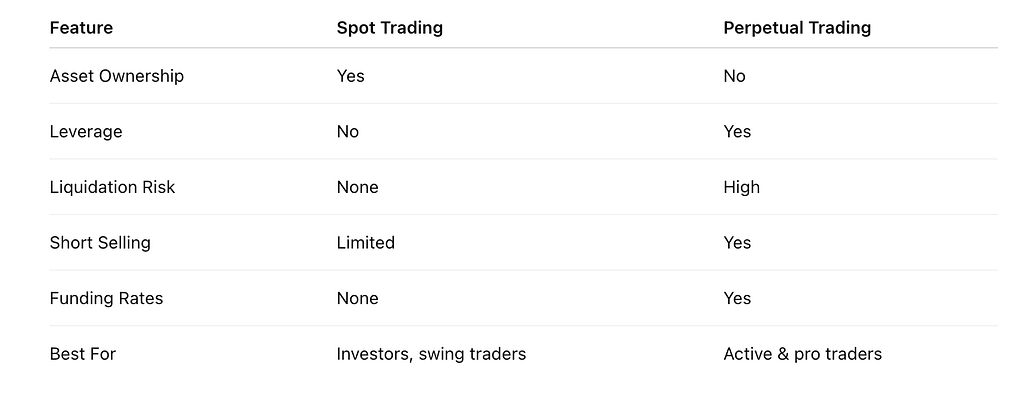
Choose Spot Trading If:
Choose Perpetual Trading If:
Professional traders often use both.
This approach:
This is how professionals trade. Combining spot and perpetuals isn’t advanced — it’s essential.
If this strategy changed how you think about trading, clap to help it reach more serious traders.
Avoiding these mistakes alone can dramatically improve performance.
Hyperliquid’s non-custodial design reduces:
However:
The platform isn’t dangerous — poor risk management is.
Hyperliquid is one of the most powerful decentralized trading platforms available today. But power cuts both ways.
Understanding the difference is not optional — it’s essential.
The traders who thrive on Hyperliquid aren’t the most aggressive. They’re the ones who choose the right tool for the right market condition.
The difference between surviving and thriving isn’t luck — it’s structure.
Your capital deserves better decisions.
Spot vs Perpetual Trading on Hyperliquid: What Every Trader Must Understand was originally published in Coinmonks on Medium, where people are continuing the conversation by highlighting and responding to this story.
Nathaniel Chastain, a former product manager at OpenSea, will not face a retrial after federal prosecutors chose to drop their re-review of his insider trading case.
Reports say the US Attorney’s Office reached a deferred prosecution agreement with Chastain that will lead to dismissal of the charges once the agreement runs its course.
Prosecutors told a Manhattan federal court they would not retry Chastain following an appeals court ruling that tossed his earlier conviction.
Under the deferred prosecution deal, the government will dismiss the case about a month after notifying the court, and Chastain has agreed to forfeit roughly 15.98 ETH tied to the trades. He has already served three months in prison from his original sentence.

According to the US Court of Appeals for the Second Circuit, the jury in the first trial had been given the wrong instructions about what the wire fraud law covers.
The judges said confidential information only counts as property under the statute when it has commercial value to the employer, and jurors might otherwise convict someone for behavior that is unethical but not criminal. That legal point is at the heart of the reversal.
Reports note that prosecutors had called the matter the first-ever insider trading case tied to NFTs. Now, lower courts and enforcement teams will have to think carefully before using traditional fraud laws to police activity in NFT markets.
The ruling highlights a gap between old statutes and new kinds of online goods, which may push lawmakers to give clearer rules for how to treat confidential business signals related to crypto platforms.
Chastain was first charged in mid-2022 after prosecutors said he bought certain NFTs before they were featured on OpenSea’s homepage, then sold them after prices rose.
He was convicted at trial in 2023 of wire fraud and money laundering and received a sentence that included three months behind bars. The US Attorney’s Office originally described the scheme as a novel use of insider knowledge in digital markets.
With the deferred prosecution agreement in place for OpenSea, prosecutors can close this chapter without a new trial.
Chastain’s forfeiture of crypto assets and his already served time mean the government has secured some remedy, while the appellate decision leaves open big questions about when private business information can be treated as property for federal fraud charges.
Legal teams, judges, and regulators are likely to keep a close eye on how similar cases are handled in the future.
Featured image from Getty Images, chart from TradingView

Bitcoin Magazine

UBS Plans Bitcoin Trading for Select Wealth Clients
UBS Group AG is preparing to offer bitcoin trading to a select group of private banking clients in Switzerland.
According to a Bloomberg report citing people familiar with the matter, the Swiss banking giant has been in discussions for several months about launching a cryptocurrency trading offering and is currently in the process of selecting external partners.
The service would initially be limited to a small subset of Swiss private banking clients, with a broader rollout possible at a later stage.
UBS has not made a final decision on implementation, the people said, and the plans remain subject to regulatory, operational, and risk considerations.
Rather than building a full digital asset stack in-house, the banks is reportedly evaluating partnerships with third-party providers that could handle trading execution, custody, and compliance.
A partner-led model would allow the bank to offer crypto exposure while limiting balance sheet risk and operational complexity.
Such an approach mirrors strategies adopted by other major financial institutions entering the digital asset space, particularly those seeking to comply with stringent capital requirements under the Basel III framework.
Under the proposed structure, the company would initially allow eligible clients to buy and sell bitcoin (BTC) and ethereum (ETH), the two largest digital assets by market capitalization.
Additional assets have not been discussed.
While the initial rollout would focus on Switzerland, Bloomberg reported that UBS is considering expanding the service to other regions, including Asia-Pacific and the United States, depending on regulatory clarity and client demand.
UBS currently manages approximately $4.7 trillion in wealth assets as of September 30, making it the largest wealth manager globally, according to Bloomberg. Even a limited crypto offering could represent a meaningful step toward broader institutional adoption of bitcoin within traditional private banking.
The bank has historically maintained a cautious stance on cryptocurrencies.
In November 2023, UBS allowed wealthy clients in Hong Kong to trade cryptocurrency-linked exchange-traded funds, joining competitors such as HSBC, but stopped short of offering direct spot crypto trading.
A UBS spokesperson declined to comment on the specifics of the Bloomberg report but confirmed that the bank continues to explore digital asset initiatives.
“As part of UBS’s digital asset strategy, we actively monitor developments and explore initiatives that reflect client needs, regulatory developments, market trends and robust risk controls,” the spokesperson said. “We recognize the importance of distributed ledger technology like blockchain, which underpins digital assets.”
This post UBS Plans Bitcoin Trading for Select Wealth Clients first appeared on Bitcoin Magazine and is written by Micah Zimmerman.





If you don’t understand a token’s economics, you are the exit liquidity.
Every bull cycle creates innovation.
Every bull cycle also creates perfect conditions for rug pulls.
From meme coins that vanish overnight to “next-gen DeFi protocols” that drain liquidity in minutes, most crypto scams don’t fail because of bad marketing or weak hype — they succeed because investors ignore tokenomics.
Tokenomics is where truth lives.
You can fake roadmaps.
You can fake partnerships.
But you cannot fake economic incentives forever.
This article breaks down the 7 most dangerous tokenomics red flags that consistently signal a rug pull — often weeks or months before it happens.
If you learn to spot these early, you stop chasing pumps — and start protecting capital.
Tokenomics refers to how a crypto token is designed, distributed, incentivized, and controlled.
At its core, tokenomics answers five critical questions:
Rug pulls exploit imbalances in these answers.
Most investors focus on:
But rug pull architects focus on token supply mechanics, because that’s where they extract value.
Before You Buy Another Token — Read This
Most rug pulls are visible in the tokenomics long before price collapses.
If you’re serious about protecting capital in crypto, this guide will change how you evaluate every project going forward.
Clap now so you can easily come back to this checklist later.
The biggest tokenomics red flags signaling a rug pull include concentrated token ownership, unlocked team allocations, manipulable liquidity pools, unlimited minting rights, unsustainable yield emissions, unclear utility, and governance controlled by insiders.
Now let’s break each one down — with real-world logic and investor psychology behind them:
If a small number of wallets control a large percentage of supply, price is an illusion.
A common rug pull structure looks like this:
Scammers:
Retail sees:
“Healthy pullbacks”
Reality:
Controlled distribution unloading
If whales can exit before you can react, it’s not investing — it’s a trap.
Legitimate projects align incentives over years, not weeks.
Rug pulls align incentives until liquidity is deep enough.
If founders can exit before product-market fit, they will.
Liquidity determines:
Rug pulls revolve around liquidity control.
Price may still display — but there’s no exit.
No locked liquidity = no real market.
If supply can be increased at will, your ownership is temporary.
Many rug pulls don’t crash price immediately — they inflate supply until price dies slowly.
Retail focuses on:
Scammers focus on:
By the time inflation hits:
If supply is elastic and centralized, so is risk.
If yields are paid only in newly printed tokens, value transfer is happening — from late buyers to early sellers.
Where does yield come from?
Healthy answers:
Unhealthy answer:
If yield requires new buyers to sustain it, collapse is guaranteed.
High APY ≠ Passive Income
If yield comes from token emissions, someone is paying the price — and it’s usually late buyers.
Bookmark this article and use it as a pre-buy checklist before touching any new token.
One saved decision can protect years of gains.
A token without real utility has only one buyer motivation: price appreciation.
That’s fragile.
Speculation fades. Utility compounds.
Many rug pulls advertise “DAO governance” while maintaining full control behind the scenes.
Governance can be used to:
All legally on-chain, but economically devastating.
If governance isn’t real, decentralization is marketing.
Even experienced investors fall for rug pulls because:
But the truth is simple:
Price tells you what happened.
Tokenomics tells you what will happen.
Before buying any token, ask:
If two or more answers are unclear, walk away.
Most rug pulls are not chaotic failures. They are financially engineered exits.
Tokenomics is the blueprint.
If you learn to read it, you stop chasing hype — and start preserving capital.
In crypto, survival is alpha.
If this article helped you:
Because in the next bull market, the biggest returns won’t come from buying faster — but from avoiding traps earlier.
7 Tokenomics Red Flags That Signal a Rug Pull was originally published in Coinmonks on Medium, where people are continuing the conversation by highlighting and responding to this story.


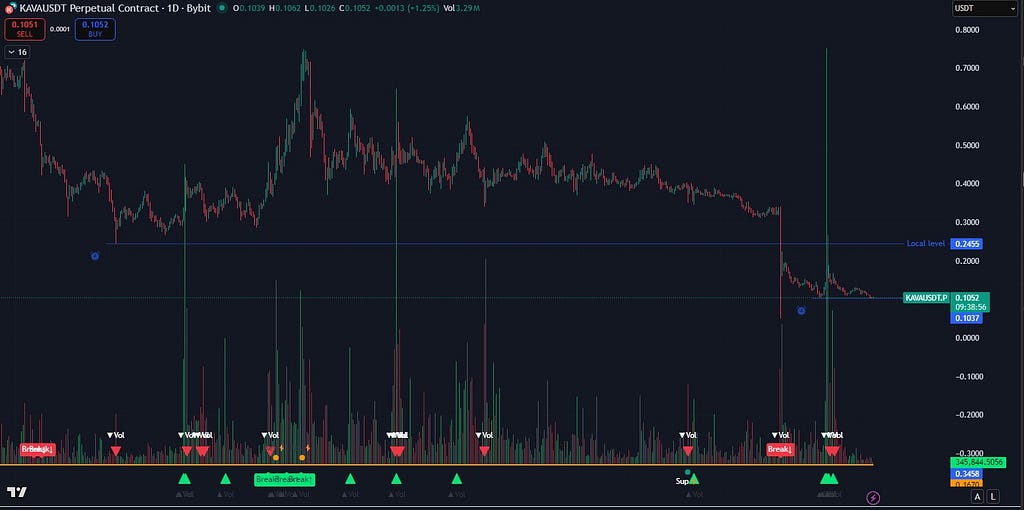
Volume is one of the most widely used metrics in trading. Every crypto trader, from beginner to professional, has stared at the green and red bars under their chart trying to decode market intent.
But here’s the uncomfortable truth:
Most traders are reading the wrong volume.
Or worse — they’re reading it in the wrong context.
This is especially true when it comes to the popular Daily 24h Volume indicator. You’ve probably seen it on exchanges like Binance, Bybit, OKX — and on TradingView indicators that attempt to emulate it.
And while the metric sounds intuitive (“how much volume traded in the last 24h”), it’s often misunderstood and misapplied in live trading.
In this article, I want to break down:
Let’s start with the basics.

Daily 24h Volume Indicator is attractive because:
For example:
It’s a macro-level liquidity gauge.
But here’s the problem:
Daily 24h volume does NOT tell you what’s happening right now on your candle. It tells you what happened in the past day, smoothed into one enormous rolling window. This introduces several pitfalls.
Daily 24 volume cannot show momentum shifts inside a candle. You might think volume is increasing… But it’s actually just updating the rolling window.
It blends all buy/sell pressure, spikes, and micro-movements into one big number.
You miss:
Because it covers the full 24h window, it behaves like a moving average:
But the bar forming RIGHT NOW could have:
— or —
This disconnect confuses decision-making.
Below is a simplified comparison to set things straight.
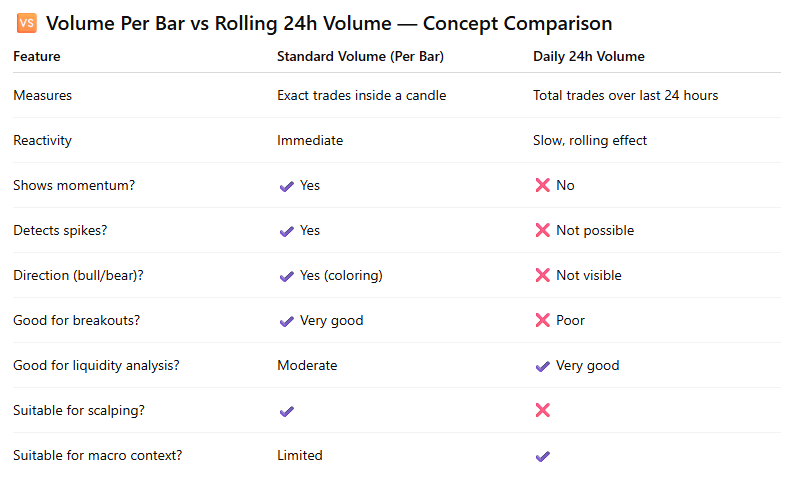
In short:
Most traders mix these two concepts — and get confused signals as a result.
After years of active crypto trading, I realized I needed:
This led me to develop the Advanced Volume Suite — a tool that merges the strengths of both worlds:
It’s the volume engine I personally use in my trading, and now I’m sharing it publicly.
The next section describes how it works.
The Advanced Volume Suite is a multi-layered volume analysis system designed for traders who rely on volume as a primary decision driver. It expands far beyond TradingView’s standard volume bars by adding:
All volume is converted into USDT value (volume × close) to normalize activity across increasing or decreasing prices.
The indicator calculates a custom 24h rolling volume, just like Binance and Bybit display.
A powerful ratio that measures momentum inside each bar.
Identifies abnormal activity using:
Detects:
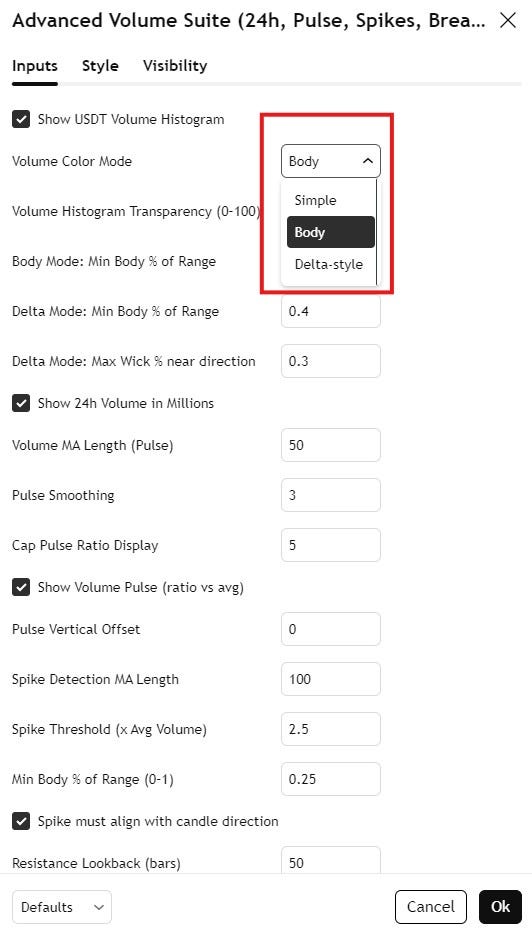
The indicator introduces intelligent volume bar coloring, which improves clarity and helps interpret orderflow visually:
Green = close > open
Red = close < open
(Like standard volume but using USDT values)
Colors only when candle body is strong relative to its range.
Filters noise and highlights meaningful bars.
Detects “aggressive” buyers or sellers based on:
This indicator bridges the gap between:
And wraps it into:
It replaces multiple tools and simplifies your volume-based decision-making.

Volume is one of the most important trading metrics — but only when interpreted correctly.
If you’ve ever missed a breakout, failed to see a spike, or misjudged the strength behind a move, this suite gives you the clarity you were missing.
This indicator is fully free and open-source on TradingView, so that traders can review and verity its functionality.
Advanced Volume Suite (24h, Pulse, Spikes, Breakout Pressure) — Indicator by zalutskyiyuriy — TradingView
Why Most Traders Misread Volume: A Deep Dive into Standard Volume vs Daily 24h Volume was originally published in Coinmonks on Medium, where people are continuing the conversation by highlighting and responding to this story.
I remember staring at my position size one evening and thinking, something feels off, but I can’t name it.
The trade itself wasn’t dramatic. No big loss. No big win. Just one of those regular trades that quietly adds up over time. But when I looked at my journal later, I noticed something uncomfortable.
Two trades. Same setup quality. Same confidence. Very different emotional reactions.
That’s when the confusion really started for me — fixed risk versus fixed quantity.
Not as concepts. I already “knew” them.
But as lived decisions.
Most of us hear about these ideas early on. Fixed quantity sounds simple: buy the same number of shares or lots every time. Fixed risk sounds more mature: risk the same amount of money per trade.
On paper, both feel reasonable.
And that’s part of the problem. Nothing obviously screams wrong.
But trading doesn’t punish what’s obviously wrong.
It punishes what’s subtly inconsistent.
I didn’t realize this at first. I thought my confusion was technical. It wasn’t. It was emotional.
When I traded fixed quantity, everything looked clean. Same lot size. Same number. No extra math.
But the risk was never the same.
Some trades barely moved against me. Others went straight to the stop and felt heavy. Not because the loss was huge — but because I didn’t expect it to feel that way.
I started reacting differently to identical outcomes.
A loss on a tight stop felt “acceptable.”
A loss on a wider stop felt unfair — even though I chose both.
That inconsistency messed with my head more than I expected.
When I switched to fixed risk, I felt grown up. Disciplined. Responsible.
Same money risked every trade. No exceptions.
But then another thing happened.
My position sizes changed constantly.
Some traders felt tiny. Almost pointless.
Others felt uncomfortably large.
Again, nothing was technically wrong. But emotionally, I kept second-guessing myself.
I’d look at a trade and think, why does this one feel scarier?
Same risk. Different exposure.
It took me longer than I’d like to admit realizing that fear doesn’t respond to math. It responds to perception.
I’ve seen endless debates online.
“Fixed risk is the only professional way.”
“Fixed quantity is simpler and more consistent.”
“Just do what institutions do.”
None of that helped me.
Because the real issue wasn’t which method was correct.
It was whether the method matched how my brain processes uncertainty.
No one talks enough about that.
Here’s something I learned the slow way.
Your risk model shapes your behavior more than your strategy ever will.
With fixed quantity, I became lazy about stop placement.
With fixed risk, I became obsessed with position size.
Both distracted me — from the actual quality of the trade.
And worse, they influenced how long I stayed in losing trades, how quickly I booked winners, and how much confidence I carried into the next setup.
Same chart. Different mindset.
The change didn’t come from reading another thread or watching another video.
It came from journaling a streak of boring trades.
Not the big wins. Not the disasters.
The normal ones.
I noticed something simple:
I traded best when I stopped thinking about money during the trade.
Not before. During.
The moment I entered, the less aware I was of position size or loss amount, the calmer I was. The clearer my decisions became.
That’s when the question stopped being “fixed risk or fixed quantity?”
It became: Which approach lets me forget about money once I’m in the trade?
Risk consistency matters.
But emotional consistency matters more.
If fixed quantity keeps you calm and present, it’s not “wrong.”
If fixed risk keeps you detached and steady, it’s not automatically better — it’s just better for you.
The danger isn’t choosing the wrong model.
The danger is choosing one because it sounds right, not because it feels stable over time.
I wish someone had told me that earlier.
I don’t think of this as a solved problem anymore.
Markets change.
My psychology changes.
Life changes.
What works for me now might quietly stop working later.
And that’s okay.
I’m less interested in being correct.
More interested in being consistent — emotionally, not mathematically.
Because in the end, the account doesn’t blow up from bad formulas.
It blows up from tiny, repeated moments of internal conflict.
That’s the part I pay attention to now.
This piece is part of Quiet Trading Notes, where ideas are explored clearly — without hype, shortcuts, or promises.
Fixed Risk vs Fixed Quantity — why this kept bothering me was originally published in Coinmonks on Medium, where people are continuing the conversation by highlighting and responding to this story.
Hyperliquid doesn’t punish bad traders — it exposes them. And in 2026’s ultra-competitive on-chain trading landscape, exposure happens faster than ever.
As one of the fastest-growing decentralized perpetual exchanges, Hyperliquid has become a magnet for professional traders, whales, and high-frequency participants looking for deep liquidity without centralized risk. But while the platform itself is powerful, most traders still lose money on it — not because Hyperliquid is flawed, but because their strategies are.
This article breaks down which trading strategies actually work on Hyperliquid, which ones consistently fail, and why.
If you trade perpetuals, plan to, or are migrating from Binance, Bybit, or dYdX, this guide will help you avoid the most expensive mistakes traders keep repeating.
Hyperliquid trading refers to spot and perpetual futures trading on Hyperliquid, a decentralized exchange with a fully on-chain order book, low latency execution, and transparent liquidation mechanics.
Traders use Hyperliquid to trade crypto perpetuals with leverage while retaining self-custody and avoiding centralized exchange risk.
Before discussing strategies, it’s critical to understand why strategies behave differently on Hyperliquid compared to centralized exchanges.
Hyperliquid is not just “another perp DEX.” Its architecture directly impacts trading outcomes:
This combination attracts professional traders, which means edge disappears faster and poor strategies are punished more efficiently.
Most traders lose money on Hyperliquid because they overuse leverage, ignore funding rates, overtrade low-liquidity pairs, and abandon risk management after losses.
Hyperliquid’s transparency exposes poor discipline faster than centralized exchanges.
If you’ve ever been liquidated and thought “I’ll make it back on the next trade”… you’re not alone, and that mindset is exactly why Hyperliquid wipes accounts fast.
Comment “DISCIPLINE” if this hit close to home, and clap so other traders see this before learning the hard way.
Trend following remains one of the most consistently profitable strategies on Hyperliquid — when executed properly.
Because Hyperliquid’s order book reflects real, on-chain demand, strong directional moves tend to be cleaner and less manipulated than on smaller DEXs.
What works:
Why it works:
Many traders arrive on Hyperliquid thinking it’s a scalper’s paradise. Tight spreads, fast execution, no KYC — what could go wrong? Everything.
High-leverage scalping (20x–50x) consistently underperforms on Hyperliquid for most retail traders.
Why it fails:
Hyperliquid is efficient, not forgiving.
One of the most overlooked advantages on Hyperliquid is funding transparency.
Unlike centralized exchanges where funding can feel opaque or manipulated, Hyperliquid’s funding dynamics reflect real positioning imbalance.
Profitable approach:
Example:
When longs are paying excessive funding:
This strategy rewards patience and capital efficiency, not reflexive trading.
Yes, Hyperliquid is on-chain.
Yes, you can see whale activity.
No, that does not mean copying them will make you profitable.
Why copy-trading fails:
By the time retail traders react, the edge is already gone.
Better alternative:
Use whale activity as context, not signals.
Not every market trends — and Hyperliquid’s liquidity makes range trading viable when volatility compresses.
Best conditions:
Execution rules:
Range trading rewards precision, not prediction.
Hyperliquid supports a wide variety of assets — but liquidity quality varies dramatically.
Common failure patterns:
Professional traders stick to high-volume pairs for a reason.
No strategy survives poor risk management.
The traders who last on Hyperliquid:
Successful Hyperliquid traders prioritize position sizing and liquidation avoidance over leverage maximization.
Hyperliquid’s liquidation engine is transparent — but brutal.
The worst traders:
This is not a strategy. It’s self-destruction with a chart.
Know someone trading Hyperliquid like it’s a casino?
Share this article with them before leverage teaches the lesson instead. One share can save a blown account.
Liquidity on Hyperliquid peaks during:
Avoid trading during:
Time selection alone can dramatically improve results.
Hyperliquid is not:
It is a professional-grade trading venue that rewards preparation and punishes ego.
The final difference isn’t strategy — it’s mindset.
Losing traders focus on:
Winning traders focus on:
Hyperliquid magnifies both skill and weakness.
Hyperliquid doesn’t create bad traders — it reveals them.
If your strategy relies on:
It will fail.
If your strategy emphasizes:
It will scale.
The difference isn’t the platform. It’s the trader.
If this guide helped you:
Trader Strategies That Work (and Fail) on Hyperliquid was originally published in Coinmonks on Medium, where people are continuing the conversation by highlighting and responding to this story.

“You should never move your stop loss.”
This is one of the most famous statements any trader will come across in their career, whether a newbie or an experienced trader.
My setup was solid. I was calm, composed (at least I thought I was), and knew what was expected of me. Executed my entry to perfection. I even took a screenshot to brag to my future self about how “perfect trades” get executed.
Little did I know, my trade had just begun. The price oscillated for hours around my breakeven level. I could feel the heaviness building up in my jaw with every price point move against my position.
There was no major news this day, so the price inched lower and lower, slowly heading towards my stop loss. “This is not fair. Why me?” I remember asking. “But hey… I am an experienced trader. I can beat the market. If only I could move my stop — and let this trade breathe a little. Only this once!”
Once became twice, then three times, and then four times. By the time I snapped out of it, I was negative 30% down on my account balance. That’s when I realized that I just met the Guy who trades my account.
That story isn’t about mistakes. It’s about identity exposure. Every trader has moments where the market removes excuses and leaves only one question:
“Who are you when execution actually costs something?”
Week 7 is about answering that honestly. Not with discipline. With identity.
Most traders believe consistency comes from:
That belief keeps them trapped. Because discipline is conditional.
Identity is not.
You don’t become consistent by trying harder. You become consistent when inconsistency becomes psychologically expensive. Until then, discipline will always fail on schedule.
Discipline depends on variables the market is designed to attack:
When any of these shift, discipline collapses.
That’s why traders can look “disciplined” for:
…and then implode.
Not because they’re lazy. Because discipline was never the controlling force. Identity was.
Here’s the uncomfortable truth:
Most traders act like traders, but identify as gamblers trying to improve.
So under pressure:
Your actions will always obey your identity — not your goals.
If you still need:
You already know which identity is in control.
Pro traders don’t ask:
“How do I stay disciplined here?”
They ask:
“What does someone like me do in this situation?”
That question removes:
Consistency stops being forced. It becomes self-aligned behavior. This is not mindset. It’s identity enforcement.

These are not traits. They are standards with consequences.
Consistent traders do not need this trade to work.
They measure success by:
If your self-worth moves with P&L, consistency is impossible.
Pro traders understand this rule clearly:
A profitable trade with broken rules is logged as a loss.
If rules are violated:
No exceptions. No emotional accounting.
Inconsistency begins the moment you say “just this once.” Pro traders do not violate rules to win.
They understand something amateurs don’t:
Rule violation is the real loss.
Winning while breaking rules trains the wrong identity. So they enforce this standard:
If you can’t follow your process on bad days, you don’t own a process — it owns you.
Consistency is impossible without self-trust.
And self-trust is not confidence.
It is evidence accumulated over time.
It’s built by:
No evidence = no trust. No matter how good today feels.
Because consistency is boring.
No adrenaline.
No hero moments.
No dramatic recoveries.
Just:
Most traders don’t fail from a lack of skill. They fail because their ego needs stimulation. Boredom is the price of staying in the game. Most traders won’t pay it.

Markets are noisy.
Participants are emotional.
Information is abundant.
Consistency is rare. And rarity creates edge. Not because it’s complex, but because it’s uncomfortable to maintain. If you can do what others won’t sustain, you don’t need to outsmart them.
You just outlast them.
This is where the roadmap stops being theory and starts becoming behavior. If identity doesn’t change here, nothing downstream holds.
You don’t become consistent by forcing discipline.
You ONLY become consistent when:
Consistency is not something you do. It’s who you are when no one is watching.
And if your behavior changes when no one is watching, your identity hasn’t changed.
Consistency Is Not Discipline — It’s Identity was originally published in Coinmonks on Medium, where people are continuing the conversation by highlighting and responding to this story.