Reading view

There are new articles available, click to refresh the page.

Bitcoin Difficulty Drops 3.3% As Miners Pull Back Hashrate

On-chain data shows the Bitcoin mining Difficulty has seen a downward adjustment following the decline in the network Hashrate.

Bitcoin Blockchain Has Eased Mining Difficulty

According to data from CoinWarz, the Bitcoin mining Difficulty has gone through a decline in the latest network adjustment. The “Difficulty” here refers to a metric built into the blockchain that controls how hard miners would find it to discover a block.

The indicator’s value automatically changes roughly every two weeks in events called adjustments, based on how miners performed since the last such event. The blockchain follows one simple rule to adjust the Difficulty: miner blockchain production rate should converge to 10 minutes per block.

If miners find the average block in an interval greater than 10 minutes, then the network responds by raising its Difficulty just enough that these validators are slowed back down to the standard rate. On the other hand, this cohort performing slower than needed forces the blockchain to ease things up.

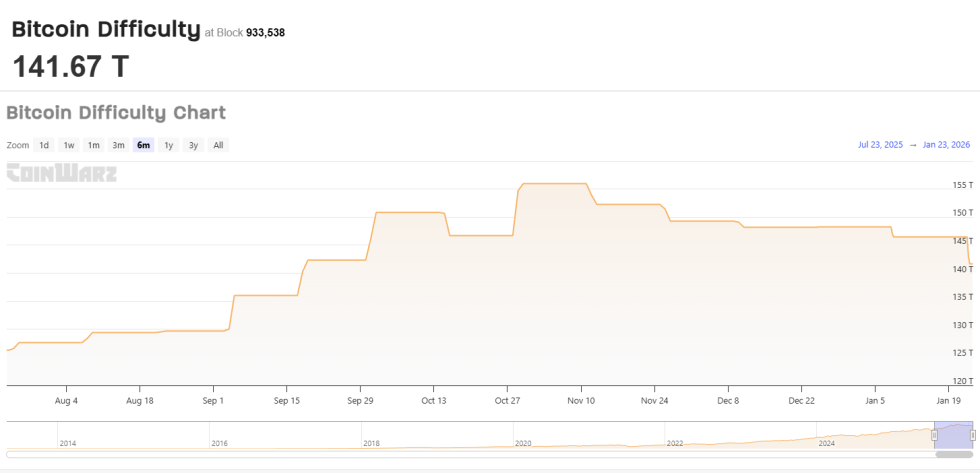
The latest Bitcoin Difficulty adjustment occurred on Thursday, and as the below chart shows, it resulted in a decrease for the metric.
Bitcoin Difficulty

Prior to the change, the indicator had a value of 146.47 trillion hashes. Now, it has dropped to 141.67 trillion hashes, indicating a decrease of 3.28%. This is the second-consecutive reduction in the network Difficulty.

In fact, the indicator has been in a long-term decline since November, with five of the six Difficulty changes that have occurred in the period leading to a drop in its value. Even the one adjustment that didn’t lead to a decrease in the metric had an almost neutral effect, so while the decline didn’t strengthen during it, it didn’t correspond to a change of direction either.

The reason for this long drawdown in the Bitcoin Difficulty lies in the trend witnessed by the Hashrate, a measure of the total amount of computing power connected by the miners to the network.

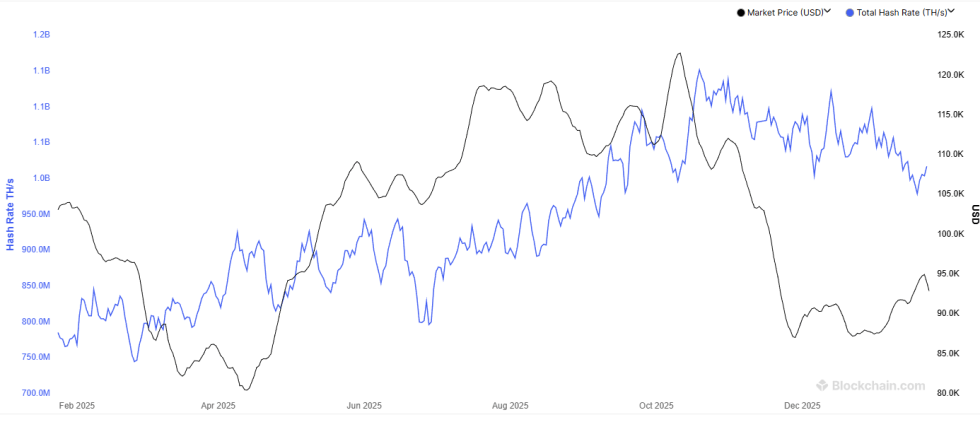
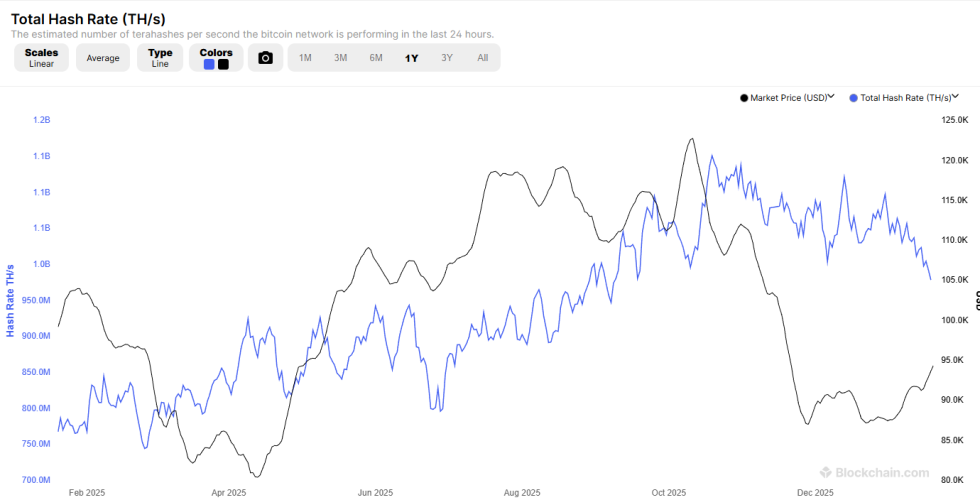
As data from Blockchain.com shows, the 7-day average value of the Hashrate has been going down during the last few months.
Bitcoin Hashrate

On January 18th, the 7-day average Bitcoin Hashrate fell to 978.8 exahashes per second (EH/s), its lowest level since the first half of September. The indicator has observed a rebound since this low, but its value still remains notably lower than earlier in the month.

Miners’ pace tends to directly correlate with the amount of computing power that they possess, so a decline in the Hashrate usually results in a correction for the Difficulty. The continued downtrend in the former since October is why the latter has also plunged.

BTC Price

At the time of writing, Bitcoin is trading around $90,000, down more than 5% over the last week.

Bitcoin Price Chart

Dogecoin Wedge Breakout Could Be “Powerful,” Analyst Says

Dogecoin is potentially following a Falling Wedge right now, and this cryptocurrency analyst thinks a breakout from it may be a “powerful” one.

Dogecoin Could Be Trading Inside A Falling Wedge Pattern

In a new post on X, analyst Ali Martinez has shared a Falling Wedge that Dogecoin is potentially trading inside on the weekly timeframe. A “Wedge” is a pattern from technical analysis (TA) that forms whenever the asset’s price trades between two converging trendlines.

A “Triangle” consolidation channel also involves converging trendlines, but the difference from a Wedge is that it either involves one trendline that’s horizontally flat or trendlines that converge with an opposite slope. On the other hand, a Wedge involves trendlines sloped in the same direction.

When these lines point in the up direction, the pattern formed is known as a Rising Wedge. Similarly, their being sloped downward creates a Falling Wedge. The latter is the Wedge of interest in the current discussion. Like other consolidation patterns in TA, the upper line of a Falling Wedge is also likely to be a source of resistance, while the lower one is that of support. A breakout of either of these bounds can signal a sustained move in that direction.

Wedges are generally considered to be either continuation or reversal patterns, depending on the prevailing price trend. When a Falling Wedge is preceded by an upward price trajectory, the pattern is assumed to be one pertaining to a bullish continuation. Similarly, it acts as a reversal pattern during a downtrend.

Now, here is the chart shared by Martinez that shows the Falling Wedge that Dogecoin has been stuck inside for the past year:

Dogecoin Falling Wedge

As displayed in the above graph, Dogecoin’s weekly price has retraced to the lower level of the Falling Wedge recently, suggesting the pattern’s support is being retested.

In the same chart, the analyst has highlighted some Falling Wedges that Dogecoin traveled through in the past. It would appear that each of these ended up holding as bullish continuation patterns and led to upward breakouts. In terms of the width, the latest Wedge has been the largest among these.

“Dogecoin $DOGE tends to respect wedge structures, and a breakout from this one could be powerful,” noted Martinez. It now remains to be seen whether the support line of the channel will hold for the memecoin this time and if a breakout will follow.

DOGE Price

At the time of writing, Dogecoin is floating around $0.125, down more than 9% over the last seven days.

Dogecoin Price Chart

GameStop Locking In $76M Bitcoin Loss? Holdings Hit Coinbase

On-chain data from CryptoQuant shows GameStop has deposited its entire Bitcoin stack into Coinbase Prime, a potential sign of selling.

GameStop Has Transferred 4,710 BTC To Coinbase Prime

In a new post on X, on-chain analytics firm CryptoQuant has revealed how GameStop just moved all its Bitcoin holdings to Coinbase Prime, the institutional prime brokerage wing of cryptocurrency exchange Coinbase. GameStop is an American videogame retailer that’s considered the largest chain of its kind in the world. In recent years, the company has seen a decline as physical gaming stores have increasingly lost relevance in the digital era.

In 2025, the struggling retailer diversified by adopting a Bitcoin treasury reserve, following in the footsteps of other firms like Strategy. As the chart below, shared by CryptoQuant, shows, the company bought 4,710 BTC between May 14th and 23rd. These purchases involved an average buying price of $107,900 per token, costing GameStop a total of $504 million.

GameStop Bitcoin Holdings

It’s also visible in the graph that the company has cleared out all of its wallets recently, with its total holdings dropping to zero. GameStop has made these moves as the asset has gone through a bearish turn since October.

As this other chart showcases, the firm’s reserve was trading a notable amount below its investment value before the outflows occurred.

GameStop Bitcoin Loss

According to CryptoQuant, the transfer of GameStop’s holdings to Coinbase Prime could be a sign that the retailer is preparing to sell, a move that would lock in losses of around $76 million at current prices.

The potential sale of GameStop’s Bitcoin reserve has come alongside a significant number of store closures. According to a blog that compiles data using the retailer’s online store locator, 470 stores have so far either been confirmed to be closing or closed this January.

Back in 2021, GameStop was the highlight of a “meme stock” frenzy, in which its share price saw a 1,500% spike alongside a short squeeze over the course of two weeks.

Later in that year, the company decided to take a gamble on a non-fungible token (NFT) marketplace, attempting to ride the NFT craze of the period. Its platform hit the market in 2022, but it wasn’t long before GameStop started winding it down, and ultimately shuttered its doors in early 2024.

If the latest Bitcoin transactions represent sales, then it would mean that GameStop’s BTC treasury initiative has met a similar end as its NFT venture.

BTC Price

Bitcoin has returned to the $89,100 mark following this week’s pullback.

Bitcoin Price Chart

Bitcoin Supply Overhang Likely To Cap Rallies Above $98,400, Glassnode Says

On-chain analytics firm Glassnode has pointed out in a new report how Bitcoin is facing supply overhang beyond the $98,000 region.

Bitcoin Could Find Resistance Beyond $98,000

In its latest weekly report, Glassnode has discussed about how the recent Bitcoin rally stalled near the Realized Price of the short-term holders (STHs). The “Realized Price” is an on-chain metric that tracks the cost basis of the average investor or address on the BTC network.

The STH Realized specifically measures the average acquisition level of traders who purchased within the past 155 days. As the below chart shows, this indicator is located at $98,400 right now.

Bitcoin STH Realized Price

This level is around where the recent recovery run hit an obstacle, potentially due to selling from underwater recent buyers who used the rally to exit near their break-even mark.

Glassnode explained:

The recent rejection near the Short-Term Holder cost basis at ~$98.4k mirrors the market structure observed in Q1 2022, where repeated failures to reclaim recent buyers’ cost basis prolonged consolidation.

The STH Realized Price provides a look at the average break-even level of a broad section of the market. For a more granular look, another indicator called the UTXO Realized Price Distribution (URPD) exists.

Bitcoin URPD

From the chart of the Bitcoin URPD, it’s visible that a notable amount of the STH supply has a cost basis between the current level and $98,000 (colored in blue). This supply represents the tokens that were redistributed by top buyers into newer market participants during the price rally.

Not all top buyers sold, however, as it’s apparent in the graph that at levels around and above $100,000, the long-term holder (LTH) supply is becoming a notable force (shaded in red).

Coins count under the LTH cohort once they mature past the 155-day age bracket. The fact that LTH supply is building up at these levels suggests some bull market entrants are willing to hold.

The analytics firm noted:

This unresolved supply overhang remains a persistent source of sell pressure, likely to cap attempts above the $98.4k STH cost basis and the $100k level. A clean breakout would therefore require a meaningful and sustained acceleration in demand momentum.

It now remains to be seen how Bitcoin’s upcoming price action would look, particularly in the context that major supply clusters are still sitting underwater.

BTC Price

Bitcoin has been following a downward trajectory since its rejection from the STH Realized Price as its value is now trading around $89,100.

Bitcoin Price Chart

Crypto ETFs Are Coming To Thailand: SEC To Launch New Rules This Year

Thailand’s Securities and Exchange Commission (SEC) is preparing to launch new rules related to crypto, including exchange-traded funds (ETFs).

Thailand To Regulate Crypto ETFs And Futures This Year

As reported by Bangkok Post, the Thailand SEC is preparing regulatory changes related to crypto to support the growth of investment in the sector. Jomkwan Kongsakul, deputy secretary-general of the SEC, said the regulator is planning to issue guidelines supporting the launch of digital asset ETFs, while also working to enable crypto futures trading on the Thailand Futures Exchange (TFEX).

ETFs are investment vehicles that allow investors to gain exposure to an underlying asset without having to directly own it. In the context of digital assets, ETFs enable traders to invest into coins like Bitcoin without interacting with any on-chain element like wallets or exchanges.

In the United States, spot ETFs gained approval by the nation’s SEC in January 2024 for Bitcoin and July 2024 for Ethereum. Since then, these funds have attracted notable attention, capturing demand from traditional investors who were reluctant to deal with blockchain infrastructure.

Kongsakul noted:

A key advantage of crypto ETFs is ease of access; they eliminate concerns over hacking and wallet security, which has been a major barrier for many investors.

Within Asia, Hong Kong approved spot ETFs for both Bitcoin and Ethereum in April 2024, while South Korea is planning to roll out similar investment vehicles this year.

According to Kongsakul, Thailand’s SEC board has already approved crypto ETFs in principle, with detailed investment and operational rules currently being finalized. Although an exact timeline is unknown, the SEC is expected to introduce the regulations “early this year.”

Alongside ETFs, the SEC is also moving to formally recognize crypto within Thailand’s derivatives framework, allowing digital asset futures products to trade on the TFEX. Kongsakul said crypto futures would provide traders with hedging tools and more sophisticated risk management options.

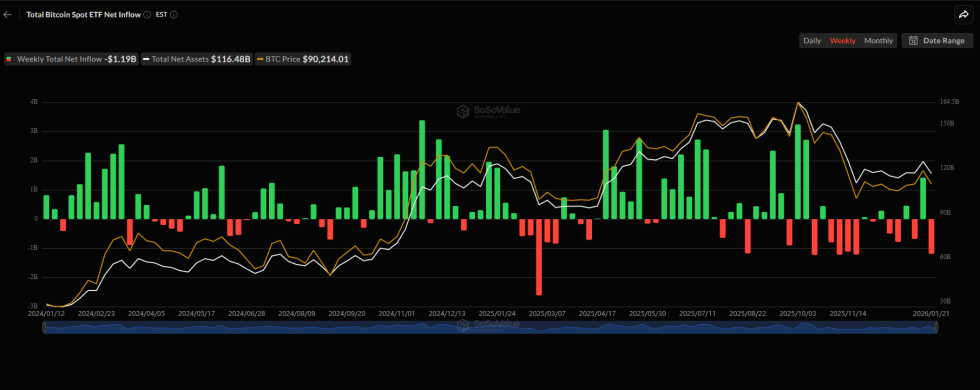
In related news, the US spot Bitcoin ETFs have faced weak demand recently, with the netflow for the current week sitting at a notable negative value, according to data from SoSoValue.

Bitcoin Spot ETF Netflows

As displayed in the above graph, the US Bitcoin spot ETFs have witnessed net outflows of $1.19 billion this week so far. These negative netflows have come as the asset’s price has gone through a bearish shift, retracing the recovery it had made earlier this year.

Last week, the funds actually saw net inflows of $1.42 billion, breaking the trend of weak inflows or outright outflows that had persisted since mid-October. But this week’s netflow suggests the bullish market mood couldn’t last.

BTC Price

At the time of writing, Bitcoin is trading around $89,100, down more than 8% over the last week.

Bitcoin Price Chart

Bitcoin Sentiment Whiplash: Mood Sours From Greed To Extreme Fear In Days

Data shows the Bitcoin market sentiment has seen a sharp turnaround recently as the Fear & Greed Index has swung to extreme fear.

Bitcoin Fear & Greed Index Is Back In Extreme Fear Zone

The “Fear & Greed Index” refers to an indicator created by Alternative that tells us about the average sentiment present among traders in the Bitcoin and wider cryptocurrency markets.

The index uses the data of the following five factors to determine the investor mentality: market cap dominance, trading volume, volatility, Google Trends, and social media sentiment. To represent the sentiment, it uses a numerical scale running from zero to hundred.

When the value of the Fear & Greed Index is greater than 53, it means a sentiment of greed is shared by the majority of traders. On the other hand, the indicator being below 47 implies the dominance of fear. All values lying between these two cutoffs correspond to a net neutral mentality.

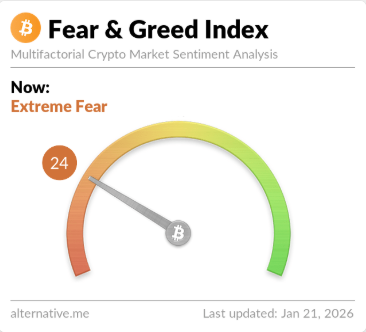
Besides these three core regions, there are also two ‘extreme’ zones, known as the extreme fear (occurring at 25 and under) and extreme greed (above 75). At present, the market sentiment is in one of these zones, as the Fear & Greed Index’s latest value suggests.

Bitcoin Extreme Fear

As displayed above, the Bitcoin market sentiment is just inside the extreme fear territory right now, with the Fear & Greed Index sitting at 24. This level of despair among traders is a new development, as just earlier mood was much better.

Bitcoin Fear & Greed Index

On January 15th, the index had a value of 61, putting the sentiment of the average investor firmly inside the greed territory. Only six days later, the situation has completely flipped.

The reason behind this shift lies in the bearish price action that the cryptocurrency has faced since US President Donald Trump announced tariffs on several European countries over Greenland.

The earlier greed sentiment also came after trader mentality saw a sharp swing. In fact, the shift was even faster back then, as the Fear & Greed Index went from a near-extreme fear level of 26 to the greedy value of 61 over just two days as Bitcoin witnessed a price surge beyond $97,000.

The latest drop back into the extreme zone may not entirely be a negative development for the cryptocurrency, though, if history is anything to refer to. Often, digital asset markets have tended to move in the direction that goes contrary to the expectations of the majority.

Since extreme fear is where a bearish mentality is the strongest, bottoms can be likely to occur in the zone. Similarly, extreme greed can lead to tops instead. With the sentiment currently in the former zone, it now remains to be seen how long it will take for Bitcoin to find back its footing.

BTC Price

Bitcoin dropped under $88,000 earlier in the day, but the coin has since bounced back to $90,200.

Bitcoin Price Chart

Bitcoin Took Top Spot In 2025 Crypto Payments, Litecoin Third-Most Used: CoinGate

A new report from CoinGate shows Bitcoin took back the crown in cryptocurrency payments during 2025. Here’s how the rest of the rankings looked.

Bitcoin Was The Most Used Cryptocurrency On CoinGate In 2025

In a new thread on X, digital asset payments processor CoinGate has shared insights from its latest report about transactions that occurred on the platform in 2025. In total, CoinGate processed 1.42 million cryptocurrency payments during the year, bringing its total lifetime payments beyond 7 million.

As the below pie chart shows, Bitcoin accounted for the largest share of these payments.

Bitcoin Vs Other Cryptos

Back in 2024, Tether’s USDT ranked the highest in payments on the platform, beating Bitcoin. With a share of 22.10% in 2025, however, the original cryptocurrency managed to reclaim the top spot over the stablecoin, which ended the year with a payments dominance of 16.60%.

The third position was occupied by Litecoin, which was involved in 14.40% of CoinGate payments. In Summer 2025, LTC even briefly became the second-best coin in the metric. Litecoin being preferred over some other popular assets could be due to the fact that its blockchain offers cheap and fast transactions as core features.

Ethereum and Tron, the fifth and sixth most used coins, both observed growth in payments dominance during 2025. “TRX payment share grew from 9.1% to 11.5% and ETH from 8.9% to 10.6%,” noted CoinGate.

In terms of networks, the Bitcoin blockchain, including the Lightning Network, was the most widely used on the platform in 2025, symmetrical with the token’s payments share itself.

Bitcoin Vs Litecoin

As displayed above, the second and third largest networks on CoinGate were Tron and Ethereum, occupying shares of 19.6% and 15.1%, respectively. These blockchains being above Litecoin despite their native tokens accounting for lower payment shares is because they also facilitate stablecoin transactions.

The United States led in country rankings on the platform, with 24.37% of payments on the platform taking place in the nation. Germany and Netherlands rounded out the top three with shares of 6.83% and 5.16%, respectively.

Crypto CoinGate Country Stats

Cryptocurrencies saw significant usage on the platform in terms of being a payment mode, but that’s not all they were used for. According to the report, merchants also increasingly chose to settle in digital assets.

More specifically, cryptocurrency settlements rose from 27% in 2024 to 37.5% in 2025. Stablecoins were the preferred option for merchants, being involved in 25.2% of all settlements, while Bitcoin occupied a smaller, but still notable, 9.7% share.

Merchants also used cryptocurrencies to pay vendors, affiliates, partners, and contractors. “The most popular payouts were in USDC, Bitcoin, and Ethereum,” said CoinGate. Stablecoins once again dominated here, occupying a payouts share of 87.8%.

BTC Price

At the time of writing, Bitcoin is trading around $88,300, down more than 9% over the last week.

Bitcoin Price Chart

Bitcoin Bottoming Phase Was Driven By Large Entities, Glassnode Data Shows

On-chain analytics firm Glassnode has pointed out how large entities drove Bitcoin accumulation during the November-December bottoming phase.

Large Entities Accumulated BTC, While Smaller Investors Sold

In a new post on X, Glassnode has talked about the recent Bitcoin investor behavior. “During the November–December bottoming phase, supply accumulation was primarily driven by larger entities, while smaller cohorts were distributing,” noted Glassnode.

To showcase the trend, the analytics firm has cited the Accumulation Trend Score, an on-chain indicator that tells us about whether BTC addresses are accumulating or distributing. The indicator uses two factors to calculate its value: the balance changes happening in the wallets of the investors and the size of the wallets themselves. This means that larger entities have a stronger influence on the metric.

When the value of the Accumulation Trend Score is greater than 0.5, it means large entities (or alternatively, a large number of small entities) are accumulating. The closer is the indicator to 1.0, the stronger is this behavior. On the other hand, the metric being under the threshold implies that distribution is the dominant behavior among investors. The zero level acts as the extreme point for this side of the scale.

The Accumulation Trend Score can also be separately calculated for specific Bitcoin segments to get a more granular view of behavior. Below is the chart shared by Glassnode, doing exactly this for the various BTC investor groups.

Bitcoin Accumulation Trend Score

As is visible in the graph, the Bitcoin Accumulation Trend Score was close to a value of 1.0 for 10,000+ BTC investors during the bottoming period that followed the price crash in November. The investors in this wallet range are often dubbed as “mega whales,” corresponding to the largest of entities on the network.

The normal whales, holding coins in the 1,000 to 10,000 BTC range, started accumulating a bit later, as their Accumulation Trend Score turned blue in December. The whales have since maintained net buying, but the mega whales switched to a neutral behavior around mid-December.

Interestingly, while the whales have been showing accumulation, the same hasn’t been true for the smaller investor groups. All cohorts carrying less than 1,000 BTC have displayed varying degrees of distribution during the last few weeks, with the 1 to 10 coins group in particular showing a near-perfect selling behavior.

“This divergence appears to be driven in part by exchange-related wallet reshuffling, and also by large holders buying the dip,” explained the analytics firm. It now remains to be seen how long the distribution from smaller Bitcoin entities will continue.

BTC Price

Bitcoin has been falling since the week started as its price is now trading around $88,900.

Bitcoin Price Chart

Bitcoin As Bonus: Steak ’n Shake Rolls Out BTC Pay Perks For Workers

American fast food chain Steak ‘n Shake has announced that all hourly employees will receive a Bitcoin bonus starting on March 1st.

Steak ‘n Shake Integrates Bitcoin Bonus Payments

Steak ‘n Shake will pay all hourly employees at its company-operated restaurants a bonus in Bitcoin for every hour of work, as revealed by the company’s official X handle. Steak ‘n Shake, primarily based in the United States, is a fast food chain that mainly serves burgers and milkshakes, with its flagship item being the Steakburger. Back in May 2025, the firm opened itself to Bitcoin, allowing customers to pay at all its locations using the cryptocurrency.

Last Friday, Steak ‘n Shake provided an update on the scheme, noting that same-store sales have dramatically increased for the company since it started accepting BTC. The firm added that all of its BTC sales go into its Strategic Bitcoin Reserve (SBR) and announced that it expanded this reserve by an additional $10 million in notional value in that same update.

“We have created a self-sustaining system — growing same-store sales that grow the SBR,” wrote the company. “Improving food quality expands Steak n Shake’s reach and leverages Bitcoin into a new and delicious dimension.” Now, it seems Steak ‘n Shake has taken its BTC acceptance a step further with the employee bonus integration.

According to the announcement, all hourly employees will receive $0.21 BTC for every hour worked. However, only workers who have passed a two-year vesting period will be able to collect their digital asset pay.

Steak ‘n Shake credited Fold for providing assistance on the initiative. Fold is a financial services platform that offers, among other features, a debit card allowing users to earn BTC rewards on payments.

The Bitcoin bonus program is set to go live on March 1st. “We take care of our employees; they, in turn, take care of customers; and the results take care of themselves,” said Steak ‘n Shake.

In some other news, institutional demand for Bitcoin has remained strong recently, according to CryptoQuant founder and CEO Ki Young Ju. To track the behavior of these large entities, Young Ju has referred to the supply of addresses carrying between 100 and 1,000 BTC.

“US custody wallets typically hold 100-1,000 BTC each,” explained the CryptoQuant founder. “Excluding exchanges and miners, this gives a rough read on institutional demand.” As the chart below shows, the supply of this investor segment has shown significant growth in recent months.

Bitcoin Institutional Demand

In total, Bitcoin wallets in the 100 to 1,000 tokens range have collectively added 577,000 BTC (roughly worth $51.5 billion) to their holdings over the past year. So far, this accumulation hasn’t shown signs of slowing down.

BTC Price

At the time of writing, Bitcoin is floating around $89,200, down 6% in the last seven days.

Bitcoin Price Chart

Strategy Makes Its Biggest Bitcoin Bet In Months With $2.13 Billion Buy

Bitcoin treasury company Strategy has unveiled a new $2.13 billion BTC acquisition, its largest spend since July 2025’s $2.46 billion purchase.

Strategy Has Expanded Its Bitcoin Reserves By 22,305 BTC

As announced by Strategy co-founder and chairman Michael Saylor in an X post, the company has completed another Bitcoin acquisition, this one involving 22,305 BTC.

According to the filing with the US Securities and Exchange Commission (SEC), the purchase occurred in the period between January 12th and 19th, and cost Strategy $95,284 per token or $2.13 billion in total. The firm sold shares of its STRK, STRC, and MSTR at-the-market (ATM) stock offerings to fund the buy.

Usually, Strategy reveals new acquisitions on Mondays, but this time the announcement has come on a Tuesday. The routine Sunday Saylor post foreshadowing the buy, however, did come on time.

This time, the Strategy chairman made the post with the caption “₿igger Orange.” Many in the community speculated that the caption was a hint at the next purchase from the company being bigger than the last, which already involved a significant sum of 13,627 BTC.

And indeed, not only has the buy been larger, it has in fact been the largest Bitcoin acquisition made by the firm since November 2024 in terms of the number of tokens involved. The larger purchase in that month expanded Strategy’s treasury by a whopping 55,500 BTC.

When considering the USD value, though, the latest acquisition falls short of a purchase from late July 2025, costing the company about $2.46 billion. BTC was trading at a higher value back then, so the larger USD sum got the company a lower amount of coins (21,021 BTC).

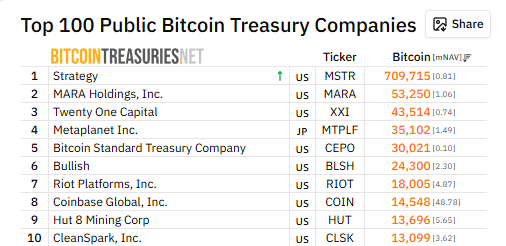
Following the latest purchase, Saylor’s firm has crossed the 700,000 BTC milestone, as its holdings have now risen to 709,715 BTC. Strategy spent a total of $53.92 billion on this stack and its current value stands at $63.55 billion, putting it in a profit of nearly 18%.

As Strategy continues to accumulate, it’s solidifying its already dominant position as by far the largest corporate holder of Bitcoin, as rankings from BitcoinTreasuries.net indicate.

Bitcoin Treasuries

Strategy’s closest digital asset treasury competitor isn’t a Bitcoin company, but rather an Ethereum one: Bitmine. Originally a mining-focused firm, Bitmine adopted an ETH treasury strategy in mid-2025 and has quickly established itself in the space, becoming the number one corporate holder of Ethereum and number two in overall rankings behind Strategy.

According to a Tuesday press release, Bitmine has also added to its reserves over the past week, purchasing 35,268 ETH. This has taken the company’s total holdings to 4,203,036 ETH, equivalent to nearly 3.5% of the cryptocurrency’s entire circulating supply.

BTC Price

Bitcoin has been showing bearish momentum recently as its price has declined to the $89,300 level.

Bitcoin Price Chart

Chainlink Drops To $12.50, But Largest Whales Are Accumulating

On-chain data shows the largest of Chainlink whales have been accumulating recently even as the cryptocurrency’s price has slipped below $13.00.

Top 100 Chainlink Whales Have Been Expanding Their Supply

In a new post on X, on-chain analytics firm Santiment has talked about the latest trend in the holdings of the 100 largest addresses present on the Chainlink network.

This category of holders naturally includes the large whales, investors who carry sums significant enough to have some influence on the blockchain. As such, their combined supply can be worth keeping an eye on.

Below is the chart shared by Santiment that shows the trend in the supply of the 100 largest Chainlink addresses over the last few months.

Chainlink Whale Supply

As displayed in the graph, the Chainlink supply held by the top 100 addresses went up in November as the cryptocurrency’s price plummeted, a possible sign that big-money investors were loading up.

These whales shed some of their holdings in December and the first week of January, but recently, they have showed signs of renewed accumulation as LINK’s price has plunged below the $13.00 level. Compared to the start of November, the cohort’s holdings are up 16.1 million tokens.

“As retail sells off due to impatience & FUD, it’s common to see smart money gather up more $LINK to prepare for (or cause) the next pump,” explained the analytics firm. It now remains to be seen whether this accumulation will have any effect on the cryptocurrency.

Chainlink isn’t the only asset that has seen movements from large investors recently. As Santiment has highlighted in another X post, Bitcoin sharks and whales have participated in net buying over the last nine days.

In the context of BTC, sharks and whales are defined as investors holding between 10 to 10,000 tokens. Below is a chart that shows how the supply of these investors has changed since late July.

Bitcoin Sharks & Whales

As is visible in the graph, the Bitcoin sharks and whales have increased their combined supply by 36,322 BTC in the last nine days, equivalent to an increase of 0.27%. Interestingly, the large investors have held on despite the fact that the asset’s price has gone through a retrace over the past few days.

However, the same hasn’t been true for the opposite end of the market, the retail entities. These investors, corresponding to addresses holding less than 0.01 BTC, have shed 132 BTC (0.28%) in the same window.

LINK Price

At the time of writing, Chainlink is floating around $12.33, down more than 10% in the last seven days.

Chainlink Price Chart

Bitcoin IFP Hints At Potential Turnaround: What It Means

On-chain data shows the Bitcoin Inter-exchange Flow Pulse (IFP) has shown early signs of a turnaround recently, suggesting tokens have started moving into derivatives platforms.

Bitcoin IFP Is Turning Around, But Not Yet Inside Bull Market Zone

As pointed out by an analyst in a CryptoQuant Quicktake post, the Bitcoin IFP has seemingly hit a bottom recently. The “IFP” is an indicator that measures the amount of BTC that’s flowing between spot and derivatives exchanges. When the value of this metric is rising, it means the investors are making a higher amount of transactions from spot to derivatives platforms. Such a trend suggests speculative interest in the market is going up.

On the other hand, the indicator witnessing a decline implies traders may be pulling back on risk as they are sending a lower number of tokens to derivatives markets.

Now, here is a chart that shows the trend in the Bitcoin IFP, as well as its 90-day moving average (MA), over the past decade:

Bitcoin IFP

As displayed in the above graph, the Bitcoin IFP hit a high in the first quarter of 2025 and reversed course, suggesting speculative activity began to decline. Soon after the start of this downtrend, the metric slipped under its 90-day MA. CryptoQuant considers such a crossover to be a bearish one, labeling periods with the indicator below the 90-day MA to correspond to bear markets or corrections.

Interestingly, while the cryptocurrency went on to see rejuvenation of bullish momentum and set a new all-time high (ATH) later in 2025, the market environment leaned bearish from the perspective of the IFP, with the metric’s value holding a steady downward trajectory.

Recently, however, the early signs of a shift may have finally emerged, as the IFP has shown a turnaround. This increase in derivatives exchange flows has come for Bitcoin as its price has gone through a recovery surge. For now, though, the indicator is still floating at a notable distance under its 90-day MA.

In the past, a break beyond this line has usually led to bullish price action for the cryptocurrency, so such a crossover could potentially be a positive sign this time as well. Whether speculative activity related to the asset will rise enough to overcome this threshold only remains to be seen.

Speaking of speculation, the Bitcoin Open Interest, a measure of the amount of BTC positions open on all derivatives exchanges, has surged 3.2% alongside BTC’s pullback in the past day, as CryptoQuant community analyst Maartunn has highlighted in an X post.

Bitcoin Open Interest

BTC Price

Bitcoin has gone through a plunge over the last couple of days that has taken its price from $95,000 to $91,200.

Bitcoin Price Chart

Bitcoin New Holder Pain Extends: $98,000 Needed For Relief

On-chain data shows Bitcoin short-term holders have extended their underwater streak, with BTC continuing to trade under their cost basis.

Bitcoin Short-Term Holders Are Still Holding Net Losses

In a new post on X, on-chain analytics firm Glassnode has talked about the latest trend in the Net Unrealized Profit/Loss (NUPL) for Bitcoin short-term holders. This indicator measures, as its name suggests, the net amount of profit or loss that BTC investors as a whole are carrying.

The metric finds the net profit/loss in USD terms, but as capital stored in the cryptocurrency is following an upward trajectory, the absolute value of profits and losses is also ballooning. To normalize across cycles, the indicator compares the net profit/loss against the asset’s market cap.

When the value of the NUPL is positive, it means the BTC investors as a whole are in a state of net unrealized profit relative to the market cap. On the other hand, the metric’s value being under the zero mark suggests the overall network is underwater. In the context of the current topic, the NUPL of a specific part of the blockchain is of interest: short-term holders (STHs). This cohort includes the BTC investors who purchased their coins within the past 155 days.

Now, here is the chart shared by Glassnode that shows the trend in the Bitcoin STH NUPL over the last several years:

Bitcoin STH NUPL

As displayed in the above graph, the Bitcoin STH NUPL has been negative recently, indicating that the recent buyers of the asset have been holding a net unrealized loss.

The group first went underwater back in November when the cryptocurrency’s price witnessed its crash. BTC steadied course in December and has seen some recovery in January, but even at the peak of the surge, the STHs couldn’t return to profits.

“A recovery above ~$98K appears to be the minimum threshold required to return this cohort to a net profitable state,” explained the analytics firm. It now remains to be seen whether the unrealized loss streak of the STHs will extend further in the near future or if BTC will reclaim its cost basis.

The NUPL provides information about the profits and losses that Bitcoin investors have yet to capture. Another metric called the Net Realized Profit/Loss covers the profits and losses that BTC holders are “harvesting” through their transactions.

As CryptoQuant head of research, Julio Moreno, has pointed out in an X post, the 30-day value of the Bitcoin Net Realized Profit/Loss has been negative recently, a sign that loss-taking has outweighed profit-taking. This is the first time since October 2023 that loss realization has dominated this timeframe, as the chart below shows.

Bitcoin Net Realized Profit/Loss

BTC Price

At the time of writing, Bitcoin is trading around $90,900, down more than 2% over the past week.

Bitcoin Price Chart

Bitcoin Hashrate Continues To Fall, Now Lowest Since September

On-chain data shows the Bitcoin Hashrate has continued to decline, with its 7-day average value hitting lows not seen since early September.

Bitcoin Hashrate Has Been Sliding Down

The Bitcoin “Hashrate” refers to a measure of the total amount of computing power that the miners as a whole have connected to the network. It’s denoted in units of hashes per second (H/s) or, more practically, in exahashes per second (EH/s). This indicator can be useful for gauging the sentiment shared by the miners. Growth in the network Hashrate can signal that this cohort is either responding to a period of profitability or expanding in anticipation of future price action. On the other hand, a decline can signal a weakening of sentiment.

As the chart below from Blockchain.com shows, the 7-day average value of the Bitcoin Hashrate has been following the latter kind of trajectory in recent months.

Bitcoin Hashrate

The Hashrate set a new all-time high (ATH) in mid-October, but miners moved to decommissioning power as the cryptocurrency’s price went through its bearish shift in that month. Recently, BTC has shown some recovery, but that doesn’t appear to have changed opinion among the miners, as the metric’s value has only continued to go down.

Currently, the 7-day average Bitcoin Hashrate is sitting at 978.8 EH/s, which is the lowest level since the first half of September. The recent low levels are on a path to affect another BTC-network-related metric: the Difficulty. The Difficulty is a feature built into the blockchain that controls how hard it is for miners to mine blocks. This metric automatically changes its value about every two weeks based on how fast miners have been performing their duty since the last adjustment.

Satoshi coded in a simple rule for the network to follow: block time should converge to 10 minutes. If miners take an average time faster than this to find a block, the chain raises its Difficulty in the next adjustment. Similarly, a decrease instead happens if the validators are slower at their job.

As miners have reduced their computing power over the last few months, their pace has been going down, and the network has been adjusting the Difficulty lower.

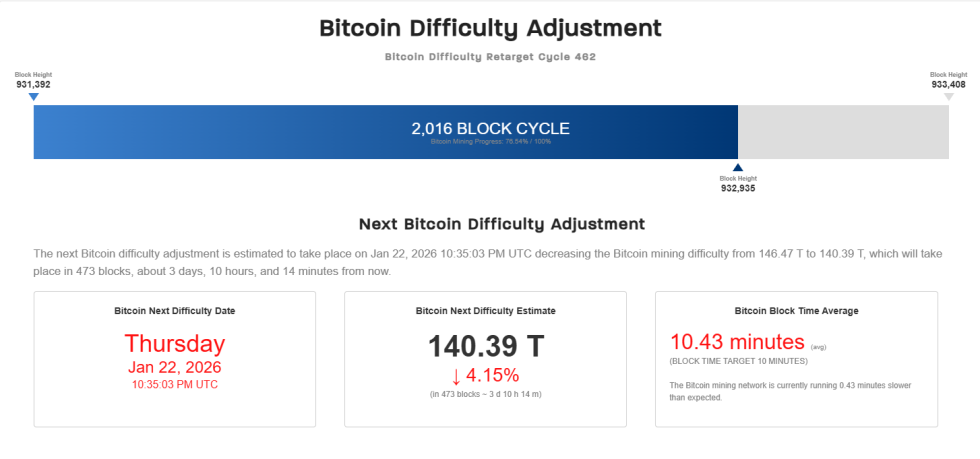
With the Hashrate decline only continuing recently, the network is once again moving toward another relaxation in Difficulty, as data from CoinWarz suggests.

Bitcoin Difficulty

The average Bitcoin block time has stood at 10.43 minutes since the last adjustment, which is notably slower than the standard rate. As a result, the network is estimated to reduce the Difficulty by 4.15%.

With the adjustment still being a few days away, however, this figure could change depending on whether miners expand or decommission in the coming days.

BTC Price

At the time of writing, Bitcoin is floating around $93,000, up 2.5% in the last seven days.

Bitcoin Price Chart

$790 Million In Crypto Longs Decimated As Bitcoin Plunges To $93,000

Bitcoin and the altcoins have plummeted during the past day, leading to the liquidation of a large amount of crypto longs in derivatives markets.

Crypto Sector Has Seen A Notable Amount Of Liquidations In The Last Day

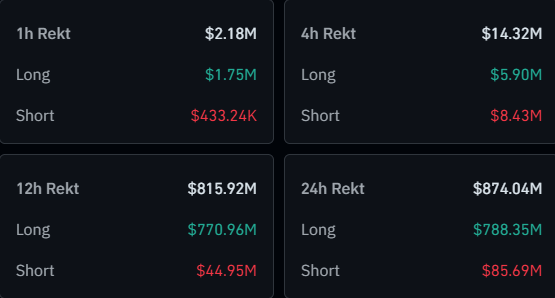
According to data from CoinGlass, the past day’s volatility in the crypto market has been accompanied by a swath of liquidations. The “liquidation” of a contract occurs when it accumulates losses of a certain degree and is forcibly shut down by the exchange. In the digital asset sector, volatility tends to be high, so a large number of liquidations take place on a regular basis. The last 24 hours involved one such volatile event, as the table below depicts.

Bitcoin & Crypto Liquidations

In total, the crypto market has faced $874 million in liquidations within this window. Out of these, long contracts have made up for an overwhelming share: $788 million.

The reason for liquidations being this lopsided naturally lies in the price action that has developed over the last day. Bitcoin saw a sudden drop from $95,500 to a low of $93,000, while Ethereum went from $3,350 to $3,200. In percentage terms, these drops aren’t too big, but the rapid nature of them is what triggered the liquidations.

The source of the crash could lie in revitalized US-EU tariff tensions. As reported by Reuters, President Donald Trump vowed over the weekend to implement tariffs on eight European nations.

Starting February 1st, goods from Denmark, Great Britain, Norway, Sweden, France, Germany, the Netherlands, and Finland will face an additional 10% import tariff. If the US isn’t allowed to acquire the Danish territory of Greenland, these tariffs will go up to 25% on June 1st.

2025 already saw several events where tariff-related uncertainty affected the crypto market, so it’s not surprising to see that the latest news has also been accompanied by volatility. As is usually the case, the latest market volatility has led to Bitcoin-related contracts occupying a disproportionate share of liquidations.

Bitcoin & Other Cryptos

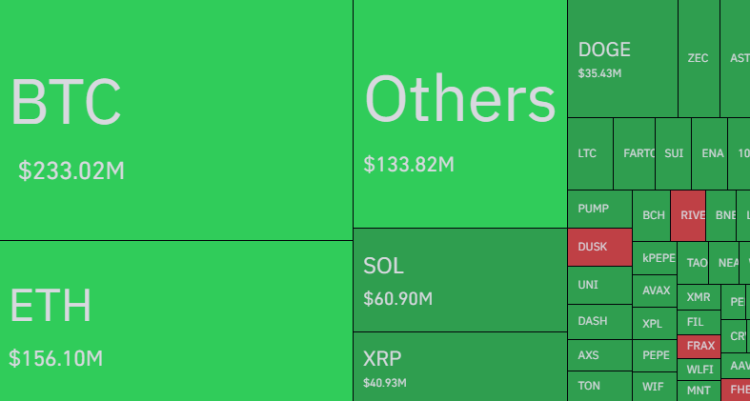
As is visible in the above heatmap, Bitcoin has seen liquidations of around $233 million in the past day. Ethereum, the next-ranked coin in this category, has witnessed $156 million in contracts being involved.

From the altcoins, Solana, XRP, and Dogecoin have ranked the highest with $61 million, $41 million, and $35 million in liquidations, respectively. SOL being ahead of XRP despite being smaller in market cap may be because of its 6% plunge being larger than the latter’s 4% drop.

Bitcoin Price

Bitcoin has seen a slight rebound from its low as the cryptocurrency’s price is now back at $93,100.

Bitcoin Price Chart

Bitcoin Miners Pull Back: Hashrate Drops To 3-Month Low

On-chain data shows the Bitcoin mining Hashrate has declined to its lowest level since October as miners continue to decommission farms.

7-Day Average Bitcoin Mining Hashrate Has Declined Recently

The Bitcoin “Hashrate” refers to an indicator that keeps track of the total amount of computing power that the miners as a whole have attached to the blockchain. This metric may be used as a proxy for the behavior of the network validators.

When the value of the Hashrate goes up, it means new miners are joining the chain and/or old ones are expanding their facilities. Such a trend implies BTC mining is looking attractive to these validators.

On the other hand, the indicator observing a decline suggests some of the miners have decided to disconnect their rigs from the network, potentially because they are finding the cryptocurrency to be unprofitable.

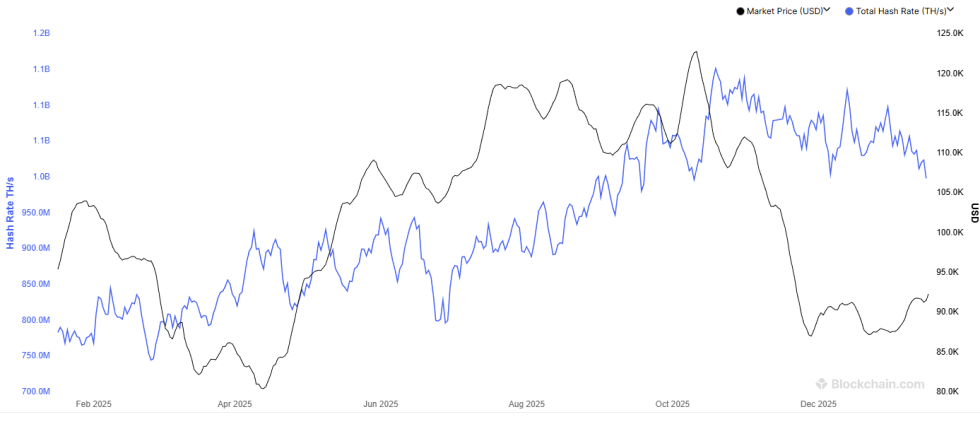
Now, here is a chart from Blockchain.com that shows the trend in the 7-day average value of the Bitcoin Hashrate over the past year:

Bitcoin Hashrate

As displayed in the above graph, the 7-day average Bitcoin Hashrate set a new all-time high (ATH) around 1,151 exahashes per second (EH/s) back in October. Since this record, however, the indicator’s value has gone down.

What’s behind this trend? The answer to that question could lie in the miner revenue. Miners earn their income through two means: block subsidy and transaction fees. Out of these, the former contributes the largest portion to their revenue.

Block subsidy remains fixed in terms of BTC value (outside of Halving events, during which they permanently get slashed in half), but its USD value changes alongside the cryptocurrency’s price. Thus, miner revenue is more-or-less dependent on the asset’s price action.

Back in October, Bitcoin rallied to a new ATH, so miners responded by upgrading their facilities. When the bullish price action didn’t continue, however, the cohort started pulling back. As a result, the 7-day average Hashrate has fallen to around 998 EH/s, its lowest level in more than three months.

Interestingly, the latest continuation of the decline in the indicator has come despite the fact that the cryptocurrency has made some recovery recently. This may be a possible sign that miners aren’t yet convinced by a return of bullish momentum.

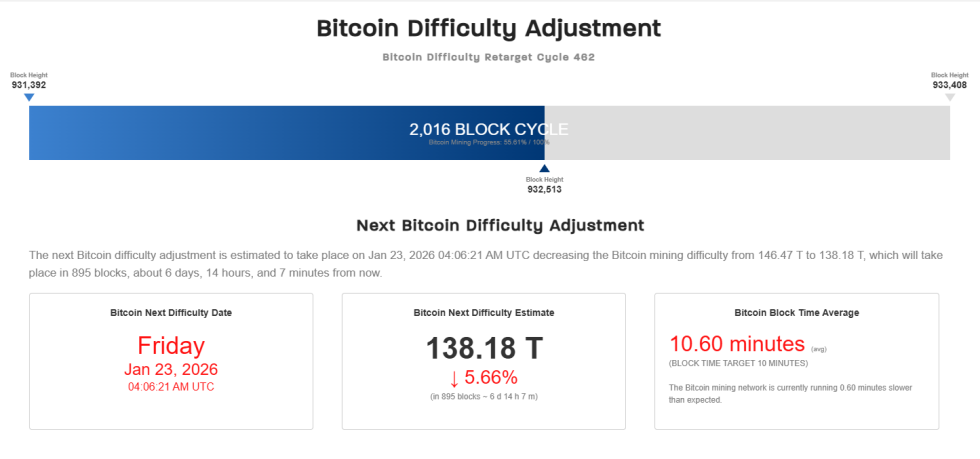
A potential consequence of the Hashrate decline may be a drop in the Bitcoin mining Difficulty during the next network adjustment. According to data from CoinWarz, miners have taken an average of 10.6 minutes per block since the last adjustment, which is notably slower than the blockchain’s target of 10 minutes.

Bitcoin Difficulty

To correct for this, Bitcoin could be forced to decrease its Difficulty by 5.6% in the next biweekly adjustment. However, something to note is that there is still about a week to go until this event, so the network’s response could change depending on how the Hashrate behaves in the coming days.

BTC Price

At the time of writing, Bitcoin is floating around $95,500, up more than 5% over the last seven days.

Bitcoin Price Chart

Bitcoin Short-Term Holders Take Profits: 41,800 BTC Sent To Exchanges

On-chain data shows Bitcoin short-term holders have transferred a large amount of tokens to exchanges alongside the asset’s recovery rally.

Bitcoin Short-Term Holders Have Made Profit Transactions To Exchanges

In a new post on X, CryptoQuant community analyst Maartunn has talked about the latest trend in the exchange deposit transactions of Bitcoin short-term holders (STHs).

STHs include the BTC investors who purchased their coins within the past 155 days. They make up for one of the two main sides of the network divided on the basis of holding time, with the other side being known as long-term holders (LTHs).

Historically, the STH cohort has proven to represent the weak hands of the market, who easily react to market volatility. In contrast, LTHs include the diamond hands of the sector.

Bitcoin has witnessed a recovery rally recently, so, considering the track record of STHs, some selling from them is likely to have occurred. One way to track distribution from the group is through its exchange inflow data.

Below is the chart shared by Maartunn that shows the exchange deposit transactions that Bitcoin STHs have made over the last couple of months.

Bitcoin STH P&L

In the graph, the STH exchange inflows are shown separately for profit and loss transactions, based on whether holders held an unrealized gain or loss before sending the tokens to exchanges.

From the chart, it’s apparent that the 24-hour sum of the STH exchange deposit transactions in profit has shot up as the cryptocurrency has gone through its rally, reaching a high of 41,800 BTC. Meanwhile, loss exchange inflows have shrunken, falling to a low of 1,800 BTC. Thus, it would appear that selling focus from STHs has largely shifted to profit-taking.

Though, while some STHs may be harvesting profits, the cohort has a whole is still in a state of net unrealized loss as Bitcoin is trading below the STH Realized Profit, as highlighted by the analyst in another X post.

Bitcoin STH Realized Price

The “Realized Price” is an on-chain metric that measures the average cost basis of Bitcoin investors or addresses as a whole. The STH version specifically tracks the break-even level of the supply purchased within the past 155 days.

As displayed in the above chart, the Bitcoin spot price plummeted under the STH Realized Price during the drawdown of Q4 2025. Since then, it has remained under the line, although the latest rally has brought it close. Currently, the indicator’s value is situated at $99,412.

BTC Price

Bitcoin has gone down since its high above $97,000 earlier in the week as its price is now trading around $94,600.

Bitcoin Price Chart

Ethereum Treasury Bitmine Makes $200M Bet On MrBeast’s Company

Ethereum treasury company Bitmine has announced a $200 million investment into Beast Industries, owned by popular creator MrBeast.

Bitmine Is Making An Investment In MrBeast-Owned Firm

As revealed in a press release, Bitmine Immersion Technologies is investing $200 million into Beast Industries in a deal that’s expected to close on or around January 19th.

Originally a cryptocurrency mining-focused company, Bitmine pivoted into being an Ethereum treasury company in mid-2025. Since then, the firm has aggressively accumulated ETH and established itself as the second largest digital asset treasury in the world behind Strategy.

Now, it seems Bitmine is looking to diversify with the Beast Industries move. Beast Industries is an entertainment company founded and led by Jimmy Donaldson, the personality behind MrBeast.

MrBeast is the most subscribed channel on YouTube with more than 460 million subscribers. “MrBeast and Beast Industries, in our view, is the leading content creator of our generation, with a reach and engagement unmatched with GenZ, GenAlpha and Millennials,” said Thomas ‘Tom’ Lee, Bitmine Chairman.

In December, Beast Industries revealed a new financial services platform. Now, with the Bitmine investment, Jeff Housenbold, Beast Industries CEO, has hinted at a collaboration with Bitmine for the platform.

Housenbold noted:

Their support is a strong validation of our vision, strategy, and growth trajectory and it provides additional capital to achieve our goal to become the most impactful entertainment brand in the world. We look forward to exploring ways to further collaborate and incorporate DeFi into our upcoming financial services platform.

Bitmine has set a long-term goal of acquiring 5% of the Ethereum supply for its treasury. According to a Monday press release, the company’s holdings have grown to around 4.17 million ETH, equivalent to 3.45% of the cryptocurrency’s total supply in circulation.

Thus, the firm is still some ways from its 5% target, but considering that it only started accumulating ETH half a year ago, its progress is significant. Bitmine’s momentum could, however, soon face a structural obstacle.

Bitmine currently has a 500 million share authorization and the company is looking to increase the cap via a shareholder vote. “Bitmine charter has an unusual feature requiring 50.1% of all shares outstanding to support a share increase,” said Lee. “This is an extremely high bar and thus, makes it very difficult to get an authorized share increase.”

The proposal will be discussed at the firm’s annual stock meeting, scheduled for January 15th, with the remaining votes tied to in-person participation after remote voting channels were closed earlier this week.
Ethereum Price

Ethereum has witnessed a notable jump over the last week as its price has surged nearly 7% to the $3,300 level.

Ethereum Price Chart

XRP In A ‘Super Cycle’? SuperTrend Suggests Another Story

Talks of an XRP “super cycle” have emerged recently, but the cryptocurrency’s weekly SuperTrend has formed a sell signal instead.

XRP SuperTrend Has Formed A Sell Signal

In a new post on X, analyst Ali Martinez has shared the weekly XRP price chart, writing, “I’m hearing about a $XRP super cycle…” The “super cycle” is the popular term for a sustained period of expansion in an asset.

There has been some chatter online around an XRP super cycle recently, with one mention being from YoungHoon Kim, who claims to be the holder of the world’s highest IQ. “XRP is in a super cycle,” said Kim in an X post.

Whether the idea of a super cycle for the cryptocurrency holds weight remains unclear, but Martinez’ chart showcases the asset’s trajectory from the lens of a technical analysis (TA) indicator known as the “SuperTrend.”

XRP SuperTrend

The SuperTrend is used for finding whether a given asset is following a bullish or bearish trend. It involves only one trendline, which acts as either resistance or support depending upon which side of it the price is trading.

This trendline is built using another indicator called the Average True Range (ATR), which gauges, in brief, the degree of volatility that the asset’s price is experiencing.

From the above chart, it’s visible that the 1-week price of XRP was above the SuperTrend line in 2025, meaning that a bullish trend was active for the cryptocurrency from the indicator’s perspective.

The coin ended the year with a reversal in the SuperTrend, however, and it has since remained under the trendline. Thus, at least this indicator would suggest that a bullish regime is no longer dominant for the digital asset.

Only time will tell, though, whether the SuperTrend will hold for XRP like it did during 2025 or if bullish momentum will see a fresh continuation, leading to another reversal in the indicator.

XRP isn’t alone in witnessing a signal on the SuperTrend recently. As the analyst has pointed out in another X post, Solana (SOL) has also seen a shift in the indicator.

Solana SuperTrend

As displayed in the graph, Solana has just turned bullish on the SuperTrend after the latest recovery rally took its 1-day price above the trendline. Previously, the cryptocurrency had been stuck under the SuperTrend trendline since the last quarter of 2025.

XRP Price

While most of the digital asset sector has enjoyed an uptick during the past week, XRP is underwater in the period as its price has gone down 2% to $2.07.

XRP Price Chart

US Institutions Resume Bitcoin Buying As Coinbase Premium Flips Green

Data shows the Bitcoin Coinbase Premium Gap has turned positive, a sign that American whales have been buying alongside the price surge.

Bitcoin Coinbase Premium Gap Has Surged Recently

As pointed out by CryptoQuant author IT Tech in an X post, the Coinbase Premium Gap has observed a shift as BTC’s latest price rally has occurred. The “Coinbase Premium Gap” measures the difference between the Bitcoin price listed on Coinbase (USD pair) and that on Binance (USDT pair).

This indicator is useful for knowing how the userbases of the two cryptocurrency exchanges differ when it comes to BTC buying/selling behavior. There is some overlap in the traffic of these platforms, but Coinbase, being the preferred exchange of US-based investors, particularly large institutional entities, gives movements on it a distinct character from Binance’s globally distributed userbase.

Now, here is the chart shared by IT Tech that shows the trend in the Bitcoin Coinbase Premium Gap over the past month:

Bitcoin Coinbase Premium Gap

As displayed in the above graph, the Bitcoin Coinbase Premium Gap has mostly been inside the negative territory during the last few weeks, indicating that the cryptocurrency has been trading at a lower price on Coinbase compared to Binance. In other words, the American whales have potentially been applying a larger amount of selling pressure or a lower amount of buying pressure than Binance users.

BTC has witnessed a recovery rally during the past few days, and initially, the Coinbase Premium Gap remained inside the red zone, but with the latest leg to $97,000, a shift has occurred. With the indicator now inside the green zone, it would appear possible that the US institutional investors have resumed accumulation of Bitcoin after a near-consistent phase of selling over the past month.

For now, though, the surge into the positive region is still brief, so it only remains to be seen whether the American investors will continue to back the bullish price action in the coming days. Earlier this month, a similar trend developed when Bitcoin saw a rally above $94,000. The Coinbase Premium Gap took a green shade late in that surge, but what followed was a plunge back into the negative zone and a fizzling out for the price rally.

In some other news, the BTC price surge has resulted in a significant amount of short liquidations in the futures market, as analytics firm Glassnode has highlighted in its latest weekly report.

Bitcoin Liquidations

From the chart, it’s visible that Bitcoin short liquidations saw a sharp peak nearing $90 million when BTC first pushed into the $96,000 region during this rally.

BTC Price

At the time of writing, Bitcoin is floating around $96,500, up nearly 8% in the last seven days.

Bitcoin Price Chart

❌