The World Economic Forum’s annual meeting in Davos felt different this year, and not just because Meta and Salesforce took over storefronts on the main promenade. AI dominated the conversation in a way that overshadowed traditional topics like climate change and global poverty, and the CEOs weren’t holding back. There was public criticism of trade policy, warnings about AI […]
Meta today said that it is pausing teens' access to its AI characters globally across all its apps. The company mentioned that it is not abandoning its efforts but wants to develop an updated version of AI characters for teens.
The visit comes as New Delhi prepares to host a major AI summit expected to draw top executives from Meta, Google, and Anthropic. This will be Altman's first visit to the country in nearly a year.
Meta is set to go on trial in New Mexico for allegedly failing to protect minors. The company is requesting a broad swath of information not be allowed to be presented in court.
As Meta heads to trial in the state of New Mexico for allegedly failing to protect minors from sexual exploitation, the company is making an aggressive push to have certain information excluded from the court proceedings.
The company has petitioned the judge to exclude certain research studies and articles around social media and youth mental health; any mention of a recent high-profile case involving teen suicide and social media content; and any references to Meta’s financial resources, the personal activities of employees, and Mark Zuckerberg’s time as a student at Harvard University.
Meta’s requests to exclude information, known as motions in limine, are a standard part of pretrial proceedings, in which a party can ask a judge to determine in advance which evidence or arguments are permissible in court. This is to ensure the jury is presented with facts and not irrelevant or prejudicial information and that the defendant is granted a fair trial.
The company has made it easy for existing advertisers to expand their reach to include Threads by allowing them to automatically place ads through both Meta's Advantage+ program and via manual campaigns.
Internet outages are incredibly disruptive in our modern world. We don’t realize just how much is actually connected until everything goes down. While massive outages are uncommon, they do happen—here are 10 of the worst.
The lawsuit against Snap was brought by a 19-year-old known in court documents as K.G.M., accusing the social media app of designing algorithms and features that caused addiction and mental health issues.
Still feeling uneasy about Meta's acquisition of Instagram in 2012 and WhatsApp in 2014, the Federal Trade Commission will be appealing a November ruling that cleared Meta of allegations that it holds an illegal monopoly in a market dubbed "personal social networking."
The FTC hopes the US Court of Appeals for the District of Columbia will agree that "robust evidence at trial" showed that Meta's acquisitions were improper. In the initial trial, the FTC sought a breakup of Meta's apps, with Meta risking forced divestments of Instagram or WhatsApp.
In a press release Tuesday, the FTC confirmed that it "continues to allege" that "for over a decade Meta has illegally maintained a monopoly in personal social networking services through anticompetitive conduct—by buying the significant competitive threats it identified in Instagram and WhatsApp."
Meta’s Dexter Station office in Seattle. (Meta Photo)
New layoffs at Meta will impact 331 workers in the Seattle area and Washington state, according to a filing from the state Employment Security Department.
The company is cutting employees at four facilities located in Seattle and on the Eastside, as well as approximately 97 employees who work remotely in Washington. The layoffs are part of broader reductions in the company’s Reality Labs division, first announced last week, that impacted 1,500 jobs companywide.
The heaviest hit facility is the Reality Labs office in Redmond, followed by the Spring District office in Bellevue, according to the Worker Adjustment and Retraining Notification (WARN) filing.
Meta’s Horizon OS software engineering team, working out of a Meta office on Dexter Avenue North in Seattle, was the hardest hit single group with 20 jobs cut. Horizon OS is the extended reality operating system developed to power Meta Quest virtual reality and mixed reality headsets.
Layoffs are expected to take effect on March 20.
With about 15,000 employees, Reality Labs currently represents about 19% of Meta’s total global workforce of roughly 78,000.
The company employs thousands of people across multiple offices in the Seattle region, one of its largest engineering hubs outside Menlo Park, Calif. Last October, the Facebook parent laid off more than 100 employees in Washington state as part of a broader round of cuts within its artificial intelligence division.
The Reality Labs cuts come at a time when the company is reportedly shifting priorities away from the metaverse to build next-generation artificial intelligence.
Threads’ daily mobile usage has quietly surpassed X as Meta leans on cross-promotion, creator tools, and fast feature rollouts — even as X faces fresh controversies
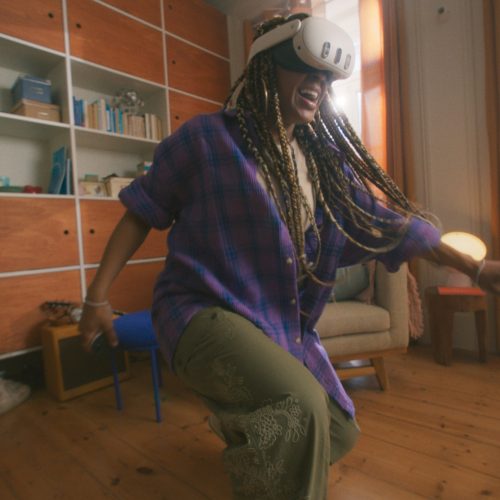
Tencia Benavidez, a Supernatural user who lives in New Mexico, started her VR workouts during the Covid pandemic. She has been a regular user in the five years since, calling the ability to work out in VR ideal, given that she lives in a rural area where it’s hard to get to a gym or work out outside during a brutal winter. She stuck with Supernatural because of the community and the eagerness of Supernatural’s coaches.
“They seem like really authentic individuals that were not talking down to you,” Benavidez says. “There's just something really special about those coaches.”
Meta bought Supernatural in 2022, folding it into its then-heavily-invested-in metaverse efforts. The purchase was not a smooth process, as it triggered a lengthy legal battle in which the US Federal Trade Commission tried to block Meta from purchasing the service due to antitrust concerns about Meta “trying to buy its way to the top” of the VR market. Meta ultimately prevailed. At the time, some Supernatural users were cautiously optimistic, hoping that big bag of Zuckerbucks could keep its workout juggernaut afloat.
On Thursday, the Wikimedia Foundation announced API access deals with Microsoft, Meta, Amazon, Perplexity, and Mistral AI, expanding its effort to get major tech companies to pay for high-volume API access to Wikipedia content, which these companies use to train AI models like Microsoft Copilot and ChatGPT.
The deals mean that most major AI developers have now signed on to the foundation's Wikimedia Enterprise program, a commercial subsidiary that sells high-speed API access to Wikipedia's 65 million articles at higher speeds and volumes than the free public APIs provide. Wikipedia's content remains freely available under a Creative Commons license, but the Enterprise program charges for faster, higher-volume access to the data. The foundation did not disclose the financial terms of the deals.
The new partners join Google, which signed a deal with Wikimedia Enterprise in 2022, as well as smaller companies like Ecosia, Nomic, Pleias, ProRata, and Reef Media. The revenue helps offset infrastructure costs for the nonprofit, which otherwise relies on small public donations while watching its content become a staple of training data for AI models.
In a letter to the leaders of X, Meta, Alphabet, Snap, Reddit, and TikTok, several U.S. senators are demanding the companies provide proof that they have "robust protections and policies" in place, and how they plan to curb the rise of sexualized deepfakes on their platforms.

 Login
Login