
Reading view

There are new articles available, click to refresh the page.

Spot vs Perpetual Trading on Hyperliquid: What Every Trader Must Understand
By: MintonFin
Spot vs Perpetual Trading on Hyperliquid

One wrong choice between spot and perpetual trading can silently drain your capital — especially on a high-performance platform like Hyperliquid.

Hyperliquid has rapidly emerged as one of the most talked-about decentralized trading platforms in crypto. With lightning-fast execution, deep liquidity, and a fully on-chain order book, it attracts everyone from casual traders to highly leveraged professionals.

But here’s the uncomfortable truth most guides don’t tell you:

  • Spot and perpetual trading on Hyperliquid are not interchangeable.
  • They reward completely different mindsets, risk tolerances, and time horizons.
  • Choosing the wrong one can turn a profitable strategy into a liquidation event.

In this guide, you’ll learn exactly how spot trading and perpetual trading work on Hyperliquid, how they differ, and most importantly, which one aligns with your goals, capital structure, and psychology as a trader.

Whether you’re a long-term crypto holder, an active DeFi participant, or an advanced derivatives trader, this article will help you make smarter, safer, and more profitable decisions on Hyperliquid.

What Is Hyperliquid?

Hyperliquid is a decentralized exchange (DEX) optimized for high-performance spot and perpetual futures trading, built with a custom Layer-1 blockchain designed specifically for trading.

Unlike many DeFi platforms that rely on AMMs (automated market makers), Hyperliquid uses a fully on-chain central limit order book (CLOB) — similar to Binance or OKX, but decentralized.

Key Features of Hyperliquid

  • Fully on-chain order book
  • Ultra-low latency execution
  • Deep liquidity for major trading pairs
  • Spot trading and perpetual futures in one interface
  • No KYC required
  • Non-custodial (you control your funds)

This hybrid design makes Hyperliquid uniquely powerful — but also more complex than typical DeFi platforms.

Understanding spot vs perpetual trading is critical before using it seriously.

Are you servicing a high-interest debt or want better savings?

Private credit is becoming the new income solution. Get $300 on first deposit with Insidefinacent.

Spot Trading Explained (Hyperliquid Spot Markets)

What Is Spot Trading?

Spot trading means buying or selling an asset for immediate settlement at the current market price.

When you buy ETH on the spot market:

  • You own the ETH
  • It appears directly in your wallet
  • There is no leverage
  • No liquidation risk

How Spot Trading Works on Hyperliquid

On Hyperliquid’s spot market:

  • You trade crypto pairs (e.g., ETH/USDC)
  • Trades settle instantly on-chain
  • Assets are fully owned by you
  • Profits and losses are unrealized until you sell

Spot Trading Example

If you:

  • Buy ETH at $2,500
  • Hold it for three months
  • Sell at $3,000

Your profit is simply:

($3,000 — $2,500) × ETH amount

No funding rates. No margin calls. No forced liquidation.

Advantages of Spot Trading on Hyperliquid

Spot trading is often underestimated — especially in a derivatives-driven market.

1. Zero Liquidation Risk

Your position cannot be forcibly closed due to volatility.

This makes spot trading ideal for:

  • Long-term investors
  • Conservative traders
  • Portfolio builders

2. Full Asset Ownership

You actually own the underlying crypto, which means:

  • You can withdraw anytime
  • You can move assets to cold storage
  • You can use them in DeFi elsewhere

3. Simple Risk Management

Your maximum loss is limited to your initial investment.

No leverage = no surprise margin calls.

4. Ideal for Market Cycles

Spot trading excels during:

  • Bull markets
  • Accumulation phases
  • Long-term trend formation

Disadvantages of Spot Trading

Despite its safety, spot trading has limitations.

1. Capital Inefficiency

Without leverage:

  • Returns are slower
  • Large capital is needed for meaningful gains

2. No Short Selling (in pure spot)

You cannot profit from falling prices unless:

  • You sell an asset you already own
  • Or rotate into stablecoins

3. Opportunity Cost

Capital tied in spot positions can’t be redeployed quickly for short-term trades.

Perpetual Trading Explained (Hyperliquid Perps)

What Are Perpetual Futures?

Perpetual contracts (perps) are derivative instruments that track the price of an asset without expiration.

You do NOT own the underlying asset.

Instead, you:

  • Open long or short positions
  • Use margin
  • Trade price movement only

How Perpetual Trading Works on Hyperliquid

Hyperliquid’s perpetual markets allow:

  • High leverage
  • Long and short positions
  • Cross-margin and isolated margin
  • Continuous funding payments

Key Components

  • Margin: Collateral posted to open a position
  • Leverage: Borrowed exposure (e.g., 10x, 20x)
  • Funding Rate: Periodic payments between longs and shorts
  • Liquidation Price: Price at which your position is forcibly closed

Perpetual Trading Example

You:

  • Deposit $1,000
  • Open a 10x long on ETH
  • Control $10,000 worth of ETH exposure

If ETH rises 5%:

  • Your profit ≈ 50%

If ETH drops ~10%:

  • Your position is liquidated
  • Your capital is gone

Advantages of Perpetual Trading on Hyperliquid

1. Leverage Amplifies Returns

Perps allow:

  • Faster capital growth
  • Efficient use of capital
  • Aggressive strategies

2. Ability to Short the Market

You can profit from:

  • Bear markets
  • Downtrends
  • Market corrections

This is critical for professional traders.

3. High Liquidity and Tight Spreads

Hyperliquid’s order book provides:

  • Minimal slippage
  • Institutional-grade execution

4. Advanced Trading Strategies

Perpetuals support:

  • Hedging spot positions
  • Delta-neutral strategies
  • Arbitrage opportunities

Risks of Perpetual Trading

Perpetual trading is not forgiving.

1. Liquidation Risk

Small price movements can wipe out positions.

Most retail traders lose money due to:

  • Over-leverage
  • Poor stop placement
  • Emotional trading

2. Funding Rate Costs

Holding perps long-term can:

  • Erode profits
  • Turn winning trades negative

3. Psychological Pressure

Perps amplify:

  • Stress
  • Overtrading
  • Revenge trading

This is why many traders underperform despite good analysis.

Spot vs Perpetual Trading on Hyperliquid (Comparison Table)
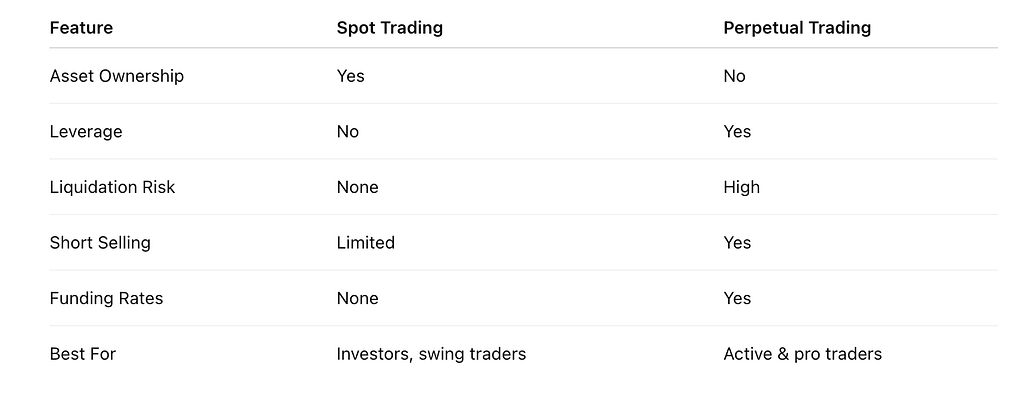
Spot vs Perpetual Trading on Hyperliquid

Which Should You Choose on Hyperliquid?

Choose Spot Trading If:

  • You’re building long-term positions
  • You want low stress
  • You prioritize capital preservation
  • You’re new to Hyperliquid

Choose Perpetual Trading If:

  • You understand leverage deeply
  • You actively manage risk
  • You trade intraday or swing short-term
  • You have strict stop-loss discipline

Advanced Strategy: Combining Spot + Perpetuals

Professional traders often use both.

Example Hedging Strategy

  • Hold ETH spot long-term
  • Short ETH perps during market weakness
  • Reduce volatility without selling spot

This approach:

  • Protects capital
  • Preserves upside
  • Requires discipline

This is how professionals trade. Combining spot and perpetuals isn’t advanced — it’s essential.

If this strategy changed how you think about trading, clap to help it reach more serious traders.

Common Mistakes Traders Make on Hyperliquid

  1. Over-leveraging perps
  2. Using perps for long-term holding
  3. Ignoring funding rates
  4. Trading emotionally after losses
  5. Treating perps like spot

Avoiding these mistakes alone can dramatically improve performance.

Is Hyperliquid Safe for Spot and Perpetual Trading?

Hyperliquid’s non-custodial design reduces:

  • Exchange counterparty risk
  • Custody failures

However:

  • Smart contract risk exists
  • Trader behavior is the biggest risk factor

The platform isn’t dangerous — poor risk management is.

Final Thoughts: Spot vs Perpetual Trading on Hyperliquid

Hyperliquid is one of the most powerful decentralized trading platforms available today. But power cuts both ways.

  • Spot trading rewards patience and conviction
  • Perpetual trading rewards precision and discipline

Understanding the difference is not optional — it’s essential.

The traders who thrive on Hyperliquid aren’t the most aggressive. They’re the ones who choose the right tool for the right market condition.

Trade Smarter on Hyperliquid

The difference between surviving and thriving isn’t luck — it’s structure.

  • Save this guide
  • Clap if it added value
  • Follow for more no-nonsense crypto trading breakdowns

Your capital deserves better decisions.


Spot vs Perpetual Trading on Hyperliquid: What Every Trader Must Understand was originally published in Coinmonks on Medium, where people are continuing the conversation by highlighting and responding to this story.

Spot vs Futures on Binance: Where Should Smart Money Actually Trade?

By: MintonFin
Spot vs Futures on Binance - Where Should Smart Money Actually Trade?

Smart money doesn’t chase hype — it chooses structure, liquidity, and asymmetric risk. On Binance, that choice usually comes down to one critical decision: Spot trading or Futures trading?

Retail traders often frame this debate as simple — low risk vs high reward. Professionals know it’s far more nuanced. The real question isn’t which market is more profitable, but which market aligns with capital preservation, risk-adjusted returns, and scalable strategy execution.

In this in‑depth guide, we break down Spot vs Futures on Binance from the perspective of institutional traders, hedge funds, high‑net‑worth investors, and disciplined professionals — not gamblers.

By the end, you’ll know exactly where smart money actually trades, why, and how to position yourself accordingly.

Smart money uses both Spot and Futures on Binance — but for different objectives.

  • Spot trading is preferred for long‑term accumulation, capital preservation, and directional conviction.
  • Futures trading is used for hedging, short‑term alpha, volatility capture, and capital efficiency — not reckless leverage.

The edge comes from knowing when to use each market, not choosing only one.

Smart traders don’t rely on hype — they rely on frameworks. If you want more deep‑dive guides on Binance, crypto risk management, and professional‑grade trading strategies, follow this Medium profile now so you don’t miss the next article.

Understanding Binance Spot Trading

What Is Spot Trading on Binance?

Spot trading on Binance involves buying or selling cryptocurrencies at the current market price, with immediate ownership of the underlying asset. When you buy BTC on the spot market, you actually own BTC — no contracts, no expiry, no liquidation risk.

This is the most straightforward and transparent form of crypto trading, which is why it remains the foundation of most professional portfolios.

Key Features of Binance Spot Markets

  • Real ownership of assets
  • No leverage required
  • No liquidation risk
  • Simple fee structure
  • Ideal for long‑term holding

Who Uses Spot Trading?

Spot markets attract:

  • Long‑term investors
  • Funds building core crypto exposure
  • Family offices allocating to digital assets
  • Traders with strong directional conviction
  • Risk‑averse capital seeking asymmetric upside

For smart money, spot trading is about positioning, not excitement.

Advantages of Spot Trading (Why Smart Money Loves It)

1. No Liquidation Risk

One of the biggest advantages of spot trading is zero liquidation risk. Prices can move violently against you, but your position remains intact unless you choose to exit.

This is critical for professionals who prioritize survivability over short‑term performance.

2. Ideal for Long‑Term Conviction Trades

Smart money often identifies structural trends early — Layer 2 adoption, Bitcoin halvings, ETF inflows, DeFi primitives, or real‑world asset tokenization.

Spot markets allow them to:

  • Accumulate gradually
  • Ride multi‑year trends
  • Ignore short‑term volatility

3. Simpler Risk Management

Risk is limited to the capital invested. There are no margin calls, funding rates, or forced liquidations to manage.

This simplicity is a feature, not a weakness.

4. Psychological Advantage

Spot traders experience far less emotional pressure than leveraged traders.

This leads to:

  • Better decision‑making
  • Less over‑trading
  • More consistent execution

Smart money values emotional control as much as strategy.

Limitations of Spot Trading

Despite its strengths, spot trading isn’t perfect.

Capital Inefficiency

To generate meaningful returns, spot traders must deploy significant capital. A 20% move requires 100% capital exposure.

For institutions seeking capital efficiency, this can be a constraint.

Limited Short Opportunities

Spot markets make shorting difficult or impossible without borrowing assets, which adds complexity and counterparty risk.

This is where futures enter the conversation.

Pro Insight: Most traders lose money not because of bad markets — but because they choose the wrong tool.

Are you servicing a high-interest debt or want better savings?

Private credit is becoming the new income solution. Get $300 on first deposit with Insidefinacent. Here’s how it works.

Understanding Binance Futures Trading

What Are Binance Futures?

Binance Futures allows traders to speculate on the price of cryptocurrencies using derivative contracts rather than owning the underlying asset.

Key characteristics include:

  • Ability to go long or short
  • Use of leverage
  • Funding rates
  • Liquidation thresholds

Types of Binance Futures

  • USDT‑Margined Futures (most popular)
  • COIN‑Margined Futures

Smart money overwhelmingly prefers USDT‑margined perpetual futures due to liquidity and simplicity.

Why Smart Money Uses Futures (The Real Reasons)

Contrary to popular belief, professionals do not use futures primarily to gamble with high leverage.

1. Hedging Spot Exposure

One of the most common professional strategies is spot‑futures hedging.

Example:

  • Long BTC in spot
  • Short BTC perpetual futures during high volatility

This allows smart money to:

  • Protect downside risk
  • Lock in profits
  • Reduce portfolio volatility

2. Capital Efficiency

Futures require far less capital than spot positions. This allows funds to:

  • Deploy capital across multiple strategies
  • Maintain liquidity
  • Optimize returns on equity

3. Short‑Term Alpha Generation

Futures markets are ideal for:

  • Range trading
  • Breakout strategies
  • Mean reversion
  • Event‑driven trades

These strategies are difficult to execute efficiently on spot markets.

4. Market Neutral Strategies

Smart money often aims for delta‑neutral returns — profits regardless of market direction.

This is only possible with futures.

Risks of Futures Trading (Why Retail Traders Lose)

Liquidation Risk

Leverage magnifies both gains and losses. Poor risk management leads to forced liquidation — the #1 reason retail traders fail.

Funding Rate Costs

Holding futures positions during crowded trades can result in significant funding payments, silently eroding profits.

Emotional Overload

Leverage amplifies stress, leading to:

  • Over‑trading
  • Revenge trading
  • Strategy abandonment

Smart money survives by avoiding these traps.

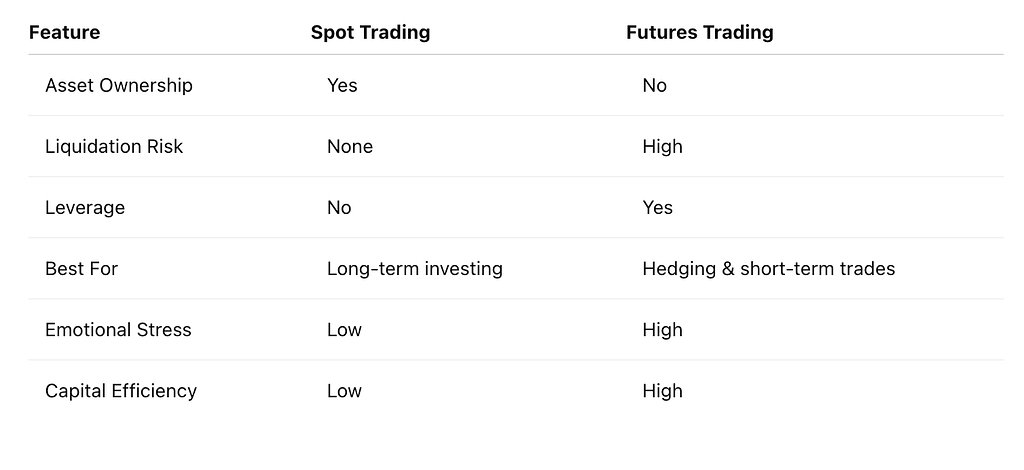
Spot vs Futures: Side‑by‑Side Comparison

Spot vs Futures: Side‑by‑Side Comparison

Want the full smart‑money playbook? This article is part of a series focused on how professionals actually trade crypto — not what influencers sell.

Save this article so you can revisit these frameworks before your next trade.

Where Does Smart Money Actually Trade?

The honest answer: both — but strategically.

Smart Money Playbook

  • Spot for core holdings and conviction trades
  • Futures for risk management, tactical positioning, and volatility capture

They do not:

  • Go all‑in on high leverage
  • Trade emotionally
  • Chase every move

They focus on risk‑adjusted returns, not screenshots.

Common Retail Mistakes to Avoid

  1. Using high leverage without a plan
  2. Trading futures without understanding funding rates
  3. Ignoring spot accumulation
  4. Over‑trading low‑quality setups
  5. Confusing luck with skill

Avoiding these mistakes immediately puts you ahead of 90% of traders.

How to Choose Between Spot and Futures

Ask yourself:

  • Is my goal long‑term wealth or short‑term income?
  • Can I emotionally handle leverage?
  • Do I understand liquidation mechanics?
  • Am I trading with a strategy or chasing price?

If unsure, start with spot.

Advanced Strategy: Combining Spot and Futures

Professionals often run hybrid strategies, such as:

  • Spot accumulation + futures hedging
  • Spot long‑term + futures scalping
  • Spot portfolio + futures arbitrage

This layered approach reduces risk while maximizing opportunity.

Final Verdict: Spot vs Futures on Binance

Spot trading builds wealth. Futures trading manages and enhances it.

Smart money doesn’t choose sides — it chooses structure, discipline, and survivability.

If your goal is long‑term success rather than short‑term excitement, the path is clear:

  • Build conviction in spot markets
  • Use futures selectively
  • Manage risk relentlessly

That’s where smart money actually trades.

If this guide helped sharpen your understanding of Spot vs Futures on Binance, do clap and save. Your future self will thank you before your next trade.

This isn’t content for gamblers.

It’s for traders who want to stay in the game long enough to win.


Spot vs Futures on Binance: Where Should Smart Money Actually Trade? was originally published in Coinmonks on Medium, where people are continuing the conversation by highlighting and responding to this story.

Why Modern Traders Love Exchanges with Spot, Margin, Futures & More

What makes a cryptocurrency exchange genuinely user-friendly nowadays? And which aspects are most trusted by traders?

Let us break it down.

Why Modern Traders Love Exchanges with Spot, Margin, Futures & More
Why Modern Traders Love Exchanges with Spot, Margin, Futures & More

Modern platforms prosper when they provide a balanced range of trading choices, including Spot, Margin, Future, OTC, and Copy. These features not only make trading easier, but they also appeal to traders of all skill levels. With a strong trading clone script, companies can effortlessly incorporate all of these elements, resulting in easier navigation, better trading, and a seamless user experience.

Spot Trading: The Core Engine of User-Friendly Exchanges

  • Spot trading remains at the heart of any cryptocurrency exchange, allowing customers to buy and sell instantly with transparent pricing.
  • Traders value quick execution, user-friendly interfaces, and graphing tools that enable real-time judgments.
  • By including Spot modules in a Spot trading clone script, companies can provide steady liquidity, little slippage, etc.
  • And a seamless trading experience that appeals to both novice and experienced traders.

Margin trading: provides leveraged power to serious traders

  • Margin trading appeals to customers who wish to enhance returns through leverage.
  • Modern traders anticipate risk controls, isolated/cross margin modes, and automated liquidation measures to create a secure trading environment.
  • When a Margin trading clone script contains multiple leverage options, exchanges can provide significant Margin capabilities, allowing ambitious traders to pinpoint larger opportunities with precision.

Future Trading: Effective Tools for Strategic Market Planning

  • Futures trading allows users to hedge risks, speculate on longer-term fluctuations, and diversify their trading strategies.
  • With characteristics such as everlasting contracts, funding rates, and advanced indicators, the Futures market becomes a valuable arena for strategic traders.
  • Integrating this capability into a Future trading clone script ensures that exchanges may provide professional-grade derivatives trading to market-savvy individuals.

OTC Desks: High-Volume Trading Made Easy and Secure

  • OTC trading is vital for customers who want to conduct large-scale crypto deals without affecting market prices.
  • Traders value private transaction discussion, fixed pricing, and quick settlements, which provide both convenience and effectiveness.
  • Platforms that include OTC characteristics within an OTC Crypto Exchange Script can attract institutions, wealthy traders, and business customers who value confidentiality and dependability.

Copy Trading: Easy Support for Beginners

  • Copy trading allows new users to follow skilled traders automatically.
  • Rather than memorizing charts or methods, individuals can just replicate the transactions of top performers in real time.
  • When Copy Trading is introduced to a Copy trading clone script, it promotes user confidence, engagement, and makes the platform more appealing to those who like simple, guided trading.

How a Trading Clone Script Brings All These Features Together

  • A robust trading clone script combines Spot, Margin, Future, OTC, and Copy trading into a single unified ecosystem.
  • It provides scalability, faster deployment, strong security, and customized modules based on business objectives.
  • With all core features pre-built, entrepreneurs can build a competitive exchange that provides an excellent user experience while minimizing development time, cost, and complexity.

Conclusion

Building an effective cryptocurrency exchange entails more than just basic trading modules. Platforms that combine Spot, Margin, Future, OTC, and Copy functionalities can provide a quick, secure, and user-friendly experience. With an advanced trading clone script, organizations may swiftly implement these features and attract all types of traders. The end result is a high-performing exchange that distinguishes out in today’s competitive cryptocurrency market.


Why Modern Traders Love Exchanges with Spot, Margin, Futures & More was originally published in Coinmonks on Medium, where people are continuing the conversation by highlighting and responding to this story.

❌